

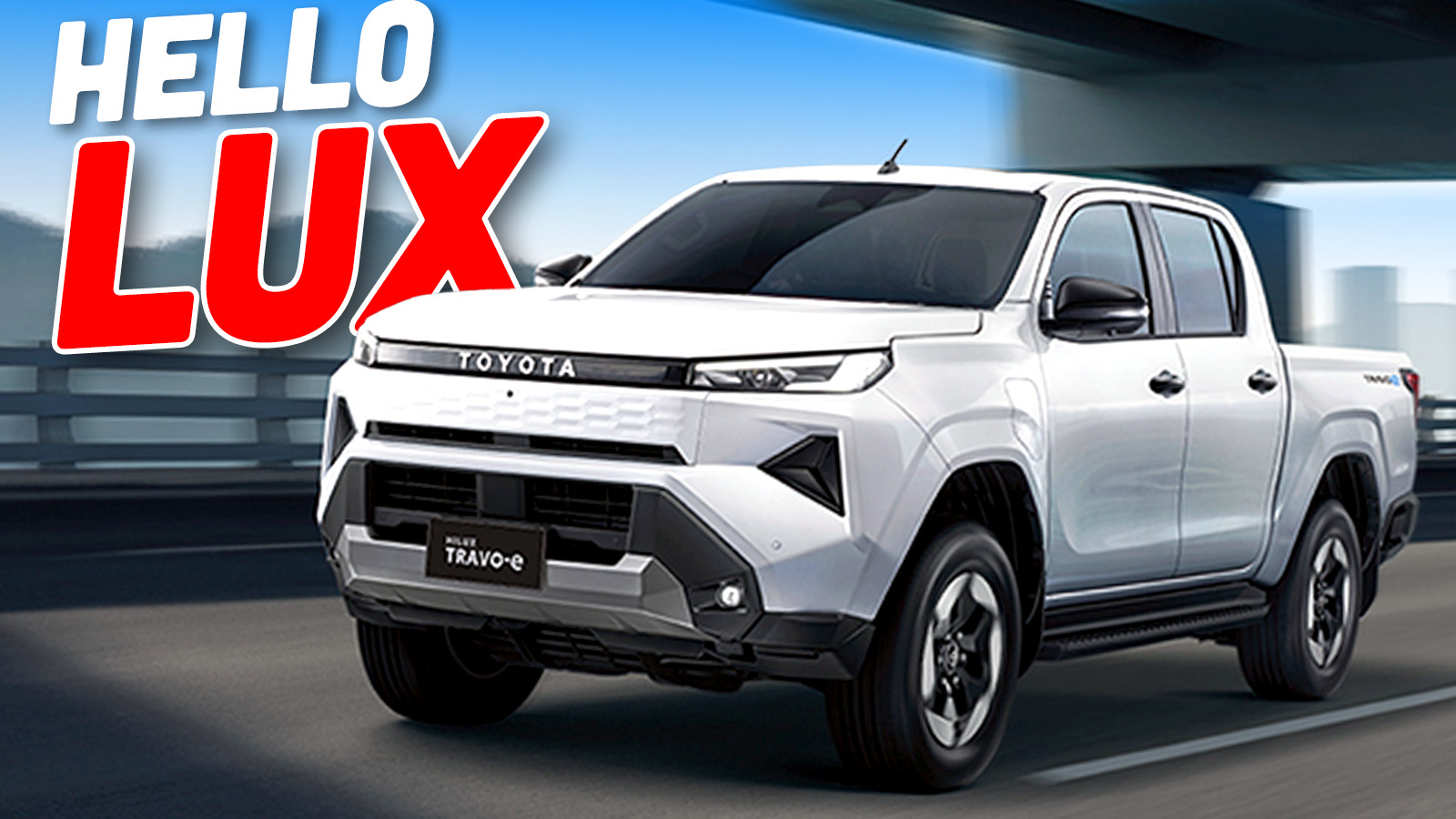
If the Ford F-150 is America’s truck, the Toyota Hilux is the world’s truck. Even though it hasn’t been available in North America since the mid-1990s, it’s an unstoppable force that sells by the boatload. We’ve seen it conquer both poles, and prove its toughness on both primetime TV and the six o’clock news. Now there’s a new one, and it seems to be leaning hard on the concept of choice.
At first glance, the new Hilux seems to be evolutionary rather than revolutionary. Up front, Toyota’s global pickup truck gets a variant of the new family face with a dark trim piece spanning in the gap between the headlights, either a hole-punched grille or a dimpled filler panel, and loads of sharp angles and creases. This general chiseling continues with the angular wheel arches and stamped tailgate, although the cab seems roughly similar to what we’ve seen for the past decade or so. Those not-quite-Chevrolet-like steps in the corners of the rear bumper are incredibly useful though, a more-than-welcome addition.


In contrast, the interior of the new Hilux is quite different in a good way, because new tech has opened up new opportunities for storage. Okay, so the new floating touchscreen display means you no longer get a nostalgic LCD clock, but it also means there’s more room on the dashboard for extra cubbies without ditching physical climate controls. If you’re getting a whiff of Land Cruiser from the interior, you can thank the largely flat dash pad and familiar steering wheel for that.

Toyota’s leaning on choice right now, so guess what? The new Hilux will be available with almost every sort of motive power imaginable, kicking things off with a surprisingly normal-seeming battery electric variant. A 59.2 kWh battery pack slung between the frame rails powers two electric motors, resulting in some rather modest figures. Peak output stands at a hair over 193 horsepower, and WLTP range should work out to just 149 miles. Not exactly game-changing stuff and not ideal for towing, but as a work vehicle in South Asia’s most populous cities, maybe that’s all most customers need. Even though towing capacity’s a crossover-like 3,527 pounds, payload clocks in at 1,576 pounds. Plus, with DC fast charging at up to 150 kW, it should be easier to juice up the electric Hilux than the hydrogen fuel cell variant expected to arrive in 2028. If the level of normalcy on display here seems familiar, that’s because the Hilux BEV thematically follows the Ford F-150 Lightning in going truck-first, electric-second. It doesn’t look like a cut-up crossover, so it’s unlikely to alienate buyers.

That being said, the majority of ninth-generation Hilux sales will likely burn fossil fuels, and the 2.8-liter 1GD-FTV turbodiesel inline-four will rule the roost. It’s been around for a decade and pumps out the same 201 horsepower and 369 lb.-ft. of torque as it did in the old Hilux. With 2,205 pounds of payload capacity and 7,716 pounds of towing capacity, it’s the move for serious work. A mild-hybrid diesel variant will soon join the party for Europe, and for those who prefer spark ignition, a familiar 2.7-liter four-cylinder gasoline engine is also on the options list.
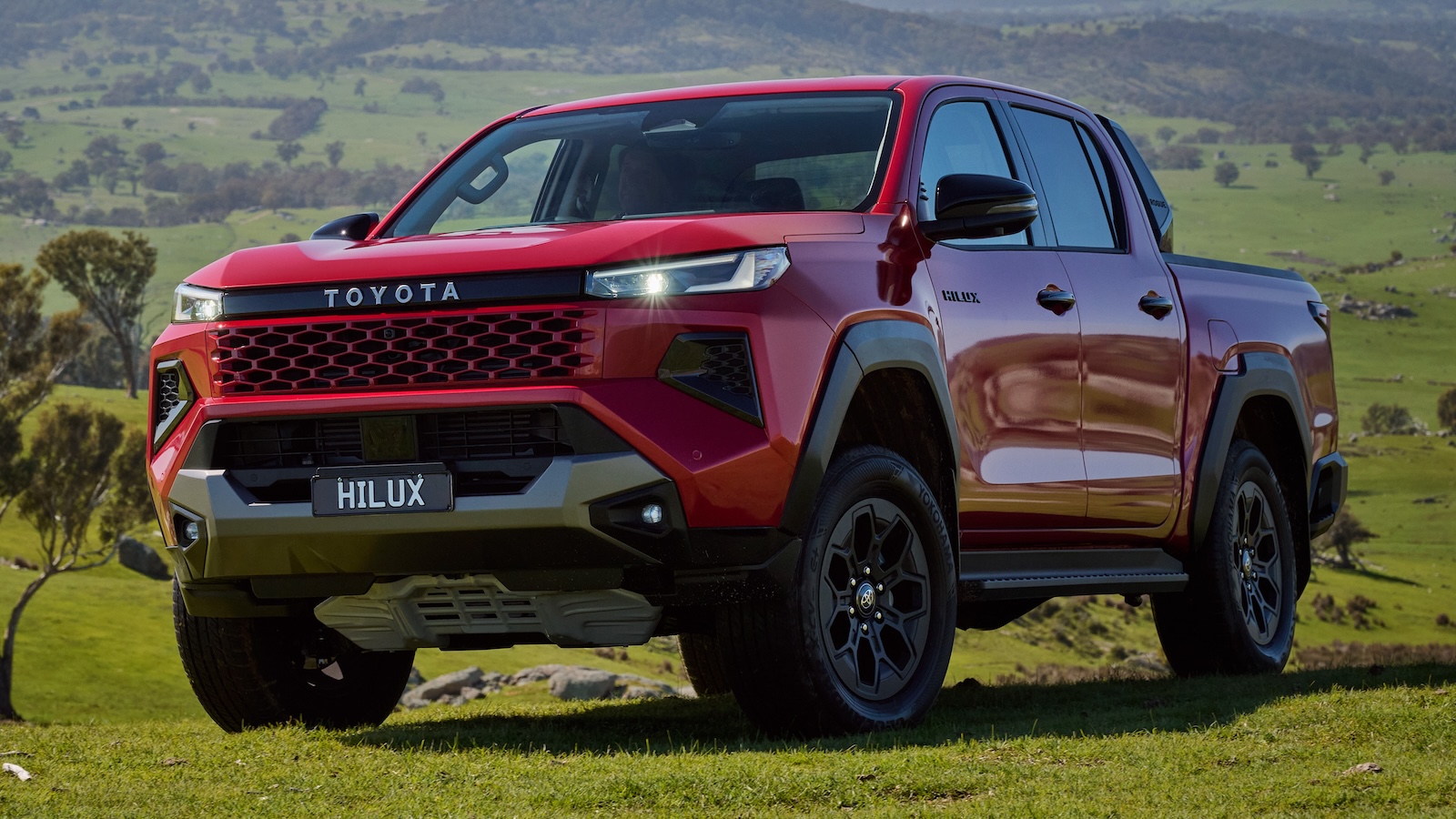
Speaking of proven technology, the choice of a six-speed automatic or six-speed manual isn’t revolutionary, but both of these transmissions should be stout. People buy the Hilux because it has a reputation for being unbreakable, and with these major powertrain components already known to be durable, it just makes sense for Toyota to give drivers what they want. That includes two-wheel-drive or four-wheel-drive, a crew cab or a single cab, or even an access cab, and even hydraulic or electric power steering, depending on the market.

Whether with fossil fuel or electric power, the Hilux’s largely familiar form and an almost overwhelming array of options should still be all things to all people, provided said people don’t live in America. Even better, Toyota’s promising a short lead time. The first examples will roll off the line relatively early in the new year, with European-market models launching in the first half of 2026. Sure, it’s not a revolutionary truck, but such a big swing would just feel wrong. The Hilux has long been a known quantity, and judging by the look of the new one, it shouldn’t have a hard time finding hundreds of thousands of homes each year across the globe.
Top graphic image: Toyota


Toyota needs to headhunt some Audi or Hyundai stylists. This thing is unbelievably fugly compared to early 90s Toyota pickups. One of which I owned.
I’m relatively sure the powertrains are better than the ’90 V6/5M mine had that was, honestly, disappointing.
But wow. It’s not nice to look at. I don’t have a use case for a pickup anymore, but I’d buy a Maverick or a Colorado over this ugh, thing.
Nooooooo! Big ugly thing!
I want this Hilux
https://en.wikipedia.org/wiki/Toyota_Hilux_Champ , that shares the IMV platform with the new Landcruiser FJ
What are those weird openings under the headlights? If you don’t want the stupid plastic fender trim, you get a contoured where it’s missing? Really? All that’s going to be a pain to keep clean.
That champ hilux is cool looking and that bed is so much more functional! I’d buy that.
This thing? What’s the Unique Selling Proposition here?
It looks like it sooooooo wants to be a boat it made a Boaty McBoatface costume.
Yet another Truck I want that we won’t get in the US
I do not understand the height of modern trucks.