

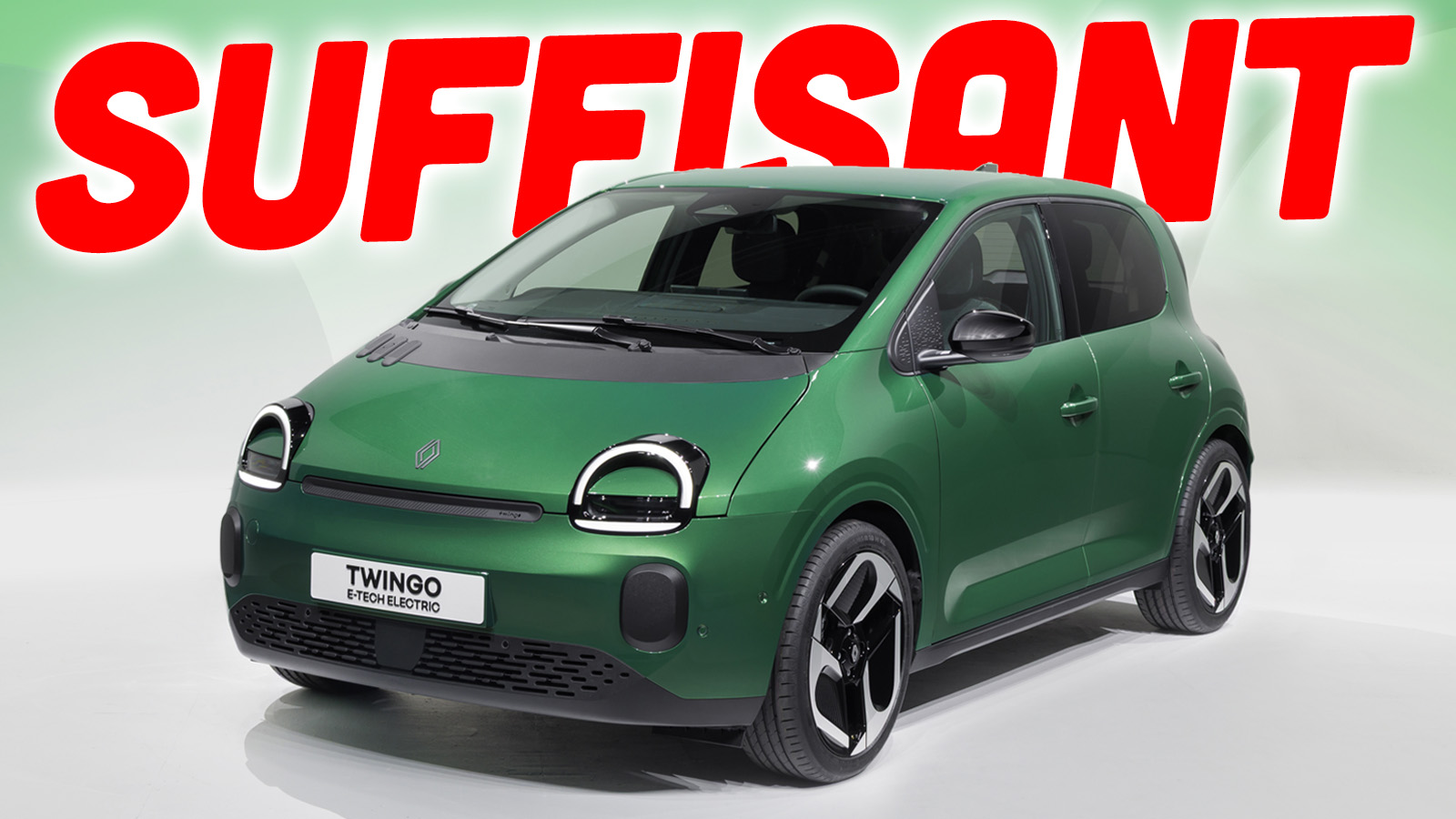
The Renault Twingo is so back. Originally an icon of the ’90s with its Memphis-inspired colors and smiley face, Renault has tried to reinvent this cult classic a couple of times. The second-generation model was a cromulent but comparatively low-charm city car, the third-generation model was essentially a Smart Fortwo with an extendo clip, but now the fourth-generation model is taking things back to the ’90s with one foot in the future.
Yep, underneath that retro-inspired bodywork sits an all-electric powertrain, albeit one that isn’t going to make any headlines. It has less WLTP range than the previous-generation Nissan Leaf, barely more horsepower than a Mitsubishi Mirage, and while it can technically break the speed limit on Texas’ fastest toll road, it can only do so by a single mile per hour. However, if you look beyond the headline figures and consider what this car’s purpose is, Renault might’ve nailed it.


After all, this is a city car. You don’t need a ton of power or range in bumper-to-bumper traffic, and the low-maintenance nature of EVs should be a huge benefit for city living, provided you have a place to charge. Plus, it’s packed with clever touches that weren’t accidentally released in that big leak earlier this week.

Obviously, the electric powertrain is a huge chunk of an electric car’s cost, so Renault has gone almost diabolically small. The Twingo E-Tech features a 27.5 kWh lithium iron phosphate battery pack feeding an 80-horsepower electric motor. Figure a WLTP range of just 163 miles and a top speed of 81 MPH. That’s about 15.5 percent less WLTP range than the 42 kWh Fiat 500e, and since that car’s rated at just 149 miles of EPA range, it wouldn’t be surprising if the Twingo E-Tech were to cover about 126 miles out on the open road before needing a charge. While maximum DC fast charging of 50 kW doesn’t sound impressive, that tiny battery pack means a 10-to-80 percent session should only take half an hour.

Alright, so road trips might take a while in the Twingo E-Tech, but at least Renault’s given you space to put your feet up. The front passenger seat folds flat, an immensely useful touch for hauling long items that doubles as an ottoman should you wish to move to the rear seat and crack open a book. It’s not quite the double bed the original Twingo’s seats could fold into, but it should get the job done in a pinch, if you know what I mean. Speaking of seats, the rears both slide and recline, and in the cargo area behind them, you’ll find a two-piece split false floor that grants access to a deep well even if you have a handful of things in the back.

Speaking of interior touches, while some of the plastics look hard, Renault’s used color well and provided just enough physical controls. There’s no volume knob on the dashboard, but instead a stalk on the steering column for all your media controls, from changing the volume to skipping tracks. Only the front windows are motorized, but they both have automatic detents on their switches. Oh, and check out those colorful, big-print floor mats. It’s about time fun floor mats made a comeback.

Plus, you do have to consider the price with the new Twingo E-Tech. Renault says it’ll come in at under £20,000, or around $26,000 at current conversion rates. That includes value-added tax, and it makes the Twingo the attractive choice in its segment. It’ll be a few grand less expensive than a Fiat Grande Panda, and about five grand more than the far-lower-output, shorter-range Dacia Spring.
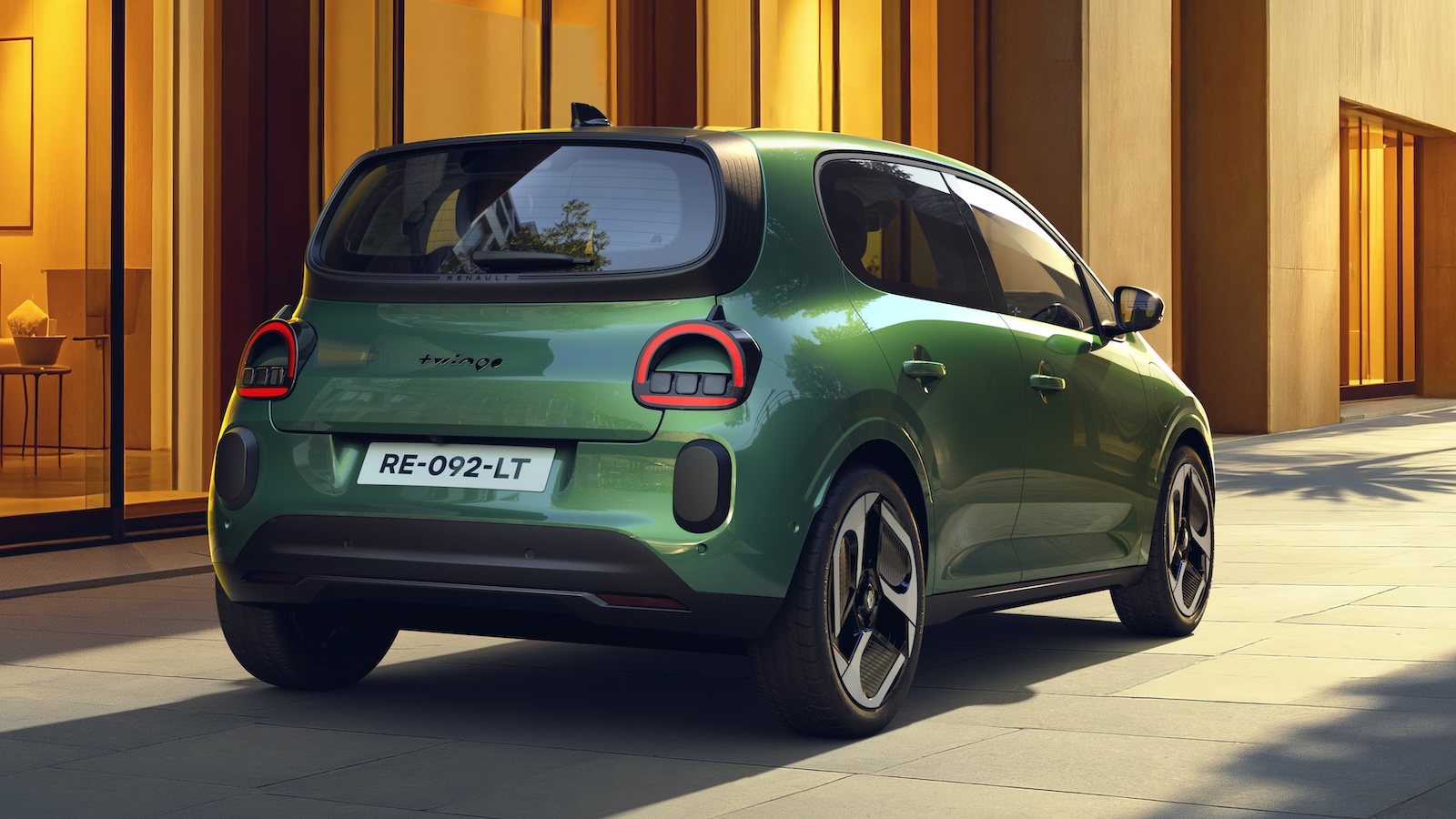
Alright, so the Renault Twingo E-Tech isn’t going to win any races, it’s not a range champion, and it puts up numbers similar to EVs from a decade ago. Still, with this much charm and a low starting price, it might not matter. In the context of a European city car, it seems like perfectly, precisely enough, and that long-life lithium iron phosphate pack is a bonus. I reckon we’ll see slightly dented examples tooling around Montpellier with sprongly bass house on the stereo in 20 years?
Top graphic image: Renault


I’d love one – the range is fine for even all-day jaunts showing houses to clients and whatnot.
It would make far more sense to subsidize these for small businesses like mine in the form of 100% tax deductions than the current blanket 6500GVW requirement…
…but ‘Murica.
I need to know what Sprongly Bass House is, and whether I will enjoy it as much as Canterbury Folk, but leaving that curiosity aside, this is now top of the list for when we finally replace my wife’s gas Ford Fiesta with something electric. Her daily mileage is about 30 miles. Much of that is in 30mph and 40mph zones, with no more than 6 miles at 70mph, and because of a quirk of the UK’s electricity infrastructure, we can’t have a fast charger at home. So an overnight charge to replenish that little range lost per day should be fine with such a small battery. Now. Will it be available in pink (Twingo à la fraise)?
Blue would be nice too. Preferably non metallic. 🙂
“provided you have a place to charge” <– This phase is doing a lot of heavy lifting.
I don’t see the point of city electric vehicles, unless you live in a city with access to affordable public charging, because most people in cities are in apartments. What city would meet this criteria? Everything I read is that it’s very expensive to use public charging, and it only makes sense if you can charge at home. So what’s the point of these cars?
It’s a shame, because at the moment, this is one of the best use cases (city driving).
Considering this car is intended for European cities, and from what I learned last year Lisbon will install an EV charger outlet on the street in front of your apartment at no cost.
Other major EU cities are also very pro-EV – some such as Glasgow even have free charge points.
I also learned while in Lisbon that taxi drivers keep more of what they earn when driving EVs because while the daily bill for fuel might be 20 Euros, the daily bill for charging a similar-sized EV (Renault Zoe, in this case) was 2 Euro.
Calling the Twingo, and other’s like it, “City” cars is the mistake.
The original Twingo wasn’t a “City” car, it was a small car. It was for the suburbs, rural France, small villages, everywhere, including sometimes the city. It could reach, and cruise all day at, Autoroute speeds if needed, if a little noisily. Today’s small European-market cars like the Kia Picanto, and Hyundai i10 are no different. You wouldn’t choose one if most of your driving was long distances on the Autoroutes and Autobahnen, but if it is your only car, and you need to do an occasional 200km journey, it will cope.
For those who do live in cities in Europe, a small car like this may well be the wrong choice, because their local journeys won’t be by car, but by much more convenient public transport, so their car is only for longer journeys. However for those in the countryside a small car for local journeys is perfect. Remember the European countryside isn’t like rural North America. The nearest town is likely 20 minutes away, not two hours away, but the roads to get there may be narrow and twisty, and when you do get there the streets are older than the car, so narrow with limited parking spaces.
The new Twingo is just the same. It is a small car, a low-ish cost car, but a lot more than a “City” car.
But if you live in a European city and never want to travel outside it, aren’t you just using public transportation? I mean, it’s adorable and all, but these super short range EVs are filling such a small niche that I just can’t see them making much of an impact.
True – but Uber drivers use small cars like this and are handy for us tourists.
Then there are the people who live outside the city centers – such as those who live across the river from Lisbon or out in Cascais, those who live between Amsterdam and Rotterdam, or those in villages outside London, etc.
What a delightful-looking machine. I really hope it spreads joy wherever it goes.
I wanted to like the Honda E- it was a failure due to poor range, even if it was a pretty good rendition of the Civic hatches of yore, but it would never have sold in any real numbers in the US and it is now the way of the Dodo in Europe. Same with the VW Van, seemed like a great idea when first suggested, went through some body variations and yeah the thing is probably better than the old Vans of the 60s/70’s, but for the price the range and overall use case for the US is just not there really.
My guess is the price tag was a bigger factor than the range.
Meh. Fine for somebody, not for me. Make mine a 1.1L with a stick and no stupid iPad on the dash. The original Twingo didn’t need one, and neither does this. If a backup camera is a must, put it in the rearview mirror where it belongs.
At around $18.5k when you factor in the 20% vat and the French price of around €20k. I can see it. People would buy such a vehicle. Has the style and utility for most around town and suburbs exurbs could be an issue but city cars arent designed for that. If Nissian built some in the US maybe give it the Nissian micra name plate. It could be a decent seller especially in state where it qualifies for incentives. It could be a $10k car.
Nissan already sells a Micra EV, which is the Renault 5 with different styling bits. I want one (of course). So, this would probably slot below the Micra. But I suspect that Nissan wouldn’t bring the Micra to the US thinking it was too small for American buyers, and this is even smaller.
Yes but the Renault 5 is about $23k when you factor out vat and do the conversion. The leaf is supposed to be $27k not enough room between. It would be the ayria all over. It’s definitely a long shot but it could fill the mirage, soul hole in the market.
Ooooh: I would SO buy a Renault 5 if it were actually just $23K (plus tax, reg, title). Or the Nissan Micra EV, which is the same car with different looks.
So sad Nissan is killing the 3rd gen Leaf already: I haven’t even seen a single 3rd get Leaf on the street yet. Maybe it’ll make the last few ones in inventory extra-cheap?
The last I heard it wasn’t dead just slowed production because of a battery shortage. The outgoing leaf the ayria and the new leaf really look so similar most people have trouble telling them apart from the back or side. Last I looked you can still find 2nd gen incentive stripped delivery mile used for $15k in some states.
Again, though I haven’t seen one, I prefer the 3rd gen Leaf if only for a water-cooled battery and the nice shade of blue it can be had in. The 2nd gen, which I’ve only sat in but not driven, looked better (IMO) than the first, but again: an air-cooled battery makes me nervous… the idea of buying a car that might not be cost-effective to fix in less than 10 years is worrying. I drove the first gen Leaf multiple times and it was fine, but I wasn’t wild about the styling or the air-cooled battery.
The Ariya I won’t miss, but I do see them driving around LA now and then… I assume there were incentives and/or dealers were discounting it, or maybe (?) it was a low credit score kind of thing (but then, would those folks be looking for an EV that wasn’t a Tesla?).
I’ve seen a new leaf next to an ayria and outgoing leaf all in the same color just in a parking lot. They really look similar and surprisingly similar dimensions and shape even heights but the ayria and new leaf are on the same platform have the liquid cooled battery.
The 8 year battery warrenty is a bit of worry with their track record. The whole gen2 pack I think they call it a sled with all it’s components goes for about $2k used good. The first gen are aout $1k. Replacing it is almost like a heavy gas tank. I expect the liquid cooled packs will cost more but who knows. Heat defiantly effects the air cooled packs. I have some first gen cells as energy storage and they are sketchy lots of swelling not great density. The gen 2 cells are a little better but my old byd LiFe and various LiFePo4 cells are much more stable and cost roughly the same used.
You sound like you know what you’re talking about M S V. If I ever happen to dip my toe in Leaf waters (anything’s possible) I’ll hopefully remember to ask you Qs. 🙂
Sold.
BTW, they also say ‘under 20,000 euros’ which comes out to about $23K freedom bucks (as opposed to $26K from the British pounds conversion).
It’ll never come here of course because Americans ‘know better’ when it comes to small cars and everything else. 🙁 After all, just look at us now: the best country, with the best quality of life, and of course, the very best leaders. 🙁
$26K feels a bit much for something this small (by usual American tastes) but if it came in under $23K, they’d absolutely sell some in urban areas, including one to me (in green).
A few factoids garnered from the Everything Electric p/review on Youtube this morning: vehicle to load is supported, it comes in a choice of red, green, yellow, and black, it’s on the same platform used in the Renault 5, the base model gets steelies with covers, and the infotainment is Google’s car OS as in other Renault and Polestar cars.
I want one.
It would never sell. Just the same as the Fiat 500E and even the much improved, but now axed Leaf, America is too big. city dwellers use bikes or Mass transit because Parking and charging is tough to find. mid size cities could probably do fine with one, but even at 23K most would look towards maybe a hybrid Maverick at 27k instead. this way they could have the EV stigma, get good mileage and and still use the thing on the occasional camping or road trip semi comfortably.
$20K would make it more popular than $23K of course: a MSRP of $19,995. and a really clever ad campaign in metro areas might even make it a viral/meme thing.
America is big, but not everyone requires a car well suited for interstate or coast-to-coast trips. I’m not exactly typical, but I am over 50, and literally 98% of my driving is in the city. I barely ever get to use fifth gear on my old Volvo.
Not dissing the Maverick, but it’s gone up in price 40-50% in <5 years, and TBH, Ford is less trustworthy IMO than any of the three big French carmakers in terms of bugs/recalls/issues. JMHO of course, your O may differ.
I love it and I’d buy one in the alternate universe where we have the choice to buy small cars. It has juuuuuust enough range to be usable for me, though I do wish it was closer to 200.
Whoops, was looking at the WLTP range. Yeah, unfortunately not gonna be enough range for me dawg. Still love the design though.
I still want to know what that green box thing with a hole in the top is in between the 2 front seats? (it was red in the yellow version showed in a prior story). Hot dog slicer? Cigar cutter? French finger trap? What?
Baguette dispenser.
It’s just a box, though there are inserts to use it for an additional cupholder, etc… There are various fixing points around the inside to attach third-party/3D printed accessories.
And it’s rotated from the red one we saw before, which probably means removeable!!!
Rolodex for your mistresses.
An Aygo X Hybrid can be bought from about the equivalent of $23 000 here (list price, 27% VAT included), and it has 114 HP and a 600 mile WLTP range. (And a manual, 1 liter NA Aygo X Classic with 71 HP has a starting price of less than 20 000. That’s why I’m not a fan of Toyota turning everything into a hybrid.)
OMG! Where is ‘here’ that there’s 27% VAT?
When I lived in the UK, I think it was 17ish percent, and now that I’m in LA, it’s close to 10%, which is a lot by U.S. standards.
But 27%?!?! Do you live on Ganymede?
Hungary. Officially they say it’s 27%, because even those who try to avoid paying the income tax have to pay the VAT while shopping.
Wow. I had no idea. My sympathies.
UK VAT is currently 20%, France and Germany are similar. But France has an eco-bonus on zero-emission cars, which would bring the “clé en main” price back down to near the pre-tax price.
Wow (again). The UK only 20%? That’s only a little more than a couple points higher than it was in the 90s when I lived there. I’m surprised it didn’t go up faster.
At least it’s not property tax in New Jersey (just over 2% of the assessed value of the home, paid YEARLY).
In NJ does property tax equate to real estate tax? Or some other personal property?
AFAIK, state property tax is assessed yearly, and is based on a percentage of the assessed value of a home or property as determined by the local assessor’s office. IME, assessed value is usually less than the actual market value, and the property gets reassessed whenever it changes ownership (or for some other reasons). I live in CA, and here the payment is semi-annual: i.e.: the yearly tax is divided in two and you pay half at a time over the course of a year. The property tax percentage is subject to change over time, so along with the change in a home’s assessed value, the tax amount due each year will vary… IME, it basically usually just goes up. 🙁
Here’s a chart (scroll down) of property tax percentages by state:
https://www.rocketmortgage.com/learn/property-taxes-by-state
As you can see, New Jersey has the highest tax rate of 2.23%, so a home assessed at $303K owes $6,770. in property tax each year. On the other end of the spectrum, Hawaii has the lowest tax rate of just .27%, so a home of the same assessed value only owes $820. each year.
Donald, I’m not sure if that’s what you mean by ‘real estate tax’… things probably work differently in other countries. I lived in the UK for a couple years and though I considered moving there, I never quite got the grasp of the whole system.
Hope this tidbit helps a bit. 🙂
I’ve lived most of my life in Illinois (number 2 on your list at 2.07%) so I was surprised you thought New Jersey’s 2.23% was anything extraordinary at all. Now that I own a home in Indiana (for the last 12 years), my real estate taxes are less than a third of what they were there, on a property 10 times the size. Separately,15 states (eg. Connecticut, Kentucky, Mississippi, Missouri, etc.) have yearly personal property taxes on movable assets such as vehicles and motorboats.
They pay tax on a car they already own?
Other than registration?
I didn’t know that.
In Massachusetts, Governor Healy’s latest tax proposal would allow the current 2.5% to rise to 7.5% annually.
That’s for car registration, right? And based on a percentage of the current/depreciated value (?) of the vehicle?
I’ve always been fuzzy about where the registration cost comes from.
No, this additional annual tax. I’m not a Massachusetts native, but the increase proposed there by the governor has been in the news.
So, it’s in addition to annual registration fees?
Yes.
Wow! 🙁
No wonder folks in red states like to call it Taxachusetts.
I use my ’14 Camry Hybrid or ’13 Highlander for road trips. I can run all errands I need to in the city and back out to ex-burbia in 200 miles. At worst I charge while getting a coffee/pee break.
TBH we often use the Camry Hybrid in the city as it more efficient than the partner’s ’07 Corolla on the same 35 mile or so trip.
This seems like a decent car, but I don’t understand why there is so much enthusiasm for it. For less money you can get a used 2025 Leaf, a low-mileage 2023 Bolt, or many other 2- or 3-year-old used EVs that have years left on the battery warranty. Most of these will have far longer ranges than the Twingo and will be more comfortable to drive.
If you like the way this car looks (it is a nice-looking car) and want a tiny car for whatever reason, I can see where this would be appealing. For those that just want a cheap EV for commuting and live in the US, there are plenty of great options available on the secondhand market.
Under €20,000 not £20,000. There is a difference….
Both are true. The projected UK price is under £20k, while the Spring currently starts under £15k
Will I have friends like those 4 beautiful people if I buy one?
“Oh, and check out those colorful, big-print floor mats. It’s about time fun floor mats made a comeback”
no pic ?
It’s a small point but I am thrilled that you correctly called it a lithium *iron* phosphate battery and not lithium ion phosphate like I see so often.
I appreciate this clarification… I dunno that I ever listened that closely, but I do get annoyed when people confuse silicone for silicon, etc…
I live in a semi-rural region outside Pittsburgh and generally do not travel more than 60 miles one way on a trip to the city for shopping, etc… If I could easily charge it, a no brainer to replace my partner’s ’07 Corolla. I still prefer my larger Camry Hybrid for longer highway runs.
I’d daily one of these in a heartbeat if they were available stateside.
This is the kind of car wealthy white collar parents of teens should be getting their kids instead of the 400+hp Tesla said kids actually want.
Teach them proper life lessons, and get them a bus pass.
They now need to plan their route, in advance, with plans to walk from whatever horridly poorly maintained American infrastructure remains of public transit to their final destination.
Sometimes, tough love is best. 😉
Maybe it’ll inspire hope for our future generations to fix public transit.
Or… result in their total abandonment of public transit, walkable cities, bicycle routes or other reasonable transit options – and they end up driving everywhere in an F150.
Sadly, the later is much more likely.
Here in SoCal, I cannot begin to guesstimate the number of 3,4,5,600+ horsepower cars being driven by people not yet old enough to legally buy alcohol. It’s frightening.
I had a hint a few weeks ago when the Car Talk rerun featured a woman wanting to get her daughter a BMW Z3. Even that is frightening enough when cars on average had about 100-200hp less than something similar does now.
It probably brands me as a socialist or something, but I’d not be opposed to drivers under 25 being limited to cars with no more than 100 HP (or cars with more, but limited to 100 until the driver/registered owner turns 25).
I’m sure many would disagree, but the carnage wrought on American roads is staggering. So many lives lost and shattered.
Nowadays with how heavy cars tend to be, you could probably get away with 125, maybe 150 for an SUV. But yes, learner-legal cars would make me feel a little better about my niece and nephews. The nephews especially.
Granted, that also would mean the kids would have to either learn on my brother’s ’51 Chrysler with the flathead six, or the in-laws wasserboxxer VW Vanagon, or a cheap Japanese or Korean hooptie, but I digress…
To be fair, I did a LOT of stupid driving as a teenager with only 90 horsepower in a VW GTI. But it’d have been worse had the car been heavier/faster.
That’s the key, lightweight, low power, not a two and a half ton, 150mph menace to society!
Most Australian states restrict “high performance vehicles” from provisional drivers. The list is largely based on power-to-weight ratios.
Drivers are provisional for a period of 4 years so this is a significant restriction.
Very sensible. Would never fly here in the states of course. 😉
For my use case for this thing, put a solar panel on the roof and I’d never have to charge it. It would be a perfect grocery getter.
Love it, I would buy one if the price was <$20K out the door.
It’s the perfect car for a 16-year-old. Enough range to get to school and back, to soccer practice. But not enough to skip school and drive across the state to go to the beach and then break down in the middle of nowhere at 10pm without a cell phone and have rednecks jump up and down on the roof of your sad 1990s Honda Accord overnight while your friend’s parents rescued you.
Oddly specific example there…
I would as well. It’s 99% of what we use a car for, and under 20 would make it an easier to swallow pill. To be fair, in our area, the top speed would be maxed on the highways, so it would only be good for a run to the largest big city and back on a charge I would guess.
I am willing to piss off people going 20 over on the highway for the 20 minutes I would be on the highway if this was my DD.
At that price, I might want two. 😉
This is absolutely what I wanna see more of. If someone won’t give me an EREV truck, I want a cheap EV for commuting. I could probably commute 4/5 days on a single charge in this thing.
Make it cheap enough that I can have a payment equal to, or less than, my fuel bill to commute, and I’m in.
I agree. I am tired of being told just buy an old worn out used leaf. I want modern EV but super cheap, small and I do not need a $50K luxury EV with 600 miles on a charge.
I owned a worn-out used Leaf and it was awful. I gambled on getting the battery replaced under warranty and lost, bigly.
Yup. Gimme new with cruise control, heated seats, a radio, and heat-A/C. Skip everything else.
I’m willing to skip the heated seats and though I like it, I’ll even forego cruise control. I usually buy used, and often quite old, so my usual minimum is just working AC and an FM radio. 🙂
Speaking of basic but sufficient: this owner’s review of a Toyota Hilux Champ in Thailand (2.4 turbo diesel automatic) was entertaining and informative: https://youtu.be/XQSj7BwidhU Even the accessories were hella cheap (in Thailand, w/lower labor rates than the $150-300/hr paid here in SoCal for an experienced mechanic at a dealership).
I live in the frozen North of Canada, heated seats have been a minimum creature comfort for a decade for my aging body.
They also use far less of your range compared to blasting the heat.
Yes, of course. I had ’em in two cara (a ’98 Mercedes CLK, and a ’00 VW Golf TDI) and liked ’em, but I live in LA, so it’s not a deal breaker.
LOVE IT
Me too!
But why no blue? 🙁