

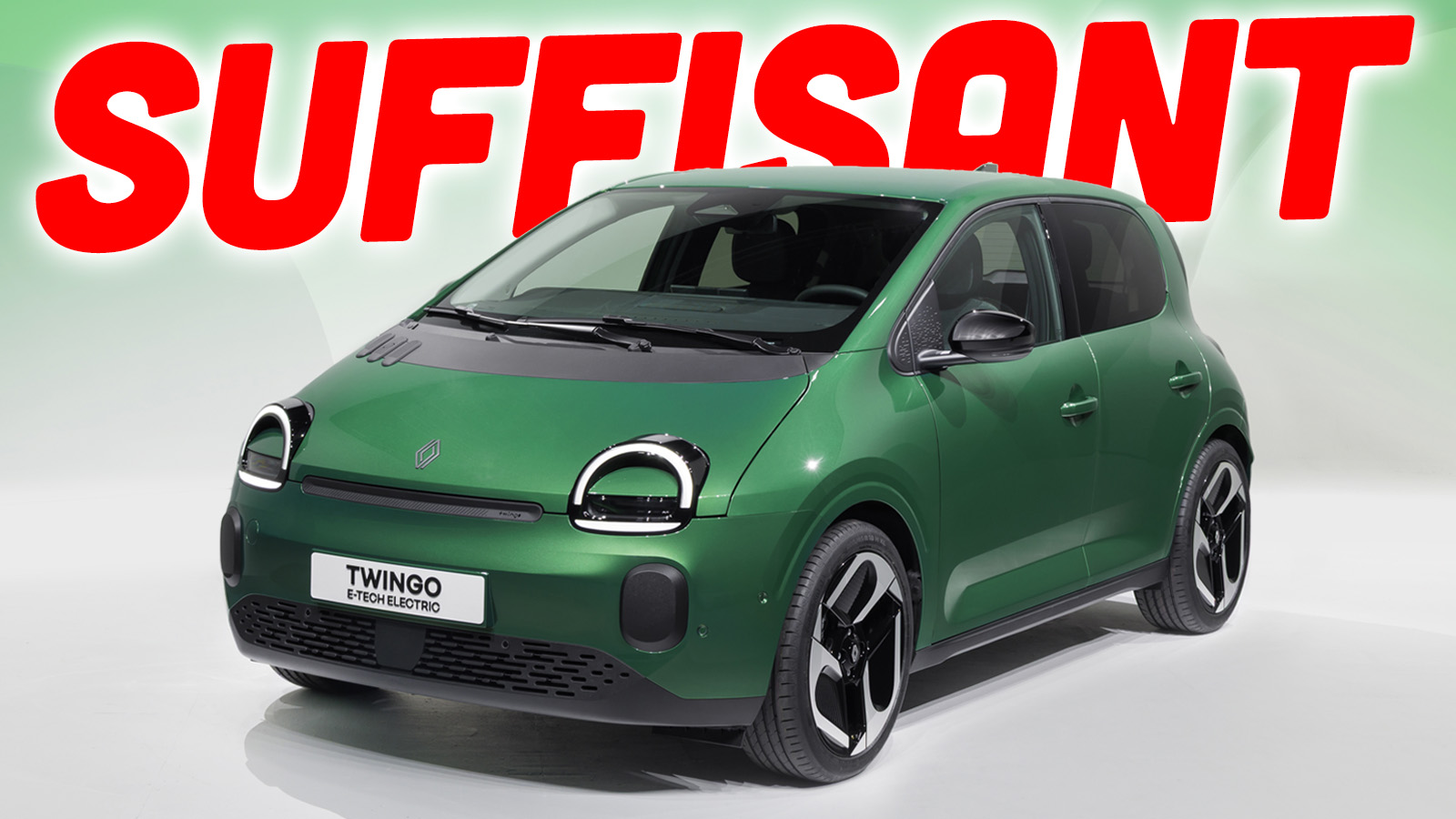
The Renault Twingo is so back. Originally an icon of the ’90s with its Memphis-inspired colors and smiley face, Renault has tried to reinvent this cult classic a couple of times. The second-generation model was a cromulent but comparatively low-charm city car, the third-generation model was essentially a Smart Fortwo with an extendo clip, but now the fourth-generation model is taking things back to the ’90s with one foot in the future.
Yep, underneath that retro-inspired bodywork sits an all-electric powertrain, albeit one that isn’t going to make any headlines. It has less WLTP range than the previous-generation Nissan Leaf, barely more horsepower than a Mitsubishi Mirage, and while it can technically break the speed limit on Texas’ fastest toll road, it can only do so by a single mile per hour. However, if you look beyond the headline figures and consider what this car’s purpose is, Renault might’ve nailed it.


After all, this is a city car. You don’t need a ton of power or range in bumper-to-bumper traffic, and the low-maintenance nature of EVs should be a huge benefit for city living, provided you have a place to charge. Plus, it’s packed with clever touches that weren’t accidentally released in that big leak earlier this week.

Obviously, the electric powertrain is a huge chunk of an electric car’s cost, so Renault has gone almost diabolically small. The Twingo E-Tech features a 27.5 kWh lithium iron phosphate battery pack feeding an 80-horsepower electric motor. Figure a WLTP range of just 163 miles and a top speed of 81 MPH. That’s about 15.5 percent less WLTP range than the 42 kWh Fiat 500e, and since that car’s rated at just 149 miles of EPA range, it wouldn’t be surprising if the Twingo E-Tech were to cover about 126 miles out on the open road before needing a charge. While maximum DC fast charging of 50 kW doesn’t sound impressive, that tiny battery pack means a 10-to-80 percent session should only take half an hour.

Alright, so road trips might take a while in the Twingo E-Tech, but at least Renault’s given you space to put your feet up. The front passenger seat folds flat, an immensely useful touch for hauling long items that doubles as an ottoman should you wish to move to the rear seat and crack open a book. It’s not quite the double bed the original Twingo’s seats could fold into, but it should get the job done in a pinch, if you know what I mean. Speaking of seats, the rears both slide and recline, and in the cargo area behind them, you’ll find a two-piece split false floor that grants access to a deep well even if you have a handful of things in the back.

Speaking of interior touches, while some of the plastics look hard, Renault’s used color well and provided just enough physical controls. There’s no volume knob on the dashboard, but instead a stalk on the steering column for all your media controls, from changing the volume to skipping tracks. Only the front windows are motorized, but they both have automatic detents on their switches. Oh, and check out those colorful, big-print floor mats. It’s about time fun floor mats made a comeback.

Plus, you do have to consider the price with the new Twingo E-Tech. Renault says it’ll come in at under £20,000, or around $26,000 at current conversion rates. That includes value-added tax, and it makes the Twingo the attractive choice in its segment. It’ll be a few grand less expensive than a Fiat Grande Panda, and about five grand more than the far-lower-output, shorter-range Dacia Spring.
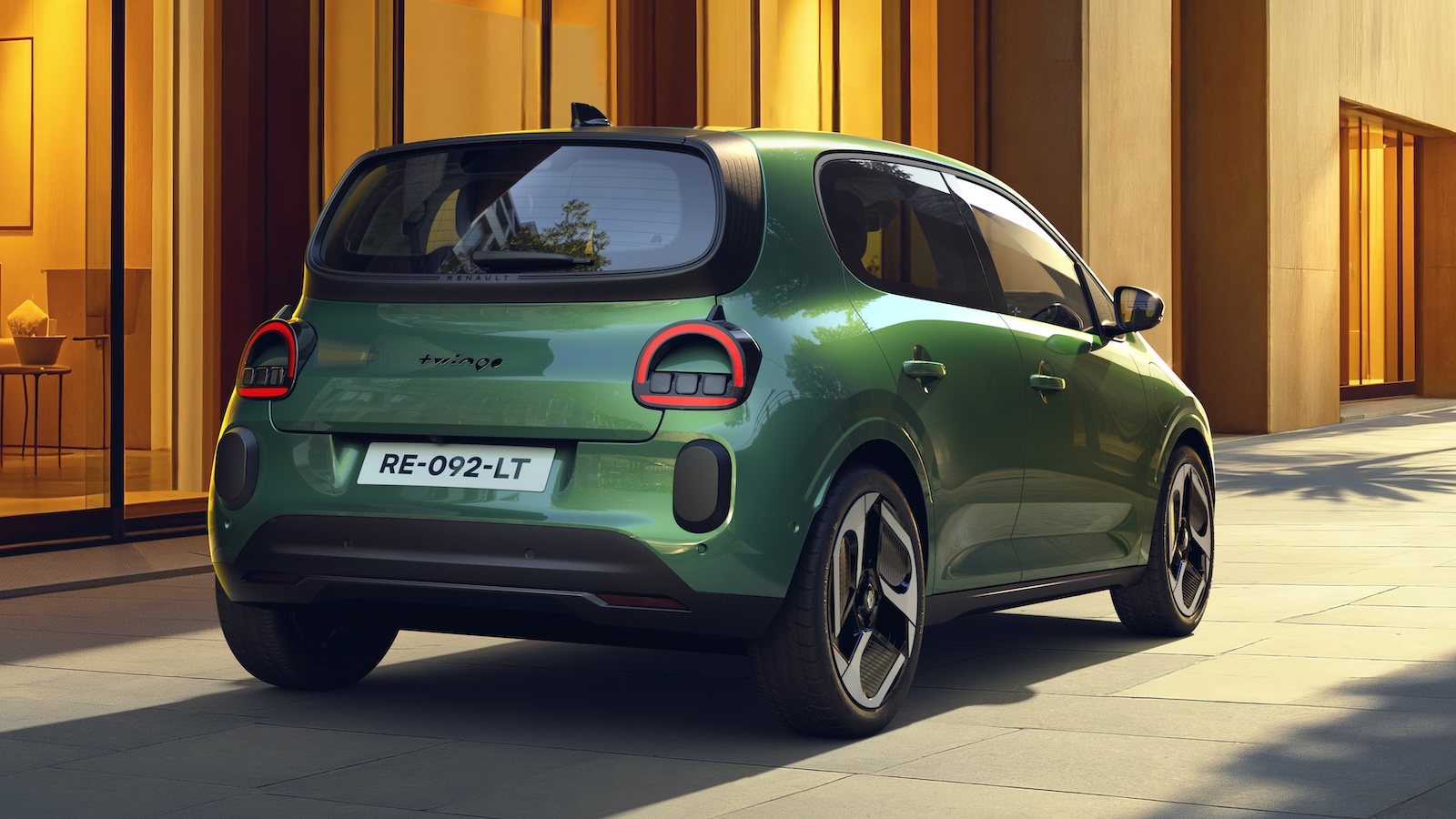
Alright, so the Renault Twingo E-Tech isn’t going to win any races, it’s not a range champion, and it puts up numbers similar to EVs from a decade ago. Still, with this much charm and a low starting price, it might not matter. In the context of a European city car, it seems like perfectly, precisely enough, and that long-life lithium iron phosphate pack is a bonus. I reckon we’ll see slightly dented examples tooling around Montpellier with sprongly bass house on the stereo in 20 years?
Top graphic image: Renault


I’ve already expressed my enthusiasm for this car, but I’ve watched several more video reviews of it on Youtube and damn, now I want it even more. It’s cute, interesting, and useful enough for almost all of my regular/daily needs.
Yellow or green would be fine if there’s no blue. Heck, I’ll even take black despite it being boring compared to the bright colors. What an appealing small car. 🙂
This or the Hyundai Inster would be perfect for me mostly doing grocery runs or ferrying a kid around town. Fiat 500e isn’t really an option since they decided to hobble it with that vestigial backseat. Very disappointing considering some of Fiat’s history with packaging in small cars.
Unfortunately, brands refuse to sell small cars here.
I know.
The Inster, or Kia EV3, or Renault 5 or Twingo, or the Nissan Micra… all of them satisfy so many of my local car needs.
Agreed! Great commuters or first cars if you’re too rich to buy a used car for your kid. Lol
Many commenters hope for an unrealistically low price if it were sold in the U.S. And it won’t be.
It’s a pretty car, but city cars like this are just stupid. You know what big dense cities have? Public transit. If a car can’t take you an hour or two away to another city, what’s the point of having a car? Furthermore, even cities in developed regions like Europe have excellent intercity public transport. (Yes that’s a dig at the US.)
Counter argument: You know what else big dense cities sometimes have? Transit strikes, but will you buy a limited use car just in case?
I live in a dense European city, and I still have a car.
(Ok, that’s partly because I grew up in the middle of nowhere, and not having a car in my life would feel very weird.)
But even though there’s ‘ok’ public transport here, a car make life a lot more convenient. I could get public transport to visit my friend, who’s on literally the other side of the city, but it would take probably over an hour vs 20 mins, and cost me about 3-4 times more than I’d spend on fuel*. Plus, I can travel when I want, rather than waiting for a bus. (All this is outside of rush hour, between 8-9 and 4-6 just don’t bother driving, or getting the bus, walking is quicker. Traffic here is bloody awful).
Don’t get me wrong, I could live without my car, but I’d spend a lot more time sat on buses and trains, and I’d have to be a lot less spontaneous.
*(That’s ignoring all the other costs of motoring)
I’ve lived most of my entire life in big cities: New York for the first 25 years and Los Angeles for the last 30+. In between, stints in San Francisco and London. Though I live in Hollywood, the nearest store to me now is more than a mile and a half down (and then back up) a large hill. It’s just not doable for someone carrying a week’s worth of shopping, let alone someone my age.
Big cities have public transit to a greater or lesser degree (of usefullness and accessibility). I’ve lived w/o a car in some places for years at a time (lower east side in NYC, and in London) but other times, a car has been (and is) an absolute necessity depending on a person’s lifestyle, hobbies, work location, family size, social obligations, etc…
Small cars aren’t ‘stupid’ any more than all cars are ‘stupid.’ A small car generally costs less to buy and run, to maintain, to fuel, and is easier to park. Why is that ‘stupid’ vs. an oversized crossover or Ford F-150 (still the best selling vehicle in America AFAIK)? If a small car serves the needs of its owner, how is that ‘stupid?’ All of the cars being discussed can drive an ‘hour or two to another city’ per your example, so that’s a strawman argument.
I currently own three cars, including a three-row SUV, but TBH, if I could buy a Hyundai Inster, or Kia EV3, or Renault 5 or Twingo, or the Nissan Micra TODAY, at a competitive price, I’d do so without hesitation.
Small cars now are SO much better and safer than they were decades ago, but lots of big cars weren’t that safe decades ago either. We have so few small car options in the states… being desirous of some of the great small options available elsewhere is hardly a sin.
You should never use WLTP cycle range of a vehicle in the headline, it’s not real.
Or at least specfify in the headline that it’s a WLTP estimate, which we know to be optimistic.
Are you insane? This would be a niche use market vehicle that would be exhausted in 2 years.
This will be perfectly fine in Europe, in either a city or in rural locations, for local trips, and like all unreliable French cars, will last 10-12 years. The first generation Twingo launched with 55hp, and sold 2.6 million units, which isn’t niche use.
Actually, I see first gen Twingos here all of the time. Even if there are more reliable cars, simple cars get simple fixes.
All hail the ‘simple car gets a simple fix!” 😀
This Twingo is adorable. Something like this would fit my needs perfectly if I ever need to replace my beloved little wagon!
Yet another huge win for Renault’s design team. It’s been banger after banger for years now. Many of my relatives had Twingos and this is such a perfect interpretation of the original.
Unfortunately, there are some important misses that make this a bit of a fail:
Power is free, but the reinforcements to every component that has to handle more power isn’t. It sounds fine for what it needs to be.
Agreed. 🙂 Enough for purpose is enough. 🙂
The concept of a “City Car” has never really existed in Europe, but the concept of a “Small car” has existed for a long time, and is still in demand, not just for city use (public transport is a much better way to get around most European cities than any car ever could be), but also for rural and suburban use. Manufacturers have stopped producing them not because there is no demand, but because they couldn’t meet emissions targets that had a sliding scale based on vehicle mass with such lightweight vehicles, and couldn’t make the business case for the added cost of hybridisation on such low-margin vehicles. If Renault can produce this for €15,000-20,000 and make a profit on it, there will be demand.
I totally agree on range. There’s a psychological barrier with the claimed range at the 200 mile mark and I’d imagine the 300 km mark (186 miles)
They should have got the car to just over those levels, at least as an option. Cheap model has the 27.5kWh batter, and then a more premium version with a ~35kWh battery.
I suggest that the psychological barrier you mention exists, but varies from place to place and (of course) from person to person. In Europe, where cities are closer together and populations generally more dense, that barrier would surely be less than it is if you live in the midwest of America, where destinations can be hours apart.
Personally, for daily use, about 100 miles of range is probably sufficient for me, but I know that’s much less than would suit most folks. 200 would be luxurious. More than that would rarely, if ever, get used, so I’d be paying for/carrying around battery capacity that would almost never do anything at all.
You could tow this behind your RV and then use shore power at the RV park to keep it topped up. Perfect for little trips into town or whatever. But, I just wonder how big the market is for that kind of thing.
Judging by all of the Neighborhood Electric Vehicles (mostly golf carts with aftermarket mirrors, horn and whatever else is needed to make them legal) I see around here, it might not be as small as you’d think.
Something like this would greatly extend usage into the winter season (if not all the way through) as well as allow travel on highways and at highway speeds.
My thought as well. More weatherproof than a golf cart. Faster, and better safety too.
Of, for EVs that support V2L (vehicle to load) you could use the towed EV to supply a few days’ worth of power to the RV without having to hook up to utilities or run a generator.
Where I live, we have power outages pretty much every year. Once every few years, there’s one that lasts more than a day (trees/wind/powerlines don’t mix). I own a small generator, but I’d prefer to have an EV that could be used as a battery to power the fridge, etc… when necessary.
This is exactly what an EV should be. Short range, around town, practical, sensibly powered, simple.
I think, anyway.
Not 9000 lbs block shaped off-road wandering pedestrian crushing behemoths with one passenger driving to Home Depot to get two bags of mulch.
For 15,000$ I would consider one. Would be perfect for my new situation. 5 mile round trip to work, 30 mile trip to visit the parents. Wouldn’t need anymore. But alas, I’m in America. Never would see it here.
Would sir care for a Dacia Spring perhaps?
Yes, yes I would actually. Would also love a good Lada 2107/6/5/ whatever the model number of the day is
$15K is probably too optimistic a retail price for such a car in America. If that were so, I’d brush my teeth and go to my local Renault dealer NOW (in my pajamas) to buy one ASAP.
It might take a decade or more, along with $8./gallon gas, but I think eventually we will get the chance to have cars like this… eventually. Whether you and I live long enough to see it, I dunno.
Oh, I agree. 15K is what it would take for me to grab one right away. Hopefully I will see one within a couple years. Planning to move to Europe eventually.
I’d love to see something like this do well in the US. I hear a lot about how things like this are perfect second car to use around town. And while that sounds nice in theory, I haven’t really seen it in practice. I mean sure, in every other Stephen King book someone has a International Harvester Scout they use around town. But with small EVs, I don’t see people buying them for that purpose, unless they’re properly cheap. $26k can get you a new ICE compact crossover in the US with way more room and no range limitations, and all sorts of used cars. I assume there’s some good used EV deals to be had as well.
My point is that Americans don’t seem to like buying a small EVs, or small cars, that make them put up with compromises. Even if those compromises aren’t really a big deal. Once again, I would love to see small EVs take off in the US but I don’t think enough people are willing to buy them, at least not yet.
And outside of other classic car owners, I’ve never met anyone who keeps a car around for local errands. Not to say they don’t exist, and I’m sure there’s some of y’all here in the comments section! It’s just not something I’ve seen.
In the US, you need at least a Ford 250 for when you get into an accident with one of the many Ford 150s.
I’ll maintain the argument that small, affordable EVs/cars haven’t actually been an option for Americans in recent memory. Certainly not within whatever graphs the analysts are using to determine small cars aren’t selling in comparison to crossovers (most cars).
In machine learning, when a system takes a variety of inputs and responds with roughly the same answer for all of them, it’s called “mode collapse” and means the system is, effectively, brain-dead.
Or, I mean, it’s really so brilliant how analysts have found the one perfect car and replaced most of the other cars with it, and they should probably all get bonuses or whatever before the next round of layoffs.