

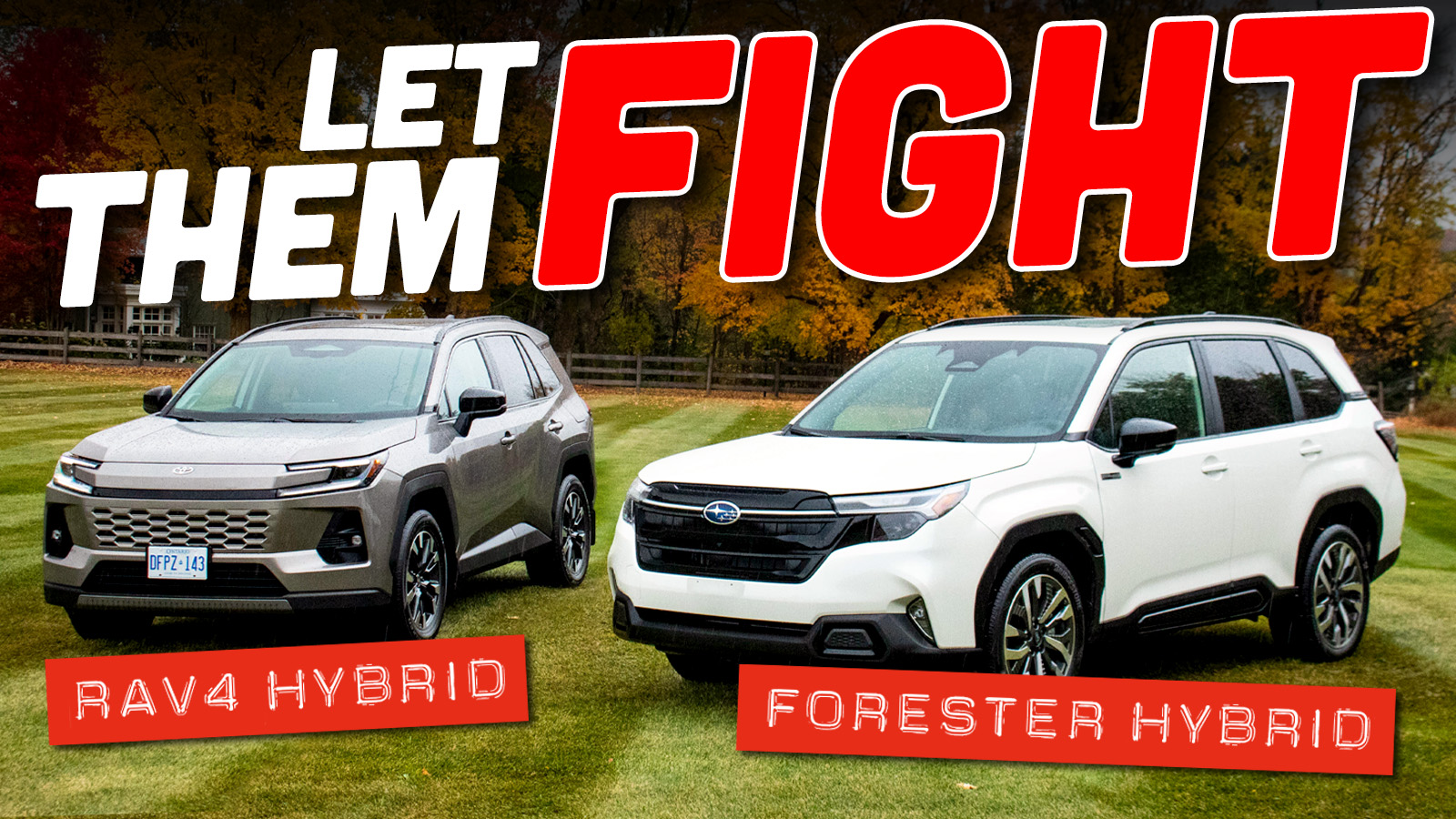
So, you want a hybrid Japanese crossover? No joke, great choice, you’re pretty much looking at the platonic ideal of a new daily driver. Not too big or small, plenty practical, and more efficient than something without electrification, we’re getting closer to the perfect ultimate form of family car. The question is: How much all-wheel-drive do you want? While the new Toyota RAV4 and the Subaru Forester Hybrid are similar in both form and battery pack sizing, they’re more different than the average Joe on the street might think.
One has an inline-four, one has a flat-four. One uses an electric motor for all-wheel-drive while the other uses more traditional means. One seems more Old Navy, while the other practically comes with an REI membership. However, they’re around the same size and should be about the same price. This is gonna be interesting.


[Full disclosure: Toyota Canada and Subaru Canada both brought their latest hybrid compact crossovers to AJAC TestFest, an annual event put on by the Automobile Journalists Association of Canada as part of the run-up to and evaluation for Canadian Car of the Year. Food and lodging were provided by the Association.]
How Do They Look?
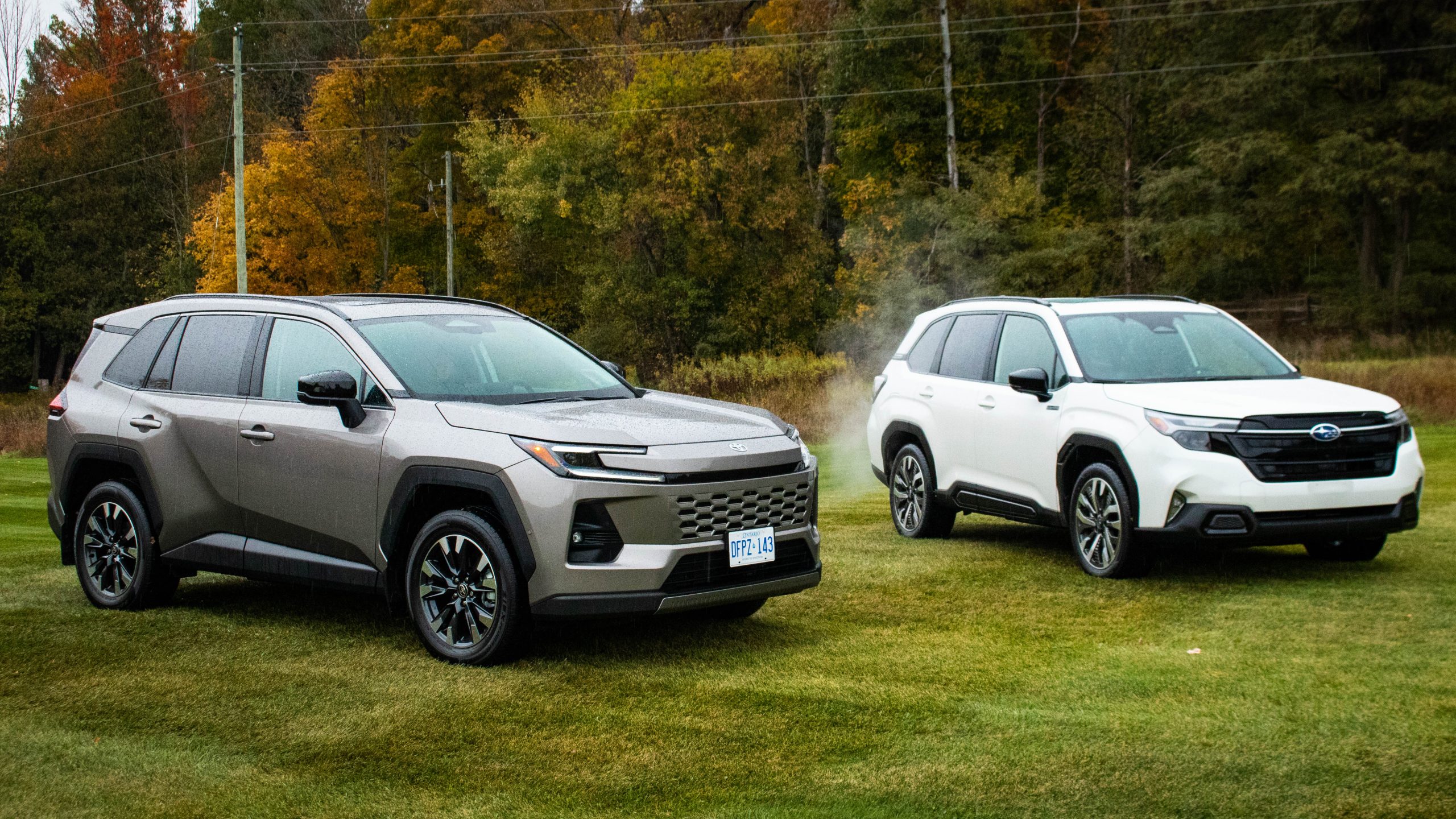
It’s 2025 and boxy is in, so Toyota’s put in the work to take some of the rakishness out of the RAV4. The sixth-generation crossover’s silhouette works pretty well, and the taillights are great, but we need to talk about its face. Sure, the Woodlands and GR Sport trims have more conventional grillework, but the series of holes on most models are shocking enough to make the Forester’s unusual wheel arch trims look downright conservative in comparison.
Admittedly, the styling of the Forester doesn’t always dissect perfectly. The Gandini-influenced fender plastics are strange in execution, the grillework is busy, and the rest of the cladding contains enough lumps that it might want to contact a physician. However, zoom out and the Forester looks familiar, conventional, like you’ve seen it before. It also has a great greenhouse-to-metal ratio, which pays dividends once you climb inside.
What About Their Interiors?

Slide inside the latest Toyota RAV4, and it’s immediately apparent that the people who made the thing have children, because there’s genuinely a place for everything. A central shelf for phones, a smaller one beneath it for other trinkets like gum and cool rocks, one across the passenger side of the dashboard for other flotsam and jetsam like spare tissues and snacks, and even a surprisingly versatile center console lid. All good stuff, and the visual design of the cabin is particularly modern and sleek compared to the Forester’s.
That being said, the ergonomics of the RAV4 are a bit strange. The center console tries to occupy the same space as your inboard knee, the steering wheel feels a little bit far away even at full column extension, you sit quite close to the headliner, and the seats start to feel a bit flat after some real time in them. It’s also easy to pick up the occasional whiff of cheapness, so if you want a wagyu experience for fast-fry money, the RAV4 probably isn’t for you.

In contrast, the Forester Hybrid is a more comfortable, more premium place to be. Sure, there are lots of shut lines and different materials, but everything’s just a bit softer, richer, and more thoughtfully designed. The console sits low enough to avoid most cases of knee conflict and is actually padded. An extra 2.3 inches of front headroom goes a long way, and the armrests are properly cushy. However, perhaps the most surprising thing is the visibility, a revelation compared to the RAV4. Subaru has somehow managed to build a car that performs brilliantly in crash testing and has pillars so thin by modern standards, they’re practically wispy. Add in loads of glass, including a huge single-panel moonroof, and you get a really pleasant place to pass the miles.
Downsides? Well, you do give up a serious amount of on-paper seats-up cargo space in the Forester compared to the RAV4—about 10.2 cu.-ft. based on each model’s spec sheets—even if cargo space with the seats folded is within 1.31 cu.-ft. of the RAV4. Disregarding potential spec sheet shenanigans, the steering wheel comes out of the dashboard at a more bus-like angle than in the RAV4, and you get fewer cubbies to put stuff in up front. However, the Forester does have a wider rear seat and more rear legroom than the RAV4, important stuff for carrying rear passengers with or without child seats.
How Do They Drive?

If you’re familiar with Toyota’s hybrids, you know exactly what powers the new RAV4: A 2.5-liter inline-four mated to a two-motor transaxle with an integrated planetary gearset, and all-wheel drive is offered via a 54-horsepower electric motor on the rear axle. Officially delivering up to 40 MPG combined in certain all-wheel-drive models, the result is the most efficient all-wheel-drive series-parallel hybrid in its segment, no doubt about it. The all-wheel-drive RAV4 also outguns the Forester with an extra 42 horsepower, so on the asphalt, it’s really a case of having your cake and eating it too.
Indeed, it’s not especially hard to beat the official EPA figures in the RAV4, and it offers up a sense of confidence that extends beyond sailing past fuel pumps. Toyota’s done a good job of keeping body roll in check, and although you do notice the odd bump in the road through your seat, the tradeoff is more secure handling than in the outgoing model. However, it is worth noting that because the non-plug-in Toyota RAV4 can only send 54 horsepower and 89 lb.-ft. of torque to its rear axle, a predominantly front-wheel-drive feel shows up off the pavement. Not a huge problem on flat ground, but on a wet, hilly dirt road, a less efficient mechanical all-wheel-drive system would offer superior traction.

Speaking of mechanical all-wheel-drive, here’s a completely different way to build a hybrid crossover. Under the skin of the Subaru Forester Hybrid sits a 2.5-liter flat-four hitched to a regular all-wheel-drive system with a power transfer unit, a driveshaft, and a traditional rear differential. In practice, Subaru’s system isn’t as willing as Toyota’s to cruise along at freeway speeds on electric power alone, but it has a few major benefits. Because the total powertrain output can be split equally front to rear, the Forester Hybrid is just more surefooted when the going gets unpaved. Snow-belters, this one’s for you. Around town, Subaru’s tuned the powertrain response to be eager, and when the flat-four fires into life, it doesn’t seem ashamed of the fact that it is an engine. There’s character here, and the extra torque and smoothness of electrification only make it better.
Of course, with an EPA rating of 35 MPG combined, the Forester Hybrid can’t match the fuel economy numbers the RAV4 is putting down, but the pleasant driving experience doesn’t stop with the powertrain. The spring rates and damping feel softer than in the RAV4, and the result is that the Subaru glides over bumps you might feel in the Toyota. As a bonus, a 16.6-gallon (63-liter) fuel tank gives the Forester enormous cruising range for truly bladder-busting road trips. At the same time, outstanding visibility makes for easier parking, although I do wish the Forester Hybrid’s brake pedal was as dialled-in as the one in the RAV4.
Do They Have The Electronic Crap I Want?

Two weeks ago, I got my first chance to sample the new infotainment system Toyota’s been working on for the latest RAV4. Since then, I’ve had a bit more time to play around with it, and guess what? It all works great. The RAV4 makes much better use of its screen real estate for wireless Apple CarPlay, including beaming certain mapping apps into the gauge cluster, the infotainment system boots quickly, everything’s responsive, and the menu structure is light enough to not be confusing. Alright, so the digital gauge cluster screen can feel a bit feeble in bright sunlight, and the only physical audio and HVAC controls you get on the dashboard are a volume knob and a few temperature controls, but the overall experience is very modern and user-friendly. With available dual wireless smartphone chargers and 45-watt USB-C charging ports as the maraschino cherries atop this banana split, Toyota’s cooked up a pretty good overall tech package.

In contrast, Subaru’s 11.6-inch portrait-style touchscreen infotainment system has been around for a few years, and it’s starting to show its age. Its biggest sin is having the screen completely wash out in bright sunlight, but slow boot times and limited use of screen real estate for phone mirroring are also slight annoyances. Everything works fine once it’s booted up, it just takes a minute to get there, and Apple CarPlay only takes up about half the screen. The Forester also doesn’t have any huge advantages over the RAV4 when it comes to physical controls outside of a real button for the heated steering wheel. Sure, there’s a tuning knob you don’t get in the Toyota, but Subaru’s system still relies on virtual tiles to activate the heated seats. However, it is somewhat nice that Subaru has provisions for both USB-A and USB-C charging and connectivity, as some of us just haven’t made the leap to all-USB-C.
What The Toyota RAV4 Does Better
- Its fuel economy’s on another level.
- There’s so much more small-item storage in the front of the cabin.
- The RAV4’s high-speed handling feels more secure than the Forester’s.
- More modern cabin tech means fast, big Apple CarPlay, huge gauge cluster configurability, available dual wireless phone chargers, and available 45-watt USB-C power points.
What The Subaru Forester Hybrid Does Better
- It’s comfier, from the console design to the ride quality.
- Mechanical all-wheel drive is a big plus in the dirt.
- The sheer outward visibility is a game-changer.
- Your kids will appreciate the overabundance of seatback storage pockets.
The Bottom Line

It’s safe to say the new Toyota RAV4 going all-hybrid is a big deal, because it means more people than ever will be able to experience awesome fuel economy for the segment. Between efficiency and the sheer range of trims on offer, the 2026 Toyota RAV4 is the best hybrid in its class, and it features a pretty slick new tech suite that’s remarkably user-friendly.
However, if you’re the sort of person to buy a car based on purely physical attributes, the Forester Hybrid feels like a better crossover. It has a bit more passenger space, a bit more comfort, and a bit more soft-road capability. Both are great choices for a daily driver, but if it were my money on the line for a U.S.-spec example and I had to buy one, I’d personally take the Subaru. Now that’s a sentence I didn’t expect to write.
Of course, things are a little different in Canada because the Forester Hybrid only comes fully-loaded north of the border for 2025. At the time of writing, details on electrified 2026 models haven’t been announced, and the availability of entry-level RAV4 trims is a huge plus. Still, the fact that these two crossovers are so close to the point where pricing could be the decider is a good thing. It just means people shopping in this space have several solid options.
Top graphic image: Thomas Hundal



I”ve owned Foresters and a 1st-gen RAV, and I’ve had a million modern RAV4 as rentals. RAV always feels like an off-brand Temu toy. Give me the Forester any day of the week, even if it will only last 100k miles.
Which gen Foresters aren’t lasting more than 100k miles?
Those are not boxy; they are lumpy.
just get the CRV
Why haven’t car makers figured out how to integrate touch screens into the dash better by this point? I hate the way the Rav 4’s looks like an ipad slapped onto the dash, multiple inches above it.
I see the Subaru warming up in that 2nd picture. I’d like to make the easy (if dated) joke about head gaskets please and thank you.
I think we’ll all get used to the Rav4 front end once we’ve seen them all over the place. On the hand I don’t like it, but on the other I’m glad Toyota at least tried something. And as many people pointed out on the first Rav4 article, it’s better than the wannabe tough guy frown of the current gen. That thing legitimately sucks.
I just realized that someone took a sledgehammer to the bottom part of that new RAV4’s doors.
I’d take the Forester just because I’d rather eat my own hair than look at the RAV4’s front end every day.
both are ugly pieces of shit
For the same money, there is absolutely no reason to buy the janky ass Subaru. It’ll be less than 3 years before it feels and drives like a 15-year-old car. That’s what makes a Subaru a Subaru.
The Subaru looks like it could have come out in 1994.
You would be better served with a Mitsubishi Outlander PHEV, btw.
Wow! They both have windows big enough to actually see out of. Hopefully this will become trendy and catch on.
Forester has always had a large greenhouse which I expect is both heavier and more expensive to produce than the high beltline of its competitors.
I driven a heck of a lot of rental RAV4’s and no cat has a cheaper feeling interior. Also, zero road feel, disconnected throttle and brake pedal, loud interior and uncomfortable seats. At least the hybrid won’t have the horrible, jerky 8-speed of the non-hybrid.
Toyota is the synonym to the zero road feel. we have had it for years but every time i drive my momma’s sienna I always wonder: are the front wheels even down there touching the ground or I am airborne right now?
How about neither? If I really had to pick, Toyota.
Not that I’d be excited about either, but I’m not putting myself in the gimp suit at a Toyota dealer for the right to own a gray crossover. I can get a Forester Hybrid for at or below MSRP, and I don’t even have be hung from a hook on the ceiling above my salesperson’s cubicle.
Also I genuinely like the Forester greenhouse and sightlines. I’ll take the efficiency hit just for that. Also, nobody I know here in Winter Wonderland seems to be too happy with the AWD performance from Toyota crossovers.
I smell a story incoming. Please share with us your horrible Toyota dealership experience!
Toyotas lack of inventory and trimflation has basically kept me from their products. The only time I’ve gone to my local ones interested in their products (once in the Corolla Hatch, once for the Sienna) they sort of made it clear to me that unless I’m willing to take whatever higher trim than I wanted at whatever price they wanted me to pay (above MSRP), that I could go scratch. So it’s sort of a non-story, but I don’t think I’m the only person who has experienced a Toyota dealer disinterested in buyers that aren’t willing to shotgun a tallboy of Jim Jones Kool-Aid.
Toyota dealers have leaned hard into the “our products are so superior and reliable, that it’s totally worth spending 3-4k more than our competition for a spec that you don’t really want”. I don’t agree with that.