

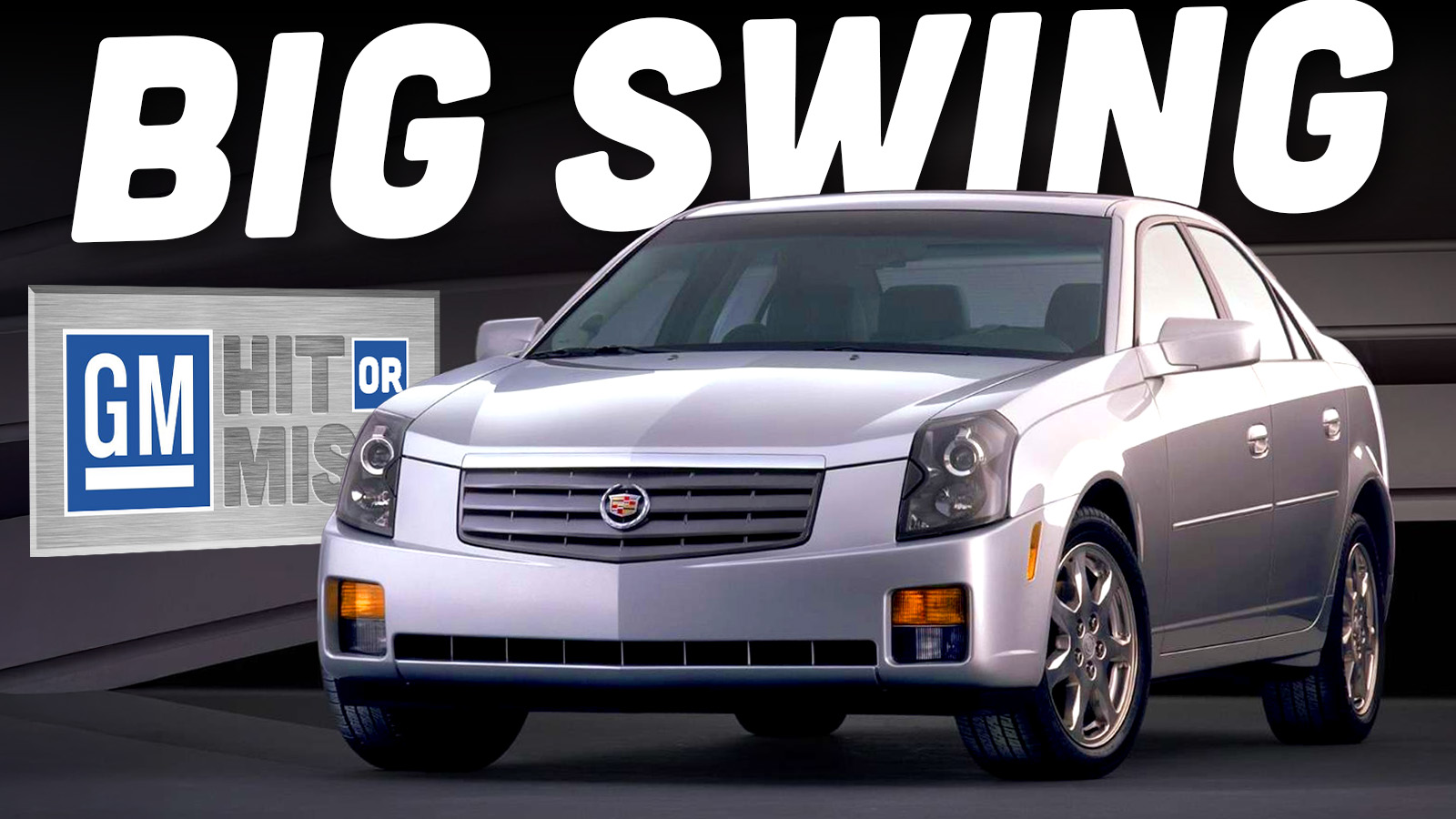
By the end of the ’90s, Cadillac was in a dire situation. If it kept on its path, there was absolutely no room to grow. The average buyer age in 1998, as reported by Forbes, was 64, and sales were in enough of a low spot that Cadillac was caught faking figures for 1998, with Automotive News reporting that Lincoln had actually taken the domestic luxury brand crown that year. The brand had to change, and while the Escalade was a lifeline, the most obvious path forward was to go where the product was hot by building a proper compact sports sedan good enough to rival the Germans.
Entry level cars had historically been a notorious sore spot for GM’s luxury division. The Cimarron was, by-and-large, a mistake, a hastily reworked economy car aiming far above its league. It became the butt of jokes, and once it went off sale at the end of 1988, it would be another eight years before Cadillac gave the compact executive car thing another shot.


This time, it was with a rear-wheel-drive Opel that drove reasonably well, but a few factors conspired against the Catera. For one, Cadillac was still in its frumpy phase, and the early egg-crate grille clashes with the jellybean silhouette. This was fixed with a facelift, but the bigger issues were competition and marketing. Shortly after the Catera launched, BMW dropped the era-defining E46 3 Series, a car that vacuumed all the air out of the sports sedan room. At the same time, who approved “The Caddy That Zigs” as an ad campaign?
It was time to incinerate the old script, and while the launch of the first Escalade bought Cadillac a lifeline, the real hard work would start with the Catera replacement. Welcome to the Cadillac CTS.
The Big Bet
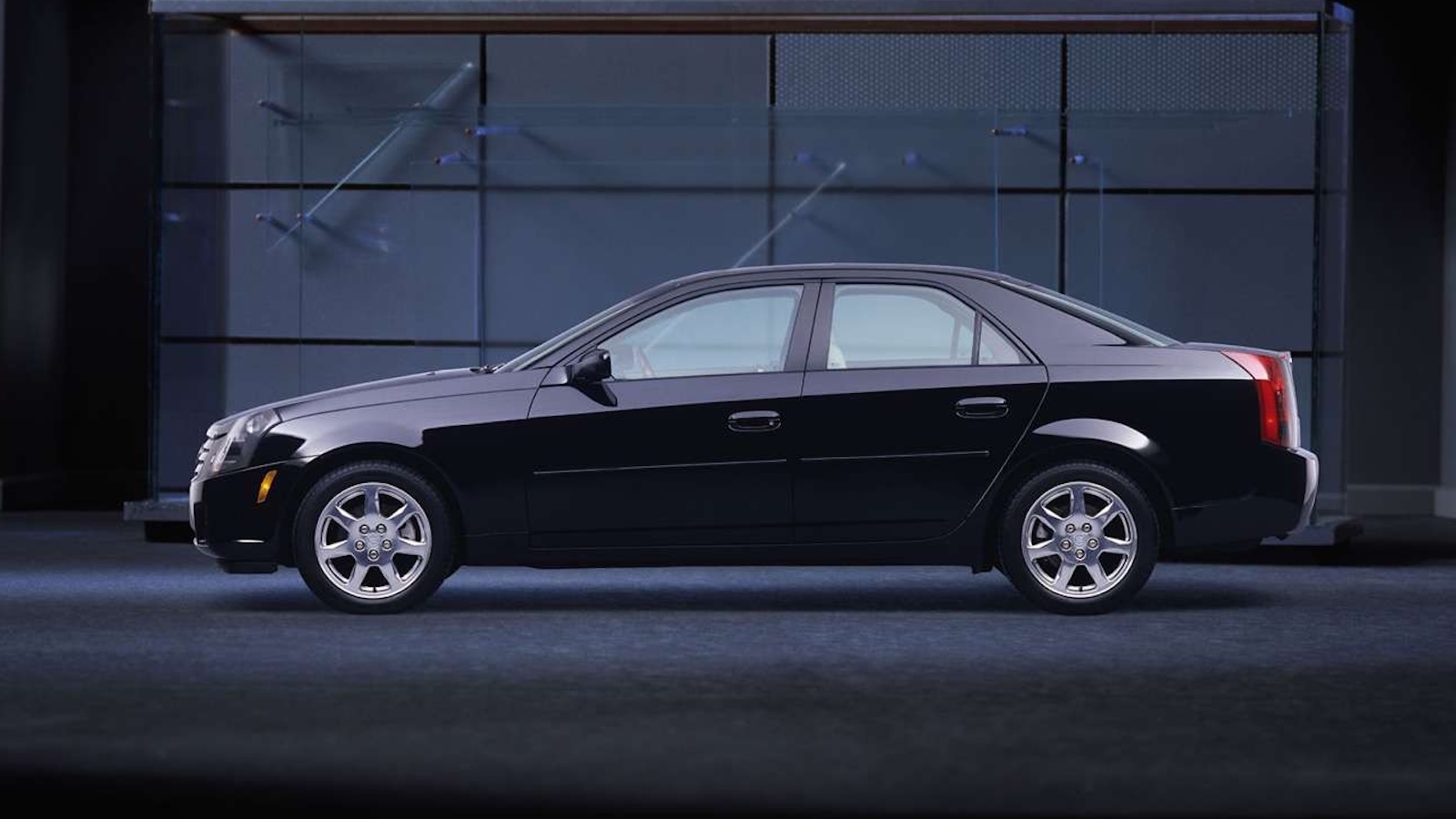
The plan for the CTS came together astonishingly quickly. As Autoweek reported, the first full-sized sketches of what would be the Catera-replacement were shown to brass in February of 1998. The first full-sized foam model? That was ready by May. Not only was it GM’s first model of the sort with functional lighting, it met what seemed like an impossible deadline.
“When we pulled off the cover, we got a round of applause,” [Chief designer Wayne] Cherry says. With a laugh, he adds, “That may have been for how fast we did it.”
The first full-scale foam model of the CTS showcased an entirely new design language, radically angular and unlike anything Cadillac had produced before. While the rest of the industry was evolving the jellybean language of the ’90s, Cadillac was doing something it called Art & Science. It was a huge risk, one that would need a $4 billion investment in a new rear-wheel-drive architecture, new models, and a new plant, but Cadillac was getting absolutely trampled at the time. It really was a case of evolve or die.

Roughly three years later, the production CTS was ready to be shown to the world, and it was a hard break from tradition. Not only was it the first stick-shift Cadillac since the Cimarron, it had a chassis tuned on the Nürburgring, looked like nothing else on the market, and was enough of a shock to almost instantly fade the Catera out of everyone’s minds. Sure, the interior still had some cheapness to it, and the old-school GM tilt column hampered the driving position somewhat, but when Car And Driver compared it against the rest of the segment, the magazine came away largely impressed.
Make no mistake, this is the best Cadillac ever. Get past the styling that, to some, has been carved from a bar of soap, and underneath lies a first-rate effort to bring Cadillac into the 21st century. The target is BMW. It is still wide of that mark. A bull’s-eye, perhaps, on a 10-year-old 7-series sedan, but not against a current 3- or 5-series from Munich.
But Cadillac is now truly in the hunt, and the CTS is only an opening shot.
This truly was a turning point, the moment Cadillac really stopped looking back and started looking at the future. Less chrome, more dark finishes. Less float, more precision. The brand had a new mission, one of developing world-class sports sedans that, in tandem with the Escalade, would try their hardest to shake off a Boca Raton image. Being featured in “Bad Boys 2” and “The Matrix: Reloaded” certainly didn’t hurt.
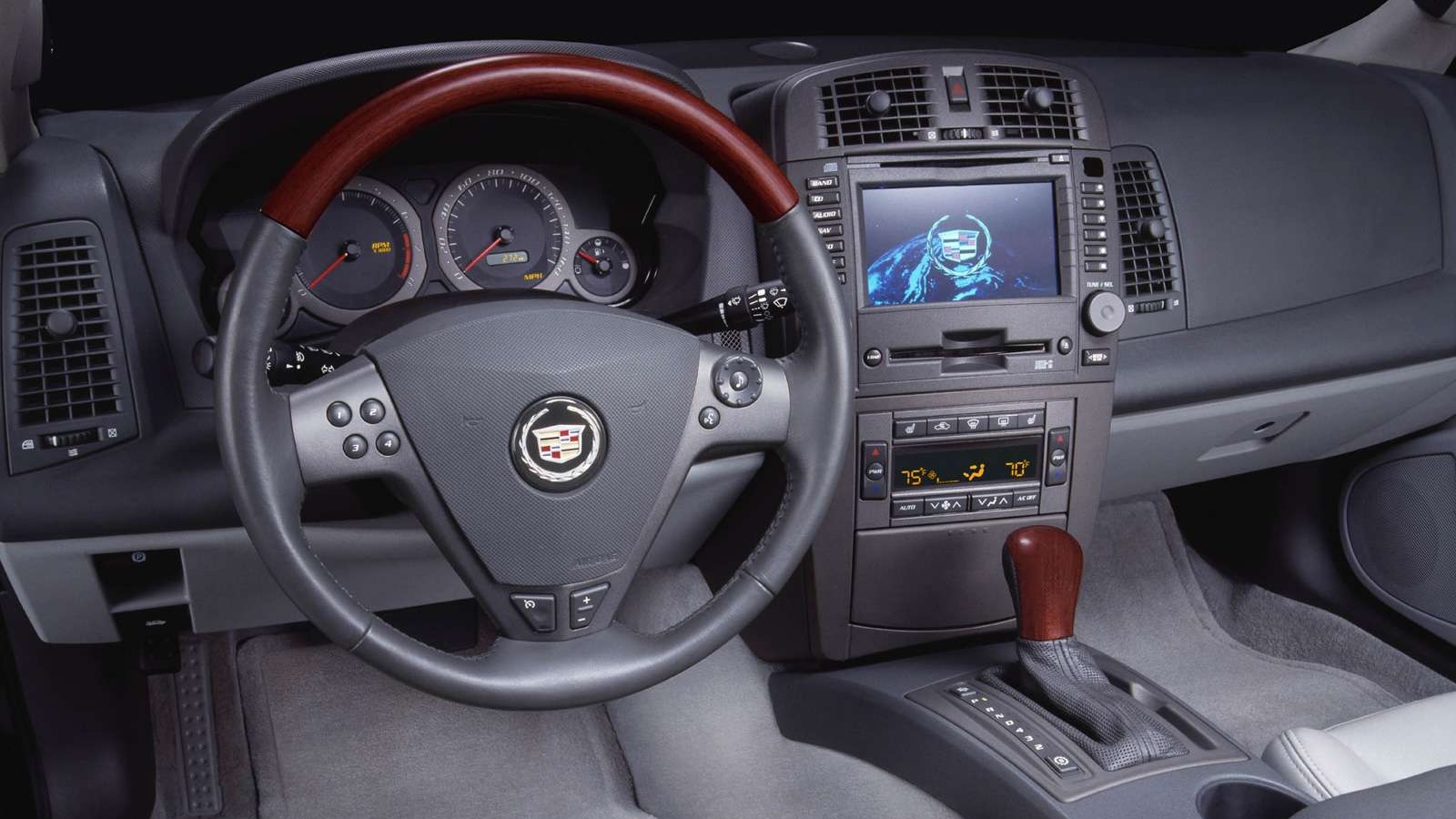
Over time, the CTS would see the sort of incremental improvements expected from a product GM tried hard with. A 260-horsepower 3.6-liter V6 appeared on the options sheet for 2004 and supplanted the original 220-horsepower 3.2-liter V6 for 2005, an Aisin six-speed manual replaced the five-speed Getrag for 2005, sales channels spread to Europe and Japan, and touches like more legible gauges and a cleaner steering wheel control layout helped usability. However, arguably the most memorable arc of the original CTS was when Cadillac took an even bigger swing.
The Corporate Hot Rod
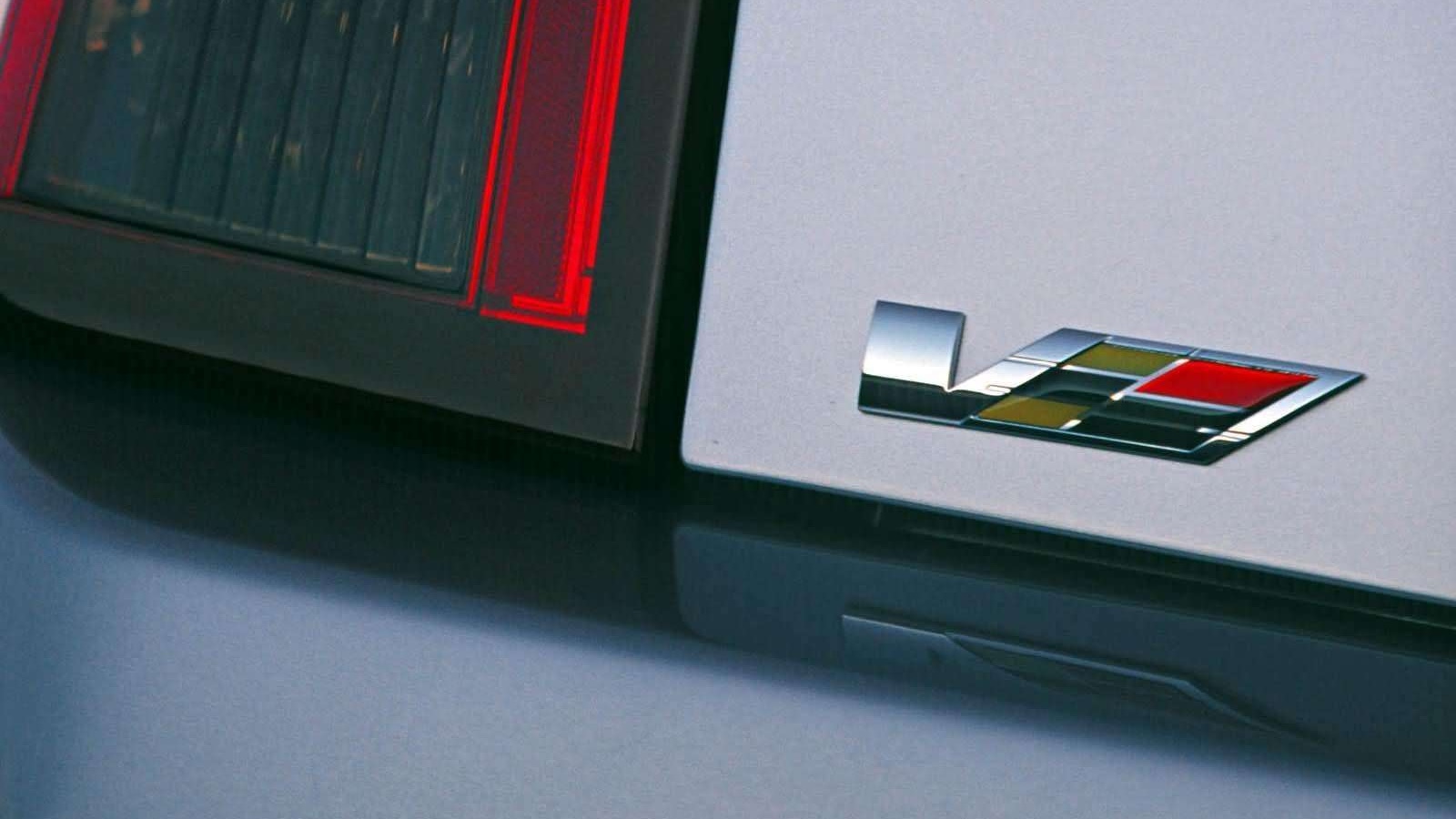
If you were going after BMW, Mercedes-Benz, and Audi back in the 2000s, you were going to need something fast. If you listened carefully in finance districts around the world, you’d hear M cars, AMGs, and the like being revved up in underground garages, the left-lane chariots of power brokers with wild streaks and city boys seeking a thrill. Cadillac had never really made a performance car of this sort before, but the CTS was the perfect place to give it a shot. The name of the sub-brand? Cadillac went with a pretty good letter: V.
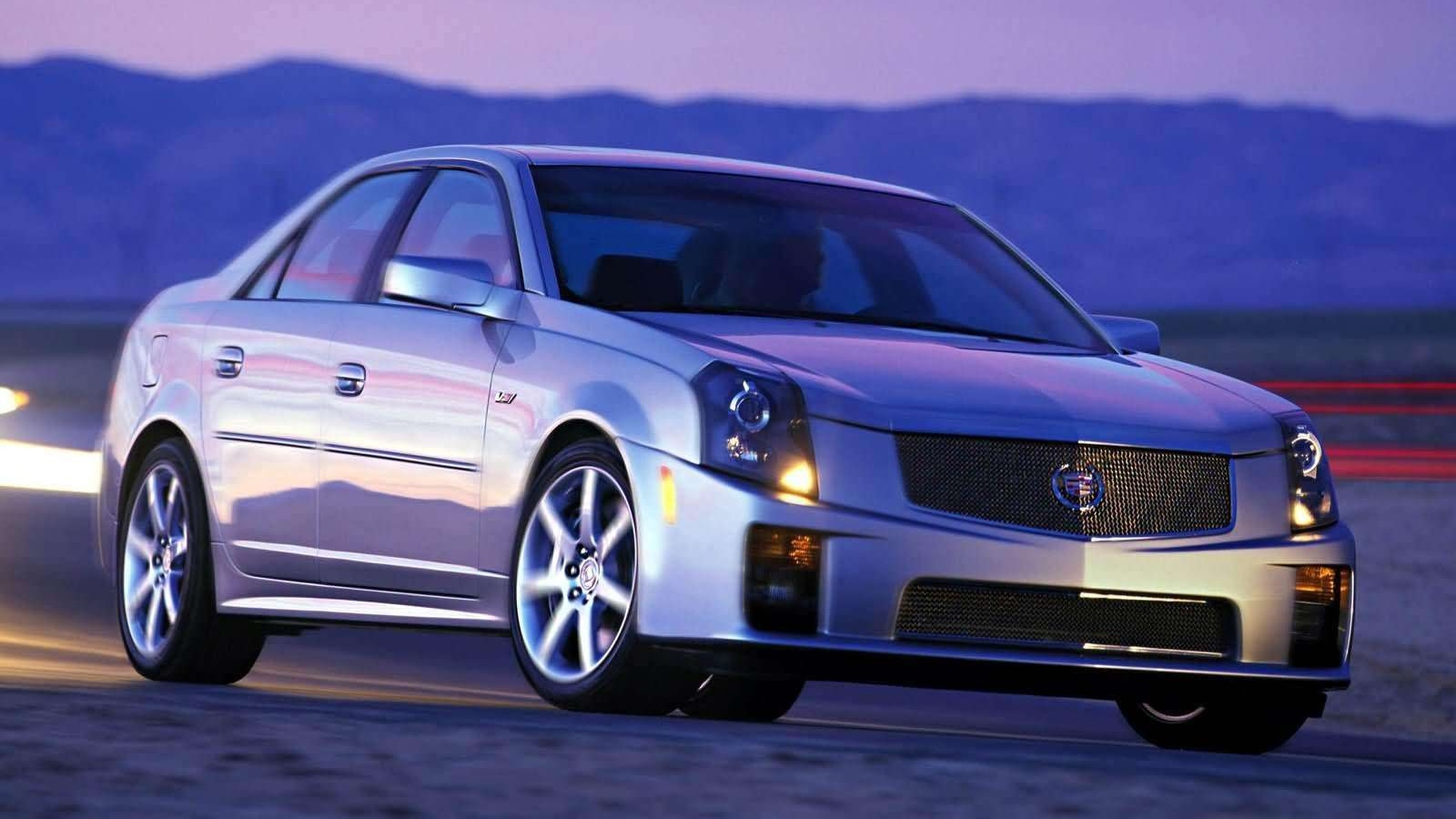
To create the original CTS-V, Cadillac raided the parts bin where it could, absconding from the warehouses with the 5.7-liter LS6 V8 from the C5 Chevrolet Corvette Z06 and Tremec’s T-56 six-speed manual transmission under its jumper. We’re talking 400 horsepower and 395 lb.-ft. of torque, 60 more horsepower than an Audi S4 and 38 more than a C 55 AMG. However, Cadillac didn’t stop there. Four-piston Brembo calipers clamping 14-inch discs hauled the CTS-V down from triple-digit speeds, 46 mm monotube dampers joined forces with 27 percent stiffer springs and a larger front anti-roll bar to maintain body control, and square 245-section Goodyears did what they could to manage grip. Cadillac changed so much that even the bolt patterns for the wheels were different, with the CTS-V being one of the few passenger cars to feature six-lug hubs.

The result was a sharp-looking midsize sports sedan that could sprint to 60 MPH in under five seconds, wouldn’t stop pulling until 163 MPH, and was properly capable on a circuit. Launched for the 2004 model year, it meant business, and this executive muscle car with BMW-troubling handling instantly had people raving. As Car And Driver wrote:
Watch out, children, fusty old GM is raising hell. The power is loud, violent, and addictive. The steering is sharp, the suspension is in control, and the brakes are a strain on tendons. You touch bliss in a drift out of an apex, the grille pointing where your right foot aims it. Holy Saint Herman of Alaska—the traction-control-disable button is right there on the steering wheel! You can boot GM’s lawyers out of the car with one thumb flick. No need to, though, since the computer allows lots of sideways horseplay before it intervenes. Straight-line acceleration is crimped by spasmodic axle hop, and the chintzy interior (pre-Lutz) should be shoveled. But GM’s being bad is really quite good.
Now, that’s not to say that everything was perfect with the first-generation CTS-V because there were some teething issues. That early Car And Driver test was hampered by an early oil temperature display software issue, but the biggest issue with the original CTS-V was what happened if you tried to launch it. Dumping the clutch was met with violent, areola-shaking wheel hop, to the point where some owners grew familiar with how much a replacement differential cost. A whole aftermarket sub-sector appeared to mitigate the likelihood of breaking rear end components, but so long as you abstained from hard launches, the CTS-V was a sweet machine.
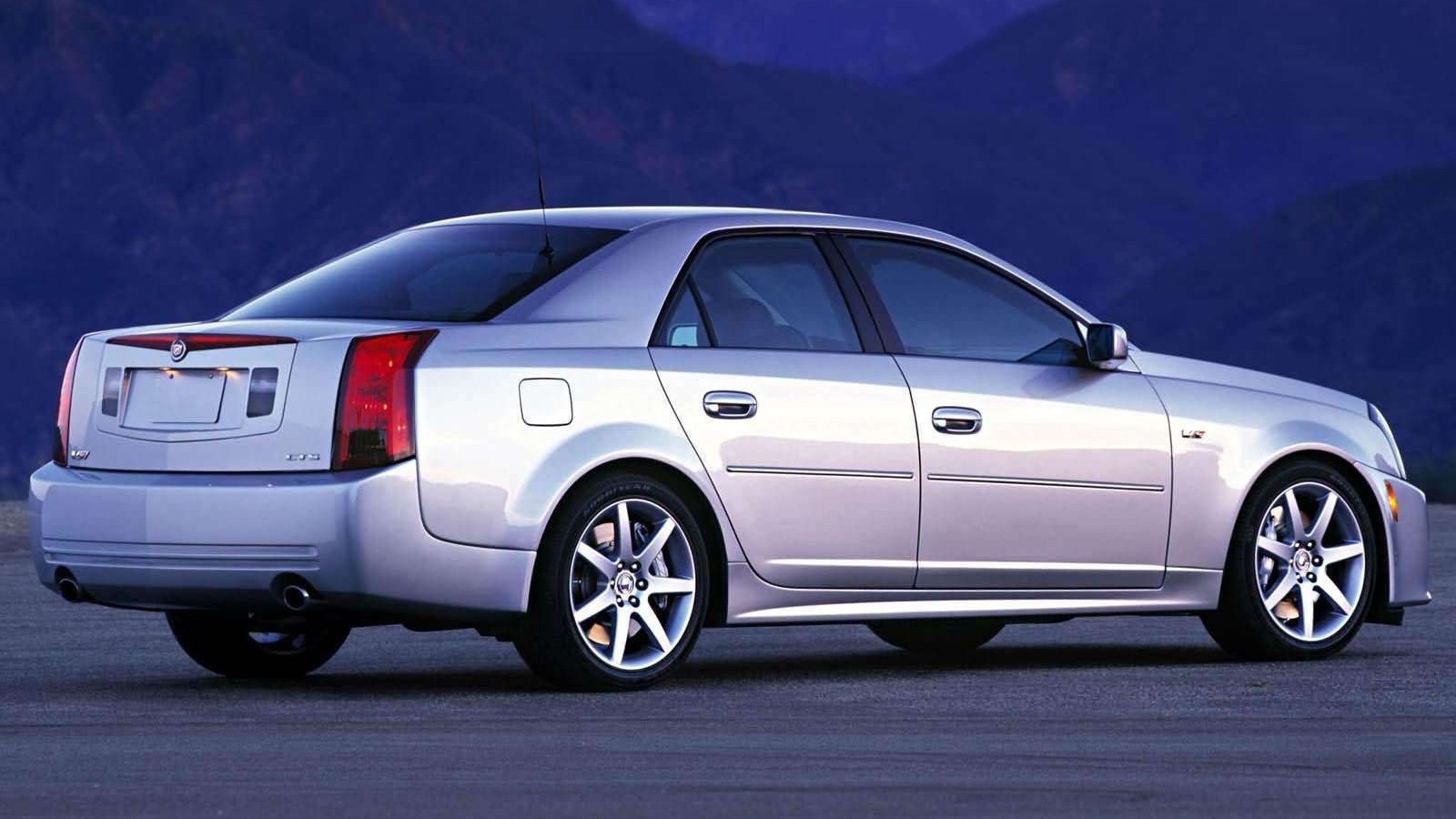
Plus, it got even better in 2006 with the arrival of the six-liter LS2 V8. Sure, it made the same 400 horsepower and 395 lb.-ft. of torque, but the torque peak arrived 400 RPM sooner for a wider power band. The rear end also gained some much-needed upgrades for hard driving, beefier half-shafts and a stronger differential that was far more difficult to blow up.
The Legacy Of The CTS
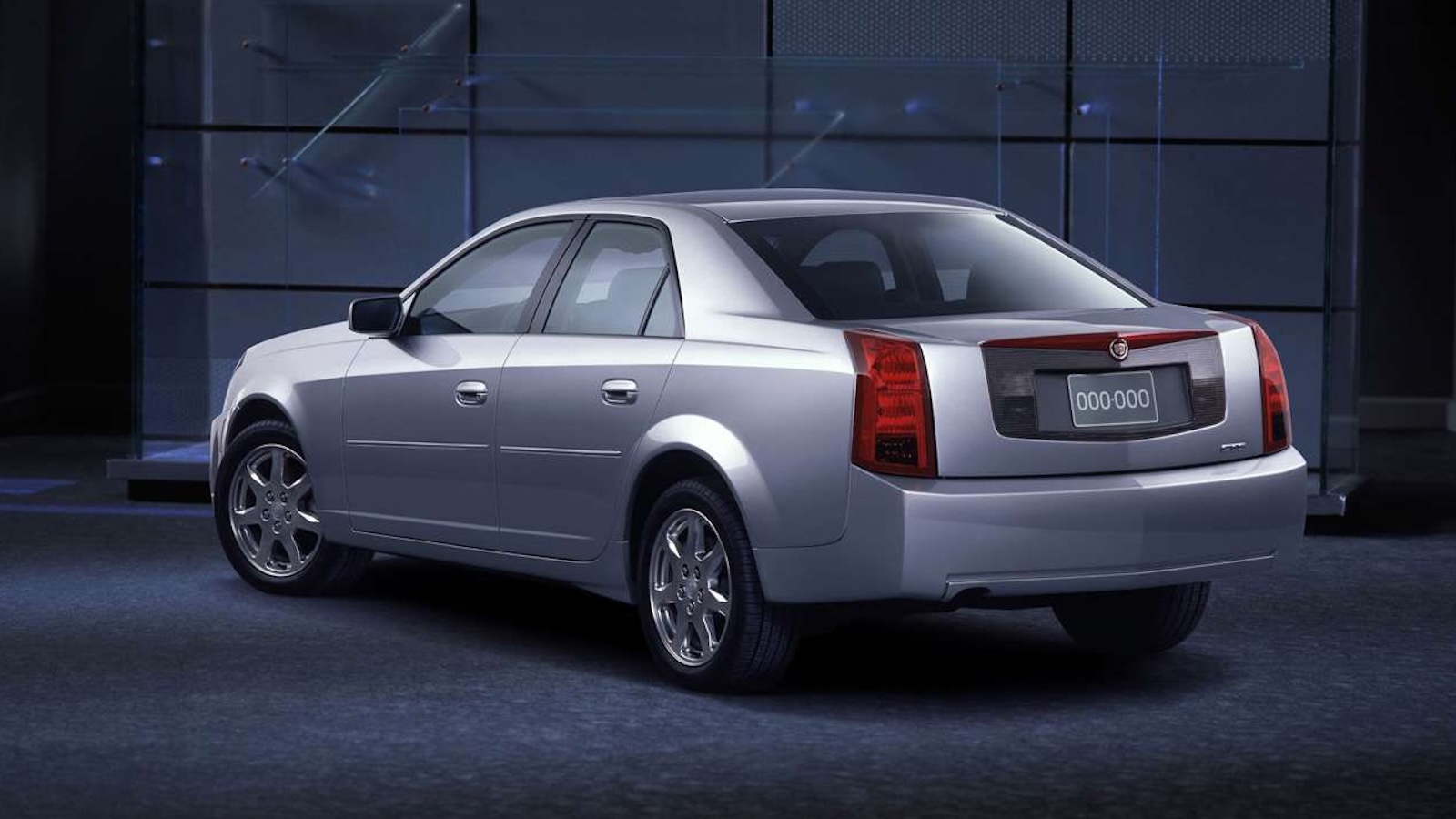
It’s easy to forget how groundbreaking the CTS was, but it was the starting point to Cadillac making some truly epic cars. The 556-horsepower supercharged stick-shift second-generation Cadillac CTS-V wagon is one of my favorite cars of all time, the third-generation CTS-V was absolutely ludicrous thanks to the 640-horsepower LT4 engine from the Corvette Z06, and then there are the performance sedans of the moment, the CT4-V Blackwing and CT5-V Blackwing. It’s wild to think that the most coveted new fast four-doors are American, but the Blackwings are that good.
Then there’s the styling. The Art & Science motif has coursed through Cadillac’s veins for nearly a quarter-century, refined into a series of signature vertical and horizontal elements that offer distinction while rarely toeing the line of vulgarity. Guess what? It worked, to an extent. Cadillac’s average buyer age has been slowly trending downward since the early 2000s, with GM Authority reporting an average buyer age of 54 in 2023. Plus, the CTS immediately buoyed sales. Over the Catera’s production run, only 94,801 were sold, with the last units not making it off dealer lots until 2003. In contrast, over the six years the original CTS was in production, Cadillac sold 317,966 entry level sports sedans. Let that sink in.
While Cadillac’s sports sedan reign won’t last forever, given the brand’s intention of an electric future, it helped do what it needed to do. Sure, the Escalade gets all the credit, but it’s worth remembering that the CTS also changed Cadillac in a massive way.
Top graphic image: Cadillac
Support our mission of championing car culture by becoming an Official Autopian Member.


Love the CTS, especially the 2nd gen wagons. I wish Cadillac had stuck with giving their cars actual names instead of chasing the word/number salad that most German brands love to use. Explaining to a non-car person what the hell a ATS-V Blackwing is and how it’s different from the ATS-V sport is excruciating.
It seems like they are reverting slightly (Lyirq, Celestiq, etc.) which I am fan of.
I absolutely loved my 2007 CTS-V. So much so that I have been buying Cadillacs ever since: 2014 ATS 3.6, 2019 CTS-VSport, 2024 Lyriq AWD. And I’m still younger than the average purchaser’s age! (for now, lol)
And people complain that Cadillac and Lexus seem to be both old people’s cars.
I know plenty of young people drive both brands.
Gotta give credit to the CTS-V, it really brought back a characteristic Cadillac had been missing in its cars for A LONG TIME. Uncompromising excellence delivered with a unique swagger of vulgar excess. This time it just happened to be a 4 door Corvette missle instead of a finned cruiser.
I had an 03 with the 5 speed, I loved that car. They’re still great looking and super unique, styling wise. They had some cool tech too, like 4 programmable buttons on the steering wheel, and a button push sequence on the nav screen that would let you pull DTC’s for all systems.
I’ve always loved these. Being a young teen when these came out was pretty mind blowing!
I never realized how much the CD slot on the CTS looks like a 5.25″ floppy drive.
dammit, now I want to 3D print a fake floppy disk with what looks like the swing down locking arm I could stick into my vestigial CD player slot
I read that they designed the center stack to have similarities to a desktop computer from the early 00s
’12-’14 3 bar grills are peak CTS.
I’ve got a ’12 RWD 6-speed V6 3.slow, and it’s an amazing car, and the best highway cruiser I have owned.
Downside, 252k miles and rust from bumper to bumper. For sale, make me an offer before I send it to the junkyard.
I always loved the second gen CTS. Remember when you could choose between sedan, coupe and wagon on an American luxury car?
*In Archie Bunker voice* Those were the days!
Different take: the CTS and its successors were fighting battles in a war that was already over, and by the time they finally started winning with the CT4 and CT5 (both great cars) the German competition had long since moved on and were now crushing Cadillac on the new battlefield of luxury midsize crossovers. Cadillac never fielded a competitive entry in that field at all. The existence of the CT sedans neither helped nor hurt Cadillac from either a product or branding perspective.
The only Cadillac that really truly mattered to the brand’s survival is the Escalade. It is said that success is where preparation meets luck, and the Cadillac was exactly both. They rushed out a badge-engineered Tahoe, which dumb-lucked into being a successful vehicle in no small part because it was built on top of all the hard work GM had done for generations making its full size SUV platform the best.
So Cadillac had to go where the Germans don’t even compete in order to be successful. The only place where Cadillac might ever beat ze Germans head to head is in EVs, where I’d argue GM has done their most impressive work and are actually winning in a new and mutually contested market.
I mean, okay.
I eagerly await your rebuttal.
No rebuttal just a weird thing to flex on I guess. So Cadillac is making what the “car people” want and they’re “losers” for not making more crossovers like the Germans? Do I have that right?
I remember being quite excited about this car, being a RWD Cadillac with an available stick shift, but then was a little underwhelmed when it actually came out. There was something about the early pics I saw that I didn’t care for, but that went away once I got to see it in person and hear enough Led Zeppelin. The V-series was/is so great. Everyone I told about it had no idea Cadillac was building such a machine. And now I’ve got relatives actively seeking them out.
That influence, traced back to the CTS, is even still here with the newer electric models. My sister’s Vistiq has a V-sport button that lets that vehicle accelerate in a way I never dreamed a big Caddy could. And the Lyriq is getting it’s own V-series. All that combined with the latest crop of Blackwings and the various racing endeavors have definitely proved the big swing was well worth it even if it took awhile to gain traction.
Seeing all the people younger than my middle-aged self at Sebring and Road America wearing “Cadillac Racing” shirts earlier this year just adds to the evidence that they did something right. Even some of my daughter’s teenage friends are excited about the brand and its decision to join F1. One of them is actively looking at used DTS’s for a first car just because Cadillac. I’m not sure it can all be traced back to the CTS and the original V-series, but that does seem to be ground zero for the vast majority of the excellent things they’re doing these days.
DTS cars before MY06 had head gasket issues. STAY AWAY unless the HG issue or bolts were done.
She had her eye on an ’07 specifically, although I’m not sure what’s happened with that. I had thought it was ’04 when they finally got the Deathstar HG issues sorted. I’ve steered at least a few people away from the late 90’s early 2000’s Caddies in general because of that. That said, we had a ’98 Eldorado that made it to over 290,000 miles on its original head gaskets, so there was at least one good one out there.
That is good to hear.
The flaw might be real, but I sometimes wonder if the issues may be overblown by people/”YT Techs/Mechanics/commenters” here on the internet (or maybe people who are loyalists of other brands such as Lexus (yes, it is a better car but a lot more expensive) either love to make fun/insult or are paid to).
Did it? Not really. The goal for GM was to resurrect the Cadillac brand and put it onto competitive parity with the likes of BMW and Mercedes and to get those types of buyers to switch to Cadillac. It never really happened. That’s what happens when you permanently damage a brand so badly that its almost irreversible. The perception of it being a bygone brand is still very much a contributing factor to its less than stellar performance. The brutal reality is that GM should have cut their losses, cut the entire brand name and instead created an entirely new luxury brand similar to what they did with Saturn- which actually worked for awhile in getting some people to buy them over Japanese cars of the time.
The damage was done in the 80s, with the atrocious V8-6-4, the HT4100, the Olds 350 diesel, and the rest.
I will admit it: if I look at the CTS while shutting down my preconceived notions it makes me feel the same way a Quattroporte IV feels (the wedgy, Gandini design never sold here). It’s a really good looking, taut design.
I had an ’05 Sport/Luxury, used. It was a great car. I outgrew it once my first kid was born and it also got rear ended pretty bad on the highway.
I also had a chance to drive the V Series at Bondurant School of High Performance driving for a three day course. Really opened my eyes to what the cars were capable of, got to do a ride along in a new C6 Vette at the time as well, amazing experience on the track.
The styling was always 50/50 for me. The base versions with smaller wheels always looked bad. Overall, a great first attempt and a big jump for GM at the time, I should know as a kid who grew up in a family that exclusively bought used FWD GM cars throughout the ’90s.
While I like the current CT5 and prior MY CTS, I never liked the original. At all. Sat in one ~2006 and the exterior felt overdone (especially with those oversized headlights) and generic at the same time, and interior was cheap AF. Though I guess it did eventually give birth to something nice – which sadly is on its way out already 🙁
Always liked the CTS with one exception- that center stack on the dash looked so out of place.
At least it was a step forward for Cadillac, in the 60’s and earlier you had it made when you got a Cadillac. By the time the 70’s rolled around they were over glorified versions of the cheaper GM products.
That volume knob on the steering wheel was so satisfying. I really wish more cars had that. My dad had a first gen CTS for a while so I got to drive it a few times. My 04 Saturn Vue had the same parts bin steering wheel, except without the radio controls, which I found to be hilarious.
The first gen CTS was great…until you sat in it. Granted, nothing GM made at the time was good, but the interior on the CTS was bad when new and aged like milk. But the chassis was excellent and I always thought the styling, especially in CTS-V trim, was excellent. Sadly, the electrical/computer stuff has proven unreliable over the years, putting a lot of them in the scrap yards.
How much electrical computer stuff did these have? I guess the computer issues may have cost more than the cars worth, especially for initial model years (although late model years would also have it to a lesser extent).
They made a good number of CTSs, correct? I don’t know what percentage are in junkyards…
This was the early years of nearly everything being computer controlled via canbus. There were engine control modules, transmission control modules, and multiple body control modules for the various systems. The cost is only part of the issue – the other is availability. GM hasn’t made new modules for these cars in a long time, and the failure rate on them is unusually high, so even if you manage to find a car in the junkyard with a module, there’s a high chance it is bad (and was the reason it was taken to the junk yard in the first place). There used to be folks who would fix certain modules, like a failed PCM or TCM, but I’m not even sure those folks are still around anymore.
Any years that were the most affected?
I’ve not paid a lot of attention to the CTS in years, but it used to be the newer the better. I’m uncertain if that is still true, given how old they all are now.
Hmm. I see. Thanks for the info.
I still find it ugly as sin. But yeah, heck of a swing they took and I’m glad they did.
I always figured that they were thinking luxury should be noticed. For that, they succeeded.
I bought a used CTS circa 2010; it was a 2004, with the 3.6 and an automatic. It was owned by an older man who was told he couldn’t drive any more. Low miles, perfect condition, but outfitted like a old guy would do it; whitewalls, pinstriping, one of those huge dark plastic visor attachments, and a knob on the steering wheel.
Once all that was corrected, it was a fantastic car. Fast, comfortable, good looking, handled great.
The only reason I got rid of it was that there was something going on with the computer, and it kept going into limp mode, and no one could figure out how to fix it. But at that time, it was 11 years old. It was a real shame, because it was a really, really good car.
Early model years had lots of issues. As time went on, the bugs got worked out to an extent.
These seemed to disappear from the roads pretty fast, saw one out and about earlier this week and took note of it, because it was the first first gen CTS I had seen in a good while
They’re shockingly thick on the ground up here in Canada. At least in my part of Ontario.
Well, that rules out rust as the killer, I suppose
A lot of them get taken out by ECM/trans related issues on the V6 engines.
I only know this because I’ve researched them since there’s quite a few on marketplace. I like the wagons.
Yeah, the electrical systems and various computer modules have sidelined quite a few of them. In fact, there’s a dead one in the parking lot at my work (covered in tacky inuendo stickers and sitting on some really ugly Cragar SS wheels with flat tires). It hasn’t moved in so long it is covered in spider webs and the lawn service has trimmed the grass around the front of it, but since it has a valid parking pass no one is willing to tow it.
I know factory parts are not available, but is there ANY WAY the aftermarket can help with the ECM or electrical issues on the CTS cars?
I know early model years had issues.
You can get aftermarket BCMs, but you’d have to wire and program it for EVERYTHING.
Which typically, the juice is not worth the squeeze
Hmm…
the ones I see are pretty clapped out and strangely murdered out with Cheap Krylon. I think most end up in the same group that likes G35’s and even similar year 3 series at this point. Kind of too bad, I do now and i have liked both the CTS-V 1st gen as well as the G35 Coupe. But know better than to search one out these days.
I’ve thought a couple times about getting a first generation CTS-V. They drove great, ergonomically they were pretty flawless, they were “right” sized, styling wise they were a great new direction for the brand (even as much as I love Greyhound Seville and the 5th gen derived from it). Dynamically and drivetrain wise Cadillac hit all that stuff out of the park (which makes them screwing around with supercharged Northstars in the XLR-V and STS-V all the sillier).
However, the interiors in them are actively horrendous; like someone at Cadillac resented the concept of the car entirely and went out of their way to stick it to whatever manager told them to work on it. I legitimately cannot fathom them being that bad on accident. The Lincoln LS, that nominally they were a competitor with, and the Catera (that they more or less replaced) were both much nicer inside both in fit, materials and appearance.
I disagree, somewhat. The interiors were NOT “luxury”. They were just OK, compared to say an Accord or a Mazda. If you wanted a hot rod RWD Accord I think this would have been a good option.
A manual Cadillac was so unusual that I think there are still non-car people who would not believe it existed.
I was surprised when I found out, and I’m on these enthusiast sites daily.
Like the C4 Corvette before it – GM pandered to the journalists who they knew would wax glowing reviews due to the performance numbers, sending buyers to their dealers…
…yet the actual product lacked refinement and quality – and in the end, they peeled very few buyers away from their BMWs, Audis and Mercedes.
THIS! Spot on – typical GM effort – pretty decent engineering that hit “the numbers”, but the feel of the thing just wasn’t competitive to the to the Germans. And the whole thing just had a whiff of “cheap” about it. GM always struggles with understanding that you don’t have to be the fastest, or the stickiest, or whatever other metric is important du jour. It’s the overall feel that makes a great car. BMWs were rarely all that fast, and they never had the best lateral acceleration, but few other cars feel as good belting down a back road.
“…the whole thing just had a whiff of “cheap” about it.”
You’re not kidding.
A coworker of mine had one – and I thought he had great taste till I got into his CTS.
The impression was “Ew”
I’d been in Priuses with nicer interior finishes.
“And the whole thing just had a whiff of “cheap” about it.”
Yeah? And?
I don’t know about you, but I prefer my expensive luxury cars to not feel cheap. Kind of defeats the purpose, no?
That’s what depreciation is for. This thing was no pricy used BMW but it wasn’t a bad reasonably priced used Accord.
I am talking about buying them new. The whole problem with these cars was they were too cheaply built for the price. And cheaply built doesn’t tend to improve with age.
The original owners didn’t seem to mind the cheapness.
Given the relatively small sales numbers compared to the Germans, they were the exception.
Maybe those exceptions wanted something not timed to explode the day after the warranty expired.
If that’s the case, they sure as Hell weren’t buying Cadillacs. They liked to explode under warranty.
BTW, my BMW wagon has been out of warranty for 9 years now – in that time it’s needed a battery. <shrug> My BMW convertible has needed a little more than that, but not much more.
I’ve never owned a BMW so I can’t speak to that from firsthand experience. Friends and family members have had them and their horror stories have been enough to steer me clear. As do websites like these:
“Why Are BMWs So Unreliable? An Expert Analysis
BMW is a coveted luxury vehicle brand that conjures images of finely crafted German engineering. Yet many BMW owners report frustrating reliability issues that can make owning one a stressful and costly endeavor. So are BMWs actually unreliable, and if so, why?
In short, BMWs tend to be less reliable than other brands largely due to more complex technology, higher repair costs, and specific problem areas affecting certain models. However, many BMWs can be quite reliable when properly maintained and driven conservatively.”
https://bmwinsights.com/why-are-bmws-so-unreliable
“Out of all the brands sold in the United States, we found that BMW has by far the lowest reliability rating of 2.5 out of 5. This indicates that one of the leading chains of car repair shops in the United States has found that BMWs show up in their shop disproportionally much, that the problems are worse than average, and that they also cost more (more on that later).
Furthermore, we see that BMWs, on average, have to go to a repair shop for an unexpected visit around 0.9 times per year (this is the highest score of all brands, which is not a good thing). This means you can expect a non-planned stop at a repair shop almost annually. When doing so, there’s a 15% chance of your BMW having a severe problem, which is higher than many other brands (but less than Buick, Cadillac, and GMC
…
The conclusion: BMW is the most expensive brand of car you can have. On average, a BMW costs $968 to maintain. Even compared to other luxury brands, such as Lincoln and Mercedes-Benz, BMW is still much more expensive.”
https://thedriveradviser.com/how-unreliable-are-bmw-really-we-did-our-research/
If you’ve never owned one, you have no basis for comparison. I have owned seven. All were very reliable. My ’11 328i has been reliable to make a Toyota jealous. Just a battery in 14 years. I am in two local chapters of BMWCCA and know many dozens of very happy owners. Horror stories are few and far between. The hur-dur versions are very expensive to maintain – do not buy those if you don’t want to spend money. Neglected ones get very expensive, very quickly, don’t neglect or buy neglected BMWs. <shrug> Do not go to the dealer for anything unless BMW is paying for it, though IMHO that goes for every dealer. I haven’t spent a grand out of pocket in a combined 20 years of owning the two that I own, including routine maintenance, excluding tires.
You can always find your neighbor’s sister’s cousin’s idiot stepbrother car horror stories around.
Nothing that tenuous. The friends and family members I refer to are immediate family, decades long friendships and coworkers. Folks I have known for years and trust. I’ll admit its not a huge group, just large enough and negative enough to put me off the brand. Every single person I know whose owned a BMW has been burned by it.
That said maybe as you say the key is to avoid the high end models/neglected examples and focus on cheap bread and butter models with a good maintainance history. That works for me. If my current cars ever die maybe I’ll take another look but given my current cars are highly wrenchable Honda and Mazda makes and that rust doesn’t exist here I don’t think that will be anytime soon.
BMWs are eminently wrenchable – I find them far nicer to work on than any of the various Japanese cars I have fixed for friends and family. Ultimately, they are just cars. Every car has it’s built in dilemmas, the trick is finding the right compromise for you. And a hur-dur Toyota costs a lot more to run than a Camry too – see the various explodey Hyper-Corollas of late.
As I have said on many forums for many years, if what makes a 3-series better than a Camry is meaningless to you, just buy a Camry. TANSTAAFL, and the last 10% of perfection is wildly more expensive than the first 80% of adequacy.
Depends on how you define perfection doesn’t it? A cheap, car with ultra high fuel efficiency that can be expected to hit half a million miles with little more than rubber, brake pads, spark plugs and fluids is perfection in many ledgers, especially if that car is the key to making a living.
Of course. All things are relative. I just need fuel efficiency to be “reasonable” for the performance on offer, and the 30mpg highway I get is way more than adequate for my needs. It will take me until the heat death of the universe to put 500K miles on any one car of mine – I have no interest in spending that much time in a car. But I want to very much enjoy the time I AM spending in the car, so I have no interest in driving some hairshirt econobox no matter how “reliable and efficient” it is. Even when I only had hairshirt econobox money, I just bought well used nice cars and learned to fix and maintain them myself. An excellent life skill to have.
The general trick to car ownership is owning one more than you actually need. Shit happens to even the most “reliable” cars.
“The general trick to car ownership is owning one more than you actually need.”
Only what have the non public parking space for, otherwise you’re that jerk in the neighborhood with “the collection” hogging up street parking.
” I just need fuel efficiency to be “reasonable” for the performance on offer, and the 30mpg highway”
Sure but that does bring up one of my issues with BMWs; they need premium fuel. Which has a premium price.
The other issue is if I’m getting a BMW I want what BMW is best at, a NA I6 which AFAIK isn’t getting 30+ MPG on the highway despite my light as a feather foot and is probably getting 20ish in the city which isn’t great.
My e91 N52 with 6spd gets 30+ all day long on the highway with my not at all light foot. The N51 e88 does a bit worse, but the N51 trades efficiency for that SULEV rating and the convertible is obviously a lot less aerodynamic. It can do it if I slow down – but what’s the fun in that? On trips with heavy enough traffic to keep the average speed to 60ish I have seen 33. Hell, in Germany it managed 25mpg at an average speed of 105mph between Stuttgart and Berlin not even run in yet. Autotragics of the era of my car do notably worse, especially around town. Don’t buy an autotragic.
They also run just fine on regular gas at the cost of a bit of performance, like every modern car. It’s not going to hurt a damned thing. But if you are buying a premium car, why would you not put the gas in it that results in all of the performance you are paying for being available? If you just want a cheap, economical car, buy a Corolla.
I have run regular in both of my BMWs plenty of times when the cost delta to premium is stupid. Where I am, it’s usually ~$.30 difference, and I will tolerate up to $.50. When it gets to be $1 or more, fuggedaboutit. So on my migrations between homes, generally whichever car I am in gets the cheap stuff when I tank up on the road (at home(s) I get gas at a wholesale club). The Mercedes currently, as I am in Maine this week, heading back to Florida by way of a work gig next week. It also recommends 91, but runs perfectly happily on 87, and my butt dyno can’t tell the difference. The cars I have owned where it DID make a difference were the turbo Saabs and my GTI. All of which were of the “premium recommended for maximum performance, regular is perfectly fine” genre officially. Octane makes FAR more difference in turbocharged cars, as a rule.
But if you are buying a premium car, why would you not put the gas in it that results in all of the performance you are paying for being available? If you just want a cheap, economical car, buy a Corolla.
IMO it’s a waste of money if I don’t tap that performance and whose tapping 10/10ths all day every day? That kind of performance is how people get into trouble which I prefer to avoid.
IMO If regular gets you 8/10th when all you use is 6/10ths (or less) there’s no advantage to that fancy gas. Using regular or premium makes not a bit of difference on the the highway at the speed limit.
IMO One can also get 10/10th enjoyment out of the other reasons one bought a BMW on regular as on premium. Seats are just as comfy, the cabin just as quiet, the stares of jealous raging envy from the unwashed masses suffering in their boring, beige Corollas are just as sweet.
(As a side note I don’t understand why anyone designs engines to use premium anymore when DI can precisely inject the fuel multiple times during the compression/ignition cycle. Mazda’s Skyactiv has a compression ratio of 14:1 and it’s recommended to run those on regular.)
So run your BMW on regular all the time and call it a day. You won’t hurt it a bit. <shrug>
What makes you think they AREN’T designed to run on regular, regardless of what is “recommended”? They recommend premium, because they get to legally advertise the hp/torque and performance specs that premium results in. No more reason than that. For my GTI Sport, VW simply gave the specs for both. 10hp more on premium. I could tell the difference on that car, just. And you could see it on the boost gauge, it would pull boost sooner. More obvious on a hot day, not surprisingly. For roughly $4/tank, typically once a month, I just run premium when the cost difference is small. And premium DOES generally have more detergents and whatnot in it, which is somewhat beneficial over the long run. And in my (southern anyway) area, less corn juice, which is even MORE beneficial. Maine mandates the crap in everything, unfortunately.
“What makes you think they AREN’T designed to run on regular, regardless of what is “recommended”?”
Because of bullshit fear mongering like this:
“Using regular gas, which typically has an octane rating of 87, can negatively impact your BMW’s performance. The lower octane level can cause the engine to work harder, leading to potential issues like knocking, reduced power, and decreased fuel efficiency. Over time, consistently using regular gas can even cause long-term damage to the engine.
What Happens If You Use Regular Gas?
While modern BMWs have advanced engine management systems that can adjust to lower-octane fuel, it’s not ideal. If you accidentally fill up with regular gas once, it’s unlikely to cause immediate harm. However, if regular gas becomes a habit, you may start to notice some performance issues:
Reduced Power: The engine may not deliver the same level of performance, resulting in slower acceleration and a less responsive driving experience.
Lower Fuel Efficiency: The engine might consume more fuel to compensate for the lower octane, reducing your overall miles per gallon (MPG).
Engine Knocking: The lower octane fuel can cause knocking or pinging noises from the engine, which, over time, can lead to engine damage.
Why Premium Fuel Is Worth It
While premium fuel is more expensive, it’s worth the investment to protect your BMW’s engine and maintain its performance. By using the recommended 91 octane or higher, you ensure that your BMW runs as it was designed to, providing you with the power, efficiency, and reliability you expect.
Conclusion: Stick with Premium for Optimal Performance
In short, while you can put regular gas in a BMW, it’s not recommended. To keep your BMW performing at its best, always use premium fuel. It may cost a little more at the pump, but it’s a small price to pay for the long-term health and performance of your vehicle.”
https://www.bmwofbridgewater.com/blog/can-you-put-regular-gas-in-a-bmw
“Premium Fuel Preferred in the BMW X3
The BMW X3, like many other BMW models, is designed to run on premium gasoline with an octane rating of 91 or higher. This is because the X3 has a high-compression engine that requires higher-octane fuel to prevent knocking and maintain optimal performance. Using regular gas with a lower octane rating can cause the engine to knock, which is a metallic pinging sound that indicates premature ignition of the fuel in the engine’s cylinders.
If you accidentally fill up your BMW X3 with regular gas, you may notice a decrease in performance and fuel efficiency. The engine may also produce a knocking sound, which can be damaging over time if left unchecked. In Montgomery, AL, where summer temperatures can soar, using the correct fuel is especially important to prevent engine knocking and maintain the longevity of your vehicle.
While using regular gas in your BMW X3 may not cause immediate damage, it can lead to long-term issues if done repeatedly. The engine’s components may experience increased wear and tear, potentially leading to costly repairs down the line. It’s always best to follow the manufacturer’s recommendations and use premium gasoline to ensure your X3 performs at its best.”
https://www.bmwofmontgomery.com/blog/2025/march/7/what-happens-if-you-put-regular-gas-in-your-bmw-x3.htm
Given these are the people who decide what gets fixed or denied under warranty and BMWs reputation for painfully expensive out of warranty repair costs I can sympathize with folks who aren’t willing to take the chance to save a few bucks despite your opinion.
Fun fact, the base 2010 1.8L Corolla engine offered 132 HP and 128 ft job of torque on regular.
https://www.thecarconnection.com/overview/toyota_corolla_2010
Extrapolated to 3L as per the N52B30 would be 220 HP and 213 ft-lb which is better than what some versions of the base N52B30 offered:
https://en.m.wikipedia.org/wiki/BMW_N52
Kinda makes one question whether BMWs are really all that.
It is, in fact, bullshit fearmongering. Do you REALLY think that Molly Soccermom who drives an X3 is putting anything but regular in it? Now would I put regular in it and flog it around a track or across Germany with the pedal matted? Uh, no. But for daily driving the ECU is going to just retard the spark (and in the case of the newer ones, lower the boost) inject more fuel, and all the other things that a modern ECU with knock-sensing does to keep things healthy. This isn’t 1985. But Molly Soccermom isn’t getting all the performance she is paying for either. And quite likely using more gas in the process. Though likely not enough more to make up for the cost difference.
The US 328i version of the N52 makes 230hp/200lb-ft of torque – but that torque “curve” has no peak, unlike the Toyota motor – dead flat from 1800-5500rpm. I have no doubt they could tune it to have a nice spike that would look great on a spec sheet. Which was somewhat sandbagged to make the difference to the N54 bigger, as the 330i version made 255hp. The lowest powered version, in the 2006-only 325i, made 200hp – and again, intentionally detuned to be the lesser option to the 2006-only 330i. All of them can be easily made to make that same 255hp with BMW parts (or more if you go with aftermarket).
“Do you REALLY think that Molly Soccermom who drives an X3 is putting anything but regular in it?”
I think Molly Soccermom has no clue what octane is. Molly Soccermom isn’t a gear head or a scientist. Molly Soccermom is DEEP into MLMs, thinks “organic” food means something, it’s healthier…somehow and that it doesn’t have any *chemicals*. She knows *chemicals* are very, very bad. She’s done her research which is why she won’t vaccinate her kids.
Molly Soccermom is just going to put whatever she’s told to put in the tank because the salesperson vaguely implied if she didn’t the engine could explode. She is secretly terrified of being publicly humiliated when BMW’s crack investigative team (which totally exists) shoves a laboratory report printout in her face proving she filled up with cheap regular gas and in doing so violated BMWs recommendations and voided ALL warranty coverage.
Molly Soccer mom watches WAAAY too much CSI. She’s also not much of a legal eagle, although she’s spent plenty of time in both divorce and traffic courts.
Nope – she’s going to put in what’s cheapest. Like 90% of the rest of humanity who can’t tell the difference between how a RAV4 drives and how a BMW X3 drives, but likes the look of the BMW in their driveway. I suspect the only BMWs that get anything but regular are M cars and the few owned by guys like me today.And the tuner set of course, who all run e85 and such crap.
You’ve got it backwards. Drivers squander money on premium even when its not called for
https://newsroom.aaa.com/2016/09/u-s-drivers-waste-2-1-billion-annually-premium-gasoline/
According to The EIA about 13% of the fuel delivered to stations is premium.:
https://www.eia.gov/dnav/pet/pet_sum_mkt_dcu_nus_m.htm
That’s a lot of premium being delivered if folks who need premium aren’t filling up with it.
87% of drivers are not. That includes waaaay more cars where premium is “recommended”. There are very, very few cars where premium is *required*. Neither of us is ever likely to own one.
I’ve drilled down into that AAA data a bit more. The study’s conclusions were:
“Seven in 10 (70 percent) U.S. drivers currently own a vehicle that requires regular gasoline, while 16 percent drive vehicles that require premium fuel. The remaining 14 percent own a vehicle that requires mid‐grade gasoline (10 percent) or uses an alternate energy source (4 percent).
In the past 12 months:
(emphasis mine)
https://newsroom.aaa.com/wp-content/uploads/2016/09/Premium-Fuel-Fact-Sheet-FINAL.pdf
(The claim of 10% that require midgrade is a bit suspicious since very, very few models specify midgrade)
https://www.energy.gov/eere/vehicles/articles/fotw-1353-july-29-2024-premium-gasoline-has-been-recommended-manufacturers
Still if 16% of cars REQUIRE premium and only 13% of the gas being delivered is premium it seems on the surface that based on these figures at least 3% of drivers are doing as you say, putting regular into a premium tank.
The study was released in 2016. Assuming the data was collected from the previous year, the EIA gasoline sales data for 2015 shows 89% of gas delivered was regular and only 11% was premium. Which appears to contradict AAA’s conclusions even more.
So maybe, just MAYBE you are right, Molly may indeed be an octane cheater. And AAA has some questions to clear up. Like why they claim so many cars need midgrade and does “requires” actually mean “REQUIRES” or are they convoluting “requires” with “recommended” or are they putting “premium recommended” as midgrade?
If however your assertion that “There are very, very few cars where premium is *required*. Neither of us is ever likely to own one.” is correct and < 11% of cars on the road in 2016 actually required premium then people may indeed have been putting premium in cars that didn’t need it. Or maybe they didn’t drive those premium swilling toys nearly as much as they do their regular daily drivers. Much more data is needed to prove the case either way.
Yet another item for the Autopian’s investigation list.
You are the definition of weird nerd, my Internet friend. And I damned well KNOW I am right about this. 🙂 There is a certain percentage of people who think “premium is best” and will put it in anything, and there are whole lot more who just put the cheapest gas in everything. And then there are the people who just do what the automaker says to do.
As I said, I fall into that category until it doesn’t make financial sense to do so. I’ll spend $.30 more, but not $1+ more. I am currently 1/2 way home from my annual roundtrip to Maine, in my “91 octane minimum” Mercedes E350 wagon. When I left Florida, it had a tank of 93 from BJ’s in it (they have 87 and 93). It got filled up with 87 on the road twice, and filled up with 91 at the BJ’s in Maine (all they have there is 87 and 91). And today it got filled up with 87 again in Maryland. It runs perfectly fine either way. I think it MAYBE pulls just a little bit harder on the good stuff, but being an autotragic it’s just going to downshift anyway, and I don’t drive like a moron as a general rule. In my manual BMWs, the big difference is that you absolutely can tell the difference when you plant it in a high gear without downshifting (for example, 30mph in 6th gear and floor the thing). They WILL pull timing under that circumstance, and you can feel that they aren’t pulling as hard. So the solution is just don’t be lazy, downshift the thing. Turbos are an even more dramatic difference as they will pull boost too. I could definitely tell the difference in my GTI, and of course Saabs just use all the octane you can give them. The more octane, the more boost they give you. That was the whole point of Saab’s pioneering APC system back in the day.
The only cars that REQUIRE premium to avoid engine damage are high-strung nonsense like the sundry Billionaire’s codpieces, possibly down to M-cars and such used in anger (the hottest versions of “normal” cars). And of course OLD turbos and high strung cars from back in the day before sophisticated engine management systems. Though as I said – if you are paying $100K+ for X performance, WTF would you not put the fuel in the thing that guarantees that performance? But in a fairly ordinary car like my e91, it’s very much a “nice to have” not a hard requirement, and the car isn’t going to be damaged putting the cheap stuff in it. It just won’t go as fast or pull as hard at low rpm.
“You are the definition of weird nerd, my Internet friend”
You should meet the staff here. If you’re lucky it’ll be on wheelbarrow shrimp day.
“Though as I said – if you are paying $100K+ for X performance, WTF would you not put the fuel in the thing that guarantees that performance?”
If I had to guess perhaps because max engine performance is not needed to slowly meander down the Vegas strip. Most of those exotics are just tools for tools tooling about town for attention from other tools.
When you have the sort of money to buy that sort of thing, you don’t care what it costs to fuel it. Like complaining that good staff is hard to find for your $100M mansion… Hell, you probably have staff to fuel your Koenissseggggggggggg for you.
I would say it’s more accurate to say the CTS changed Cadillac’s philosophy forever.
For good or bad, Lincoln never really tried to do anything similar.
Picturing a Navigator or a RWD Lincoln sedan with the Predator engine hurts the brain, because it’s so unlike Ford’s positioning of the brand. Meanwhile, the overwhelming question with the Escalade V is “why did it take so long?”
The overwhelming question for me with all of the “performance” SUVs, and especially that tank is WHY? Nobody needs a faster school bus.
Nobody needs anything faster or more powerful than a Prius, but we’re all here because we want more.
It’s a little strange to draw the line at a faster Escalade.
I don’t need more. I am stuck with more because cars that otherwise drive properly in the US inevitably have more engine than they need. I need 302hp in my Mercedes wagon like I need a hole in the head, but that was the SMALL engine option here. 175hp in that car would be perfectly fine, especially if you could ditch the useless AWD system to save weight, drag, and complexity too.
More is always more in America. On the old site I once compared my XC70 to an Escalade saying that the Volvo was already a ‘big car’ so I personally couldn’t imagine what it would be like trying to slot one of those LWB GM SUVs into a parking spot.
You would not believe the amount of nonsense I was told because ‘an XC70 isn’t a big car at all! It’s not even close to big! There are so many bigger cars!’ Americans don’t even realize how preposterous their perceptions of reality are. Meanwhile sub-100 hp superminis are still considered normal in many places.
Some of us sometimes need sliding doors/three rows/more room for crap than a Prius can offer though.
If a Prius can swallow a few days worth of luggage, two bicycles and still have room for three all in comfy, reclining, climate controlled seating with plenty of legroom let me know and I may reconsider.
I remember seeing the first Audi RS6s (sedans) sold in the US. Early 2000s. All of them were driven by the wives of wealthy men, because when they went to the dealership, they would only get the “best one they had.”
Same thing. I’ve seen Escalade Vs. The person behind the wheel is the same demo — the person (or spouse of) that has to have “the best one.”
Number is bigger is an objective way to differentiate. Do they need more horseponies? No. But it has more, so it is “better.” Ergo, they buy it.
No, but the question remains on why it took so long considering the American desire to continue to make performance pickup trucks but not large SUVs considering the significant overlap potential of prospective buyers to attract them.
At least in theory, performance pickups like the Raptor make some sense as off-road things. A fast SUV the size of a small school bus is just stupid. Other than advertising to the world how big your wallet is, which let’s face it, is the only real reason people buy them. Otherwise, a GMC Yukon Denali is every bit as nice inside for a price difference that will buy you a Miata to go with it for when you are feeling frisky. But nobody notices those.
Lincoln needs to change nothing over there is making sense the interiors are beautiful but they need to get newer buyers in the door I always thought a mustang platform luxe coupe would be great and maybe a variant of the Mach E? They are pretty cool but there is no excitement. But 10/10 would drive a Navigator
“I always thought a mustang platform luxe coupe would be great…”
Ditto
Coulda called it a Lincoln Capri.
Fill it with light colored leather, wood trim, a multi-layer roof that retracts under a tonneau cover – and give it clean, elegant styling.
Would have hit a whole other demographic of folks (like me) who would never be seen in a Mustang and had to turn to the Germans to get a coupe/convertible.
They still could! I think it would be a gorgeous styling exercise imagine a suicide door black label coupe/ or convertible with the Lincoln design language turned up to eleven. I’d buy one they’d get bonus points if they made a sedan.
What a circular evolution that would be!
Take the DEW98 platform from the LS, S Type, Thunderbird and XF – decontent it with a solid rear axle to make it into the D2C platform for S197 Mustang – then add back IRS and other gubbins for the two successive generations of Mustangs – then reskin it to make a Lincoln again.
Perhaps this is a project for The Bishop?
Someone summon him! I need to see this coupe and sedan come to life!
Lincoln made an honest effort with the LS, which was pretty decent to drive. But, whereas Cadillac stuck with the plan, Lincoln quickly gave up and backtracked with the Zephyr/MKZ
I wish automakers would realize that consistency is key. Cadillac’s sporty chops are just now starting to bear real fruit in the public eye. The larger the ship, the harder it is to change direction