


We all have a vision in mind when we hear “Ford Panther Platform.” Typically, it involves a car driven by a Matlock-watching old person to bingo, or a yellow thing you’d ride in to the Upper East Side, or worst of all, a car with red and blue lights on the roof behind you as you dig for your registration.
It’s hard to believe, but when the radically redesigned Panther platform debuted in 1992, Ford seems to have wanted to take its large sedan in a more sporting direction as a European-themed design. The Crown Victoria Touring Sedan was an experiment that failed in a number of ways, but it’s an interesting glimpse of what could have been that we’ll revisit for today’s Ford Friday.


Downsized, Not Shrunken
I could be wrong, but I have a strong feeling that Lee Iacocca and colleague Hal Sperlich absolutely despised the Panther platform. I mean, they must have hated it with a passion. At least, I wouldn’t blame them if they did. Here’s a car that was a perpetual bone in Lido’s throat, and it’s a product that would go on to almost outlive Iacocca himself.
You see, in the early seventies, it was obvious to Ford that the gas crunch meant its cars needed to get much smaller and become more efficient. Internally at the soon-to-be-demolished Glass House, there were two different directions being taken on how to meet the challenge of replacing the massive full-sized Fords that, by 1978, would be marketed as having “road hugging weight” as a way to put a positive spin on their embarrassing mass.

According to the David Halberstam book The Reckoning, Lee and Hal’s proposal was an advanced front-wheel-drive platform that could be built in different wheelbases to create everything from small to mid-sized cars all the way up to a new generation of full-sized products. The other possible direction was to simply downsize the existing rear-drive platforms, which would remain rather sizeable. This second direction was the one favored by a guy who completely hated small cars, seeing them as unprofitable products that were not the “fine cars” he wanted to sell. Who was this seemingly backward-thinking guy? Oh, just the guy with his last name on the building.
Henry Ford II couldn’t stand the whole front-drive, dramatically-smaller approach that Iacocca and Sperlich were championing. He also hated Iacocca and Sperlich personally, and would very soon show them both the door, inadvertently sending them to Chrysler where they would bring the whole front-drive platform thing to life as the venerable K-Car. Ford II’s favored solution moved forward, and the partially downsized “Panther” full-size Ford LTD was released in late 1978, right into the heart of the second energy crisis where it initially landed with a thud. This must have warmed Lee and Hal’s hearts to no end, but sadly for them, that wasn’t the end of it. Not by a long shot.

The Panther was about two feet shorter than the gargantuan outgoing Ford full-sizers and weighed about 1000 pounds less. Despite this, it offered significantly more interior and trunk space. Even better, fuel economy was far higher than before, with 16 MPG city and 22 highway, an improvement of four miles per gallon or so compared to the outgoing dinosaur. Further, driving the new car was a far more manageable experience, and its smaller size allegedly revealed an additional ten full feet of road ahead of the car that the old full-size design obscured.

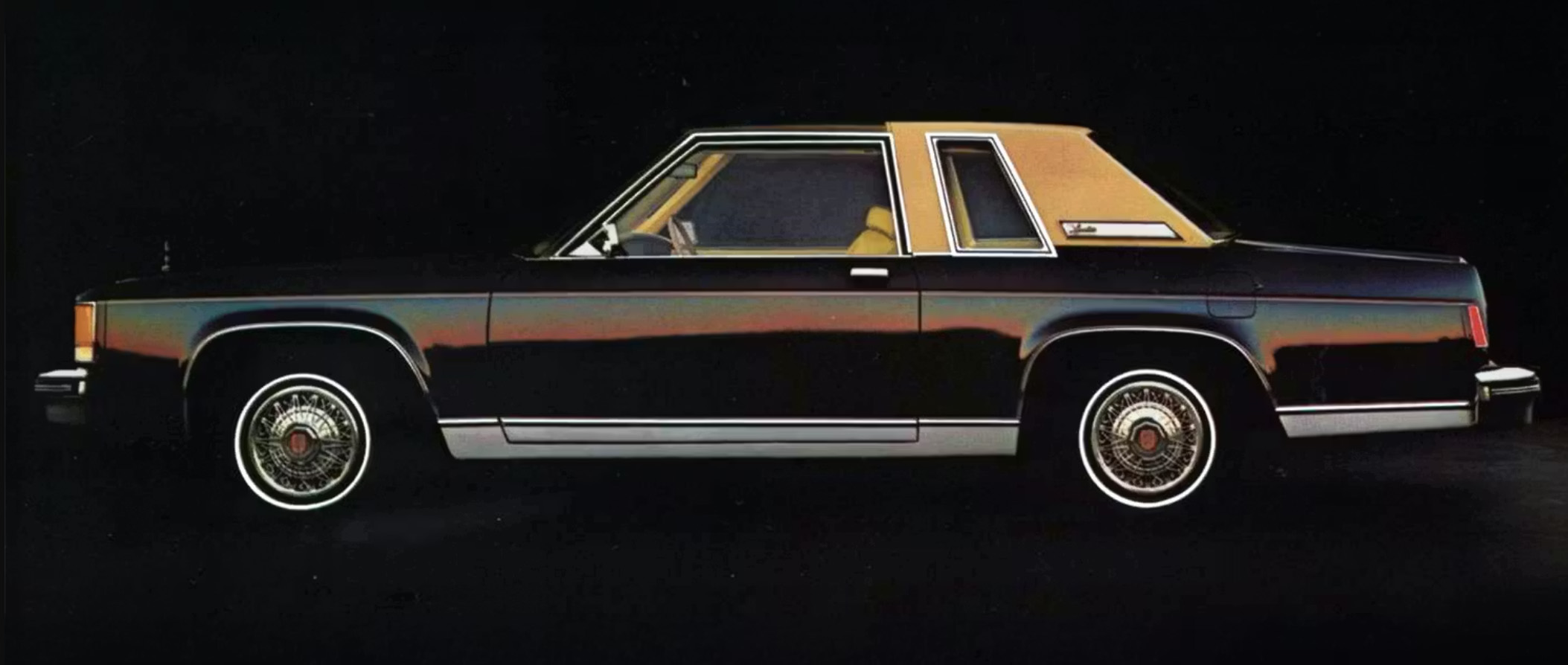
As the eighties began, fuel prices slowly started to drop. Buyers began to see the benefits of the Panther cars, and sales increased to the point that Ford backed out of their initial plans to cancel the “big” platform after 1983 (and required them to name it the “LTD Crown Victoria” against the new Fox-bodied LTD). Meanwhile, Iacocca and Sperlich’s Chrysler was offering much smaller “full-sized” cars such as the Dodge 600 and Chrysler “E Class” that offered a little better fuel economy but not enough to justify putting up with their smaller interior space and buzzy little 2.2-liter four cylinder enginess. As “Hank” Ford predicted, these overly-shrunken cars were totally out of step with what traditional US buyers wanted.
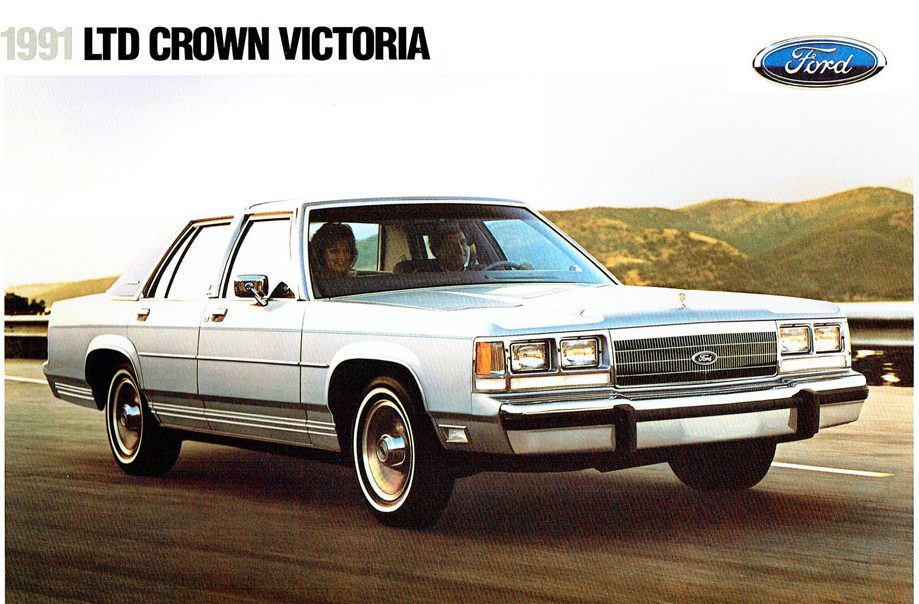

Still, I seriously doubt that even Mr. Ford could have imagined that the big Fords would continue relatively unchanged for nearly a dozen years. It’s rather hard to believe that the car in the image above was a brand-new 1991 offering from the company that was, at the time, making the Taurus and T-Bird Super Coupe.
Stranger still, the car marked for discontinuation nearly a decade before was now getting a second life that would end up dwarfing the first.
Slick Vick
When car enthusiasts first saw pictures of the new-for-1992 Crown Victoria, we were all rather shocked. The outgoing model was one of those designs you could make a model of using wood blocks and still have it be recognizable. The new car, however, looked a bit like the still-somewhat-radical-at-the-time Taurus, just stretched into pleasingly longer and lower proportions. The Crown Victoria didn’t even have a radiator grille, something that big luxury Fords had sported since, well, forever.

While later Crown Vics shared a blocky roof and thick C-pillars from the Mercury Grand Marquis variant, I’d forgotten that the first aero big Fords had a rounded and very glassy greenhouse that lightened the overall look. “If you squint it looks like a Jag-wire!” Maybe not, but it’s a surprisingly handsome car. At least it didn’t end up looking like a beluga whale, as the new “Shamu” 1991 Chevy Caprice competitor did.

The chassis was massaged from the 1979-91 models, even featuring the magic of four-wheel disc brakes. The biggest change, however, was under the hood: the ancient 302 (or “five point oh”) motor was gone, replaced by a forty-pounds-lighter 4.6 liter “modular” V8 with an aluminum block and overhead cams. Again, if you were alive then, the idea of a big Ford cop car-style vehicle with engine specs that seemed similar to the concurrent S-Class Benz was unthinkable (reportedly, Ford did look at the design of the Mercedes engine for inspiration). Other tricks included accessories mounted right to the engine block, eliminating brackets that added weight and vibrations.

With such an advanced new design, Ford seemed to be getting quite ambitious with what was once a typical fire marshal’s car. Ford even had brief plans to make it much more than the old ladies’ bingo transportation it had become.
“Touring” Did Not Include Tail Of The Dragon
Ever since World War II, a top-of-the-line big Ford sedan meant one with extra heaps of chrome, white wall tires, and usually some kind of padded vinyl contraption glued to the roof. You can understand the shock from the public when Ford introduced the Crown Victoria Touring Sedan as a performance-oriented flagship of the line. Where was the freaking Brougham or Ghia model?

Forget the opera windows: the Touring Sedan was only available in special two-tone paint schemes with painted alloy wheels in a style that mimicked some Mercedes of the time (but in a way more convincing way than the Granada did in the seventies). The most un-LTD specification of the Touring Sedan was under the skin; the chassis featured heavier-duty suspension components from the police package, and the dual-exhaust 210-horsepower version of the modular V8. I’ve got the video below set to the Touring Sedan, but I can just feel that you’re going to look at Papa John’s review of the whole 1992 Ford lineup:
Wider 225/70-15 tires were standard, but could opt your Touring Sedan out with speed-sensitive steering and larger-diameter sway bars. Note that the for-sale example shown here seems to have wider Lincoln wheels replacing the stock ones. You forget how nice-looking this first 1992 Crown Vic really was with that roofline and well-resolved trim.

Naturally, a Panther chassis is still a Panther chassis; you were never going to challenge a 7-series BMW. A zero to sixty time of just under ten seconds wasn’t horrible for the time, though a Road & Track review said that the quicker speed-sensitive steering was still too light at any speed. Naturally, they thought the firmer suspension of the Touring Sedan was still too soft for their tastes and dull in response.
Touring Sedans received their own special leather interior trim. While a huge improvement over the button-tufted land yachts from years past, the sofa-like seats provided no lateral support in turns.


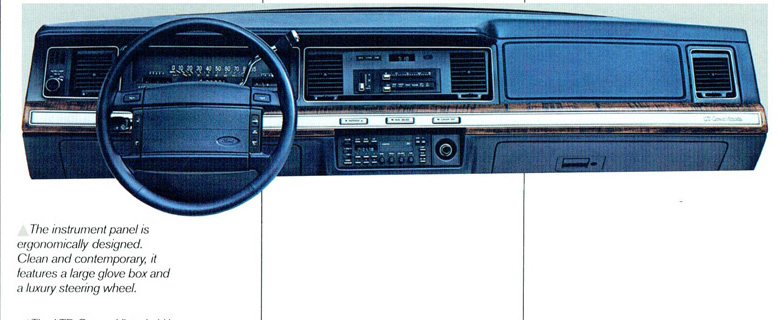
At least the slab-like dash had all the instruments you’d want except for a tach, but you couldn’t help but wonder exactly who this car was supposed to be for anyway. It was too cushy for people who wanted anything even remotely European-sporty yet too austere for typical prairie schooner buyers.

Ultimately, the Touring Sedan model lasted only a year. You could still get most of the engine and suspension upgrades in a separate package, but the Crown Vic quickly went off in the trajectory of Fleet and Florida retiree owners. Even the grille-free front end was almost immediately abandoned for a more traditional (and fake) chrome radiator opening. I shudder to think how many unsold Touring Sedans ended up with glued-on fake convertible “carriage roofs” to make them sellable to old people.
Back To The Livery And Police Force With You, Vicky
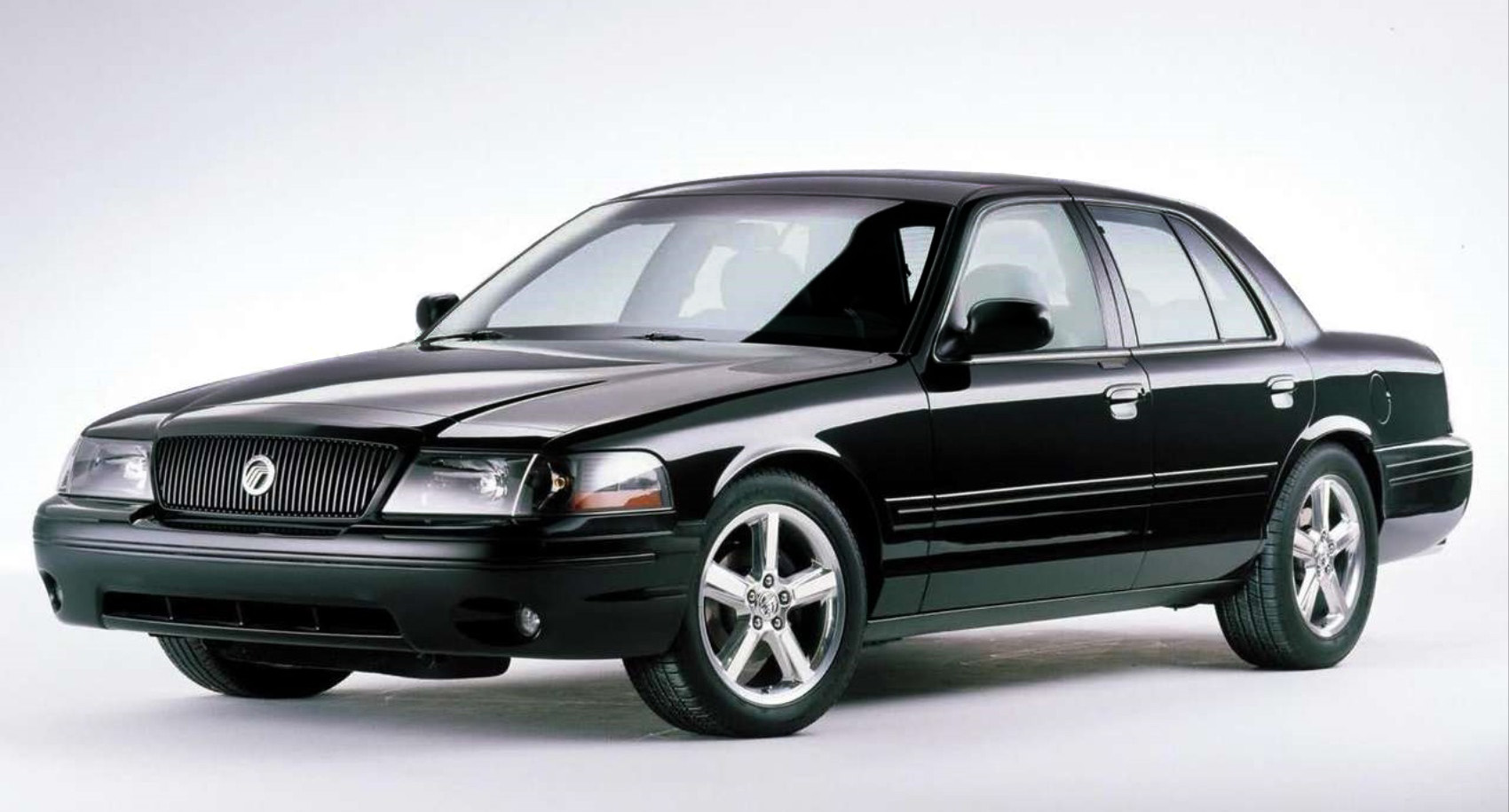
The concept of a “performance” Panther wasn’t totally done. To counter the vaunted Impala SS of the mid-nineties, Ford eventually released the Mercury Marauder edition of the Grand Marquis. This limited edition got the tachometer, floor shifter, bucket seats, and more aggressive suspension tuning that the Touring Sedan really needed, but it was a much different car conceptually than that 1992 car. The Marauder was really meant to be a muscle car revival piece, not the Black Forest cruiser that the Touring Sedan made a pale attempt at being.
Hank The Deuce didn’t see his Panther get a new lease on life, having passed away in 1987. He certainly wasn’t around to see his downsized “fine car” eventually cease production in 2011, a move that caused a number of fleet buyers to stockpile final examples (a big chunk of which got destroyed in Hurricane Sandy).

With the many variations of the Crown Victoria having had such a long and successful run over nearly two decades, nobody’s really going to cry for the failed Touring Sedan version of the Panther. Somehow, though, I just can’t help but wonder about the potential it briefly showed for a slick-looking American mile eater with some sense of road manners.
Top graphic image: GM Classics (car for sale)




I loved the six side window version of these. I thought they looked like a discounted Infinity back in the days. I suspect they dropped the six side window version and used the Mercury version later due to cost. Damm, there would have been two more back windows on old cops episodes for the perps to kick out.
When these first came out, I was in Jr High and though these looked like a supersized Ford Tempo. I think the later ones are still good-looking cars, and honestly, I’d love to own a clean example of the ’91 pictured.
Marauder is up there with the 90’s Impala SS in my big car desirable list. My dad had a 2002 Vic and he loved it. He traded it (when the suspension basically rusted off the car) for a 2013 Chevy Cruze which he still drives today
This gen of panther are really really good cars. Only serious flaws I can think of are the stupid plastic intake that had an alternator mounted to it. Otherwise most issues people had were from lack of maintenance (spark plugs, bad trannys). I love my 97 Grand Marquis. Its got every single option you could get, including the “””handling”””” and performance package.
Parents had a Mercury Grand Marquis, circa 2010 or so. All the boaty ride characteristics so often sited, though what I remember most is that it was incredibly challenging to get in and out of the back seat.
The rear doors didn’t open wide enough, and the space between the front seat and back seat bottom was tight for my size 13 shoes plus the feet space really low between the central transmission tunnel and door opening. One would think that for such a large car, my 6′-3″ self would have had an easier time exiting that wallowing beast.
Its kind of a pity the middle east vic was sold here, a longer back seat entry was their gift.
Well, Touring Sedan didn’t have amber turn signal indicators in the taillamps. Pass.
Boo, massive American yachts need to look like massive American yachts. My ’97 Grand-Ma has some of the coolest and reddest taillights of the era
There are MANY “red” taillamps with amber turn signal indicators behind the red lenses that shine orange when illuminated. It’s not expensive to implement that feature. Ford is too fucking cheap to make one extra safety feature.
So, you don’t give a fuck about the safety and clear communication with other drivers of your fucking intention to change lanes or turn. No wonder United States has one of the highest accident rates for the first-world country…
JFC, someone woke up on the wrong side of the bed.
We have a high accident rate because of the high percentage of selfish assholes, not because of taillight design. Regardless, none of them had amber turn signals, so that’s not specific to the Touring.
Also…what bulb are you talking about that magically turns a red lens amber when lighted?
Jesus dude take a break. Don’t have a stroke because you don’t like a design decision Ford made 30 something years ago. Also what are you even on about, I would have accepted “clear lens with amber bulb”, but red lens with amber bulb?