


Changing a tire is one of those things that you may as well accept is just going to happen at some point in your driving life. Well, if you have a car with a spare tire, at least. You can’t predict exactly when or where a tire may fail, which means that we often end up changing tires in less-than-ideal circumstances. On the side of a busy road, in the rain, at night, when you’re already tired and frustrated, a pack of angry weasels menacing you from the bushes – no one is ever happy that they have to pull over to change a flat tire. That’s why, ideally, car designers and engineers really should do all they can to make the process as painless as possible. Unless, it seems, you were working for Range Rover around 2013 to 2022 or so, when it seems perverse masochists were in charge of the whole spare tire process on the second-gen Range Rover Sport.
I know this sounds harsh, but I just recently happened to come across the procedure – complete with specialized equipment that sure looks like bondage gear – required to get a 2013-2022 Range Rover Sport’s spare tire out of its well so you can change the tire. It’s absurd. And it pisses me off.


I’m serious about the equipment looking like bondage gear: I have the actual equipment in this image twice, surrounded by S&M gear. See if you can pick the Range Rover parts!
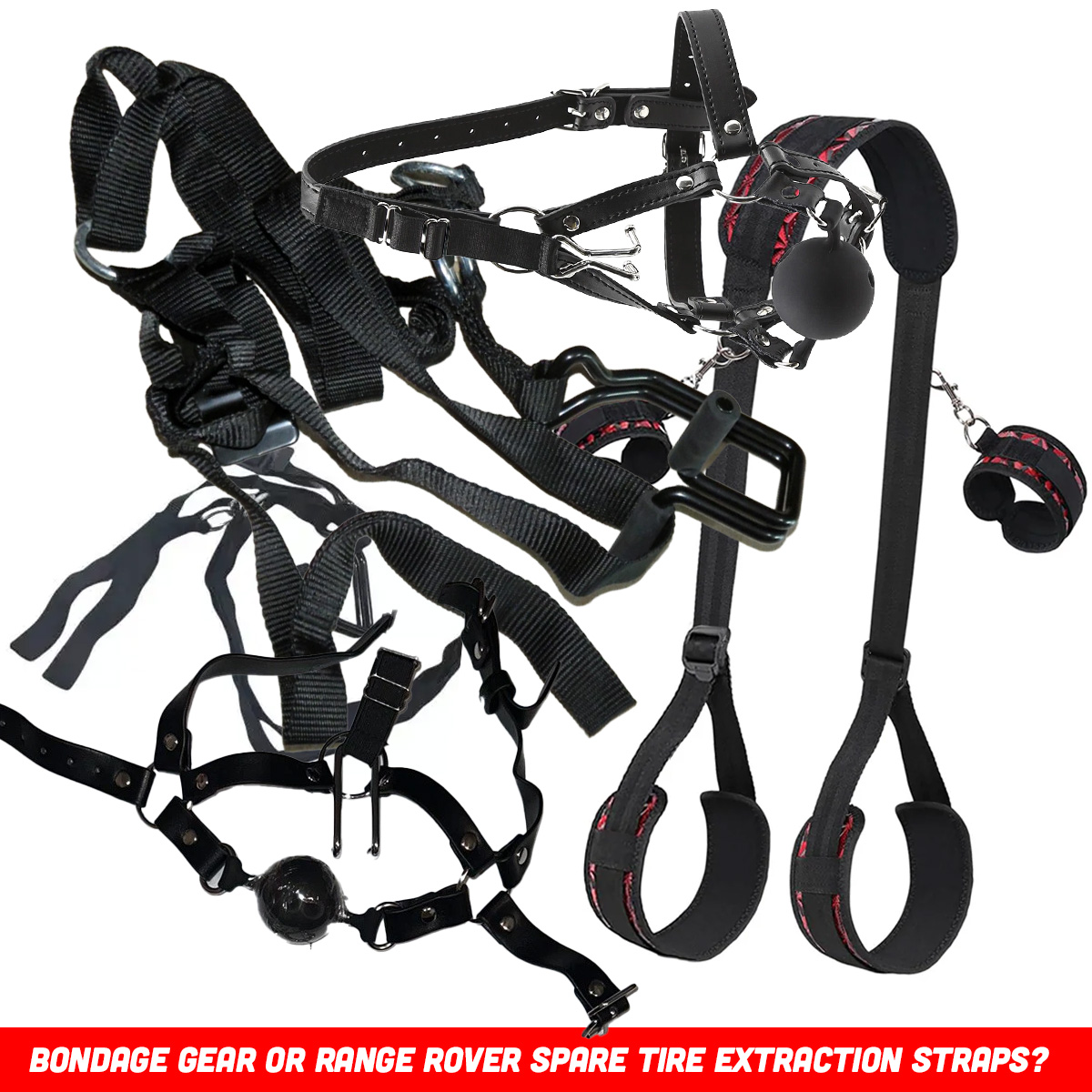
Not so easy, is it?
Here’s how the process is shown in the owner’s manual, so you can get an idea of what those straps do:

It looks kind of like you’re rigging up some sort of ersatz tire swing back there, which might be a pretty good time, if only you weren’t doing this because you were stuck on the side of the road with a flat.
Here’s a video of the strap being actually used, or at least partially used, because the guy in this video admits that most Range Rover owners aren’t likely to actually, you know, do this:
If you don’t have this strappy contraption, you can buy one; Land Rover will sell it to you, part number LR124638, for $166.30, or you can find one on eBay for a bit cheaper:
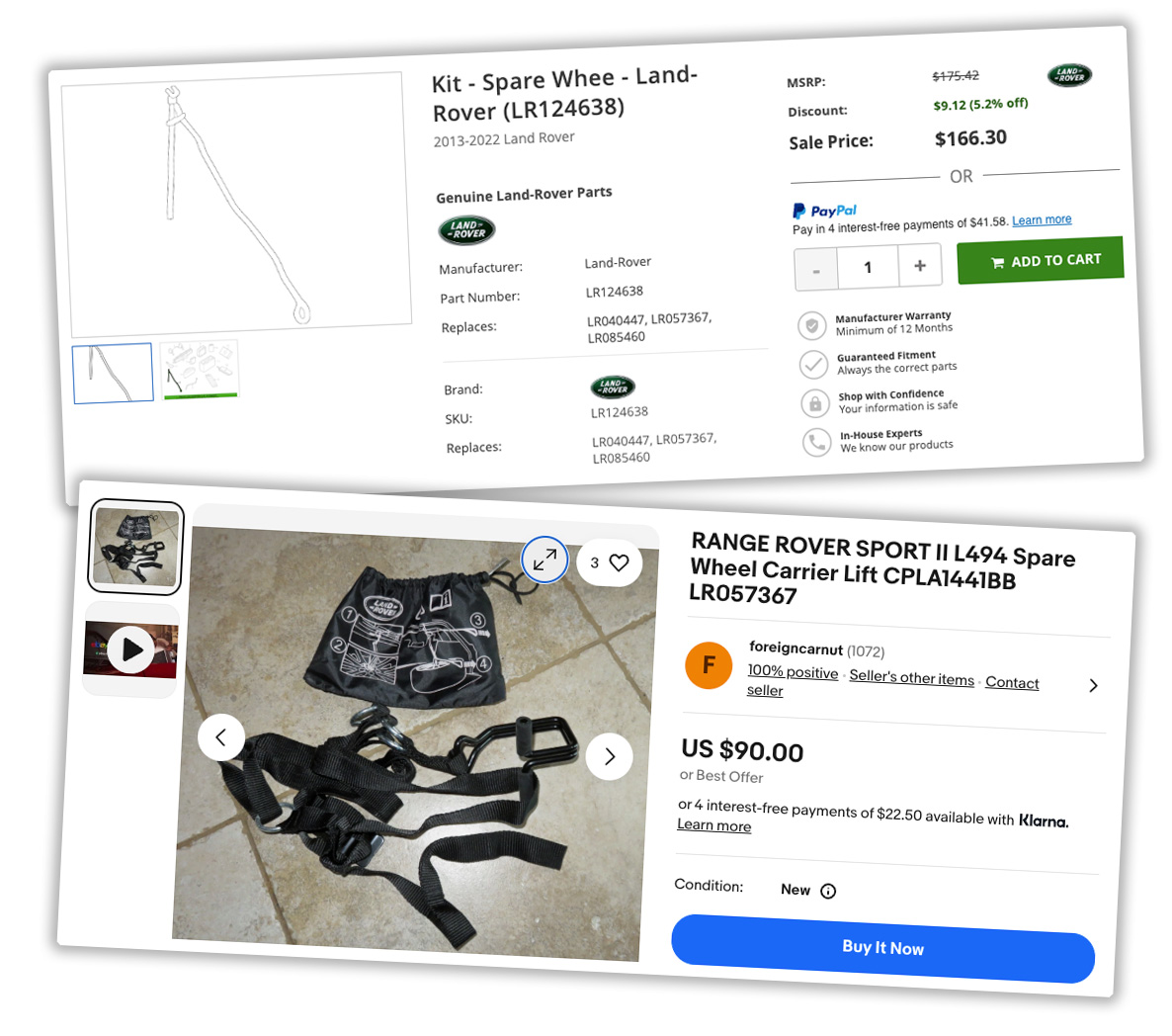
Looking at forums, it seems to be pretty hit-or-miss whether or not these SUVs came with the strap-traption. There is at least one Range Rover Technical Service Bulletin that addresses cars that didn’t have the strap, so if you have one of these, maybe check that you actually have one.
The reason this thing exists at all is because that tire and wheel combination weighs about 100 pounds, and must be extracted from the spare tire well in the luggage compartment floor exactly vertically, because there isn’t any room to tilt it to get it out, as the air suspension compressor is mounted below the wheel well. Your only option to get it out is to lift straight up, and that’s effectively a physical impossibility to do, given the location, size, and weight of the tire.
This all just seems like such a terrible location for the spare tire, which leads to a miserable procedure for getting it out. First off, if you’re on a road trip and get a flat, you have to empty everything out of your cargo area to get to the wheel in the first place. This is not exactly an issue unique to Range Rover – plenty of cars have spare tires under the cargo floor – but in this case, it just seems all the more of a groin-punch because there was a time when Range Rover mounted their spare tires in a much better place: under the car.
This is how the prior generation Range Rover Sport stored its spare tire, and how it was accessed:
Look how much easier that is! You’d still have to move some luggage out of the way to get to that bolt that lowers the tire, but this sort of setup seems dramatically easier. That video above seems to show a smaller spare; this one looks more like a full-sized spare:
The old way was so vastly better, I can’t fathom why they changed it! I’m not sure I’ve ever encountered any car that requires setting up a makeshift pulley/hoist system just to get the damn spare wheel out. It just seems so cruel and punishing a thing to do to your customers. Imagine being on a long trip in your Range Rover Sport and getting a flat and looking in the back and struggling with that huge-ass wheel for 15 sweaty, profanity-filled minutes before realizing you need to rig up a whole freaking crane to get the damn thing out, using some strappy bullshit you’re not even sure you have? That’d be devastating.
Sure, some people have rigged up their own systems using ratchet straps and that sort of thing, but just the fact they had to do that at all represents a design and engineering failure on Range Rover’s part. Even if we assume that the well-heeled buyers of these cars aren’t the kind to debase themselves by changing their own tires, someone still has to do it! And, hell, what if you’re somewhere remote, where there is no help – you should be able to at least make a decent attempt at changing a tire!
This kind of unforgiving and heartless design just drives me nuts. It takes an unfortunate situation and just makes it so much worse, and for zero benefit that I can see. What’s the matter with an externally mounted spare wheel? This is an SUV, externally mounted spare wheels look great! There’s aftermarket options for these:
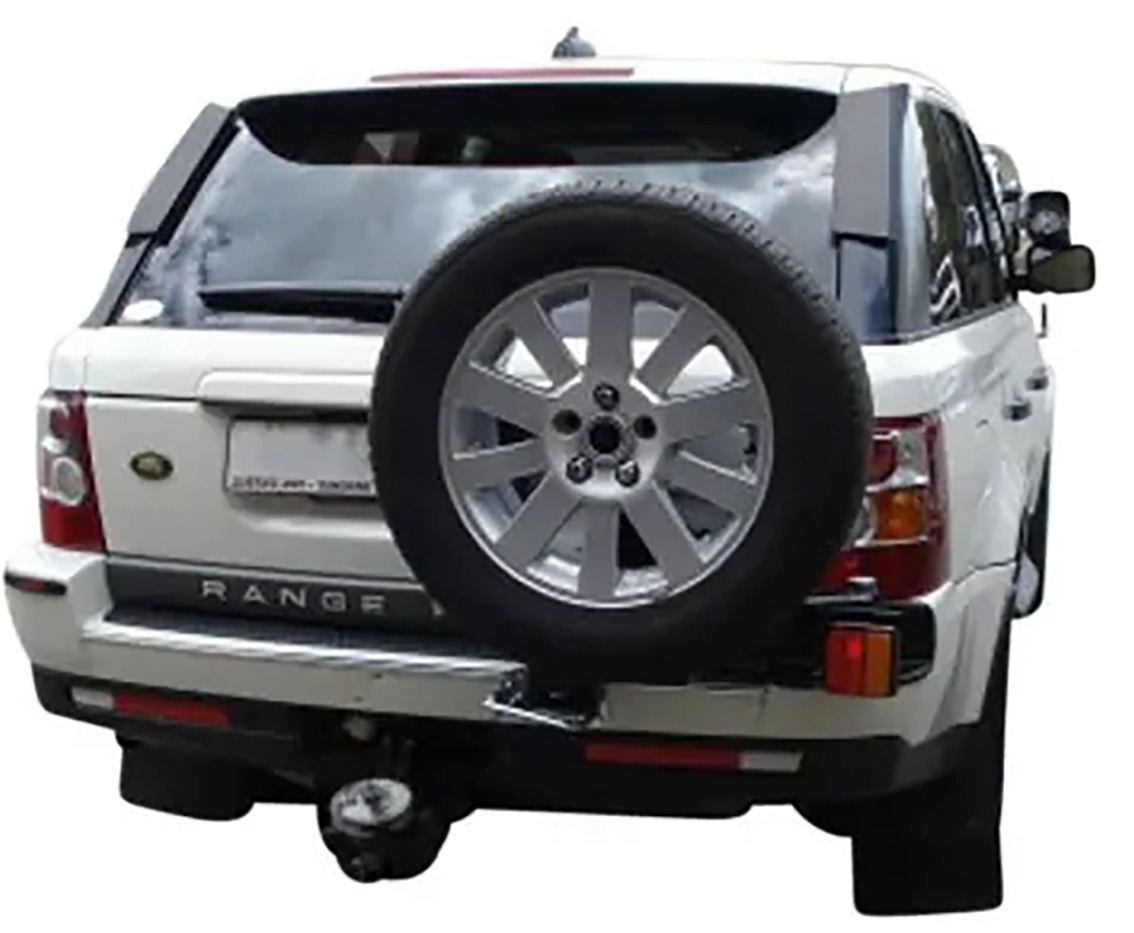
Range Rover could have come up with their own appropriately swanky version of this, with a fancy wheel cover or something, and maybe without blocking the taillight like this one does. They have good designers and engineers, they could figure it out! But no, instead they made something that is less convenient, eats more luggage room, is a daunting ass-pain to actually use, and is just worse overall, in every way.
Ugh. What a cruel spare tire design. It looks like the more recent ones still use this system, so I guess no one at Land Rover really seems to care.
But I care.



You had me at “The second-gen Range Rover … is so stupid I want to scream.”
That wheel and tire combination is significantly larger than it should be.
A simple tray in the back, locked by a key inside the rear luggage area, would be the best solution. It would keep the tire in new condition longer, as well as keep it clean and secure.
All Landrover products are a test of loyalty by the company to their customers. Spare wheel carrying mechanisms are just one example of that.
Here’s some examples of spare wheel related woes, in vehicles I have owned.
2nd Gen RR (P38) – actually… I have no idea. It didn’t spend enough time on the road for me to find out. I’d sure it would have been deeply vexing though.
Late model “old” defender (puma) – spare wheel was mounted on the rear cargo door, making it monstrously heavy. Parking on a slope was potentially fatal, and the weight of the wheel caused the carrier to crack inside the door, leading to additional annoying rattles. In addition, if some kind person had mounted the spare with an air gun you had about zero chance of removing it with the included wheel nut spanner.
Discovery 4 – with the winch system Jason praised. Really very long winded process to remove the spare. Me, a kind soul: “I’ll put the old wheel in the boot, to save the tyre replacing place the pain of this, and winch in the cable without a wheel on it”. Landrover: aha! Gotcha! Now you can spend a couple of hours in the mud trying to unjam that bastard. When you give up, that will be £1200 for a new winch.
Really, I think Landrover deserve praise for continuing to innovate in new ways to make changing a spare wheel deeply annoying and painful.
Somehow still not as bad as the design Ram used on my truck, where the spare tire is mounted underneath but the jack is under the passenger seat, secured in place by a thumbscrew that goes all the way through the body to the exposed underside. Guess what happens to the protruding threads on that screw in the Midwest?
Luckily, I had my bike stuff along and was able to use chain lube as a PB Blaster standin. Otherwise I might still be stuck on the side of the road just because the jack was rusted in place.
Really: there should be a trigger warning for this, just so readers can swallow their coffee first.
“a pack of angry weasels menacing you from the bushes”
😀
I will take spare tire inside every time. Two times I have had to fix a flat on the side of a road in vehicles where the tire was under the car and both times the securing bolt was a nightmare to get off because it had lived for years in road grime and salt.
In addition, I was driving on the interstate and had the wire snap on a spare tire once. Hear thunk and feel a major bump. Look back and spare tire is cartwheeling across the interstate narrowly missing multiple other vehicles.
How can you tell when it’s going to be a “Jason fairly normal article” as opposed to a “Torch unhinged humor” article? It’s when there’s only one reference to angered wild animals, and it’s not until the third sentence.