


At my “real” nine-to-five job dealing with product marketing and advertising, one common idiom is that if you can’t pitch something in a quick, concise sentence, then it probably isn’t going to succeed. Sadly, failing the one-sentence pitch test has likely contributed to the demise of many interesting and well-executed cars that failed to find buyers and are forgotten today (though not forgotten by Autopians, of course)
Ford in particular has plenty of experience with this unfortunate phenomenon, and the example we’ll look at today is arguably one of the best enthusiast cars Ford has ever made. Let’s take a look at the time Dearborn shot for the moon and came surprisingly close with the 1989 Thunderbird SC “Super Coupe.”


Ch-Ch-Ch-Changes
Few cars have changed their identity more dramatically than the Thunderbird, which saw David-Bowie-level transformations over its lifespan. To keep the metaphor going, one might say the T-Bird’s evolution was more Elvis-like through the sixties and seventies. It debuted in 1955 as a svelte two-seat “sports car” boulevardier, then fattened up in the decades that followed, becoming a true behemoth of a “personal luxury car” that sold relatively well but was a joke to enthusiasts.

In 1980, Ford finally downsized the Eighth Generation Thunderbird to the far-more-manageable Fox chassis, but remained stuck on the shrunken-down baroque styling of the outgoing car so that it appeared to be a bit like a brougham Halloween costume on a Fairmont.

It looked awful, and the only saving grace was that it sold so poorly that Ford leadership let the design team step in and do a complete turnaround (which is a story in itself that you’ll get in the coming weeks). With the launch of the Ford Sierra in 1982, Ford went all-in on the aero look overseas; it was decided the ninth-generation T-Bird might be the perfect car to kick off this styling trend in America. Ah, but that was just the tip of the iceberg.
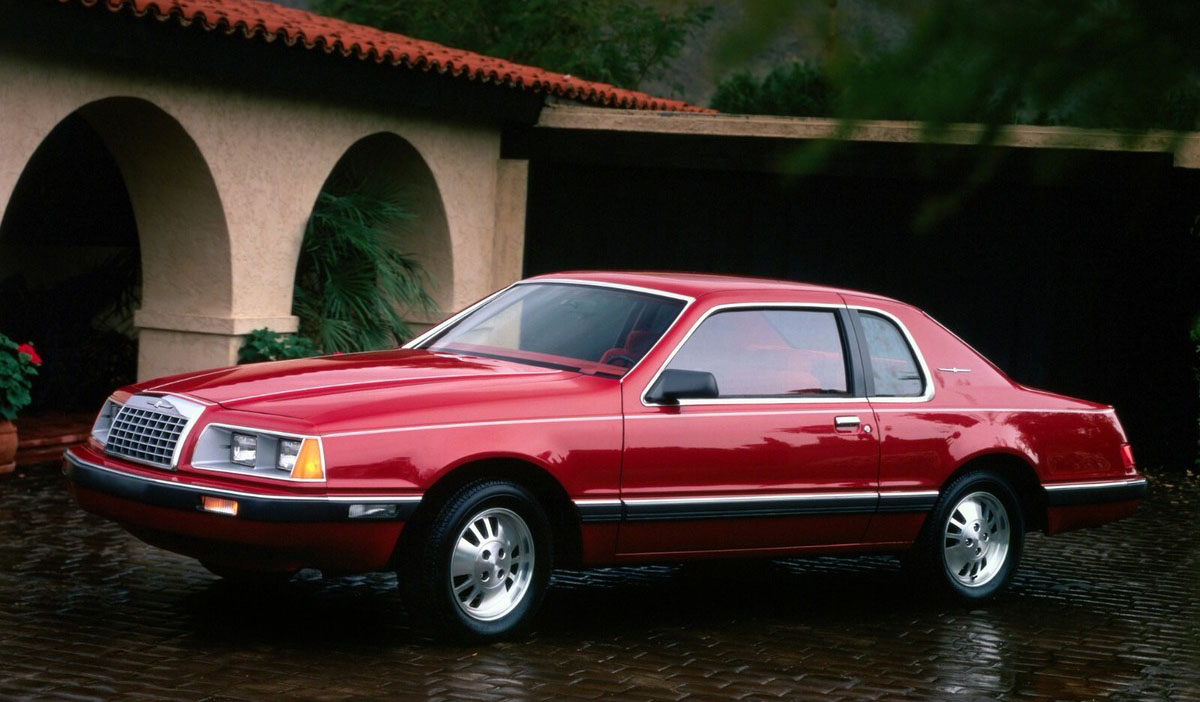
Sure, Ford could have made a more streamlined Fox-chassis’d Olds Cutlass fighter, but the team set their sights higher. This new T-Bird’s aesthetic would be aimed not at other domestic “personal luxury coupes” but instead expensive German models like the e24 BMW 635csi and w126 Mercedes 380SEC.
Crazy? It got even more insane. While the top-of-the-line 1982 Thunderbird sported whitewall tires and a landau roof, the 1983 range topper was the Turbo Coupe with a blown four cylinder, manual transmission, Mustang chassis bits, bucket seats, and a tachometer

You want to hear something even more bizarre? This new Thunderbird sold well. The Turbo Coupe was obviously a smaller number of those sales, but it did find buyers who probably hadn’t considered a T-Bird in their entire lives, or at least not since the last two-seater or stick-shift-equipped ‘Bird was sold.
Now, you know how many people react after taking a big gamble and winning, right? They figure they’re on a roll and now it’s worth doing a double-or-nothing. Ford product managers tried to do just that with the brand’s flagship coupe. Enthusiasts were briefly rewarded, but I can assure you these executives were not. Yes, it’s a sad tale.
Who Are You Anyway?
In the eighties, Ford had some great products that suffered greatly from the inability to fit comfortably into a market niche. They generally failed in the market (or at least didn’t live up to their potential) because you couldn’t easily do that ten-word-or-less sentence description.
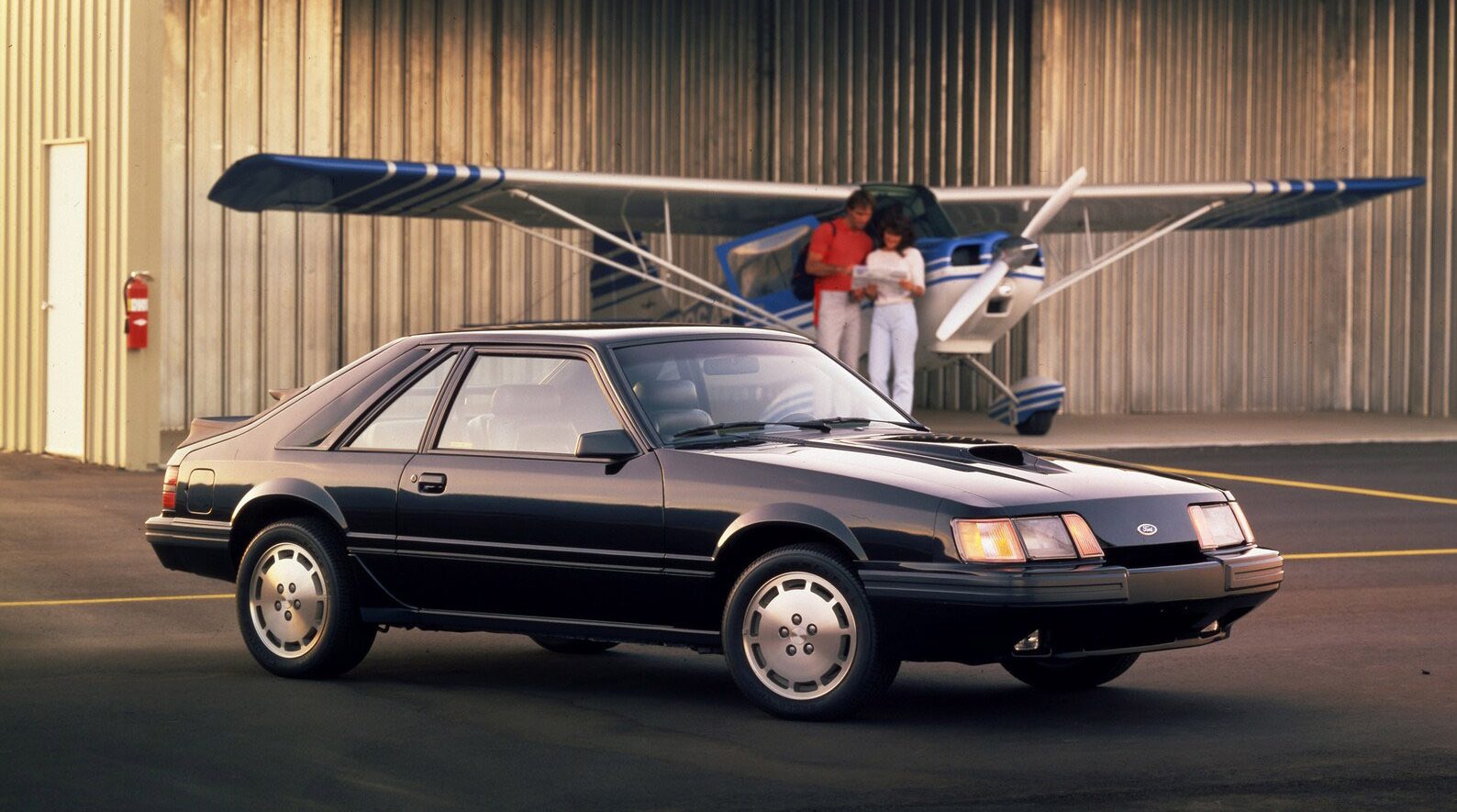
Let’s take the Mustang SVO. It’s technically a Pony car, but it was more sophisticated and didn’t really appeal to typical Pony Car people, especially since it was priced on the higher side. At the same time, it wasn’t necessarily a Z-car/Supra adjacent machine since it was a bit more European than that. Well, European might be the wrong word since a BMW owner would never want the likes of any Mustang.
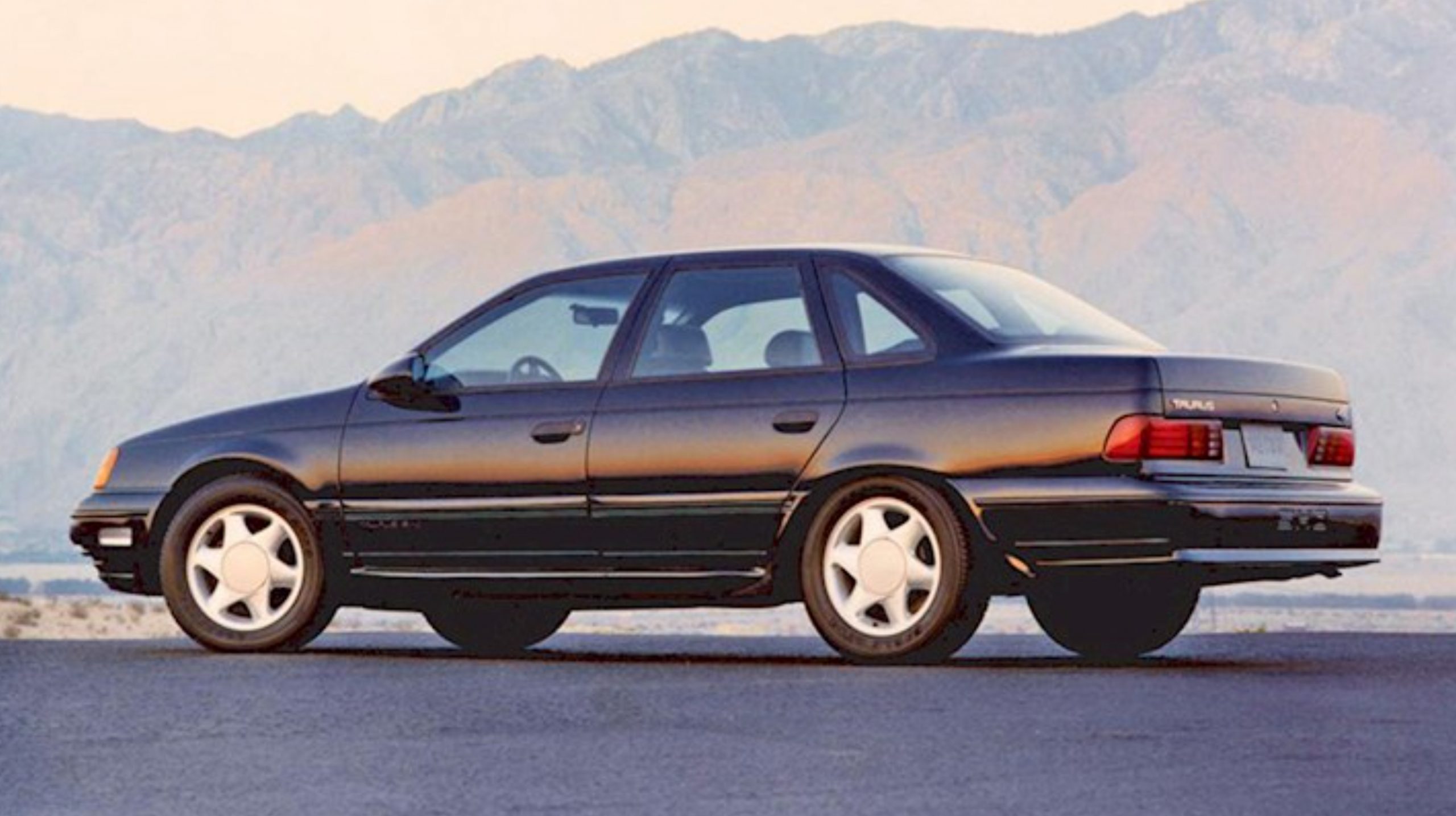
How about a Taurus SHO? Here’s a quick car based on a larger American sedan, so it’s kind of a muscle car. However, with subdued and advanced styling and a tuned suspension, it was more of a German Black Forest warrior, though realistically not as sophisticated. Maybe it was like a giant Japanese sport sedan, sort of a huge Maxima?
See the problem? The ’83 Thunderbird Turbo Coupe sort of fit into this sort of nether-land of what-is-it, but boosted by a Car of the Year win and enthusiastic press, you can see how product manager Tony Kuchta might have been encouraged to go all-out with the new-for-1989 MN12 Platform T-Bird. No, I mean really go all out.
Now, with product development, it’s always a good idea to see what the competition is doing. In Ford’s case, the logical thing would have been to benchmark the new GM-10 front-drive coupes like the aero Olds Cutlass and Buick Regal, or maybe the K-Car-chassis Chrysler LeBaron.

Indeed, that would have meant making a Taurus-based two-door with slicker styling and maybe a more powerful V6. Tony Kuchta wasn’t having that. According to the book Comeback: The Fall and Rise of the American Automobile Industry, Kuchta had no kind words for the new GM-10s:
“They are nothing cars.”
“They are losers because they aren’t giving the customer what he wants.”
Good Lord, he really said that! It was BMW M6-or-bust for Tony. As an enthusiast, you want to stand up and cheer, but in the back of your mind, you’re wondering if Kuchta was right. Here’s a spoiler alert: he wasn’t.
The Bird Flies Higher Than Ever
Developing a mock BMW in the face of the American front-drive tide couldn’t have been an easy task, and it’s almost unimaginable that Kuchta was able to give the new MN12 an independent rear suspension. The only other rear-drive American car without a live axle at the time was a Corvette.
Also rather unfathomable was the fact that the tenth-generation T-Bird would have more interior room than the spacious front-drive Taurus sedan. The length of the outgoing Thunderbird shrank by several inches, but the wheelbase increased by a whopping nine inches! With such a drastic change in proportions, you would think that the end result would be decidedly un-T-Bird-like, but with Jack Telnack’s direction, the 1989 T-Bird was a great-looking car that appeared to be the updated e24 Six Series that BMW never built, even in base model form.
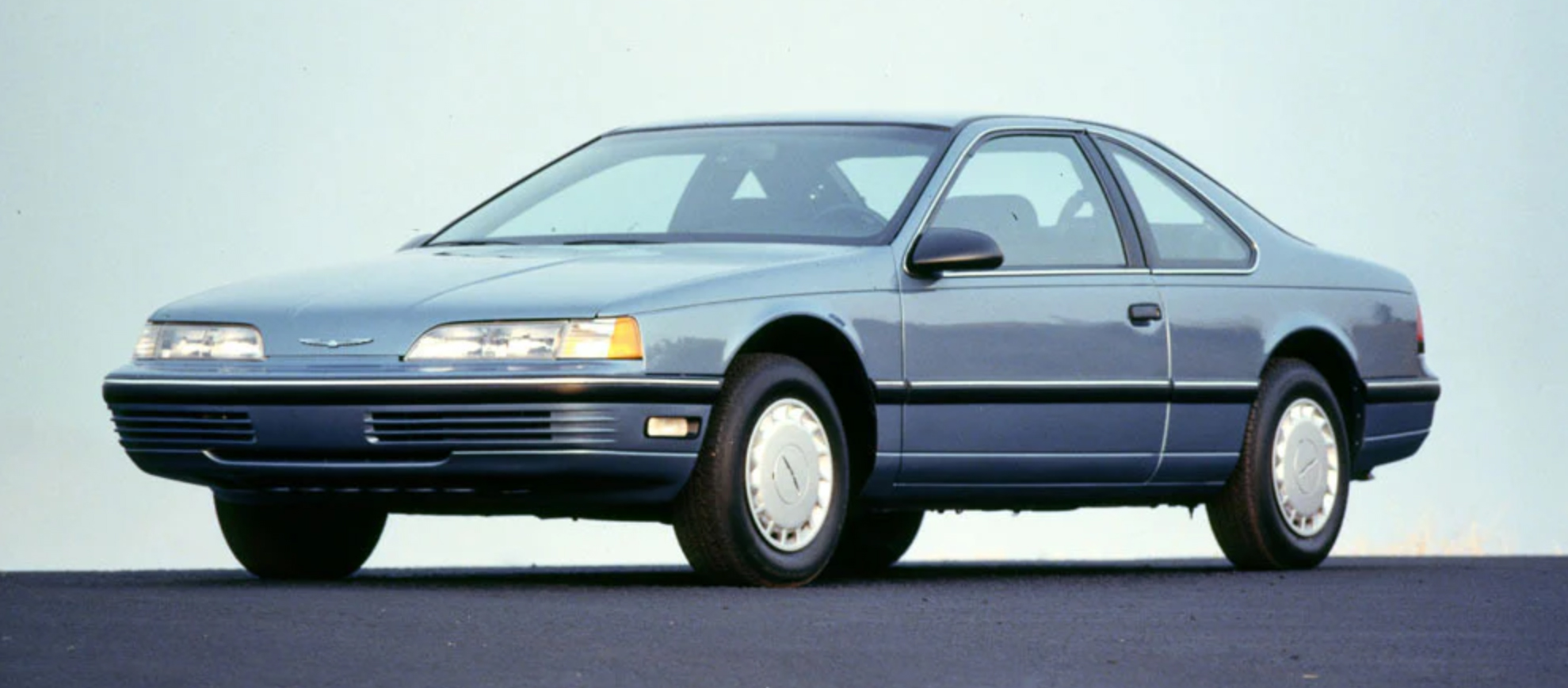
The standard T-Bird seen here received a 3.8 liter “Essex” V6 with 140 horsepower pumping through a four-speed automatic. In this 3800-pound car, that meant less-than-thrilling performance, but the slick aerodynamics meant an EPA rating of 27 miles to the gallon on the highway – a rather decent package for the average “personal luxury coupe” buyer.
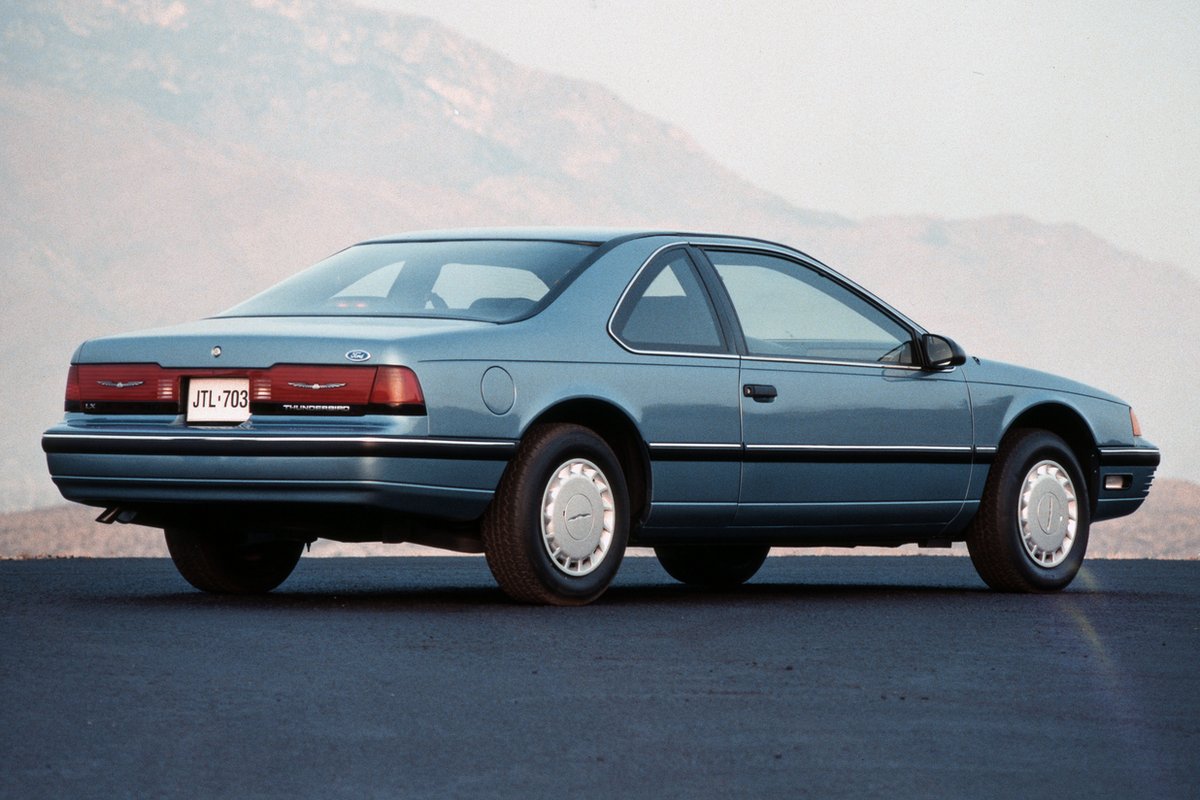
Set aside the base model car that would be the sales leader. The raison d’etre of the whole MN12 project was the Super Coupe version that took the platform to its full potential. The V6 received a supercharger and intercooler that pushed it up to 210 horsepower (later up to 230), mated to either a Mazda-derived five-speed manual transmission or an automatic.
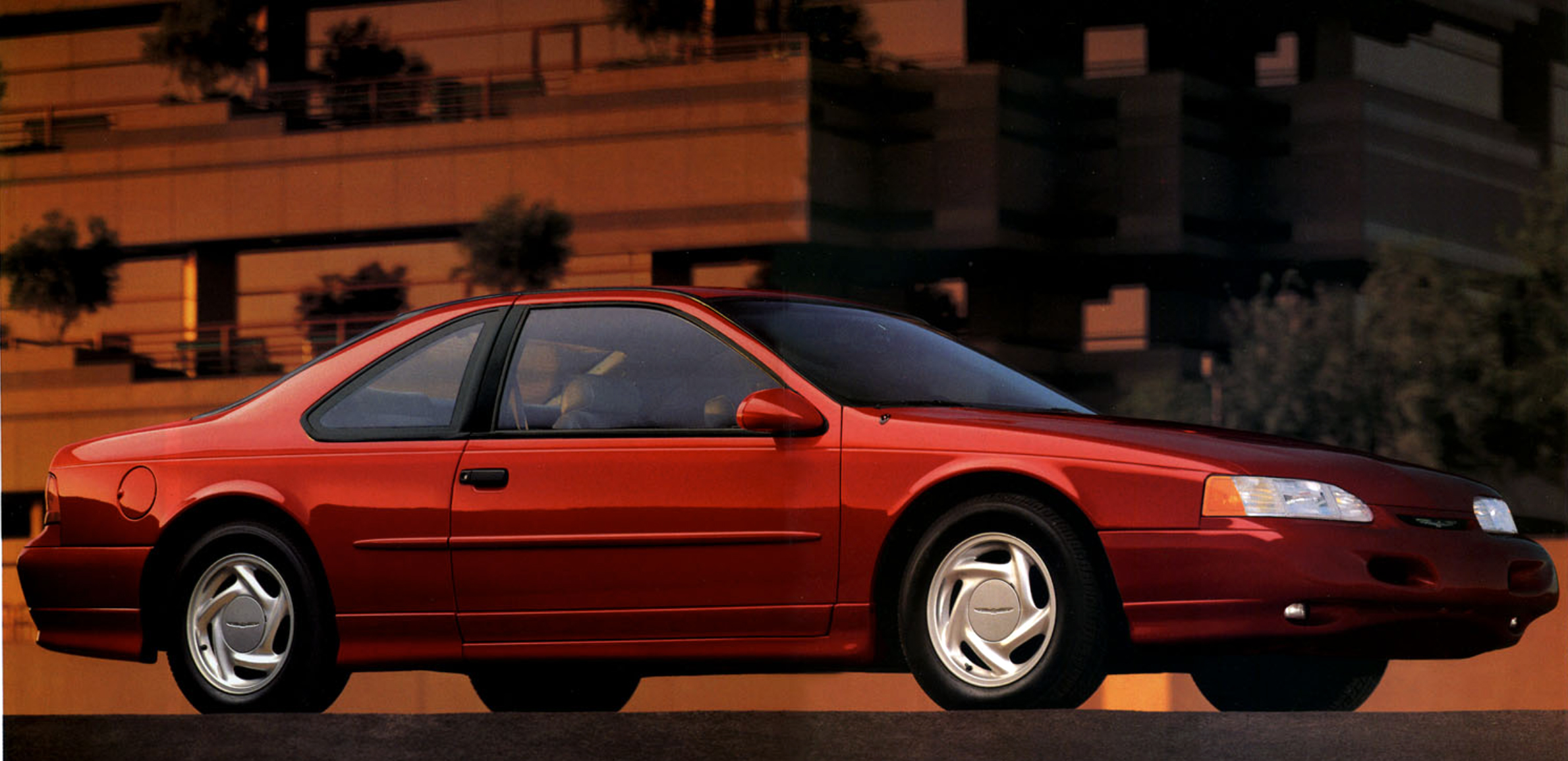

Four-wheel anti-lock disc brakes at each corner replaced the standard back drums, but the bigger news was the adjustable Tokigo damping system. Called Automatic Ride Control, the system monitored vehicle speed, brake-line pressure, steering angle, and acceleration signals to adjust the shock valving in real time. There were two driver-controlled settings that included “auto” and “firm.” The Firm setting basically overrode the automatic system, locking it into the stiffer valving.

The SC’s seats were multi-adjustable buckets with thick side bolsters, and the dashboard with full instrumentation had a nice design except for those unnecessary silver trims around the upper switch binnacles that cheapened the look.

On the outside, the Super Coupe received very subtle ground effects and 16-inch alloy wheels for an appearance that was the polar opposite of GM’s flashy Pontiac coupes of the time.
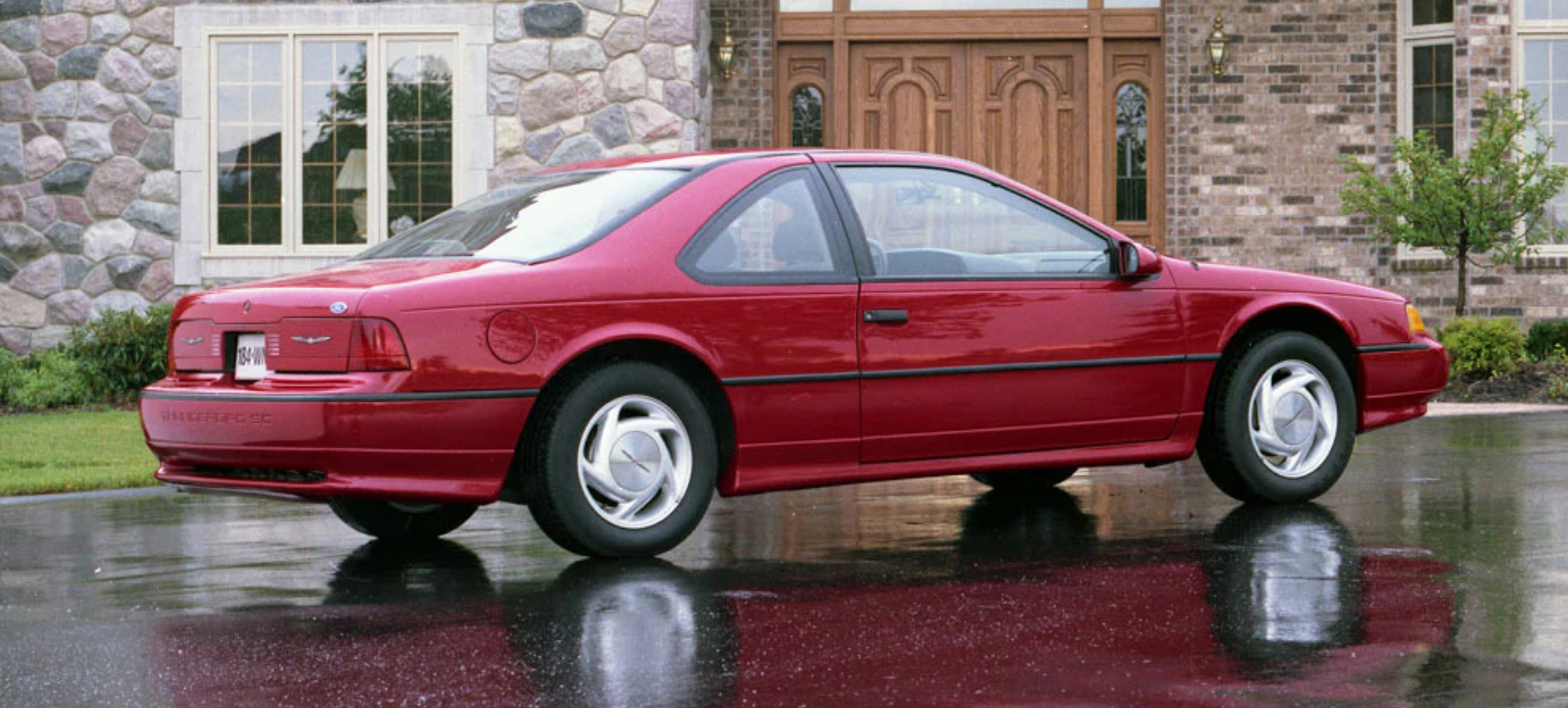
The press was as enthusiastic as expected. Motorweek gushed over the “glued down handling that is akin to Europe’s best.”
That Motorweek zero to sixty time of 6.0 seconds is a bit on an anomaly based on other sources that seem to put it in the low seven-second range; either way, those numbers were quite formidable for the time, even if it was around a second slower than that benchmarked BMW M6. However, it’s interesting to note that Ford put a rather tall 2.73:1 rear gear in manual transmission SCs. With the automatic’s 3.27:1 differential in the stick car, there’s no telling how much quicker this sporting T-Bird would have been.
In 1995, Motor Trend compared a by-then-six-year-old Super Coupe with the Chevy Monte Carlo Z34 and Buick Regal Gran Sport, where former Car and Driver man Don Sherman concluded:
“The Buick Regal is a competent, comfortable car at an attractive price, but it’s too androgynous to be called a Gran Sport. Nothing about it is grand, and there isn’t a sporting bone in its body. All the Monte Carlo needs to succeed is a V-8 engine and a year of refinement to eradicate its quality bugs. That leaves the Thunderbird SC as this test’s big winner. It’s a far more sophisticated solution to the four-place-coupe equation, but is priced accordingly.”
Indeed, with a price approaching $25,000, it was around $4000 more than the GM competitors; a worthwhile premium for a real enthusiasts, but not for average buyers.
Hot Rod felt that it was a “formidable competition for these world-class performers while still maintaining its unique American-built character.” Well, that odd accolade turned out to be the conundrum that did the MN12 in.
The T-Bird Gets T-Boned
There again, in the Hot Rod description, we see that hard-to-define personality making a Ford product a tough sell. The second year was the most successful, and Ford even celebrated the T-Bird’s 35th anniversary with a special edition in a bad-ass black two-tone combination that would get you a good spot at any Radwood today.

From that not-very-high point, SC sales took a nosedive from which it would not recover:
- 1989: 12,809 total. Of these, 4,768 were automatic and 8,041 had the 5-speed manual transmission.
- 1990: Over 21,809 total. Specific breakdown: 15,742 automatic and 6,067 manual. A special 35th Anniversary Edition was also produced with 3,371 automatic models, but no manual transmission figures were specified.
- 1991: 5,975 total, with 5,134 automatic and 1,905 manual.
- 1992: 3,891 total, with 2,853 automatic and 1,038 manual.
- 1993: 2,647 total, with 1,925 automatic and 722 manual.
- 1994: 5,741 total, with 5,167 automatic and 574 manual.
- 1995: 2,467 total.
With those paltry final year numbers, the great Super Coupe finally vanished after 1995.
Oddly enough, Ford eventually offered a V8 in the T-Bird, but they refused to put in a hot example from a Mustang or a Lincoln Mark VII or VIII. It’s reported that the intake and exhaust were quite restrictive and limited the 5.0’s output to 200hp. Motorweek pushed a 5.0 example to sixty in 9.2 seconds – around two seconds better than the V6 but down almost two from the SC. The V8 seemed to be more a way to make the T-Bird into a latter-day rear-drive family Cutlass than a Mustang in a suit.

A mid-cycle refresh and introduction of the 4.6 modular motor with 205 horsepower helped, but it wasn’t enough to save the Tenth Generation T-Bird from its 1997 demise. Sadly, Tony Kuchta’s line about GM’s front drivers “not giving customers what they want” backfired to the point that Kuchta ended up taking (or being forced into) early retirement due to his championing of the MN12.
Like Icarus putting on those wings and flying too close to the sun, Tony Kuchta had pushed the envelope too far. Of course, the MN12 Thunderbird was likely doomed from the start by the changing market, regardless of how good it was. The winds of change were already blowing, and in 1991, Ford themselves really kicked up those breezes with the Ford Explorer. Suddenly, large two-doors were dropping in popularity faster than hair metal bands at the time.
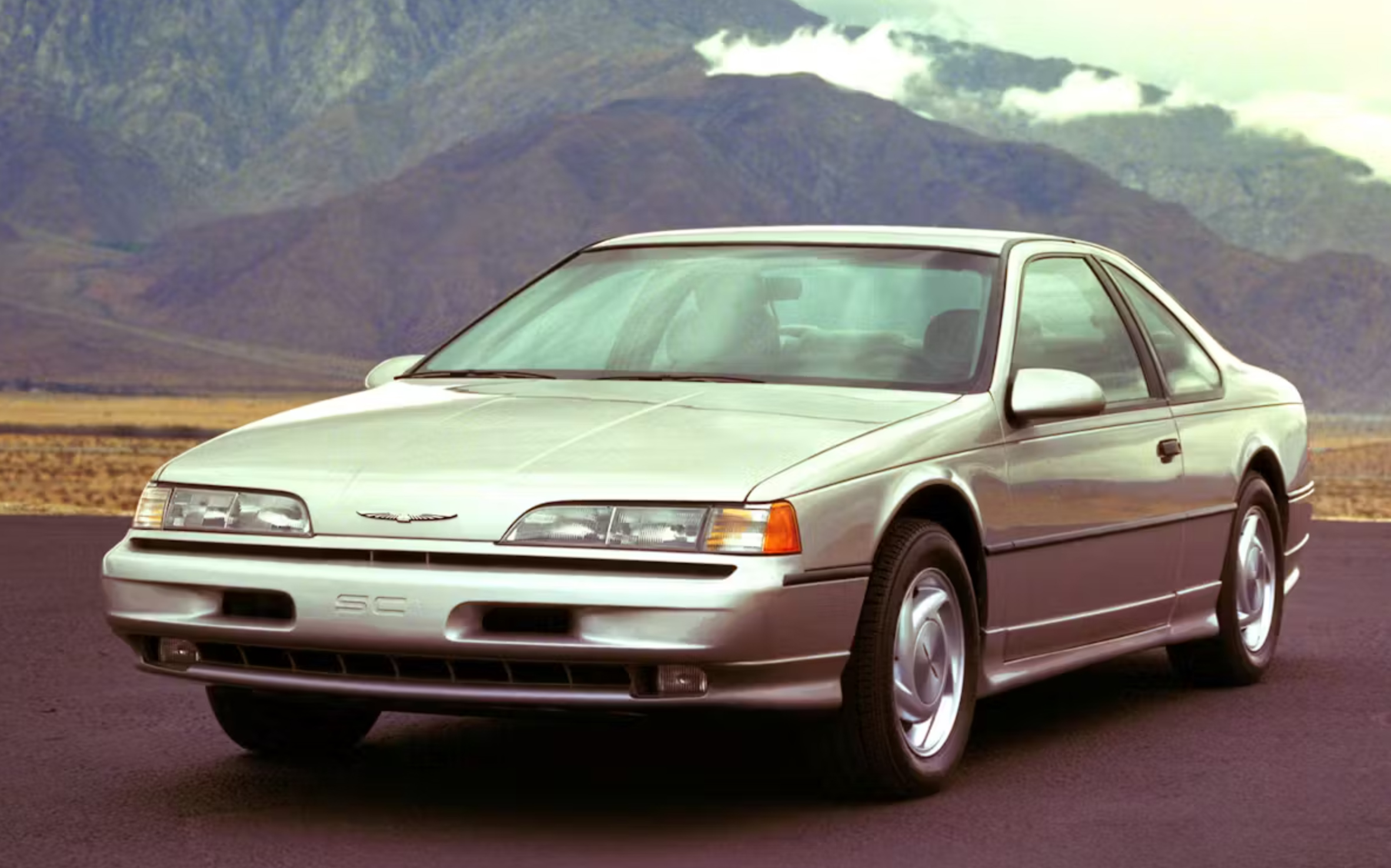
A Taurus-based Thunderbird likely would have appeased ninety-five percent of potential buyers; it might have even gained more, since many snow belters would have preferred front-wheel drive. Going for broke Bob Lutz-style and making a car to capture that last five percent of enthusiasts isn’t how you build a successful, profitable car. It is, however, the way to build legends.
Most Autopians idolize the likes of the 850csi and other over-the-top imported examples from the twilight of the big coupe era. At the same time, we seem to forget that Ford was also stretching the limits of cost and complexity to give enthusiasts what they wanted. Maybe it’s finally time to give the most underrated Thunderbird of all time the respect it deserves.
Top graphic image: Ford


One of my favorite Torch quotes is from an entry for Meh Car Monday from the old site about the gen 10 T-Bird, in which he described the power of the 3.8L Essex as “adequate, but nothing that would give your genitalia any reason to get involved.”
When I met my husband almost 20 years ago he was driving a 1991 3.8 in purple that he had bought just a few years earlier. He was 17 and paid the princely sum of $1000 for it, which might as well have been $50,000 to him at the time. Even today, we still use “how many Thunderbirds could we buy?” as our primary unit of measuring money.
“I paid 1.6 Thunderbirds for my Honda Hawk GT”
“How much did you pay for my engagement ring?” “4 Thunderbirds.”
“I paid 19 Thunderbirds for this brand new 2008 Mazda3”
“Ugh, I know we just got married, but do we really want to buy a house? Think of how many Thunderbirds that would be!”
And so on.
I preferred the lines of it’s Mercury cousin, but both are good looking.
I had three of the MN-12 Thunderbirds. I actually owned all three at the same time. I bought a used ’90 base model as my first car that actually cost more than $500. Even with 140 hp, the 3.8 was the fastest vehicle I had owned at that point in time. It had a little torque which I had never had before.
I bought a ’91 SC off eBay after I ran my ’90 into the ground (Mostly the western Pa road salt). It was the dream car of my 18-year-old self (I was in my early 30’s?). It only had 21,000 miles, it had the aeroform widebody kit and was painted 2000 Cobra R Mustang Performance Red. I had a three-hour drive home with it in a pouring rain, and it was a nightmare because even though I was used to rear wheel drive cars at the time it wanted to go sideways even when I barely rolled into the throttle. I wasn’t able to really play with it because of this. It eventually stopped raining about an hour from home and dad and I stopped to eat. After we finished, we were heading up a small PA mountain that had a sharp curve about halfway up. I let dad get ahead of me and I decided that once I got around the curve and got it straightened out that I would stomp it to see what it would do. I was going around 40 when these conditions were met and I immediately got the car completely sideways staring at the guardrails. I got out of the gas and it came back around. I almost wrecked my less than 3-hour old “new” car. I was shaking for the next two miles before I started laughing. I never did trust it in the rain after that. I found out later that the tires were a smaller diameter than the car should have which effectively changed the gear ratio. I still have this car in my garage even though I haven’t driven it regularly in almost ten years. Time to sell it to someone who will appreciate it like I did. Good power, handling, and ride. I also love the seats with the inflatable bolsters. Sadly, I can’t get myself motivated to work on it. It needs a lot of little things, and I just can’t find the time. It has a whole 33,000 on it now.
After I got the SC I parked the ’90 since rust was an issue. A garage close to my parents had a 93 lx that had a bad motor and trans. Since he knew my dad and knew I had a Thunderbird he offered to sell it for $100(?). The car was in great shape and dad pulled the motor and trans out of my ’90 and dropped it in. It ran great and the later model interior was way nicer than my previous T-birds. No rattles and it looked much nicer. I ran it for a few years and my parents ran it after dad was in an accident and it was a great car. Nice purple color also. Mom did say it was too small. I guess it’s because she’d been driving a Buick Roadmaster wagon for so long.
I still love these cars and would love a 35th someday or a FN-10 Lincoln, but it might be hard to go back as my AWD 400hp MKZ has spoiled me with toys and I’m less likely to lose it in the rain if I do something stupid. I do miss rear wheel drive though sometimes.
I think it was a great car and was reasonably successful until the Lincoln Mark VIII coupe came out and stole the Bird’s lunch money and customers.
The blower Pinto engine was pretty sweet though. The Pinto engine never gets the respect it deserves.
My grandfather was an engineer at the Ford Romeoville plant for over 30 years and retired after the launch of the 4.6L V8s. Bought himself a ’94 Thunderbird as a retirement present. He told me that the MN12 Thunderbirds were the best car Ford had ever produced. Having inherited his at 24K miles and putting 100K trouble free miles on it before Midwest rust took it, I was inclined to agree… with the exception of the interior squeaks and rattles. It was a big, heavy, sport-looking coupe, and at least in the V8 LX trim didn’t have the rigid SC suspension. Last I had heard someone on the Thunderbird forums was trying to put an AWD system into it like Ford had intended from the start.
On the flip side, he talked my mother out of buying an Eddie Bauer Bronco right at the end of their run. It would have been a lot of truck for her but boy were they lookers!
One of the highlights of my Thunderbird owning career was a fellow student in highschool had a SC. They talked it up and down about how great it was. I got to watch them fishtail it into the ditch after school one day.
Late weighing in here – the V8 was the death knell of the SC, particularly once the 4.6L was available in ’94. These buyers wanted the V8 refinement, and the 4.6 had it in spades. I should know, I bought a 3 yr old ’96 V8 shortly out of college. It was not a drag racer or canyon carver, it was an Interstate highway missile. Smoothly cruised at 75 mph, 2200 rpm and 26 mpg ’till the tank ran dry. It was never short on reserve power. Mine had a 3.27 Traction-lok rear axle and 4 wheel discs. The 4.6 was Mustang, not Crown Vic spec, differing only in intake ducting and exhaust. Backed by a heavy duty 4R70W wide ratio 4 speed auto.
Once I opened up the intake, and installed Jerry’s mod on the transmission for faster, harder shifting this car was transformed. It topped out in 2nd at about 70 mph. I could punch it at 55, it would immediately downshift to 2nd barking the tires, then upshift to 3rd at 70, again illiciting a chirp. That car had unworldly passing power 25 years ago.
You could tell the 4.6 was a shoehorn job. There was one way, and one way only to pull the oil filter and one inevitably spilled it’s contents. That said, having owned an Essex, it was a far smoother, more refined motor. The SC was always meant to be refined, not raw like a Grand National. I think most buyers readily sacrificed a few HP on the supercharged V6 for V8 smoothness. Also, either a 5.0 Windsor or 4.6 can be woken up pretty easily.
I’ve always liked these. I knew a guy who had one in white and installed a competition level audio system in one that got him on the cover of an audio magazine.
Sidebar, I found myself looking and lusting at the picture of the Chrysler Lebaron. It looks so much more awesome than they were on the street. Of course, I did hit my head earlier today.
> This new T-Bird’s aesthetic would be aimed not at other domestic “personal luxury coupes” but instead expensive German models like the e24 BMW 635csi and w126 Mercedes 380SEC.
Lol, good luck with that. As much as like that Thunderbird generation, going up against two of the very best coupes Germany had ever made up to that point wasn’t going to go well.
> the 1989 T-Bird was a great-looking car that appeared to be the updated e24 Six Series that BMW never built
Let’s not get carried away 😀
A friend of mine bought one of these new and it was an awesome car. The blower made it sound like the Batmobile.
I had a boss who had an SC. I think his was an automatic and it was quite brisk for the time. It also seemed perfectly happy at 100 mph, even if me in the passenger seat. The guy was essentially blind in one eye.
Was it the eye that would normally see the speedo?
My next door neighbor dailyed a pearl white manual SC, and had a C4 ZR1 for his weekend car. You really couldn’t go wrong with either.
Ugh, I have never understood what was going on in Ford executives’ heads with the 1980 T-Bird. It wasn’t just Baroque. It doubled down on brougham. And on the smaller Fox platform it was pure , over-the-top brougham cosplay. It looked like somebody put a ’70s Mercury Marquis in the wash and it shrank.
Even worse, they had the perfect replacement on hand — the slightly oddball, upscale Fairmont Futura. It had the ’77-’79 T-Bird’s basket handle and sloping rear profile. If it had been given a slightly more stylish grille — perhaps still with covered headlights and a set of wall-to-wall taillights in the back, it could have recaptured the prior T-Bird generation’s exuberant style in a smaller package with no problem. I still wonder if that wasn’t the original idea behind the Futura, until boneheaded management decided no, what we need is more brougham!
The Futura replaced the LTDII coupe, I had a ’78 in high school. Exact same rear roofline. The T-bird was supposed to be more upscale.
Younger brother had an ’88 T-bird with a V6 in high school. It looked wicked with the turbine type Mustang rims.
I don’t know… The LTDII was already 3/4 of the way to being a T-Bird. It shared nearly everything other than the front and rear caps and the T-Bird’s special basket-handle roof treatment. Taking that relationship and then making a LTDII-successor cosplaying as a T-Bird and then a Baroque something-or-other as a more upscale Thunderbird was still kind of a boneheaded move. Besides, they already had the new Fox-derived Granada as the broughamed-out alternative to the Fairmont. The Fairmont itself could be optioned up or down pretty well — even with V-8 engine options. Which was what kind of made the LTDII such a popular car in the first place.
Looking at it another way, most of the former model lineup was more or less consolidated into the Fairmont/Mercury Zephyr just by playing with the options list. Lincoln had the luxury/prestige segment. The then-new Panther-platform LTD and Mercury Marquis took care of large cars. That left the Granada and Thunderbird as sort of Ford’s answer to the mid-size Buicks of the time. There’s some marketing sense in that, I suppose, if the marketing department felt that they needed to focus on getting aging retirees and near-retirees into Fox-platform Fords at the cost of making the Thunderbird in particular downright off-putting to significant swath of its prior generation’s buyers.
Thanks for a great article.
Glad you liked it! It’s a lot of fun researching these cars from my youth that I thought I knew all about, but didn’t.
A million years ago (well, about 40) a crazy coworker of mine got one of these, and he’d hoon it like hell around parking lots, etc… with 3 or 4 passengers in the car. It was so torquey (at least compared to the 90HP Mark 1 GTI I was driving at the time) and tail-happy, and the engine seemed so physically small vs. all that space under the long hood. Of course, it was an early-ish turbo, so I’d assume that longevity wasn’t a strong point. I have literally not seen one of these on the road out in public in a few decades at least.
It was fun til Tony had his T-Bird taken away.
Oh I’ve long loved the 9th and 10th gen T-birds!! I think my fav would be a late gen fox turbo manual. But they are all neat! Have long been on my list of classics I would own.
I had a ’92 Thunderbird LX – it had the front bumper from the SC, and the revised taillights with the LED panels. Was it a sports car? No, but it handled and rode better than any car I’d owned before it. Was it the best road tripper I ever owned? Yes, spacious and comfortable interior made for a great place to be on long trips.10/10, would own one again.
Bingo, these were cross country tourers. My V8 ’96 would haul ass between states. It would cruise effortlessly at whatever speed you chose, and have enough reserve power to likely never need to downshift out of O/D. IIRC I could cruise at 26 mpg at 75 or so all day.
I had an 89 SC for a few years, after hearing a friend laud his for quite some time. I got the 5 speed. It was repainted, but showed no signs of damage.
I remember reading Car and Driver’s review and thinking it was pretty much on point. There was so much amazing about that car, while there was also a lot of “late-80s Ford” about it as well. The chrome sliders on the climate control panel seemed way out of place with the rest of the interior. The seats, while not bad, couldn’t handle the torque of the car with a heavier driver (me). The rivet holes in the seat frame would elongate, causing it to get loose and to twist. As well, the head gaskets were a problem — I was lucky enough to avoid that one. And it loved to gulp down premium fuel.
Still, I had some of the best drives of my life in that beast, which I nicknamed “Big Dog.” I still do a search for one every now and then. I never modded mine, and would like the chance. But at the same time, there are a lot of great cars out there I haven’t tried, and would like to.
I bought two 89 SHO and test drove an 89 Supercoupe, Taurus felt much faster, but the Thunderbird was very pretty and drove well. Ford actually sold four completely different cars in 89 that could reach 140 mph including probe GT and mustang GT
Owned a ’94 SHO 5 speed and a ’96 T-Bird V8 concurrently. Completely different vehicles and mission statements. The SHO was an absolute blast, with better handling and acceleration. The T-bird was Thor’s Hammer on the Interstate.
My ‘87 turbocoupe T-bird with the 5-speed was one of the best cars I’ve owned. Amazing long-distance tourer, comfortable for days, 36mpg on the freeway if you kept your foot out of the turbo (18mpg if you didn’t), and sufficiently quick.
Instead of a Supercoupe, I replaced it with a 1960 Rambler Cross Country wagon, 3-on-the-tree. Also one of the best cars I’ve owned, for completely different reasons.
I had the anniversary sc coupe. Nice car but usual Ford cheapness. No leather wrapped steering wheel and the royal blue anniversary stripe was a sticker. Additionally, the engine had the refinement of a spoon caught in a garbage disposal.
Always have loved these cars, including the MKVIII. Friend had a 4.6 T bird in HS and it moved but the gearing was crazy tall. First gear wound out to about 50mph just like my friends parents 94 Crown Vic. A DOHC 4.6 should have gone into the T Bird as the final Super coupe, paired with a manual transmission. Would have been incredible. The aero birds will always grab my eye too
The 3.27 gears and 4R70W wide ratio trans fixed the acceleration on later 4.6 ‘Birds.
This just reminds me of my grandmas 1978 Thunderbird. I can still feel the burns from the vinyl seats and metal belt buckles in summer.
T-birds have been in my automotive peripheral for a while. My FIL actually had 2 Turbo Coupes; one was stolen and one he sold to his brother who let it rot away in his backyard. My next door neighbor had a 4.6 MN12 for about 20 years…I almost bought it when he sold it but couldn’t scrape together the money before someone else got it. A friend of mine has an SC, and my wife’s friend from college has a later one though I don’t know what generation. All that to say, I like T-Birds but I never really think about them when I think of “enthusiast” cars. They’re cool, but I guess the lack of a rabid fan base means they’re kinda slept on.