


At my “real” nine-to-five job dealing with product marketing and advertising, one common idiom is that if you can’t pitch something in a quick, concise sentence, then it probably isn’t going to succeed. Sadly, failing the one-sentence pitch test has likely contributed to the demise of many interesting and well-executed cars that failed to find buyers and are forgotten today (though not forgotten by Autopians, of course)
Ford in particular has plenty of experience with this unfortunate phenomenon, and the example we’ll look at today is arguably one of the best enthusiast cars Ford has ever made. Let’s take a look at the time Dearborn shot for the moon and came surprisingly close with the 1989 Thunderbird SC “Super Coupe.”


Ch-Ch-Ch-Changes
Few cars have changed their identity more dramatically than the Thunderbird, which saw David-Bowie-level transformations over its lifespan. To keep the metaphor going, one might say the T-Bird’s evolution was more Elvis-like through the sixties and seventies. It debuted in 1955 as a svelte two-seat “sports car” boulevardier, then fattened up in the decades that followed, becoming a true behemoth of a “personal luxury car” that sold relatively well but was a joke to enthusiasts.

In 1980, Ford finally downsized the Eighth Generation Thunderbird to the far-more-manageable Fox chassis, but remained stuck on the shrunken-down baroque styling of the outgoing car so that it appeared to be a bit like a brougham Halloween costume on a Fairmont.

It looked awful, and the only saving grace was that it sold so poorly that Ford leadership let the design team step in and do a complete turnaround (which is a story in itself that you’ll get in the coming weeks). With the launch of the Ford Sierra in 1982, Ford went all-in on the aero look overseas; it was decided the ninth-generation T-Bird might be the perfect car to kick off this styling trend in America. Ah, but that was just the tip of the iceberg.
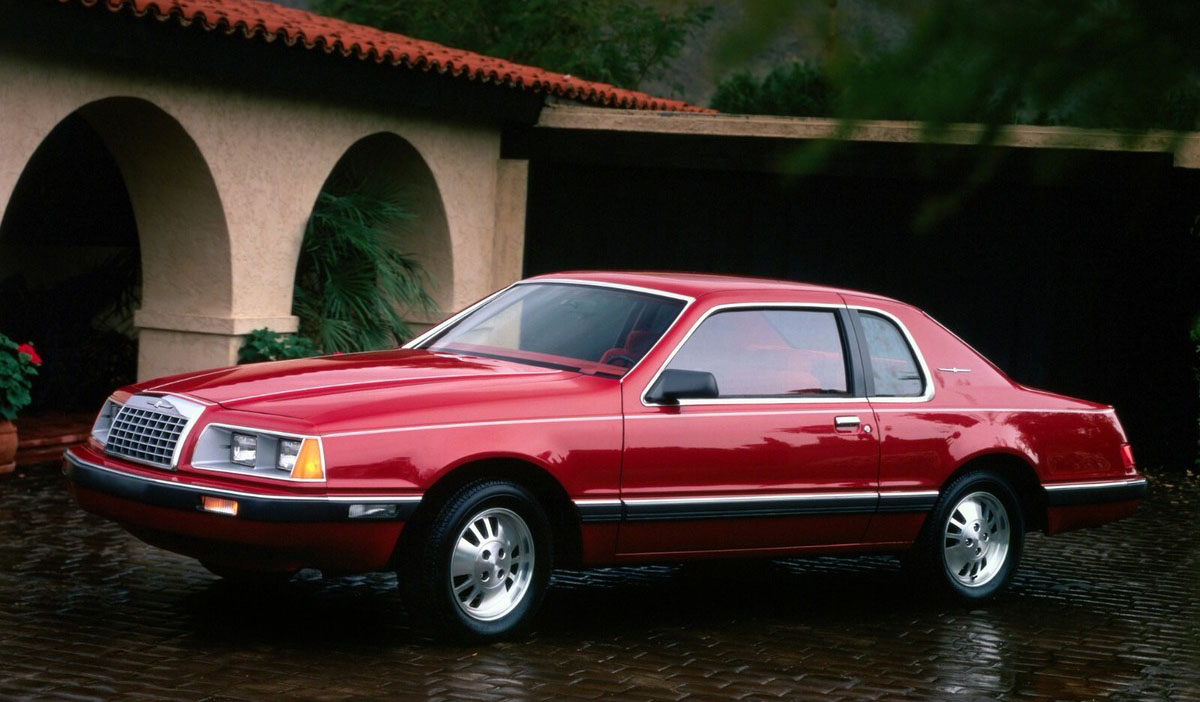
Sure, Ford could have made a more streamlined Fox-chassis’d Olds Cutlass fighter, but the team set their sights higher. This new T-Bird’s aesthetic would be aimed not at other domestic “personal luxury coupes” but instead expensive German models like the e24 BMW 635csi and w126 Mercedes 380SEC.
Crazy? It got even more insane. While the top-of-the-line 1982 Thunderbird sported whitewall tires and a landau roof, the 1983 range topper was the Turbo Coupe with a blown four cylinder, manual transmission, Mustang chassis bits, bucket seats, and a tachometer

You want to hear something even more bizarre? This new Thunderbird sold well. The Turbo Coupe was obviously a smaller number of those sales, but it did find buyers who probably hadn’t considered a T-Bird in their entire lives, or at least not since the last two-seater or stick-shift-equipped ‘Bird was sold.
Now, you know how many people react after taking a big gamble and winning, right? They figure they’re on a roll and now it’s worth doing a double-or-nothing. Ford product managers tried to do just that with the brand’s flagship coupe. Enthusiasts were briefly rewarded, but I can assure you these executives were not. Yes, it’s a sad tale.
Who Are You Anyway?
In the eighties, Ford had some great products that suffered greatly from the inability to fit comfortably into a market niche. They generally failed in the market (or at least didn’t live up to their potential) because you couldn’t easily do that ten-word-or-less sentence description.
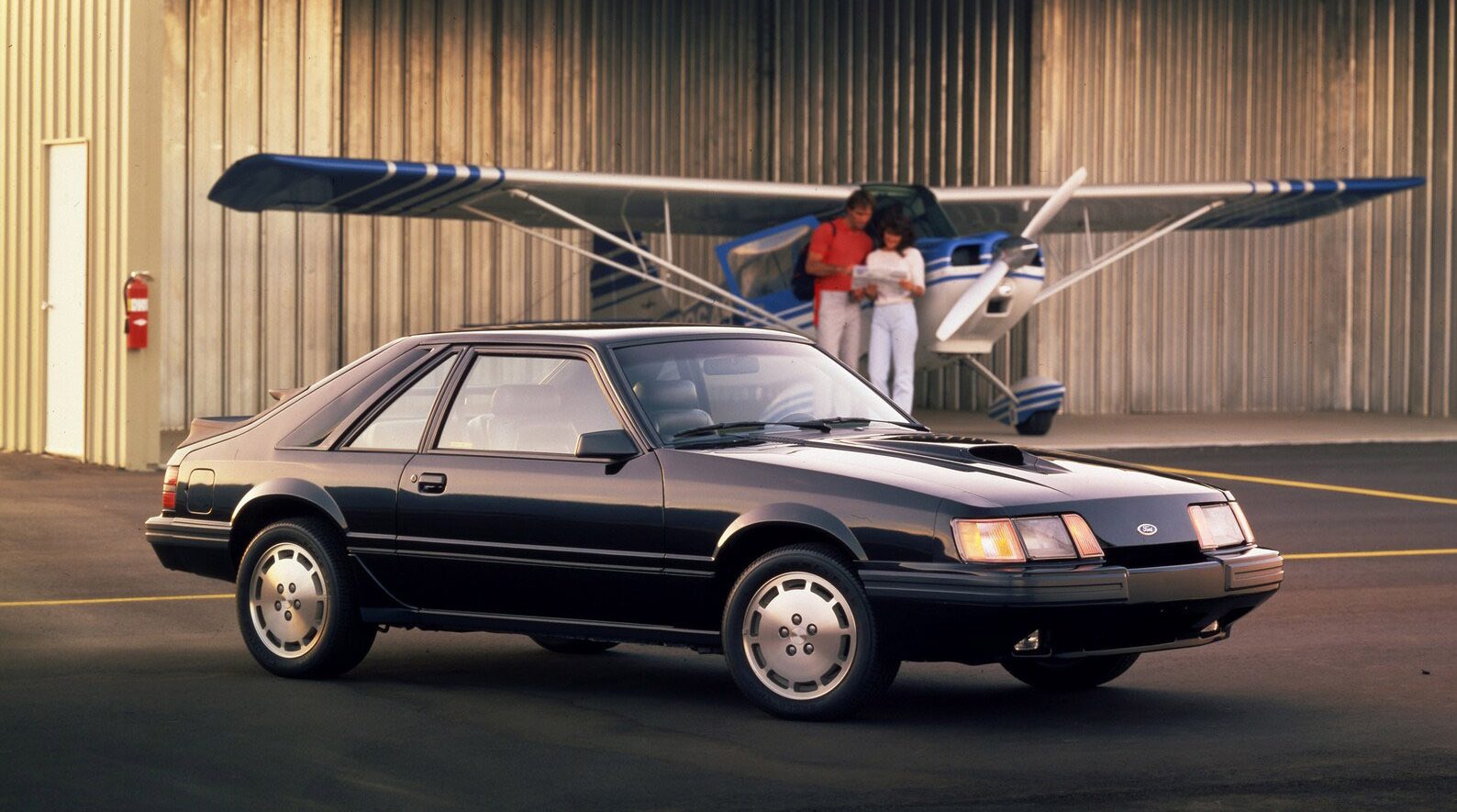
Let’s take the Mustang SVO. It’s technically a Pony car, but it was more sophisticated and didn’t really appeal to typical Pony Car people, especially since it was priced on the higher side. At the same time, it wasn’t necessarily a Z-car/Supra adjacent machine since it was a bit more European than that. Well, European might be the wrong word since a BMW owner would never want the likes of any Mustang.
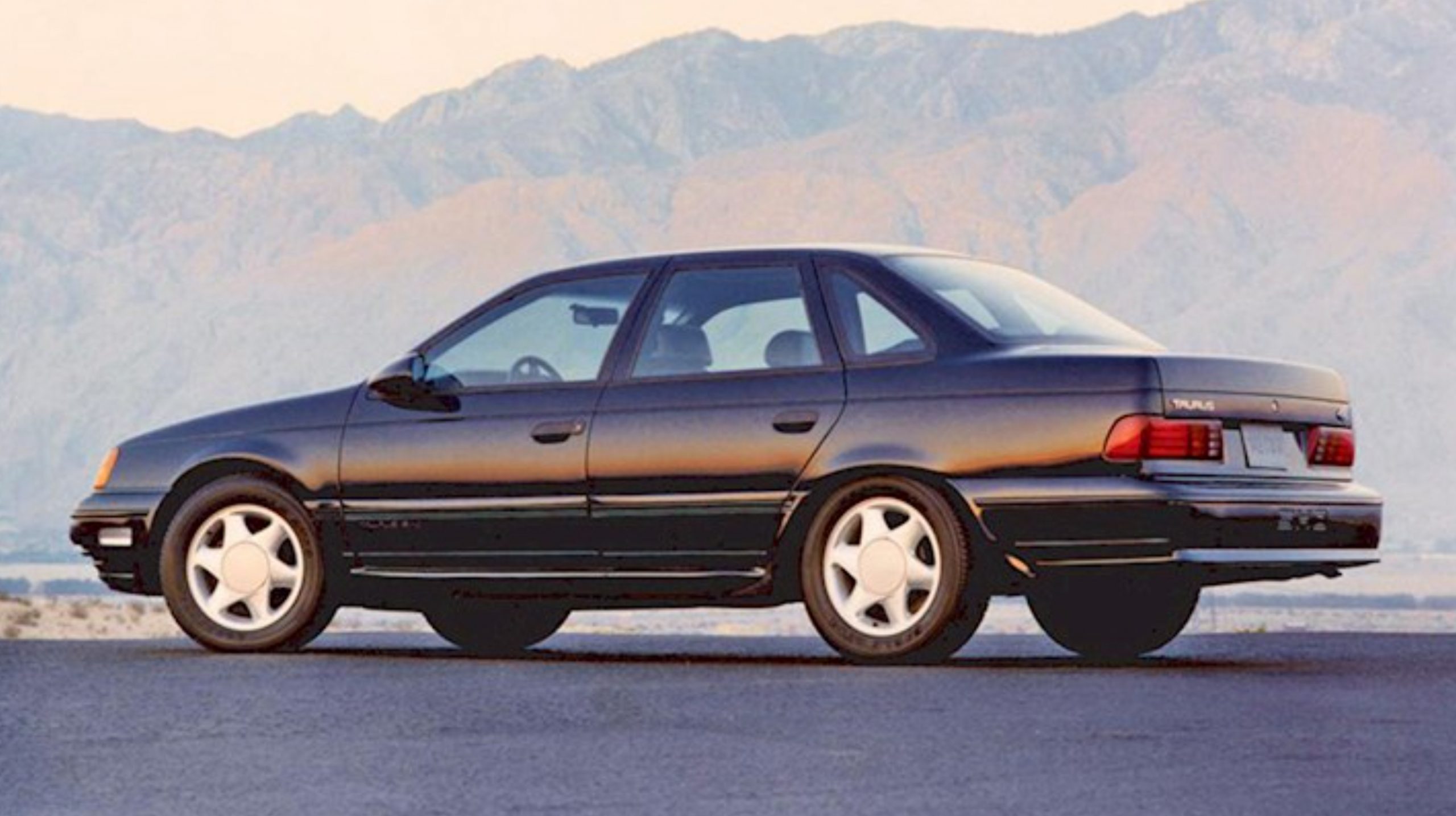
How about a Taurus SHO? Here’s a quick car based on a larger American sedan, so it’s kind of a muscle car. However, with subdued and advanced styling and a tuned suspension, it was more of a German Black Forest warrior, though realistically not as sophisticated. Maybe it was like a giant Japanese sport sedan, sort of a huge Maxima?
See the problem? The ’83 Thunderbird Turbo Coupe sort of fit into this sort of nether-land of what-is-it, but boosted by a Car of the Year win and enthusiastic press, you can see how product manager Tony Kuchta might have been encouraged to go all-out with the new-for-1989 MN12 Platform T-Bird. No, I mean really go all out.
Now, with product development, it’s always a good idea to see what the competition is doing. In Ford’s case, the logical thing would have been to benchmark the new GM-10 front-drive coupes like the aero Olds Cutlass and Buick Regal, or maybe the K-Car-chassis Chrysler LeBaron.

Indeed, that would have meant making a Taurus-based two-door with slicker styling and maybe a more powerful V6. Tony Kuchta wasn’t having that. According to the book Comeback: The Fall and Rise of the American Automobile Industry, Kuchta had no kind words for the new GM-10s:
“They are nothing cars.”
“They are losers because they aren’t giving the customer what he wants.”
Good Lord, he really said that! It was BMW M6-or-bust for Tony. As an enthusiast, you want to stand up and cheer, but in the back of your mind, you’re wondering if Kuchta was right. Here’s a spoiler alert: he wasn’t.
The Bird Flies Higher Than Ever
Developing a mock BMW in the face of the American front-drive tide couldn’t have been an easy task, and it’s almost unimaginable that Kuchta was able to give the new MN12 an independent rear suspension. The only other rear-drive American car without a live axle at the time was a Corvette.
Also rather unfathomable was the fact that the tenth-generation T-Bird would have more interior room than the spacious front-drive Taurus sedan. The length of the outgoing Thunderbird shrank by several inches, but the wheelbase increased by a whopping nine inches! With such a drastic change in proportions, you would think that the end result would be decidedly un-T-Bird-like, but with Jack Telnack’s direction, the 1989 T-Bird was a great-looking car that appeared to be the updated e24 Six Series that BMW never built, even in base model form.
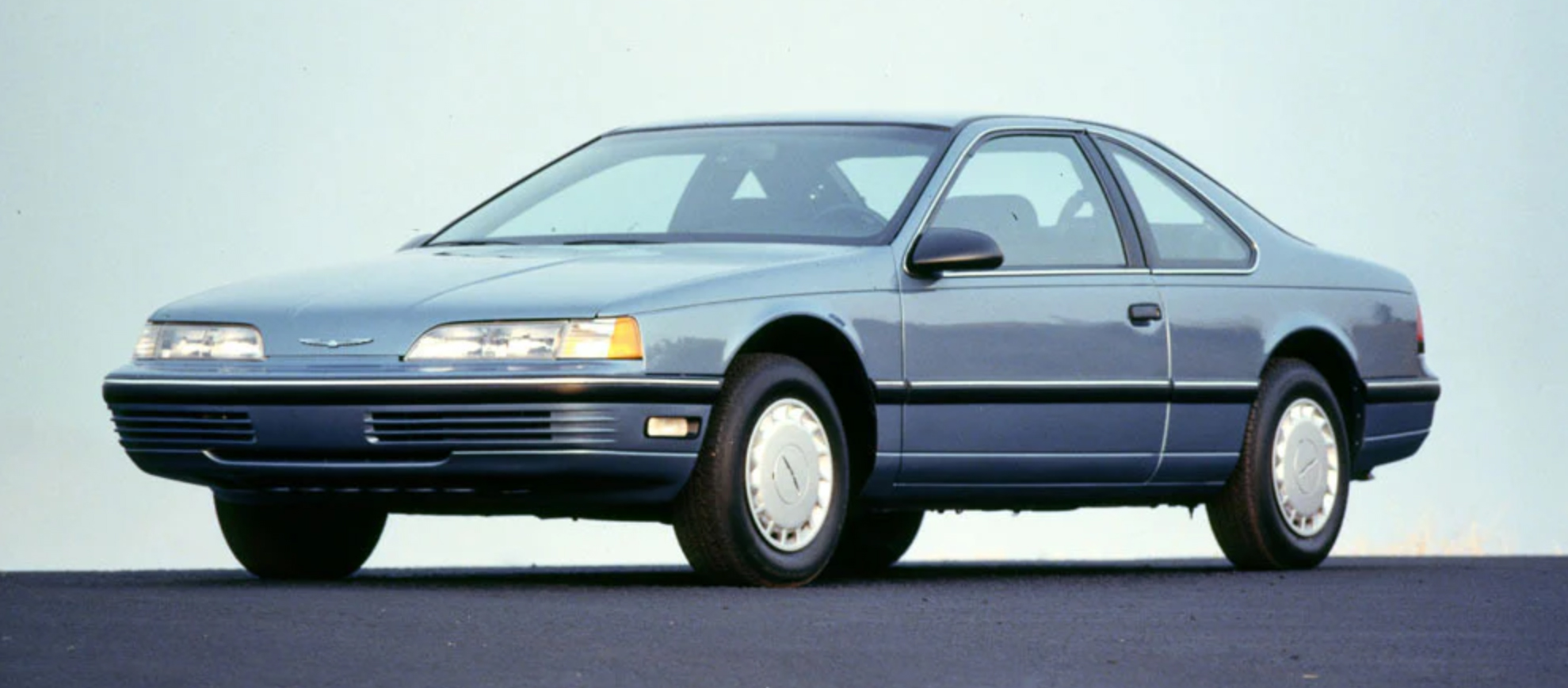
The standard T-Bird seen here received a 3.8 liter “Essex” V6 with 140 horsepower pumping through a four-speed automatic. In this 3800-pound car, that meant less-than-thrilling performance, but the slick aerodynamics meant an EPA rating of 27 miles to the gallon on the highway – a rather decent package for the average “personal luxury coupe” buyer.
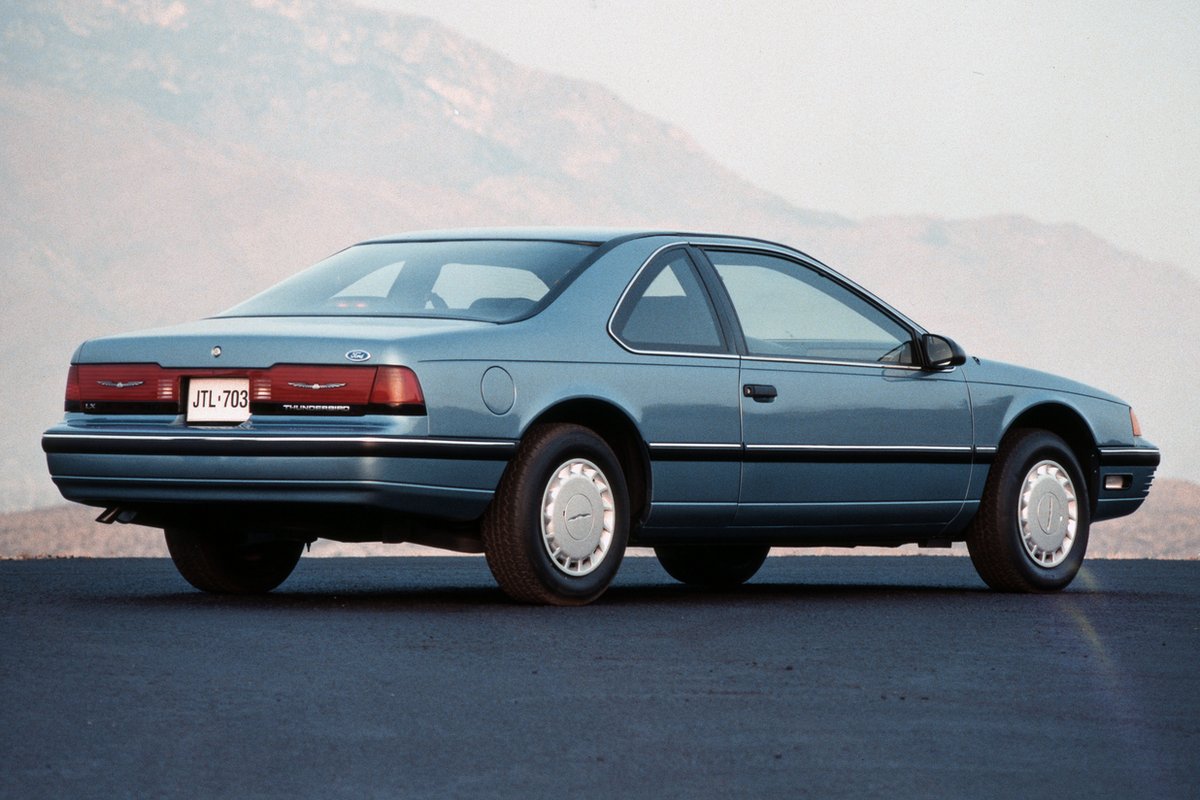
Set aside the base model car that would be the sales leader. The raison d’etre of the whole MN12 project was the Super Coupe version that took the platform to its full potential. The V6 received a supercharger and intercooler that pushed it up to 210 horsepower (later up to 230), mated to either a Mazda-derived five-speed manual transmission or an automatic.

Four-wheel anti-lock disc brakes at each corner replaced the standard back drums, but the bigger news was the adjustable Tokigo damping system. Called Automatic Ride Control, the system monitored vehicle speed, brake-line pressure, steering angle, and acceleration signals to adjust the shock valving in real time. There were two driver-controlled settings that included “auto” and “firm.” The Firm setting basically overrode the automatic system, locking it into the stiffer valving.

The SC’s seats were multi-adjustable buckets with thick side bolsters, and the dashboard with full instrumentation had a nice design except for those unnecessary silver trims around the upper switch binnacles that cheapened the look.

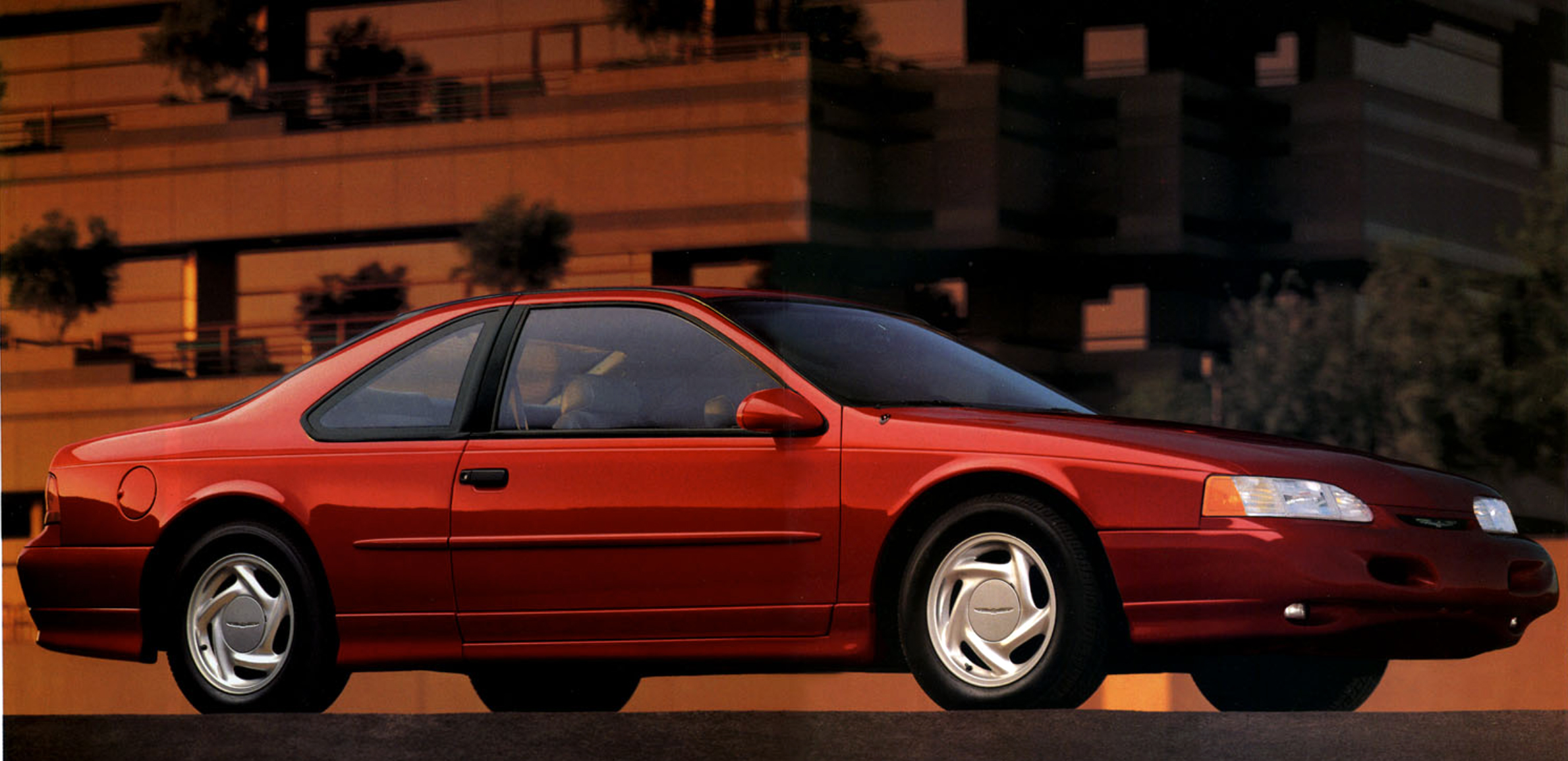
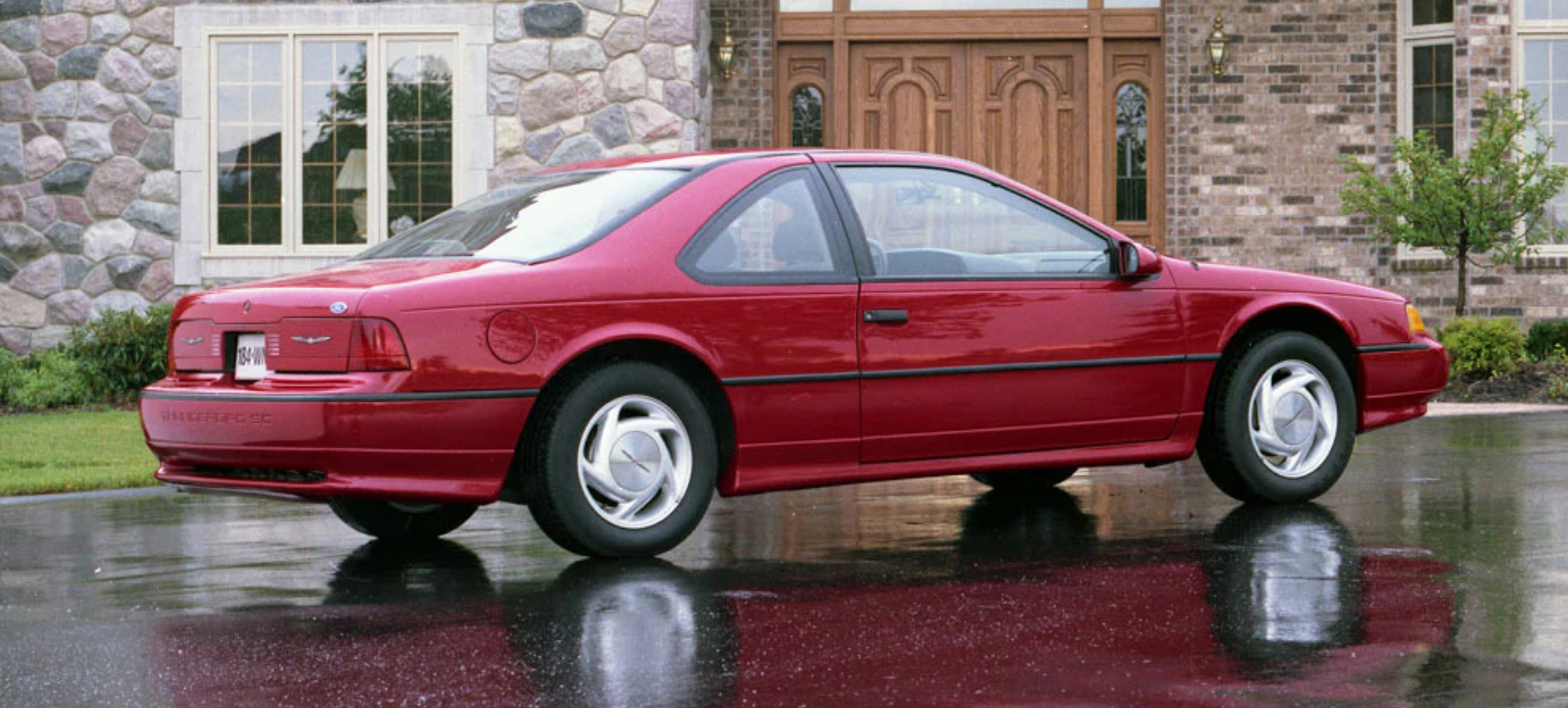
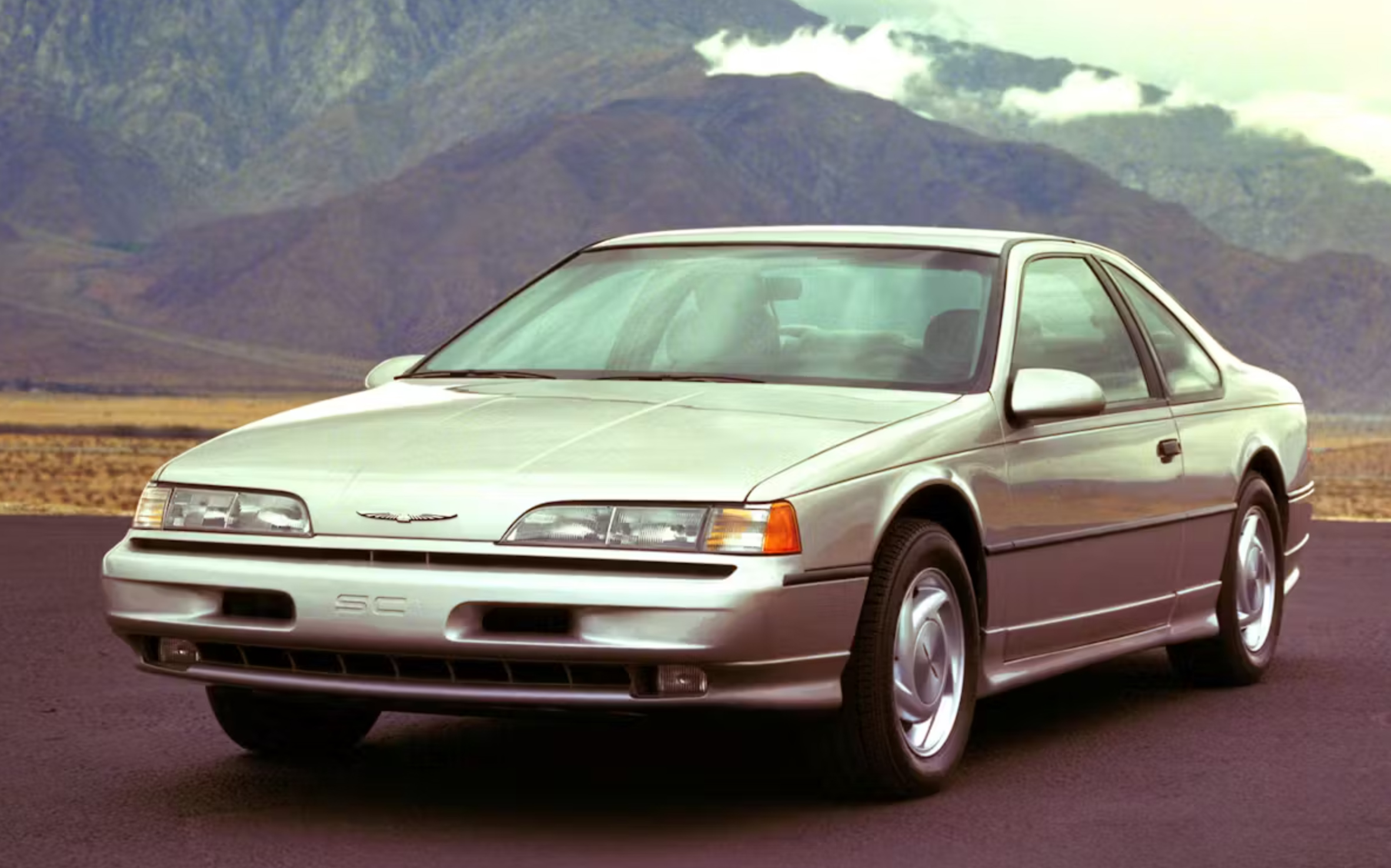
On the outside, the Super Coupe received very subtle ground effects and 16-inch alloy wheels for an appearance that was the polar opposite of GM’s flashy Pontiac coupes of the time.
The press was as enthusiastic as expected. Motorweek gushed over the “glued down handling that is akin to Europe’s best.”
That Motorweek zero to sixty time of 6.0 seconds is a bit on an anomaly based on other sources that seem to put it in the low seven-second range; either way, those numbers were quite formidable for the time, even if it was around a second slower than that benchmarked BMW M6. However, it’s interesting to note that Ford put a rather tall 2.73:1 rear gear in manual transmission SCs. With the automatic’s 3.27:1 differential in the stick car, there’s no telling how much quicker this sporting T-Bird would have been.
In 1995, Motor Trend compared a by-then-six-year-old Super Coupe with the Chevy Monte Carlo Z34 and Buick Regal Gran Sport, where former Car and Driver man Don Sherman concluded:
“The Buick Regal is a competent, comfortable car at an attractive price, but it’s too androgynous to be called a Gran Sport. Nothing about it is grand, and there isn’t a sporting bone in its body. All the Monte Carlo needs to succeed is a V-8 engine and a year of refinement to eradicate its quality bugs. That leaves the Thunderbird SC as this test’s big winner. It’s a far more sophisticated solution to the four-place-coupe equation, but is priced accordingly.”
Indeed, with a price approaching $25,000, it was around $4000 more than the GM competitors; a worthwhile premium for a real enthusiasts, but not for average buyers.
Hot Rod felt that it was a “formidable competition for these world-class performers while still maintaining its unique American-built character.” Well, that odd accolade turned out to be the conundrum that did the MN12 in.
The T-Bird Gets T-Boned
There again, in the Hot Rod description, we see that hard-to-define personality making a Ford product a tough sell. The second year was the most successful, and Ford even celebrated the T-Bird’s 35th anniversary with a special edition in a bad-ass black two-tone combination that would get you a good spot at any Radwood today.

From that not-very-high point, SC sales took a nosedive from which it would not recover:
- 1989: 12,809 total. Of these, 4,768 were automatic and 8,041 had the 5-speed manual transmission.
- 1990: Over 21,809 total. Specific breakdown: 15,742 automatic and 6,067 manual. A special 35th Anniversary Edition was also produced with 3,371 automatic models, but no manual transmission figures were specified.
- 1991: 5,975 total, with 5,134 automatic and 1,905 manual.
- 1992: 3,891 total, with 2,853 automatic and 1,038 manual.
- 1993: 2,647 total, with 1,925 automatic and 722 manual.
- 1994: 5,741 total, with 5,167 automatic and 574 manual.
- 1995: 2,467 total.
With those paltry final year numbers, the great Super Coupe finally vanished after 1995.
Oddly enough, Ford eventually offered a V8 in the T-Bird, but they refused to put in a hot example from a Mustang or a Lincoln Mark VII or VIII. It’s reported that the intake and exhaust were quite restrictive and limited the 5.0’s output to 200hp. Motorweek pushed a 5.0 example to sixty in 9.2 seconds – around two seconds better than the V6 but down almost two from the SC. The V8 seemed to be more a way to make the T-Bird into a latter-day rear-drive family Cutlass than a Mustang in a suit.

A mid-cycle refresh and introduction of the 4.6 modular motor with 205 horsepower helped, but it wasn’t enough to save the Tenth Generation T-Bird from its 1997 demise. Sadly, Tony Kuchta’s line about GM’s front drivers “not giving customers what they want” backfired to the point that Kuchta ended up taking (or being forced into) early retirement due to his championing of the MN12.
Like Icarus putting on those wings and flying too close to the sun, Tony Kuchta had pushed the envelope too far. Of course, the MN12 Thunderbird was likely doomed from the start by the changing market, regardless of how good it was. The winds of change were already blowing, and in 1991, Ford themselves really kicked up those breezes with the Ford Explorer. Suddenly, large two-doors were dropping in popularity faster than hair metal bands at the time.
A Taurus-based Thunderbird likely would have appeased ninety-five percent of potential buyers; it might have even gained more, since many snow belters would have preferred front-wheel drive. Going for broke Bob Lutz-style and making a car to capture that last five percent of enthusiasts isn’t how you build a successful, profitable car. It is, however, the way to build legends.
Most Autopians idolize the likes of the 850csi and other over-the-top imported examples from the twilight of the big coupe era. At the same time, we seem to forget that Ford was also stretching the limits of cost and complexity to give enthusiasts what they wanted. Maybe it’s finally time to give the most underrated Thunderbird of all time the respect it deserves.
Top graphic image: Ford


This is a dream car of mine. I was a Bill Elliot fan growing up and when I got to high school a friend had one of these. It did the best burnouts and donuts. His was a 5 speed. After he had that he even got the supercharged v6 Mercury Cougar XR7 with a 5 speed that was a super rare car.
I’ve always thought the SC looked fabulous. Kuchta missed the mark on these given their sales numbers and enormous dev costs, but he was right about the GM10 cars, which missed the mark too. At least at first. In the end the W bodies developed into what they should have been from the start whereas the Bird was sort of put out to pasture.
I was obsessed with this era of Ford SVO… I eventually owned an 87 Turbo Coupe and a 94 SHO… Never the right time for the S/C (and their head gasket problems) but if the right Mustang SVO (or XR4Ti) came around, it’d be difficult to resist.
I’m tempted everytime a Supercoupe or turbocoupe shows up.
I followed a fox body mkvii lsc home today and was reminded how much I love them and the aerobirds. It’s probably for the best that every one I’ve looked at was too rusty underneath.
Also that LeBarron coupe press photo is incredible. I had no idea they could look that good. Apparently you have to lay on the pavement to see what the designers were going for.
The LeBaron GTS coupe was a nice looking car. I somehow remember when it came out that Giugiaro commented on how he thought it was quite appealing- this was the same guy that upon seeing the Triumph TR7 looked at one side and then looked at the other and said “my God, they did the same thing on both sides!”
I’ll be honest I headed over to BAT to see if a LeBaron coupe was for sale. Amazingly a coupe has never been listed on the site. Plenty of convertibles. They do have a nice magazine article on a preface lift LeBaron coupe though.
mutter grumble…
This article directly addresses two of the reasons I will never, ever give the Ford Motor Company another dime of my money: the 1983 Thunderbird Turbo Coupe and the Mazda 5-speed (which I had the misfortune of having in a 1992 Explorer Sport).
I bout the T-bird new. By the time I unloaded it on an unsuspecting Chevy dealer in trace for a 1987 S-10 Blazer, it had eaten the turbo, the camshaft, and a bunch of other top-end parts…and the extended warranty I bought didn’t cover the turbo. $3000 down the drain on a $15000 car. When I unloaded it, it had a cracked exhaust manifold; I’d taken it in for a ch-ch-ch-ch noise when cold, but they didn’t fix it until the manifold cracked wide open – after the warranty had run. Did Ford make it good? Of course not.
And then there was the Explorer. I was on the highway, cruising along, minding my own business, when the truck quit moving under its own power. Had it towed 70 miles to the nearest Ford dealer. $1700 rebuild; had 65000 miles on it. 4000 miles later, the transmission failed again. Ford refused to honor the repair warranty. And the dealer I’d bought it from told me the input shaft it needed was on “national backorder”. Had it towed to a manual transmission rebuilder. They found the shaft at the next Ford dealer up the freeway.
And that’s why I would have been happy if Ford had been the one to declare bankruptcy and sink beneath the waves in 2009. If someone dropped a nuke on Dearborn, I’d go dance in the fallout.
A beautiful car. I owned a ’94 with the 4.6 engine. So comfortable. It was like it was designed around my measurements. FWIW, I worked with a woman who had an SC. She was selling and I expressed interest. She said she couldn’t sell it to me because she liked me too much. Then she shared the horror stories. Yikes! Her particular car was a lemon.
I never did get to drive a T-bird SC but I drove the Mercury equivalent, the Cougar XR7. It was eye opening for a young car guy, the 5.0L, the automatic ride control, black on black, it was badass for the time.
I had a Champagne 1990 automatic SC for my senior of college (2003) and the beginning of my first job. What a stellar car. The brakes were a little finicky but good night was that car something.
I gave it to my dad when I decided street parking in Philly wasn’t fun in a giant coupe. I still look for them on marketplace.
Hot dang, I loved this generation of TBird.
So much I owned two of them, both 1994 versions.
The T-bird SC was never going to be a track-day warrior. It was always positioned to be an affordable tourer. It was certainly comfortable and handled better than most American cars of the era and was a really great car to have. Was it legendary? I would say no. But ask anyone who drove one and they will have fond memories.
My ’96 V8 was a highway cruise missile.
It’s funny you should say that. My friend Jason’s black-over-silver 1990 Thunderbird SC 35th Anniversary edition is identical to the one pictured, and took home the Raddest Domestic prize at this year’s RADwood Charlotte.
I nearly bought one of these when I was looking for a second car. Spent too much time waffling.
The MN12 did look best in red, white, and (two different shades of) blue. That being Mark Martin’s Valvoline-sponsored Roush #6 stock car, but I digress…
The Thunderbird SC was an awesome concept and a great-looking car for the time. Unfortunately, the Essex V6 was an unrefined, boorish American turd that had no hope of competing with any European drivetrain.
It should have had the 32V 4.6 that the MK8 got and stuck with the SVO turbo 4 until that was available. While it put out decent power in supercharged trim, the 3.8 just sounds and feels cheap all the way around.
Essex v6, should clue you in its not American turd.
The Essex V6 used in this and the Taurus is completely unrelated to the British Essex V6.
It was actually a reverse engineered Buick 3.8, but not as good.
Not much power or refinement, and they loved to eat head gaskets. My parents ’95 did exactly that after only a few years. Eventually there was a “service campaign” which reimbursed them.
And then, someone, somewhere, looked at the MN12 and thought “that’s great, but you know what would really improve it? An ill-fitting pastiche of a 1949 Ford nose that guys can install in their garage with self tappers and Bondo”
Yeah, that facelift…ughhhh
The tragedy with this gen of Thunderbird and the related Lincoln MKVIII is they didn’t use that MN12/FN10 chassis on more vehicles because it cost a few bucks more to build than the old Fox or Panther chassis cars.
Ford should have used variations of this chassis as an eventual replacement for the Fox, Panther and new Jaguar models.
A new Lincoln Town car on the FN10 chassis would have been a much better car that the subsequent Town Cars we got.
And a new Lincoln Continental on the MN12 would have been way better than the FWD-Taurus-based Continentals we got.
What? You are saying a mod motored Taurus with a fat trunk is bad?
No, I’m saying a mod motored FN10/MN12 vehicle would have been better than anything Taurus-based.
Yeah it’s so bizarre. They infamously went crazy overbudget and time developing the thing to the extent that Tony Kuchta was given the gold watch treatment when it came out; but instead of trying the amortize the costs across their entire product range with their fully modern well reviewed RWD platform and the brand new engine package that they had coming down the pipeline, they just spent the next 8 years cutting costs/quality out of them to try and make up their money solely during the dwindling sales of a dying segment instead. Could the Lincoln LS have come out half a decade earlier? Could Jaguar (and Aston Martin!) have gotten rid of the ancient XJ40 and XJS platforms sometime sooner than 2004?
Like it’s fascinating to see Kuchta talk all that shit about the GM-10 cars where GM also wildly overspent on their development, overestimated their competence and sales acceptance and largely botched the launch; but GM at least got their money back on that venture and probably did so soon after they started getting the W-Body sedans on the market in 1990 (nevermind the 20 more years they got out of it afterward).
Loved these.
Shame that engine never ended up in a mustang. Supposedly there was a test car in 94, but it outperformed the 5.0 GT and ford killed the project.
Especially since I promise the Foxstang was lighter weight.
A friend of mine in college built one out of his 94 v6 mustang. He loved it but it was more than a little red-green show ish with the shredded fiberglass cowl induction hood, baling wired up cherry bombs, and rice burner wing pop riveted to the trunk lid. His didn’t exactly perform well, but I put that down to execution rather than a failing of the eaton m62 on the tired v6 he pulled out of the junk yard.
Always liked this generation of Thunderbird, there were quite a few in my area up until a couple years ago.
They really are ALL gone now.
Well, I wrecked one and blew the engine out of another, so I certainly wasn’t helping.
I had a 1990 SC with the 5-speed in high school and into college. It was a champagne silver with a lurid red interior. The seats were amazing with the adjustable side bolsters. It was an awesome car for sure. I put a smaller supercharger pulley on it for more boost. I loved that car.
Always liked the looks of these. The fact that it featured in one of my favorite 90’s PC games helped too: Police Quest Open Season
Buddy in high school had a ’92 SC that was the envy of all of us. That thing had some real get up and go for the time, and he didn’t hesitate to show it off.
Meanwhile I was tooling around in an ’81 Mustang with the 2.3 and a hole in the floor…
“You have a Mustang with a 4-on-the-floor, cool!”
“No, I said it has a HOLE in the floor.”
I’ve always liked this era of the Thunderbird in a genuine way. And I always enjoyed it’s derpy as shit cousin, the Cougar. But more like in a so bad it’s good sort of way. That car always made me laugh.
There was a supercharged Cougar version as well!
The good ol’ XR7. My aunt used to have one in an outstanding light teal color. She loved that car. Now she’s relegated to RAV4 duty. While the RAV4 is a damn fine car, it doesn’t have the character of the XR7.
The teal and the green are the way to go.
The XR7! There are a number of these available in great shape thanks to straddling the line between muscle car and Old Country Buffet shuttle. Sort of went down a rabbit hole looking at these.
I’ll take one in green.
Fiero?
Fiero was already out of production by the time Ford started shipping MN12s.
The context was about development of the car, but I concede the truth of your point.
True. I should have mentioned “front engined rear drive” as well.
I got to see one of these and an 86 Chevy stepside truck get totaled racing each other in 1998. I had two friends in each of them. The truck pulled ahead but something happened and it spun out resulting in the T-Bird SC tboning it and damn near bending the truck in half. The TBird basically didn’t exist anymore forward of the driver compartment. Was a real shame because both vehicles were in great shape, the truck was downright gorgeous.
By some miracle everyone walked away with not so much as a bruise.
That can’t be true. I’m essentially told that everybody died fiery deaths or permanent disfigurement in every collision over parking lot speeds in the days before IIHS-approved [insert current year] safety.
buddy of mine in HS got a Cougar with the 3.8SC man that car went like stink, but was no match for our driveway in a syracuse winter lol
A reminder that the cars that are the worst for driving in snow are often the most fun to drive in snow.
yup agreed! he plowed right into our garage, good times!
When I had my Geo Metro, I put snow tires on that beast. My friends with Wranglers who only had all-seasons only ever saw my taillights and it irritated them to no end during the colder months in the Midwest.
Ahh, being in high school would explain it. Can’t hardly afford gas, much less snow tires. Those transform some very sketchy winter drivers into tanks. It was a revelation once I could afford a set, well after high school.
Eh… While the roots of the Contintental Mark VII were more pedestrian, I’d still say the actual end result was a closer attempt for its time at being a euro-fighter vs the hopelessly overbudget and feature creeped MN12 cars; especially since Ford immediately started cost cutting them to hell to try and offset their costs.
I love the Supercoupe and I think it looks proportionally close to perfect (albeit it would probably have been a better car it if was about 10% smaller across every dimension), but it was aiming at the moving target that eclipsed it if not immediately (with things like the R129) than very quickly (with things the SC400).
The bigger issue is that the Lincoln version of the MN12 (the Mark VIII) verged too much on the luxobarge territory instead of being the C140 or BMW 8 series that us enthusiasts would have liked it to be.