

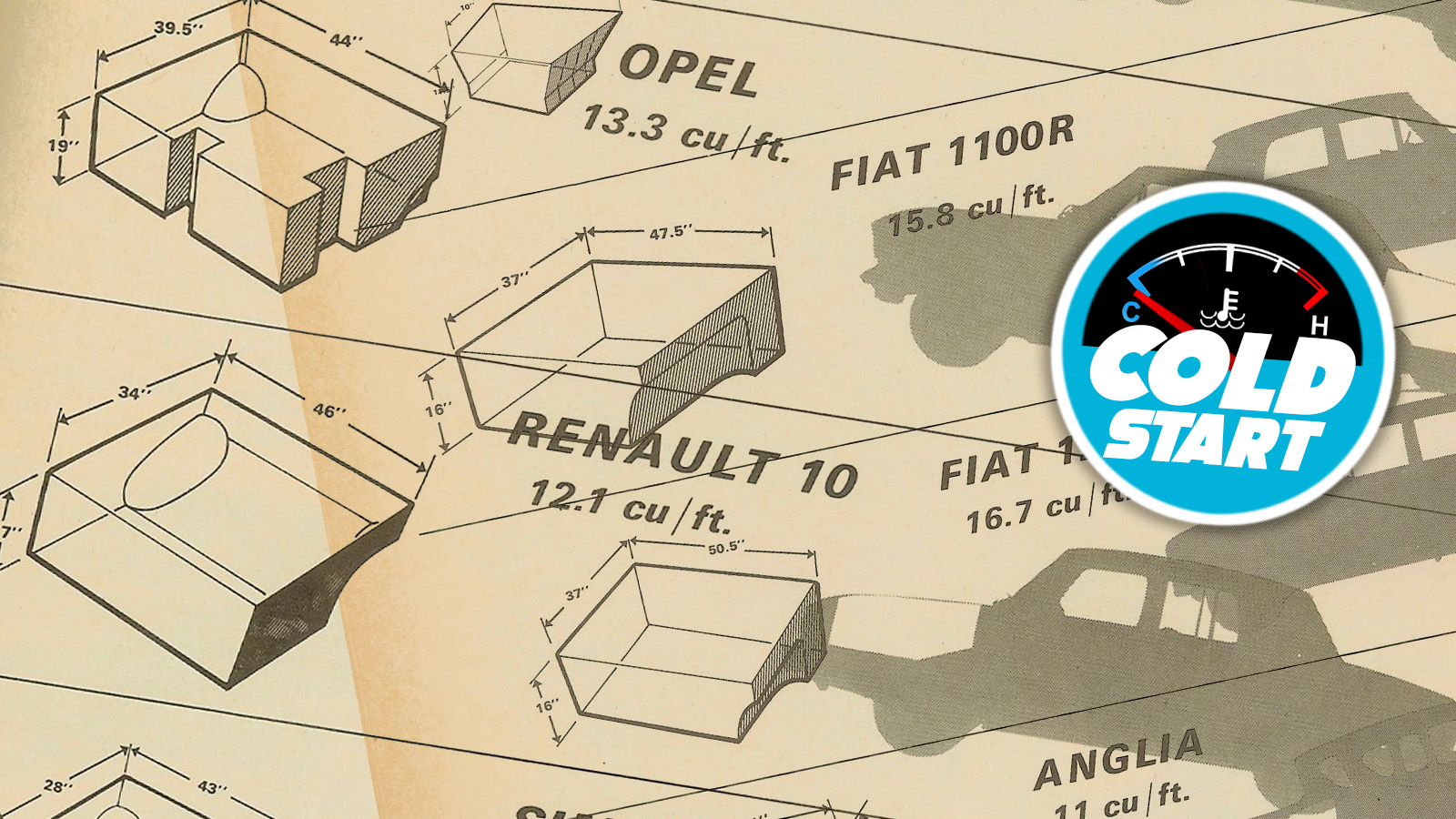
Long before the internet and its constant hunger for new content, demanding feeding not just once a day, but many, many times a day. Taking a long time on a story is possible, sure, and we try to do that, but the luxury of time for each and every post just isn’t a thing anymore. But back in February of 1967? Time in the automotive journalism was a rich, plentiful resource, like bauxite. And, also like bauxite, it was delicious and intoxicating, which is what (I believe, at least) allowed for the creation of one of my favorite details of an automotive review ever:
Three-dimensional drawings of the volumes of small car trunks.


This isn’t the first time I’ve mentioned these, but for some reason they have been in my mind and I wanted to re-visit them, so why not? Some things are worth re-visiting. These drawings appeared in a 1967 issue of the creatively-named magazine Road Test, and remain some of my favorite details of any car review, ever. 
Road Test was a very no-bull-feces sort of magazine. It was exactly what it said on the label: road tests, of cars. In this issue, they compared all the major “economy imports” that America had to offer in the late ’60s, and what a glorious mix of cars that was! Just look at this lineup:
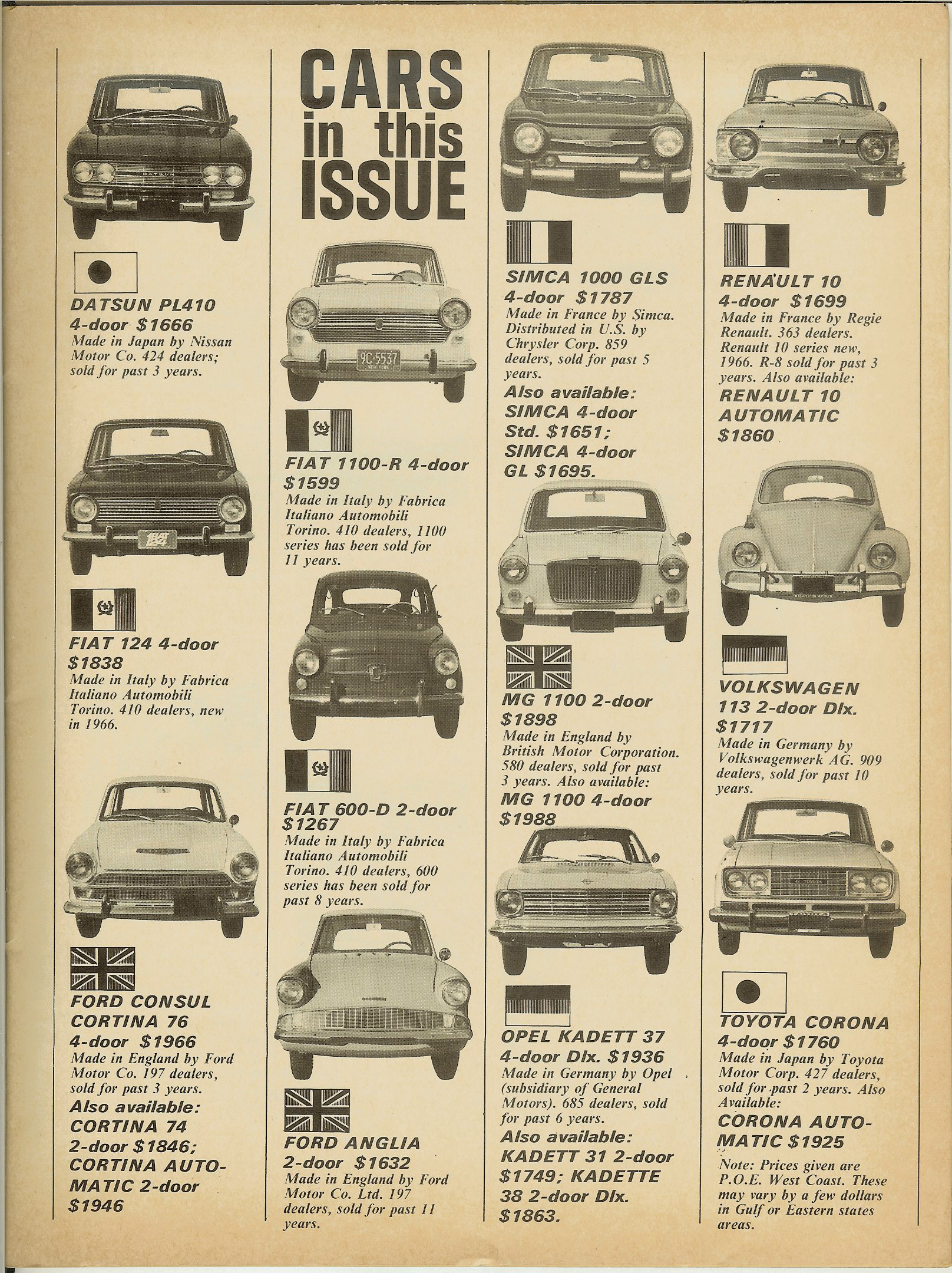
Simcas and Volkswagens and Fiats and Datsuns and Opels and beans-on-toast-burning Fords – it’s a motherflapping wonderland. And these tests they performed were varied and many, but I really want to just laser-focus on these trunk diagrams because, well, you’ll see why.
They didn’t just tell you how many cubic feet or micro-hectares of space the trunks had. They didn’t even talk about how many suitcases fit. No, they crawled inside each of those little trunks and measured every little nook and crevice and used slide rules, maybe, to assemble those measurements into three-dimensional volumes. And then had their artist draw them. Look:
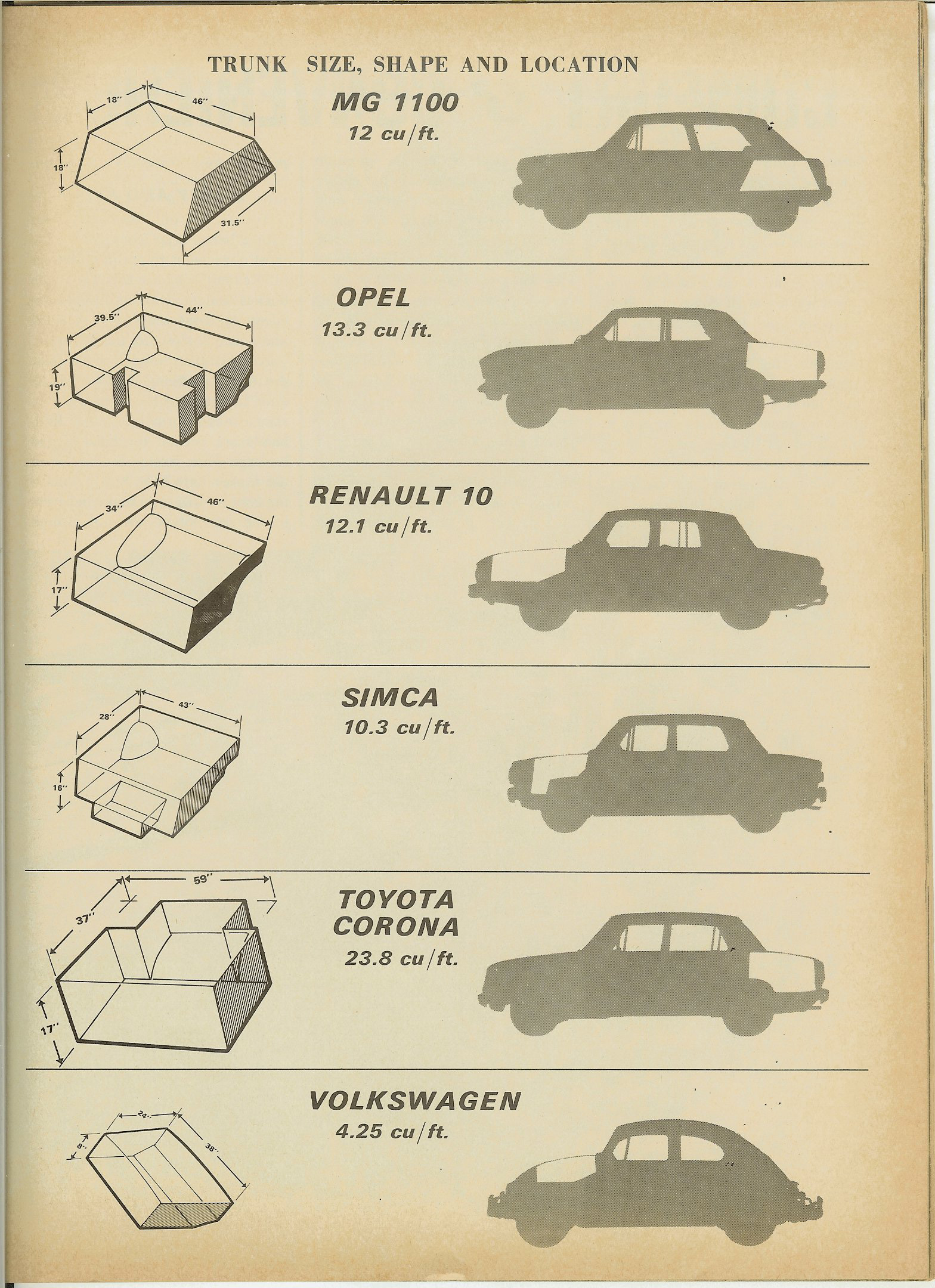
Look at that! you get a profile of the trunk’s space and location within the car, then you get the trunk volume removed from the car, presented as a dimensional solid. As though each trunk was filled with plaster and the cast removed. They feel like the sculptures of Isamu Noguchi, kind of. Maybe. Maybe they feel like architectural models? Something like that.
I do want to note that these diagrams are a little unfair to cars like the Beetle and the Fiat 600 which had secondary rear storage areas. The Beetle’s rear luggage well could hold about 5 cubic feet, and the Fiat 600’s was…hm, I’m not sure. A bit smaller. Here’s a look at the Beetle’s rear luggage well:

…and here’s a cutaway of the Fiat:

Maybe I’m a little protective of my rear-engined friends, but I do think those rear luggage areas should have been included. The Renault 10 has a small rear luggage well, too, but since it has such a cavernous front trunk, it’s a little less of a big deal for that car.
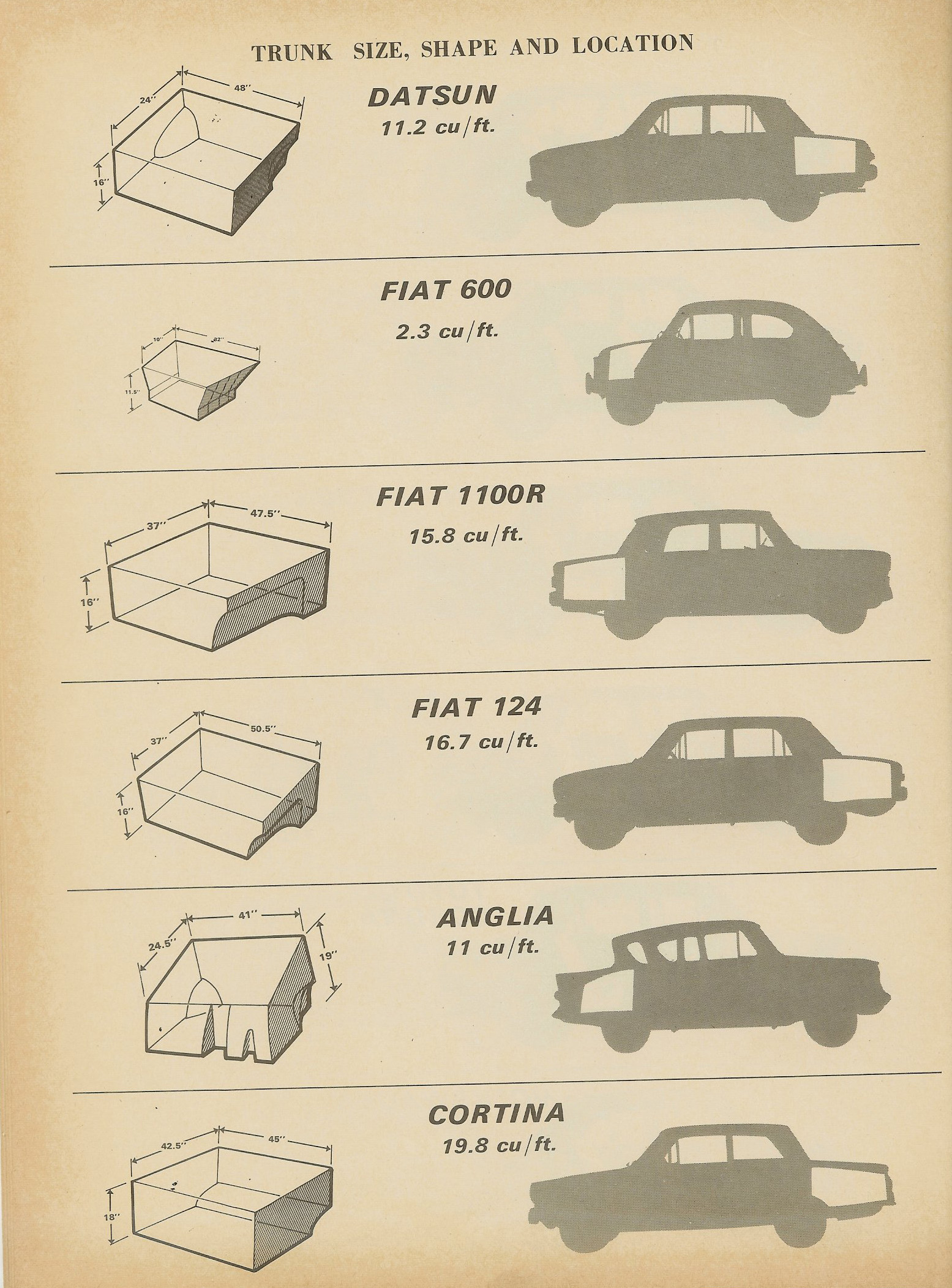
Are they actually helpful? I’m not entirely sure. I mean, you can see every wheel arch lump, every lost bit of space needed for a fuel filler line or a structural support. You could use these to craft some wildly accurate fitted luggage, too.
I love how the Fiat 600’s little yet determined trunk looks a bit like an anvil. The Opel’s feels like some kind of brutalist temple. The MG’s is a bunker, the Anglia’s maybe a museum. The Simca has a secret little room!
I love the time and care and effort that went into these, the combination of seeming rationality that bleeds over, a bit, into madness. I love the idea that maybe, just maybe, these trunk volumes were what someone studied and used to make that final decision to get the Renault over a Volkswagen, or an MG over an Opel.
I can’t fully explain why I love these strange things so much, but I do. I think I’ll stop trying to explain them, and let them just be, and let you enjoy them and find inspiration in car reviews that took such wonderfully strange and detailed steps like these.


What’s with the symbol on the Italian flags?
I really never could care for road test results. Just not interesting. Car test results are more meaningful. I do like that they present the topography of the trunk. Cubic volume means nothing if you can’t fit common items in there. I guess it’s the same with some modern cars that have largish trunks but tiny letter slot openings to access them.
I am worried about that passenger in the front of the VW who is obviously unsecured in case of a collision. The kids in the back? Eh, been there/survived that.
Let me introduce you to the artist Rachel Whiteread who does this on a larger scale
I saw the leading pic that included a trunk drawing of a R-10. I had one in college, a nice, fun car for me and my intro intro into the world of keeping a car on the road! I learned a lot! It was a water cooled, 4 cylinder, rear engine car with a pretty good sized trunk in the front. I still like small cars, but they don’t exist in this country.
Hey Torch – was gonna hit you up on Discord, but couldn’t tell which Torch was you. Whats your favorite air-cooled VW parts source? Jbugs? Got a 78 Super Beetle Cabriolet, and guess gonna have to get working on it since no one is interested on Hemming in taking it off my hands. Need fuel lines and brakes – figured you would have the skinny on best, or at least your favorite, site. I’m a water cooled guy, but wanna get this little guy back on the road.
I was a subscriber to Road Test when it took its last breath in 1981. The road goes on forever.
This is actually useful information. In modern times, I just want to know if the 2nd row seats of a crossover fold dead flat to the cargo floor. Car camping is pretty popular these days, but neither manufacturers or reviewers will give you this information.
Boxes for bauxite, rhombuses for regolith. If you really go balls out-
Can’t beat ping-pong balls.
https://share.google/kmDGbMOwvWqPHvOps
That is excellent. I just got finished shopping for a van to haul an ebike, and it was difficult to find cargo area specs for most of them.
But, what about the trunk OPENING? All that space is worthless if you have to put everything in through a mail slot!
I’d like to think this kind of reporting kept companies honest: any brand can brag about their “massive” 10 cu ft cargo area and most people would have no idea if that is a lot or a little. Comparisons like this would push them to do better, kind of like Consumer Reports has led the charge on soft-touch plastics and whatever other details they’ve decided are important.
I though that was Sofyan from Redline Reviews always going on about the soft touch plastics lol
Yup. Why do you think no one does it anymore?
Once upon a time C/D used to count how many std cases of bottled beer could fit in the cargo areas of wagons, vans and SUVs – in all seating configurations as well.
The secret room in the Simca was an especially popular feature amongst buyers with legally dubious intentions, until the dastardly journalists at Road Test exposed it to the authorities.
I don’t know, a 3D scanner could probably do this nowadays a lot faster than sticking an intern in the trunk with a tape measure and then drawing it up.
But then how would you haze the interns?
I think you make the interns measure it with a tape measure, then you scan it and grade them on how close they got.
This. This is precisely how interns are meant to be treated.
You make them put reflective dot stockers all over the interior for accurate scanning and then take them off again after.
3D scanners are a pain in the ass. For a model that is mostly flat sides, it is way faster to just use a tape measure or yard stick.
These envisioned volumes – Jason, did you ever visit Governors Island while you were in New York? There is a casting in concrete of the interior volume of a small wooden cabin by artist Rachel Whitread that is very reminiscent to these envisioned trunk volumes. The flyover video at the top of the page https://www.govisland.com/ starts with it, and its own page is here https://www.govisland.com/things-to-do/public-art/cabin .
no but those are fascinating!
Since these cars were tested in the US, I’m surprised Road Test didn’t think of measuring the volume of the trunk in turkeys.
https://www.youtube.com/watch?v=E1FwyR0LWVg
It’s great that they put the Toyota Corona with its 23.8 cf trunk next to the Beetle with its 4.25 cf trunk. That could actually help you make a decision.
You know, they were a little unfair to the Beetle (and Fiat 600 here) because they didn’t include the rear luggage well, which basically doubles the trunk volume of the Beetle. Lemme make a note.
That puts the Beetle a little closer to the average.
TL/DR. Journalist used to do real testing
Why are the Anglia and Fiat 110R facing the opposite directions from the rest? What is the hidden meaning behind this? How are we supposed to go on knowing this?
Both were on the way out, destined to live in the shadow of their replacements the Escort Mk 1 which didn’t come here and the 128 which did?
But then the Datsun 410 should be facing that way too.
Why are perfectly normal posts getting held for moderation! Sometimes for 5 days?
I’ll see if I can find out what’s going on! Sorry!
Thanks. Started happening last week
We have a particularly aggressive spam filter that automatically holds comments containing slurs, “MAGA”, “Nazi”, “Fascist”, and other terms that might start a fight in the comments sections.
However, the filter sometimes acts like a drunk and holds comments that have none of those trigger words. I think I might be the only person who checks the comment queue, and I sometimes don’t do it on weekends or when I’m otherwise out of the office. Sorry about that!
No doubt “ergonomic triangles” was the offending phrase. 🙂
Back when auto journalists did real testing. Very hard to find any measured data today. Heck it is hard to find a picture of a car with the trunk or hatch open.
Same with motorcycles. It used to be common for pretty much every magazine to take measurements, draw ergonomic triangles, measure the real wet weight, and then take it to the track to do acceleration, braking, and roll on testing. Some would even sneak off into the desert to do a top speed run.