


If anyone ever doubts that I may not be on the spectrum in some way need only to roll an air-cooled Volkswagen in front of me and take note of what happens. There’d be no hiding it then, I’m pretty sure. For whatever reason, when it comes to old VWs, I can’t help but scrutinize the smallest, seemingly insignificant details and be fascinated by things that would make most “normal” adults collapse into a deep, bored sleep. But not me. That’s why I’m so enthralled by these wildly tiny details in a 1967 (1968 model year) Volkswagen brochure that, I think, point to something significant.
That something is the appearance of a pre-production Beetle in an official VW brochure, with notable visual differences from what the actual production car would have. As far as I know, this is the only brochure to have ever shown a visually different, pre-production Beetle.


Now, these differences are tiny, and I doubt most people would notice them, but to me they stick out like a red handkerchief hanging out of someone’s fly – strange and obvious and hard not to stare at and wonder. I think the time this happened is significant, because the switch from the 1967 Beetle to the 1968 model is, arguably, the biggest change in the Beetle’s incredibly long life. It’s the line where we see the shift from the “early” to the “late” Beetles.
Look, you can see it happen in this chart:

See? In 1968 the Beetle was “modernized” and set the template for all Beetles to follow (well, less so the Super Beetles, but that’s another thing) until production ended in 2003, and for a car that prided itself on making only small, incremental changes over the years, was the biggest and most obvious set of changes and updates ever seen.
With that in mind, it’s not hard to imagine that nailing down the final form and details may have taken a bit longer, to the point that a brochure like this one would have been produced before all those changes were truly finalized.
We get a hint of what’s strange here with this whimsical illustration on the cover:
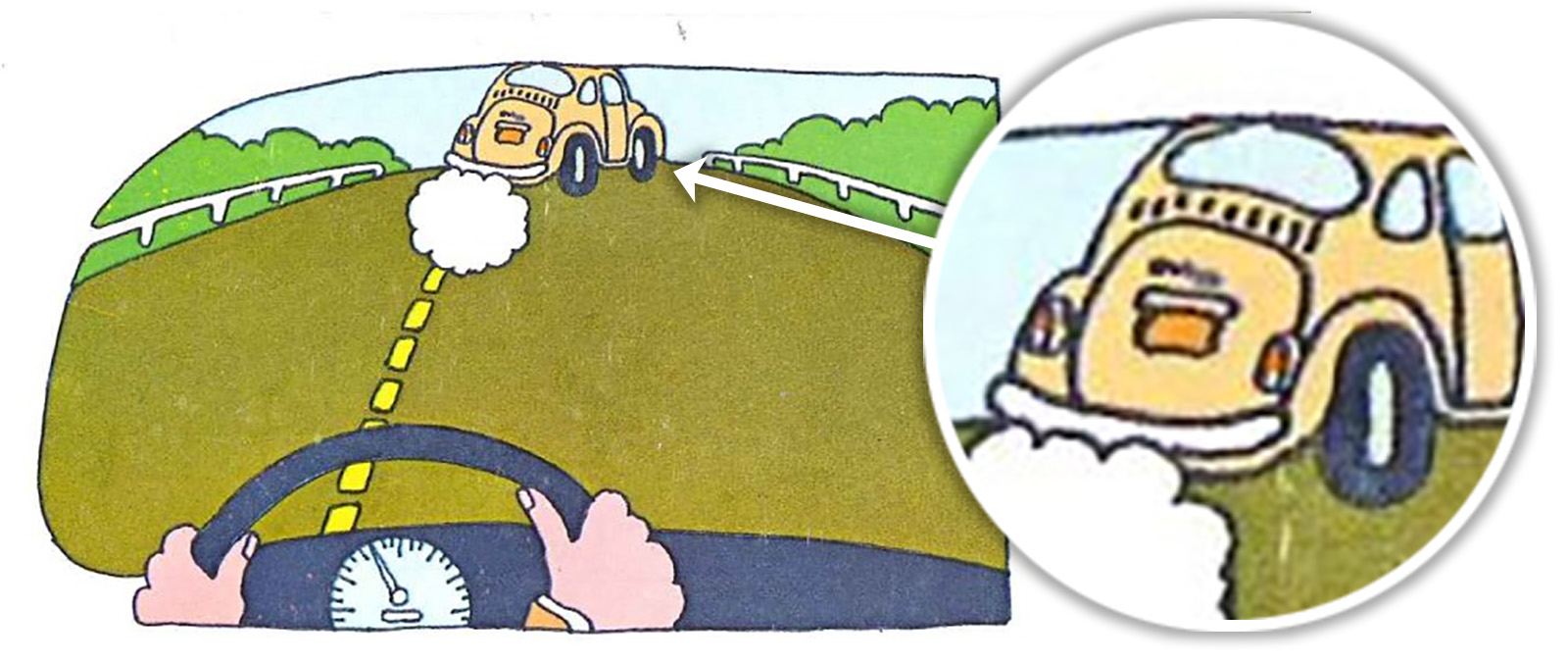
That crude little drawing there may be the first illustration of a ’68-type Beetle anywhere, and you can see the key visual traits: the simpler, higher “Europa” bumpers, and the new “tombstone” shaped taillights with the integrated reverse lamp.
But what’s weird here is the little scribble over the license plate light housing, which is intended to be the chrome VOLKSWAGEN script on the rear hood. No production Beetle ever had the script in that location or orientation. I actually noticed this detail before and wrote about it a while back, but I promise there’s more coming. Here’s what I noticed before, at the rear of the car:
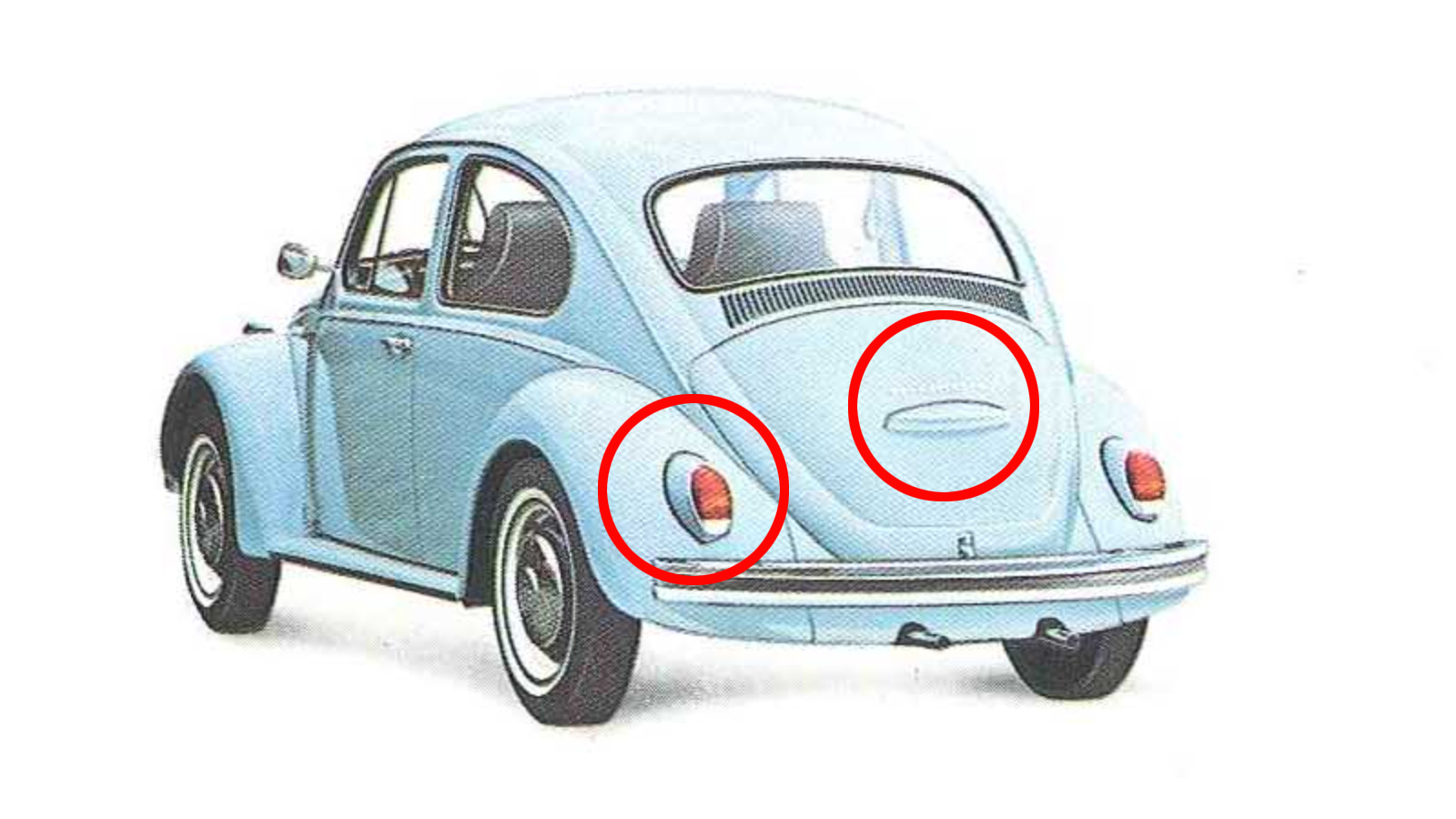
The VOLKSWAGEN badge is horizontal and just above the license plate light, and the taillights, while close, look smaller and slightly differently shaped. Also, and I didn’t call it out before, but the rear bumper seems to hide the four bolts that hold it to the mounting brackets, under what looks like a stripe of possibly rubberized tape?
Here’s a convertible version, with slightly more visible details and visible bumper mounting bolts:

For comparison, here’s the rear of a production 1968 Beetle:

See how the VOLKSWAGEN badge is angled and to the side? And note the subtle difference in the taillight shape. Okay, so those were differences I noticed before. But I’ve noticed more! It doesn’t matter why I was looking at this brochure again, what are you, my therapist? It’s fine.
Anyway, take a deep breath and look at this:
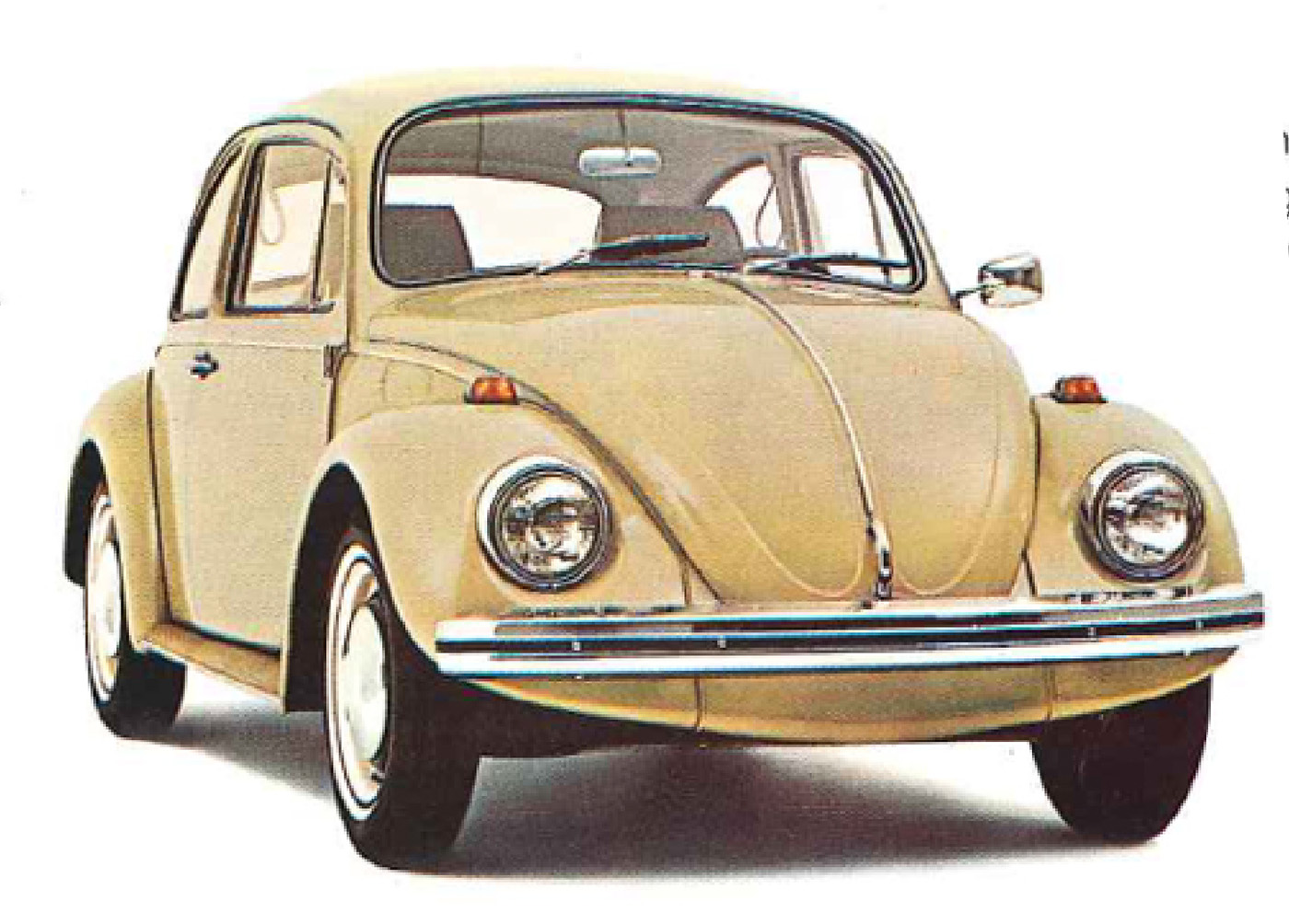
Wow, right? How did I miss this before? You see it, right? No? Wait, here, let me show you a production Beetle to compare:

Now you get it, don’t you? What? Really, do I have to spell it out for you? Ugh, fine:
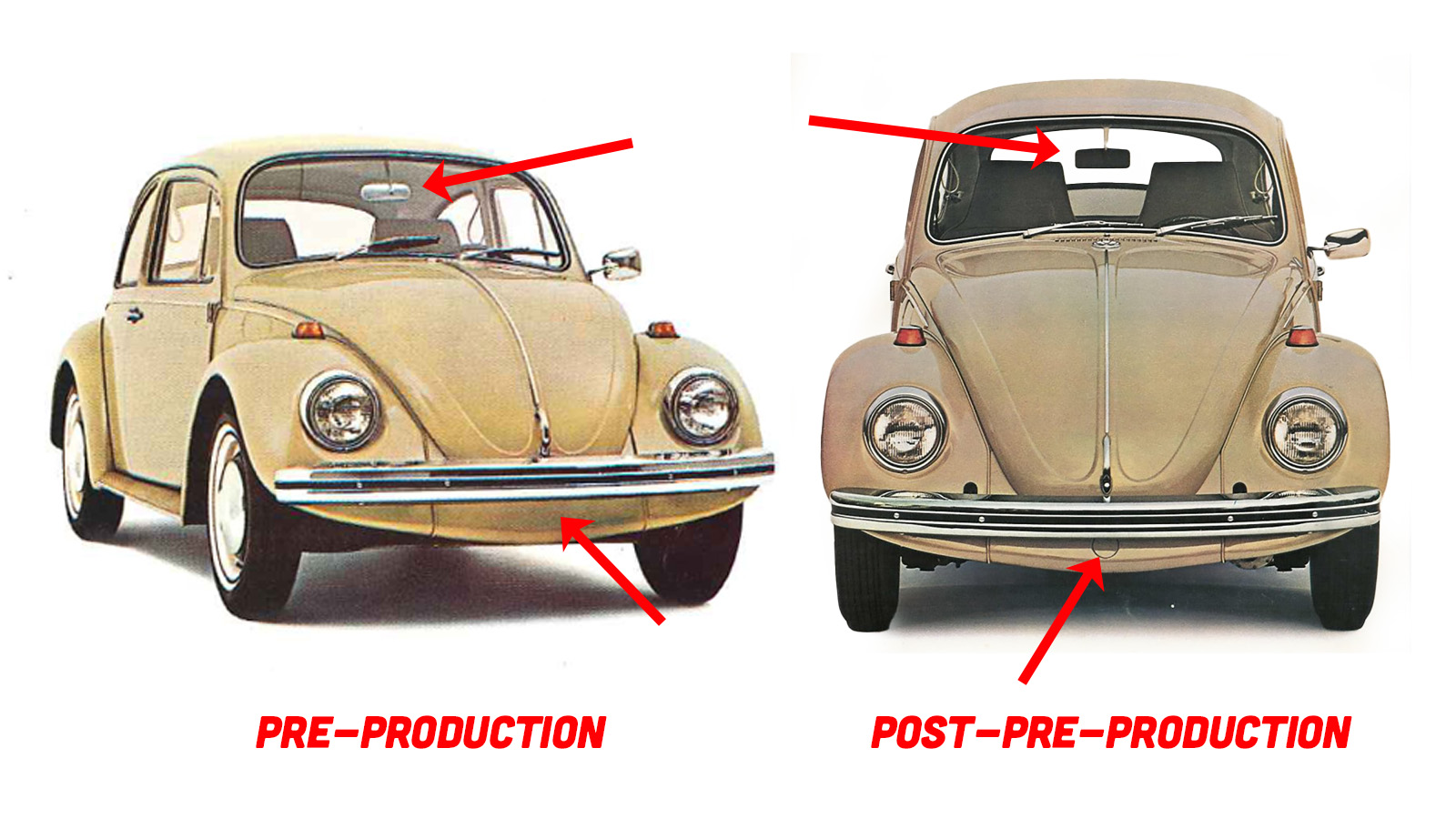
Look at this! That one on the left is clearly a pre-production Beetle, because there are two glaring differences between it and what would be the 1968 Beetle. First, the rear-view mirror. The one on the left has the old metal one on the metal arm; the production car would end up with a very modern, more rectangular black plastic-covered mirror (with the anti-dazzle switch) mounted on an arm covered in softer white rubberized, textured plastic.
That was a huge change in Beetledom! And now we know it must have been a very last-minute change!
The other one is even more odd. Beetles from ’68 and up had this odd little circular inset panel thing on their front apron. You can see where it goes more easily on the part itself:
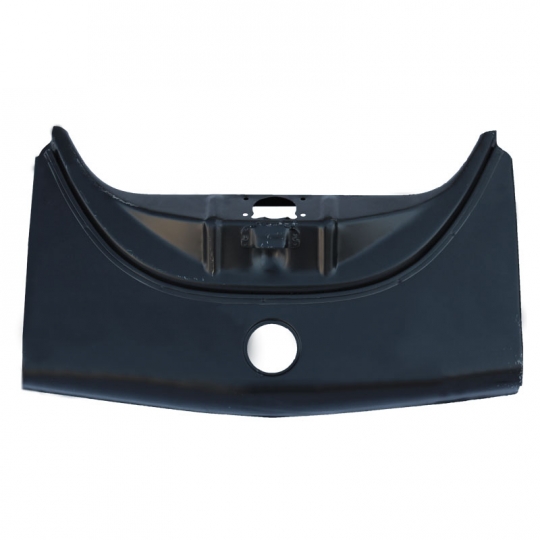
The little circle of metal that fills that hole is technically called the Front Apron Tunnel Hole Cover. It’s just a little cover for that access hole. On Brazilian-built Beetles (or Fuscas) the little cover was often black. I always thought VW should have offered a little foglamp to go in there; that’d be cool as hell.
Anyway, the pre-production Beetle shown here did not have that access hole or cover! This is like seeing someone born without a belly button for VW geeks.
Man, this is big. Like I said, as far as I know, this is the only pre-production, visibly different Beetle ever shown in an official VW brochure – you know, not counting any of that KdF-Wagen stuff from WWII, I mean. Let’s say post-1950, VW as we know them today VW.
If you need to take the rest of the day off to process this, tell your boss I said it was okay. They can email me, if need be.


Is it possible that these difference aren’t real, but rather just poor air-brushing (That’s what they did before Photoshop) by the brochure-production department? Maybe it was a pre-production car with NO mirror, and the brochure people air-brushed one in, but picked the wrong one? And maybe they thought the missing access-hole cover didn’t look good, so they just air-brushed it out? I find it hard to believe that VW didn’t think about the need to remove the shift rod (for repairs) WITHOUT removing the body while the car was being designed. By the way, the Karmann-Ghia has similar access holes on the rear quarter panels (so you can get the torsion bars out WITHOUT removing the body).
I have a ‘68 that was first sold new in Seattle, Nov ‘67. The oddities I’ve noticed:
1. Behind the right speedo grille, there’s still an unused fuel gauge bracket. (The gauge was relocated to the speedo in ‘68).
2. The owner manual shows the heater knob being red, but they’re both black.
3. The seatbelts pictured are the older ‘67 style retractable lap belts, that clip onto a weird central ring. My car has non-retracting 3-point seatbelts—a new US requirement for ‘68.
4. The car has a German market Blaupunkt radio in it with odd bands. I found out it wasn’t for the American market when I tried to source a replacement dial bulb. The only place that had them was German eBay. The band selector buttons also double as station pre-selects: LMKUU.
L is longwave. It doesn’t pick up anything. They use this in Germany for weather & traffic conditions.
M is medium wave, it’s basically AM.
K (Kurzwelle) is shortwave. It doesn’t pick up anything.
U Ultra-shortwave is FM. Clearly the preferred band in 1968 because it got TWO presets instead of one!
USA Beetles typically got American radios as a dealer-installed option, made by Motorola or Bendix. I assume mine got a weird German radio because Motorola hadn’t started making new radios to accommodate the padded dash yet (also mandated for 1968). The bands are also truncated oddly. But hey, VW had cars to sell!
Cool chart! I’m not a psychologist, but I think you may have VWOCD.
I would suggest that the 89 to 90 transition was equally significant. But you’re far deeper into VW design and engineering than I am.
What I don’t understand is why righthand side wing mirrors were there only in 74 and 75. And why there’s no lefthand side ones 59 – 62.
To be honest, this felt like one of those spot the difference puzzles.
And as I scroll down through the rest of the comments, I see Boulevard_Yachtsman has already pointed out the lack of any external mirrors in 59 – 62.
Damn the ordering logic of comments on this site.
But maybe it’s me. Maybe I should read ALL the comments before posting mine. But it would be nice if when one gets to the end of an article, the oldest comments display first and get more recent as one scrolls down, like they do on most sites.
Why did they remove the upper horizontal bumper bar for 59 but bring it back in 63?
“post-pre-production” finally got me
Jason, you have something by the corner of your mouth there. Looks like food.
No, no, other side.
Up a bit.
There. You got it.
Corvair > Beetle
It also looks like they changed the resting position of the passenger side wiper blade or am I missing something?
Never change Jason.
Or, if he does change, we’ll want to see both pre-change and post-change photos to compare and comment upon.
I believe we’re experiencing a post-recall Jason with new hoses.
Ok, what about the other apparent glaring difference, also in the front apron?
At the bottom edge of the pre-production, I’m seeing a smooth sweep down, ending with a lip forwards. On both the post-pre-production pic and the gray/black part pic, I’m seeing the main sweep down, then a bend downwards or rearwards, and then finally a lip forwards. No?
This is great stuff, but I have a question about the chart. Did VW really not have an external rearview mirror from ’59 to ’62?
I don’t know about elsewhere in the world, but the US didn’t require any outside mirrors until 1966. The 1959-62 models pictured lack the bumper overriders of “export” model Beetles, so maybe they’re stripper German-market examples?
They do seem to be their own thing as the steering wheel also appears to change in ’59. Then the wipers appear to change in ’63 along with the bumpers and mirrors again.
I need someone to explain the other differences between 67 and 68. I just see the different front bumper and rear-view mirror.
Off the top of my head:
Headlights and reworked front fenders to accommodate them, taillights, bumpers, dashboard (received padding), steering wheel, seats (I think), the rear decklid over the engine, and probably several other things I missed.
If I remember the old Torch video from the old website (the one where he ranted about 66-68 beetle changes and talked about his “fleshy yarmulke”), the 66 was old covered headlights and old bumper, 67 was new headlights but old bumper, and 68 was new headlights and new europa bumper.
Ooh yes good catch on the headlights! I forgot the 67s got the new lights but looked mostly the same otherwise. There’s a fair bit of Beetle parts that are 1967-only, from what I’ve read and seen when buying parts for my ’72 Super Beetle.
Orderly: Mr. Leidig? It’s time for your meds. Oh, and I brought you some of our newest soft cookies. They are the most delicious chocolate chip cookies you will ever gum.
Leidig: Thank you. It’s been a stressful last few years and these cookies are my solace.
Orderly: One more thing…
Leidig: Really, I just want to enjoy my cookie and a nap…
Orderly: Torchinsky found another inconsistency in one of your brochures. From 1967.
Leidig: F**k.
Not a VW, but I have a brochure that’s been bugging me since I looked at it a few months ago for the first time in many, many years and noticed something very weird. It’s an early launch fold-out for the 1996 Dodge Caravan; see if you can spot what’s wrong with it.
This is like seeing someone born without a belly button for VW geeks.
As we all know, the 1968 Beetle was birthed when the Type 2 swung its sword at a Porsche 356, slicing off its genitals which fell into the foaming sea.
Being a Beetle, the 1968 simply floated to shore.
So what is the front apron hole for on a VW bug? I have a few cars with holes in the front to get it the hole in the radiator to get at the crankshaft so you can crank the engine by hand but obviously the VW hole in the front is not for the engine, so what is it?
Honestly, I’ve never really been sure! It opens into the spare tire well!
It’s so you can pull the shifter linkage out! It slides out the front of the central tunnel. On pre-68 cars, the luggage compartment lid stretches far down enough that it covers the opening, but on the 68 model, as they raised the lid’s edge, they needed to create a dedicated access port for it. On the Type 3, the bottom of the spare tire compartment has to be removed for this service, which VW were considerate enough to make a similarly easy process. The Brasilia has a similar port to the late Beetles, as does the Karmann Ghia, but I’m not sure if either has a lid for it, as both have noses that taper inward below the bumper, making the valence panel less conspicuous.
ohhhhhhh thank you! That makes sense now that I think about it; there’s that other access panel on the other side of the wheel well!
Sharing a new fact about VW’s with you feels like I imagine adding a book to the Library of Alexandria would feel.
And one more on the front of the tunnel! (Three total, if you’re counting)
I’m really glad VW decided to add the hole through the apron. I recently replaced the shift bushing on my bug, and without the access hole, the body would have had to come off to change it.
You mean you don’t have to remove the transmission?
Indeed, I do. Why do I get the feeling that you, at some point, unnecessarily removed and/or helped someone remove the transmission for shifter linkage work?
Oh what would ever give you that idea. See also, sawing a hole in the firewall to change the fan belt on a 914/6
It’s intended to store snacks or weed. Tap a thread into the opening to screw a VW emblem into it, and nobody’s the wiser.
It’s for the tow hook/anchor for shipping.
“This is like seeing someone born without a belly button for VW geeks.”
Ha, makes one think of the 1973 TV sci-fi movie Genesis II made by Gene Roddenberry where he had some of the characters shown as having double navels (seems that he did that partly as an inside joke since the censors at NBC refused to allow characters to show their navels on the original Star Trek series.)
Alas, no Beetles in that film, only a golf cart: https://imcdb.org/movie_64366-Genesis-II.html
Ok, you reminded me of this.
https://youtu.be/Zjpooj6uvEQ
I have a 68 Beetle, so this article feels tailor-made for me!
Shameless photo plug because I’m so damn proud of this car:
https://www.thesamba.com/vw/gallery/pix/2592863.jpg
Jeez, I’d be proud too.
Beautiful! 🙂
Thank you so much! It’s been a huge labor of love since 2019. Bought it as a non-running, rough project from the original owner in Arizona. It’s come a long way!
That’s really nice!
Thank you Dan! It’s a driver, and far from perfect, but I love it! Truly my dream car.
What’s always amused me is how VW would use the previous years part supply before using parts meant for that year. For example, my early 72 Super Beetle (built October ’71) came with the old style “lobster claw” seatbelts and no seatbelt warning light despite the owners manual showing more modern retractable belts and the warning light. And I think my front brake drums are still the 71 style, I had to buy them based on my cars production date. There’s been more things too, but those are what I remember off the top of my head.
Always a good day when something for VW anoraks drops 🙂
Where did the chart of the front views of Beetles come from? Not altogether sure about taking it as 100% gospel since it shows the ’58 still rocking an oval window…
Would the chart be from another country? Hard to tell about the headlights due to the scale and resolution but the chart appears to show the old style bulb-and-reflector still being used beyond ’67; US-spec models changed to the new style in ’67, despite having the old style bumpers, while other countries got Beetles continuing to use the old style headlights.
Don’t let anybody tell you that you are weird for this obsessive behavior; this is not wrong, this is passion. Those people are wrong for not appreciating the air-cool Volkswagens.
That’s nice – but here’s my question:
“The Love Bug” was in previews December 1968 and released March 1969 – it had been filmed April-June 1968.
So why was Herbie – which required over 20 different cars – a 1963 model?
One would think it may have been far easier to have ordered 20 1967 white sunroof Beetles from the local VW dealer in Burbank rather than running around collecting 20 1963 Pearl White sunroof Beetles off used car lots?
You’re close enough to the studios in Burbank.
Surely someone there still knows….
Isn’t it explained in the movie that Herbie is a cheap, used car? I imagine having Herbie be an older used car would make the “Underdog” story all the better considering people were buying new cars every couple of years back then.
Yep! Herbie is bought by his owner in the Love Bug, who is looking for “cheap, honest transportation.”
All Herbies aren’t 1963 models anyway. Beetles were so common and similar that sometimes an earlier/later model would be modified to have its most glaring differences between a ’63 model corrected.
Yes, one of Thorndyke Motors’ regular wealthy customers asked them to find a reliable, economical used car for their upstairs maid to use for running errands, so they found Herbie, probably at a dealer auction. Not the sort of car they usually dealt with, but they wanted to keep an important customer happy
>You’re close enough to the studios in Burbank.
Jason lives in North Carolina. Although lately he seems to be going to LA about once a month on business. David lives in the Valley and between that and The Autopian’s office being somewhere on the Galpin property, I sure hope Jason gets to fly to Burbank and not LAX.
Oops – You’re right – I was thinking of David….
TBF Jason *used* to live in LA, so he was close then.
Is it me, or is there something weird going on with that ’74 Beetle (beyond the passenger side mirror)? The hood looks off, the lower fascia is different, it looks wider somehow?
It’s a Super Beetle. That’s why.
Like Jason said it’s a Super Beetle, which used McPherson struts up front instead of the torsion beam setup used in most Beetles. Everything in front of the doors is unique to Super Beetles. From 73-74 the Super Beetle got a larger, curved windshield and a real dashboard as well. Competition was heating up and VW tried to modernize the Beetle with the Super Beetle, which supposedly had better driving dynamics and considerably more trunk space, as well as the most powerful air-cooled engine VW produced from the factory.
I own a 72 Super Beetle and am always amazed that VW managed to sell such an old-fashioned, space inefficient car in the numbers they did for as long as they did.
the 74-75 have passenger side mirrors the rest do not.
’67s are easy to spot was the ONLY year for the sealed beams on the old fenders (they still have the horn grilles) – it was also the introduction of the 1500
’68 was the introduction of IRS with CV joint axles – significant chassis change.
SO – looking at those photos, does it look like there’s photo manipulation of the taillight lenses, especially the convertible, where it’s the old housings with either actual new lenses fitted to mimic the “tombstone” lamps, or done in post with a careful X-Acto hand?
They do look weirdly manipulated! I suspect they may be the old lights, and the photos modified. Maybe I’ll try to reach out to VW to find out more, but it’s unlikely they’ll know.
You’re probably going to need a seance and a ouija board to talk to anyone who might know
Fortunately, ’tis the season for doing so, as today’s the first day of October…
You just atoned for sending research depts on wild goose chases. It’s not even sundown yet!
Do it. 😉
Not all 68’s have IRS. Mine is an early car, and still has a swing axle. My understanding is that they essentially used up the swing axles on the early 68 cars.
Ja, make better trailing throttle oversteer!
In ’68, IRS was only on the semi-Autos. It went across the board the next year.
Damn, we’re nerds.
The best kind of nerd to be is an air-cooled VW nerd in my book!
Yep yep! The Auto-Stick was the only way to get IRS in 68 from what I’ve always understood.
All Beetles had sealed beams (they were mandatory on all new cars sold in the US from 1940 onward), 1966 and earlier models just had an additional glass cover over them as part of the headlight assembly. US regulations banned headlight covers effective 1968, VW redesigned their fenders to accommodate uncovered lights for 1967