

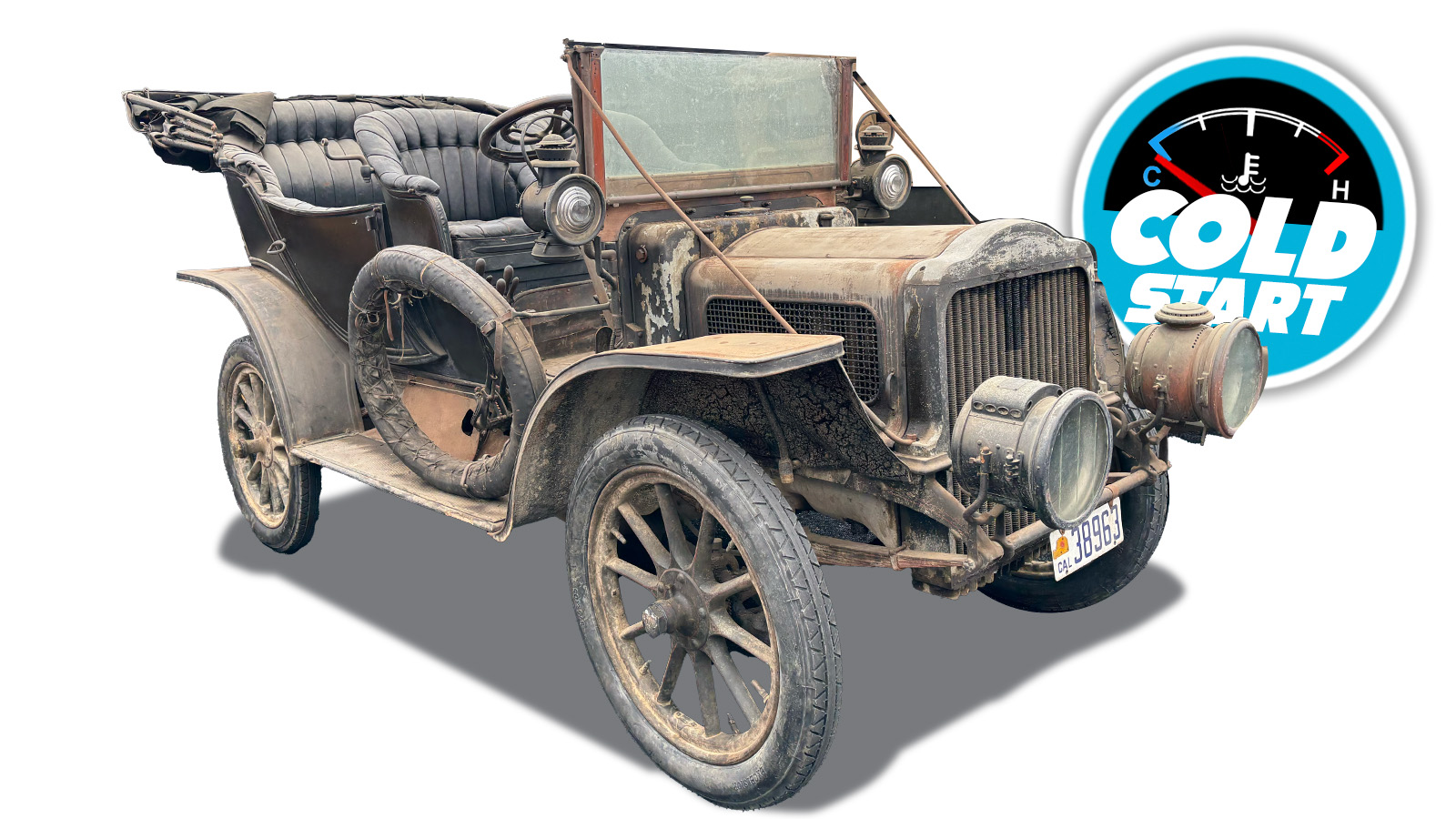
This is going to be a somewhat short Cold Start, because, as usual, it’s very late and I fell asleep trying to write this earlier, but I’m not going to give up, because there’s too much good stuff to share with you. Today I just want to share one fascinating detail, something we have on all our cars and likely take for granted, but in a form so primeval and archaic that it becomes absolutely fascinating.
This detail is on a 1908 White Model L steam car; this is a remarkable machine that’s being auctioned off this week, having been owned by one family for over a century and appearing to have never been restored, just preserved. It’s a colossal, locomotive-like machine, fitting its steam nature, and has a strange presence when you’re near it. It’s clearly a car, but the scale of everything is so off, and it feels like such a complex assemblage of clunky, heavy blaclksmithed parts that the whole thing has an air of a lumbering contraption, but somehow in a charming way, if that’s possible.


Here’s how the whole car looks, so you can get an idea of what we’re dealing with:
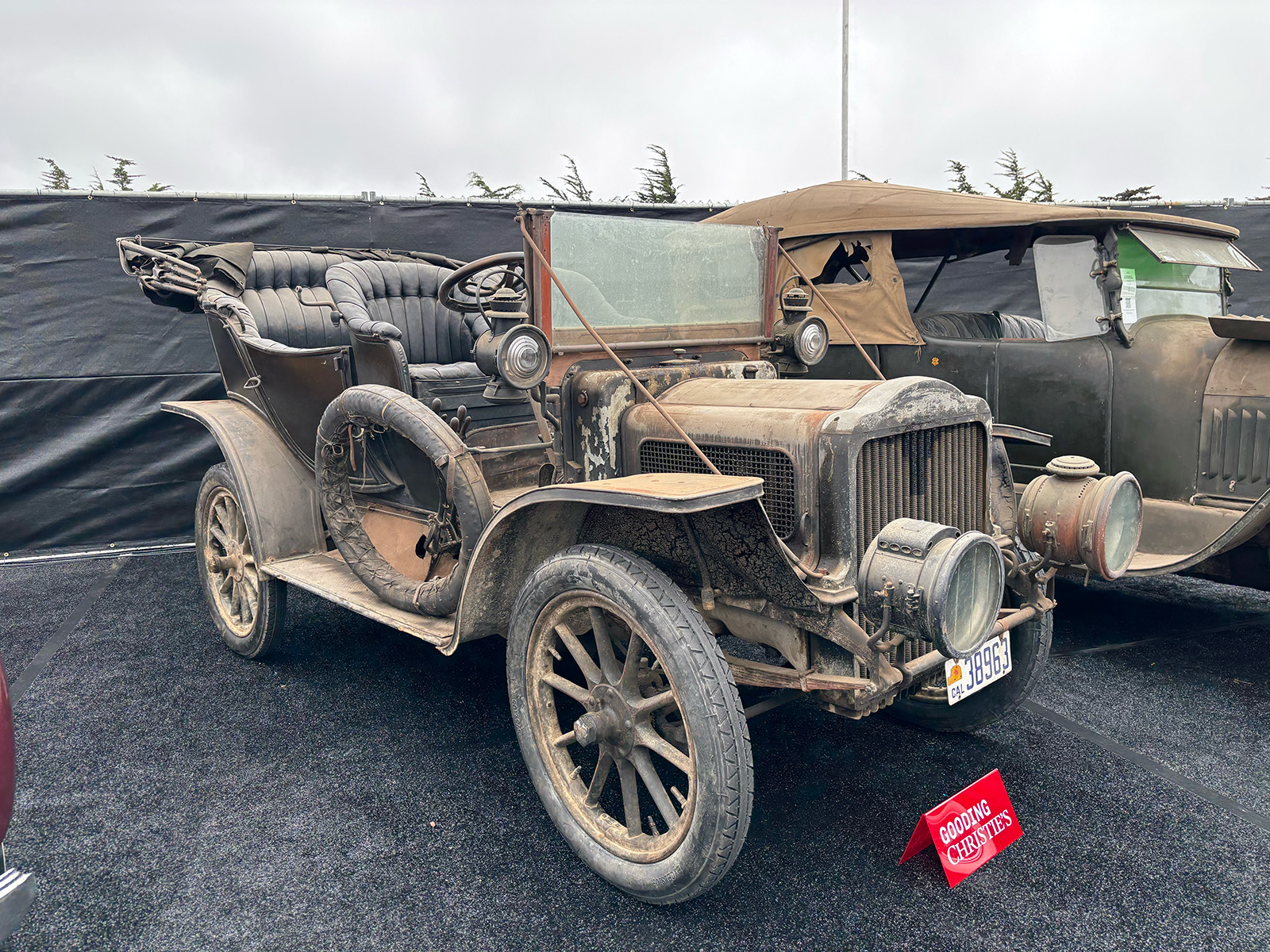
The detail I want to show you is on the inside of the car, as much as something as open as this can be said to have an “inside.”
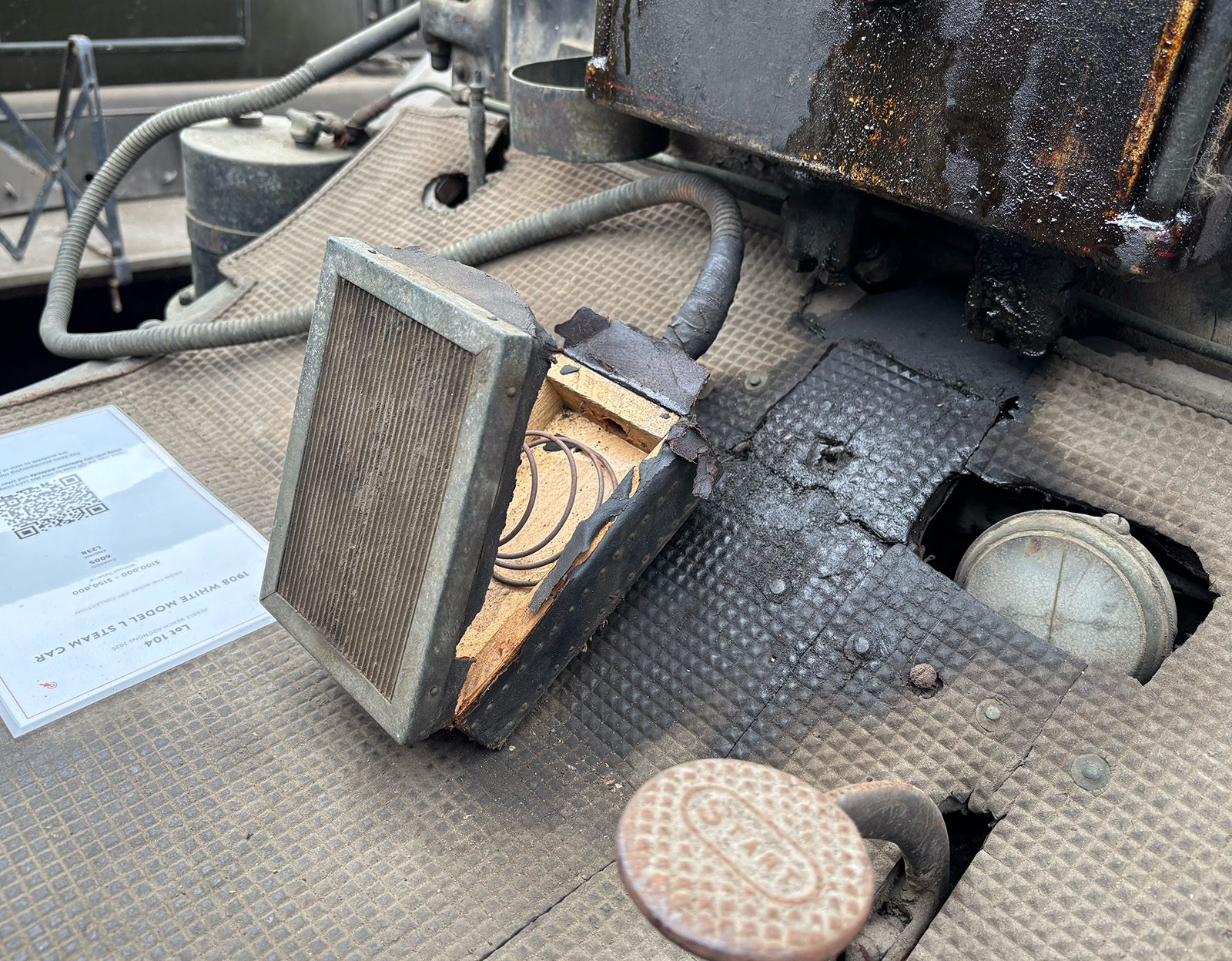
It’s not this, but this is also incredible; this is on the floor, where you can see that comical-looking spring-loaded pedal. I suspect it used to have some kind of accordian-like rubber or leather boot, because it’s used to actuate the horn, and I think it literally pushed air to the horn through that tube, in a very accordian-like manner.
I also love that gauge peeking up through a hole in the floor, like a timid mole. There’s something Dali-esque about that, too. Oh, and that big START pedal there. But what I really want to show you is this:
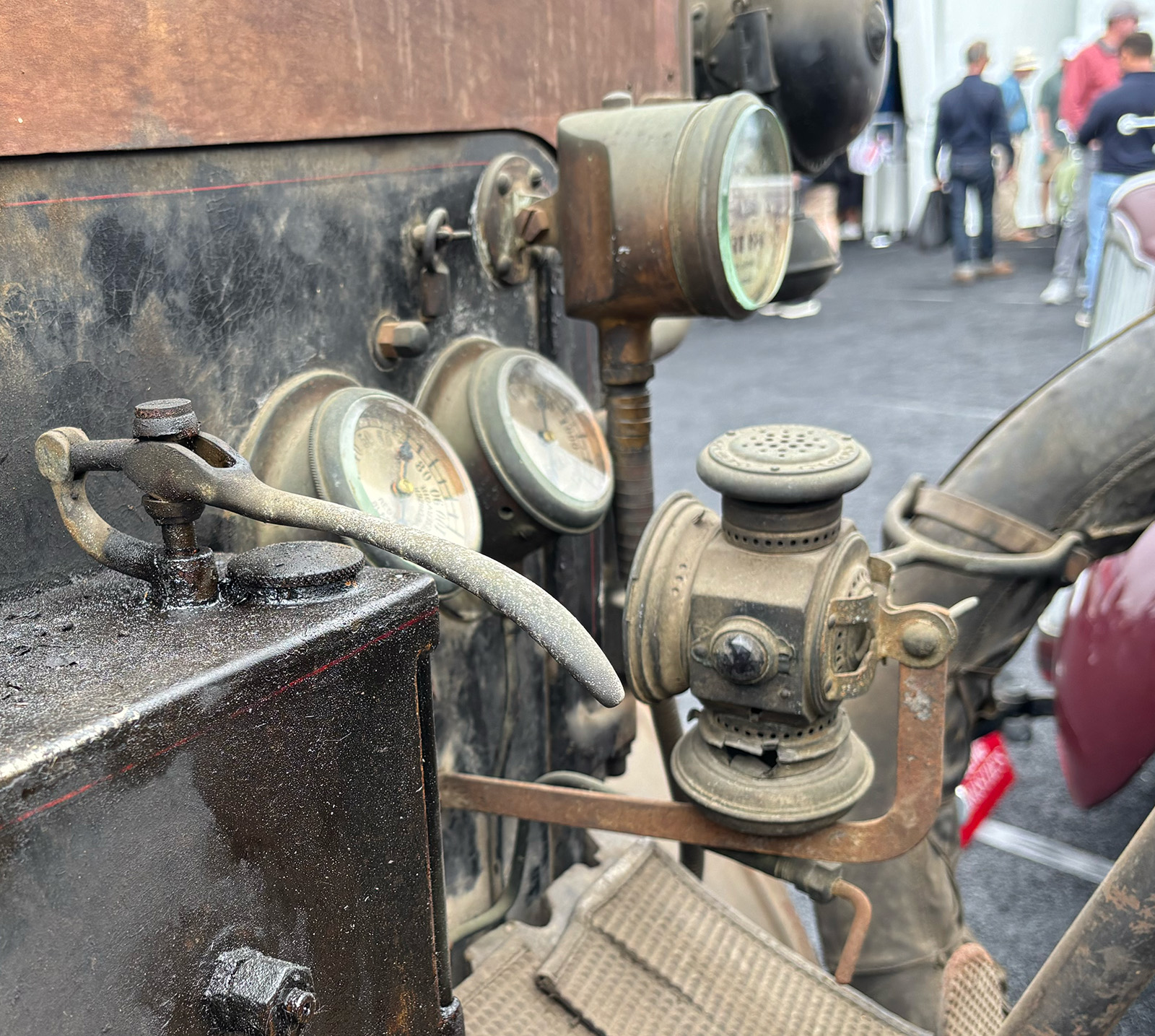
See that? That’s the gauge cluster there, but what I want to note is the incredible dashboard lighting setup: a kerosene lantern, mounted on a huge L-shaped bracket, shining on those gauges.
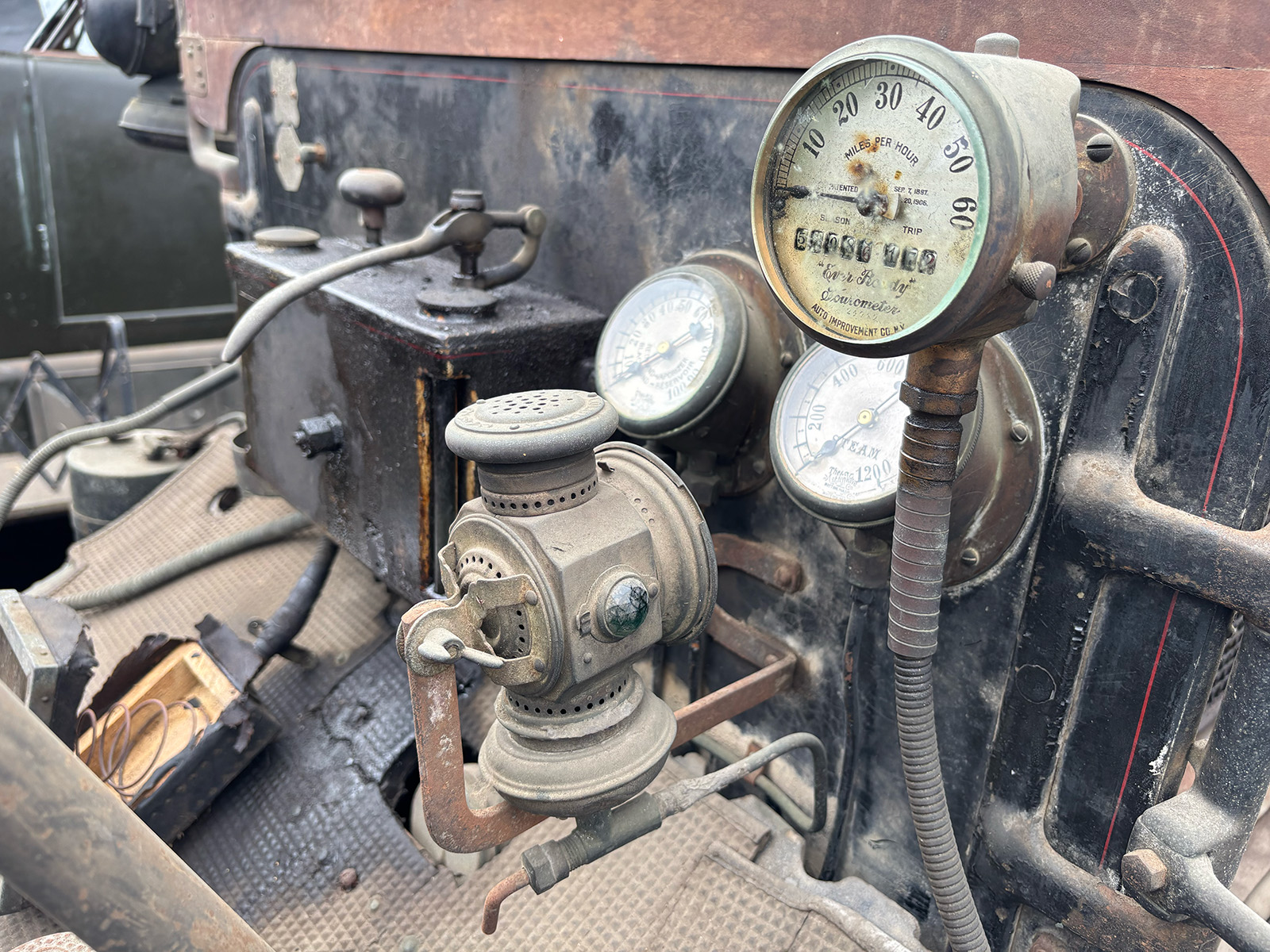

I love the crude but effective nature of this setup, the incredible clunkiness and charm of it all, and thinking about the process of using it, which must have involved igniting a wick with a match, is fascinating. This feels like one step past just having a small fire there to light those gauges.
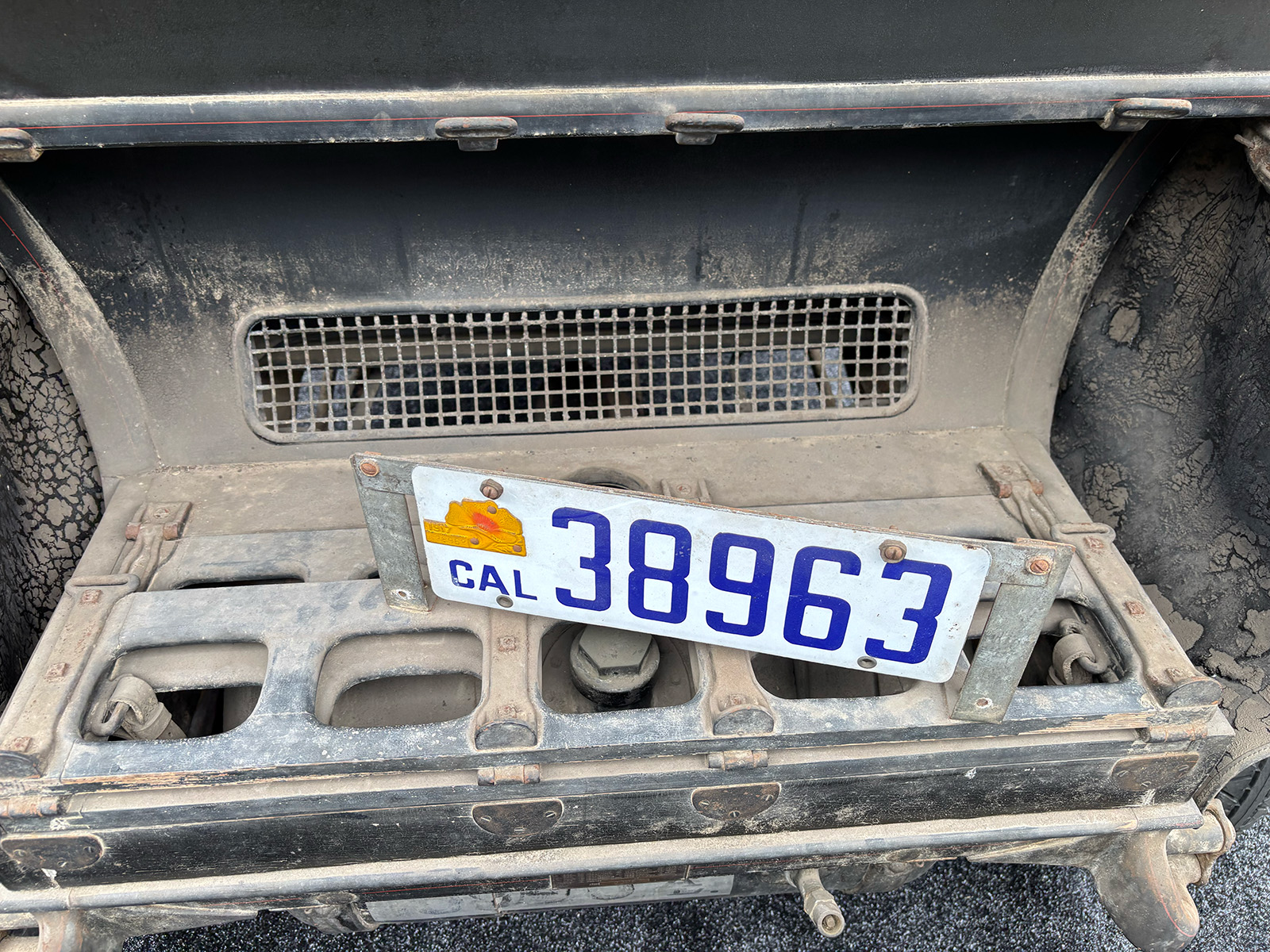 Around back, there’s another little mystery: why is the rear license plate mounted at an angle? There would have been plenty of room to mount it straight on, so what was the reasoning here? I’m kind of baffled.
This is an incredible machine, and I’m thrilled I got to see it up close.




I wonder if they had horn fluid back then? Ha ha
This immediately reminded me of the spotlight in the dash of a 70s Beetle that illuminated the heater levers by the handbrake (at least enough to satisfy the NHTSA)
There’s an older registration “plate” painted directly onto the tank that’s mounted below the angled plate. This is visible in the photo above but it shown more clearly in some of the photos on the auction site. My guess is that when the metal plate was added (the date on it is 1917), the owner decided it would receive better illumination from the license plate lens built into the side of the single tail light assembly if it were facing at an angle towards the lens. The auction photos show the post upon which the tail light used to be (on the left side, as was typical) although the light assembly itself isn’t currently installed.
My further guess is that the tail light assembly was replaced with one that contained a license plate lens at about the same time the new plate was installed, as a side-mounted lens for this purpose wouldn’t have been of much use with the older, lower, painted-on registration.
Despite this being built like a locomotive, it probably still only weighs half as much as many modern EVs.
Zoom in on the speedometer, or rather the “Ever-Ready Tourometer.” It has two odometers: the smaller one is for “Trip” and the larger is for “Season.” I’m sure the owner was the life of the party, regaling others with the number of miles achieved by his auto during the 1909 touring season.
“Around back, there’s another little mystery: why is the rear license plate mounted at an angle? There would have been plenty of room to mount it straight on, so what was the reasoning here? I’m kind of baffled.”
When did license plates become the norm, at least where that car was originally driven?
Among some possible reasons is that it looks like people used that platform as a step so if the license plate was straight on there wouldn’t be enough room for someone to step on the platform.
The frame holding the license plate looks so janky that it doesn’t seem at all factory so one wonders if it was home-made by the owner (or their chauffeur! Those cars weren’t cheap!! So it stands to reason Richie Rich or Reginald Van Dough, Jr would’ve had a chauffeur*) with whatever scrap material was available. And drilling holes in that kind of metal (which looks like some kind of cast iron) is confoundingly hard especially with hand drills and/or dull drill bits, lol, so perhaps they just made use of pre-existing holes where they simply made the sheet metal frame to fit since the sheet metal is a damn sight easier to work with.
*Named Bascomb
A Mercedes W123, a car made 70 years later, still didn’t have backlit gauges. There are two incandescent bulbs in the back and two little light tunnels to get that light onto the gauges.
“There are two incandescent bulbs in the back and two little light tunnels to get that light onto the gauges.”
No, the source of illumination comes from the incandenscent bulbs in the small housings at top of the bezel close to the clear plastic cover in the instrument cluster. See this photo. You can see the rectangular housings in this photo.
What? No radium-painted dials!?!?
They didn’t exist yet, that’s how old this thing is. Marie Curie didn’t isolate radium as a separate element until 1910, two years *after* this thing hit the road.
Yeah combustion then
I love your depth of geeky knowledge!
Fun fact: watches use tritium now because you get the same glowing effect without (most) of the fun radiation dangers!
I prefer my radium with lanolin anyway:
https://live.staticflickr.com/6107/6305945617_902883ec9c_c.jpg
Unless you are licking the paint the radiation danger is trivial.
BRB, taking my watch apart…
I hope you know licking that dial won’t give you super powers.
(or WILL it???)
SITREP: My mouth feels like a space ship, and I can smell all the colors.
This is so my sort of contraption! The springy pedal hooter thing was as a result of early heath and safety regulations, the shriek of a steam whistle was said to cause miscarriages in livestock and ladies of a fraught disposition so a warning note more akin to a mooing cow was required.
I really would like to own this, but even in a chemically addled post tooth extraction state I can hear ghostly voices, NO oooooooooooooooooooo
It’s pumping air alright, but my guess is that it is to pressurize the fuel tank. Pretty lux compared to the hand-operated fuel tank pressure pumps of the time
Holy cow… That’s amazing 😮
It looks like the lantern for the frontlit gauges is fed from that large-ish box to the left: it has a hand pump on top and there appears to be a hard line running from the bottom of the box to the bottom of the lantern, which has a small 90-degree handle to open/close the flow valve.
Aero. 🙂
Acetylene, Due to global treaties and things I cannot legally tell you any more.
The pump handle is probably to squirt some water onto some calcium carbide, to get acetylene as needed. The last thing you want is too much acetylene.
LOL – The speedometer goes up to 60!!! That would be absolutely terrifying! In that vehicle and on what they would call “roads” back in 1908.
Steam cars were the high performance road cars of the time, a modified Stanley held the world land speed record in 1908, at just under 128mph, and these Whites could top 75 with lighter weight bodywork
Steam also offers maximum torque at zero speed. You hear about electric cars chewing through their tires, I wonder how those tires held up. Maybe they just didn’t offer low enough gearing for that to be an issue.
Spinning the wheels on steam locomotives was a problem. Gee, I just realized that when I was a child, there would be multiple steam engineers talking about driving locomotives. I haven’t heard one of those conversations in about 60 years.
This is just a whole other level. Steam cars are interesting in that they’re externally combusting: a flame outside the engine heating the working fluid. But that isn’t the only external flame? OH no:
There’s a couple more up front: headlights! Two slightly different designs, too. One might be acetylene, like an old-school miner’s lamp? Can’t tell from here but it doesn’t seem likely. You wouldn’t want to unnecessarily pack different fuels.
A couple more sort-of up front, to either side of the windshield. Smart, considering that even under the best circumstances a kero lamp isn’t very bright unless these are mantle lamps, and the angle doesn’t let me see that. More lamps lighting the way is probably wise, though outrunning your headlights’ throw is probably not a big issue with this rig. Then again, with whatever braking it had to offer, maybe it is.
One more! And to cloud the whole internal-external combustion thing, this is the aforementioned kerosene lamp lighting the instrument “panel,” about as “inside” such an open car as you can get.
Are there more? One on the back to warn off vehicles unwisely gaining from astern? A helpful navigational aid for rampaging moose? Something inside so passengers can read a nicely long Victorian novel as they make their leisurely way home?
In yet another example of “they don’t build them like they used to,” this is one of the ones you hold up to illustrate why.
There’s one special feature of carriage lamps (those lights adjacent to the windshield). See the hoops on top? The lamps are removable and the hoops are carrying handles. The idea is you would arrive at your (unpaved, unlit) destination and you’d grab a carbide-fueled carriage lamp to light your way to the door.
There’s a downside though: those lights get very hot in operation (open flames do that) so you’d want to be wearing heavy leather gloves. You’d then discover that you’re carrying a very hot metal object so you probably wouldn’t want to walk a great distance.
(I just learned this from the owner of a 1914 Locomobile displayed at Car Week. He said most owners tried the portable carriage lamp feature…once. Then the lamps stayed on their cars permanently.)
Acetylene was the normal automotive lighting and miner’s headlamp until electric lighting improved. Cavers still carry carbide lighting today because it’s lighter and more reliable than batteries.
Acetylene makes a very impressive bang too.
I once had a car where I had to carry a pocket Maglite to check my speed/revs at night. The dash was front-lit until a couple days past the warranty, then for a couple more years you could smack the dashboard and make it come back on.
Yes, it was a 90s VW product, how did you know?
I had a 2001 Subaru 2.5RS that I bought from a rallycross friend. By the time we finished paperwork it was dark, and I had a 1.5hr drive back home. I learned 1/3 of the gauges didn’t light up, including the fuel. Yes, it was almost empty.
“Hon, should you maybe clean the car up a bit before heading to Monterey? Have you checked the DEF levels in the truck before you tow?”
Husband crawls out from under car, in full character and costume
“Stay in your lane, woman! They give you the right to vote and now you’ve got an uppity opinion on everything!”
I agree, they could have at least washed it. Reminds me of RV ads where the insides haven’t been cleaned and the bed is unmade. And you want someone to pay big bucks for that!? Shesh!
Half of the value is in that patina though!
The internet says license plates began becoming reflective in the 1920s, maybe the angle of the plate would be to reduce light reflection to the cars behind.
Regarding the angled plate, it appears the part it is mounted on is hinged on the side toward the camera. There is also a thin bar a couple of inches closer still.
It looks like when that part is flipped up, the plate frame and the bar would act as a stop to prevent it from going much past vertical.
The pieces holding the plate aren’t very stout, so it might be mounted at an angle to give it a little more structural integrity, so they don’t get bent/deformed as easily.
Also, it would prevent the plate from being defaced by that bar.
Looking closely about halfway up the vertical piece on the right, I think I can see a bit of a worn spot on the edge that seems to line up with the bar in the foreground. But maybe I’m imagining things.
Just a guess.
With a dashboard light like that, Meat Loaf should have owned it.
I can see pressure twice by the dashboard light.
I think this car is where I draw the line with regard to driving on a highway.
Maybe not this exact example, pre-restoration, but a White Model L might be one of the few pre-WWI cars that legitimately could get on the highway, this should be able to cruise at around 70mph
The problem with Brass Era cars isn’t getting the to go fast, it’s getting them to stop. Something like this might have weaker brakes than my Honda CM250C
I think that Jay Leno might be able to help get this thing going. Oh, wait…
An attempt to defeat early speed cameras? You know, the kind that mount on a tripod with a cover over the photographer’s head.
Cop chases car down on his penny farthing bike
“Where ya going in such a hurry, steam punk?!”
My grandfather’s first regular job was on a steam-powered river dredge on the Mississippi. We went to multiple steam events, trains, tractors, cars, etc., where he would explain all the workings of the steam engines, their differences, and benefits. I still occasionally go to steam demonstrations, and they can be great fun.
I also imagine that if my grandfather were still around, he would be able to answer the question on the angled license plate.
Lets talk about those headlamps!
Are they electric or kerosene? I can’t tell.
What I can tell is that they appear to be the size of a 5 gallon bucket!!! DAYUM!!!!
Others have mentioned—but all the lamps are likely carbide lamps. You steadily drip water over calcium carbide and you get acetylene gas. I don’t think any are kerosene, despite torch’s copy.
First thought is, why have a pedal/accordion horn when you could have a nice loud steam whistle? Imagine the response from pedestrians when you blast that thing at them – and the horses! Terrify all the horses and they’ll clear the street for you!
“Terrify all the horses and
they’ll clear the street for youyou’ll need to have the street cleared of all the panic-poop!”ftfy
Oops wrong reply
It’s amazing that it’s survived this long, but I’d love to see this restored to factory condition and chugging down the road. What a fascinating piece of engineering history.
And it might beat the CrossCab in a drag race.
Now that would be an interesting “long term review article”… How many staff cars can this out accelerate… I think the Changli, 2CV, and Pao should be worried. Sorry Jason.
A long term review of this vehicle would span generations