


In the 50-plus years since airbags began to appear in road cars, they’ve become an integral part of the safety systems of vehicles, mostly for occupants inside the cabin, but in some cases, even for people outside the cabin.
More recently, airbags have made their way to bicycles and motorcycles, mounted on the vehicles themselves or integrated into the driver’s clothing. These days, you can even wear a vest that’ll deploy airbags in case of a fall.


My point is, airbag technology has come a long way. But as with most tech, it’s still evolving. One company in China has figured out a way to make an airbag for the driver of a car that wraps itself around the person’s head like a puffer jacket. And I’m deeply intrigued.
The Many Wonderful Types Of In-Car Airbags
Weird car airbags are nothing new. In addition to the front-facing, side, and side-curtain airbags most people are familiar with, there are front-facing airbags for rear seat occupants, introduced by Mercedes-Benz in 2021. There are knee airbags, which deploy from an area under the steering wheel. There are even center console-area airbags, which first came about from GM in 2013 with cars like the Buick Enclave, GMC Acadia, and Chevrolet Traverse. This video shows how they work:
There are also airbags built into the exterior of cars meant to cushion the impact of pedestrians on the front of a vehicle. Volvo was the first to introduce such an airbag in 2012. It works by inflating an airbag mounted underneath the rear of the hood, just before the windshield, where the pedestrian’s head is most likely to land in the event of an impact. The U-shaped airbag shoots up and rearward onto the windshield area. Here’s how it works:
All of these designs are, of course, meant to cushion body parts from striking hard points in or on the vehicle, as well as other people in the car. In the case of side airbags and knee airbags, they also act as restraints for flailing limbs. While these many individual airbags have worked well to prevent death—the NHTSA estimates frontal airbags have saved more than 50,000 lives between 1987 and 2017—Chinese automotive supplier Yanfeng thinks that its device can be even better.
This One Is Fascinating
Instead of relying on an occupant to “fall” into an airbag to cushion their impact in a crash, Yanfeng has designed an airbag that emerges from the seat and looks to physically wrap around an occupant’s head and neck areas, effectively equipping them with an air-filled helmet device in milliseconds.
In a press release from 2023, the company describes the airbag as “a fully integrated, enclosed airbag that can better protect the occupant’s head, neck, chest, and other critical parts in a variety of different collision scenarios.” There’s no word on how it deploys, but a singular photo shows the airbag wrapped around the head and even extends to the front of the neck, where it can reduce whiplash (the same sort of injury HANS devices are used to prevent in motorsports).

The device, which Yanfeng calls the Head-Mounted Airbag (HAB), was developed as part of an effort to increase occupant safety across a wide range of seating positions and seat designs. From the release:
In the new intelligent cockpit scenario, the large-angle reclining adjustment of the seat back, such as zero gravity and reclining posture, as well as the seat movement trajectory, such as rotation and long-distance sliding, are all very different from those in traditional cockpits. The seats are becoming more and more flexible in the cockpit, and all occupants may sit in the same car in different sitting positions, whether reclining or turned around.
Since current restraint systems are designed for upright sitting postures, statistics on traffic accident injuries show that traditional safety restraint systems cannot provide effective protection for occupants in non-upright or similar sitting postures. Therefore, Yanfeng began researching safety solutions to meet future mobility needs in 2020, attempting to find a solution to this increasingly prominent industry challenge.
In addition to the HAB, Yenfang has also developed a seatbelt that “uses a retractor fixed to the seat back to lock the seat belt in a more human-fitting posture at different seat back angles, providing more effective protection for occupants.” Then there’s the Pre-Crash Seat Quick Return Function, which can fling you from a reclined position to upright in the blink of an eye, so your body is better-positioned in an impact:
When an unavoidable collision occurs during vehicle operation, the Pre-Crash Seat Quick Return function adjusts the seat from a large angle to a position that meets occupant protection requirements shortly before the collision, based on signals from the vehicle’s Advanced Driver Assistance System (ADAS) or Autonomous Driving System (SDS).
When ADAS or SDS fails to accurately predict a collision, or when the vehicle does not have pre-collision functionality, the seat servo mechanism (FUS) allows the seat to return to a suitable backrest angle along a predetermined path after a collision, even in a large sitting or reclining position. This optimizes the seating posture and enhances restraint and protection for the occupants.
I’m curious to know how weird it feels to be jolted up right in a car right before an impact (not that I want to get into a car crash or anything. It just seems like it’d be fun.) Either way, the world might soon find out. According to Car News China, the helmet airbag will soon be available for the road in the upcoming Luxeed V9, a minivan from Chinese automaker giant Chery.
We’ve Seen This Before

This type of airbag might seem strange for automobiles, but it’s already been widely popularized in the bicycle and motorcycle industries. Yanfeng’s design reminds me most of Swedish firm Hövding’s head airbag, which mounts around a bicyclist’s neck and inflates using onboard helium and built-in accelerometer and gyrometer sensors.
Here’s a video showing how it works in slow motion:
The type of airbag above is also just an extension of the wearable airbags that have become commonplace among motorcycle riders over the past three decades. There are airbag vests, airbag suits, and even airbag jeans.
These types of airbags have even extended into plain pedestrian use, where people who are in danger of being injured in a fall can have their fall broken by a quickly-inflating airbag:

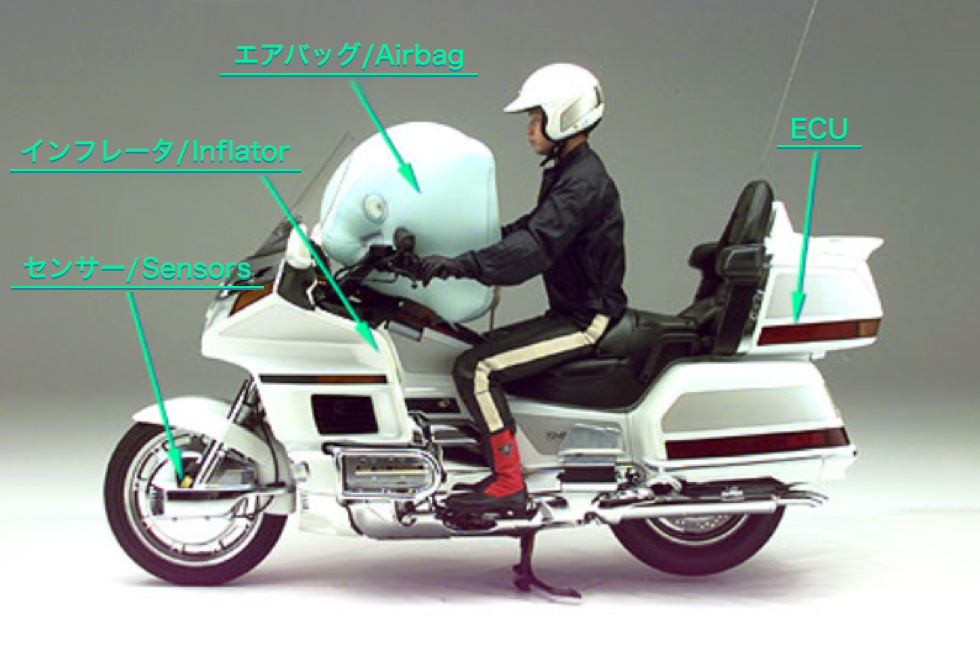
Even if you prefer not to wear an airbag while riding a motorcycle, Honda has you covered with its frontal airbag system for motorcycles, which was first introduced on the Honda Goldwing in 2006—a system that Honda says had been in development for 16 years.
With systems like this helmet airbag now in use, I suspect it’s only a matter of time until cars begin to appear with full-body airbags that inflate around occupants to the point where they’re fully contained in a crash, like those inflatable ball suits kids use to run into each other at full speed.
Top graphic image: Yanfeng



I don’t know how many more airbags we can get; I was first on the scene to a CR-V getting t-boned at low speed (ran a red light as the lights changed), and it was like trying to unwrap a cocoon to even get to the driver.
May as well strap me into an SR-71 ejection seat and be done with it.
GTFO with this type of thing. Now we gotta strap a collar around our necks to drive?
At what point can we just say things are stupid and bad and not everything new is progress. Life has risks, people get hurt and people die. It sucks, but you can’t go around in a literal fucking bubble like Brian seems interested in and still live a real life.
You should read the article more closely.
Brian doesn’t advocate for this in cars, and he doesn’t say it’s needed, or even that it’s a good idea. He’s only reporting on this and placing it in the context of what similar systems others have demonstrated.
It’s fine that you think this is stupid; I kind of do too, but there’s no reason to yell at Brian. All he did was to report it’s existence.
I’m getting strong “Demolition Man” vibes
“Yenfang has also developed a seatbelt that “uses a retractor fixed to the seat back to lock the seat belt in a more human-fitting posture at different seat back angles, providing more effective protection for occupants.”
You mean like the Mercedes-Benz R129 SL of 1990?
That even drifted down to the 1996 Chrysler Sebring Convertible.
I’m digging it. Putting all of the restraint systems in the seat means that we could have thin(ner) A and B pillars back, and in the event of a repairable accident, an entirely new seat could be swapped in with a few bolts and a single harness rather than replacing multiple systems throughout the interior.
Not until the rules change with regards to crash testing cars without seatbelts.
If you elect to drive without your seatbelt on, you should be on your own.
I’m pretty sure I see a seatbelt in the illustations?
The evolution of airbags makes me think of SecureFoam from Demolition Man.
another weird airbag: the Scion iQ had a rear window curtain
He survived the crash, but he choked on his Big Gulp.
“Then there’s the Pre-Crash Seat Quick Return Function, which can fling you from a reclined position to upright in the blink of an eye”
This is a terrible idea. I am tall and recline my seat so my head is not scraping on the headliner. If the seat auto-magically tightened the belt and went to full upright, then it would break my neck. I think that might be the opposite of the intended result.
I wonder if this could actually be a good retrofit type mod for old cars. Obviously crash structure isn’t as good, but an airbag enabled seat seems easier to install than a steering wheel mounted unit and plenty of people want more comfortable seats than vintage cars offer.
My guess this might work if everyone is the exact same weight, size and body frame and sits and steers exactly the same. Otherwise more likely to cause more damage than without it. Shoving the head away from the air bag and into the stuff that kills them.
I assume they’ve thought of that. Think of amusement park ride restraints: through whatever wizardry they use, they can design a harness that can safely secure 99%+ of adults. That said, no comment on whether this is a good idea. I’m curious to see the data on airbag deployment crashes where there were injuries that a better airbag could have prevented.
Putting all of the restraint systems on the seat could, in theory, mean more adaptability for drivers outside of the 99.9% envelope; instead of having to re-engineer much of the interior, you could swap in a new seat designed to accommodate someone too tall/small/light/heavy for average restraints.
I think a spike mounted to the center of the steering wheel would be more useful. Make people think about what they are doing behind the wheel a tad bit more. The best crash is the one that doesn’t happen in the first place.
Hovding, the cycling helmet airbag makers, went bankrupt. Issues with false inflations and non-inflations triggering a recall which, though reversed, was reversed after the damage was done. Not sure if bankruptcy means they’re dead or what, but thought I’d mention it.
In concept, I don’t necessarily hate it if it replaces all the other airbags, but I have concerns about the (potentially) flinging-people-forward seat, which I would think might exacerbate a whiplash incident* and I’m definitely giving a raised eyebrow over the intended efficacy of that one-armed pillow deploying across the front of the neck to reduce whiplash.
*While I understand effectively stretching out the length of the crash event, even by microseconds, reduces peak g loading, I question the effects of the sudden stop after reaching the seat’s end point and the steeper angle at impact on whiplash as my instinct is thinking it would be better to be seated at a greater reclined angle.
I also wonder (genuinely) about what regulation looks like in China. Over here an OEM would have to get all sorts of approvals to prove something like this was safe. But yeah, maybe this really is going to get beta tested on customers.
There is an American car company that uses customer cars to beta test it’s “self driving” software on public roads, and fits door handles that don’t always work after a crash.
The US isn’t as regulated as you might hope.
I’d worry about submarining with the current 3 point restraint designs once we start dealing with impacts where the occupants of the vehicle aren’t necessarily the operators of said vehicle, and therefore are more likely to be in a reclined position in the event of a collision, which the pull quote in the article appears to reference. I suppose testing will eventually inform us which is the lesser risk and systems will be designed accordingly.
That’s a good point. I was thinking typical driving position recline rather than a resting “self driving” takeover position. That would even be an issue with “self driving” without this airbag design, but it’s going to be difficult to get people to use a crotch grabber (even if they might vote for one!). I don’t know about China, but technically, someone operating under self-driving in the US is supposed to remain in position to take over, so maybe it’s legally on them if they recline beyond readiness and are hurt? Engineering-wise, a solution might be a bag under the steering column area to try to keep people from submarining much, though I imagine making it effective enough without causing knee damage or similar would be difficult. The positive side of extreme reclining—if the submarining problem can be solved—is that the passenger is far less likely to suffer whiplash.
I’ll take them in my car if you let me have some interstates without speed limits.
Can we just fast forward safety restraints to the Demolition Man full car foam?
And make it cotton candy flavored while we are at it.
I keep seeing Otto the Auto-Pilot. Does that have manual inflation? 😉
Surely you’re not serious.
How much do my health insurance premiums increase annually if I refuse to be encsonsed in full body airbags 24/7?