

Imagine an auto enthusiast version of Maslow’s hierarchy of needs. We start down at the foundation with essentials like horsepower and sharp handling. Take it up a level to see manual transmissions and sporty styling. Keep going upward, past RWD, inline-6s, wagons, and even analog gauges. Near the very top, just below self-actualization, we find amber turn signals.
A small but dedicated core of car lovers will be the first to tell you that amber indicators are safer, clearer, and better looking. They’re also required almost everywhere in the world, except North America. If you’re one of the dozens of us who love amber as much as John Hammond did, you’ve found your people.


[Editor’s Note: I’m delighted to be able to host this important annual study once again; a few years back, we had the State of Amber Turn Signals 2023, and I’m fortunately this project remains ongoing. The quest for universal amber rear indicators remains a beautiful dream for many of us, and these reports are the best way humanity has for evaluating progress in service of that goal. – JT]
The Playing Field for 2026
We lost a lot of regular cars in the recent churns. Malibu, Mirage, Maxima, and a number of other non-crossovers are now cold in the ground. Infiniti and Jaguar were unceremoniously pruned like peach trees, with lineups looking nearly as skeletal and shaky as Chrysler.
The Subaru Legacy now leaves one of itself behind, and Volvo only makes crossovers. Cadillac has kept its sedans, surprisingly, but killed the XT4 and XT6 to focus on EVs. You blink and you miss it. With constant facelifts and model changes, this project feels like a mosaic where the pieces are constantly moving.
Some cars are “on the chopping block”, like the Mercedes EQE (sedan) and EQE SUV, which were…uh…definitely two different things, even though they’re grouped together on various car-buying websites. However, they both still appear as 2026 models, so included they are.
Some cars are on hiatus for just one model year, like the Chevy Bolt and Kia Telluride (both maintain red turn signals, so nothing to get excited about).
Let’s take a look at the entire spread of “regular” 2026 models (the type you’d find in Consumer Reports, no Ferrari or Rolls-Royce included). Who is putting in the effort, who is making roads safer…and who has amber as the color of their energy?
Recap: Why Are Amber Turn Signals Better than Red Ones?
Virtually every country on earth, besides the U.S. and Canada, requires amber rear turn signals. It makes sense. A function that’s very different than braking should use a different color (and definitely should NOT use the same exact light as the stop lamp). Several studies have found that amber rear turn indicators are safer and clearer.
A 2009 NHTSA preliminary study had a principal finding that “amber signals show a 5.3% effectiveness in reducing involvement in two-vehicle crashes where a lead vehicle is rear-struck in the act of turning left, turning right, merging into traffic, changing lanes, or entering/leaving” (emphasis mine). For merging and changing lanes, amber signals may be 6.4% more effective than red, but this finding was not statistically significant.
It’s also worth noting that “the [beneficial] effect of amber turn signals is larger in injury crashes: (8.3%, with a 95% confidence interval).”
Vehicle lighting consultant and amber signal activist Daniel Stern points out that although a 5.3% reduction in crash rates may not seem like a huge number, it means that amber signals are actually more effective at avoiding crashes than the third brake light/center high-mounted stop lamp (CHMSL), which IS mandated, and was found to have a 4.3% crash avoidance. And of course, a small percentage of millions of vehicles adds up to a very large number.
We really need a more updated study, especially in the modern era of cheap, bright, and commonplace LED lights. But even without data, the common sense of separating two functions and the vast prevalence of required amber signals globally should help drive the conversation regardless.
What’s worse is that so many of the cars that use red turn signals in the U.S. and Canada use amber signals abroad. They’re not saving money on the design process because they must have two separate types of turn signals for every vehicle model that is sold overseas.
Moreover, LED lights are extremely cheap (and configurable), meaning that production cost isn’t the hurdle that it used to be. To be clear, the most cited reason for rear red turn signals seems to be “style and aesthetics”. Consider something like the Honda Ridgeline; yes, it has red signals, but at least it doesn’t share the turn signal with the brakes and is built in and for the United States (primarily). We still think ambers would look better stylistically.
But What About Small Turn Signals from Overseas?
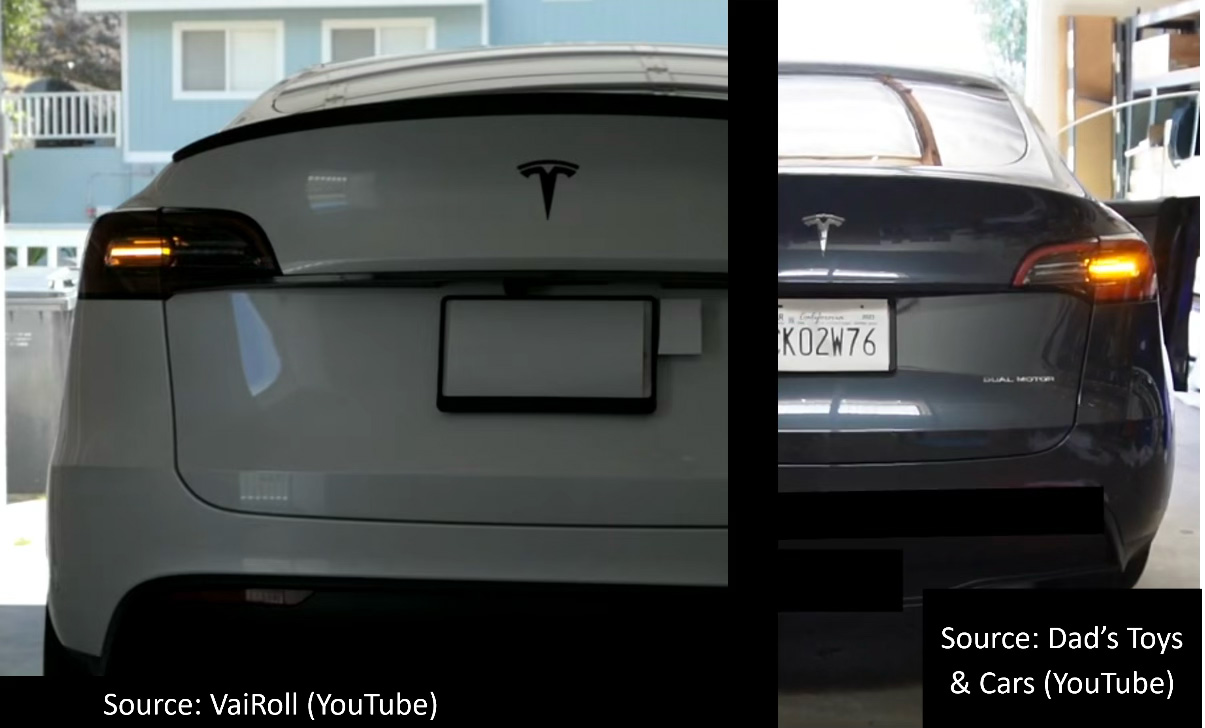
Perhaps the only valid counterargument in favor of red turn signals comes from those who say that Euro-spec amber turn signals are often too small to meet the American EPLLA requirements (Effective Projected Luminous Lens Area, which is a minimum of 50 cm2 of lit area). I’m sure that’s true in some cases, but the 2023 Tesla Model Y has a very small and thin amber turn signal. It’s only about 6 inches wide and maybe a half inch thick. The luminosity is what counts, not the actual size of the light fixture.
And get this, in 2024, Tesla had to ask the NHTSA for an exemption of “inconsequential noncompliance”, because they accidentally made those tiny rear signals too bright. This sums up one of my most important theses: if the 2023 Model Y can do amber turn signals, anyone can.
The last amber lights article also mentioned some turn signals that are mounted too low, like the Hyundai Santa Fe, Kia Carnival, and Chevy Bolt. I understand the frustration here as well, but right now let’s keep it separate from amber lights for simplicity.
For next year’s article, I plan to dig specifically into the worst form of red turn signals that should be extra illegal: those that use the same bulbs as the brake lights. These might be the worst illuminative automobile choice of all time, with the probable exception of GM’s “let’s just use the reverse lights as parking lights” disaster.
Data Collection and Notes
Shoutout to the YouTube channel Car Confections for showing all lights on every vehicle in practically every video they do. Likewise to Auto Buyers Guide (Alex on Autos) and Redline Reviews, for helping to confirm any tricky ones. Also, I appreciate the compliments and feedback from Charles K, lighting consultant Daniel Stern, and Jason Torchinsky!
And hey, special shoutout to Mercedes-Benz, who continue to add more amber signals with each refresh, showing exactly how it can be done. They maintain a purely red look to all rear lenses to maintain the aesthetic they want, but the turn signal still shows amber when activated. Style and substance come together for some very nice rear lamps.
Data Notes
-
Kia Telluride and Chevy Bolt are on hiatus, returning in 2027…both are red signal anyway
-
VW id.Buzz is also on 2026 hiatus, but with an uncertain future
-
Voyager is treated as a trim level of the Pacifica
-
Heavy-duty trucks are excluded
-
Slate truck and Scout truck are not certain enough to include
-
The 2026 BMW iX3 and Volvo EX60 don’t have American-spec models to look at yet, at least not on video
-
All front turn signals are amber, thankfully, so we’re only ever talking about the rear ones here in this article
-
Canada Motor Vehicle Safety Standard 108 is almost identical to U.S. Federal Motor Vehicle Safety Standard 108, and so Canadian vehicles use the same specs for turn signals
2026 Amber Signal Make and Model Breakdown
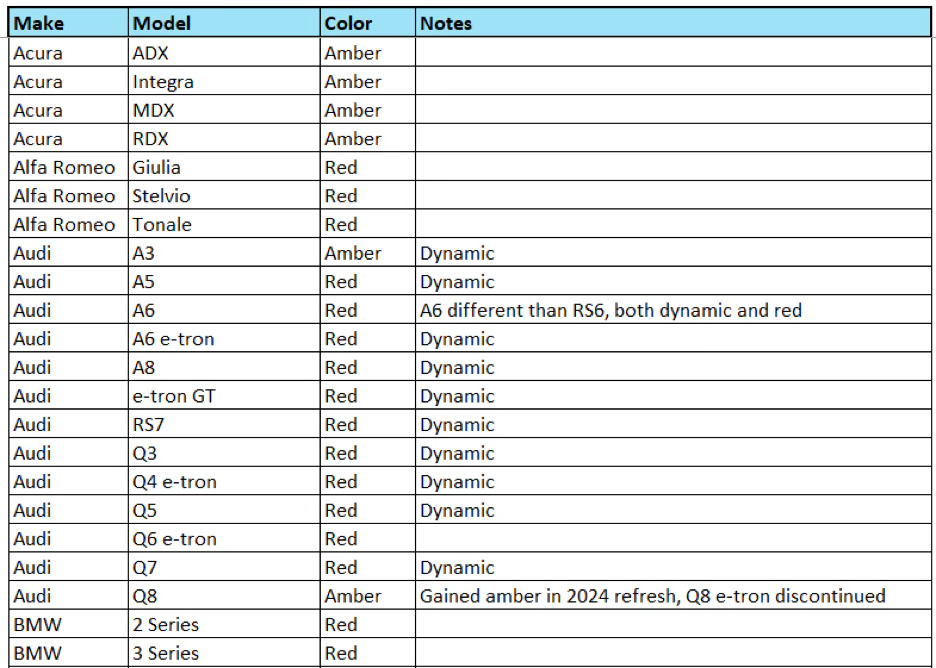
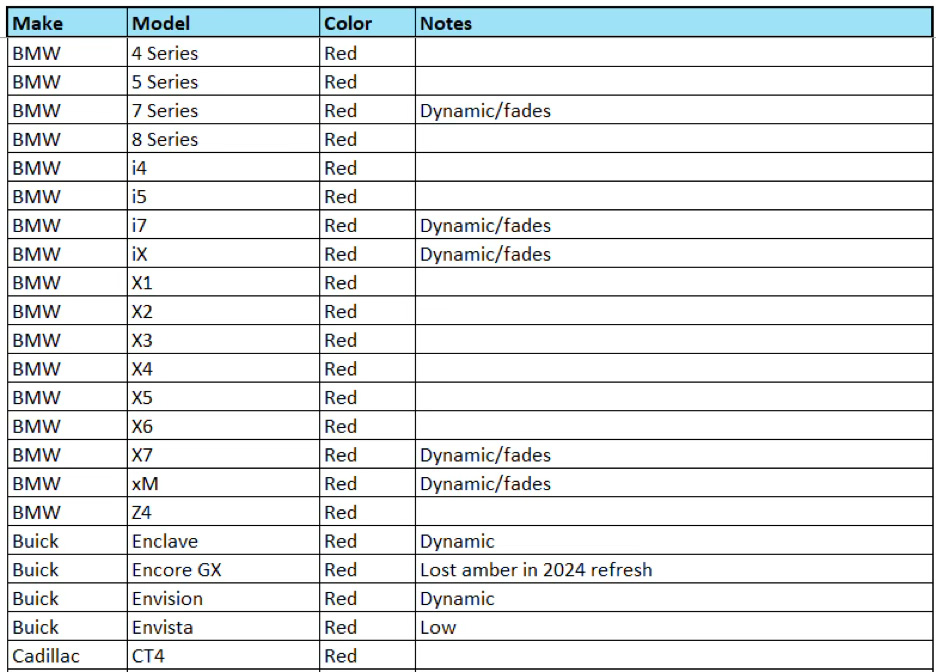
Below we have charts showing overall amber turn signal performance by manufacturer, and below that a breakdown for each specific model.

Specific model breakdown charts:
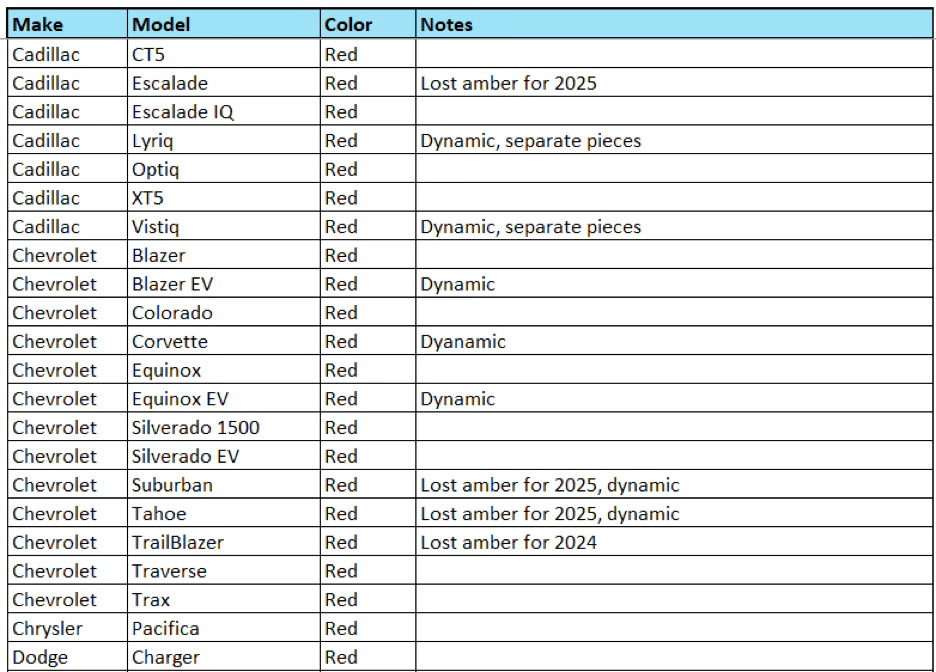
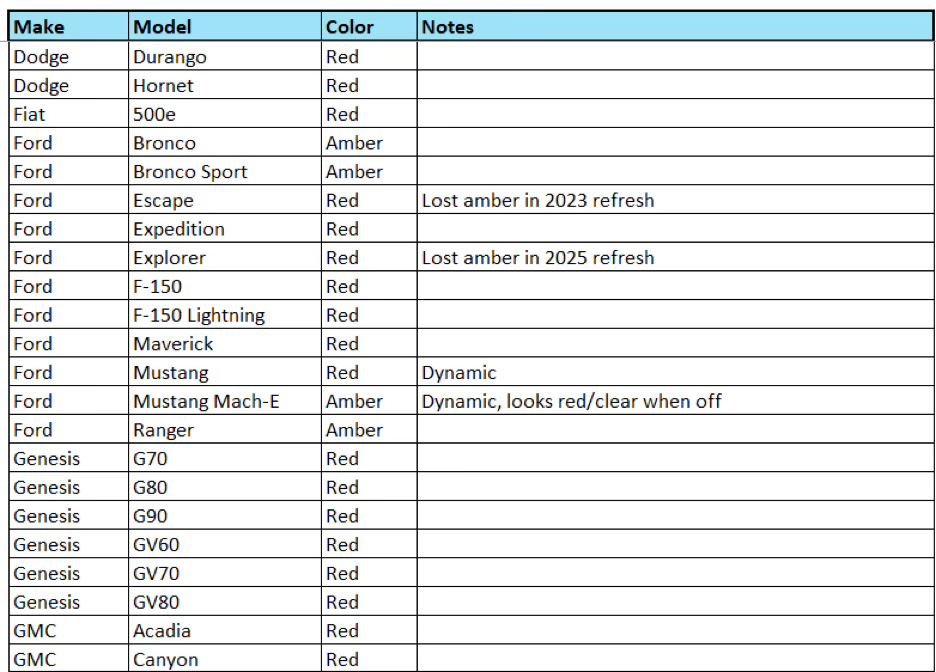
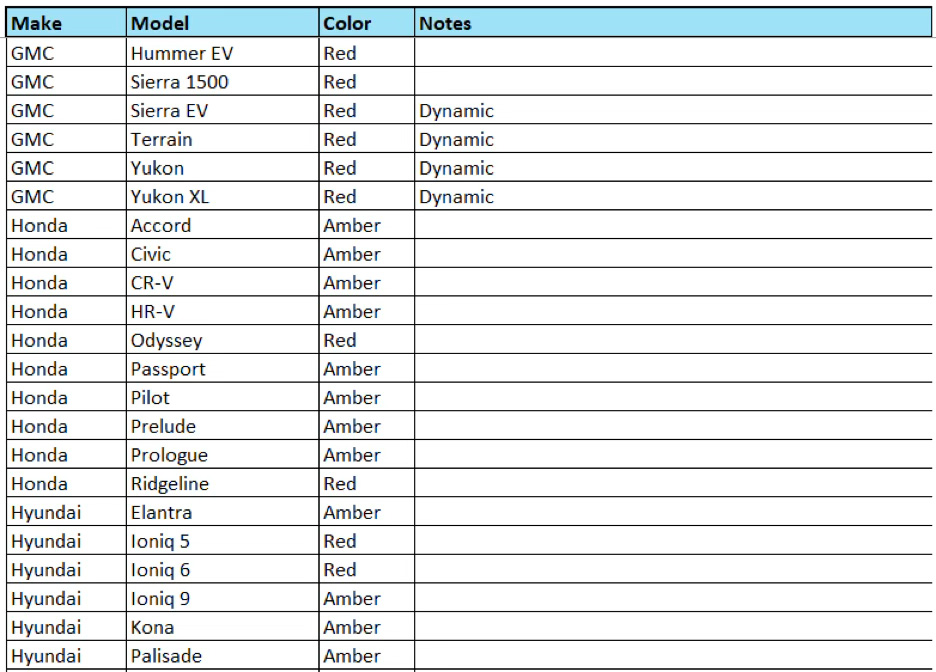
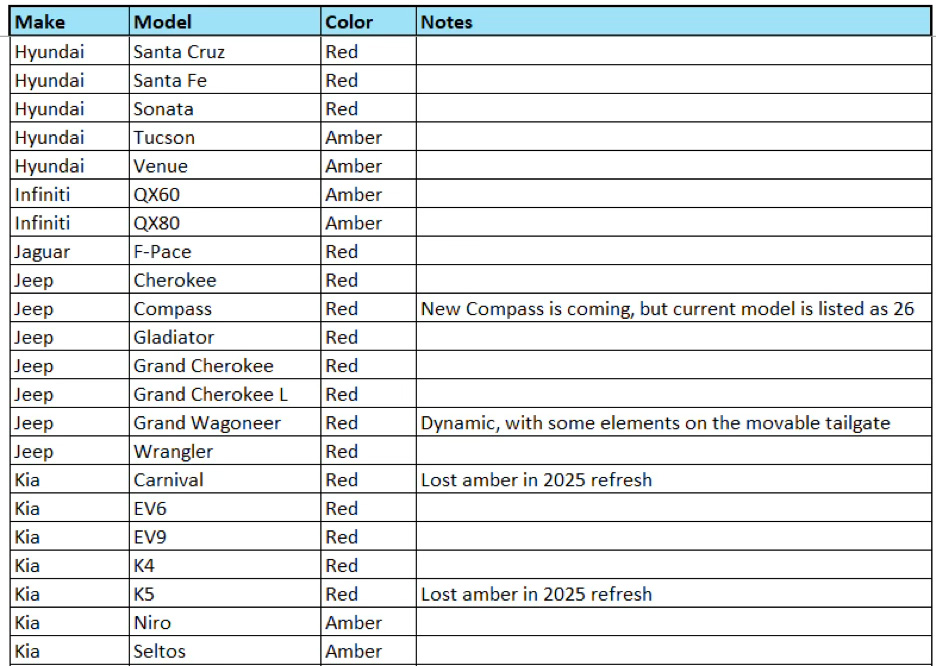
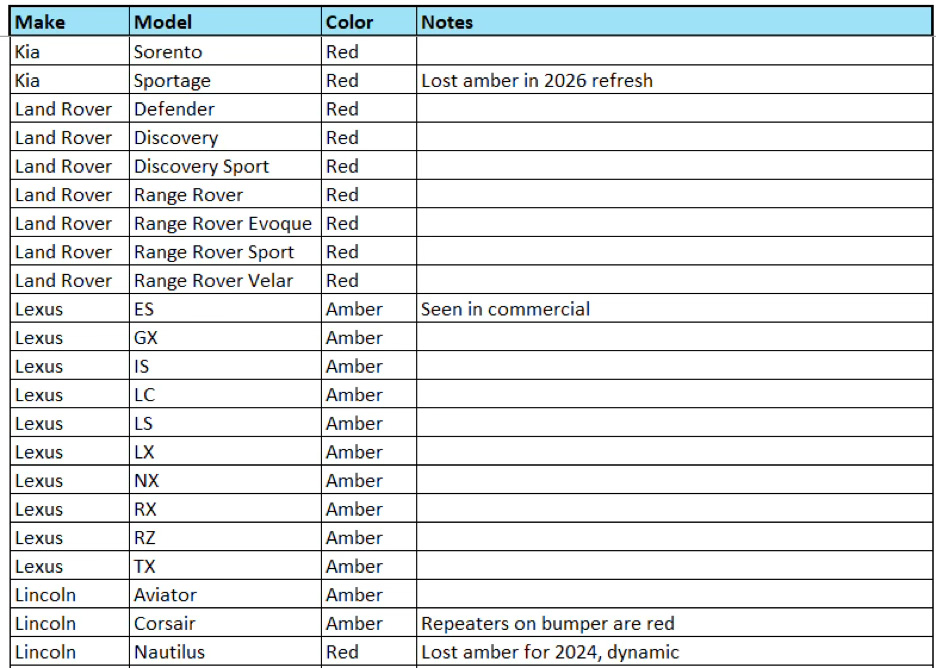
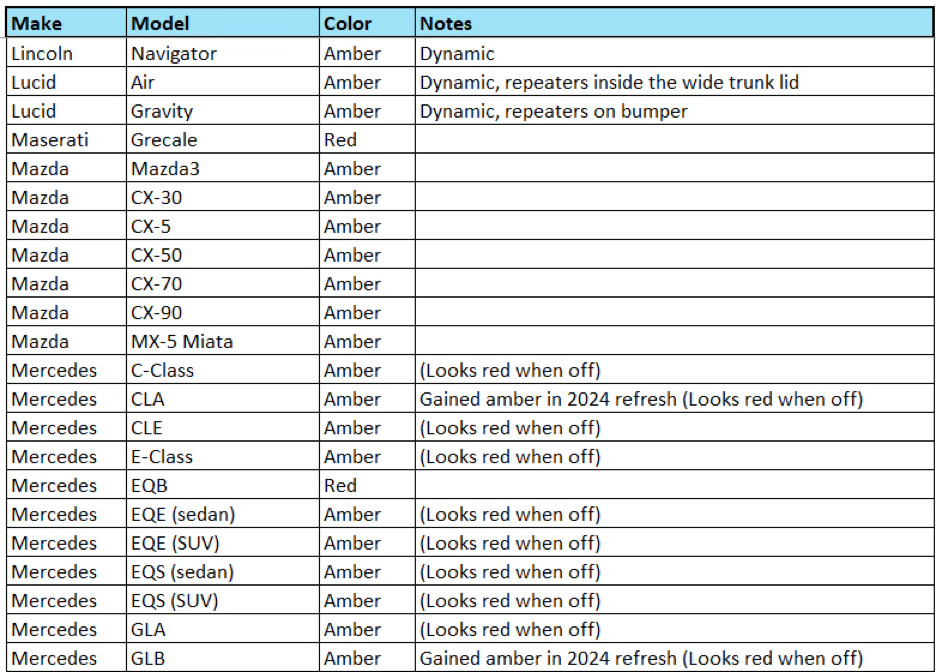
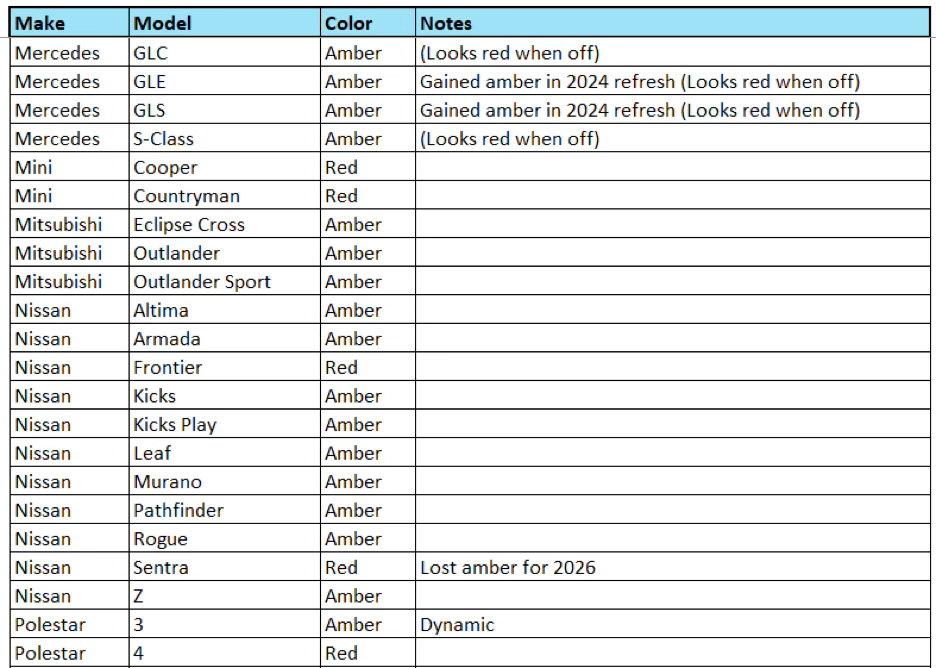
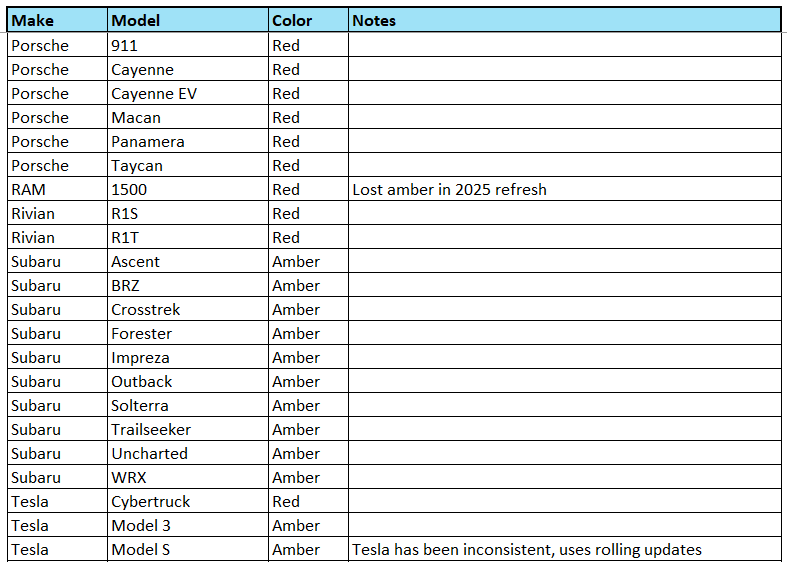
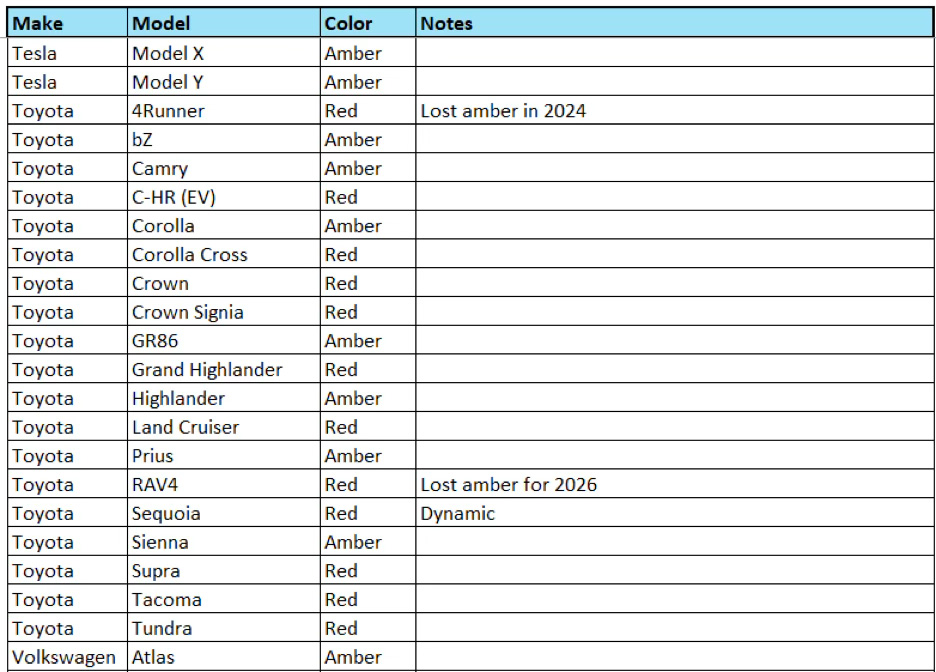
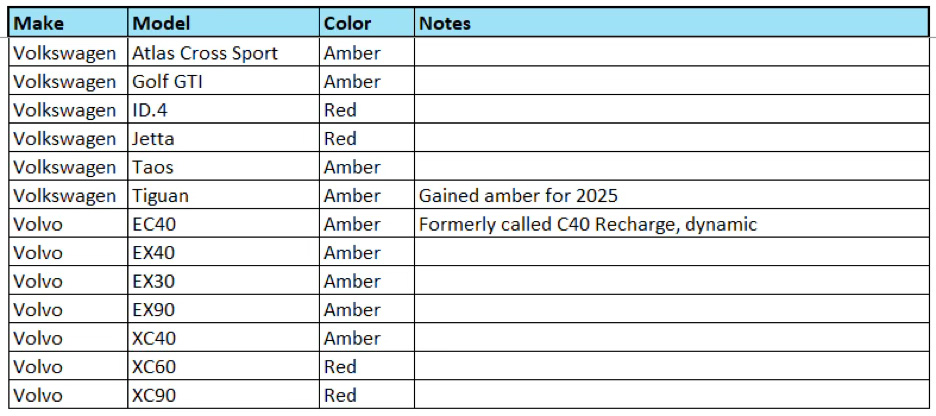
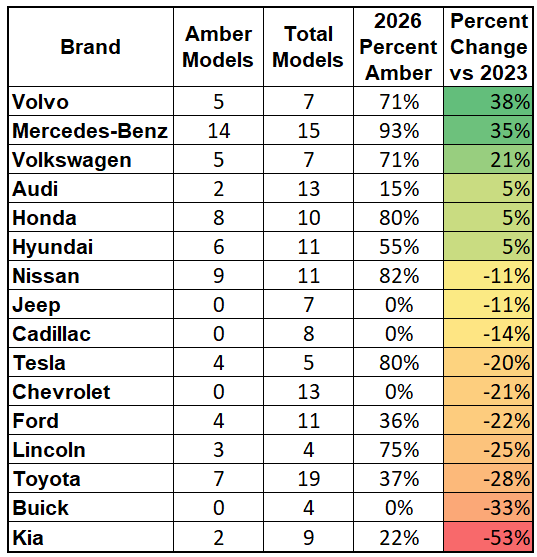
Here, we have a chart of automakers with at least 4 models that had a change in amber signal percentage from 2023 to 2026:
Best New Turn Signal of 2026 Award
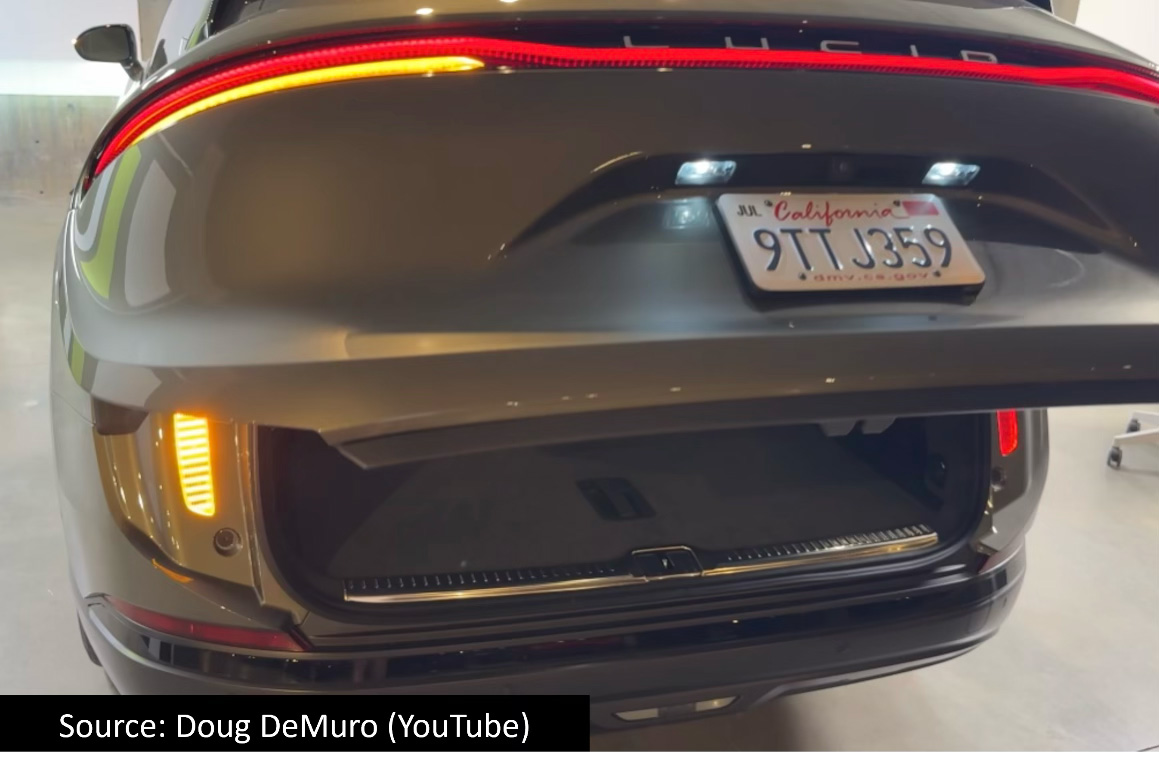
Lucid Gravity. It has massive, sweeping amber turn signals that span a huge portion of the trunk. This means that it also has repeaters underneath. Even the repeaters are both amber and red! Since no part of the signal is located on the sides, this allows for a gigantic trunk opening width that could frankly be described as “Hearse-like”. I don’t expect every automaker to take an expensive approach like this, but it’s cool enough that I had to award it.
The image below shows every element: the normal red light bar, the amber left turn signal, the amber left signal repeater, and the red right brake light repeater. Truly a dedicated approach to maintaining both aesthetic design and safe color choices.
Honorable Mention: Best New Turn Signal of 2026
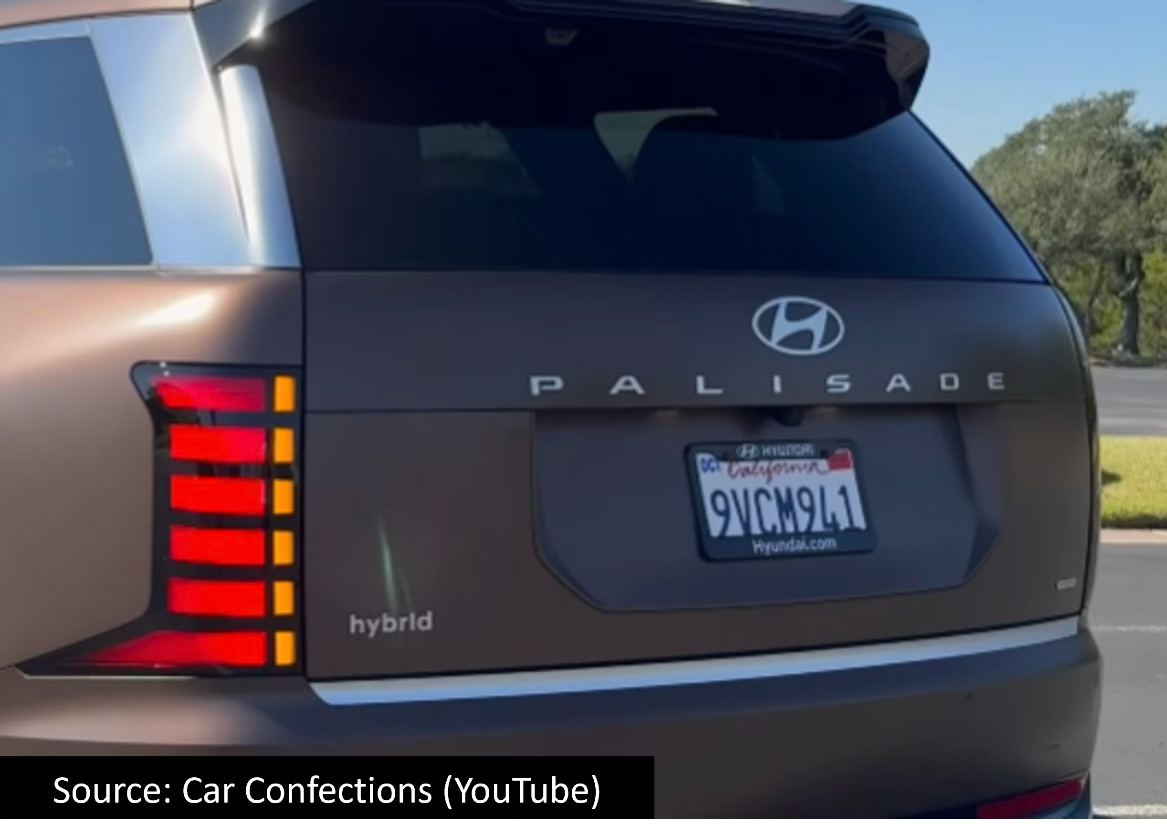
Hyundai Palisade. It looks like it’s going to have a red, blocky turn signal that may even be shared with the brake light. But no, a strip of amber lights is cleverly integrated into the design, showing how well it can be done for companies that worry about messing up their aesthetics. Hyundai might not be consistent, but I’m glad the Palisade keeps the amber lamps.
Worst New Turn Signal of 2026 Award
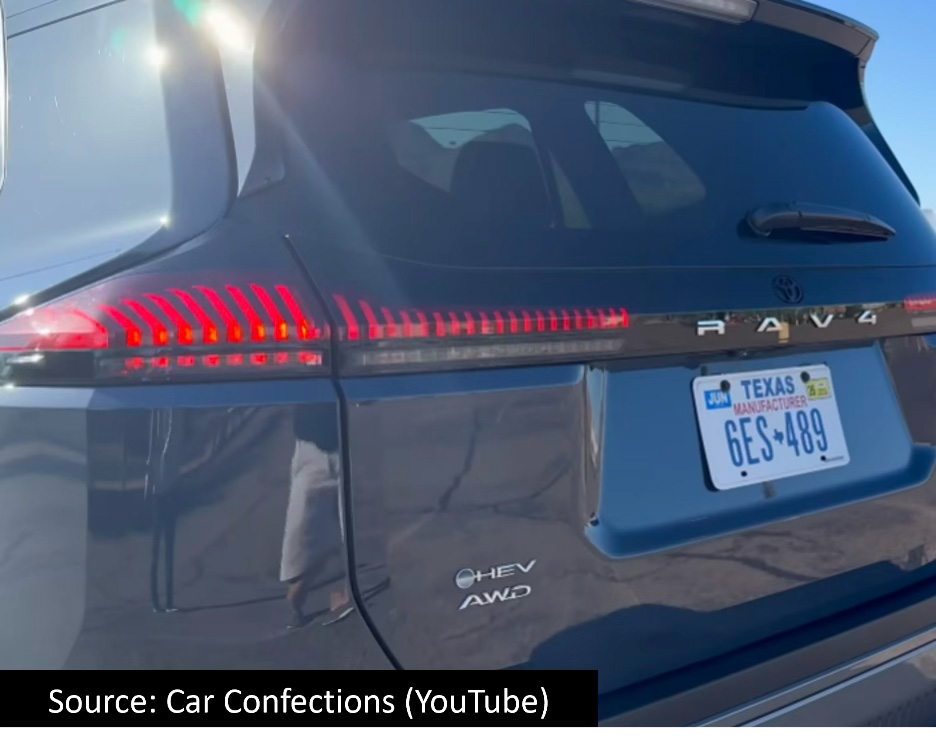
The worst turn signal of 2026 goes to the redesigned Toyota RAV4. The #1-selling non-truck vehicle in the U.S. throws away 32 years of amber turn signal heritage. Instead, the streets of the U.S. will be flooded with probably 1 million new red turn signals (assuming RAV4 sales stay on track) that just didn’t have to be there.
The redesign even has a clear section of lens, but both that area and the upper red lens section flash red. Overseas, only the lower clear section is used as a turn indicator, and it is, of course, amber. This feels very similar in size to the amber signal used by the 2023 Model Y that I mentioned above. Frustrating.
Honorable Mention: Worst New Turn Signal of 2026
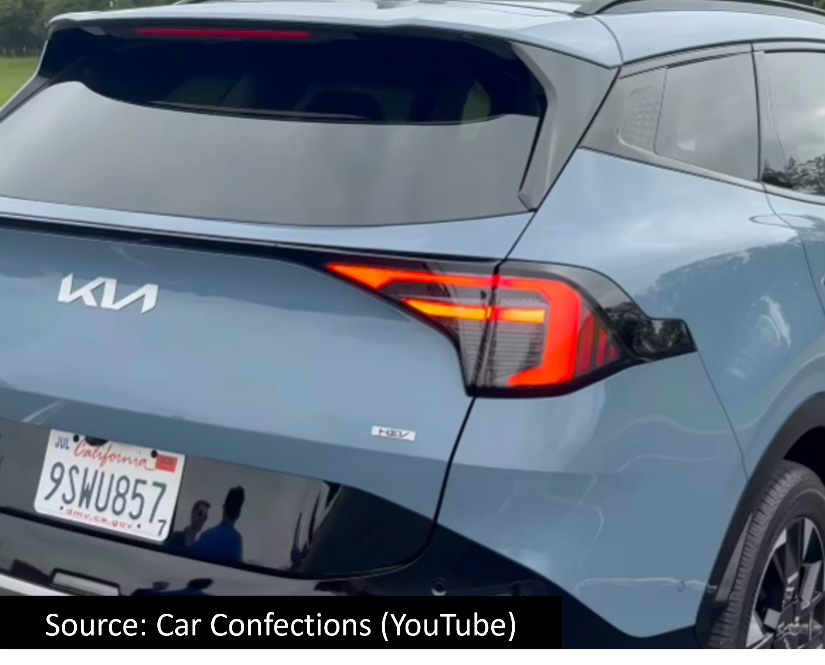
Sadly, Kia-Hyundai is also getting an award for worst this year with the updated Kia Sportage. Not only did the turn signal used to be a beautiful amber (and actually the header image in the original 2023 article), but there’s also tons of clear lens space where an amber bulb COULD have gone. As you might guess, markets abroad have an amber bulb assembly in that clear space, although the overall light design is admittedly slightly different. Didn’t it cost more money to design a separate North America-specific lens setup?
That does it for the 2026 round-up. There were wins and losses, but sadly, just 43% of all models here use amber turn signals. This compares to 48% of models in the 2023 roundup. GM, Ford, Kia, and Toyota are some of the biggest contributors to that decrease, and Mercedes alone couldn’t do enough to balance them out. New facelifts and redesigns are always rolling out, so maybe we’ll have better luck next year. Until then, please continue to use your turn signal, even if it is red.
(C.J. Tragakis is a writer with a focus on automotive content. He recently acquired a Polestar 2, which has amber turn signals. Other interests include collecting antique car brochures, driving the Blue Ridge Parkway, and trying to understand the psychology of why people buy the cars they do. Email: cjtragakis@gmail.com)


I did my part for future amber turn signals by messaging Slate auto directly about the issue on their future pickup. I got back a ‘we use one bulb for everything so no amber turn signal option.” What a shame.
On my Geo Tracker the taillights were full red, but with two bulbs, one for brake and one for turn signal, so it was easy to swap over to the Suzuki amber turn signals (which they are now making new ones of).
I realized I haven’t been on here in awhile. But completed a rewire of my utility trailer last summer which included adding amber turn signals, and changing the lower sidemarkers to flash in sync. And getting started on a Celebrity Eurosport wagon, converting to Euro lighting (export taillights with amber turn signals, side repeaters, rear fogs).
I broke my rule of not buying a car without amber turn signals with my EV6 (does it not count because it’s leased? hmmm). Didn’t notice it until a few days after getting the car.
“The last amber lights article also mentioned some turn signals that are mounted too low, like the Hyundai Santa Fe, Kia Carnival, and Chevy Bolt.”
Two reasons for the bumper-mounted taillamps…
Living in Germany for twenty years now, I am very much convinced of the need for better ECE regulations on LED taillamps, especially the output and glare. The incandescent bulbs behind the Fresnel lens produce less glare than the LED bulbs in tiny space.
Tinier the turn signal indicators and brake lamps are, more painful glare they produce especially at night. Opel, Peugeot, and Tesla are the worst offence. The incandescent bulbs cast the more even and softer light, but LED bulbs are like pen flashlamps.
In some countries, the drivers are advised to use the parking brake when idling at the traffic lights at night because the LED taillamps cast so much glare and somewhat painful to look at. This was reported in this Autopian article.
More and more Europeans have complained about how the thin stripes of turn signal indicators and brake lamps seem to blend together, making it harder to see the turn signal indicators blinking when the brake lamps are on.
For the Teslas with the amber turn signals; what gives with the amber turn signal indicator getting illuminated when the vehicle brakes? So you get the brake lights coming on along with both amber turn signals as if the software treats all the tail lights as brake lights. See this a lot around here. That doesn’t seem compliant to the regs as I would think they work,
You blinker [tilts head to signal intent]…and you don’t.[raises eyebrows]
Driving to work today I found myself apprising all and any taillights I could see. It took a few years but I have finally been absorbed by The Autopian collective. Resistance was futile.
Technically, resistance is in Ohms.
Amber Turn Signals tells everyone that you have the most JDM vehicle in the United States… a signaling of higher quality.
Deeply impressed by the color-coded charts, Torch.
At the risk of getting me kicked off this website – I like red turn signals, purely from an aesthetic perspective. Fewer colors means a cleaner look.
Although with the proven safety benefits of amber, I’ll concede they rationally should be implemented.
I do think the US is onto something with the minimum surface regulation. Some Euro turn signals are so dinky, they probably negate the benefit of them being amber. The G87 M2 is a good example. The signal is a 6cm long tiny strip.
Yeah… you should leave by your own means while you still can
The audacity…
Ppnw; an everyday ordinary person neither exceptionally liked nor disliked by those around him. That is until he made known his preference for non amber turn signals. Prepare yourselves to take a trip with Ppnw as he signals a turn into The Twilight Zone.
We should at least be thankful the new RAV4’s turn signal isn’t at wheel height.
Very disappointed with BMW (0% models) and Toyota (new RAV4)… I’m very proud of the amber rear signals on my i3s and show them off every chance I get! Is the i3 BMWs last NA model with amber rear signals??
Two things that stood out to me in this article:
Class move. Nothing but class from the evil gm vampire. Doing away with rear amber -big time. Just like the other class moves like removing side repeaters from XT-5. Dont get me going on the great reduction of ground clearance on the Tahoe class when going from live axle to independent rear. Every single manufacturer from the beginning of time? > the ground clearance INCREASES ! Nice to have in a SUV.
I have noticed that when behind these in traffic, they have no more clearance than my Impreza. Glorified, bloated station wagons.
In the massive tahoe i rented last week. My shoulder touches the ‘B’ pillar. So, i have less room than in my Accord. In this massive road porn mobile.
Those lower control arms on those things make me laugh every time I see them, which is often as I drive ALOT. Last week I saw an OBVIOUSLY lifted Tahoe and I mean this body lift looked like high waters on Erkel… and there they were those insanely laughable LCA’s hanging out like a tired sailors biceps…
What engineer designed those? Oh, General Motors did it, so no real engineers.
I worked there for 10 years. All the good engineers leave for better jobs. 9 of the 10 guys in my dept. (~about my age) left within an 8 year window.
I have not been a fan of GM after the 2008 Government bail-out and especially how they handled the “we are new GM (post-Ch 11) and now we are not responsible for the deaths cause by us trying to cover up the ignition switch redesign under the same p/n scandal” and the whole not taking responsibility for their obvious wrongs done to the consumer.
I don’t have anything to add other than I support shaming automakers into giving us Amber turn signals all around. I don’t care if it makes trailer wiring harnesses a little more difficult; it’s the right thing to do.
While we’re at it, can we also shame people who put primary brake lights/turn signals in bumpers? Especially while having tailights higher up.
Looking at you Hyundai and Kia among some others too.
I like the look of an amber colored turn signal alongside the red brake and clear reverse lenses, it gives the designers an additional chance to create and distinguish the vehicle from the herd. Any rear lights at bumper height or below should be illegal, period. And at the front end, the integration of the amber turn signals next to the headlights in a single housing (cheaper to source and install) should be banned. Maybe its just my eyes, but even in daylight, with the brighter LED running lights, I cannot be sure if an approaching vehicle, which seems to be slowing down, is going to make a turn as the glare of the LED’s obliterates the view of its immediate surroundings, which is where the turn signal is located.
Any rear lights at bumper height or below should be illegal, period —YES !!!! Please people- dont be stupid- dont buy one of these. And i agree on the front low vis point too.
Thank god, not just my old eyes.
Then again, none of this matters if using turn signals is not enforced with actual tickets, fines, etc.
No lies detected anywhere here.