

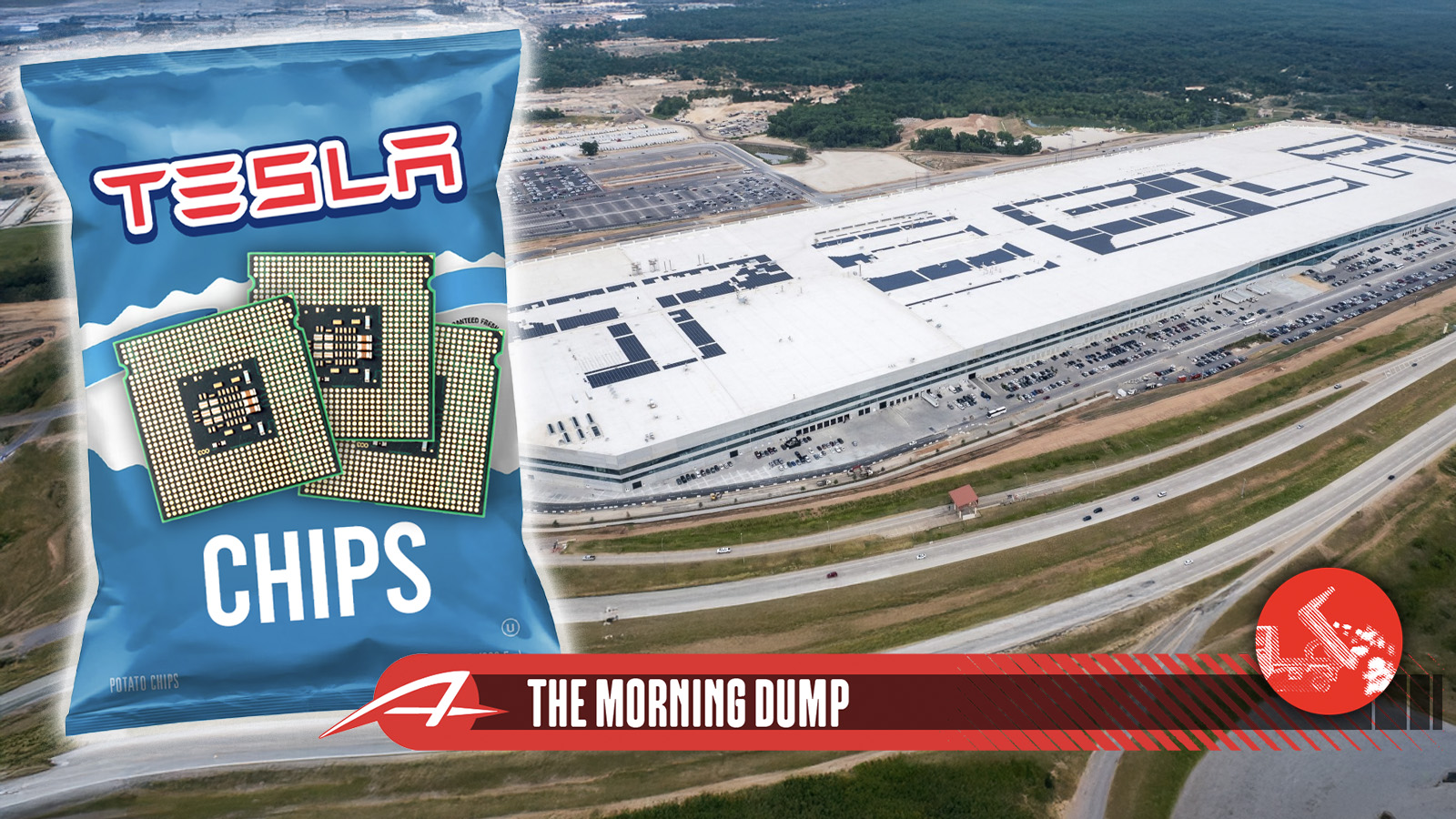
In modern automotive manufacturing, those who hold the chips hold the keys to success. Microprocessors and other integrated circuits, the little pieces of silicon that today’s vehicles need to exist, are highly in demand not just for the car industry, but for lots of industries. Because of that demand, and because so few places on the planet actually make these chips, there’s always a shortage.
That dynamic became clearer than ever in the years following the COVID-19 pandemic, when chip shortages forced carmakers to exclude certain features from their vehicles because they lacked chips to include them, or to pause production altogether.


Instead of continuing to compete in the rat race, Tesla CEO Elon Musk, who also runs SpaceX, plans to launch a chip-making facility specifically for his two companies in Austin, Texas. If the world stays on the direction it’s on now, it might be the smartest decision Tesla will ever make.
What else is going on? General Motors and its Chinese partner, SAIC, are planning a major electrification push in China to sustain their joint venture, using Buick and Cadillac EVs. Additionally, Gerry McGovern, Jaguar-Land Rover’s long-standing design head, has officially parted ways with the company following extensive reported drama and confusion. Faraday Future, the Chinese-backed, Los Angeles-based electric car startup, has had its four-year case with the Securities and Exchange Commission dismissed.
Let’s get into it.
Tesla Will Make Chips Of Its Own Using A Factory In Austin

While many automakers struggled to meet demand in 2020 and 2021, Tesla really didn’t have that problem. According to Forbes, that success can be traced back to 2016, when the company began developing its own silicon-carbide chips to reduce its reliance on foreign suppliers. In addition to being more energy-efficient and durable than standard silicon chips, these in-house chips were also just… available to Tesla, meaning they didn’t have to slow or stop production during the pandemic.
While several car companies are now either partnering with chip makers or starting to develop chips of their own, Tesla is taking the initiative yet again. CEO Elon Musk announced on Saturday night plans to develop a new site in Austin to produce chips for Tesla vehicles, humanoid robots, and SpaceX satellites through a jointly run program called “Terafab.” From Bloomberg:
Musk, the chief executive officer of both companies, said he will start off with an “advanced technology fab” in Austin that will have all of the equipment necessary to make chips of any kind, and test them. Musk, who has no background in semiconductor production and a history of over-promising on goals and timelines, had said before that the company will start with a smaller scale fab before moving to a bigger one.
Musk has said the semiconductor industry is moving too slow to keep up with the supply of chips he expects to need, even as the industry increases output.
“That rate is much less than we’d like,” Musk said. “We either build the Terafab or we don’t have the chips, and we need the chips, so we build the Terafab.” Musk’s project would call for one day supporting a terawatt of computing power per year, the amount he expects the companies to eventually use as he ramps up his investments in AI and robotics.
For some context, the United States currently produces a combined half a terawatt of computing power every year, according to Reuters. So we’re talking a whole lot of chips. Musk says that production will be split into two specific wafers: One for Teslas and the Optimus robot, and another for AI data centers in space.
Back in 2023, Tesla decided to slash the use of silicon carbide chips, citing cost and advancements in powertrain design. Musk’s companies currently get chips from the likes of Samsung, Micron, and the Taiwan Semiconductor Manufacturing Company, but added that his ventures would eventually demand more chips than the world’s current total output.
As I mentioned earlier, microchips are the lifeblood of not just the car manufacturing industry, but also of a large swath of all manufacturing industries. Recently, in the race to build computing power for AI, the chip shortage has reemerged as an ongoing issue in the automotive sector, as wafers are being directed away from cars to AI data centers.
Tesla and SpaceX building a chip-producing facility for themselves, then, is a logical solution that allows the companies to skip over the bidding war for chips produced elsewhere. Not only that, but the in-house chips would be optimized from the jump to work with Tesla and SpaceX products, further streamlining costs.
Obviously, this won’t be easy for Musk and his companies—if it were, every carmaker would have its own chip facility. As Bloomberg points out, it usually costs tens of billions of dollars and several years to bring a chip factory fully online. In his announcement, the CEO did not give any timeline for when Terafab might go active or when it will become fully operational.
Musk is known for overpromising on timelines and project scale. Remember the Tesla Roadster, first revealed in 2017? As of last week, it was delayed again, for what feels like the 37th time. But considering how important microchips are (and will continue to be), perhaps this will be different.
Here’s How GM Plans To Turn Things Around In China

Like many legacy manufacturer efforts in China, General Motors hasn’t been doing great in the region these past few years. Advancements from domestic automakers in the EV and software space have drawn buyers away, to the point where GM’s joint venture with local producer SAIC Motor Corp. saw sales collapse by 75% last year to 562,000 cars, down sharply from a peak of around 2 million vehicles in 2017, according to Automotive News.
The plan to get sales back on track? Lots of new offerings from Buick and Cadillac. But mostly Buick. From Autonews:
SAIC-GM will invest more than 10 billion yuan ($1.4 billion) to upgrade existing Buick models and develop next-generation products to protect its position as the top multipurpose vehicle seller in China. In 2025, Buick sold 123,000 gasoline and plug-in hybrid MPVs, up 18 percent from a year earlier.
Buick launched an all-electric variant of its plug-in hybrid Encasa MPV on March 17. And an update of the plug-in hybrid variant will arrive in the second half, featuring a larger engine and faster battery charging.
To expand electrified offerings, Buick will introduce the E7, a five-seat plug-in hybrid crossover, in mid-2026. The E7 will be the third nameplate from Buick’s Electra subbrand to be based on the Xiaoyao platform.
In case you’re not familiar, Xiaoyao is a vehicle architecture developed in China meant to underpin plug-in hybrids, range-extended EVs, and full-electric vehicles. In an effort to keep up with domestic competition, this platform will be getting stuff like a 1,000-volt architecture for high-speed charging, with up to 621 miles of range and over 1,100 horsepower on tap. Additionally, Autonews says these electric Buicks, as well as the Cadillac XT5, are getting a bunch of new “smart cockpit technologies” later this year, which will enable seamless phone connectivity for most smartphones.
The plan comes as the joint venture contract between SAIC and GM is set to expire in June 2027. For what it’s worth, no one thinks the company will be disbanded. From Autonews:
Currently, GM and SAIC have agreed in principle to extend the venture but still need to negotiate details, according to sources familiar with the situation.
“It would be unimaginable for GM or SAIC to choose to close the joint venture,” GlobalData’s Zeng said. “For SAIC, that would result in the loss of a core business. For GM, it literally means death of Buick since China is an indispensable market for the brand.”
While I wouldn’t go as far as to say Buick would die without China’s sales, I agree that it’d be crazy not to push on and turn things around, seeing as how strong the brand is in China.
Gerry McGovern Is Finally, Actually Out At JLR

Following JLR head designer Gerry McGovern’s controversial decision to throw away Jaguar’s design ethos in favor of a polarizing EV was a report from December that suggested he had departed the company and had to be “escorted out of the office.”
About two weeks later, Jaguar Land Rover came out and told the media that it didn’t fire McGovern, leaving his fate unclear. Then, another report in January emerged saying that he was, in fact, fired, though JLR refused to comment. Now, three months later, McGovern’s exit has finally been made official. Like Ian Callum before him, McGovern intends to launch a design studio of his own. From Automotive News:
McGovern will step down at the end of March to set up his own creative consultancy, JLR said in statement on March 20. The statement draws a line under a period of uncertainty during which the automaker declined to clarify McGovern’s employment status after reports in January said he had been dismissed.
“Gerry’s creative leadership, vision, drive and passion have left an indelible stamp on our brands,” JLR CEO PB Balaji said in the statement. “I would like to thank Gerry for the significant contribution he has made to JLR and wish him every success in his next creative chapter.”
McGovern has held the Chief Creative Officer role at JLR since 2020. Before that, he spent 14 years as the head of design at Land Rover, where he was responsible for cars like the Velar and, more importantly, the Defender, which has been a major success for the brand.
Faraday Future Gets Away From The SEC

Remember Faraday Future? The Chinese-backed California startup has been clinging to life for years now, taking seven years to deliver its first car, which it introduced back in 2016. After going public in 2021, the company became the subject of a years-long investigation by the SEC over founder Jia Yueting’s control of the company, and claims that the first deliveries of its car, the FF91, in 2023 were not true sales, and that Faraday was misleading investors.
Despite SEC staff recommending enforcement action on Faraday Future last year, the agency has decided to close the case without taking any action against the company. TechCrunch broke the story on Sunday:
The dismissal of the case comes amid a historic drop in enforcement actions by the SEC, which only initiated four cases against publicly-traded companies in its 2025 fiscal year, a recent report shows. The SEC did not respond to an after-hours request for comment.
The investigation into Faraday Future lasted for nearly four years. The SEC was looking at whether the EV startup made “false and misleading statements” when it went public in a 2021 merger with a special purpose acquisition company (SPAC), and was also probing whether Faraday Future faked the sales of its first electric vehicles in 2023 — a claim that’s been made by at least three former employee whistleblowers.
What does this mean for Faraday Future’s… future? Well, now that the investigation is over, the company can “advance potential strategic financing and strategic partnerships” that it couldn’t before due to compliance issues. Whether that means the company will survive, I’m not sure. But it’s gotten this far, right?
What I’m Listening To While Writing TMD
For no reason at all, I am listening to “Save My Love,” a new song from Kygo, Khalid, and Gryffin, while writing TMD this morning.
The Big Question
Which automakers would benefit most from their own line of microchips?
Top graphic images: Tesla; Ruffles; DepositPhotos.com


SpaceX, and xAI largest purchasers of Cybertrucks…something..something.
Tesla working with Samsung on chip fab has been amusing especially with their 18A problems. The ai bubble bursting is getting more terrifying everyday.
Xiaomi has experience with soc design but I don’t think they are doing much of it anymore. I would imagine them and rivian would stay fabless. The only company I could see going into actual fab is BYD.
BYD already has their own chip subsidiary – BYD Semiconductor.
Yep, the closest thing they are making are mcu. Still a very different chip. Most of their focus has been on IGBT. Their 4nm chip they had help from mediatek who is fabless and tsmc built in on their 4nm process. Huawei and SMIC have a 3nm process using domestic euv. So it’s possible byd will get involved with that.
You have to start somewhere. BYD understands the importance of software in a modern car.
BYD was founded more than 2 decades ago and back in 2022 they were going to spin it off with an IPO but then decided against it. Instead they invested more wafer production capacity.
Maybe you should stop taking anything Tesla says at face value. It’s obvious this is just more hype garbage. You make it so obvious in your own post:
“Microprocessors and other integrated circuits, the little pieces of silicon that today’s vehicles need to exist, are highly in demand not just for the car industry, but for lots of industries. Because of that demand, and because so few places on the planet actually make these chips, there’s always a shortage.”
There’s an insanely profitable industry where demand consistently outstrips supply, and yet, there are only a couple places that can produce them? Hmm, I wonder why that is.
You know what else Tesla should do, if they could actually do it? Cure cancer. Make EVs for $10. Save a bunch of kids stuck in a cave.
The brain dead regurgitation of shameless hype from a company that regularly commits fraud is getting really old.
I’ll believe Tesla can make chips once Elon delivers on those kitchen (bathroom) sinks he was carrying around a few years ago. Where’s my Tesla Sink!!!
Oh, now GM is proud of offering phone connectivity in their new cars.
A company cannot offer seamless phone connectivity without doing the software themselves. Android Auto and CarPlay are far from seamless and have a pretty garbage interface.
Legacy automakers have only recently woken up to this reality after getting stomped in the Chinese market by new startups that don’t try to integrate software for 100+ suppliers.
(Comment 1: flagged for “moderation”)
A company cannot offer seamless phone connectivity without doing the software themselves. Android Auto and CarPlay are far from seamless.
Legacy automakers have only recently woken up to this reality after losing massive marketshare in the Chinese market to local new startups that don’t try to integrate software for 100+ suppliers.
(Comment 2: Also flagged for “moderation”)
The only way to offer seamless phone connectivity in a car is to control the software. Legacy automakers have been slow to learn this and 3rd party apps like Android Auto and CarPlay are far from seamless.
(Comment 3: Was allowed without “moderation”)
I’m surprised Tesla isn’t calling it GigaFab.
Tera > Giga. Given the shortage in storage right now, I assume their next project will be SSDs. Maybe they can call them…petafiles.
Well, Musk does seem to have an issue with that type of person…
Car companies should reduce their reliance on chips, not make their own production facilities. Others can explain the technical reasons. The reason I want fewer chips is that I don’t think cars should be “software defined”. It just leads to half-baked solutions for things that were already solved, like door handles. It also leads to recalls stacked on recalls (or maybe that’s just Ford 🙂 ). Sure, some things need chips, but not my lights and windows.
“Software defined” is just marketing BS to woo investors, it has no material impact on the number of chips needed in the car.
And I regret to inform you that both your windows and lights need chips these days- windows to integrate the force sensors that prevent bodily harm when a child (or dumb adult) closes the window on their neck or appendages, and lights for adaptive conditions.
If it’s electrical on a car, it needs to connect to a chip, and compared to the bad old days it’s a substantial improvement in reliability and performance.
“Software defined” is of course marketing speak, but what it really means is half-baked software requiring recalls to fix dash lights that don’t work, or brake lights that don’t work. These are two real life examples from my own Ford. I know that cars use software for these things now; I just think they should return to mechanical switches that just worked for decades. It’s not an improvement that I have to drive to a dealer to get a software patch to make my brake lights work instead of them just being attached to a switch that activates when I use the brakes. And as far as windows go, fine, wouldn’t want an idiot to be able to hurt themselves. My point is not everything that’s electrical needs to be run by a computer and forcing it just causes problems.
If Ford was with the times they would not need you to drive to the dealership to load a software update. It would happen over-the-air just like when your phone gets a bug patched.
Not really the point. The point is, a mechanical switch wouldn’t have had a problem to begin with.
As Wuffles pointed out – there is a reason chips are used for functions that used to be done with a copper wire and mechanical switch.
Your brake lights are most likely part of anLED assembly that integrates multiple functions together instead of using individual sockets, bulbs, and housings. They will also likely last the life of the vehicles and never require the owner to disassemble their interior to replace a burned out bulb. Sign me up for never seeing a halogen lightbulb again.
There are far fewer vehicles running around today with a bunch of the lights on the rear of the vehicle no longer working than there used to be. A problem solved with LEDs.
Tesla would realistically go bankrupt from their pointless foray into humanoid robots, before they ever get to making chips. But we don’t quite live in reality so maybe they’re gonna actually make it.
I see that Faraday Future’s check to Trump or associates has cleared. Good for them I guess.
GM should call it quits in China, it adds a lot of complexity to the lineup for not much profit. There are no signs that this can improve in the medium to long term, and it is causing a drain of any intellectual property that hasn’t already been taken.
When it comes to automotive manufacturing there isn’t anything left for Chinese companies to steal. They did that decades ago, learned from it, and then surpassed us. It would benefit us to copy the old Chinese playbook and open the US market to Chinese automakers but only if they form joint ventures so we can learn from them.
The first step in making a comeback is admitting you are behind.
It is entirely inaccurate to reason that the US automotive space is not creating anything that is new or better than existing tech or ideas. The issue is that this is a 1 way street, we do not get the benefits of what Chinese manufacturers develop, but they get the benefits of what they develop and what the US develops. Nothing left to steal? New intellectual property is produced everyday and they get all the benefits of it.
It isn’t a one-way street if you make Chinese companies build factories in the USA so we can learn from them. It is near impossible to teach people how to make something and still keep that knowledge from spreading into the general industry as people move around from company to company as of yet “Severance” technology doesn’t exists. The Chinese knew that which is why they used to require foreign automakers to partner with Chinese companies. (They don’t anymore – because we don’t have anything to teach them about making cars)
Yes, new intellectual property is produced everyday. In 2024 49% of global patents were filed by Chinese companies. China graduates 600,000 engineers a year. The USA graduates 120,000 and plenty of those are foreign students that we then kick out of the country.
We are losing the race.
It sure has left a stamp. Maybe they should hope it’s not indelible.
Vertical integration for the win!!!!!!!!!!!!!!!!
Vertical integration worked for YKK Group, the premier manufacturer of zippers in the world. They even smelt their own brass.
I’ve smelt worse!
I prefer walleye over smelt but both are good with tartar sauce
In theory, most, but in reality, very very few if any. The reality of a an inhouse fab to make dedicated top of the line silicon is incredibly optimistic, but also immensely risky. The simple reality is much of the expertise required to accomplish even a fraction of Teslas stated goals does not exist in the US. The talent, knowledge personnel and infrastructure are not here. Even if it did, it completely ignores the absolutely gargantuan cost.
There are two ways I see framing this endeavor, that of Apple, and that of Intel. INtel has faltered heavily over the past decade, ceding their entire edge to foreign companies, struggling to advance their fab processes beyond 8nm. Their US based fabs have run over budget, overschedule, and under on performance. Apple has been incredibly successful with their inhouse silicon, designing their own industry leading chips that deliver on their goals leading to more efficient, lower cost compute. The difference here? Apple gets TSMC to build their chips.
The benefits of a vertically integrated supply chain are obvious. There is immense flexibility in design, reduced cost of components, and a speed of implementation that cannot be rivaled. However there is also a gigantic risk in overhead costs. Onboarding everything requires a level of manufacturing excellence that is very, very hard to achieve in EVs, which we know Tesla hardly lives up to. The cost to even build a fab of moderate scale (an order of magnitude LESS than a Terawatt hour) is in the tens of Billions of dollars. What Elon has done is announced a a commitment of money equaling a double-digit percentage of Tesla’s market cap, $100B+.
This is money Tesla does not have on hand. Tesla had a Net-Income of under $10B in 2025. Elon has signed up his company for a commitment above their assets that would make Sam Altman blush. The ROI is nebulous at best given their declining sales and dubious portfolio strategy of vision-only autonomy and humanoid robots which will not have a market. All of this at the potential cost of leveraging themselves to the gills for an extremely technologically risky endeavor that has a very low chance of working out smoothly under the best of circumstances.
All the signs in my point of view tell me this will backfire heavily or be abandoned after a $10B spend with nothing to show for it, but the investors will somehow eat it up, boosting the Tesla stock price closer to the $1T pay package payout for Elon.
As you note, even Intel has struggled for the last few years, and they know chips. I don’t have faith Tesla will be able to figure out something new in that regard, to make it profitable in any capacity. I don’t see how Tesla has to bandwidth or funds to develop all the shit that has been foisted on them.
This is a common refrain, but completely wrong. The talent base does exist in the US, just on the defense side that you never read about in industry publications. Source: the 15 year old, 3 nm chipset in certain missile guidance packages.
Also, given how important chip design is in the modern world, throwing up your hands and saying “we’re not smart enough” seems like a pretty terrible solution instead of trying to claw back that gap.
I should clarify, the technology and expertise to do this manufacturing at scale is not in the US. Small production for defense or in a lab setting is not equivalent to a terawatt hour per year of production. ASML makes the world leader of EUV Lithography machines, but simply buying a few dozen at a quarter billion a pop and making a top-tier clean room does not equal mass production of sub-4nm chips. Intel has been desperate to claw back that knowledge gap for a decade and is still struggling to do so, but nobody there is throwing their hands up and giving up. It’s just that this problem is that complicated. Not to mention things made for and funded by defense contracts often is restricted in who is legally allowed to know it, much less distribute or exercise on that technology.
My main comment was not on “what is the best way for the US to develop world leading chip fabs” but was a commentary that Tesla is not going to be the one to do it for all of the personnel and financial reasons stated. Their goals do not align with reality, their timelines do not make sense, and their arrogance has been and will continue to be a detriment to any future successes, not the driver of it.
The key question is how much of the auto-semiconductor content needs to be bleeding edge? Maybe ADAS systems, but everything else can probably be made on tools that are a few generations back. My first garmin(?) portable gps was purchased more than 20 years ago, and it worked well, for onboard control systems what matters is (long term) reliability – where you are probably back a few generations.
It’s a fair question, and I’m not entirely certain of the answer to be honest. My intuition on what Tesla wants them for primarily being autonomous vehicles and robots, they would need to be relatively current if not bleeding edge. In both cases, they are using very data heavy sensor suites that require a lot of on-board machine learning processing, so the amount of compute is reasonably large, and the speed of compute will be relatively correlated to transistor size. They’re not trying to put Nvidia H200s in their cars, but they certainly cant get by with a GTX1660 level of compute either. Regardless it would be a custom chipset tailored to their needs, but manufacturing has even more challenges than design.
I just went down a rabbit hole – it does look like the most advanced systems, like ADAS, may be using very small node size (3 nm) controllers, but that most of the microcontrollers doing real-time computing are likely older, more robust architectures – like 28 nm or higher (this is from ARM’s website..). The real-time computing is needed for subsystems that do physical control functions like drive-by-wire, and even window controls and door locks.
This is not really my bailiwick, so I may have gotten this wrong, but it does look like a typical car has a mix of complexity in its many electronic controllers. As an aside, real-time control, when done right, doesn’t need a lot of computing power, but does typically need to be able to tightly control the sequence of operations.
He doesn’t need the cash.
His stock price is such that he can continue to borrow against it.
Being that it’s a meme-stock; it won’t follow normal market conditions. So why not?
It’s not about the cash with his $1T pay package, it’s the amount of shares he earns should those milestones be hit. If the absurd goals of the package are met, he gains a significant amount of control over the company which is what he really wants. At present he has about 12.5% of Tesla stock, if he fully unlocks the 1T pay package, he would be just shy of 30% ownership of Tesla, making it far harder to overrule him in shareholder votes.
I see that I wrote is as Tesla/Elon being synonyms. Which, legitimately, is how they both operate – and, you’re right, will only get worse going forward.
Tesla could borrow against the stock value to fund whatever Elon wanted to do, and it’ll go up.
I do think Intel’s arrogant, inflexible “copy exact” framework prevented incremental improvements from increasing their productivity. Copy exact works when demand is soaring and you have a good process to copy; it’s not so good when your rivals have been adding capacity and leapfrogging your productivity.
My first thought was Tesla building chips is a dumb idea because Tesla will soon have nothing to put them in. Tesla hasn’t come up with a new mainstream product since the 3/Y, and that is old at this point. Elon’s other ideas (creepy-ass robots, robotaxis, nihilistic AI [Grok], etc.) have been rather terrible of late.
I think this might actually be a good idea, though. I don’t know much about the economics of computer chip manufacturing, but Elon has made things work in the past that others couldn’t (EVs, private spacecraft, etc.). If nothing else, there is high demand for chips and Tesla can always supply their chips to other companies when their own products flop. I could also see Tesla benefiting greatly from making an invisible but ubiquitous product – people might hate Elon but if they don’t know their phone/car/lawn mower/smart toilet/whatever is running a Tesla chip they won’t care. Also, additional domestic chip production capacity is also a good thing for the US, even if it doesn’t end up being a major profit center for Tesla.
I’m not saying pivoting to building compute chips is a great idea (I’m not buying Tesla stock anytime soon), but this is the first thing I have heard in a long time that makes me think Tesla might have a decent future.
A car company making their own chips isn’t a new idea. BYD and Xaaomi already do it.
Historically automakers have made their own engines. Today software, chips, and batteries are as important as engines were in the past. They are the defining feature of cars today.
It isn’t a new idea, but it doesn’t have to be. Tesla didn’t invent EVs. SpaceX didn’t invent commercial space services. Paypal didn’t invent online payments. Elon is better at making money off someone else’s idea than coming up with novel ideas himself.
I see chip manufacturing as unrelated to the automotive business. Frankly, Tesla as a car manufacturer seems to be going nowhere fast. I’m not sure if benefits their car business much to build their own chips, mostly because I don’t see any reason to believe they will release a vehicle with mass appeal anytime soon.
I could see chips being a major profit center for Tesla. US companies design a lot of chips but don’t make many of them here, presumably because it is cheaper to build them abroad. Obviously, it would be better for strategic reasons if more chips were built here. If nothing else, Tesla could land a lot of government contracts if Elon can pull this off.
Of course, this might just be another one of Elon’s big ideas that is going nowhere. It is just encouraging to see Elon has an idea that doesn’t involve creepy robots.
I just checked GM had Delco (which became Delphi) and Ford has Philco before spinning them out a while ago. At the height of the pandemic Ford made a partnership with Global Foundries for U.S. chip production. For a long time the pace of semiconductor innovation was tough to keep up with so it made sense to spin these divisions out – but for auto use especially maybe the pace has slowed.
Both Delphi and Visteon were spun off because they were massively unprofitable due to union wages and legacy retirement contracts They both when bankrupt after being spun off and then were reconstituted into profitable businesses.
In bankruptcy Delphi opened with an offer of $10 / hour (down from $27 / hour) and the workers ended up with $13 / hour. That was still double minimum wage at the time and workers at the Delphi plant I worked at still made about $3 an hour more than the union workers at the foundry I later moved to. About 20,000 UAW workers took a buyout and left.
Musk better call his old buddy in that big, colourless house and ask him to stop blowing up LNG fields.
Gonna be real tricky to make microchips without Helium. Let alone every other hurdle.
LNG comes from fields? Helium as well? The things you learn in the comments section!
There’s a reason TSMC exists
And there’s a reason why TSMC has zero open production slots for the next three years or so.
LOL at Tesla putting together their own fab.
It may happen, but it’s going to be more expensive than Musk thinks it is. And “make chips of any kind” is a tall order. A lot of varieties aren’t compatible, and are made in different facilities for contamination reasons. And if he actually wants to make advanced CMOS, I’m sure he already knows how long the wait list is for deep EUV lithography machines. Actually, nobody has probably told him yet.
But hopefully it takes a long time to get anywhere, as the current supply constraint is for raw materials needed (most of the worlds helium comes through Hormuz, and is required to cool wafers during process) and adding more fabs just makes the situation worse.
If he actually wants to make a splash in the chain, he would focus on advanced packaging of others’ chips, including the testing. That is actually needed here, and UT Austin and the gov’t are already headed down that road. Musk should maybe help out.
I suspect it will just be a money grab for Elmo when he floats the new company and then promises wonderous chips in the future, and then delivers all dressed
Yes, I think you and Arch Duke Maxyenko are right. This is just a snake oil flash sale. And he’s doing it to bury his upcoming $2.6B civil judgement against him.
Like AI, Musk puts together a string of words that sounds smart to people with no knowledge of the subject. It’ll almost certainly bolster the stock price for a bit, which is pretty much the entire goal.
I suspect the project will be repeatedly delayed and then he’ll announce a successful “partnership” with a supplier that will be much cheaper than building a chip fab.
I do like this bit from the Bloomberg quote:
How long has it taken for any major news org to finally get around to pointing out the obvious with these BS artists?
So Musk makes a big announcement to pump up the stock price of Tesla right after a jury found him liable for fraud and now owes billions to the victims, most of his worth is in Tesla stock. Now I’m sure the timing of this announcement is complete coincidence…
“The spicy (chips) must flow.”
I’m escaping to the one place that hasn’t been corrupted by capitalism: SPACE!
https://www.youtube.com/watch?v=niZpcdp2v34
I think Toyota should get into the chip business. Those hybrids aren’t going to build themselves, yet.
Toyota, VW and perhaps Ford would do well to setup a JV that would be fabricate the necessary chips.
A single manufacturer (even Tesla) going it alone seems like it might be a massive money pit. But get a few bigs together and they might be able to achieve the economy of scale for the math to actually be mathing.
I don’t think a JV only between automakers would work. Building a running a fab is an entirely different world. I don’t think Tesla/X/whatever will be successful either.
But would someone make a JV with Intel? There’s a company with deep fab knowledge, trying to make a turn to contract foundry (and still losing billons on trying to build it out) and domestic production.
I don’t see an upside for Intel on a JV, they have a market, adding a set of new masters is just going to dilute their focus further.
What we need here is a resurrection of Cyrix!
Cyrix was ahead of its time as an IP-less, fabless chip maker. That model works today, but didn’t then.
Yeah… I didn’t really expand my thoughts on this matter too much in my previous comment… but to make this work, partnering up with Intel might be a good on-ramp, however I do see such a JV requiring both the know-how and the fab itself to make it worthwhile. Getting that know-how would likely mean poaching top talent from the likes of Intel, IBM, TSMC, Samsung and others.
It’s possible that without a JV, Intel (or any other fab-owner) might see this as just a side quest and it won’t work out for the automobile partners.
Kinda like this?
“On Jan. 6, NIO signed a framework agreement with Chery Automobile and JAC Group to jointly build a collaborative innovation platform for automotive industry development, and also inked a collaborative auto-chip industrialization project with Lontium Semiconductor Corporation.”
https://autonews.gasgoo.com/articles/news/four-chinese-companies-join-forces-to-accelerate-automotive-chip-industrialization-2008565809767297025
I was living in SoCal when the FF set up their factory just a few miles away from where I lived. Still the gold rush days of EVs so there were some positive vibes. I’m not sure they’re even gonna’ get as many EVs on the road as Fiskers.
I think whenever someone references FF that they need to preface it with a year so we can put together which iteration of FF they might be talking about.
“Did you say 2021FF? Yeah, that’s at least 3 FFs ago”
Musk says a lot of things. And mostly just to move the needle up on the stock value. Sometimes nothing comes of it. Sometimes the company burns a few billion dollars on a failed project and it doesn’t matter because his net worth went up more than that. A bunch of people get laid off, a new fake promise is made, and the company soldiers on.
Thank you. This is Tesla hitting Peak Vaporware. Complete with telltale cheap video.
I am not sure a single company would benefit from making their own chips. Perhaps an auto-dedicated company or even a joint operation to make chips for a group of auto companies might be a good idea.
With all things Tesla, I’ll believe it when I see it. Musk is the walking embodiment of “talk is cheap”
What company should do their own chips? None of them. Car companies already juggle too many aspects of industry. Sometimes it’s best to just let a car company be a car company.
Given Musk’s net worth, his talk is probably pretty expensive for all concerned.
He has certainly cost his company a lot of money with the things he says
…and keeps getting richer.
TSMC is the gold standard for fabrication, and they shy away from design as much as possible, never mind end use. The customer should not own the manufacturing.
This x1000
Chips and software are a core competency in the automotive market today.
Software, yes.
Chip design, to an extent, especially for smaller microcontroller-type chips that tend to be quite a ways from cutting-edge fab nodes for various reasons.
Fabricating their own cutting edge compute chips? Absolutely not.
Far easier to make the software work when you control the hardware as well. We have seen this happen in the cell phone world and the automotive world is following. Legacy automakers are just really far behind and are seeing their market share plummet as a result.