

In modern automotive manufacturing, those who hold the chips hold the keys to success. Microprocessors and other integrated circuits, the little pieces of silicon that today’s vehicles need to exist, are highly in demand not just for the car industry, but for lots of industries. Because of that demand, and because so few places on the planet actually make these chips, there’s always a shortage.
That dynamic became clearer than ever in the years following the COVID-19 pandemic, when chip shortages forced carmakers to exclude certain features from their vehicles because they lacked chips to include them, or to pause production altogether.


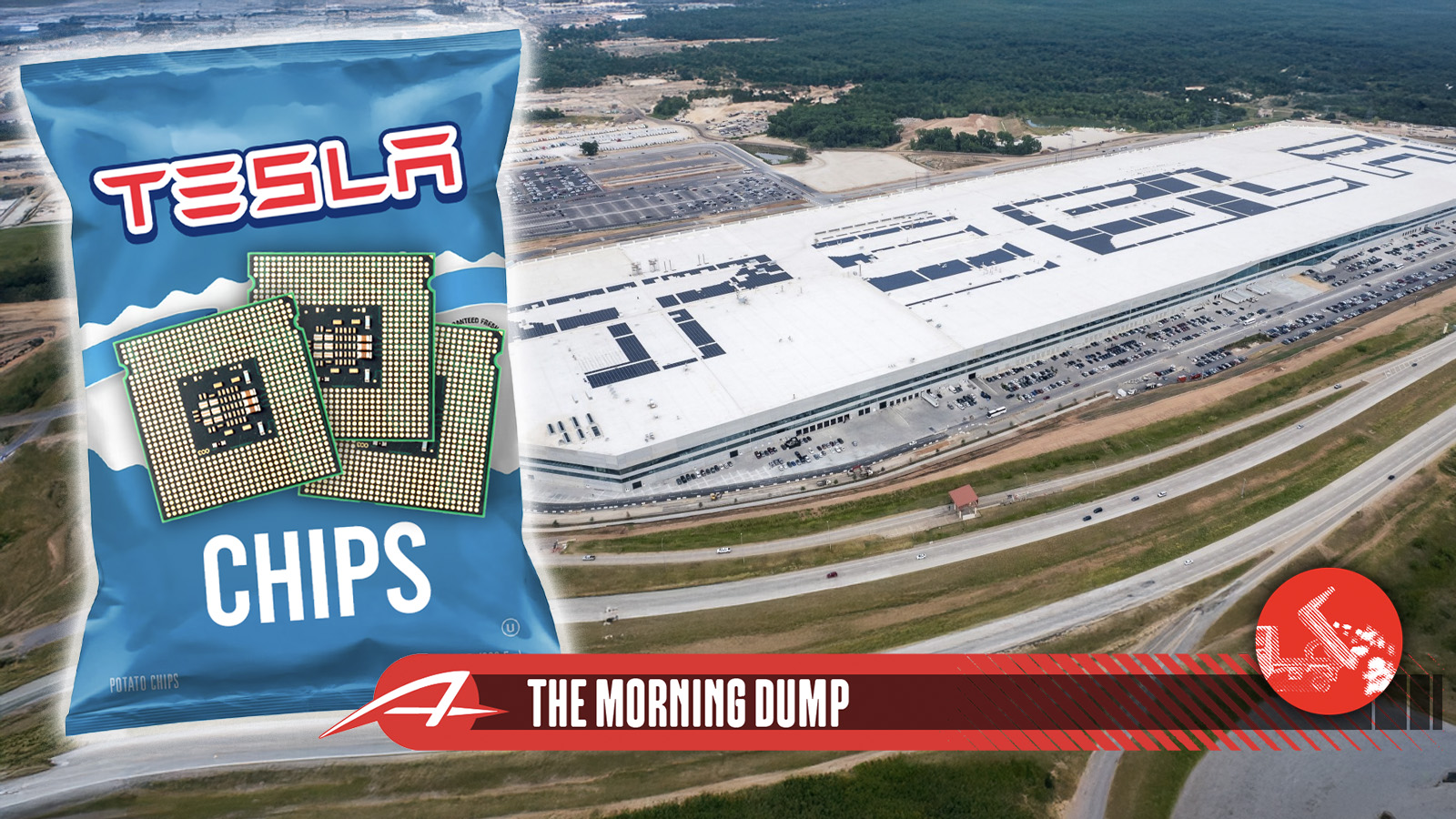
Instead of continuing to compete in the rat race, Tesla CEO Elon Musk, who also runs SpaceX, plans to launch a chip-making facility specifically for his two companies in Austin, Texas. If the world stays on the direction it’s on now, it might be the smartest decision Tesla will ever make.
What else is going on? General Motors and its Chinese partner, SAIC, are planning a major electrification push in China to sustain their joint venture, using Buick and Cadillac EVs. Additionally, Gerry McGovern, Jaguar-Land Rover’s long-standing design head, has officially parted ways with the company following extensive reported drama and confusion. Faraday Future, the Chinese-backed, Los Angeles-based electric car startup, has had its four-year case with the Securities and Exchange Commission dismissed.
Let’s get into it.
Tesla Will Make Chips Of Its Own Using A Factory In Austin

While many automakers struggled to meet demand in 2020 and 2021, Tesla really didn’t have that problem. According to Forbes, that success can be traced back to 2016, when the company began developing its own silicon-carbide chips to reduce its reliance on foreign suppliers. In addition to being more energy-efficient and durable than standard silicon chips, these in-house chips were also just… available to Tesla, meaning they didn’t have to slow or stop production during the pandemic.
While several car companies are now either partnering with chip makers or starting to develop chips of their own, Tesla is taking the initiative yet again. CEO Elon Musk announced on Saturday night plans to develop a new site in Austin to produce chips for Tesla vehicles, humanoid robots, and SpaceX satellites through a jointly run program called “Terafab.” From Bloomberg:
Musk, the chief executive officer of both companies, said he will start off with an “advanced technology fab” in Austin that will have all of the equipment necessary to make chips of any kind, and test them. Musk, who has no background in semiconductor production and a history of over-promising on goals and timelines, had said before that the company will start with a smaller scale fab before moving to a bigger one.
Musk has said the semiconductor industry is moving too slow to keep up with the supply of chips he expects to need, even as the industry increases output.
“That rate is much less than we’d like,” Musk said. “We either build the Terafab or we don’t have the chips, and we need the chips, so we build the Terafab.” Musk’s project would call for one day supporting a terawatt of computing power per year, the amount he expects the companies to eventually use as he ramps up his investments in AI and robotics.
For some context, the United States currently produces a combined half a terawatt of computing power every year, according to Reuters. So we’re talking a whole lot of chips. Musk says that production will be split into two specific wafers: One for Teslas and the Optimus robot, and another for AI data centers in space.
Back in 2023, Tesla decided to slash the use of silicon carbide chips, citing cost and advancements in powertrain design. Musk’s companies currently get chips from the likes of Samsung, Micron, and the Taiwan Semiconductor Manufacturing Company, but added that his ventures would eventually demand more chips than the world’s current total output.
As I mentioned earlier, microchips are the lifeblood of not just the car manufacturing industry, but also of a large swath of all manufacturing industries. Recently, in the race to build computing power for AI, the chip shortage has reemerged as an ongoing issue in the automotive sector, as wafers are being directed away from cars to AI data centers.
Tesla and SpaceX building a chip-producing facility for themselves, then, is a logical solution that allows the companies to skip over the bidding war for chips produced elsewhere. Not only that, but the in-house chips would be optimized from the jump to work with Tesla and SpaceX products, further streamlining costs.
Obviously, this won’t be easy for Musk and his companies—if it were, every carmaker would have its own chip facility. As Bloomberg points out, it usually costs tens of billions of dollars and several years to bring a chip factory fully online. In his announcement, the CEO did not give any timeline for when Terafab might go active or when it will become fully operational.
Musk is known for overpromising on timelines and project scale. Remember the Tesla Roadster, first revealed in 2017? As of last week, it was delayed again, for what feels like the 37th time. But considering how important microchips are (and will continue to be), perhaps this will be different.
Here’s How GM Plans To Turn Things Around In China

Like many legacy manufacturer efforts in China, General Motors hasn’t been doing great in the region these past few years. Advancements from domestic automakers in the EV and software space have drawn buyers away, to the point where GM’s joint venture with local producer SAIC Motor Corp. saw sales collapse by 75% last year to 562,000 cars, down sharply from a peak of around 2 million vehicles in 2017, according to Automotive News.
The plan to get sales back on track? Lots of new offerings from Buick and Cadillac. But mostly Buick. From Autonews:
SAIC-GM will invest more than 10 billion yuan ($1.4 billion) to upgrade existing Buick models and develop next-generation products to protect its position as the top multipurpose vehicle seller in China. In 2025, Buick sold 123,000 gasoline and plug-in hybrid MPVs, up 18 percent from a year earlier.
Buick launched an all-electric variant of its plug-in hybrid Encasa MPV on March 17. And an update of the plug-in hybrid variant will arrive in the second half, featuring a larger engine and faster battery charging.
To expand electrified offerings, Buick will introduce the E7, a five-seat plug-in hybrid crossover, in mid-2026. The E7 will be the third nameplate from Buick’s Electra subbrand to be based on the Xiaoyao platform.
In case you’re not familiar, Xiaoyao is a vehicle architecture developed in China meant to underpin plug-in hybrids, range-extended EVs, and full-electric vehicles. In an effort to keep up with domestic competition, this platform will be getting stuff like a 1,000-volt architecture for high-speed charging, with up to 621 miles of range and over 1,100 horsepower on tap. Additionally, Autonews says these electric Buicks, as well as the Cadillac XT5, are getting a bunch of new “smart cockpit technologies” later this year, which will enable seamless phone connectivity for most smartphones.
The plan comes as the joint venture contract between SAIC and GM is set to expire in June 2027. For what it’s worth, no one thinks the company will be disbanded. From Autonews:
Currently, GM and SAIC have agreed in principle to extend the venture but still need to negotiate details, according to sources familiar with the situation.
“It would be unimaginable for GM or SAIC to choose to close the joint venture,” GlobalData’s Zeng said. “For SAIC, that would result in the loss of a core business. For GM, it literally means death of Buick since China is an indispensable market for the brand.”
While I wouldn’t go as far as to say Buick would die without China’s sales, I agree that it’d be crazy not to push on and turn things around, seeing as how strong the brand is in China.
Gerry McGovern Is Finally, Actually Out At JLR

Following JLR head designer Gerry McGovern’s controversial decision to throw away Jaguar’s design ethos in favor of a polarizing EV was a report from December that suggested he had departed the company and had to be “escorted out of the office.”
About two weeks later, Jaguar Land Rover came out and told the media that it didn’t fire McGovern, leaving his fate unclear. Then, another report in January emerged saying that he was, in fact, fired, though JLR refused to comment. Now, three months later, McGovern’s exit has finally been made official. Like Ian Callum before him, McGovern intends to launch a design studio of his own. From Automotive News:
McGovern will step down at the end of March to set up his own creative consultancy, JLR said in statement on March 20. The statement draws a line under a period of uncertainty during which the automaker declined to clarify McGovern’s employment status after reports in January said he had been dismissed.
“Gerry’s creative leadership, vision, drive and passion have left an indelible stamp on our brands,” JLR CEO PB Balaji said in the statement. “I would like to thank Gerry for the significant contribution he has made to JLR and wish him every success in his next creative chapter.”
McGovern has held the Chief Creative Officer role at JLR since 2020. Before that, he spent 14 years as the head of design at Land Rover, where he was responsible for cars like the Velar and, more importantly, the Defender, which has been a major success for the brand.
Faraday Future Gets Away From The SEC

Remember Faraday Future? The Chinese-backed California startup has been clinging to life for years now, taking seven years to deliver its first car, which it introduced back in 2016. After going public in 2021, the company became the subject of a years-long investigation by the SEC over founder Jia Yueting’s control of the company, and claims that the first deliveries of its car, the FF91, in 2023 were not true sales, and that Faraday was misleading investors.
Despite SEC staff recommending enforcement action on Faraday Future last year, the agency has decided to close the case without taking any action against the company. TechCrunch broke the story on Sunday:
The dismissal of the case comes amid a historic drop in enforcement actions by the SEC, which only initiated four cases against publicly-traded companies in its 2025 fiscal year, a recent report shows. The SEC did not respond to an after-hours request for comment.
The investigation into Faraday Future lasted for nearly four years. The SEC was looking at whether the EV startup made “false and misleading statements” when it went public in a 2021 merger with a special purpose acquisition company (SPAC), and was also probing whether Faraday Future faked the sales of its first electric vehicles in 2023 — a claim that’s been made by at least three former employee whistleblowers.
What does this mean for Faraday Future’s… future? Well, now that the investigation is over, the company can “advance potential strategic financing and strategic partnerships” that it couldn’t before due to compliance issues. Whether that means the company will survive, I’m not sure. But it’s gotten this far, right?
What I’m Listening To While Writing TMD
For no reason at all, I am listening to “Save My Love,” a new song from Kygo, Khalid, and Gryffin, while writing TMD this morning.
The Big Question
Which automakers would benefit most from their own line of microchips?
Top graphic images: Tesla; Ruffles; DepositPhotos.com


“AI data centers in space” sounds like another Roger Corman movie. (For some reason I’m on a Roger Corman movies theme today.)
Maybe just putting “in space” at the end of anything makes it sound science fictitiony.
““Gerry’s creative leadership, vision, drive and passion have left an indelible stamp on our brands, which we are now trying to remove like a bad tattoo”
There… fixed it for accuracy
“Which automakers would benefit most from their own line of microchips?”
Aside from Tesla, I would say the biggest companies since they would have the scale for it. So either Toyota, GM or VAG. But in the case of VAG, it’s best if they subcontracted that to Rivian.
Good luck making semiconductors in Austin when there are extreme water issues. Lake Travis has been low for the last 10 years, sometimes very low, and the rains that used to come in from Houston now rarely do. Massive leaks in Pflugerville (suburb or Austin) had the city tell people not to wash their clothes or dishes this week.
OK, I get it now. It’s the movie Wall-E in real life: Tesla and SpaceX form Teralab to create the techy ship stuff, Twitter, FB and Amazon grab our attention and bury us in products we “need” to consume. Then, when the companies own everything and the Earth is used up, the highest paying consumers get on a Teralab ship and leave.
So the rest of us working stiffs just need to become trash compacting robots and the future is secure!
Intel, who know a thing or two about making chips, say it takes them 3-4 years and $10B to build a new fab.The lithography machines that actually lay out the transistors on the chips, are pretty much the most complicated machines on the planet, and cost hundreds of millions. There’s only a few companies that build them, and their order queue is multiple years long. The silicon crystals that are cut into wafers to build the chips on are likewise very expensive, and the only suppliers already sell everything they can manufacture to the already existing big companies.
Even once your fab is built, it can take years to get the process running efficiently enough to make a profit.
So no, even throwing tens of billions of dollars at it, Elon can’t build a chip fab any time soon.
Slightly related. As someone who’s had a PC since 1981, and still likes building PCs for fun, this dystopian tech-bro timeline, where all my PC parts have become unobtanium or cost more than gold, must end.
One thing that has always characterized both SpaceX and Tesla is vertical integration. This has worked out well for them, so this news about them going into chips is not surprising. Don’t forget that SpaceX already mass produces communication satellites.
Hopefully it’s just a matter of writing checks to people who know how to build a chip fab and not Cybertrucking something totally out to lunch because of Great Ideas! The former will be capital intensive but both companies are in a good place for that. The latter could be a massive and expensive failure.
I was sort of onboard with the concept of Terrafab until I saw the Ralph McQuarrie-looking illustration, and was reminded that Elon is the king of overstatement and selling fantasy.
sadly, at least GM, but I imagine the big 3 in general had chip making capabilities locally. then shut them down to gain maybe half a percent profit assuming all the chip making eggs in one foreign basket was not going to bite them in the end.
The Kokomo plant ceased production of semiconductors in 2017, after GM called the prospect of updating the facility “cost prohibitive.”
I’m ready for Faraway Future to be ousted to Neverland. They’ve smelled off since the beginning. Flush already.
Some days I fear that Aptera is more of the same, but I like the product a lot so I don’t listen to those quiet doubts as closely as I should.
Tesla’s chipmaking venture could really take off and become a viable concern and be spun off into its own company. They could call it Instruments Texas.
This idea that Tesla can just decide to build a semiconductor factory to provide chips for themselves is either a) ignorant on a nearly unfathomable level, for the business that they’re talking about or b) just another way to keep fleecing the faithful.
As two points to consider, take the opposite ends of the technology spectrum, TI and Intel. TI makes a mind boggling number of chips, for all kinds of different applications, including automotive. The technology used for this is older node processes and, being commoditized at this point, relies on massive scale to make the economics work. However, the takeaway from this is that it is low margin and high volume.
Intel is on the other end of the spectrum, having until recently abandoned trailing edge nodes as they focus their available capacity on high value processes, currently 18A. The nature of this business plan relies on high value/margin for a number of years, transitioning to higher volume, somewhat lower margin products once things have ramped for a while. However, these products won’t be commoditized in the way that TI technologies are for a long, long, long time.
Additionally, power electronics like the SiC (or GaN) mentioned in the article are totally different that compute processes and while some companies can do both (Infineon, ST, NXP, maybe some others), none of those companies are competing on the bleeding edge.
Finally, for people paying attention to the market, Intel is currently into a transition to becoming a true foundry player, like TSMC and Samsung, and is expected to have loads of capacity, certainly on a much shorter timeline that anything Tesla could achieve.
Anyway, this announcement and reporting just reeks of ignorance and classic Elon distraction/stupidity.
Cheers
“Finally, for people paying attention to the market, Intel is currently into a transition to becoming a true foundry player,”
Back in the days of the Pentium 3 and Pentium 4, Intel was THE BEST foundry player when Pat Gelsinger was Intel’s CTO. Intel’s foundry business started to go downhill after Gelsinger left in 2009. And after Gelsinger came back, Intel was far behind and it seemed that the board didn’t/doesn’t have the patience anymore for long term planning.
So the way I see it, Intel will continue to be a foundry player as it has been for a long time. But will they become THE major foundry player they once were?
That remains to be seen and it depends on a lot of ‘IFs’
For a guy who can sell Costco hot dogs for 13 bucks at the GigaDiner, how hard can making chips be?
It’s harder. Probably at least as hard as when Tesla transitioned from being a lower volume car maker to a true high volume car maker with the introduction of the Model 3.
Elon: Need to be self sufficient, we should produce everything in house to have control over our future and production. Working to build an in-house ecosystem that will advance everything.
GM: We need to spend billions helping China advance their car industry again so we can get left in the dust when they tell their citizens to stop buying our cars. Oh well, we can write down billions more and shrug our shoulders while doing buy-backs.
Interesting approaches, very different. Only time will tell.
I had thought JLR fired McGovern for the Type 00 but now I think it was because of that suit! Is that purple velvet?
Yes it looks like crushed velvet. The combo with the turtleneck is just terrible.
Yes! I’m appalled by the cut of the suit also.
This makes no sense. It suggests they already have (or had) a chip foundry in-house, which is clearly not the case. I checked the Forbes article and it doesn’t really explain what it means either AFAICT.
My WAG would be that they designed (but did not build) their own chips and unlike everyone else, they didn’t immediately cancel all their orders when the pandemic hit, so they didn’t get bumped to the back of the line for manufacturing. I have no evidence to back that up, but I think it makes more sense than the idea that Tesla spun up a chip fab in 2016, mothballed it sometime between 2021 and now, and is starting over from scratch in 2026.
Beat me to it. Everything I’ve found says the design is Tesla’s but the actual manufacturing has been done by ST Microelectronics and Infineon.
Chip design and manufacturing are different. They were designing chips and having a foundry fab them. So they were considered a fabless semi conductor manufacturer like most semi conductor manufacturers. They aren’t actually involved in the manufacturing but just design. I believe they are referring to SiC MOSFET fabbed by ST Microelectronics being used in the model 3 inverter. The complete package had components from TI, NXP, Infineon, Brodcom, and others.
Silicon carbide was cutting edge for motor inverters 10 years ago, which are sort of like processor chips (basically, fast, high current capacity transistors) but with a much different set of design criteria and scale. I’m guessing they got the manufacturing of these mixed up with processor chips
That makes sense, thanks!
His Muskitude has also said that incumbent chip makers have clean-room design all wrong, and that he’ll be able to eat a cheeseburger and drink a whiskey in his clean room.
Good luck with that dude.
The article doesn’t state how much they’re going to invest, or how long their timeline is. Samsung is building plant near Austin (Taylor) that reportedly cost them $25 billion, and has been underway since 2021, and will reportedly go into mass production next year. Musk’s attention span isn’t that long, and the shortcuts he’s notorious for don’t really fly when you’re trying to inscribe features smaller than the wavelength of light.
We’ll either get more chip fab capacity in the world, which is a good thing, or we get to watch the Elongated Muskrat fail, lose a ton of money, and ultimately sell the equipment at a discount to someone competent, which is also good.
I look forward to a chip being drunk on scotch and sending a Tesla into an aged in Oak barrel tree
I feel bad for the engineers who are going to be conscripted into trying to make this happen for him.
Excuse me, he prefers “His Muskiness”, thank you
Congrats on adding some context for what the hell a terawatt of semiconductor means. Really that seems to be aimed at the data centers, but still, maybe we can link it to the tesla tequila that went somehow with the cyberwhatever.
While Elon says all sorts of crazy, I am careful to not fully disregard him either. The simple fact is, he’s been core to what both Tesla and Space X have been able to achieve. But I would assume his MO would remain for chip making. Find a company doing something decently well, buy them, erase the founders and claim he did it, then iterate relentlessly.
Waiting for a whole bunch of temporary tents in their parking lot for their first run of chips. Good luck Elon
Wait, did they fire Musk? Is there now someone with common sense, and who’s not abusing drugs, at the helm?
It’s just the Overton window shifting. Stuff that was completely wackadoo previously has now migrated into normal territory due to the extreme batshittery present elsewhere.