

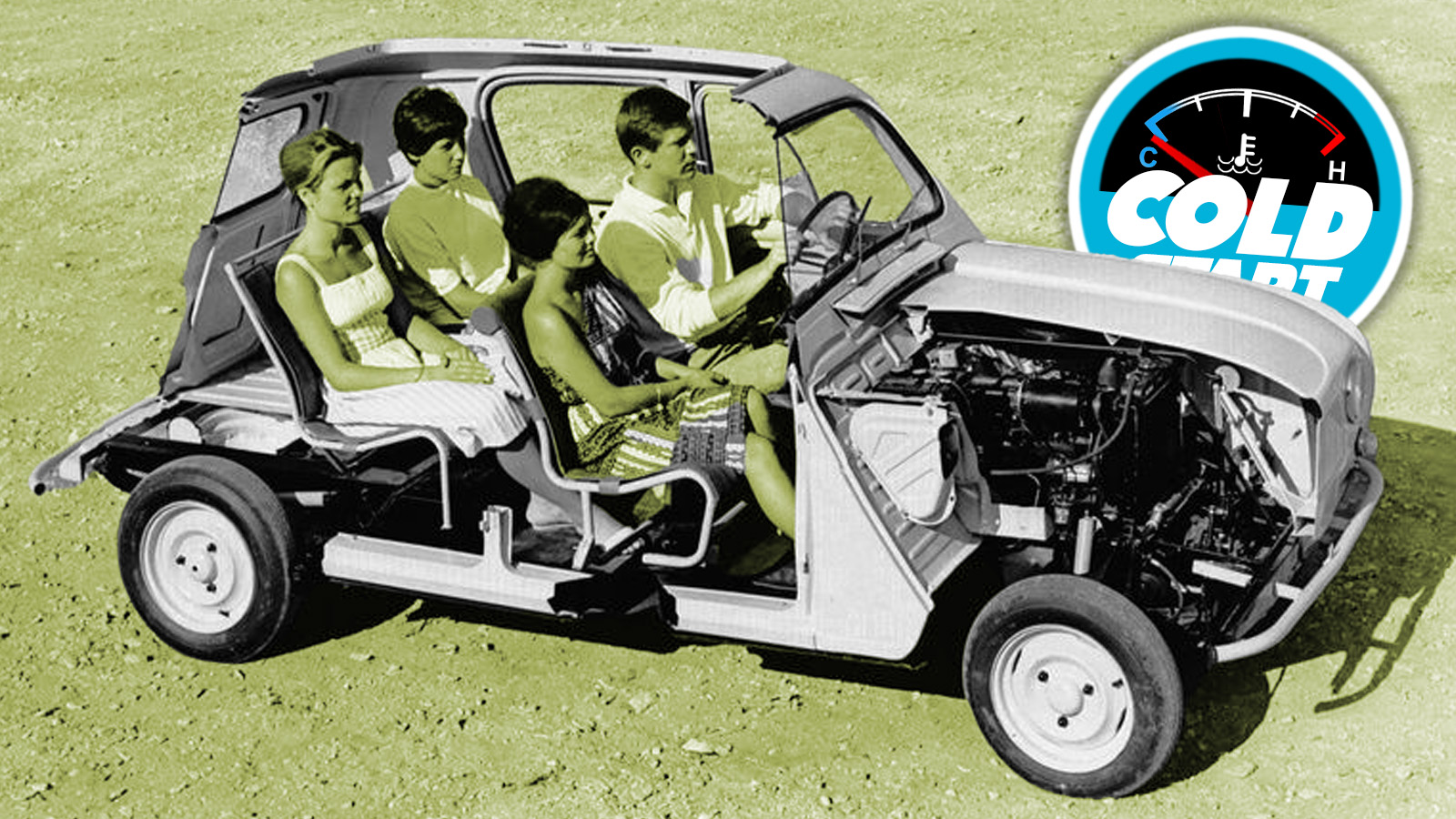
Sometimes in life it’s important to take the time to recharge and get back to some fundamentals. Just something to recalibrate one’s self, to make sure all of our internal settings are pointing in the right direction and everything is zeroed out or something like that. There’s a number of ways to do this, of course: careful application of electric shocks, eating an entire wheel of brie, meditation, vigorous and ruthless self-pleasure, and the way we’re going to try this morning, considering some early press images of Renault 4s.
Yes, the Renault 4! A fantastic, practical, humble car, a “blue jeans” car as Renault chairman of the era Pierra Dreyfus put it, a car that was designed to compete with the Citroën 2CV, which, by the time the R4 came out in 1961, was seeming pretty dated.


The R4 can be seen as a reaction to the 2CV, and in many ways was like an updating of the 2CV template, just more refined and modernized. Same longitudinal FWD setup with a funny shifter that popped out of the dash, same strange, butt-raised stance, but with a more modern full-width, boxier body that allowed for more room and came with a hatchback by default.

As you can see in this excitingly deconstructed display, even those lawn chair-style seats were very similar to the 2CV. And interior room was more generous:
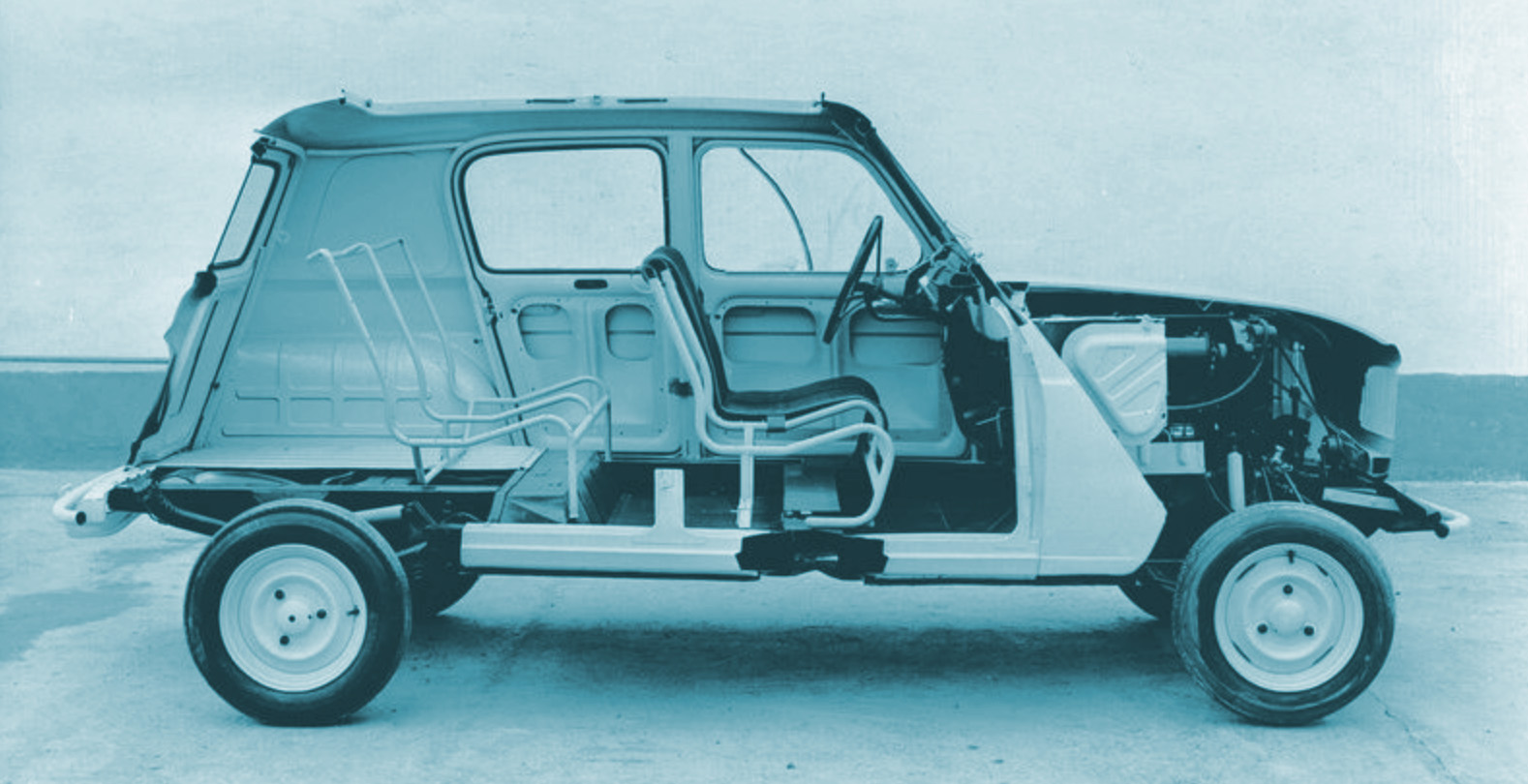
Note how the gas tank is stuck under the hood instead of at the rear, freeing up even more cargo room at the expense of even more nose-heavy weight distribution. I do love these actual cut-away cars. I don’t think they were actually drivable, but I bet they were fun to be in:

I didn’t flip this old press photo; did they have two matching ones, one with an open left side and one with an open right side? The steering wheel looks on the closed side on both pics, so maybe one of these images is flipped?
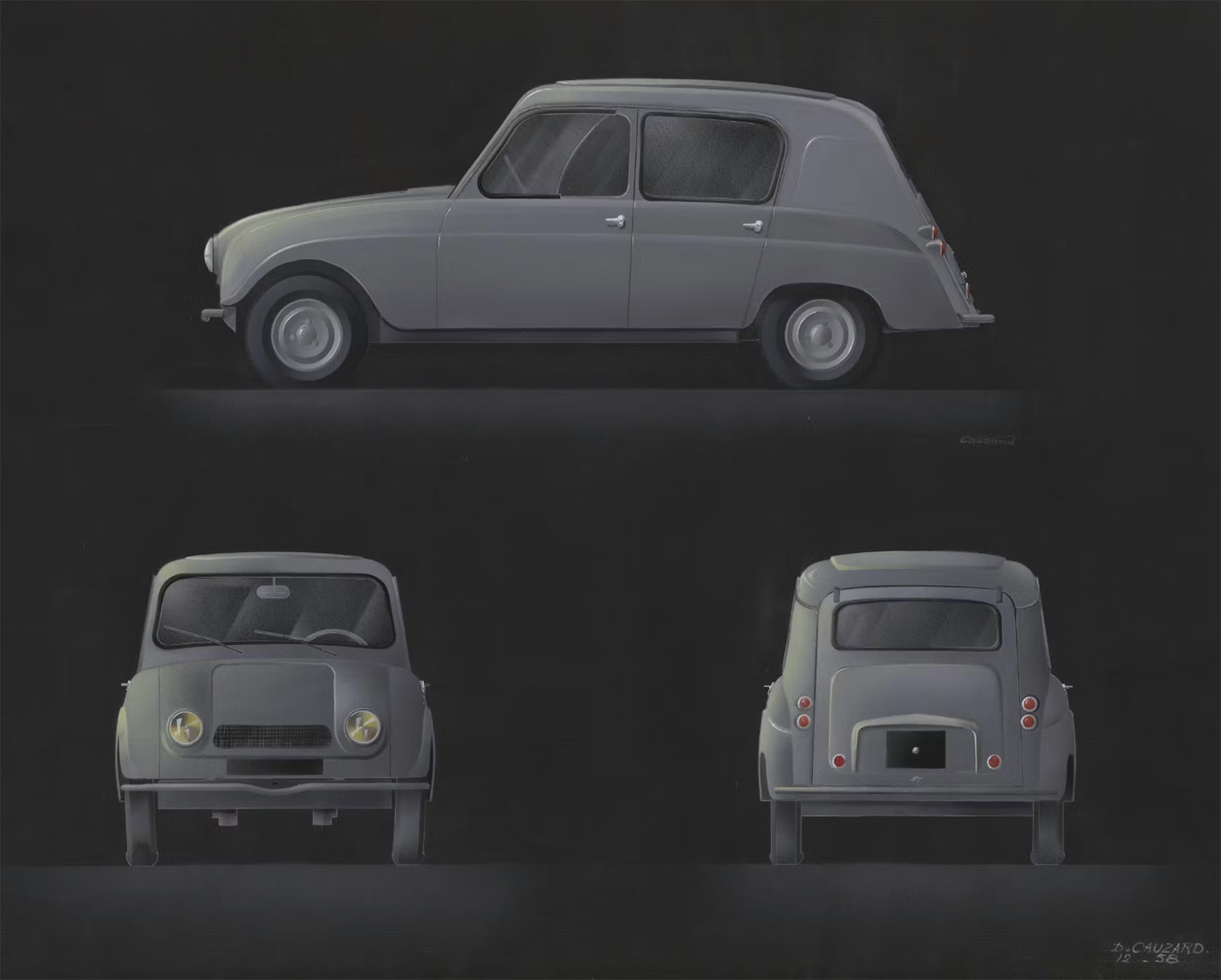
Early drawings and renderings of the R4 are interesting, too. The design is simple, yet not really austere; there’s plenty of character lines and compound curves and molded-in details, and not just for the strength from corrugations like the 2CV used on, say, its hood.
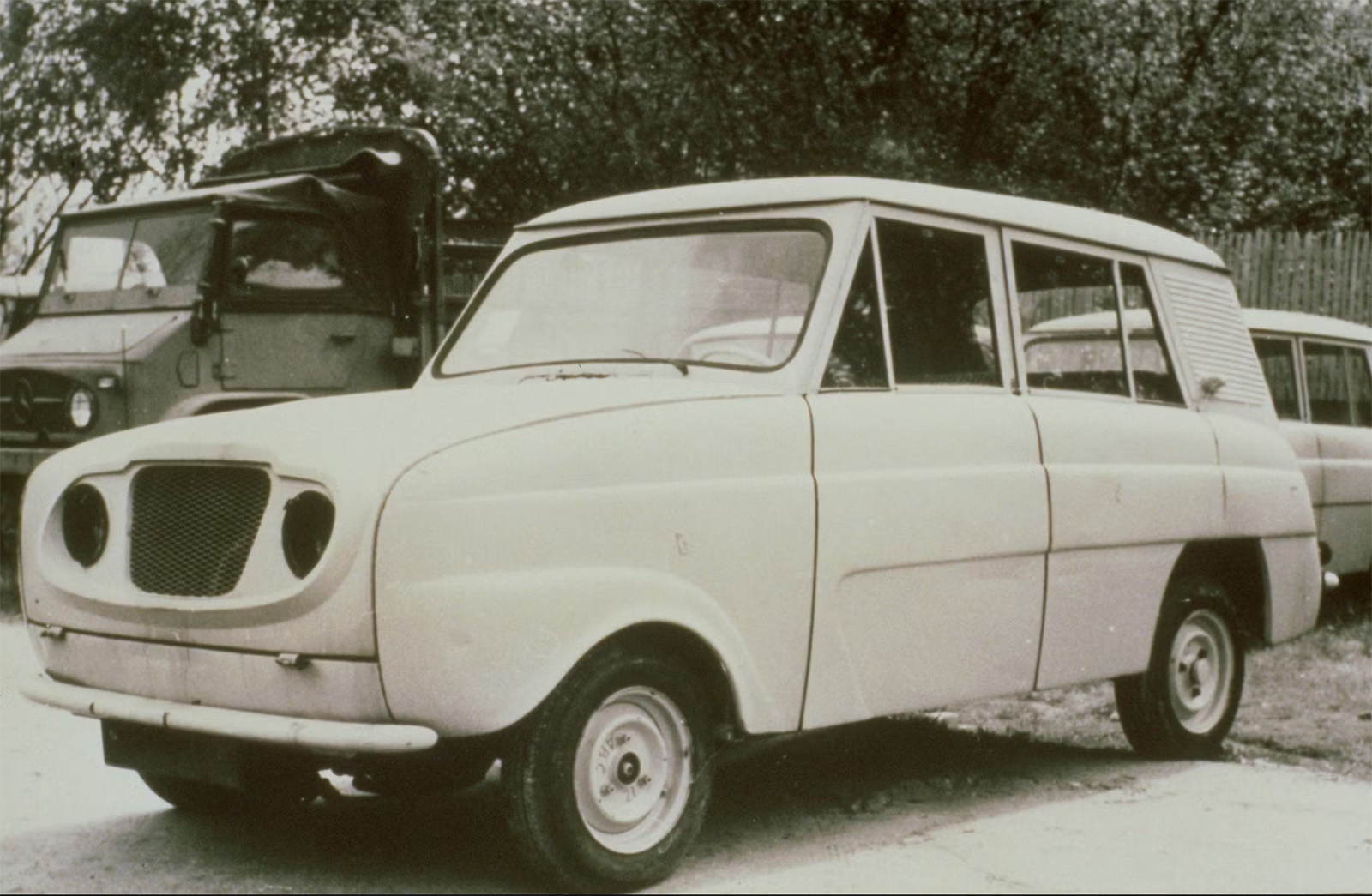
Some of these prototype R4s had quite strange styling; this one seems to have tiny wheels and a kind of funny face. It reminds me a bit of a Crosley.
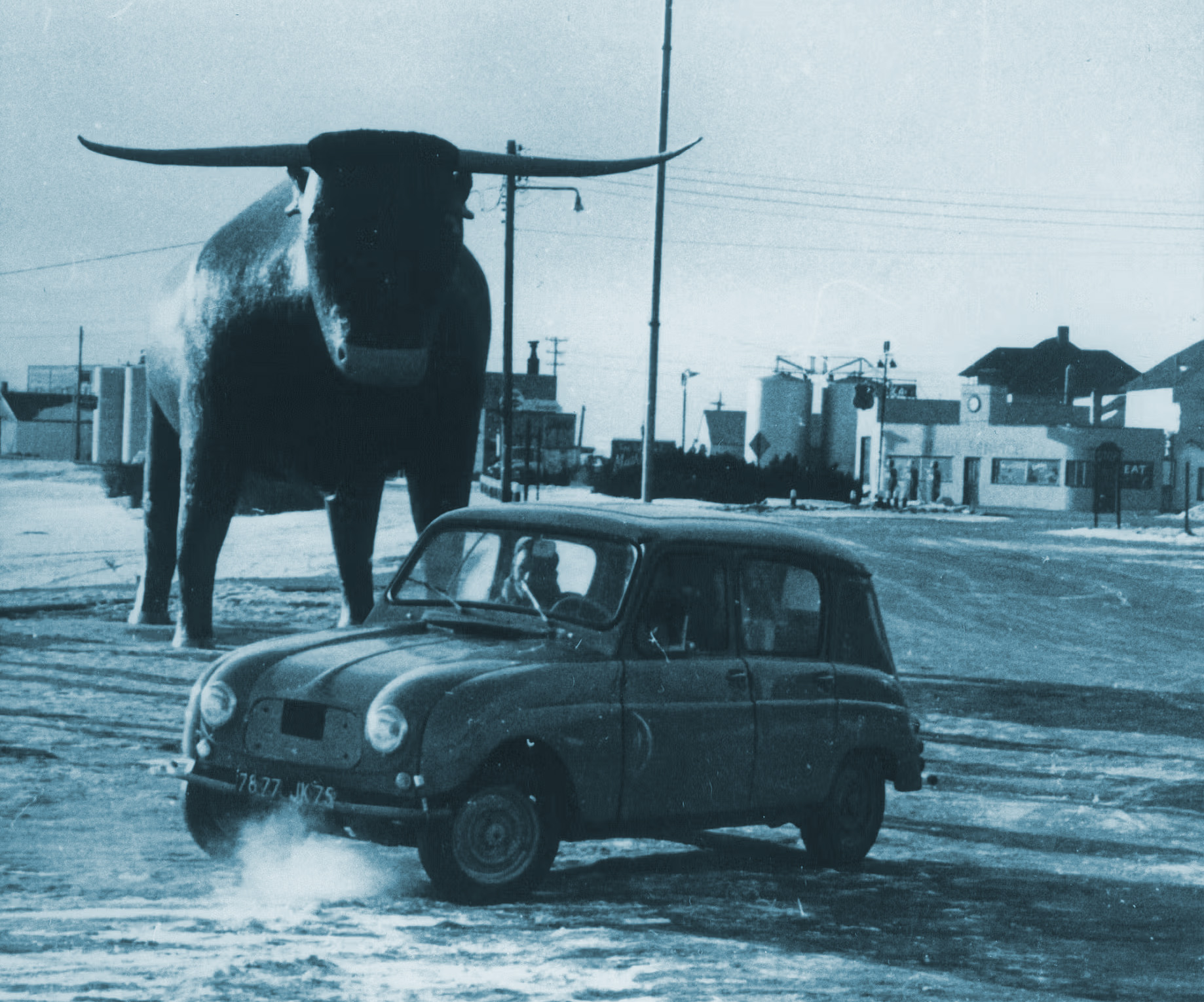 Speaking of Crosley, which was American , I didn’t realize that Renault did cold-weather testing in America! That’s Babe the Blue Ox back there, in famous sculpture form in Bemidji, Minnesota.
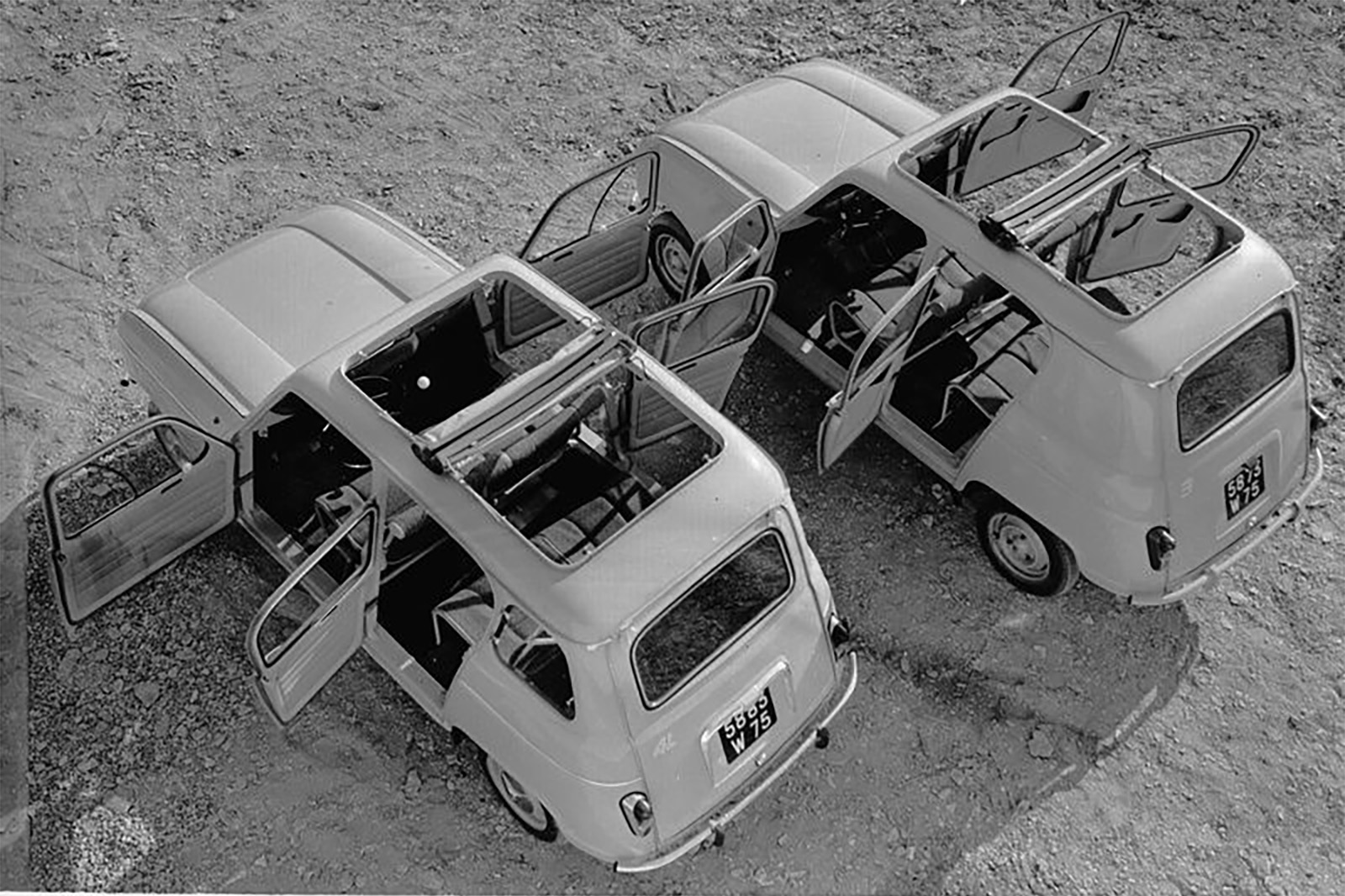
Again like the 2CV, the R4 had a large canvas roof. While not quite as all-encompassing as the 2CV roof, where pretty much the entire roof is fabric, the R4 has a metal roof, just with a big hole. The way the roof rolls is especially clever on the R4, rolling back to the center from the front, and forward to the center from the rear. This allowed just the front, just the rear, or both to be opened. I love it.
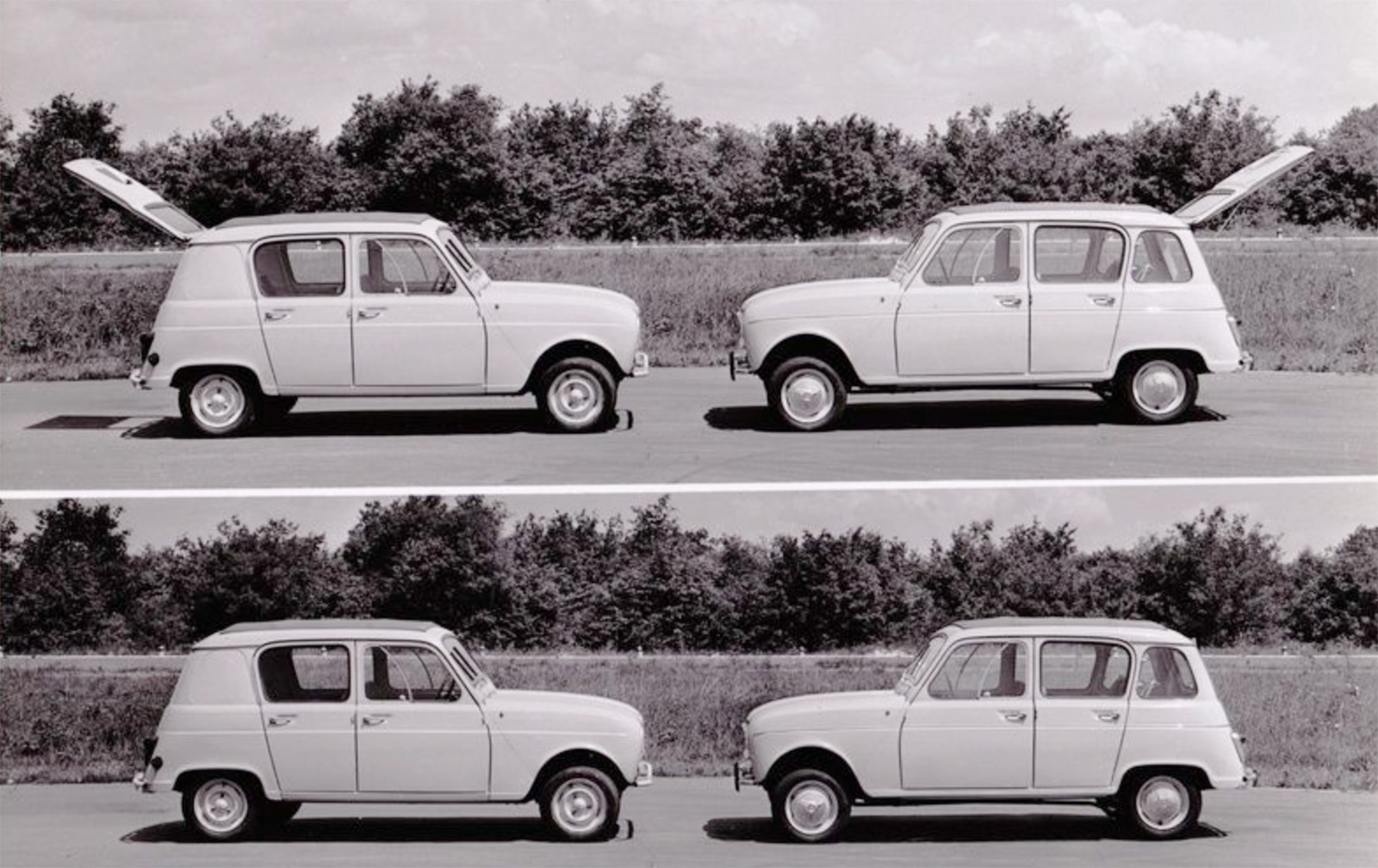
Early on in the R4’s life there was also an R3, a cheaper, lower-spec version of the car. You could spot those because they lacked the third cargo-area window at the rear. Well, technically, only the 4L version had that at first, but soon all R4s got the intense luxury of the extra windows.
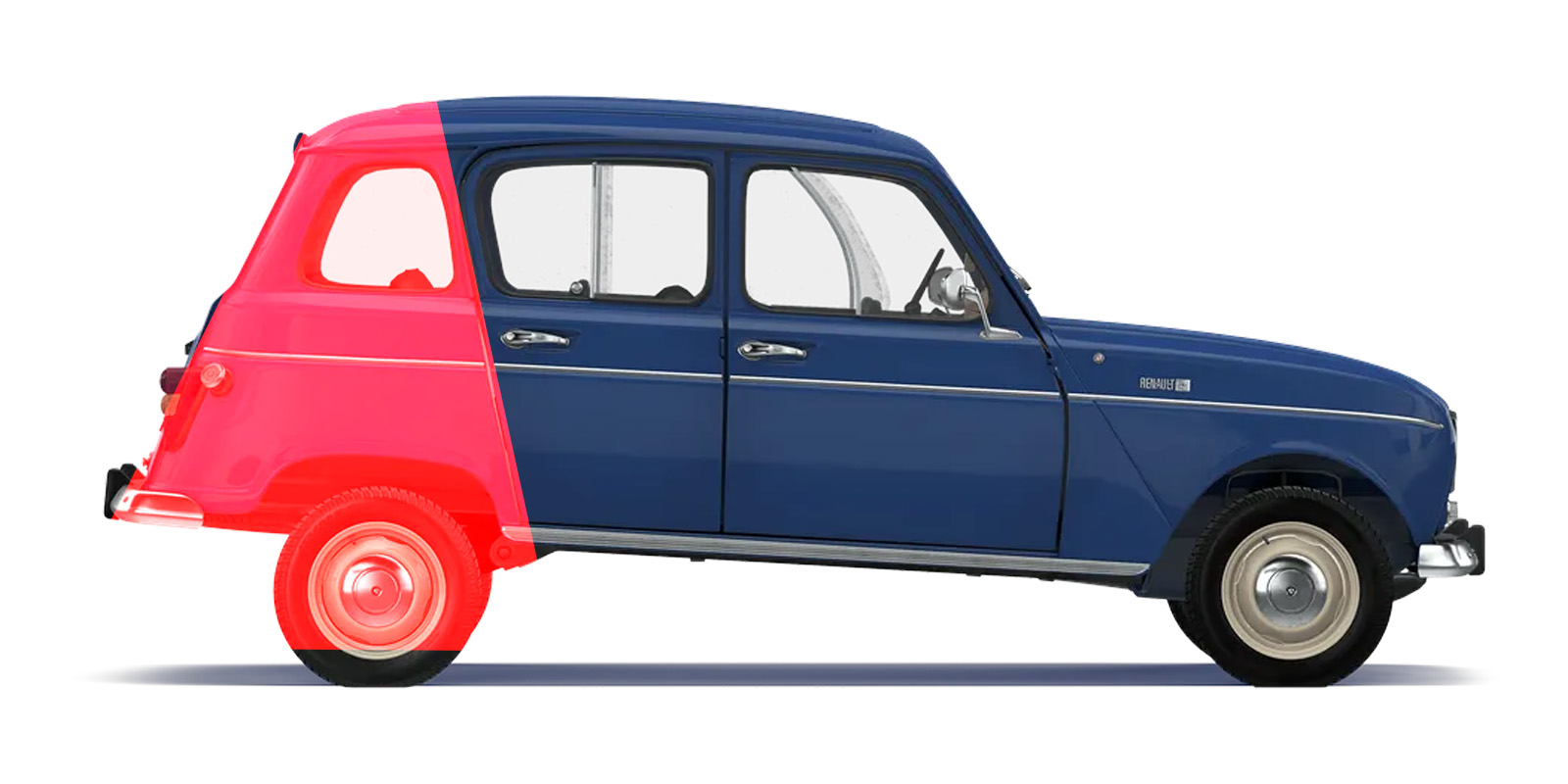
That rear side window also helps define what always caught my eye as the visual punctum of the R4: the oddly compelling triangle-like shape formed by the angle of the rear door and angle of rear hatch. Those lines just seem to form such a tidy little section there that it always grabs my attention. It’s peculiar, but I like it.
I guess you could say that about the R4 as a whole? I hope you find some inspiration today from this deeply clever and determinedly rational little car.
(Top and really all images: Renault)


Even for its era it looks like a serious death trap to me. Lawn chair seating anyone?
The cutaways look like a cross between a Citroen Mehari and a lunar rover.
It always feel like the 4 is underappreciated. And it might be the greatest car ever made. Its combination of practicality and affordability was unmatched. Truly.
One thing that’s kinda wild is that Renault produced 8 million 4s from 1961 to 1994 (33 years) while Citroën produced *only* 3.8 million 2CVs from 1948 to 1990 (42 years) so twice as many 4s as 2CVs… But if you ask most ‘Muricans to picture a French car chances are good they’ll think of the 2CV.
Yeah, the Renault 4 might indeed be quintessentially French but a bereted Snoopy (& Marcie) wouldn’t have had quite the same je ne sais quoi (or quite the same, uh, command of the French language) while driving a 4: https://youtu.be/ecTR33_mEWg
(In fact this website has covered this very topic: https://www.theautopian.com/im-pretty-sure-the-only-times-snoopy-drove-a-car-it-was-in-a-citroen-2cv/)
Wouldn’t Renault’s answer to the 2CV, be their own 4CV? I like the R4 too, but I think I’d rather have the 4CV.
The Quatrelle is absolutely iconic and also a masterpiece of engineering and design. I honestly think the worldwide alternate reality of the Beetle could have been the R4, in my mind a more compelling car than the Beetle. I fully say this as a someone who loved his Beetle during college and has just gone into hiding from Jason right after posting this.
In some latitudes, you can bet your hard-earned money that the Quatrelle represents “the” people’s car in a way that the Beetle never did. That’s definitely true of Portugal, where I’m from, but also places like Argentina, Colombia, The former Yugoslav republics, Northern Africa… Even in France, Italy or Spain, to an extent (although in those countries there was definitely competition for the title of “people’s car” – which didn’t necessarily include the Beetle).
I’m very biased, as it’s my favourite car in the entire world, and also my daily driver, but I always marvel at how smart of a design/engineering combo it is.
Ze french have many such hits. I am currently going through a Peugeot 504 phase.
Love the 504! Diesel breaks used to be very popular around here, and you don’t have to travel much to pass by a few still in active duty – people in the know often say they can go on forever as long as fluids are kept in check. Pick ups are also still relatively common as workhorses. Sedans, however, are a rare sight these days.
French cars, man… some can be very shitty, and they’ll go from extremely weird to “is car”, to both things in one (like the Renault 4 – “car” distilled to its most basic form, but still: different wheelbases on each side and a front-mid engine setup). French classics are very rarely boring, and so many of them are just historic milestones in automotive history.
Jason will chase you in his 2CV to punish you for slandering his Beetle, how ironic!
On my birthday, no less! What an awesome coincidence!
One of the pics above is actually my Apple ID profile picture 🙂
EDIT:
This is not a great way to tell R3s apart, they sold so little of them that poverty-spec R4s with the rear panel instead of window outsold R3s (and buyers could supposedly option the rear window for the R3 – it’s not clear to me if any were sold with this configuration, never seen pictures of a non-panel R3). That’s how little the general public cared for the R3 – they sold so very few of them, some information about it may have been lost to history.
Happy birthday!
Thank you very much!
Happy birthday! For you, there’s always a moment to talk about Renaults.
Thank you fellow Autopian!
Happy birthday (mine is a day after yours)!
I’ve known about the R3 but never seen one.
Happy birthday to you too!
Same with me, never actually laid eyes on a 3 in person. They were rare when they were new; they dind’t get more common since 🙂 Not 100% sure about this, but I don’t think the R3 was ever exported, so the few units they moved were all in France.
Thanks!
MaximillianMeen – great catch, . BTW, the second photo has the worst background ever chosen for a promotional picture
I was working on a project in Germany in the 1980s that entailed driving on the Autobahn in my little rental Opel, which of course I pushed to the extreme in the no-speed-limit sections, eventually achieving 180 kph on a long downhill stretch. I remember it because I found myself overtaking an old Renault 4 at a frightening rate.
Great “people’s car”. Neat factoid about the R4 is that because of how the torsion bar suspension is set up, the wheelbase is ever so slightly different on each side.
It’s a bit more than “ever so slightly” – IIRC it’s about a full two inches different from side-to-side! Which is a LOT on a quite small car.
Having driven one enthusiastically, I would say that the R4’s differing wheelbase is just not noticeable. For low-powered, lightweight cars like this, the rear suspension doesn’t have to be very sophisticated, it’s just coming along for the ride. The front suspension is important, and that on the R4 is actually very cleverly designed. Unequal length wishbones are set up so that the centre of the wheel vertical travel arc is exactly at the centre of the inner CV joint. This means that, unlike the 2CV, there are no clunky and expensive sliding joints in the driveshafts.
No doubt – I haven’t had the pleasure, but I assume that the R4 is just as sophisticated in it’s ride and handling as every other French car of it’s era. And one of the most delightful small cars I have ever driven was the R5/LeCar, which had a very similar setup I believe.
It’s not easy being green
or driving around in a car where half the body is missing
I had an R5 and as a six foot 200lb person it was umm comfy, my Mini was more spacious
I remember when there was an international design contest the year I graduated high school (2011) for the Renault 4, to celebrate that car’s 50th Anniversary. I really wish I had completed and submitted my design, since I was pretty adept with Autodesk modeling software. I’ll see if I can dig up the sketches I did.
But yes, like many French cars, the 4 has some strong and unique character traits, mainly the close-set front fascia that sits entirely between the front fenders and–like you said–the triangle that’s formed by the reverse-canted C-pillars and the artfully-sloped rear line.
With that small cloud in front of the bumper, it looks like the winter testing was conducted in reverse.
From a marketing or business perspective, building a slightly-better clone of the 2CV in 1961 would be a terrible idea. It would be catnip to an engineer though, and my favorite thing about France is how often they defer to mad engineers.
Interestingly enough the 2CV remained in production until 1990 while the R4 was retired in 1994, so a lot of people who cross shopped them must have gone with the CV2 despite the advantages offered by the R4’s more modern design. The 2CV probably cost less due to its bare bones approach. Proud tightwads would turn their noses up at the R4’s opulent 4 cylinder engine and less miserably cramped interior.
For the final 2 years of the production run of the 2CV they were built here in Portugal only (this is the last 2CV to roll out of the Mangualde plant, July 27 1990 at 16h30), and maybe because the discontinuation was anounced 2 years earlier, when production ended in France, the 2CV6 Club was actually slightly more expensive than the base model Renault 4 TL Savanne during that period.
Very cool, thanks for sharing! I love that they brought in a full band to celebrate the moment.
The local band being called to the celebrations is quintessential Portugality. This type of marching band (we call them Philarmonic Bands) is still very popular around here, and there’s rival bands and stuff. A lot of local professional musicians who eventually made it to international orchestras started in these bands.
Growing up in a family that owned, at different times, a dauphin, an r10 and then an r16, the underpowered cars were full of ergonomic surprises like what you could do with the r16 seats at the drive in movies (remember those). The seats turned into a double bed!
You know it is entirely possible those french cut open two different cars. And that they had to use a RHD market version because otherwise the steering would be cut away. All this because AI was not available yet to flip the image.
Or they just flipped the negative during printing.
Two of their most important export markets for the Dauphine were the UK (which was right there!) hence the RHD cutaway, and the US which is probably why they did cold-weather testing in Minnesota even if they ended up never selling the R4 here in any numbers.
I’m guessing it is a flipped negative since the lede LHD image and the RHD image halfway down the article appear to have the same folks sitting in the car, just less green-blooded hobgoblin looking in the second image.
How do I get a neat St Patrick’s Day sunburn like in that listing image? Does it only happen to those riding in a cutaway Renault?
Obviously it is gamma ray exposure. Don’t make them angry. You wouldn’t like them when they are angry.