

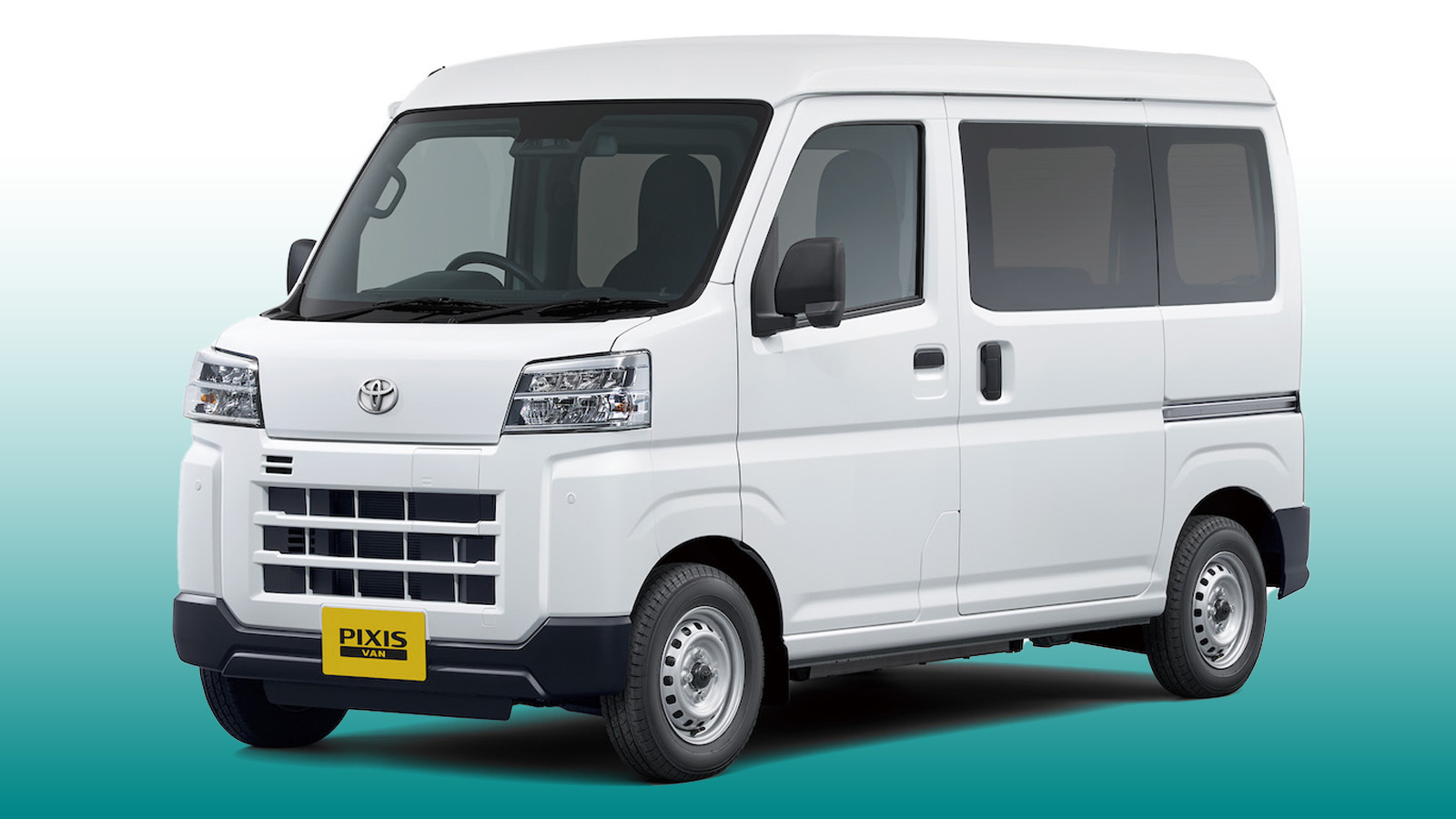
Toyota and Daihatsu have unveiled their new kei-class EV vans, the e-Hijet and the passenger version called e-Atrai. These vehicles are the first mass-production BEVs from Daihatsu, which has traditionally built small cars, vans, trucks, and 4x4s, and they will also be sold under the Toyota Pixis and Suzuki e-Every brand names. Manufacturing happens at Daihatsu, which has already built this generation of Hijet in gasoline-powered form since 2022.
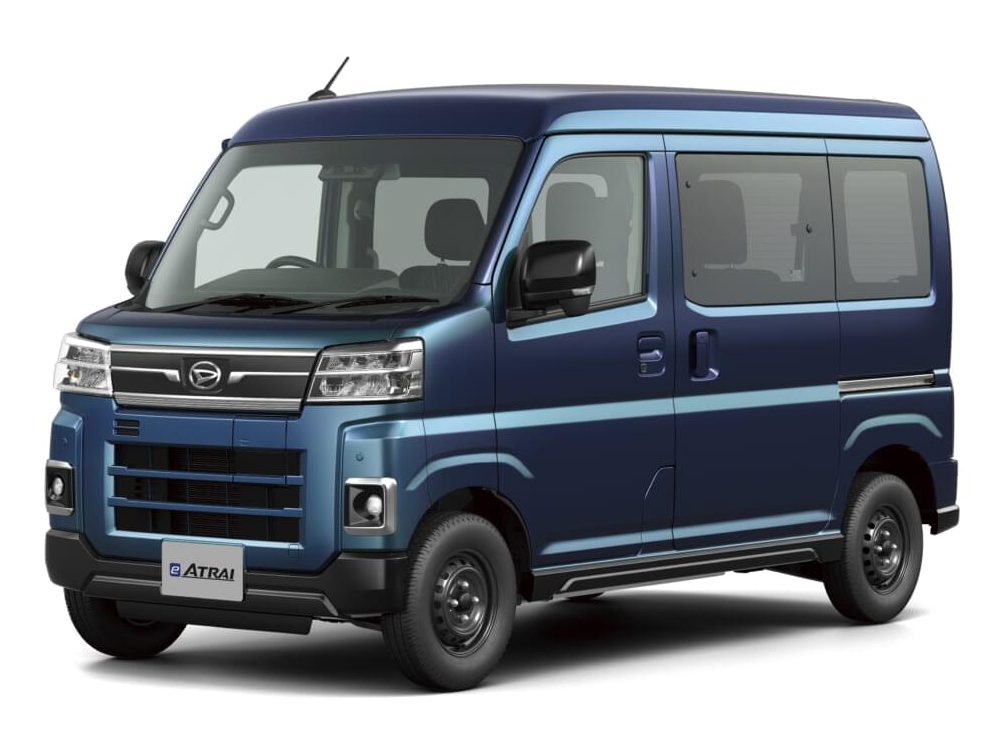
Daihatsu has specialized in manufacturing tiny work vehicles for decades. It’s great to think of a company that exists to build little guys, sympathetic buddies for people working in different fields, where you need your truck to be as small as possible or your panel van to be as big as it can be on the inside while being tiny on the outside. In other words, Japan.


Daihatsu lists industries including agriculture, forestry, fisheries, construction, and delivery as the fields for which it builds “working partners.”For last-mile logistics, a BEV panel van can make sense in a tight urban environment. Design-wise, they are literally white goods on wheels, which has its own certain charm.

According to Daihatsu, these two small EVs have been packaged to accommodate as large a battery as possible without compromising interior space. The manufacturer says this has resulted in class-leading loading space for the e-Hijet Cargo, as well as the best WLTC norm range in its class. For these vehicles, it means 257 km or 159 miles out of a 36.6 kWh lithium-ion battery that’s as thin as Toyota and Daihatsu could get it. They are rated for a 770lb payload.
The driven rear axle is dubbed the “e-Axle,” which contains the electric motor, inverter, and reduction gear. In kei vehicles such as this, a low center of gravity also adds much-needed stability, and there’s also enough weight over the driven wheels. EV torque also makes these things presumably quite zippy in city traffic.

36.6 kWh is not a lot, but it’s probably the perfect battery size for a small commercial vehicle. Because we’re talking Japan, these vans use the CHAdeMO charging standard, which you would most often only find on Nissan Leafs elsewhere in the world; in the home market, CCS is rarer. It’s Bizarro world, Jerry!
In any case, the vans fast charge at 50kW tops, meaning a charge to 80% takes 50 minutes or a long lunch break.

Since the vans are pretty much power packs you can drive around, they also feature accessory outlets and V2H (vehicle-to-house) compatibility.
They can provide power during blackouts caused by storms or earthquakes, which can be a vital feature in some regions of Japan. Heck, we had an 18-hour blackout before New Year’s and one of these would have been immensely convenient to run the house.

And if you’re using the accessory power outlet on the dashboard, you can still close the door and window, as the cable can be routed outside the vehicle using an adapter that slots in the driver’s door window. The fancier e-Atrai has powered sliding doors on both sides for convenience, while the Pixis and e-Hijet are trimmed in a more utilitarian fashion. Sales started in Japan from the beginning of February.
Top graphic image: Toyota


I wonder if they’ll try selling these in Europe and/or the UK? We have similarly dense cities with tiny streets, so kei vehicles make just as much sense over here.
I want this, but with a Subaru logo and a pop top like the Domingo. Daihatsu already builds the current generation Sambar, so it probably isn’t too much of a stretch for there to at least be an e-Sambar. Now, I just have to wait 25 years for the pressing decision to get one of these or a Kia Ray…
Maybe something’s wrong with me (no, I know there’s something wrong) but I sort of love vehicles like this. It’s not the pretties kei-van I’ve ever seen, but damn, it looks so practical. Even V2L for the power outages we have at least a couple times a year in my part of LA. Plus, ALL THAT ROOM IN BACK, with a relatively low load floor. Just think of all the dogs and/or appliances I could transport in one of those. The range is fine (for me) and I’d feel much better buying one of these with Toyota/Daihatsu experience/quality rather than some indeterminate Chinese knockoff, not that I’ll ever be able to buy any of them in real life.
My brain keeps wanting to make it “e-Atari” and I’m positive if I had to read it aloud that’s exactly what I’d do.
CHAdeMO is an interesting choice perhaps it will persist in the kei market. It really looked like they were throwing it it away and going to nacs. They had a pretty robust standard for all sorts of loads. It just never really made it out of Japan. I really can’t imagine many outside some companies and chargers have invested heavily in it. The original Tesla nacs and CHAdeMO are very similar in communication. Still throw a modern ccs based nacs on the thing for under $20k could be a nice city fleet vehicle. There are always nacs / ccs to CHAdeMO adapters out there for around $300 so I suppose it’s not the end of the world.
Oh boy TIL I learnt that Chademo is co-developed by Tokyo Electric Power Company.
You know, the one that brought us Fukushima Daiichi.
The Tōhoku earthquake gets some of the credit for Fukushima too methinks. 😉
I could have predicted earthquakes affecting Fukushima without getting out of my chair.
Yes, putting the generators in the basement wasn’t exactly prudent. I know they’ve got to be heavy, as are the tanks of fuel for them too, but they probably should have been placed high up to avoid loss of backup power during a tsunami/flood.
That’s more of Toshiba using ap1000 designs and not fixing an issue with the natural circ. Because they didn’t believe their copies had the problem even though they were in fact copies.
I’m really excited for more standardization with V2H. Being able to use my car to power my house in an outage is very attractive to me and I think would represent a fantastic selling point. Right now I’m just concerned that there are competing approaches that will render some vehicles useless for this purpose (much like Chademo…)
GM is the only one I see playing in this space seriously (versus V2L where it’s AC out of the charge port) and I think they’re still a little pricey/complex.
IMHO think it’s a shame that all the small vans have been discontinued here in the U.S. Last time I checked anyway. Ford and Nissan both discontinued theirs. I remember seeing a small Ram (Fiat?) van for a while. Chevy rebadged the Nissan van! Handy little vehicles that were economical and easy to park for deliveries. Still see quite a few on the road here in Cali. Guess the manufacturer didn’t make enough money? Once tariffs kicked in that would have killed them. The lil Ford van was made in Turkey. Still think there’s a market for them. At the right price. Y’all have a great day!
At one point I was considering buying the passenger version of one of these, and removing the third row.
I know…the passenger ones looked a nice useful economical vehicle. Looked nice in red!!! Even saw a camper conversion.
I ran into a guy (not literally) in a Home Depot parking lot who was driving a blue Transit Connect, passenger version. He said he liked it.
This thing is way too small to be proper refrigerator! My Kenmore D3500 Bass Pro Shops Memphis Pyramid Flagship Store Edition has a payload of 3 tons, can tow a school bus. Gets cold enough for Thule Culture to migrate and will do 185 off a sufficient cliff! Let’s see that out of your foreign job.
‘Memphis’?
Why not just have an outlet on the outside of the vehicle?
You can use the CHAdeMO port in the front for V2H, but this is if you also want to use the dashboard socket to power stuff outside the vehicle. The socket is in the dash as it can also be used while driving.
So your neighbour doesn’t use your car to charge his car?
I mean, locking covers are a thing. Plus, most vehicle inverter outlets don’t work with the vehicle turned off anyway. All the electric trucks have external power outlets, and I’ve never heard of people mooching electricity off them (could happen, but I’ve not heard about it).
Great! When can I wander down to Auto Nation Toyota down the road and sign/drive off? Oh wait…
I wish.
eAtari should let you play Yars Revenge on a dashboard screen when you’re waiting at a stoplight.
Surely that’d be Yaris Revenge.
Beat me to it.
About time someone built one of these for the mass market!
Having worked with electric vans as part of a fleet, last-mile delivery is pretty close to a worst use case IMO. But I see these thriving as small business runaround vehicles that don’t see constant use.
“Because we’re talking Japan, these vans use the CHAdeMO charging standard, which you would most often only find on Nissan Leafs elsewhere in the world; in the home market, CCS is rarer.”
Japan sure loves their Galapagos effect. Time and again and again they screw themselves over with their unique standards cared about by exactly nobody outside.
So often Japanese businesses still operate as if they were the largest economy outside of North America when in reality they may not make it into top 5 by the end of the decade. When would they ever learn?
It’s almost like they’re Americans.
It’s a Kei Car.
They’re built specifically for the JDM.
If a few are sold in Thailand or Malaysia – that’s a side benefit.
Weirdloaf!
New regular employee?? I saw your first couple and just assumed you were another contributor, but at this point I’m not so sure. Should we continue to expect more of these awesome articles as a regular thing??
Yes! All your articles have been great reads!
Seconded! 😀
In Dutch name means ‘anti cat’.
Interesting to use the lift-hatch rather than a pair of side-swing doors.
I would have thought the barn-doors would be easier to access things mounted on the roof, and loading/unloading into the back (without needing to duck)
These are taller than you’d think, easily the height of a CR-V.
I know, that’s why I ask.
Easier to step up when it’s a barn-door and reach the roof, easier to back towards a loading door (rather than needing to leave space for the hatch, and as a bonus I wouldn’t need to duck under it.
Cool little machines.
Would be perfect for small local deliveries, small businesses or even Uber/Lyft.
If course we’ll never see anything like this in the US.
It reminds me of the first-gen xB, which means I want it and will never get it in the US.
You and me both. The blue one with the black-painted steelies would be fine. Wonder what it costs (not that it matters, me living in the US and all). $20Kish would seem ideal, but maybe that’s too optimistic on my part.