


Toyota’s been teasing a new supercar—the long-awaited successor to its legendary Lexus LFA—for what feels like an entire year. Later this week, the company plans to finally reveal that car to the world.
Leading up to that reveal, Toyota released a single teaser photo that caught the internet by surprise: The automaker is seemingly planning to show off not one new supercar, but two.


The dark photo shows a total of three low-slung, front-engine sports cars—two that look like road cars, and a third off to the right that looks like a race car. If I had to guess, this means Toyota and Lexus are each getting supercars of their own.
What’s Going On Here?
Up until now, everyone simply assumed Toyota would be showing off a single car, the GR GT, along with a racing version. Seeing as how the car was teased with a Toyota badge last week, I figured the Lexus brand would be out of luck this time around (remember, the LFA was sold only as a Lexus, even in markets where Lexus wasn’t normally sold).
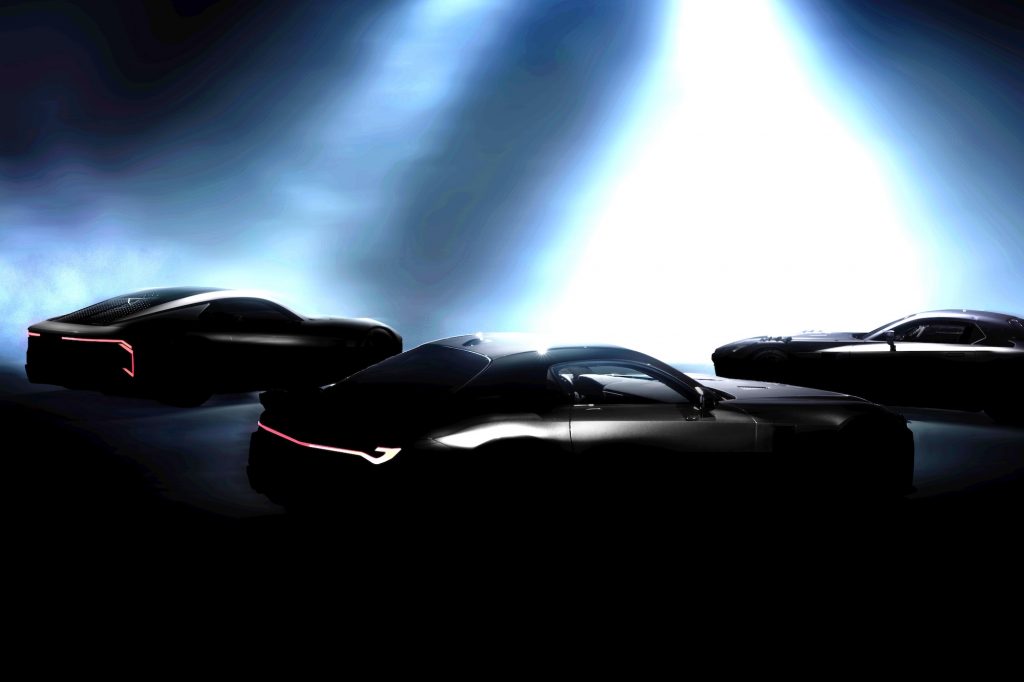
Now, though, things are different. The car that’s front and center will carry a Toyota badge and carry the GR GT name, as that taillight design matches up with previous teasers. The car on the left seems to have the same taillight design as the Sport Concept Lexus revealed by surprise at this year’s Monterey Car Week. This suggests we might see a production version of that car after all.
Seeing that there’s a Lexus version of Toyota’s new supercar also answers the question of why that concept exists at all, since, at the time, it felt like it was stepping on the GR GT’s toes. Now we know that the two will be revealed together. Rumors say it’ll be called the LFR, though there’s no knowing for sure until it actually debuts.

What about the third car to the right? Well, if you look closely (and brighten up the image), you can see that the car is sporting Michelin-branded racing slicks, fender louvers, and a roll cage in the passenger compartment. This is the pure racing version that’ll be revealed alongside the two road cars. Technically, Toyota already showed off this car as a concept all the way back in 2022, when it was called the GR GT3 concept.

Some of the design has likely changed since then (the concept didn’t have those fender louvers, for example), but overall, I expect something similar. The car is expected to race in the GT3 class in series like the World Endurance Championship.
How Will They Be Different?
Aside from looks and minor aero tweaks, it’s unclear what differences lie under the cars’ respective hoods. It’s very likely the two will share a platform, as they’re being revealed together and have the same general proportions.

There’s no indication that they won’t share the same drivetrain, either. Other vehicles that share platforms between Lexus and Toyota share drivetrains, so why shouldn’t these cars, too? The biggest contrast I’m expecting is a few horsepower difference between the two cars to differentiate them within the market. It’s also possible the U.S. could get one version of the car, while other markets get the other.
As for what’s actually under the hood, Toyota’s previously confirmed the GR GT will use a twin-turbo V8 up front, sending power to the rear wheels via a rear-mounted dual-clutch automatic transaxle. It’s also rumored to have hybrid assistence, though nothing’s been confirmed on that front just yet.
Toyota plans to reveal both cars on December 4 at 9 p.m. Eastern time, which means all of the world’s burning questions will soon be answered.
Top graphic images: Toyota



From what I have heard, select Lexus dealerships are going to be GR dealers and Century dealers. Remember, the Century is like a 20 per month volume and mostly invite only. Having GR also available at Lexus dealerships gives dealer owners more reason to do the initial investment as whatever that brand will sell will likely sell many times over more than the Century brand.
So this GR GT may actually be sold under the same rooftop as the as yet unnamed LFR. The GT car on the side being the race version ostensibly representing both of them, but it wouldn’t surprise me if they also sold that one in ultra low volumes at Lexus Century GR dealers.
It’s all just speculation and hearsay, but that’s my educamated guess how these things will join public life.
The middle car has some resemblance to the FD RX-7.
I feel the same as with the Genesis super car: I’d like something like the 4 series coupe (or the Lexus RC, or the Genesis Coupe) more. Not that I could afford to buy such cars, but if the manufacturer wants to build a positive image…
I wonder if the Toyota and Lexus versions are for different markets…
I watched Sarah -n- Tuned do her review of the final ‘bespoke’ edition of the Lexus LC500 this morning and of course, it makes me want the car and almost rationalize that $112K is a bit of a bargain for what you get, particularly in that metallic copper color. Mrs. Tuned was dressed to match the car per usual, and looked lovely.
As impressive as the LFA, and LC500, and upcoming ‘super’ cars from Toyota are, I can’t help but wish they’d green-lit this concept from a few years ago instead: https://3.bp.blogspot.com/-jq0b3czSDR8/VhaHY2w3oJI/AAAAAAAAbvw/vlvdsRoglO4/s1600/TOYOTA_S-FR_001_s.jpg
Maybe it’s just the yellow, or the non-aggressive, friendly/bubbly design, but something about the S-FR appeals to me much more than their 86 sportscar. I like to imagine four naturally aspirated cylinders, no hybrid, an actual manual available, with a base MSRP of $26,995. In my dreams, I’m taking delivery of mine (in yellow, of course) later this month.
I just watched the same video after reading this article, but before diving into the comments, seemed like a good segue.
I had never heard of this gal, and just sat down to watch the video you mentioned. She’s really good, thank you for letting me know about her channel, I will really enjoy perusing her video backlog!
Wait til you see how wonderfully OCD she is doing a restoration. It’s marvellous. 🙂
Lexus version better be offered as a convertible too! Understandable if they skipped that for the Toyota.
I was at the Tokyo auto show a few weeks ago and saw the grey Lexus concept, it is stunning in person. The 2′ tall text on the wall behind it just said “Lexus LS Coupe Concept” so I sort of took it to be an LC500 successor. I could see an SC vs Supra separation between a lexus and toyota badged variants, give the lex a v8 hybrid powertrain and put a turbo 6 in the toyota. They’d also both be too expensive for the plebes, just like back in the day.
Does anyone else just not care about unobtanium that costs more than we make in 20 years? Even my dream of owning a S197 Mustang is kind of a long shot with how expensive everything is.
Few things bring me joy anymore. I might have a problem…
I’m right there with you. Everything seemed so much simpler 30 years ago. I’m certain I have some rose colored glasses on, but no social media and no 24/7 news cycle certainly didn’t make things seem so dire. The polarization of the electorate into an us vs them grudge match doesn’t help anyone either. I don’t really want to get into politics, but the leader of the free world is a reality TV carnival huckster with 34 felony convictions.
Social media is explicitly designed to incite outrage because that produces the most revenue, so that’s not just rose-colored glasses. It’s working exactly as intended.
The wealth inequality is also objectively higher than it has been in the past century or so, which makes it pretty reasonable to be resentful of stuff like this.
From the 959 to the wrx took how long? It’s what they learn from the flights of fancy and distill into something that gives most of the benefits for small fractions of the cost that keeps me excited for unobtanium.
They need to put that twin turbo V8 in a Tacoma. Land Cruiser would be a great fit too for that powertrain.
The LFA was a hideous mess of a design with a flattened, unexciting front end that looked like it had been badly repaired after a crash. Engine sounded incredible, though.
Wild to see that a Lexus has taillights that basically co-opting a Kia’s style. Real K4 vibes going on.
Kiaundai copied Toyota for years. Turnabout is fair play.
True! Who among us has not learned something from Toyota-san?
Additional congrats to the wealthy are due, as if they needed more
Fuck Toyota, fix your engines and stop denying basic warranty work on your sports cars.
Anyone buying one of these is an idiot, full stop.
Who’s being denied? Money-shifters and half-assed modders? Yeah, there’s a reason for that.
There’s articles online showing Toyota denying warranty for going over 87mph on a track, in cars they advertise being able to run on a track. There’s no rule on how to shift your car, people’s clutches shouldn’t be getting destroyed. Defend them all you want, but they are NOT the same company people are used to.
My GR86 was covered without issue. On the forum, pretty much all the failures were manuals driven by little boys who money-shifted. One moron even posted the log showing 10k+ rpm event as “proving” he didn’t blow it up. I haven’t been following the Supra, but I also haven’t heard anything about issues with failures and denials. Corolla might be a different deal and that’s a hand grenade engine with that much power from such small displacement. One failure I saw was modded, but another did sound like it might have been BS on Toyota’s part, though if the guy was on a track, that generally means a warranty denial even if they sell it as a track car. Either way, as a former Focus ST owner, I don’t know that I’d call a hotted up version of a hatchback a sports car.
The Subaru FA24 in the 86 and BRZ have well known oiling issues at this time.
The new V35A is NOT just casting flash as thought. There’s more tear downs of these being done by very experienced engine builders, and it looks like oiling issues on the bottom end where main bearings seem to be failing.
GR Corolla has heat management issues, and maybe pre-ignition issues.
While I admit a lack of complete trust in the FA24D, the only documented failures attributed to oil pressure issues that I’ve heard of are under track conditions at certain turn and elevation change combinations on tires people aren’t driving on the streets, so though it is an issue, it’s nowhere near the magnitude every mouth breather on the internet makes it out to be any time the car is mentioned so that they can excuse themselves for buying their CRV instead of the RWD manual sports car they’ve sworn to buy if anyone had the guts to build it or guys who blew theirs up who are out of pocket for a new engine and would rather play victim than admit fault. Supposedly, it’s excessive RTV clogging the oil pickup and they fixed that process, but I am skeptical, even though that’s what they stated happened to mine and I don’t really have another reason it might have happened in my case other than just luck of the draw as I never overevved it or ran it low on oil. I don’t think it helps that they recommend POS 0W oil in the US that thins out to nothing for the sake of some tiny paper mileage gain. I only use 5W-30 on the replacement engine and still handily beat the EPA rating. I also run about 1/2 qt more than the stated capacity as the same guy who documented the low oil pressure on the track found that helped (IIRC, the prevailing guess was slow oil return from the head in hard right-handers, something I wonder might have been missed in testing in Japan because they have mostly left-hand turns where we are mostly right-hand). Either way, in my case, the original engine might just have been off as the replacement has always felt a little stronger and uses no appreciable oil between changes, unlike the first one, which wasn’t excessive, but more than I’d expect of a new modern car.
Not surprised about the GR Corolla—before they launched it, I thought that was too much from too little. Physics isn’t breakable.
I saw that about the V35A and had been cocking an eyebrow about how everyone has been claiming “casting” clearing issues lately when that’s extremely mature technology. I wonder if these corporate excuses are just reassurance management as an issue of clearing out casting debris is something that can be fixed with a process change, but an inherent design flaw is a lot more serious and the customer’s replacement will still have the potential problem. Definitely not a sports car engine, though. Funny, all those fans bitching the Supra has a BMW engine when, if Toyota had used this one, they’d have a lot more problems (and, if not, they’d still bitch just because it’s a V not an inline).
Oiling failures on “normal” tires (not the OEM all-seasons, but we’re talking 4Ses or similar) on mountain roads have occurred with the FA24. Not many, but they happen as well. More will pop up in time.
I’m curious to see if the aftermarket can find a solution in time. They’ve certainly been trying, but it’s mostly “hitting things with hammers” as I’m not sure anyone (working on it) is actually currently capable of wholly modeling the fluid dynamics to ascertain if something can be done without major revisions to address oil flow.
According to my in-car g meter, the cars can hit over 1g with HPASs, so track tires are going to get some serious results. I suspect the real problem is a marginal oil system. When Toyota threw money at them, Subaru probably took an engine they had, bumped it another 1k rpm so they could advertise somewhere near acceptable hp for a sports car (I’d gladly drop 20 hp for more midrange torque), but the oiling system wasn’t improved (or improved enough). Add that to these cars being able to pull far more lateral gs than the other cars they make, recommended oil that gets too thin when hot, and owners who might not keep the oil up enough (recommended capacity also seems like it should be higher), and you get narrow margins that can be exceeded. Problem is that’s just my guess. Do we know what those other engine failures were caused by? Even if it supports my theory, someone saying that theirs blew up to no fault of their own isn’t data. The guy who was logging pressures on a track only encountered the issue under an odd circumstance, but it could be that he got one that’s running bigger margins due to production variances and others encounter it more often. I’d really like to know what the issue is as I suspect it’s something fixable. The V35A, though, seems like it might be more serious.
Cheap, reliable performance isn’t easy.
One or two things where people try to get too clever and it all goes sideways.
Heck, just look at the past 30 years of Toyota V6s. The 2GR is the one I would completely classify as utterly bombproof, whereas every other variant had at least some manner of issue. Look at Honda V6s that aren’t the NSX, or more realistically, the things that are attached to those V6s (ATs, mounts) that go earlier than you’d expect. It’s why Nissan continues evolving the VQ. It’s not perfect but it soldiers on easily enough.
If anything, that’s likely the saving grace of something truly high end, as in, more money than a Land Cruiser 300 or Lexus GX (V35A in both). Money is being spent to where there’s a minimum of “cleverness” in the engines and for things to go wrong, as buyers are generally far less tolerant of reliability issues once ASPs hit or cross $150,000.
I’ve long wondered what explains Range Rover’s continued success in spite of this.
Looks great, feels great. Nothing touches it on those two points.
Leasing.
See: Cybertruck.
Buy for the “status,” pay to fix because it’s legit terrible.
People don’t buy the Cybertruck because it’s a good vehicle. They buy it because it’s a rolling billboard of their emotions about politics and Elon Musk.
The Range Rover doesn’t quite fit the original statement: it’s widely considered a decent vehicle, especially in places where they’re common (and where Rover mechanics are common as well).
Toyota is feeling those 11% + profit margins. This always happens with car companies. When times are flush they waste money on vanity projects. Then those get cut when the inevitable downcycle arrives.
It’s either a Celica or an MR2. Which would be awesome.
I demand a new MR2 with pop up headlights. There are dozens of us, dozens!
Pop Up
Up and Down
Headlights!
https://www.youtube.com/watch?v=GDtiO29v1Ac
As long as it goes back to the gen 2 style and interior room, you add me to the mailing list.
Developing a new V8 just for this car while pleading poverty and outsourcing engines for the 86 and Supra to others would be quite frustrating.
Obviously the price point is different, but so is the volume. Hopefully this means the V8 returns to Toyota’s other vehicles in some form.
I really doubt it will unless it’s for special editions and/or Lexus products. They’ve already sunk so much into the twin turbo V6 and the iForce Max powertrains that I think they’d have to move mountains to standardize a V8 in their BOF trucks when they’re already getting close to having the bugs worked out with the forced induction V6.
People like that engine too. It’s mentioned as a highlight in pretty much all the reviews. Would American V8 lust really push people to choose what’s likely a less powerful and less efficient engine 3-5 years down the road? I just don’t know. I think in that time more folks will become open to turbo 6s and there’s a good chance the pendulum slams in the other direction politically and regulations come back with a vengeance, for better and worse.
Yeah should have been clearer, was primarily speaking of the larger “Toyota” here including Lexus.
I agree with your take on the truck engines; that ship has probably sailed and adapting a supercar engine for Tundra use might not be the easiest thing.
I think we would both be quite happy to see a proper LC500 successor with the same ethos
My guess is yes, but I also agree that I’m not sure enough people will. Or at least, in my head, there is not a ton of overlap between “V8 or die” people and “will buy a foreign truck.” But that’s painting with a broad brush.
While I don’t think forums and blogs are the be all, end all by any means, it’s been interesting seeing how many people have come around to the Hurricane 6. Pretty much every article I’ve read about the reintroduction of the Hemi has comments from folks who went with the straight 6 and wouldn’t go back. A lot of folks prefer the Ecoboost sixes in the Fords as well because of how peaky the Coyote V8 is as well.
Toyota trucks kind of exist in their own bubble though, as you suggest. They’re never the belle of the ball when it comes to American consumers but the people that like them REALLY like them and have a cult like devotion to them. Those people are absolutely FURIOUS bout the Taco, Tundra, 4Runner, etc. no longer having naturally aspirated engines and sales have suffered as a result.
Nearly ever 4Runner near me has money on the hood, which is way out of the norm for current Toyota, and Tundras are heavily discounted as well…not to mention they have special financing for the Tundra that I see advertised during football. Toyota’s in house financing is generally god awful and best avoided if you have decent credit. Their “good” rates on their volume sellers are usually between 5-8% and if you have good credit you can certainly find more favorable rates if you look around.
But for the Tundra? I’ve seen it advertised at both 2.99% and 3.99% at different points this year. That’s LOW by Toyota standards and pretty good in our current environment. They are just not moving them and the teething issues with the new turbo V6 have turned a lot of customers away…because the average Toyota truck buyer wants (or at least claims to want) a brand new 10-15 year old truck that’ll hit 300,000 miles with nothing but oil changes and efficiency isn’t even vaguely a consideration.
If Toyota found a way to backtrack and put NA engines back in their trucks I think it could be beneficial for their sales, but at least in the Lexus application this is apparently a turbo V8 and I’m not sure how much that’ll move the needle for the Toyota truck diehards. It might win over some of the V8 or die crowd that would otherwise buy a RAM, but Toyota’s core buyers? I’m not so sure.
I think they’ll wait around and see if folks have a change of heart, but boy is the Honda Passport an interesting product…and if the new Ridgeline carries on those excellent styling cues I think it’ll steal a lot of Taco sales like the Passport is stealing 4Runner sales. For a lot of those customers literally all that matters is an NA V6…which has always been a bit silly to me because I remember days not that long ago when V6s in trucks were cringe, but nostalgia is a hell of a drug.
I’ll raise my hand as a Hurricane doubter. Recently had a Wagoneer rental and quite liked how it drove. This shouldn’t have surprised me as I quite like inline 6’s in general. However, the mpg was abysmal at 14 mpg (all highway miles in my time) and I still don’t trust the reliability on a new Stellantis product.
I know someone that recently bought a Tundra for $20k off sticker. I’m still in shock about it. I would put up with the engine teething issues for that deal.
The Tundra is a good truck! Always has been. I’m not in the market for a half ton but if I was 5 figures off MSRP on a Tundra would certainly get my attention.
Great response as usual! I have a 2007 Tacoma X-Runner, love that thing and will keep it til the truck/myself dies. I got a ’24 Tacoma as a rental and while the boosted 4 ostensibly makes similar power to my V6, the throttle response was just terrible. I also think part of that is the automatic transmission, but I was very disappointed in the way it felt overall.
You’re not kidding about the Ford Ecoboost. I remember when my dad got his F-150 with that thing, couldn’t believe how quick it was, especially for the size.
Maybe they could take off the turbos and maybe lengthen the stroke of the V35A and make it the base offering? Or they could maintain the displacement and hybridize to bring the power back up again, but it’d overlap with the 2.4T hybrid’s power output.
I’m surprised that people are cross shopping the 4Runner with the Passport give the latter is just a Honda Pilot.
I’m not, for two reasons:
1). It has an NA V6, which is a non negotiable for a lot of the Toyota truck crowd.
2). The vast majority of 4Runners never see more than a gravel driveway anyway, and all the capability they have makes them compromises dailies. If the customer wants to be honest with themselves (to be fair, this is a sizable “if”) a Passport can do anything they’d ask of their 4Runner and do so a lot more comfortably.
It’s a great product. I’m going to look at one in the next couple of years but tbd if I could live with such abysmal fuel economy…
My surprise is kinda from point 2; IMO the Passport doesn’t come close to the 4Runner in how aggressively offroady the styling is (though the most recent Passport refresh has closed the gap), which is what I thought was the entire appeal for most buyers.
I wish I could be bothered to care but I have supercar fatigue and at the end of the day this is just another codpiece for the 1%. Yawn. Whatever happened to Toyota making a Miata fighter?
Ditto. Though I thought the picture was a Gran Turismo leak at first.
I think the best you could hope for is Toyota sending the GR86 to American Sunroof and having them chop the top.
Yep. More shit for rich people… Yay.
An inexpensive MR2 with a very slippery CdA matching or beating a 1st gen Honda Insight and a curb weight of under 2,500 lbs would be amazing. Especially if it was an EV, but I’d settle for having the BMW inline-6 in the Supra or hell, even a 4-cylinder Corolla engine.
so basically make a lotus elise but with toyota build quality and prices? Sign me up!
But with a much lower CdA than the Elise had. More like aim for the CdA of a 1st gen Lotus Elite or 1st gen Europa, or better. With a stock Corolla 4-cylinder engine, you could have 0-60 mph < 7 seconds, top speed > 150 mph, and get 50+ mpg highway. If it comes in at under $30k, I’d love to buy one.
I like the way you think! I’m in.
Even a well-appointed hybrid version of the MR would be dope.
After all, Toyota has led the industry for hybrid engines for the past 3 decades.
An AWD mid-engine hybrid compact SPORTS car could lay waste to the competition in the segment.
Toyota’s Miata fighter is the GR86. The GR86 + BRZ outsell the Miata about 2:1.
That said – all 3 combined only sold 22,260 so the idea of a new budget RWD sports car is pretty much DOA.
Although it’s in -3, the ND has been production for 10.5 years. Most people who wanted one have one already, hence why sales volume is comparatively lower.
Yes, it surprised me initially as well, but when I thought about “When did the ND-1 come out…” it hit me that, yeah, the overall generation is 10+ years old.
Nothing wrong with that. The NDs are good little cars.
Which is why Miata keeps selling it. The design work paid off long ago. It remains to be seen if a small company like Mazda can justify designing and tooling a new Miata though.
Globally they sell about 15,000
Yep. Old new car is still good new car. Keep selling it.
I feel it’ll be around likely until around the decade changeover.
I assume they KNOW what they want to do for the next platform and that’s been in engineering for a while, but they’re waiting on some point on the price curve to be able to be hit before they decide to go ahead.
The challenge with the Miata is weight. Engineering out more weight CHEAPLY (especially reducing manufacturing time of components) is one of the bigger challenges, as they need to offset weight that has to be added for meeting crash standards and increased expectations of comfort.
Even the ND is still only 9% aluminum I think. More manufacturers are using aluminum, and production methods to reduce costs continue to improve, so that’s their likely angle — a good strong car with much more aluminum, and a more multi-metal chassis (think 981/991 Porsches) where they can do everything they want and still hit their BOM costs.
The problem for the Miata is that 2 door, 2 seat, RWD sports cars are a declining sales segment.
Convertibles are in a death spiral too. Down from ~ 300K sales a year in 2005 to ~ 70,000 last year.
As someone driving only 2-door, 2-seat RWD roadsters for the past 17+ years, I’m well aware.
Though so long as the Miata remains the “Toyota Corolla” of sports cars in terms of operating costs, it’ll continue to be around.
Can’t really look at the segment. While everyone converts their fleets to CUV’s, Mazda is sticking with the MX-5. And it has been steady with 6k – 10k sales per year in the US since 2008. There’s no declining pattern with Miata sales, just ebbs and flows. Those sales numbers are perfectly in line with other niche vehicles, and I’d guess Mazda is completely happy with the global numbers over the last 15 – 20 years.
In 2024 89.9% of Mazda sales in the USA are CUVs.
Personally I doubt Mazda makes money on the Miata. They likely keep it around to remind people that used to be know for that “zoom zoom”.
Yeah… I doubt they need to. It’s effectively a halo car that’s actually affordable for the few people that actually get around to buying one.
I’d argue that falling convertible sales are a symptom of a lack of options. In the past there were always a couple convertible conversions of existing affordable cars like the Chrysler 200 and VW Beetle, and something like the Audi A3 convertible wasn’t too far out of reach. There were also standalone models like the VW Eos and Buick Cascada, and the Camaro and Mustang convertibles were quite popular.
Now there’s basically only 2 options without going into luxury cars, the Miata and Mustang, and the latter has significantly increased its base price after the Camaro was discontinued. Especially after many automakers killed their sedans, I think that CAFE killed the affordable convertible because the added weight and terrible aero (with the top up) killed fuel economy. Why invest significant money into what was always going to be a lower volume product when you could sell a higher margin SUV that gets the same MPGs anyways? Plus you could sell more overpriced panoramic sunroof packages or even high margin soft top Broncos and Wranglers.
Bingo. Convertible options disappeared because they didn’t sell enough for companies to bother continuing to make them. Same as manuals, wagons, coupes, regular cab trucks…..
Making cars is a business – a business with very high capital costs and low profit margins.
The smart thing to do would be to build a RWD platform for small cars, and share it with a small sedan, hatchback, micro-van, small SUV, and/or pickup truck. High volume gets the per-unit costs down. Bonus if the platform is designed to accommodate big engines like an inline-6 or V8 in addition to EV options.
Keep it a sports car platform first and foremost, or course.
That would be a good way to lose money.
Hybrid 4-cylinder, EV, V6, I-6, V-8.
In that order of production scale.
Make a crapton of them and it could work. Kind of like the underlying idea of the original Scion models – they were all surplus Toyota Echos in the first generation.
Make a nice, affordable universal platform and run with it. Make them Toyotas, instead of a new named marque, probably.
^^^^THIS^^^^