


I’ll be honest with you, and honest with Toyota, just in case they’re reading this also: I’ve never really understood Toyota’s fascination – perhaps even fixation – on hydrogen cars. I mean, I get the general appeal of it all – hydrogen is the most abundant element in the universe, after all, and if you’re using that hydrogen to power a fuel cell to make electricity (as Toyota does) then the only emissions are pure, clear water. It’s very appealing! On paper, at least.
Reality, though, as usual, is kind of a jerk. Hydrogen may be everywhere in the universe, but here on Earth, where currently Toyota sells 100% of their cars, hydrogen is not that easy to get, and must be produced from other hydrocarbon fuel using thermal-based methods or electrolysis, and so on. It’s not just all floating around out there.


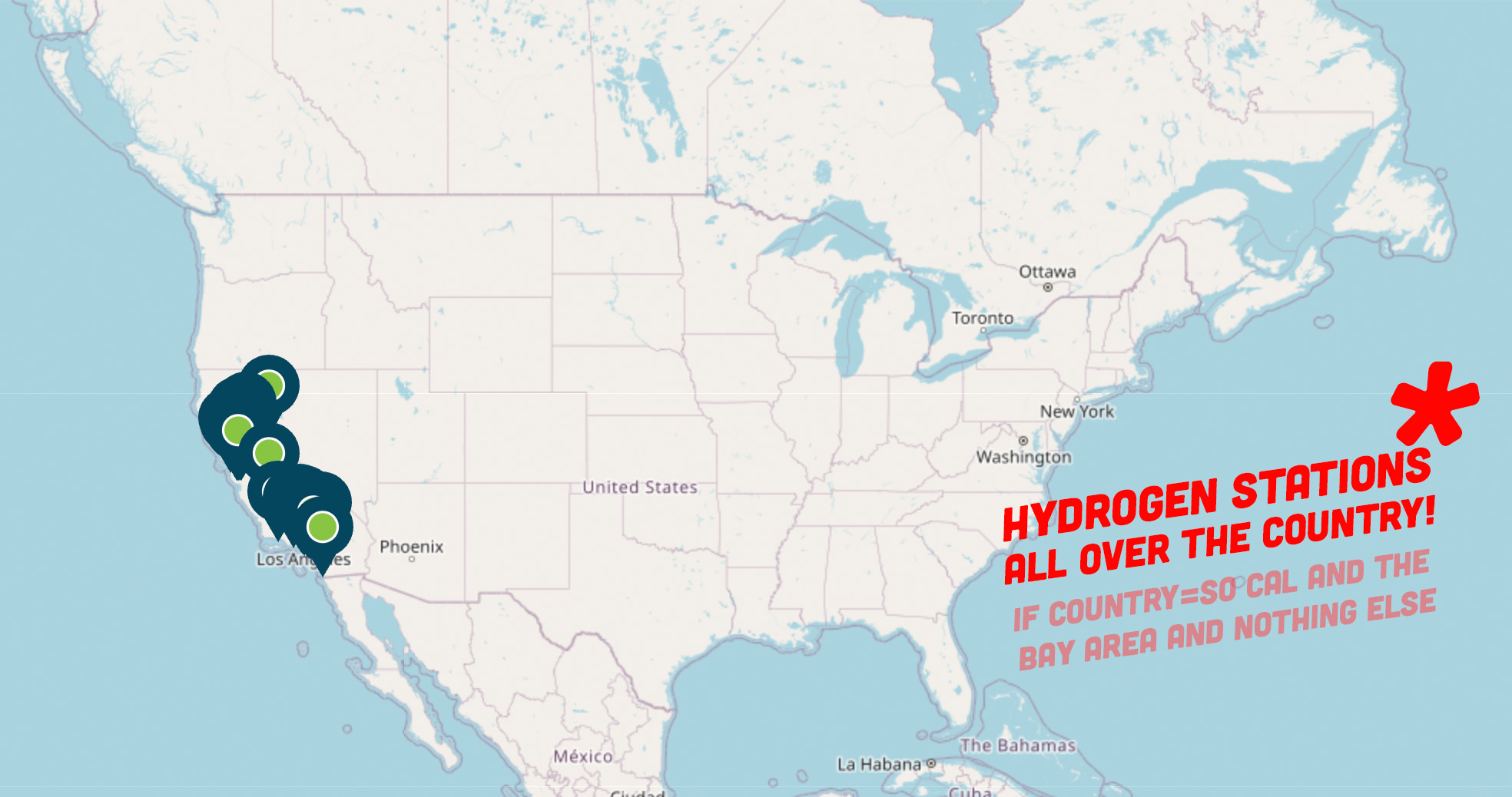
It’s also tricky to store, and a whole new infrastructure for fueling hydrogen needs to be developed, and now we’re getting closer to the whole point of this post: Toyota has been talking about an extensive network of public hydrogen filling stations that will come in the future, but over a decade has passed since the first Mirai hit the market, and as of now there are really only some stations in Southern California (and a handful in Canada if you’re Canadian).
This means that Mirai owners are finding themselves with cars that have pretty severe limitations; you simply can’t take a multi-state road trip in a Mirai, because there’s simply nowhere to refuel. If you own a Mirai, you’re pretty much tethered to whatever California hydrogen station you’re close to. And even then, the refueling situation isn’t great.
“Isn’t great” is something of an understatement, and the proof of this is that there are hundreds of Mirai owners who are in the process of suing Toyota over problems with hydrogen fueling, including chronic failures of pumps and limited supplies, and also claims that Toyota dealers dramatically oversold the usability of Mirais and did not adequately warn potential buyers of the severe limitations of the car.

The lawsuit contains a number of personal stories from Mirai owners, and in many of these you can see a combination of a poor refueling infrastructure and what seems to be willful misinformation or, at the very least, exaggeration from Toyota dealers looking to get these Mirai albatrosses off their lots. To be clear, I’m not saying there actually was any deliberate fraud or misinformation – that’s for the courts to decide.
When reached for comment, a Toyota spokesperson told us that the company doesn’t generally comment on pending litigation.
Here’s how the lawsuit describes the situation:
“This action arises from Toyota Motor Sales, U.S.A., Inc.’s fraud in the marketing, sale, and support of its Toyota Mirai hydrogen fuel cell vehicle. Plaintiffs, who represent diverse California consumers including military personnel, seniors, and working families, purchased Toyota’s hydrogen-powered Mirai based on explicit promises of convenient refueling, environmental benefits, and practical usability.
Instead, they received vehicles that are virtually unusable due to a critically deficient hydrogen infrastructure consisting of only 24 fuel nozzles across California, most of which are frequently inoperable.”
There’s also the extremely severe depreciation of Mirais at play here; likely because of the known issues with the cars and their extremely limited sphere of actually being able to be used, Mirais lose a shocking amount of their value quite fast – the lawsuit claims a 90% drop after purchase.
The personal stories of Mirai owners do paint a troubling picture; this one from Zachary Graham, a Second Lieutenant in the Marine Corps, is especially maddening, and I think you’ll see why:
61. Off the bat, Mr. Graham told said Toyota sales associate, [REDACTED], that he was in the military and required flexibility to return the vehicle if he’s stationed out of state.
62. [REDACTED] was explicit that this could be accommodated, and he proposed a finance agreement for a 2023 Toyota Mirai, highlighting several incentives, including free hydrogen fuel, in the form of a fueling card to pay for fuel at the pump.
63. During this sales process, the sales manager, [REDACTED], touted the benefits of the Mirai to Mr. Graham, including the benefits to the environment and the explicit promise of free hydrogen fuel, and that refueling hydrogen is an easy straightforward process.
64. Based on these incentives and assurances, Mr. Graham agreed to purchase the Toyota Mirai for an expensive $42,358.93. The promise of free fuel made the expensive purchase make sense to Mr. Graham.
65. Quickly after the purchase, Mr. Graham discovered that fueling the car with hydrogen fuel is practically not possible.
66. For example, when there are cars ahead of him at a fuel station it takes well over an hour to obtain any fuel. This is because there’s a long wait in between each customer for the pump to recompress and dispense fuel and the pumps never fill the car up totally.
Right from the get-go, you’d think a salesperson would have steered Graham away from a car that could only be used in one state if that person knew they may relocate, regardless of whether they planned to return the vehicle or keep it.
It seems that this severe limitation was not even brought up:
76. Moreover, soon after he bought the vehicle, he learned that hydrogen fuel stations are exclusively located in California.
77. This stifling fueling limitation was not disclosed to Mr. Graham by [REDACTED], [REDACTED], or any other personnel at the dealership during the sales transaction or otherwise. Further, nothing in Mr. Graham’s paperwork he signed with Toyota discloses this critical fueling limitation.
78. Mr. Graham is under military orders to leave California and has left to Virgina, where he cannot bring his car with because there’s absolutely zero fuel out of California.
So, Graham has orders to move to Virginia, but he finds out he can’t take his car there because he can’t refuel it, and when he tries to sell the car back, he finds the appraised value is $11,000, putting him over $24,000 in the hole.
This is, of course, miserable.
Now, sure, one could argue that some of the burden is on the buyer – you should do some research on your car purchases, especially for something as crucial as where it can be refueled. But that only goes so far; the dealer knew this limitation of the car, Graham clearly stated he need to move, and the dealer made no attempt to explain to this potential Mirai buyer that should he move to any place other than Southern California or the Bay Area, that Mirai would be, at best, yard art.
Graham’s example is far from the only one, and some seem to be even more explicit; it also seems that comparisons to the Toyota Prius were used to make the Mirai seem more viable and practical, as in this example involving 77-year-old Jamie Nahman:
102. Critically, [REDACTED] explicitly and repeatedly juxtaposed the Mirai to thePrius.
103. [REDACTED]told Mr. Nahman that the Mirai was going to take off like the Prius and said it was a great deal like the Prius and that Mr. Nahman was lucky that he was getting in early!
104. [REDACTED] made an explicit promise to Mr. Nahman and his wife that within one year hydrogen stations will be everywhere, even outside California.
The Mirai is really nothing like the Prius, aside from them both being Toyotas and being primarily eco-focused vehicles. A Prius can refuel with regular gasoline, anywhere in the world, easily. A Mirai, as we’ve noted, can very much not.
Also, the “explicit promise” that there would be many more hydrogen stations not just in California, but other places, seems downright deceptive.
Of course, there’s a lot more in the lawsuit (and this one isn’t the only one) including many claims of hydrogen fueling station pumps not working, including situations where the pump can literally freeze in the car, limited supplies where owners are restricted to getting 1/5 of a tank of hydrogen, absurdly long refueling times (going against Toyota’s claims of “five minutes“) and complaints that the range of the Mirai is nowhere near the Toyota’s claim of over 400 miles.
In fact, our own David Tracy heard a Mirai owner tell him just that when he spoke to one at a hydrogen fuel station:
Oh, and the fuel is expensive as hell, too, just in case all of this wasn’t enough for you.
I wish I were more surprised by any of this. I’ve driven a Mirai before, and they’re nice enough cars, but they’re also the only car for sale right now that I would absolutely and confidently warn anyone not to buy. Ever. There is absolutely no good reason to buy a Mirai, unless your plan is to have an excuse never to drive anywhere at all, ever – for that purpose, I really can’t think of a better car.
I don’t know if this will finally cool Toyota’s ardor for hydrogen – if it doesn’t, I have no idea what will. But, then again, I never really understood what Toyota’s plan was for hydrogen in the first place. Things definitely don’t seem to be progressing in the way they want, and at some point I would hope dealers will finally understand and be honest what they’re trying to sell to people: one of the most advanced, and well-designed and completely useless (and valueless) cars one can buy on the market today.





The idea of feeling duped by an alt-fuel vehicle purchase like this is beyond me.
I can’t imagine making a purchase this large without doing a ton of my own research and math to see if it made sense for me.
As much as I generally love Toyotas and will go to irrational lengths to defend many otherwise denigrated cars (I may be one of the most vocal defenders of the Chevy Citation) I always thought the Mirai was all hat, no cattle. What a goofy idea.
I mean – you’re going to market this thing in a part of the country where one of the many unofficial slogans is “Nobody walks in L.A.” while there aren’t even 100 hydrogen fueling stations in the entire US. There’s over 2700 gas stations JUST in LA, did anyone ever not compare these two metrics and think hmm, this might be a bit of a bottleneck?
I like the idea of hydrogen fuel cell vehicles, I really do. IAn EV that you can refuel in just a few minutes like a regular car, cool! But without the infrastructure, you have a vehicle that cannot be refueled – a lawn ornament. Tesla figured this out and built the Supercharger network; I’m no Teslarati but that was the ONE thing that was going to make an EV a viable choice, and Tesla sank the money into it to make it happen. It works.
Unless somebody – Toyota, since they’re the only ones that really seem to want this – dumps a bigass bucket of money into building out the refueling infrastructure for H2, it isn’t going to happen.
The Mirai is just the beginning for Toyota. Hydrogen vehicles make sense if you believe what they believe.
1) Hydrogen vehicles are not EVs. They’re actually the anti-BEV vehicle, because hydrogen vehicles are going to run on coal.
2) Toyota is betting that Peak Oil is coming sooner, rather than later.
3) The cheapest way to produce hydrogen fuel is coal gasification.
4) Coal is dirt cheap, and the source for cheap coal for Japan doesn’t come from a Middle East warzone halfway across the world – it comes from Australia.
For any renewable energy source that already produces electricity, it’s more efficient and cheaper to keep it and store it as electricity than using that electricity in a middle-man process to produce hydrogen to run your vehicle.
Toyota isn’t investing in hydrogen refilling infrastructure because they’re betting that energy companies themselves will invest in hydrogen refilling infrastructure as oil reserves dwindle and it gets more expensive to extract it, and cheap coal to convert into hydrogen looks more and more attractive financially.
Wait, they were still selling these things in *2023*?!
They’re still selling them! Want a 2025? They’re in stock today.
https://www.toyota.com/search-inventory/model/mirai/?availability%5B%5D=salePendingTrue,inTransitTrue&distance%5B%5D=500&zipcode=90210
…and they’re going to STAY in stock.
Well there’s one in Hawaii.
https://www.servco.com/innovation/servco-h2-station/
I would think the recent Toyota recall would be more newsworthy
Toyota is screwed but maybe now we know why GM only released those old EVs on a lease bought them all back and did whatever with them?
What am I listening to as I write this:
Baby I got a crush on you.
The only semi-reliable places to refuel a Mirai are in CA but examples somehow make it far from home like this one at a dealership in WV.
https://www.cars.com/vehicledetail/6fc65ccd-50b2-4394-a185-8e06b07f3410/?attribution_type=se_rp
Got there on the back of a truck. WHY would be an interesting story, I bet.
I bet the dealer has at least one used/off-lease vehicle buyer who is an idiot who thought the Mirai was a hybrid like the Prius.
If you go to the dealer page, they have a link to the carfax. It looks like it was traded in in Indiana, then bounced to Ohio and then South Carolina before ending up in VA.
I’m guessing it keeps going to auto auctions and getting bid on by someone who doesn’t realize it’s hydrogen.
Is there no way to get hydrogen from welding supply shops or set up a solar powered electrolosys in your backyard.?
Generating a small amount of hydrogen isn’t a big problem. Compressing and storing it are probably the limiting factors.
Sounds like the commercial equipment that handles this isn’t up to the task, so I’d imagine it would be pretty problematic for a DIYer.
It takes more energy to produce a unit of hydrogen than is contained in said unit of hydrogen. Therefore, it is–at best–a poor mechanism of energy storage, not an actual*source* of energy.
Plus, since hydrogen is the smallest element, it pretty easily “leaks” out of any container you put it in, including pipelines, so you can’t gain any efficiencies by producing it in large quantities, because you’d lose all that hydrogen transporting it any meaningful distance.
It’s like the rest of the world figured this out at the turn of the century, and Toyota was like “Nah, I got this.”
All true.
I never said producing it would be efficient, just that it could be done.
The BIG problems with hydrogen is:
It embrittles most materials, so containers need to be made from certain composites or stainless steel.
For use in FCEVs it hast to be compressed to 5-10,000 psi.
Because it is such a small molecule, it will leak through most containers.
And it’s not only highly flammable, it’s also explosive and can be set off by the slightest spark.
I can see a Mirai being a great getaway car that gets ditched when it depletes its fuel.
1) These dumb ass’ knew about the limits when they bought the car. No one to blame but themselves. They should have to pay Toyotas legal fees.
2) I love Hydrogen, don’t really know why, the idea just is great. It’s way far off though.
3) Nuclear powered cities and Hydrogen powered cars would make a wonderful world.
I used to agree on #3, pebble bed reactors can be designed to generate hydrogen cheaply. But, we have a giant fusion reactor over our heads already creating a lot of power.
Also pure electrics are still more efficient than fuel cell, and can be charged at some. The worst thing about EVs are digging up the batteries, new solutions like sodium-ion are looking promising to help with that.
To me a wonderful world would be instead of oil pipelines we have a band of solar panels from one end of the country to the other, some hydro, some wind, battery banks along the way, free, clean energy.
What I don’t understand is why doesn’t every highway have a canopy over it with solar panels on top? It would generate electricity, lessen heat islands, help keep the roads clear of snow, and maybe even help the roadways last longer.
I would venture the insane costs and the inevitable uselessness of it after trillions of taxpayers money is spent.
$$$, that’s why.
EVs are at the end of their life. We have fans and governments supporting the Conestoga Wagon industry that is EVs but the EV Market will disappear before the year that California decided to make them the only choice.2045 EVs will be in museums only.
What will replace them?
Don’t bother, I swear every time EVs are brought up that person goes on a mild rant against them.
It would be terrible for the future of the planet if that were true. Thankfully, it’s not true.
You need to add “/jk” to the end of your comment.
Are Nexo buyers suing Hyundai as well? And if not, why?
Seems like there are at least 2 lawsuits. Here’s the most recent one: https://hydrogen-central.com/hyundai-class-action-alleges-nexo-hydrogen-fuel-cell-vehicles-have-defects/
I feel like this should be laughed out of court. How could anyone with even half a brain not see the major limitations of these things? Caveat Emptor.
Who buys an experimental fuel vehicle without checking where to buy the fuel first? These folks are hoping for a fast buck out of their bogus lawsuit.
They were selling them for $17k new. With close to that much in fuel credit. Why would you buy something like that if you are active duty military you know it’s likely in 3 years you are moving unless you are in DC or are specialist working on a very specific program. Plus listening to salesman is just batshit crazy. But I guess there are young enlisted guys always seem to end up with bad deal muscle car they got taken on.
It’s hard enough to get CNG in DC area and the local utility Washington gas was one of the leaders in it but has basically abandoned it. With some stations just to service the buses they got to use it. Toyota seems to be really having dealership issues like almost all other brands. Maybe they need to learn from McDonald’s you have to hold all the cards with your franchises or they will run a muck. They still have a mess from the 60s with distributors they can’t buy out.
Unfortunately I’ve learned in my 12 years in the car business that most people don’t buy a car the way an enthusiast does. Thats doubly true for folks with credit issues. Often the store finds a car with huge incentives that they can get a subprime customer bought on because that incentive eats up negative trade equity, buyer fees that banks charge for bad credit, and just generally helps drive a lower payment. What that means is the people with the least ability to deal with issues like the depreciation on these are the ones most likely to end up with them.
But it sounds like it is the only solution to a purchaser who wants to live beyond his ability?
I’d think such a purchaser would lease, but I’m probably wrong…
leasing is tough to get approved on with bad credit.
In some cases yes. In other cases this is literally the only way someone gets financed unless they go to a buy here pay here lot. Not everyone has the skill, ability, or time to buy a cash car and keep it running.
I’m not sure either of those plantifs described fit that bill. But yeah people that buy strictly on monthly payments probably need some financial literacy. The dod guy should have looked it up, a quick search could have saved him alot of headache.
Good point if they gave a huge credit for fuel that offset the price of the car the only loss suffered is the difference between the two so $20 a buyer
Could be, I think the last time I looked it was a $16.5k fuel credit. I don’t doubt they were lied to about alot of things and over payed though. I heard about a guy that had a Hyundai fuel cell something went wrong it was twice the sticker price of the car to fix it.
There was a post I saw on a personal finance forum from someone who bought one of these. Apparently the price of hydrogen has gone up significantly fairly recently, and in the OP’s case, meant they were now getting hosed on fuel because the “fuel credit” Toyota gave didn’t go far enough anymore to cover their commute.
They also paid way more than $17k for it, and are now horribly underwater on it, made even worse by the price of hydrogen.
Yes, the fuel price increase was a big deal for the people running fuel cells. They become mechanically totaled quite easily too. I’ve also heard they weren’t efficient as they were supposed to be. Basically if there was a way to be screwed over they were.
What seems odd to me is how it got to lawsuit stage – surely the amount of dealers selling these things has to be quite small, so Toyota has had more than a fair shot at policing bad behavior, and likely can’t claim it had no idea.
Who could have possibly seen that hydrogen was, in fact, not the way of the future. But on a nerdier, more positive note, an EV conversion sounds neat.
Still possible after EVs die out in less than 10 years
If they do, it’s back to LS swaps 🙂
That’s some delusional misinformation. I’ll bet the buggy whip manufacturers insisted that the horseless carriage was a passing fad, too.
Probably slimy sales tactics, but lawsuits are designed to tell one side of the story, convincingly. What one party interprets as a “explicit promise” the other may claim as “discussing a hypothetical future scenario”
All I can think of is this Airplane! clip. At what point did they see a whole 4 gas stations available, no home charging, and think yeah, this will work for me.
Airplane Movie Counter Point clip
I feel really smug (and nerdy) that I wouldn’t even buy a Honda Clarity PHEV just because too few of the components were shared with other USDM Honda models.
Hydrogen models, even if I lived across the street from a station, are a really hard sell.
Hmmm, this is very suspicious. For starters, a male US service member who is not buying a Mustang GT? This calls for more investigation.
/s
I guess that’s the go-to since V8 Chargers/Challengers aren’t available new anymore?
Some of the navy guys got in to prius and the chair force guy love them a bmw. I’ve seen a lot of telsas at space force bases could be a thing.
FJ Cruisers are getting scarce.
IIRC PT Barnum had an epithet for these folks.
Pass the salt please.
https://news.mit.edu/2025/new-fuel-cell-could-enable-electric-aviation-0527
Slow-clap for that. It’s a bit forced, but I did a double take on the graphic, so I’ll allow it.
It works as a portmanteau(ish) of miserable and risible, which seems appropriate for the Mirai
These dingbat customers didn’t know that before they bought them?
Yeah, while I agree that the dealership’s tactics here were very slimy and they should be somehow punished for it, much of this could have been avoided by even some very rudimentary research ahead of time. I really don’t have much sympathy for people who jump into the 2nd most expensive purchase of their lives with little research and just believe car salespeople who have been infamous for YEARS as being shady and using deceptive sales tactics.
Same reason my FIL bought a Tesla Model 3 and is now having buyer’s remorse over FSD not doing what it advertises. Sorry dude, this is a well known thing and there are probably 1000 websites covering the issue, so I don’t feel bad for him. Caveat emptor.
Just another in the long line of dealerships blatantly lying to customers.
Just like Mercedes mentioned in the article yesterday that one told her folks “Sure, an Equinox can tow a 7000lb travel trailer”
Side note: The phrase “You’re lucky to be getting in early” should be taught to be as much of a red flag as “come over here, I have free candy”
The entire idea of “early adopter” gets way too much applause these days. When I was in graduate marketing classes 25 years ago, that term was more akin to “desperate for status” (or just having no available time to wait). Just one notch away from considering someone foolish.
Of course, being marketing, the goal was to see if you could get as many as possible before anything went downhill with the product, or before other competitors could undercut you. Not really the case here.
Yep, easy to get people blinded by being the latest and greatest to part with some money. And convinces them they’re smarter than the rest of the schlubs for getting in on the ‘ground floor’
Just look at any crypto launches in the past 8 years.
I am very much a fan of being a “late adopter”. The best model year of a car is nearly always the LAST model year of a car – let the early adopters find and deal with all the bugs, and find out what the track record has been before spending all that money.
And marketing is a Hell of a drug. 🙂