


Traditional auto shows are fading, but events like the SEMA Show are thriving. The Las Vegas trade show, designed for aftermarket companies to show off their latest products, has become increasingly popular for big OEMs to display their offbeat concepts and collaboration projects.
Toyota is leaning into the SEMA show heavily this year, showing off no fewer than six different creations, including a time attack car based on its all-electric bZ crossover, a resto-modded 1985 Land Cruiser, an orange-painted Camry, and a Scion-branded side-by-side.


Another one of Toyota’s concepts, the Tacoma H2-Overlander, might not seem very exciting compared to the above cars. It’s just a Hydrogen fuel cell-powered Tacoma with a handful of off-roading upgrades, after all. But it has one feature that piqued my interest: An onboard exhaust water recovery system.
Huh? Where’s That Water Coming From?
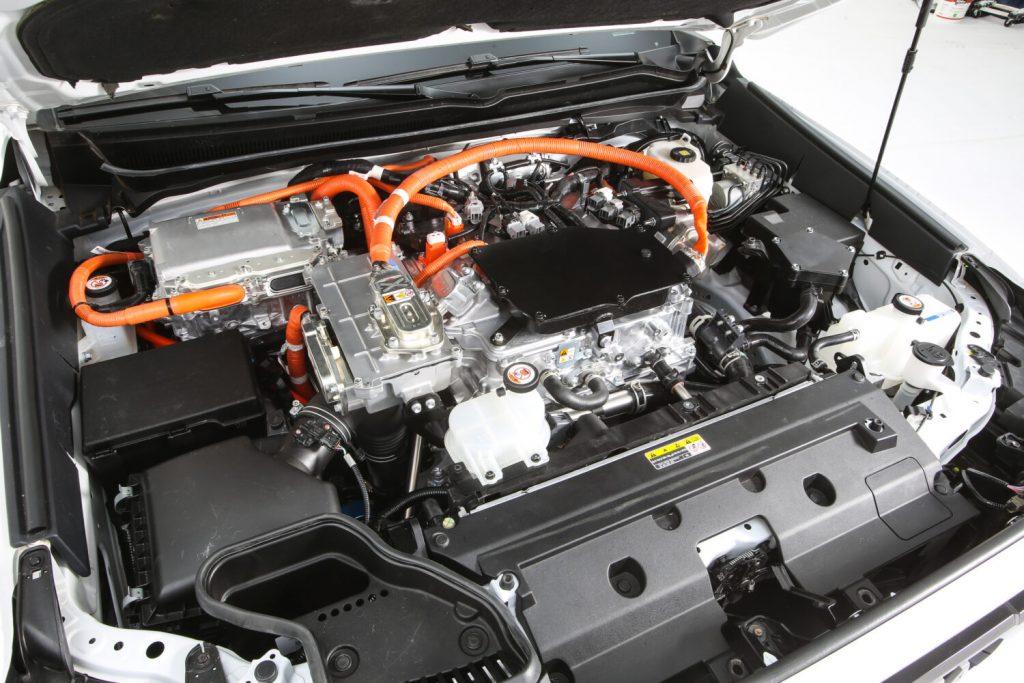
Think of a hydrogen fuel cell vehicle like any other extended-range electric vehicle (EREV). A battery pack is charged with energy, which is sent to an electric motor that spins the wheels. The biggest difference is where the battery gets that energy. In a normal EREV, it’s from an internal combustion engine. In a hydrogen fuel cell vehicle, it comes from a chemical reaction involving hydrogen and oxygen. Here’s how the Department of Energy explains it:
The most common type of fuel cell for vehicle applications is the polymer electrolyte membrane (PEM) fuel cell. In a PEM fuel cell, an electrolyte membrane is sandwiched between a positive electrode (cathode) and a negative electrode (anode). Hydrogen is introduced to the anode, and oxygen (from air) is introduced to the cathode. The hydrogen molecules break apart into protons and electrons due to an electrochemical reaction aided by a catalyst. Protons then travel through the membrane to the cathode.
The electrons are forced to travel through an external circuit to perform work (providing power to the electric motor) then recombine with the protons on the cathode side where the protons, electrons, and oxygen molecules combine to form water.

Usually, that water just drips out of a tailpipe, and evaporation returns it to the atmosphere. But Toyota, being the practical brand that it is, has found a way to capture that water before it escapes into the atmosphere so it can be used. Suggesting some off-the-grid uses to fit the truck’s overlanding theme:
One of the concept’s most distinctive features is the patent-pending TRD exhaust water recovery system, which captures and filters one of the only byproducts of the hydrogen fuel cell stack—water—for camping and outdoor use. The water is essentially distilled, containing no minerals, making it suitable for washing and showering. While not recommended for drinking, its availability adds significant utility in remote settings where water can be a scarce resource.

As a concept, onboard water recapturing is a great idea, as it capitalizes on the fuel cell’s production of a valuable resource that would otherwise be lost to the air. According to the DoE, a fuel cell car produces roughly four gallons of water every 100 miles. As Toyota points out, you shouldn’t consume this water often because it’s distilled and doesn’t have any of the vital minerals you need to stay alive. But it’s still useful for stuff like washing your hands, showering, and cleaning things.
There is, of course, one glaring issue with this Toyota concept: It’s hydrogen-powered, which means it wouldn’t be able to make it to locations remote enough to make this water recapturing device useful. There are only a small handful of hydrogen refueling stations in the US, and the vast majority are located in densely populated areas of California. So unless your overlanding weekend getaway involves going from Thousand Oaks to Newport Beach, this concept is a non-starter.
Still, I can envision a world where everyone is driving fuel cell vehicles, and every day, they plug their cars into their homes using water tubes, which transfer captured water into a tank that can be used to wash dishes or take showers. Toyota’s idea is just the start of such a concept.
In a perfect utopia, we’d get there eventually … but the lack of mass adoption for hydrogen as a fuel source means I have my doubts. Maybe one day.
Top graphic image: Toyota




Delightfully SEMA. I love it.
Honestly, it wouldn’t take too many more hydrogen stations for me feel like I could live with hydrogen. I live near LA. If I could get up and down the whole West Coast and to Vegas and back, that covers everywhere I’ve gone in my current vehicle.
Toyota’s dogged commitment to hydrogen fuel cells is honestly kind of admirable. Like, you go, guys. Stick with it, even though it hasn’t worked for the past twenty years. Let that freak flag fly.
The title didn’t mention that it was a fuel cell stack, leaving me to wonder whether combustion-flavored water would be enough to keep David from eating spaghetti in the shower…
Hmm. Water IS one of the products of gasoline combustion. Could it be thanks to California emissions equipment that combustion water might be clean enough for showering?
Man, comments today are really not passing the vibe check. Do people still not understand the SEMA show?
The OEM automaker SEMA vehicles are all about having some fun and letting their engineers and designers let their hair down a bit. The Easter Jeep Safari vehicles are another great example. Chill out people.
Fun fact: Apollo astronauts also got their drinking water from fuel cells (which powered the Service Module).
Which makes a lot of sense since the next source for clean water was hundreds of miles away at the bottom of a gravity well
Water is a lot easier to transport than hydrogen, and can be readily found in any place suitable for human habitation. I guess it makes sense to consider as a hypothetical engineering exercise, but it only emphasizes the silliness of FCEVs.
The hypothetical society wherein that trickle of water is used to supplement household plumbing makes it even sillier. Perhaps in a post-apocalyptic desert society where the air is dry and every drop of water is precious.
So, it’s silly for Toyota to show off a concept that isn’t ready for primetime? I had no idea that every SEMA vehicle became a production machine. Damn, I’ve been out of touch.
If every SEMA truck was production-worthy, every truck on the road would have bluetooth driveshafts by now!
You can get about a gallon of water from a pound of hydrogen, if memory serves, so if if had a capacity of twelve pounds of hydrogen like a Miri does, all that extra plumbing is about the same as carrying 12 jugs of bottled water.
Of course the free press /clickbait is priceless since in a sane world they will build this right after the Ford Nucleon hits the market.
This seems to be a basic workable formula. However if you take that bumper cooler from the other story you can get cold beer and oysters and as it melts you can get a warm shower. Frankly if you design it right why not do a water cooled battery system where you can use the warm water for cooking or showering and allow a 30 gallon water drum to replace the warm water shower?
Other commenters: Lighten up, Francis
This is harmless fun and perfect for SEMA. H2 isn’t happening but I still want an Autopian review of a Nexo…
Since Toyota and Subaru are sharing so much tech, the Subaru version will likely smell of vape/bong water… Ewww.
I guess claiming you should drink the essentially distilled water is a better claim then this thing going out to recharge your ev overlandig rig. I would think if you were an ev overlander you would have some kind of solar setup to charge something. Sending a h2 vehicle on a rescue mission has to be the most nonsensical thing I’ve ever heard.
I knew an old doe engineer that had worked on fuel cells in the 60s and 70s, knew redox by heart. Even 15 years ago he said it was dead, fine for space when you need wierd things but not practical in the real world. I don’t understand why they won’t let h2 die.
The reason they won’t let H2 die is because it can be produced using natural gas and shares infrastructure with it. It’s a small part of the energy industry’s constant push for natural gas.
Hydrogen doesn’t make a lot of sense in the US where a very large percentage of car buyers live in single-family homes and can plug-in an EV over night. But in Asia, the majority of car buyers aren’t able to charge at home and EV charging becomes much more cumbersome for the average car buyer. I think this is the reason why Toyota keeps pursuing hydrogen concepts, because they don’t see a viable path for EV ownership for a very large swath of their market.
If hydrogen is ever to get a foothold in the US, I think it will have to start with trucking. Building a hydrogen refueling infrastructure along the interstate system at existing truck stops reduces the total number of filling stations you need to get started, and once that system is in place, it makes it viable for individuals to purchase hydrogen vehicles.
Perhaps it’s more about the Japanese not embracing Bev as fast as other parts of Asia.
But most of developed
and some less developed parts
Asia are embracing Bev. Swap stations are part of the answer. Especially for trucks. The Chinese just crane on a charged battery and the trucks are off again. They can also work in part to ballance electric grids. Car parks in many Asian countries are installing some form of ev charging and there are solutions for street parking to. Not all are gratis and have various payment schemes.
If they used CNG for the fuel cells I could see it. Especially for trucks as there are already CNG fleets out there. Otherwise it’s going to be a lot of nuke to desalinate sea water and do electrolysis to get the h2 so you can gall it green hydrogen. There is one process where you go straight from sea water but its not commercialized yet and might never be. Or get it from methane or similar in an industrial setup but then you still have the hydrogen storage problem. Its overly complicated.
The level of hate in the comments for these nonsense vehicles is already off the charts.
I approve.
Another complete fucking waste of time/money on another dumbshit H2 passcar/truck project. Nice.
Ever heard of SEMA?
Like most “overlanding” rigs, it will never go anywhere more remote than the REI parking lot, so it should work out just fine.
Ah yes, capturing and storing water vapor produced by a hydrogen fuel cell. Certainly that is a very novel concept that has never been done before. I’m sure that one plot-critical device in that one Tom Hanks movie was a screenwriter’s invention
So disappointed this is on a FCEV instead of ICE. Since fuel emits almost as much co2 as water when burned it would be extra cool to take a carbonated shower.