


The 2000s was a gloriously weird decade for cars. Saab still existed, General Motors decided that every car had to be a performance car, Scion was presumably a way for Toyota juniors to throw raves using company money, and European automakers went harder than any other nation of car companies. We’re talking V10-powered BMW M5s, W12-powered Bentleys, unhinged AMGs that would tear your face off, and the glorious ridiculousness of Wheeler-era TVR. Even Volkswagen itself got in on the party with the Touareg V10 TDI and Phaeton W12, but those almost weren’t contenders for the craziest Volkswagen-badged car sold in America.
While the horsepower war raged on, a new sort of fight had come to town: The battle for cost and economy. For the new millennium, Honda and Toyota threw the opening salvos in the form of the Insight and Prius, and things only got more interesting from there. While Volkswagen already had a lineup of diesel-powered vehicles, something must’ve been in the water at the firm’s California offices. In 2005, a team called Moonraker was formed to, in VW’s words, “convert the wishes, dreams and needs of American drivers into mobility.” These days, you’d expect the end result to be some sort of autonomous vehicle or battery-powered city pod. You’d be half-right, in that the end result wasn’t a car in a traditional sense.


It was a trike, but not in the Harley-Davidson vein. Instead, designers drew inspiration from sport bikes and open-wheeled race cars to produce something striking. A swoosh of light and dark finishes with asymmetric headlights and gold suspension, it looked nothing like anything else in Volkswagen’s lineup. It was called the GX3, and on Jan. 4, 2006 at the Los Angeles Auto Show, then-VW brand chief Wolfgang Bernhard unveiled it to the world.

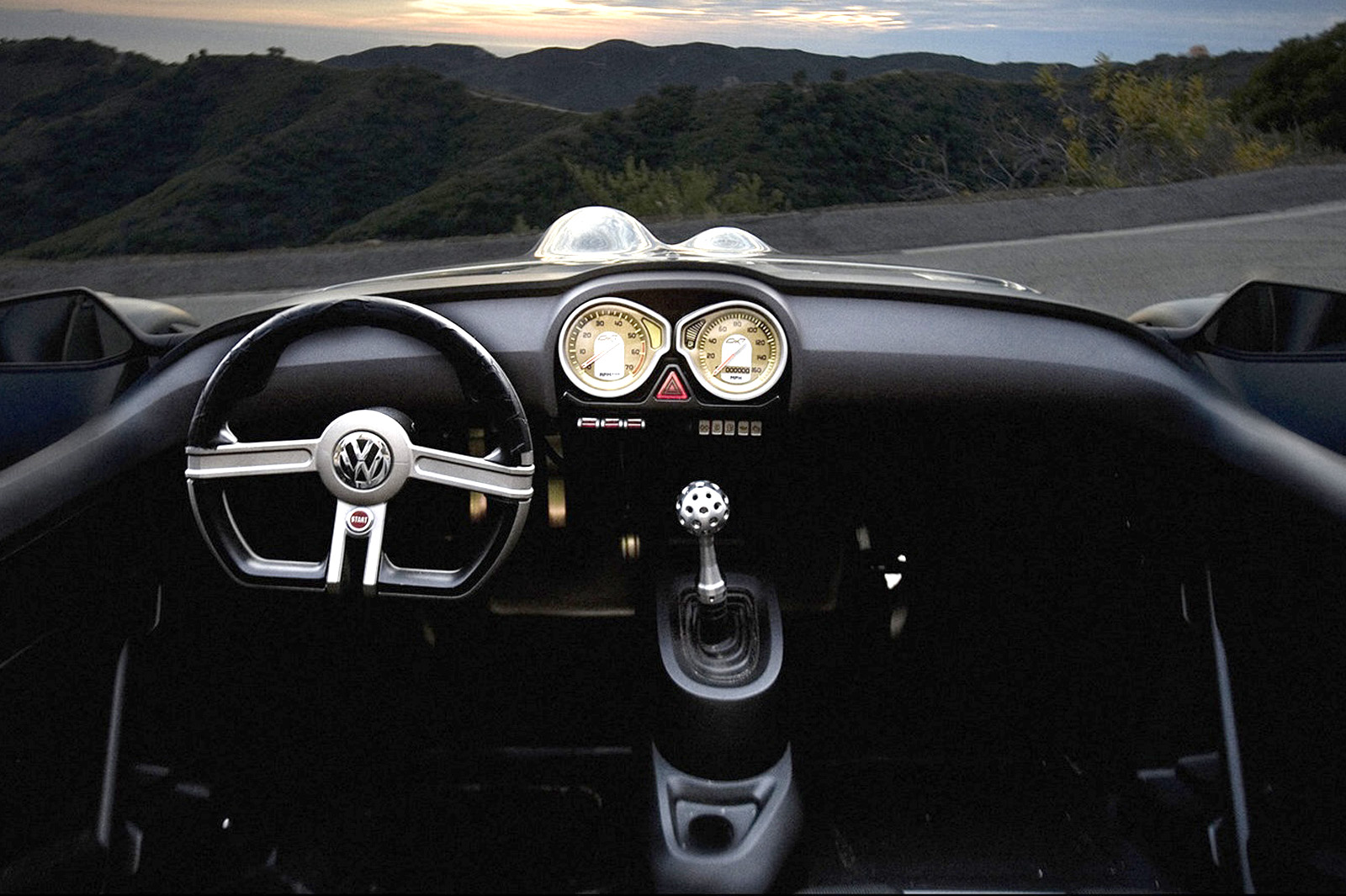
Sure, the GX3 didn’t have a windshield, or doors, or really any conventional car features, but this three-wheeler’s spec sheet got the people going. It had an enormous 315-section rear tire, the steering rack from a Lotus Elise, and the 125-horsepower 1.6-liter turbocharged engine from a Lupo GTI. Thanks to a scant curb weight of 1,257 pounds, the Volkswagen GX3 could dash from zero-to-62 mph in 5.7 seconds and return a claimed 46 MPG. Oh, and did I mention up to 1.25 g of lateral acceleration? That edges out the C8 Chevrolet Corvette Z06, a machine nearly 20 years newer and basically a supercar. Perhaps the best part was Volkswagen touting a starting price of $17,000. As the company wrote at the time, “Fact is: a production counterpart of the GX3, could be on the market very soon. It all depends on the American driver’s feedback.”

Needless to say, this got people salivating, and official comments only added fuel to the fire. Shortly after the unveiling, Bernhard told Automotive News, “If this gets positive feedback, we will see this on the streets of California soon.” Members of the press even got to drive it, and the feedback was good. As Motor Trend wrote:
After three or four hours of nonstop carving, skating, and gliding up and down challenging alpine roads, I have a broad grin on my face. No other car this inexpensive (VW claimed that it would have theoretically cost about $17,000) has ever been this much fun. Corner by corner, the sticky roadholding and the sweet handling balance enhance the appeal of this bug-eyed street machine. Climb by climb, the mix of instant grip and eager acceleration brighten its halo. Descent by descent, the subtle load transfer, the aggressive brake bite, and the very physical downshifts test the driver’s skills.
It likely helped that Lotus had a hand in sorting the handling, but the GX3 looked and sounded like a belly-laugh, a practicality-be-damned admission that cars should be fun.
Every sign pointed towards volume production in 2007, yet if you walked into a Volkswagen dealer during the year Mims had an unexpected pop chart hit, you wouldn’t have found a GX3. What happened? Well, it wasn’t a fiscal problem, as Motor Trend noted:
“The business case was watertight,” confirms Jens Berger, who was in charge of body development, specification, and vehicle safety. “Even the base model would have made money from day one.” With the exception of the frame and the floorpan, all the major components come out of existing parts bins. The Germans struck a deal with Lotus Engineering, which was to build the GX3 and sell it to VW at a fixed price. Insiders claim that the net cost per unit was about $10,000, so each vehicle would have made a healthy profit–and that’s before options.
According to Autoweek, product liability concerns started to rear their heads as early as May of 2006. As the magazine wrote:
The low-slung GX3 legally would have been considered a motorcycle, meaning VW could have engineered it to different standards than a car. But blurring the line between cycle and car could be too risky.
“It was somewhere between the two—a motorcycle and a car—and that is a problem,” says a source close to the project.
By December 2006, Motor Trend reported that the GX3 had been axed. It was basically ready to go, but the legal gap simply couldn’t be closed. With the project being canned in America, it was canned everywhere, and the publication found that unfair, writing: “America may live in the insular darkness of lawyer-led repression, but Europeans, at least, should get the chance to go play in the street.”

Maybe the GX3 was just too cool for mass consumption. Too wild, too extreme, too much fun for the money. Sure, it was immensely impractical for anyone living in a place where rain and snow are concerns, but as a fair weather toy? What other new car for $17,000 would’ve given you this sort of performance in 2007? Still, I wish I could buy one of these second-hand today. It looks so much sleeker than a Polaris Slingshot, and that golf ball shifter probably feels fantastic.
Top graphic image: Volkswagen




These are so cool!! Creating a replica kit might be fun.
For a brief moment I thought this was a Mercedes article….
Had VW made it FWD – just porting over the entire front end structure/engineering from the Lupo GTI (which was not turbocharged) – it would have made much more economic sense to produce it.
And it probably would have been just as much fun.
Life long VW sadist/owner here. VW used to be a cool car company. Now, aside from the GTI and the R, they are an SUV company, just like every other car company. I do miss the company that took chances, before Dieselgate and EU mandates screwed them over. Give us a Passat with a hybrid, a Golf EV, and something from the Cupra brand.
Tell that to Polaris, Morgan, and Campagna. Sounds like a bullshit excuse to me.
Swift Engineering in San Clemente CA did a bunch of work on the GX3, including engine integration. I remember the engineless black Lupo sitting in the back parking lot. The GX3 was a very cool design and would have been an interesting niche product for VW. I worked with one of the lead engineers a few years after on the first EVTOL for Zee Aero (now Wisk) then the 2011 Motoczysz e1pc.
Lotus Engineering is more of an engineering staffing company like AVL, FEV, IAV, Ricardo, Cosworth. People get an idea that these are especially knowledgeable or talented groups but they tend to staff a new powertrain project or whatever it might be when the OEM doesn’t want to hire staff to start an engine program. AVL started the Ford 6.7 power stroke program, had a part in the Stellantis Hurricane T6 and Pentastar Upgrade. IAV did a lot of Karma’s engineering, FEV did the Cadillac Blackwing.
Sometimes the engineers from the firms sit at the OEM and sometimes they are at their own site depending on the situation.
Lotus was probably sourced for the headcount and for the specialty manufacturing capacity
Probably for the best, by 2008 there was not a bunch of disposable income floating around.
Are you sure? Like 1.5 psi?
Back in the days before direct injection and less advanced ECM computers, that might not be out of line for a consumer grade engine. Race cars would have gone (much) higher, of course.
The engine in question did 125hp without a turbo. Even in 2006 a turbo engine could comfortably put out 100hp/liter or more.
The Lupo GTI engine was NA with 125 hp, so for this beast they may have thrown a turbo on that engine and the output is wrong, or it may just be data that has been skewed after 20 years.
I designed a closed vehicle of similar configuration around that time and, even as a home builder, the classification problem was too dissuasive. Today, there is the autocycle classification, courtesy (I believe) of Aptera—they actually accomplished something!
It’s my understanding that Elio Motors was the main driving force behind the modern autocycle classification effort.
I wonder if they could have legally sold it as a DIY Kit?