

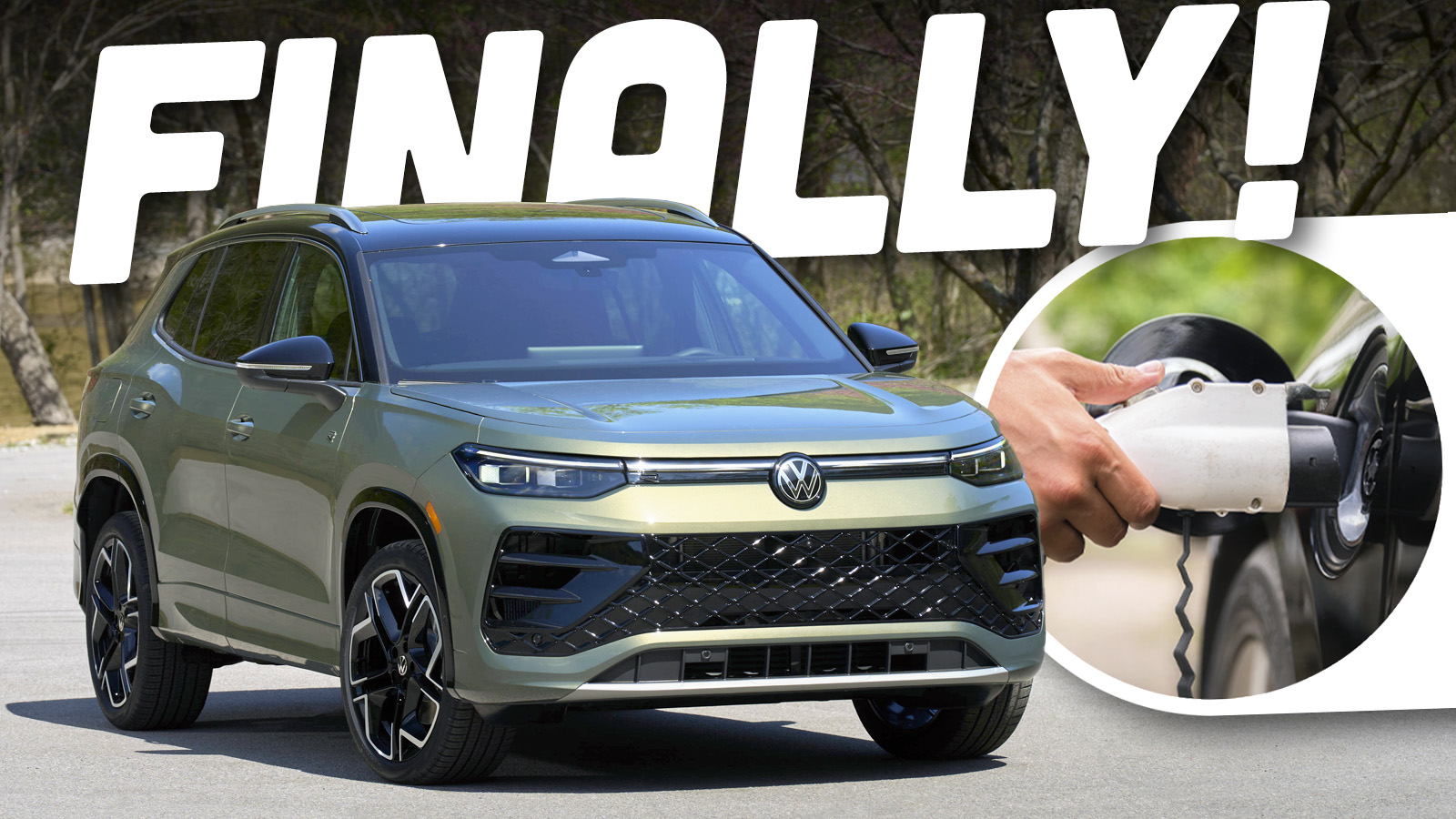
The decade of the hybrid is upon us. Falling sales of EVs in America, bolstered by the disappearance of federal incentives, mean people are turning to hybrids more than ever. It makes sense; hybrids, especially plug-ins and range-extended EVs, deliver the best of the electric experience, without any of the range anxiety of owning a pure EV.
That’s not the only benefit of owning a hybrid. According to a big survey published last week by Consumer Reports, hybrids are, on average, actually 15% more reliable than purely gas-powered cars, too.


Volkswagen, which has struggled with selling its two pure electric cars and hasn’t offered a hybrid model in nearly a decade, is reportedly starting to realize just how important the hybrid market is becoming.
Finally, Some Sense Around Here

According to a Bloomberg report published this morning, Volkswagen AG—that is, the parent company of all of VW’s brands, including Audi and Porsche—is looking at the idea of adding range-extended EVs to its lineup, according to “people familiar with the company’s thinking.” From the report:
The German manufacturer is studying adding range extenders to its high-selling sport utility vehicles and sedans, the people said, declining to be named discussing internal matters. Popular in China, the technology is not yet widely available in Western markets.
Volkswagen is monitoring market developments and has reserved the range extender concept for its future vehicle platform, the company said. “If and when this technology will be available in Europe and the US depends on customer demand,” it added. The carmaker is currently drawing up its next five-year investment plan, with a decision possible after a supervisory board meeting later Thursday.
Volkswagen famously went headfirst into the electric vehicle space after its Dieselgate fiasco, largely avoiding the development of hybrids altogether. That seemed like a smart idea five years ago, when it felt like the EU was going to ban all gas-powered cars by 2035. Now, though, it seems like that might be walked back to the point where range-extended hybrids could exist beyond that date, leaving VW on its back foot.
It’s About Time
The Volkswagen brand doesn’t sell any hybrids—plug-in or otherwise—in the U.S. right now. It announced earlier this year plans to add hybrid models to two of its volume sellers, but those won’t be plug-ins, and are likely unrelated to this Bloomberg news.

It’s not like VW is totally unfamiliar with plug-ins. It’s been selling the Skoda Kodiaq iV, a plug-in hybrid with 75 miles of pure electric range, in Europe since last year. And according to Bloomberg, it’s already planning to sell extended-range EVs in China as soon as next year.
And let’s not forget Scout Motors. In addition to pure electric models of its upcoming Terra truck and Travler SUV, the VW subsidiary plans to sell versions with range extenders mounted in the back under the floor. Once buyers learned of this plan, orders of the range-extended version quickly outpaced the EVs, forcing Scout to delay the EV models to focus on the hybrids.
That market reaction is why I believe Bloomberg’s reporting here. It’s entirely possible VW Group saw the huge delta in demand for Scout’s hybrid models versus the EVs, and figured the rest of its cars should probably take a similar approach. Electric SUVs with 1,139 horsepower are cool and all, but it’s not what the masses pine for.
Top graphic images: Volkswagen; DepositPhotos.com



“That’s not the only benefit of owning a hybrid. According to a big survey published last week by Consumer Reports, hybrids are, on average, actually 15% more reliable than purely gas-powered cars, too.”
That’ll change really fast if VAG starts selling a ton of hybrids.
Hybrids aren’t more reliable by virtue of being hybrids. They are more reliable on average because Toyota/Lexus products are overrepresented in that space.
Now having said that, what I’d like to see VAG do is keep the manuals and replace it’s variety of automatics a basic hybrid as the default ‘automatic transmissions’… and have plug-in capability as an option.
It would simplify their powertrain offerings and offer better real world fuel economy
remember the “voltswagon” joke the pulled on april 1st or something?
Considering the knotty messy pretzel that VW Corp is, I’d say they were even quick in turning this boat ????
I drove a Skoda Octavia hybrid-of-some-sort sedan earlier this fall in Ireland, it was perfectly capable and got great gas mileage. They obviously have the tech inside the group, why don’t they use it?
Due to EU bureaucratic shenanigans, pushing misguided policies and failing to adjust course when things are obviously and clearly going south
All I ask is that VW doesn’t F up the Scout. I’m holding off on a vehicle purchase until that’s available.
Don’t count on it.
The more involvement VW has, the less faith I have in Scout.
I’m a Rivian shareholder. So I’m hoping VW actually DOES fuck up the Scout.
LOL
That’s so adorable that you think Scout is real.
I fully give them a 75% chance of flopping before I ever buy one. But the EREV Scout Truck is the only vehicle that really interests me and checks my needs. Besides a Raptor.
My thesis is just, as they would say in the NFL, it’s a “busted play”.
When VW embarked on that path, with the Consent Decree Pistol held to their head, the market was operating under a COMPLETELY different set of assumptions. Now that reality has set in? And the whole VAG portfolio is completely out of position on the field? It’s asking a lot of the SCOUT management to “run an audible” and fix it.
I mean, what they really need is a Toyota-grade pure hybrid drivetrain… but I don’t see that emerging from the bowels of VW. So I’m cynical.
Which feels bad because I really, really don’t like what Bronco has done to the market. I always had-a-thing for the original Scout, due to purity of mission. And, so, kind of root for Scout even as I think VW has an inexhaustible reservoir of ways to Cokkk It Up.
Good luck.
Not to be a Debbie Downer but the idea of more tech-filled VWs coming to market doesn’t fill me with glee, having owned almost a half-dozen of their products over the past quarter century. My experience of their cars once they’re a decade old (let alone two or three) is that they’re a PITA to repair/service/maintain, and costly too.
I’m over VW, regardless of drivetrain technology. If I were forced to buy a new car today (perish the thought) it’d almost certainly be something Japanese: a Mazda, or maybe a Toyota if I could find one I wanted without a dealer mark-up. Or possibly a Hyundai/Kia.
Nothing new from any German manufacturer would get serious consideration from my bank account. With that said, a mostly-pre-computer Benz could tempt me…
https://www.youtube.com/watch?v=JV-MXlxbZZE
…thankfully for my bank balance, these are too pricey to be an impulse purchase, so I’ll stick with my old Volvos for the time being. 😉
PS: I know that nobody asked, but I always fancied Rachel Dratch.
She’s got great assets, why wouldn’t you?
The funny always is a plus. 🙂
Given the investment in Scout and the EREV platform for it, its not surprising to me they would look at how they could leverage that across more vehicles.
A straight EV is definitely the superior vehicle and we have one that we use all over our state. However for large vehicles, an EREV prob makes more sense right now for a lot of people. If I replaced our V6 SUV which I use for, among other things, long distance towing up to 5K lbs – an EREV would be a better choice for me at the moment than an EV b/c I know from experience that towing usually has a 50% penalty for an EV. For just hauling passengers, a similar sized EV would prob be fine if it was affordable and had ~350 miles of range. The ZDX would have suited my needs for a people hauler. So would the VW Buzz. Both are more expensive than I want to spend on a vehicle though.
As it is we do about 99% of our miles with our EV and the SUV stays in the garage.
This article made me take a look at the local VW dealership and they’re practically giving cars away with discounts right now. $23k for a brand new Jetta with decent options doesn’t seem like the worst deal in the world.
Until you sit in it.
????? I’ve been in a few pretty modern cheapish VWs and they have wicked nice interiors for the price. Maybe the new ones have stupid infotainment or something but like 5 years ago they were my favorite rental car by far.
Oh, a decade ago they were all a pretty nice place to spend time.
In this most recent generation?
They went a little funny-in-ze-head for putting all functions into sub-menus, controlled by wonky software, on terrible screen UIs, surrounded by hard plastics. Apparently even tuning the radio was rocket science stuff.
I’m told they are going back to buttons at present but that last generation was a freakshow.
VW isn’t the only manufacturer looking into range-extender tech. I think Stellantis partner Leapmotor has launched one in China, while BMW is considering adding one to the iX5. But VW is being aggressive about it, using its partner Xpeng to launch a wide variety of new EV/EREV models in the next few years.
The key thing is that all this tech will center around China, where EVs are widely accepted and EREVs with the much greater range will likely fare well. In the U.S., which is less important to VW than China, it makes zero sense to scramble to get one here. Adding a Tiguan/Atlas hybrid will be good enough for now.
I feel semiconductor availability plays a large part in how the product strategies get deployed, so while I would like to be, I’m not going to get excited about a short-wheelbase EREV ID.Buzz.
No, needs to be long wheelbase for sure. Also primarily an EV and hybrid secondary. Otherwise the undersized light duty hybrid battery lives a hard life that will surely be shorter than if it was larger and better managed.
Leapmotor added EREV versions of nearly all vehicles in their lineup by 2024 (I think some launched 2023) and they immediately did fairly well, the C16 EREV outsold the EV version while EREVs were ~1/3 the sales of most other models. Interestingly throughout that year that has flipped and now the C16 EV is outselling the C16 EREV in the later months of the year even though neither have received updates (I have no clue if there were pricing changes though). Sales of the EV versions of the other models are growing while the EREV versions stay flat.
Li Auto’s primarily EREV lineup has taken a hammering this year with 30% lower sales than last year while everyone else grows; this is in part due to competitor AITO’s EREVs, but I think it’s also because Chinese consumers are finally getting over their charger availability anxiety and are getting EV competitors instead.
XPeng are EREVing only their SUVs and MPV which are most susceptible to poor highway range, they’ve EREVed their lineup quite late. Initial sales have been good but we’ll see if that lasts more than a couple months. For the rest of the brands, most are only EREVing their huge flagship EREVs so they don’t need insanely huge batteries for highway range. Otherwise, it’s all EVs or PHEVs for the budget segment.
I mean, more directly than Skoda, they sell the VW Tiguan eHybrid, which is a PHEV rated at 120km of range on the WLTP cycle, or probably closer to 50miles of EPA-rated range.
Both the Skoda and the VW are built on the same MQB architecture, and are functionally nearly identical underneath. I’ve been in a Tiguan eHybrid in Germany. It was really nice and performed well. As a resident near a VW factory, he also gets sizable discounts and didn’t pay all that much for it.
The main sticking point is where those hybrids are made, and all of them for the VW brand are made outside the U.S. That’s about to change, as VW will add Atlas/Tiguan hybrids to its Chattanooga plant soon. I bet the availability of semiconductors played a big part in VW’s delayed U.S. strategy for this type of vehicle.
Also the math on Plug-in Hybrids, or E-Revs or whatever is wack. Look at a RAV-4 for instance. $7k more for a like-for-like PHEV vs Hybrid. It’s going to take you forever to recoup that difference and it’s pretty debatable as to whether a PHEV or EREV is much greener than a traditional hybrid.
Well, many PHEVs used to be able to leverage at least some of the EV tax credit, so I wouldn’t put too much stock in PHEV MSRPs for the next several months until the market settles out PHEV pricing with that credit now gone.
Like we got tons of factory, federal, and state incentives before the EV credit expired on our Mazda CX-90 PHEV. Those wiped out the price premium over the 3.3L Turbo. With free charging at work that covers our full commute, “fueling” the car is effectively free for the majority of driving.
I think the market is sorting out pricing for all this stuff right now, so I’d sit back for a while until things settle. Geopolitical factors and tariffs have thrown all car pricing into chaos as well.
I agree that driving a PHEV isn’t saving the planet.
The ’26 Ford Escape PHEV has already dropped a lot in MSRP compared to the ’24/25 I believe.
A PHEV with sufficient range to only use gas for the very occasional roadtrip saves the planet better than an EV with a bunch of extra battery capacity that doesn’t get used much, because the extra emissions from manufacturing that extra battery may not exceed the carbon from the fuel used on the road trips.
I’d like to see the math on that one.
I think it’s the last model year for the Escape. You can’t even buy or register them in CA, NY, VT, or MA
Without the incentives I couldn’t make the math work on the PHEV CX-90 over the 3.3L. We originally wanted the PHEV but ended up buying the 3.3L after calculating a break even of 10+ years.
Yeah, totally makes sense. I was stunned Mazda offered us $15k off MSRP in incentives, right on the table at time of sale. We’d planned to buy a pre-owned one, but this was cheaper than the CPO deals.
Those crazy discounts were timed right before the end of the EV credit as they were trying to move the PHEVs out before that window closed. Seeing the sticker price delta between the 3.3L and the PHEV, I see why.
NOT driving a PHEV (or anything else short of a bicycle) is.
Yeah I mean that’s an awesome deal.
That may be specific to Toyota. The Prime is also the fastest RAV4 so there’s that. Toyota is also selling every single one of the few they make. They have no reason to lower the price.
If it gets plugged in, the plug in vehicle is better. If not it’s worse.
Yeah that’s fair. I just picked that example because I’m guessing they’re both the best-selling PHEV and best-selling hybrid vehicles on the road today (could be wrong, didn’t bother checking). But the price difference without incentives has to be substantial just because there’s a substantial cost to both the battery and outfitting a car with an entirely different drivetrain. I mean, you need a whole different assembly line so there are huge fixed costs involved for several years, as well as diminished economies of scale on both cars’ supply chains (because the cars will necessarily cannibalize each others’ sales).
I think that’s the main reason Toyota has gone all hybrid. Strategy-wise, it blows everyone else away.
I don’t believe that PHEV sales are cannibalizing hybrid sales for the RAV4. It’s the range topper and some people just have to have the best one. IIRC there’s nothing directly comparable in the Lexus lineup. So the top trim RAV4 may steal some Lexus customers if anything. Folks who don’t have access to a plug will probably choose the hybrid and well heeled folks who want to dip their toes into electrified driving will get the Prime. Jump on in, the EV won’t bite. When they get tired of the Prime the (finally competent) BZ4X or whatever alphabet soup it’s named is waiting as Toyota’s BEV.
That’s why they maintain a high price point – to reduce cannibalization, but I was more talking about traditional ICE vs Hybrid. They necessarily cannibalize each others sales because someone who would otherwise buy a hybrid will opt for a cheaper ICE and someone who would otherwise buy a traditional ICE of the same model might want a more efficient hybrid.
Take Honda for example. To get the hybrid, you need to buy a more feature-rich vehicle, and to get a more feature-rich vehicle, you need to buy a hybrid. They’re trying to avoid cannibalizing their own sales.
Valid about hybrids being locked into higher trims on some models. Which is too bad since a cost-conscious buyer looking for the cheapest total cost of ownership would love a cheaper to buy vehicle that gets great fuel economy. Not everyone wants a used car.
I don’t care if it’s VW or someone else, but more EREV’s is always welcome. Just give them enough range. The 30 mile range a lot of the PHEV’s have right now is just poor.
My mother in law owned an original VW van back in the early 70s and loved it. When she was looking for a new vehicle she saw the new VW van and asked about it. Learning it was EV only she asked why it wasn’t a hybrid. In response to ‘they don’t make them’ she ordered a Ford Maverick hybrid.
Dumb VW, she said.
Volkswagen’s problem wasn’t that it thought EVs were everything, it was that it thought people would want to buy shitty, overpriced EVs with terrible UX. Volkswagen built its brand here making small, inexpensive cars that were just a little more fun than other small inexpensive cars. It has become bloatware. It should die.
More of a PHEV but I do wonder what market research would say nowadays for the GTE over here.
I mean the current administration wouldn’t even so much as bat an eye if VW were to bring back the cheater diesels.
Ok that’s great and everything, but maybe we should focus on like, bringing products to the US that aren’t somehow simultaneously more forgettable than Toyotas, whilst being far less reliable than Toyotas.
The problem isn’t that EVs are bad, it’s that Volkswagen’s EVs are bad. You can’t bike a good EREV without it being, at its core, a good EV.
I’m not even sure I’d call them bad. They aren’t competitive is the problem. I like the IDBuzz, even with it’s relatively pathetic range. It’s the price that kills it. Had it been priced $20k cheaper, the range would have been palatable. Had it been given an extra 150-200 miles of range, the price would have been acceptable.
As a van, it is cool, and quite good. As a vehicle, it’s too expensive, with too short of a range.
I’m still pissed at VW for the way they did the Buzz. I would have been all in, had it had a slightly lower price, or better range. I have been waiting my entire adult life for a modern take on the classic Bus, and they screwed it up. I live in a fairly affluent area, and I have literally seen 1 on the road since they’ve come out. What a massive swing and a miss..
I’ve seen two. One I was able to look at up close. Very nice vehicle but my Kona gets better all EV range. If I buy a vehicle like that it will be for road trips. 200 miles per charge does not make a good road trip vehicle. 300 would. 350 would be better. 400 is about what I’d like to see even if that meant a little boxer engine under the vehicle was helping boost the range. See BMW i3 REX for example. Also BYD Shark pickup truck.
I would love to have one as my family hauler. I could even stomach a price in the 50’s if it had 300+ miles of range, or (even better) a range extender. But, as it sits, it’s a huge pass for me. Despite how great it does look.
VW attempting to reposition itself for the US market, for changes brought on by political decree, would be a mistake. Two simple points. The rest of the world is still moving forward, and the current regime won’t be in power forever. For the sake of the country’s future, all of their recent damage must be reversed.
But the thing is as the article states even the EU is pushing back EV mandates. To me the EV mandates never made sense and either making more hybrids or EREV makes much more sense.
Especially now in the US with date centers going up everywhere it will be really interesting how this will affect our power grid hell the data center Amazon is building next to my work in Indiana is going to use more power then have the population of the state and Amazon has said they are going to be spending like 13 billion more to build more data centers in the state so yay.
I was just reading about that New Carlisle center. My wife has family in that town. They’re pretty damn unhappy about it.
Why? We have 475 MW of data centers in my town and more being built. Way more jobs and property tax than the farm fields they replaced.
I’d much rather see open farmland than another massive warehouse full of energy-hungry servers. The jobs these data centers create are mostly temporary during construction, and once they’re built, they only employ a few dozen people. Meanwhile, they can drive up utility costs for everyone in the area. It’s pretty understandable why most communities don’t want them in their backyard.
Yes a 50 MW data farm employs about 2 dozen people. That is about 23.9 more permanent jobs than a farm field at much higher pay. Then there are the much higher property tax rates bring money into the local community for schools and such.
Yes, power consumption is an issue but it is an issue regardless of where the data center is built. Opposition is just straight NIMBYism. People want the modern society that requires data centers for pretty much everything we do online but don’t want to see them. Same with power lines.
I don’t think the current regime is 100% responsible for the shift away from EVs. The tax credit being removed has hurt adoption, obviously, but the broader fact remains that these cars are still expensive, and not everyone is able to make them work with their lifestyles. I was considering a Mach E for a long time, but even with a tax credit, it made much more financial sense to go with a Civic hybrid. Obviously, zero emissions is the goal, but anything that reduces emissions and requires us to depend less on fossil fuels is a net positive.
Might be too little, too late for VW, but they sure could be a disrupter in the market if they take the EREV idea across the line. Target at least 50 miles all EV range (80 is better) and mate it up with the most efficient ICE/generator they can come up with.
The biggest practical advantage of the PHEV / EREV is that they take the place of multiple vehicles. An EV for around town and an ICE best suited for longer trips. If you can only have ONE vehicle, and if your round-trip daily driving is less than 50 miles or so, an EREV makes the most sense (assuming you can plug it in every night)… which leads me to:
The other practical feature that doesn’t get enough press is that PHEVs/EREVs with smallish batteries can be easily charged from a simple 120v outlet and still get a full charge every night assuming a ~50 mile all-battery range. A full on EV with the large batteries does best with a level-2 220v outlet so that’s a show stopped for a lot of people.
VW could offer a budget car, a hot-hatch, a practical sedan and a suite of larger SUVs all with variants of battery size and 2WD/AWD. Leave the trucks to SCOUT.
If they really want to go all-out, they would revisit the rear mounted engine for a small car e-rev application. Maybe a tiny, purpose-built (air-cooled?) engine + matching generator as a drop-in module in the trunk…
Bring back the Bug!
Make it an E-REV electric!
Call it the BUG-E!
(sorry about that)
I kind of disagree that PHEVs can get away with Level 1/120V charging while EVs require Level 2/220V. If you drive 40mi daily, a RAV4 PHEV is going to use about 15kWh, while a Wrangler 4Xe will need 30kWh (assuming it had a bigger battery than its 15kWh usable). On a Level 1 charger, the RAV4 can recharge in 10 hours, which is just fast enough, but the Wrangler would need a Level 2 charger to recharge its 30kWh needed overnight. Level 1 charging can be enough for aero focused 2-row crossovers, but anything bigger and draggier will need Level 2. This would mean anything significantly lower than the RAV4’s ~95MPGe, such as the 80MPGe ID. BUZZ.
Of course it all depends on miles/kwh efficiency + miles drive + recharge window time. Plug in at 6pm…unplug at 7 am and that’s 13 hours. Should be enough for most commutes, but even a partial charge is much better than none. A single tank of gas might last a month or two.
The problem with 110V charging is that it is very inefficient – especially in the winter when a lot of that 1.4 kW available is going to heat the battery and run the coolant pump. I have measured 20 – 30% charging losses when charging my Bolt in our mild PNW winters with nighttime temps only in the 30’s.
Charging at 240V (5.5 kW) charging losses are 6-7%.
Woof!
Imagine how pissed you’d be if you spilled a gallon of gas every time you filled up your ICE Camry EVERY.SINGLE.TIME. Now double the cost of the gas.
Charging losses are too often an ignored or overlooked part of the EV equation.
Driving an EV is so much cheaper it really doesn’t matter much – at least charging on Level 2. Even with losses I’m at $0.025 per mile for electricity (and that assumes I pay for every kWh which I don’t)
Yes, losing 30% charging on 110V is stupid but Level 2 and above are quite efficient. Also the EPA estimates include charging losses.
The typical Camry throws away 70% of the fuel it burns as heat even if you get it into the tank.
We pay a minimum of $0.30/kWh for non peak residential which roughly translates to a bit more than the local cost of regular. Peak pricing is about double that.
Public charging also usually runs about 2x the local price of gas:
https://www.autoblog.com/features/the-most-and-least-expensive-states-for-public-ev-charging
http://www.gasbuddy.com
Yes the EPA includes charging losses in MPGe but AFAIK chargers do not. You pay for the electricity the charger uses to charge your battery including the losses. So the $0.30/kWh out of the wall becomes $0.39/kWh using level 1 or $0.33/kWh using level 2 in the tank.
I pay $0.09 a kWh off-peak and $0.44 on-peak. Needless to say I don’t charge on-peak and the only major electrical usage I have on-peak is cooking. If I was paying $0.30 a kWh off-peak I would have installed solar years ago.
Public charging is for the rare cases one needs to travel outside the range of one’s EV and doesn’t just drive their other car.
I don’t have 10% losses charging on Level 2 – not even in winter and with my low power Level 2 (only 5 kW). If I installed a 60 amp circuit I could charge faster and with lower losses.
Also how one charges matters a lot. Topping off the last 10% is quite inefficient (and bad for the battery). That is why I let my battery SOC get down to about 30 – 40% and then charge to 90%. If I had a new EV with more charging options I would only charge to 80%.
YYMV:
https://www.readelectricavenue.com/p/an-inconvenient-truth
“If I was paying $0.30 a kWh off-peak I would have installed solar years ago.”
That’s fine if you can do it. Not everyone has that option or can do so economically.
I get at least 2 knocks on my door a week from companies that will put solar on my roof with no upfront cost. Either $0 down loans or them owning the system an selling me the power. All work out to way less than 30 cents a kWh.
I would just do it myself but my rates are low enough that the payback is a bit long. (About 7-8 years)
A bunch of my neighbors have solar though and are quite happy with the results.
Which is a privilege you and your neighbors have as homeowners. Renters do not have that option.
Renters in general are not driving EVs as it makes no sense without home charging.
Renters do use electricity though, just as much as non EV owning homeowners.
They do.
Which points out a problem with how we do energy efficiency credits in the USA. Most of them do not apply to rentals. When I replaced my hot water heater in personal house I got a credit that brought a heat pump hot water heater down to the same price as a regular electric one. I also replaced the two hot water heaters in my rental duplex but there is not credit for those. They got regular electric hot water heaters.
There is zero incentive for me to pay an extra $1,000 per unit to put in an efficient hot water heater. Or solar, an efficient heat pump, more insulation, new windows, etc. The Feds will pay for 30% of the cost for me to upgrade my personal home to save energy but nothing to help a renter.
Ah contrare!
Who can use this credit?
For the Energy Efficient Home Improvement Credit, the following requirements apply:
exterior doors, windows and skylights, insulation materials or systems, and air sealing materials or systems: the home must be located in the United States and must be owned and used by the taxpayer as the taxpayer’s principal residence (does not include renters, nor does it include second homes);central air conditioners; natural gas, propane, or oil water heaters; natural gas, propane or oil furnaces or hot water boilers; electric or natural gas heat pumps; electric or natural gas heat pump water heaters; biomass stoves or biomass boilers; and improvements to panelboards, sub-panelboards, branch circuits, or feeders: the home must be located in the United States and used as a residence, including a second home, by the taxpayer (includes renters who make eligible improvements); and home energy audits: the home must be located in the United States and owned or used by the taxpayer as the taxpayer’s principal residence (does not include second home) and (includes renters who make eligible improvements).
The credits are available only for certain improvements made to second homes, and the credits are never available when the improvements are made to homes not used as a residence by the taxpayer. For example, landlords can never use these credits for improvements made to any homes they rent out but do not use as a residence themselves. However, if a taxpayer is renting a home as their principal residence and makes eligible improvements, a tax credit may be available to such tenant.
https://www.energystar.gov/about/federal-tax-credits/heat-pump-water-heaters
(Emphasis theirs)
My interpretation of this is that you might have made an arrangement with your tenants to pay for the water heater and you reimburse them minus the amount of the credits. Granted I’m not a tax professional so I would certainly confirm this idea with someone who actually knows that they are talking about.
The Energy Efficiency tax credits are non-refundable and knowing their incomes there is a 0% chance my tenants are paying personal federal income tax.
It would be FAR more straightforward just to give the same credits to the property owner if the Feds want us to increase our energy efficiency.
Even more straightforward than that would just to make them a point of sale rebate and not even deal with the tax code at all.
It is strange that the renter would be the one allowed to take the credit since they do not own the property and have no real power to dictate how the property is maintained other than to let the landlord know when something is broken.
However don’t you as the landlord get to deduct the expenses of the property from the rental income? If so higher expenses mean higher deductions.
There might also be state level incentives and rebates from your utility company. IIRC PG&E here in NorCal had such rebates for the purchaser of energy efficient devices regardless of whether they were a owner or renter.
Yes, it is very odd to say a renter can claim a credit for something they would never actually spend money on.
Yes, I can deduct expenses. Right now both my wife and I are working so our taxes are a bit higher. We still only paid 11% in federal income tax so it makes no sense to pay an extra $1000 to save $110. That extra $890 is almost 3 months of income from the property in a good year. (2025 is a very BAD year and we will lose $40,000 on the property)
There are no state, local or utility rebates for rentals where our property is located.
I want our renters to have a decent home and will spend some extra money for mid-range appliances and fixtures. I can’t see paying double for a water heater. (There is also the risk that the renter won’t clean the filter on the water heater and destroy it)
$890 is THREE MONTHS of income? Damn! I’ve heard of YMMV but damn!
It sounds like you’re an outlier on the wrong side of the curve. Perhaps in better times the federal deductions would have been a more tempting incentive. A more progressive local government might have offered credits and rebates and higher electricity costs would have motivated your renters to play ball (after all they’re the ones standing to save money). We pay between $0.30-$0.62/kWh for electricity. The envelope maths I did a couple of years ago showed payback between a regular and a heat pump water heater to be in a bit over a year with incentives and a couple/few years without, well within the 12 year warranty.
“(There is also the risk that the renter won’t clean the filter on the water heater and destroy it)”
The solution to that I think is putting that requirement in the lease with very clear instructions printed on the heater as well as having any replacement parts readily on hand. Or you handle it yourself if you want to be sure it’s done right. Personally I’d do the latter since it seems so many people can’t even properly change a tire themselves anymore.
While your at it make sure the zinc anodes are in good shape. Without those the heater won’t last either.
I assume this is a filter for the heater only. Whole house filter systems are cheap and relatively easy to install. That might lighten the burden from the water heater filter and keep all the plumbing cleaner too.
I’m in a different part of the rental market. I bought my duplex 5 years ago for $94,000. It rents for $750 per side. It is a full brick two story in a good part of town – but in the rust belt so low housing costs. Same town you can buy a new 3 bed / 2 bath single family home for $150K
The same property would sell for $600K to $800K where I live and my wife an I couldn’t see rolling the dice on that kind of investment for our first rental.
Low rent = low margins = less flexibility when doing repairs.
There is no solution to putting things into a rental contract when the people renting have nothing to lose. As they say – you can’t get blood from a turnip. The most I will every recover from a renter is their $750 security deposit.
As to doing things myself – the property is 2,000 miles away so that isn’t going to happen.
Power is $0.18 per kWh – so no short term payback for efficiency.
Yes, a heat pump hot water heater (at least the one I have) has a removable and washable filter that should be cleaned every 2 to 3 months. I really don’t see a renter doing that. On the other hand a regular electric hot water heater basically requires zero maintenance.
The big loss this year was a new roof and some structural repairs that one would expect on a home that is 80 years old. We want to get all the big ticket items replaced before we retire.
It certainly sounds like you are an outlier. Well perhaps by the time those heaters expire the gradients of cost and maintenance will no longer exist.
I think though it’s more likely regular electric tank water heaters will simply be banned in the name of efficiency and perhaps gas tank heaters for emissions.
Not for the area with a property manager. Again, low rents = low profits. It also is a high property tax area. That rental has higher taxes than my person home worth 5x.
Don’t even bother when you can get plenty of other brands with hybrids that will actually be reliable.
Adding a range extender to the ID series wouldn’t make it more appealing to me. I still don’t find them attractive inside or out.
If they can make the ID buzz and extended range EV and a bit cheaper (HA!) then I would take a look and others might as well.
If these are as non-competitive as their EVs, it’s not gonna help.
James Pumphrey did a really good deep dive on YouTube into VW and why they lost their mojo (at least in the US market). They are chasing commodity and they just aren’t good at it. They used to be generally better (performance, handling, quality, whatever; something was usually better than the competition) and now they really aren’t. They are now just bland commodity items that are more expensive to maintain and depreciate harder while having some generally poor design choices.
Exactly my thoughts. My current Kia hybrid is closing in on 200,000 miles and has been shockingly reliable in that time, and when it comes time to replace it I can see no reason to consider a VW product as the replacement. Same or worse levels of fit and finish as everyone else. Same or worse interior design elements. Same or worse reliability. Yet VW asks a price premium, and I doubt that will change when they start offering hybrids. They need to get back to offering something distinct to get buyers on their lots before they go the way of Nissan.
I still find it funny that Mazda is basically trying to take the slot in the North American market that VW largely abandon. In the late ’90s and early aughts, VW was kind of this entry level into premium (European) offerings. They were seen as more upmarket than what you’d get from Chevrolet, Ford, Toyota and Honda, and largely sportier than most of their offerings too.
Then they suddenly wanted to lose all their personality…
I completely agree about VW being mostly bland commodity items. Aside from GLI/GTI and the ID.Buzz, VW’s U.S. configurator is a very depressing place to be.
However, VW has always built commodity and in their core market (40% of revenue in Europe) they do it very well. Pumphrey’s complaint is legitimate but it’s been made many times before about VW, which has chased greatness in recent decades and it’s been burned each time. What we’re seeing now is VW being completely over being distinctive, whether that’s handling (1980s), styling (1990s), luxury (2000s), or performance (2010s). But that’s just the U.S. market (33% of revenue). The Asia market is in major flux for VW (30%) and that’s where its big headache is.
The tariff charge-off doesn’t help, but the key thing to look at is margins, which have dropped well below pre-COVID levels. They need those to recover in order to survive a potential recession.