

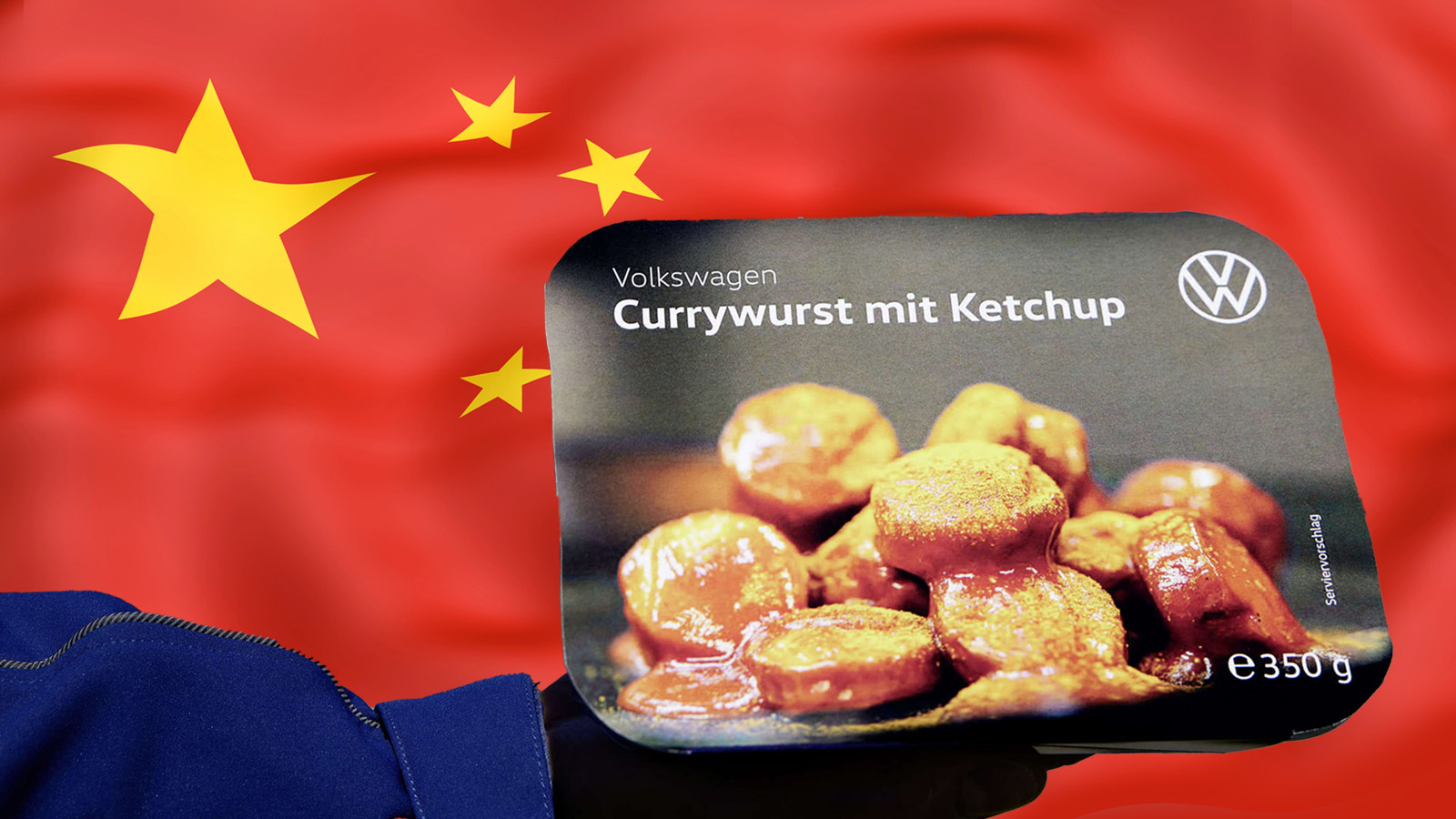
One of the most successful and well-known Volkswagen products is … the humble currywurst, a type of sausage that Volkswagen has been producing for decades. The carmaker originally started churning out these sausages for its factory canteens in 1973, but these days they’re widely sold in Germany, complete with an actual Volkswagen part number. For the record, the part number is 199 398 500 A.
The dish consists of a bockwurst-style sausage with spicy ketchup and curry powder. You can find currywurst anywhere in Germany, from the Nürburgring to Checkpoint Charlie, and visitors to Volkswagen’s Autostadt theme park can also have it for lunch. A while ago, Volkswagen also offered it as a pre-packaged, microwaveable lunch.



As Auto Motor und Sport reports, Volkswagen has now expanded sausage production to China. Beginning in September of 2025, workers at Volkswagen’s Chinese factories have also been able to have the factory correct dish for lunch, and by the end of October, 120,000 sausages had been served. That’s a good number, but AMS says that VW produces seven to eight million sausages per year for Germany and 550 tons of ketchup. Yes, China has some catching up to do.

AMS also quotes Marcus Greiner, Volkswagen’s catering boss, as saying that the currywurst is the true equalizer at VW, something that the board of directors and the factory line worker both enjoy. The actual recipe for the sausage is protected as carefully as with Coca Cola and the Big Mac sauce: only Greiner and Dietmar Schulz, head of food production at VW, control the recipe. VW’s Chinese sausages are produced locally, not imported from Germany.
A key figure is that Volkswagen makes twice as many sausages per year as it makes Volkswagen branded cars. In 2025, VW produced 4.73 million vehicles globally, out of which 1.3 million were made in Europe and two million in China. The biggest bump in production figures was in South America, with an 18.5 percent improvement to 568,200 vehicles compared to 2024. Both US and China saw around an eight percent drop, while European production was up 5%.

Volkswagen’s passenger cars have been essential in Chinese car production. The second-gen Jetta and the Santana sedan version of the second-generation Passat were produced under license in China for decades, as some of the first “modern cars” made in the country after joint ventures with Western carmakers were allowed in the 1980s, and VW quickly formed partnerships with FAW and SAIC.
By 1997, the Santana had 90 percent local parts content, and the image above shows a facelift version sold in China.
Top graphic images: Volkswagen; DepositPhotos.com


After having owned more than a few VWs both air and water-cooled, as well as an Audi, this currywurst is just about the only VW product I remain interested in buying TBH.
I’d be up for the traditional and the more recent vegetarian versions. I’m pretty sure I’d really like both.
Has someone checked the exhaust from these?
How do the locals handle the words “Volkswagen currywurst”? It’s hard enough for someone who speaks English and German, I can’t imagine it’s super easy for a mandarin speaker.
Well if making vehicles doesn’t work out, at least they have a plan B.
Hot Take:
VW should discontinue the ID-Buzz and add Spaetzle and Sauerkraut to the lineup.
Then distribute VW brand foods thru Lidl.
“
LawsVolkswagens are like sausages, it is better not to see them being made.”I know it’s a bastardization of the original von Bismark quote.