


It’s been a solid decade since the whole Volkswagen Dieselgate scandal went down, which I think may be sufficient time that we can start saying some things about the whole mess that perhaps we wouldn’t have felt comfortable saying before. Let’s just get the basics all out of the way: it was a terrible thing they did, a miserable nadir of corporate cynicism and greed at the expense of the environment, their own customers, and, really, everyone. It was an indictment of an inflexible and unreasonable management system that forced impossible demands on engineers, and the result was an absolute disaster.
That said, you have to admit that their cheat was pretty clever.


I don’t think it was ever actually revealed just who had the idea to do this in the first place, but if you think about it, you can see how that diesel train of thought got started. You’re an engineer, working on these diesel engines, and you’re being given performance and efficiency requirements to meet that are simply incompatible with the laws of chemistry, physics, mechanics, and reality in general. And yet, you can’t just tell anyone this, because the corporate culture at Volkswagen at the time was so poisoned and inflexible and unwilling to accept dissent that it was compared to North Korea. Seriously, look at this quote from J.S. Nelson’s paper, Don’t Ask, Don’t Tell Corporate Crime:
The numbers of people involved in the companies is significant as well. In the VW case, there were likely hundreds of people coordinating across at least three companies and five different name brands who made the cheating scheme possible. As the New York Times reports, “[t]he sheer amount of work required to install the software in Volkswagen vehicles suggests that a large number of people were involved.” The defeat-device “software had to be altered for each model and option package.” And these changes had to be made in “11 million tainted diesel engines in more than 30 Volkswagen, Audi, Porsche, Seat and Skoda models, which were available around the world in dozens of variations.” In another indication of how widespread VW’s fraud must have been, despite a company culture described as “North Korea without labor camps,” at least fifty whistleblowers have come forward inside VW after the fraud was publicly revealed who had not previously reported information to authorities.
As you can gather from that, it wasn’t a culture where an engineer could speak up to a manager and explain that the goals for a particular engine were unreasonable. This means that at some point, some engineer or group of engineers found themselves trapped between two immobile barriers: physics and their management. Aside from quitting en masse, what could they do? There was really only one option open to them:
Cheat.
And yes, judge all you want, but you have to respect this act of Gordion Knot cuttery on the part of the nameless engineers who finally came up with the idea. They couldn’t meet the performance and fuel economy goals demanded by their bosses while also meeting the emissions requirements demanded by the governments of the countries they would sell cars into. That much was certain. But, they could meet the performance and fuel economy goals and the emissions requirements on the same car, as long as they didn’t have to do both of these things at the same time! That, I think was the great leap of logic that made this cheat possible.
Once this concept was established, things really started to get clever. They must have realized that performance goals were going to be evaluated, informally, far more frequently than the emissions goals, because regular drivers do not check their emissions. And when emissions were evaluated, it would be formal and rigorous and follow a set pattern. This means that, using sensors and components already on the car, it should be possible to evaluate when a car was just driving, and when it was being tested.
That’s where the clever software came in. Essentially, what this software did was to look for a few key parameters that would, essentially, tell if a car was on a dynamometer or driving on regular roads. These parameters weren’t even all that complex: for example, if the car reads wheel speed over a period of time with no variation at all in steering wheel position over a decent period of time, it can reasonably conclude that the car is on a dyno, strapped down and being tested. If that’s the case, then the software puts the car into a mode where it uses all of the available emissions equipment to get the absolute best emissions cleanliness possible, at the expense of performance and fuel economy.
If the car detects steering wheel position changes consistent with normal driving, it is put into a mode where emissions equipment is bypassed, and the best fuel economy and performance are delivered, at the expense of emissions. The parameters of the test were known, so other factors were checked as well, but checking to see if there was any steering happening is perhaps the easiest to understand.
This is clever as hell. The software that does this essentially gives the car the ability to know its audience. When it’s being tested, it’s an incredibly clean diesel. When it’s being driven, it performs better than most diesels and gets better fuel economy. It teaches the car to play to its crowd.
As far as how it changes its performance and emissions parameters, this Engineering Explained video gives a great rundown:
I’m not even getting into the monkey business here, but trust me, it’s abhorrent. Also, that thumbnail image is unfair; that car is a Brazilian-market Fusca (Beetle) and in many ways those could be some of VW’s most environmentally friendly cars, as many of them ran on sugar cane alcohol, a completely renewable resource.
But that’s beside the point; if you can’t watch the video, here’s the basic breakdown of what was happening, as shown on this crude diagram of the engine’s intake and exhaust systems:
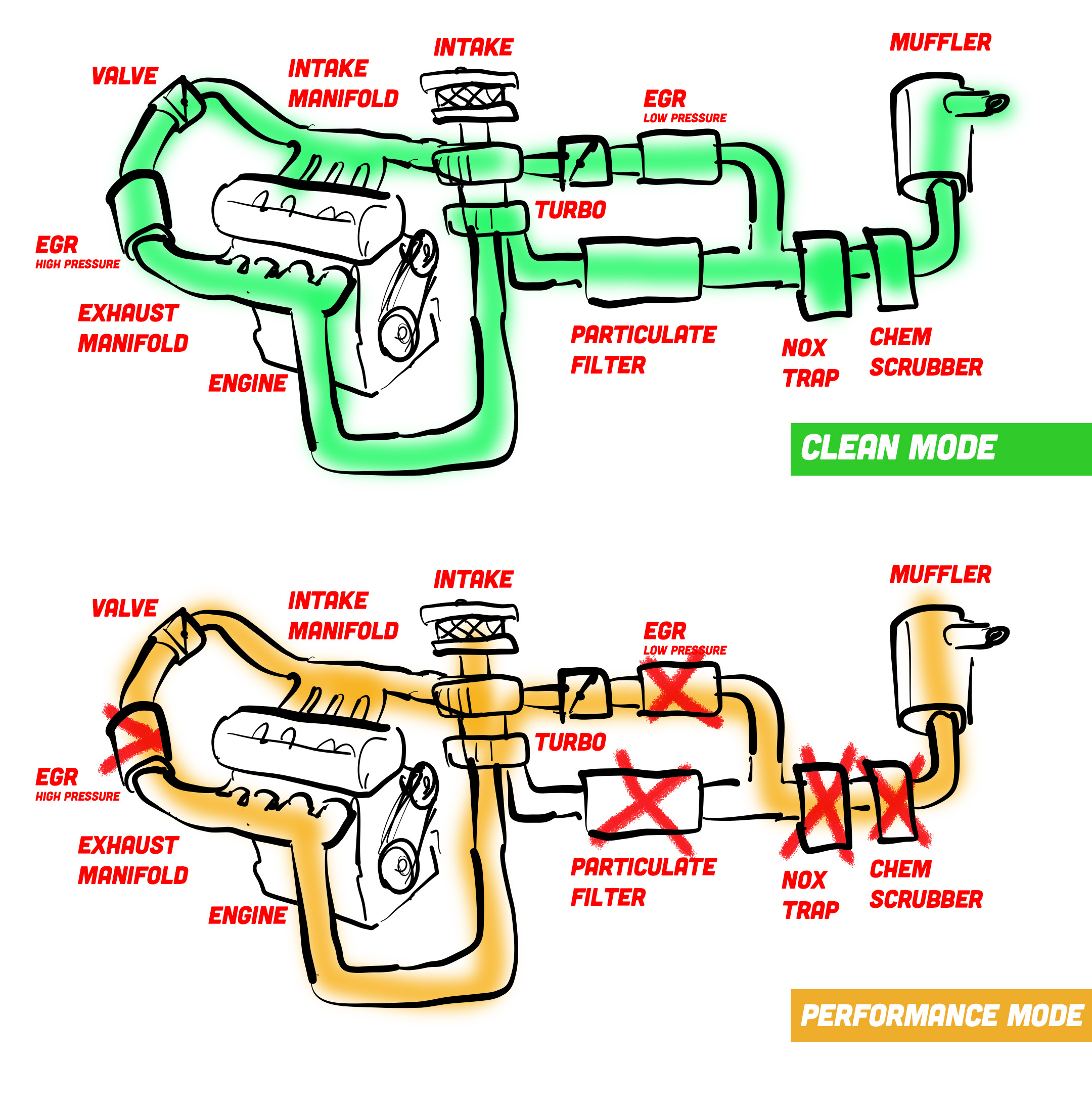
So, basically what’s going on is that in clean mode, all of the emissions equipment gets used: fuel/air comes in, the turbo is not spun up all that high (because less exhaust is being routed through it), so the ratio of fuel to air is adjusted to create lower combustion temperatures, which leads to lessened production of nitrogen oxides (NOx), then the exhaust gases get routed back into the combustion chambers via the high pressure exhaust gas recirculatior (EGR) so they go through the combustion process again, then those gases are passed through a series of filters, particulate filters, chemical NOx traps that need to be periodically “cleaned” with fuel, then to another chemical scrubber, and then finally out of the exhaust pipe.
In performance mode, the path is very simplified: air comes in, gets mixed with fuel in the combustion chambers at a much leaner ratio for better fuel economy, then the exhaust bypasses the EGR systems and the various filters – the NOx filter never gets “washed” with fuel, and overall a much less restrictive path for exhaust is made, which gets more power and fuel economy, but also 40 times the emissions!
But that’s just how it works, that’s not really what makes it clever. What’s clever is that it can figure out when it’s being tested, and all the methods used to change the engine’s characteristics are completely invisible, because they are all software changes, using the same hardware. Even though we routinely refer to what VW did as a “defeat device,” the connotation of a device as something physical is misleading, because this was all just zeroes and ones.
The idea of a machine that understands when it’s being evaluated so it can then hide some aspect of its performance is really pretty uncommon, though I can think of one sort of similar antecedent: Toyota Team Europe’s Turbo Celica cheat of 1995. I wrote about this cheat years ago, and while it’s a mechanical cheat instead of a software-based cheat, the result is the same: when being inspected/tested, the cheat was invisible, effectively non-existent. But when in use, the cheat was very active.
The cheat essentially did one thing: it changed the size of the restrictor plate that was required on cars in that racing series, and changed it to allow for up to 25% more air entering the turbo, which could provide up to 50 extra horsepower. The way it worked involved the use of springy washers that, when pushed by an intake hose and retaining clip, opened the restrictor by an extra 5 mm. But when the hose was removed so the part could be inspected, the springs returned to their baseline position, reducing the intake size to what the regulations demanded.
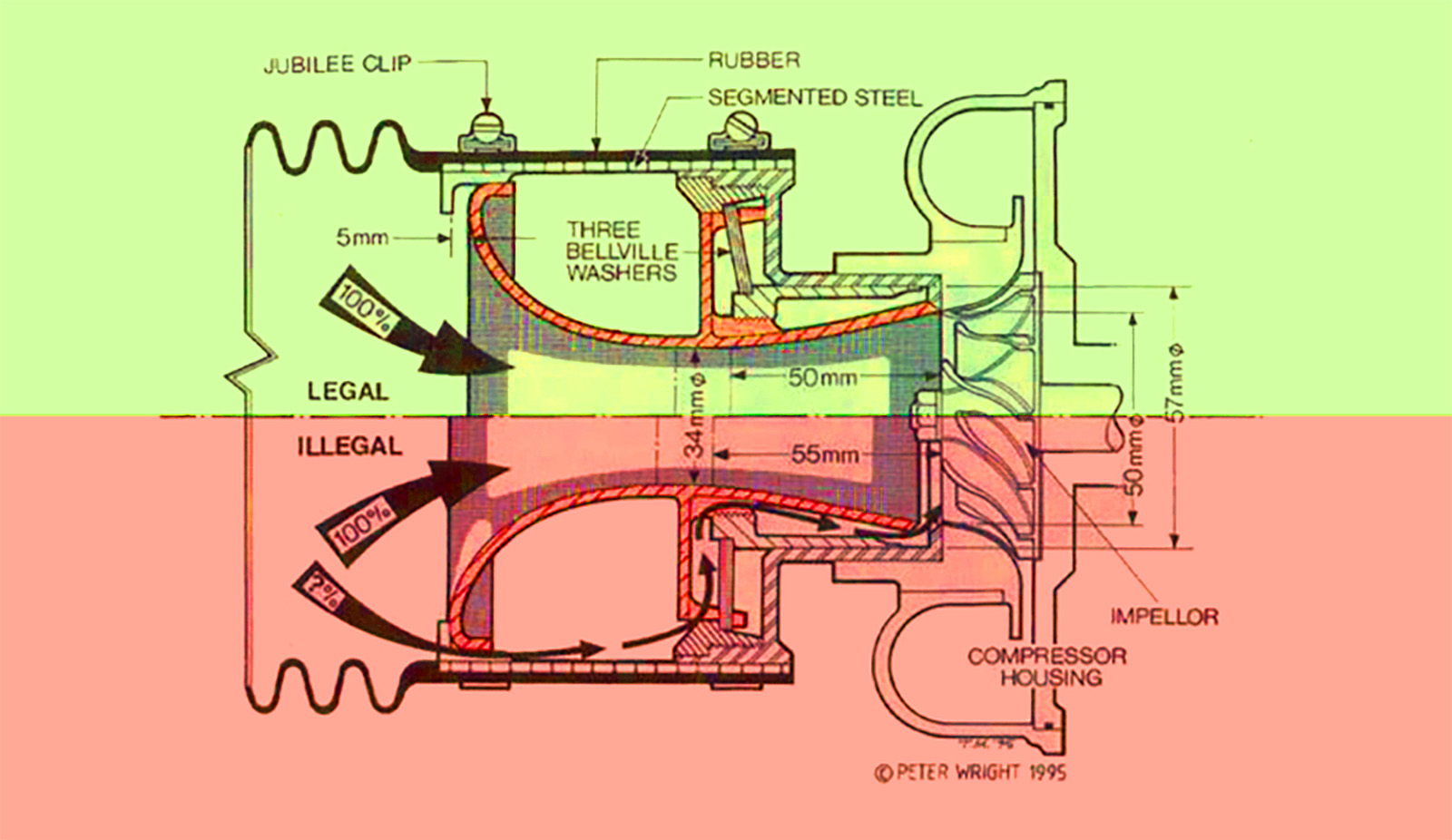
So, even though this was a purely mechanical solution, this did essentially the same thing as the VW Dieselgate cheat: when being inspected, it appeared to meet all the rules. But when in use, it very much didn’t.
Now, as clever as VW’s cheat was, it was also quite brittle: if the method of testing changed, the cheat would break, because it was only able to understand it was being tested if it matched the expected methods, specifically being on a dyno. So, when the team from West Virginia University tested the cars with portable equipment and drove normally – like, say, using the steering wheel – the cheat broke, because the cars were not able to determine that they were being tested.
This also makes me wonder if the opposite ever happened; did any VW Diesel owner ever take their cars to a dyno to just see what kind of horsepower it made? If so, it’s very likely the car may have decided it was being tested (though perhaps not; it wasn’t just steering wheel position it checked, after all) and then hp numbers would have been a lot lower than expected? But it’s very likely this never happened, as diesel compact car buyers aren’t really the same demographic as people who dyno test their cars to find how much horsepower they make.
I wish there were more details available about how this software actually worked. I’d like to know, for example, what mode these cars defaulted to; did they start in clean mode, just to be safe, or did they start in performance mode, because that’s how they would be used 99.99% of the time? And how long was the evaluation period before a mode was switched? If you were on cruise control on an absurdly straight road, would the car think it’s being tested and switch modes? Could you hit the test parameters by accident? I kind of doubt it, but I’m still curious.
For a while at least, I bet VW engineers thought they pulled it off. I’m also impressed at how quiet it all was kept before the cheat was discovered; hundreds and hundreds of people had to at least be aware that some sort of shenanigans were going on, and yet there was never a major leak about this until those clever researchers discovered what was going on. That’s impressive! Or, terrifying, depending how you think about it. I guess when you’re doing something illegal and you know your job is on the line if it gets out, you’re probably well-motivated to keep it quiet.
We all know that the VW Defeat Device was wrong. Unethical, immoral, unsavory, everything. It’s a painful reminder of capitalism gone off the rails, but I still can’t help but think that what they did was pretty damn clever. And I’m almost certain that this won’t be the last clever cheat we’ll see in this industry. At least, I hope not, perversely.




Smokey Yunick, had he had the means and opportunity, would have come up with this cheat in a millisecond. Someone at The Autopian should write about his shenanigans.
Clever? Whatever. I don’t celebrate or glorify emissions cheaters or senior citizen scams robbing them of their savings.
You are very virtuous. We are all very proud of you.
No one asked you to celebrate or glorify it. So you are in luck
I had a 2010 TDI Sportwagen I bought new. From 2011-2014 I really struggled with an issue that occurred during winter months where the engine would hydro-lock on startup due to water in the intake courtesy of (allegedly per TDI forums) the low pressure EGR loop. VW applied 3 or so iterations of a fix for it, with the final being a thermostatically controlled intercooler bypass (still didn’t work 100%) but in the end I noticed HUGE changes in 1. regen cycles and 2. fuel economy.
As FYI, the particulate filter that traps the soot needs to burn it all off every once in a while, which is called regen. And this was very noticeable in this car – it would run rough and actually have a lot more pep to it, like it switched to a more aggressive tune.
But I went from noticing a regen cycle every few months to several per week. And my fuel economy dropped – no exaggeration – at least 25% regardless of season. I asked if there were any software updates that could be causing this and the dealer said no. I had the car inspected independently to confirm there was nothing mechanically amiss because the dealer pencil-whipped when I asked the to look it over.
Looking back, I think I was a guinea pig for a SW fix of the cheating issues. Most of the work they did to fix my car occurred after the initial gotcha at WVU, so it was possible. But the behavior of the car was totally inexplicable and would align with that. I traded the car a few moths before the scandal broke for almost exactly what I would have received from the buy-back. Between the awful dealer experience, an engine I’d never trust long term thanks to all of the water it ingested and the almost normal car MPG it was getting I was done with it. Never looked at a VW again and almost certainly never will. They do nothing for me.
I had that same hydrolock issue on one or two occasions. The first time my 2010 Golf TDI had 60k miles and apparently the improved intercooler they put on the car was not covered under the powertrain warranty, so I had to shell out $600 for it (that was half the cost, VW at least covered the other half). I don’t remember if there was a SW update but man that was a weird and annoying issue. Fortunately the hydrolock only happened when I was trying to start the car (which it didn’t) and the engine speeds were low enough that I didn’t do any damage to the engine (at least from what I can tell).
Bummer. Out of warranty, the true and best fix was to delete the LPEGR and tune the car to not throw codes etc. All my work was covered under warranty fortunately, despite exceeding the mileage half way through it all.
I probably had 3 or 4 times it started and ran super rough through the water ingestion. And then at least a half dozen where it would start, slug the water down and stall. Just had to wait for the water to squeeze past the rings and turn over. The oil would look like a milkshake on the dip stick from all of the water in the crank case, eventually clearing up after a day or two once the water cooked off. Between the impact those bearings were seeing from the hard starts and the milky oil I figured that engines days were numbered.
Yeah “clever” in the same way guaranteeing a part for “the life of the engine” despite knowing that when the part goes, the whole engine goes is “clever”.
I always believed that this was incredibly clever and was impressed they came up with it. I had a 85 Dodge that I had to struggle to get through emissions testing every year because it was a tailpipe test. My newer cars they just plugged into the obd port, no tailpipe test. If you want to test emissions, you test the tailpipe period the end. Plugging into the port just allows you to download information off a computer I own, against my judgement and I have to pay you for it? That is stupid
if you want to test how clever the programmers are, test the computer. He can make the computer say anything he wants
My G8 passed IL emissions OBD2 tests and the exhaust fumes would make your eyes tear up
I remember, just before this got caught, a local VW dealership with MPG numbers painted in giant numbers and letters on windshields. The numbers were significantly bigger than the official estimates. they had a little * that said tested by them. When dieselgate broke I then knew why there was a discrepancy.
I believe most of this was also because of a fun European loophole (Conformity Factor) that stated that the car can turn off the emissions equipment if it protects the engine. They used this beyond what it was intended for.
The other scandal that I can think about was involving Toyota and Hino.
The last one is a massive SHAME.
I have always admired Hinos- they are very reliable, sold trucks. But they got caught in a class action lawsuit in MANY countries.
This reminds me of the “flexi wing“ stuff in F1 a couple of years ago. The “rigid” aerodynamic parts aren’t allowed to bend beyond a certain threshold, and this gets tested by applying a specific force in a specific place and measuring the deformation.
Accusations started flying around that teams had wings that bent in a particularly favorable way when the car was on the track, but none failed the test so they were deemed to be legal. However, the test was changed and subsequently several teams redesigned their wings to make sure they passed the new test.
https://www.bbc.com/sport/formula1/articles/cn0e8g5eg4yo
That one I have always thought of as clever engineering and a flawed test.
It’s also why I appreciate the simple brilliance of the wear planks being a hard pass/DQ criteria. Instead of trying to enforce ride height, and inherently dynamic measurement, they just use the thickness of a sacrificial wear item to determine if your car is running too low.
Agreed, wearplanks are a really smart way of making rules easy to enforce, and leaves the ambiguity on the car/team – you can try to run lower and risk falling foul of the rule, or setup the car with a slightly bigger safety margin but sacrifice a tiny bit of performance.
“then the exhaust bypasses the EGR systems and the various filters”
How? That as far as I can see would require bypass plumbing which isn’t going to be subtle. So what reason did VW have for that bypass plumbing to exist? Didn’t anyone notice?
EGR in this case is a complicated system with valve(s) and exhaust coolers etc. and it very commonly fails at some point. Don’t ask how I know.
So I think you can adjust the amount of recirculated exhaust by need. Or close it…
Exhaust gasses by their nature take up more volume than intake air. So you can’t recirculate exhaust for very long else the system will overpressurize and blow up. At some point it has to leave the system and AFAIK in a modern car the tailpipe is the only way out so eventually is HAS to go through all those filters and catalysts unless there are bypasses. And as we know from many a YouTube video bypassing diesel emission systems completely tends to result in thick clouds of black soot.
The thing is, it’s actually legal to bypass emissions equipment in specific controlled situations (typically to protect the engine). For example, the computer can respond to predetonation by closing the EGR valve to cool the intake charge.
The government’s expectation isn’t that manufacturers never bypass emissions equipment. It’s that bypassing emissions equipment is a temporary thing done for a small period of time.
I suspect the actual cheat is more complicated than we know. I don’t think it was as simple as “If in test mode, use all emissions equipment, else bypass all emissions equipment”. When it was in test mode it surely used all emissions equipment. But during low-demand periods of normal driving, like cruising on the interstate, I’d assume some emissions equipment was used. The EGR valve is a great example. There is no reason to have it closed at all times. Under low engine load you can get both better fuel economy and better emissions by opening it.
After further review I have a somewhat better understanding. The NOx filter is saturated so it no longer works, the gasses go through the same way unaffected. I’m still unclear how the particulate filter and other bypass worked though.
Yes, even with a small cheat you can get big gains. Just relax the rules a little, you don’t have to roll coal, but maybe move from euro5 emission level —> euro3 – in certain situations – to make the game easier. The vag group cars were always winning the fuel consumption tests.. wonder why? Superior engineering, surely.
My tdi polo was a 3l/100 km car on highway… sold it before the mandatory reprogamming, but apparently after that the DPF regeneration cycles got shorter, driveability got worse and the emission gubbins broke more often.
And I think in the EU all the competitors knew about the cheat and had similar solutions, at least to certain level. As in bending the rules and finding loopholes. There were similar findings about other car makers. But it was mostly wiped under the carpet, because excessive fines would have bankcrupted everyone.
They do not know. They just make stuff up to show you more ads
To quote the great Lazlo Hollyfeld, “They made the rules.” 🙂
Clever VW
Dont worry Torch. I won’t judge you. Just like a well thought out bank heist, you can admire the methods and still want the perpetrators punished.
As soon as I found out that trucks can legally turn off their diesel emissions when going uphill, I thought, “There is NO WAY that there is not someone out there that has taken this programming the next step of two,- or five.”
Wasn’t there some talk that the diesels passed the tests which was what the law stipulated, and the law said nothing about real world performance?
IE, they met the letter of the law but not the actual intent?
Ferdinand Piëch was certainly at least responsible for the corporate culture that allowed this to happen. Possibly he had more responsibility than that. At Porsche he made bet the company moves that depended upon particular interpretations of rules. The 917 program for example. That was one of the reasons the Porsche family was banished from the company.
Ford, removing back seats from Transit Connects coming from Turkey at the port to get around the Chicken Tax, nervously sweating
Imported diesel Mercedes Sprinter vans with their engine and transmission inside the cargo area as “vehicle parts” instead of “truck” 😉
VW was far from the only company doing this. They shouldn’t lied about the presence of the “cheat software,” but it should have been a wake-up call to governments that emission laws are outpacing the technological advancements required to comply with these laws without selling their customers a compromised product.
Unfortunately, emission regulators are doubling down with even stricter emission regulations. Not only does this result in vehicles that are worse than prior generations, it incentivizes cheating. There’s already a huge gap between real-life mpg’s and advertised mpg’s on many hybrids- makes you wonder what the difference in emissions is.
They could , and did make a compliant car, then chose to program it to not comply for competitive advantage.
The current emissions regulations are easily met, and have been since closed loop ECUs and 3 way catalytic converters. It’s just that the manufacturers don’t want to give up selling “trucks” with higher margins because they are exempt from some emissions and safety requirements, are cheaper to build, and get various government subsidies.
So manufacturers want to keep making high margin trucks? They need to pay back society in some manner. Equal footing and requirements—safety, emissions, gas guzzler tax, etc. There’s some tax code changes too.
Hard disagree. Engine performance has increased markedly over the years without having to cheat emissions. Hybrids have taken up the challenge and for those that are urban based offer a lot better economy than ICE/Diesel engines. I’ve been getting better than the manufacturers stated economy driving hybrids for work without having to hypermile. All cars state their emissions where I’m from. Why is it so hard for you to find?
What cars are giving worse performance generationally? I’m not sure where you are but in Australia Diesels / ICE / EV / Hybrids are all available.
Emissions laws aren’t an overreach by government. There is hard data showing the effects of emissions on the population basically responsible for millions of premature deaths per year worldwide. You may not care but wait untill someone in your family has health issues and lives in a built up area. Not to mention the costs to your health insurance etc. Plenty of data available Including:
Basically manufacturers just need to do better. I hope VW survives but I’m glad they got caught and may the monkeys haunt the dreams of those involved.
I don’t understand the confrontational tone. Do you think I’m one of those morons who refuses to believe science or something? Its not like I’m really arguing against anything that you have said.
Some points worth noting- hybrids may get better city mpg’s than anything else, but something else that matters to car buyers is cost and reliability. I work at a car dealership for an American manufacturer, and the hybrid models do have problems. Sure, its warranty, but that’s a major inconvenience, and when it happens again after the warranty expires, it’ll total out the vehicle. I have also been told by Mercedes techs to stay away from any of their hybrid or mild-hybrid vehicles, as they have issues too. The previous-gen S560 (W222) is very reliable- the newer version (S580) has the same engine but with the mild-hybrid system added is not. They ruined its reliability- and to offset the additional cost, they noticeably cheapened the W223’s interior. The whole car was compromised so that they could get a few more mpg’s without a major price increase. And there are so many other cars that have been compromised like this also. Also, overly-ambitious emission regulations are why we can’t buy new Hellcats anymore. They’re why naturally-aspirated engines and manual transmissions are increasingly rare in new cars. And poorly written emission regulations are why more-polluting trucks and SUV’s are so much more popular here in the US.
“basically responsible for millions of premature deaths” I did notice this very careful wording. Studies actually show that air pollution exasperates respiratory illnesses (which can and do cause death), but nobody has ever put down “Air Pollution” on a death certificate for cause of death. Premature deaths are something we all want to be minimized, but do you know what might be even more effective at reducing these premature deaths ? How about, y’know, better access to healthcare? Some of the most polluted places on earth are densely populated cities in countries with high poverty levels, where healthcare access is poor, and pollution from industry is high. In studies researching the effects of air pollution on human health globally, this without doubt skews statistics as there is a larger number of people with untreated health issues. To give you an example, people in polluted 3rd world countries are at a far higher risk of contracting and dying from pneumonia, bronchitis, or COPD. So many of these people could’ve been saved with an asthma diagnosis and an inhaler to prevent the development of further respiratory issues. An over-simplification? Maybe, but you get my point. Studies have yet to come up with a way to correct for this kind of unequal healthcare access. These studies themselves acknowledge that differences in healthcare quality/ accessibility will affect results.
As for the US? The most common cause of death is heart disease- and the most common cause of heart disease is atherosclerosis, which is the buildup of fat and cholesterol inside your arteries. Fixing people’s diets would save more lives in the US than lower vehicle emissions.
Saying that the car manufacturers just need to “do better” isn’t really a solution, as it ignores all other factors responsible for premature deaths linked to air pollution. Regulators need to actually consult with and work with automakers. Things work better when people work together. Putting so much responsibility on one industry will slowly cripple said industry, hurt consumers, all without actually fixing the problem. Its a lose-lose for everyone.
Hi Jordan, Please excuse the tone. I was in a bad mood as part of my work is dealing with building compliance and often dealing with persons crying out about ‘red tape’ is holding back the economy and your post must of hit a nerve because similarly to cars – residences I work on are more energy efficient, accessible, deal with bushfire than older houses. I appreciate the respectful manner you have replied in and believe most of our points are probably due to our geographical differences (I don’t live in the USA but have lived in Europe, Japan and now Australia over the last decade). All are much more urbanised societies than the USA.
Hybrids can be great. My Brother in law is a Merc salesman and he has similar tales as you to the quality of their hybrids. but not only hybrids. Their EV and ICE cars are not selling and having many issues.
I mostly drive Toyota hybrids for work and apart from a few minor issues (cheap sound deadening and plastics) can attest they are more reliable than straight ICE (petrol/Diesel) and have roughly the same amount of parts (the starter/alternator is the elec motor for instance) and breaks/ wear issues are considerably reduced by making the elec motor do the heavy lifting (I’m sure you know this). Ask your local city cabbie how their 500,000km Camry is going and if he misses his Crown Vic. I don’t believe the Hellcat going out of production is just an issue with regulations. Other companies are making manual cars cheaper and faster than before (WRX, GR Corolla – i’m not sure of the US). Simply the market for muscle cars is saturated and getting smaller due to age of the buyer. Australia gave the USA V8 Holdens as Chevys. GM killed Holden off. That wasn’t the government but thanks for killing Australian manufacturing GM by not advertising the cars in the US (rant over).
There is two major issues I have with Dieselgate. The deceit of VW (a brand I trusted and still own an old example of) and the health issues – which some believe aren’t a problem.
First, the deceit: Yes. They weren’t the only company doing this (Which is no excuse by the way) and others have been fined for it but what were they going to do to compete? tbh I’m not sure why the other companies didn’t snitch to the EPA. I’m off VW as a brand now. Not only the lies – but the touch screens, lack of manuals, fixing an ex’s mk6 Golf water leaks and timing chain issues etc. VW have continued to make terrible mistakes since Dieselgate. To put it another way their cheating also contributed to losses in other car manufacturers who weren’t able to cheat.
Second, Those stats are also funded by European governments (some of which are major shareholders in diesel car companies). I understand they sound vague but that is the nature of premature deaths. These are deaths where a proportion of NOX emissions can be proved to be part of the death. It’s still part of death so it is important and many more live but with health issues. It’s not really a problem in low density USA or even suburban Australia but in the rest of the world fumes in densely packed cities are killing people early – usually they are poorer people. They have since banned Diesel cars in Paris and the economy is simultaneously enjoying more tourist $. I agree with you in many ways about other ways to keep the population healthy and only have lived in countries with public health systems which all seem to be fairly proactive in health policy. But I believe emissions directly effect poorer population.
At the Great smog of London in 1952 where there is no single “Great Smog of 1952 death certificate”; instead, death certificates for victims of the Great Smog would have listed the cause of death as conditions exacerbated by the smog, such as respiratory illnesses (bronchitis, pneumonia) or heart failure, with the smog event being a contributing factor. But the estimated death toll from the smog is approximately 12,000, making it a significant public health crisis. Coal was banned.
For the USA Check out photos of smog in the LA Basin in the 1970s and tell me things haven’t improved from legislation.
This is not crippling an industry that is selling more – better performing cars than ever around the world. Its making them work harder and the consumers get better cars while not indirectly poisoning their poorer neighbours.
Less regulation does not always help competition. It’s a panacea – it can breed laziness. Want to know why American cars except Tesla (a faster and more efficient car) aren’t popular around the world? Why you have cheap large trucks masquerading as family cars for a once a year tow of a horse float and making the roads dangerous for everyone else? I’m not sure how governments can work with companies outside of a war type situation.
You can find more info on the deaths by auto emissions by googling Sources: CREA report (May 2025), ClientEarth press release (May 2025), The Guardian article (May 2025), and The ICCT statement (March 2023).
Anyway. I’d still have a beer with you anytime your over in Australia.
What you are describing is the second cheat, not the first. The first was super simple in that it just ran a timer since tests are a prescribed amount of time. When the researchers found the in use tests were showing dramatically different results that the official ratings they took the same vehicle and ran it through the official tests. Multiple attempts all were withing standards. Then they decided to just keep “driving” past the prescribed time w/o shutting the vehicle off and watched the emissions shoot up as soon as that timer expired and continued at that higher level as long as they didn’t shut the car off.
Once they were called out on that they developed the second test that replaced the timer with a program that looked at steering inputs as well as comparing the current and recent operating parameters to the specified test for the jurisdiction the vehicle is sold into.
https://www.epa.gov/vehicle-and-fuel-emissions-testing/dynamometer-drive-schedules
That link show the official test procedures for various jurisdictions.
Now the first one was simple enough that they could probably keep the knowledge to a fairly limited set of people, the second one not so much since it was much more complex.
That one was found out once again by deviating from the exact testing procedure long enough to kick the vehicle out of testing mode.
Cummins did something similar, and are also still paying for it, on over 1m trucks.
I like that the researchers were from WVU. West Virginia, population of not even 2 million and not one of the wealthy states knocks a huge multi-national on its ass.
WVU vs VW = uwu.
Unfortunately, the state government has pretty much gutted WVU as a research institution over past decade. About the only thing they teach there now is mining engineering. And I’m a native, with three sibling alumni.
I’d like to think that it was initially created with good intentions – as an A/B test for internal development. Test the engine baseline with nothing enabled. Then turn on/off different features to see how it impacts the engine.
Then ‘somehow’ it slipped into production when its true potential was realized.
There was some gossip that it began as a special program to adjust the noise at idle with the 3l v6 in A6 and other executive cars. Or that was the cover for the cheat?
Wasn’t there another vehicle in the 80s (for some reason I’m thinking Ford) that had the car behave differently/more efficiently when the hood was open because they realized that running the car with the hood up generally meant it was undergoing testing?
Ford had a pretty recent fuel economy exaggeration issue, but I don’t recall anything like that in the 1980s, not too many cars back then would have had electronic sensors for hood position, doors and trunk yes
If the car has an underhood light, it has a sensor for hood position. Not every car has one, but they aren’t exactly rare either.
“…their cheat was pretty clever.”
Oh yeah huge fan boy. Don’t get him started on his Tiguan. He won’t shut up about how much he loves that thing.
I’m sure you can say the same thing Nazi scientists. Hmmm, didn’t the Nazis create VW?
From a moral point of view, I’m disappointed with Torch.
It was the British Military Government, after the war, that took what was basically a bunch of bombed-out factories, and rebuilt them into a functional car company.
VW (the company) was started by the Nazi party. Ferdinand Porsche was the recipient of the contract.
Is that supposed to be meaningful, or taint them somehow? It’s 90 years later, FFS.
Edit to add – Since we’re tarring VW and Porsche with the Nazi brush, don’t forget BMW and Mercedes. And Fiat, who supported Mussolini’s Italy. And then there’s Toyota, Nissan, Isuzu, and the company that became Honda supporting Japan’s war effort . . .
If Nazis weren’t making a hell of a comeback in recent years, this would be long ago history.
I think it’s ok to recognize that things (and people) can be both clever or involve a high level of intelligence and awful / morally reprehensible at the same time.
Dirty diesels done dirt cheap.
PS: Your Tom Brady/Bill Belichick Ethics correspondence course is paying dividends.
Having had two of these dirty diesels, I was always curious what their end-game was. There were, in the US, four different engines that used this violation
– Gen. 1 2.0 TDI: 2009-2014 A3, Beetle, Golf, Jetta, Jetta SportWagen
– Gen. 2 2.0 TDI: 2012-2014 Passat
– Gen. 3 2.0 TDI: 2015 A3, Beetle, Golf, Golf SportWagen, Jetta, Passat
– 3.0 TDI: Various Volkswagen, Audi and Porsche premium cars
The Gen. 1 2.0 didn’t use DEF, and I recall people wondering how VW managed that. But also…they were going to get caught eventually. I could see a bunch of lowly engineers just “doing their jobs” and reasoning that someone else would have to reckon with this in the future. But surely a middle manger or VP, anyone with long-term plans to stay with the company and the ability to see three inches past their own nose could have foreseen that this would metastasize into a huge issue. And they never did anything to fix it. So, what, they thought they could just make these cars into perpetuity and no one would ever figure it out?
Or maybe they thought they’d get caught, but didn’t anticipate getting the book thrown at them so hard. In either event, it doesn’t seem like the juice was worth the squeeze.
And then, as a footnote, you had GM, who must have thought they’d capitalize on the diesel-enthusiast market, first with the gen. 1 Cruze and then more earnestly after Dieselgate became a thing with the gen. 2 Cruze, Equinox and Terrain. Not so. I, for one, was not inclined to buy a diesel GM car after VW bought mine back.
11 million vehicles with the affected vehicles worldwide, doing things the right way would have cost $335 per vehicle, so $3.865 Billion saved by doing the cheat.
And VW purports to have lost somewhere near €31.3 B. So, again, it wasn’t worth it.
Also, the diesel scandal was allegedly responsible for the cancellation of the gen. 2 Phaeton, which I find unforgivable.
I thought the expensive equipment was installed, just turned off most of the time.
Wasn’t one of the reasons for the cheat supposedly that they didn’t want to either put a bigger DEF tank in or have customers keep filling it?
Yes all the equipment was there to pass, it was just essentially turned off//reduced if the vehicle wasn’t detecting that it was being tested.
And yeah fluid economy and packaging constraints have been reported to be a factor in the decision to do the various cheats.
Would the savings have been the DEF injection the 2.0 didn’t have? I think I read elsewhere that the instructions from upstairs to the engineers were to make it work without DEF.
“I recall people wondering how VW managed that”
I think I heard people praising that “amazing German engineering” many of times to explain away how VW was able to do it. Except that in the end, the world found out that the laws of physics work the same in Wolfburg as they do in Detroit.
That was why the West Virginia students were testing it wasn’t it? Sort of a reverse engineering attempt, but they couldn’t afford a dyno?
Also, at the time, people had a failure of imagination: surely a legacy carmaker would not and could not cheat so shamelessly and to such an extent. Didn’t the WVU team originally assume their equipment was faulty because, in their minds, that was the only possible explanation for their results?
You are correct that they initially assumed their equipment must be faulty for it to be so far out of compliance. Then they ran the vehicle through the specified dyno procedure and found it was in compliance. It wasn’t until they decided to essentially keep driving past the test time and they saw the emissions shoot up that they figured out what was happening in the real world.
Often when people/companies decide to ‘bend the rules’, it’s intended as a short term fix. “If we can just get through the next year we’ll be ok and go back to making compliant engines”.
I’ve not idea if that was what happened here, but it’s a possibility.
I don’t know how it worked, but if I was trying to detect being tested, I’d use ABS sensors. Two wheels turning and two locked is an easy indication it is on a dyno.
Or compare GPS speed to wheel speed.
Weren’t a lot of the cars AWD?
Yes and of course that wouldn’t work which is why they were monitoring steering angle and whether the driving conditions matched the appropriate test procedures.