

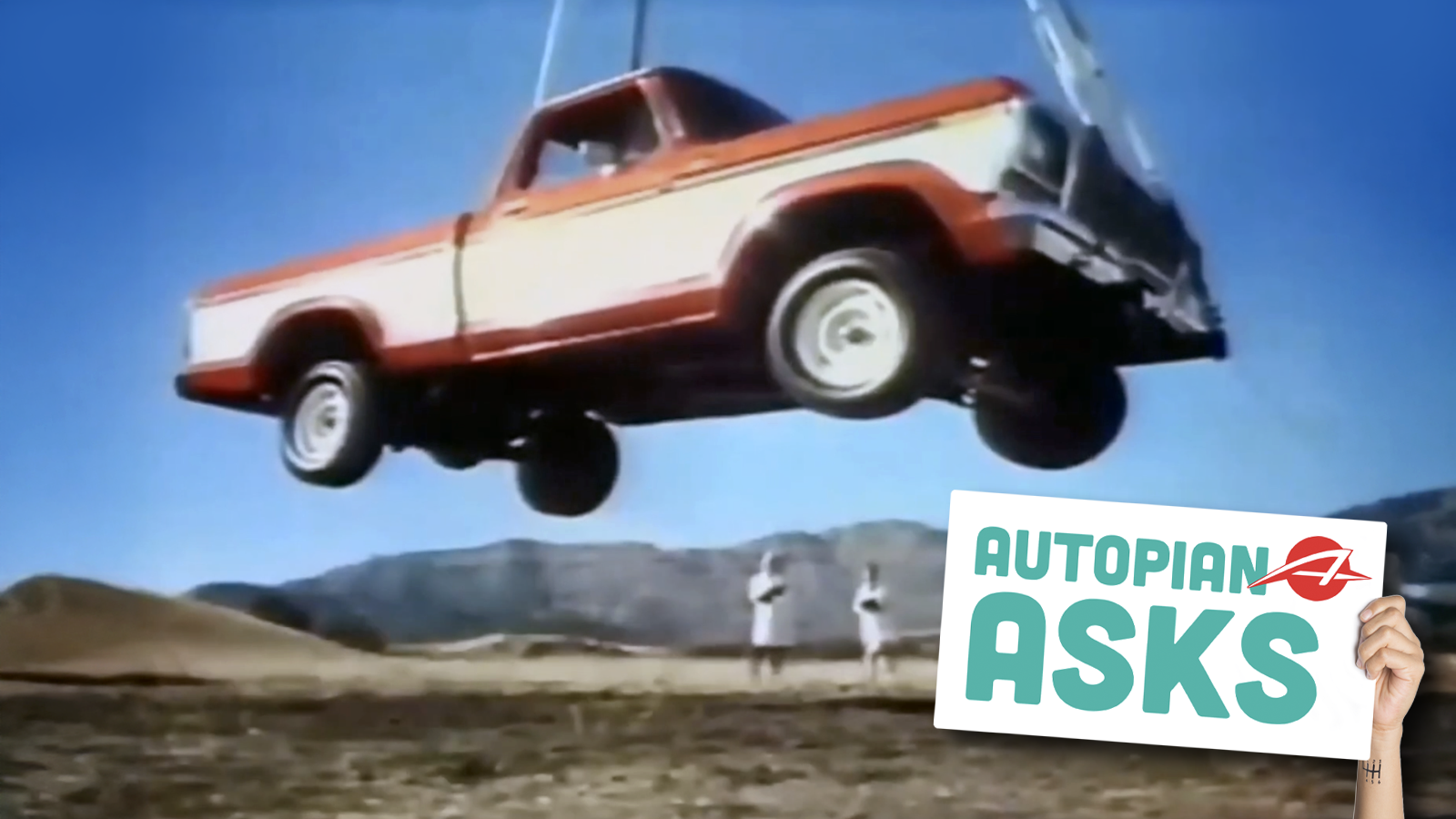
I’d say car and truck commercials don’t talk about toughness like they used to, but then I realized I haven’t seen a car or truck commercial in what feels like years. I see plenty of dealership commercials, mind you, but all they shout about is low prices, no one beats our low prices, the prices are low, check out our low prices. Actual “car / truck has features” talk? Yeah, no.
Now, back when I was seeing car commercials on the regular, they mostly just blended together. However, a few stood out because of some amazing and/or bizarre visuals (see the Robert Able-produced “Never Before” Corvette spot, this 1987 Corsica commercial, and the Plymouth Duster cocaine factory) or because the commercials were good for a laugh – Joe Isuzu, I’m looking at you.


A particular category of car-ad now seemingly long gone are ads that tout toughness, like this Subaru Justy spot that trades on the idea that everyone knows Subarus are tough:
Just go ahead and slam the shit out of this poor guy’s doors, eff him. Where does this poor Justy pilot live, downtown Bullyville? These people need to be maced.
Ford went SUPER hard on toughness with the F-150 ads that I most vividly recall from my childhood. Who can forget these high-concept stunts?
Big fan of Cinderblock Mountain:
Ours was once a land of cinderblock and log mountains pic.twitter.com/LX6iXVzs0G
— The Autopian (@the_autopian) November 6, 2022
Gotta say, the Twin I-Beam Suspension in mustard-and-ketchup paint is fantastic.
I’m inclined to say the ’78 Ford F-150 and ’88 Subaru Justy are the all-time toughest cars and trucks based on those spots alone, but surely you have your own opinions – and I can certainly attest to my 2000 Honda Civic being the toughest car I’ve ever owned, from a “logging nearly 200,000 miles with maybe three oil changes” perspective.
You tell me:
What Are The All-Time Toughest Cars And Trucks?


Well, the 1979 AMC Concord and Spirit use galvanized steel in all exterior body panels, and have factory Ziebart corrosion protection. That’s why they’re the tough Americans
(Cracks knuckles)
Okay, so when some think of tough, they think outright resistance to physical damage, others understandably believe it’s a measure of how long a vehicle can withstand a lack of proper maintenance. And then there are weird little outliers like brute strength and capability, or simply good rustproofing. A relative of mine swore off all Japanese trucks in the 1990s after a Datsun and a Toyota both rotted in half before they ever had a chance to prove thier longevity.
All they had to do was start up and drive him 5 miles to the mine, and drive home, and they were “shot in the ass before they were paid for” he would say.
Swearing off perhaps the most legendarily reliable vehicles on the planet because of his perceived idea of toughness was found lacking in two trucks.
Like in nearly all things, I believe it’s gotta be a solid mix of all that. So I’m going to cheat and list my top 7 toughest overall passenger vehicles, based on them just having the highest average of durability, neglectability, abusability, and tendency to just be too stubborn to die:
Jeep XJ/TJ Wrangler
Toyota Camry
1981-1996 Ford F-150 and broncos( 300I6, manual trans
Literally any Chevy Express
The Ford Panther platform cars
Late 90s 3800 Buicks
The Chrysler minivan
I considered every other vehicle I’ve ever come across, and declare these the tops over everything. But if anyone is up for a good spirited argument, it’s storming like crazy outside and I have nothing else I’d rather do.
GMT400 C/K, Sierra, and Suburbans
Oh I promise you those are one of my favorite platforms/vehicles of all time, and were BETTER trucks, but they’re just not as unkillable as the straight 6 fords of that era spanning the late 70s to the mid-90s or so.
Source: I’ve owned 4 of these fords with this powertrain, almost all bought for under a grand, all had over 200k, and none of them ever once stopped.
The chevys though, I have personally grenaded multiple rear ends, transmissions, and engines in GMT400 trucks. Their powertrains were more reliable than Dodges of the day, but BARELY so, honestly.
My dad’s 99 Suburban 2500 Silverado (trim) refused to shift into anything other than neutral or reverse, so he sold it (for 5 bucks!).
That glorious 454 never died as far as I know, but it drank gas like it’s trying to keep every gas station on Earth in business.
Any GM W-body car, esp when paired with the 3800 V6. I feel they may actually be the sleeper version of that era’s Crown Vic in terms of toughness.
As the proud original owner of a 1987 Toyota Truck**, I can attest to its toughness*. It has been doggedly reliable and easy to live with.
*Part of the perceived toughness is the fact that the Truck doesn’t actually promise much. It is a modest truck and doesn’t really encourage silliness. Its entire demeanor is one of moderation. Don’t get outrageous with the demands and it will deliver all day, every day. It can, due to its simple construction and flexible drivetrain, absorb stunning amounts of abuse…but don’t expect it to do that forever.
** For the record, Truck is the model designation that appears on the owner’s manual. Generations previous to mine were known as Pickup in the US, and the Truck was eventually supplanted by the Tacoma. When and why parts places and even Toyota started referring to mine as the Pickup, I don’t know. I feel as if I have been betrayed and abandoned by my wife’s family.
Where I come from rust resistance matters more than mechanical reliability. And of course, there is a big difference between durability and reliability. Japanese cars of the 70s-’00s were reliable, but they absolutely were NOT durable in a six month saltwater bath situation.
For back in the day, hard to beat a RWD red block Volvo for the best combination, with the pinnacle being the later 8V 940s. Reliable enough, durable as all-Hell, even if not as “ignore it and it still runs” as a Corolla (that on a quiet night you could hear rusting). A Panther done properly, even if not QUITE as able to be bashed off curbs and whatnot. And you’d hate being in it about 1000X less.
Lancias would be turned to dust in seconds where you live
They absolutely did.
The “good old days” mostly kind of sucked.
Hard to get past a 90s to early 2000s Toyota both cars and trucks. 92 to 96 Camry maybe a wider range with the trucks. I think they have set records for driving without oil or oil pans. Their transmissions are studied for how to build a transmission that lastsm. Then the 04 to 09 Toyota hybrids. Gen 2 ram is way up there especially with a cumins and a 5spd. 7.3 ps ford also pretty gutless and hard to break.
Then gmt 400 and 800 aren’t far behind
A combination of being hard to break and easy to fix.
A car from each of the big 3.
4th gen Dodge Darts from 72 and on. Don’t get me wrong, the Darts from 67-71 were also tough, but they were designed as muscle cars. When the fuel crunch happened, Dodge dropped the big blocks, de-tuned the small blocks and installed a ton of unkillable Slant 6s. With a chassis, rear end and transmission designed for a 383, the unkillable Slant 6 was not capable of wearing out anything about the car. Add easy to work on because of a big block sized engine bay and you combined unkillable with easy to work on. I know of people that learned to drive on a dart that was the car their grandparents learned to drive on.
3rd Gen Nova (68-74)
Same story as the Dart. Was designed to be a muscle car and adapted to be an inexpensive car that didn’t burn too much gas. The Stovebolts that ended up in a lot of them are super reliable, but not Slant 6 level reliable, but the GM transmissions (particularly the Powerglide) was more durable than the Mopar transmissions.
Ford Panther Chassis (1978-2011)
These things got upgraded to be super tough police cars regularly. These police cars would be sold off to become taxis when they had only 200k miles and go another 500k miles in taxi service. Big, easy to work on, and over 30 years of learning what breaks and how to fix it make these exceptionally tough vehicles. Although individual parts don’t match the Slant 6 or the Powerglide in unkillable levels, the ability to find parts at a junkyard from over 30 years of production and the available parts designed for taxi and police service make this car at least as tough as the Nova and Dart, likely more so.
I see two old Novas in my neighborhood, both painted rattlecan primer black with big fat aftermarket rims.
Wait a minute! The Dart and Chevy II /Nova were introduced before there were muscle cars – as compact cars with small six cylinder engines, and even a four cylinder in the early Chevy II. Before the 1964 GTO. They were not designed as muscle cars. I was there. Later, some large V8s were put in them, but that was not their design brief. The Slant 6 was there from 1960 or so and more Darts and Valiants got these than anything else.
Notice the specific generations mentioned. Both had been made larger and capable of housing big blocks, although small blocks were much more common
I’ll second the vote on Darts of this era. When I was working at a garage in the 80’s, these things were mostly on their second or third owners and the concept of “deferred maintenance” was basically everyday life. The 225 just runs and whatever mainenance you throw at it can be done simply and inexpensively. The only hiccup I remember about these cars (and all MOPAR of this era) were bad ballast resistors, which would make them stall. They were located on the top of the firewall…turn a couple screws and pop a new one on. Guys used to keep a spare in the glove box.
People forget about the cockroach cars of the past. 70s Darts were going strong past Y2K. But after being beat to the ground for 20+ years, even they eventually died. And when they did, who’s going to put a lot of money into a 4 door 30 year old Dart with 300k miles and a Slant 6? Soy the got scrapped.
My Camry is 22 years old. I used to see dozens like it in every parking lot, Now they are getting less and less common as more and more finally break something that is too expensive to fix on a generic cockroach car. In 20 more years, not many people will know they exist and how tough they were and will be talking about whatever the unkillable car built around now is.
I’ve heard rumors that Nash made unkillable cars back in the day. My dad bragged until the day he died about driving a Hudson for 25 years. But now, I have no idea how tough those cars really were and I’m not even sure what a Nash looks like.
Mercedes 190D, 240D, 240TD, 300D, 300SD, 300SDL, and Unimog. These are cars that can be theoretically kept running in a post-apocalyptic world, or at least provably in war-torn sections of Africa, and be run on a wide variety of non-petroleum fuels in a pinch with some modification. And one can rack up over 1 million miles on the original engine with proper maintenance, and fix most things on the car with basic tools.
To do better, one would need to go with a mostly-analogue EV with easily swappable components and open-source software where software is present, and the profit-driven major automakers aren’t offering those for the same exact reason outlined above. The Slate truck might be a first in the US EV market for being an EV built to last as long as the technology allows, rather than having an artificially-shortened life due to intentionally bad design decisions from the C-suite.
I’ve heard similar things about Peugeot diesels in the same parts of the world.
I can concur. I used to drive down dirt two-tracks in Michigan’s upper peninsula at speed in 3/4 ton square body Suburbans and in 1970’s ex-Military Power Wagons (property of an unnamed gov agency) that would break motor mounts, and shake radiators and electrical connections loose. But I could drive my W123 240D with 200,000 miles on the clock down the same root-strewn roads at even higher speeds and it would not flinch. The body was rock solid and the suspension had massive travel which prevented the jarring hits that broke stuff on the HD trucks. I only did it for a couple years, but that vehicle was surprisingly in its element in high-speed quasi-road scenarios.
Other honorable mentions that I’ve owned are my Ford E-350 and my 1988 Toyota pickup, both of which seemed to thrive on abuse and never break.
Our 2008 R51 V8 Pathfinder is THE single best vehicle we’ve ever owned (and that population is over 50).
18.5 years after buying it new and 175k miles (it stopped being a daily about seven years ago) it still does yeoman’s work. It’s our primary tow vehicle and has dragged home more car projects than I can count, moved house for us and for friends/family and been all over the eastern half of the country.
During that time, outside of routine maintenance, I have replaced one window motor and switch, a fuel-pump/sender assembly, and well, I think that’s it.
We love it and it rewards us with still stellar performance, and a classic SUV profile that doesn’t try to be something it isn’t. The VK56 makes all the correct noises, and has never, ever, let us down.
my 30 year old Land Cruiser just turned over 383,000 miles on a 2000 mile loop from Utah to so-cal, up the PCH to san fran, and back through nevada without a hickup. That counts for something.
Willys MB, and Ford GPW. A whole lot of them survived the biggest war in history, and many of their descendants up until 2006 were nearly as tough.
Everything Toyota made in the 90s
Of course, the Hilux is a classic, and all the Japanese trucks in general
And don’t forget the legendary Altima LOL
My beloved former Altima is now my coworker’s daily – it’s nearing 250k miles. The only part failures have been a leaking AC hose, cam and crank position sensors, and the rear O2 sensor. It burns about a half quart every 10k miles and still has the original front brakes.
Other than an annoying propensity to flood if shut off immediately after a cold start, it was a fantastic car. I drove it recently and it still feels great.
1988 – 2007 Suburbans. Both generations.
In typical GM fashion, they’ll run poorly so much longer than most trucks will run at all.
Volvo 24x, redblocks are VERY tough engines. the rest of the car puts up with a lot of use and abuse.. also, old ford rangers, every wigged out scrapper I’ve ever seen has had one, completely ragged out and overloaded to the bump stops, but still moving under its own power.
Pre-2013 North American Ford Rangers and their brethren Mazda B-Series.
Toyota HiLux/Tacoma (the that don’t have frame rust issues)
Volvo 200 and 700/900 series.
Ford Raptors.
Geo Metros, Ford Aspires, Mazda Protégés, Toyota Corollas, etc., the old boxy ones that are still kicking despite all reason.
2026 “WWII” Jeep as built by David Tracy. Perhaps not for its own toughness, but for the toughness of its assembly, and its stubborn maker and wheeler.
4th and 5th gen Toyota Truck, before it was a Tacoma.
Ahem.
https://youtu.be/8bvjge4CSVU?t=557&si=qHXY_S6mL8u3LRRg
I raise your American Top Gear clip….
https://youtu.be/kFnVZXQD5_k?si=dUFq4NtSPITNSERE
Not bad.
Any rental car.
Air cooled VWs
You can beat the living hell out of a Jeep XJ with no ill effects.
[Doubt.png]
I had one and you absolutely cannot. The unibody is so flexible that the doors are major structural components. I had mine articulated several times and the doors wouldn’t open (I actually wore the paint off the corners of the doors and the corresponding spot on the body). The XJ only came with Dana 30 axles, compared to the Wrangler that got a Dana 44 in the back, and the Wrangler Rubicon that got the Dana 44 in both front and back. The XJ’s suspension is very lightly built and can’t take the same abuse. Then there’s the inadequate cooling system, exhaust manifold that’s notorious for cracking, the interior that comes apart at ever joint and vinyl trim that cracks…
I had one for 23 years. Wheeled the hell out of it and never had body flex issues like that. The rear springs are a bit light but they never failed on me. I did end up replacing them when I got a heavy rear bumper with a tire mount though.
You’re incorrect about the axles. The XJ did come with a Dana 30 in the front and in that application it was perfectly fine. I know people who ran 35s on it for years with zero issues. Most XJs got the Chrysler 8.25 in the rear which wasn’t quite as strong as a Dana 44, but it wasn’t enough of a difference to be worth swapping out. I never saw one break. If you had a model with ABS you got the Dana 35 which was indeed a garbage axle. The Dana 44 was available on certain models with the tow package.
You might be able to get by with 35″s on a 30 or 35 axle in low traction environments; I tend to wheel where there’s lots of sand stone and that much tire on that spindly axle is just asking for breakage. I consider a stock Dana 44 the minimum for a 35″ tire, and going to a 37″ really needs trusses and upgraded axle shafts.
The XJ chassis is notoriously soft by today’s standards, there’s a reason you can buy stiffening plates for the unibody.
1974 Dodge Monaco. Can jump anything and outrun all of Chicago’s police AND run for several miles after throwing a rod.
It’s got a cop motor, a 440 cubic inch plant,
cop tires,
cop suspension,
cop shocks,
and it’s made before catalytic converters so it’ll run good on regular gas!
Needs a new cigarette lighter
What do you say, is it the new Blues Mobile or what?
1990s Landcruisers, 7.3l diesel F series Ford Trucks.
Toyota Land Cruiser and Tacoma Pickup trucks, Add Volvo most anything.
Volvo most anything pre-1999! After Ford and Geely ownership, not so much.
Model T’s had a reputation for being pretty indestructible.
Truck. Toyota Hilux. You can thank Top Gear for that torture test.
Car Chrysler Imperial, one of the few cars to be banned from demolition derbies because of how strong they are
First thing I thought of was the Top Gear Hilux.
That and the infamous binladen letter referring the the land cruisers plus all the technicals across the middle east. They would jump in one of those from on paper more capable military hardware.