

Some say the only constant is change. Okay, the existence of gravity as a force might be up there, but there’s a certain truth to that idiom. Haircuts, music, cars … they all change from decade to decade, and I’d like to clear off the table and bring out the crystal ball for a second. Today, we’re asking you for your pick of a feature common in new cars today that could seem outmoded three decades from now. It’s a big ask, but you’re a clever lot, so I’m sure you’ll have some interesting answers.
Flip the calendar back 30 years and you’ll land on 1996. That doesn’t seem terribly far in the past, but cars have changed a whole lot since then. We’ve gone from halogen headlights to LEDs, fixed steering columns in cheap cars to ones that at least tilt, optional radios at the bottom end of the market to infotainment. You can’t even play CDs in most cars anymore, yet having a CD changer in 1996 meant that you had it going on.


Perhaps the humble cigarette lighter is the most omnipresent antiquated feature in ’90s cars. From a Toyota Tercel to a Rolls-Royce Silver Spirit, sparking one up was a common enough way of passing the time that just about every car had either an optional or standard fingerprint-remover in the dashboard or center console. Between advancements in technology and changing health trends, far fewer cars now come with ways for passengers to accidentally singe the upholstery. You’re lucky if a smoker’s pack is a dealer-installed option, and some cars simply don’t have traditional 12-volt power points anymore.

Is there a true modern equivalent to this? It’s hard to say for sure, mostly because time travel hasn’t been invented yet. However, if I were to hazard a guess, the presence of hexavalent chrome plating is a strong contender. Unsurprisingly, the traditional chroming process isn’t particularly nice to things like lungs, so it’s unsurprisingly the target of recent regulations. Europe is already phasing out hexavalent chromium, and since we live in a largely global car market and chrome already seems to be out of style, it’s likely the sort of chrome we’re used to will become a rare sight.
That’s just a guess though, and I’m far from the only person capable of making a bold prediction. So, what car feature do you reckon is going to feel so antiquated in 2056? As ever, let us know in the comments below.
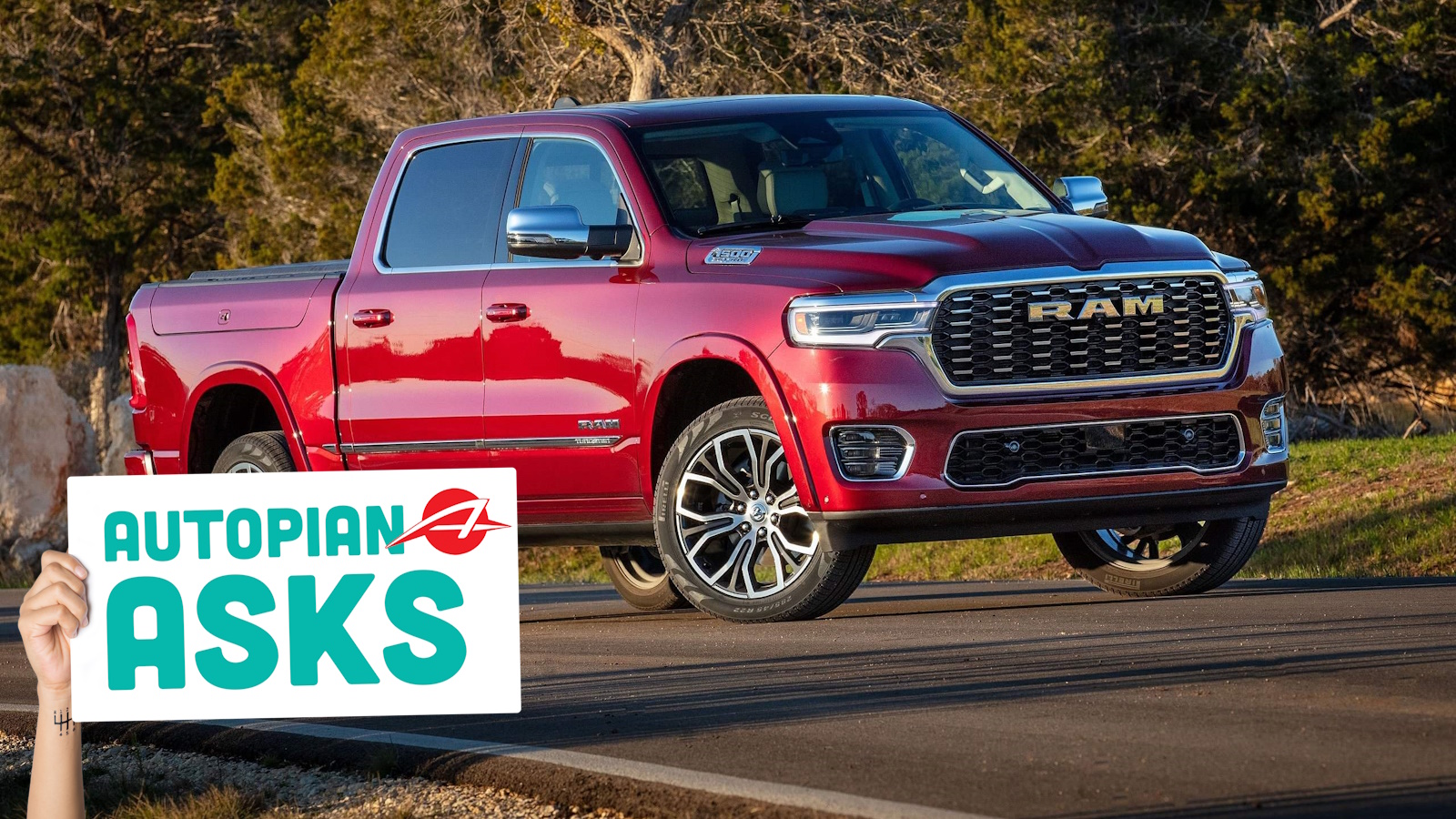
Top graphic image: Ram


If the autonomous drive advocates are right, a steering wheel.
I wouldn’t mind some sort of change in the 12V outlet connector standard to something smaller, but I don’t like 12V outlets going away. There’s still a lot of stuff out there than needs 12V connections, especially in trucks. My screen setup for my wireless trailer camera when towing still needs 12V. It’s silly to me that the industry hasn’t come up with a better connector though. The cigarette lighter isn’t needed anymore, and the 12V outlet isn’t a very solid connection and it’s way bigger than it needs to be.
As for what is going to go away… I think eventually side mirrors are going to go away. As cameras get better and screens are everywhere, I think manufacturers will want to get rid of the side mirrors to help with aerodynamics. The manufacturers that already use cameras to display images in the dash when turn signals are on are just a short step away from implementing this.
Side mirrors will continue to exist but they will normally sit flush against the body, ostensibly for aerodynamics but you’ll find they can only be activated with a subscription package and their controls will be buried in a few layers of touchscreen nonsense.
Hopefully touchscreen controls for everything will be gone by then. Although who knows, by 2056 cars might be able to just read your mind to know that you want to put on your turn signal or change music.
Tesla’s now come with a Nuralink standard and you can get lifetime weather and traffic updates right to your brain for 100 thousand dollars.
There will be far fewer changes than people think there will be.
People always over-estimate the changes that will happen to things like homes or cars in the future, forgetting that people still have to interact with them, and people don’t really change.
I think there will be a “backwards” trend were we finally start getting MORE buttons in our cars (it is already happening with some brands) and the screens that will be in them will have legitimate uses, not simply for show like you see in all the latest terrible German and Chinese cars.
And for those who thing there will be much better chances, look at things the other way – 30 years ago was 1995. Most cars from the mid-90s really don’t look, act or function that different from ones sold today. Super glue an iPad onto the dashboards of a ’95 Taurus and its not miles different than a new car.
I under estimated the changes in my home. Our living room TV setup went from a “dumb” TV, DVD player, satellite receiver box, AV receiver, CD player, six speakers, Amazon Fire Cube, Google Chromecast, DVR for broadcast TV and multiple video game systems all down to just a smart TV with a sound bar. We lost zero functionality with the upgrades. We can play games on the TV with a Bluetooth controller! Now, we can’t play the games you get with XBox or Playstation, but there are enough games we can play to keep us entertained.
I think at some point in the future there will be a great divergence in society, and not one thats political. As tech hits a certain point, some people I think will choose to use it to make life simpler, but the key will be that it’s unobtrusive and hidden. Another part of society will want the most advanced, fancy, flashy tech out there. This hopefully leads to two different styles of personal vehicle. One modeled after old school stuff, and one that’s what we would consider futuristic styling. This may never come to pass, but it’s a pipe dream of mine.
Cars from 1965 OTOH were quite different from that 1995 model though. Newer models had far better safety, efficiency, emissions, reliability, longevity, handling, stopping, acceleration, entertainment, and far, far fewer leaks, smells, smokes, shorts, break downs and maintenance needs.
I think they are far closer than you make it seem, quite honestly. I have a ’64 Buick and when I first got it (it was my first ever classic car) I was shocked at how within a few minutes it felt really not THAT different than the 80s and 90s cars I grew up with. I’m talking from a user’s perspective (not the emissions and efficiency and engineering which you can’t see) I could have given the keys to this car to anyone and they’d have little issues adjusting – the turn stalks are in their intended places, AC, power windows and power seats. The vents and heater aren’t that particularly different from ones from the 80s. The biggest modern thing I added was bluetooth so I could stream music from my phone.
YMMV. My 1960 Triumph TR3 would have sharpened that contrast for you.
The controls were pretty different, the turn indicator was a nub on the top of the steering hub, the engine started with a push button and a manual choke. HVAC was a flip up hood scoop (even a heater was an option). The doors were like a Jeep, the windows bolted on. The only protection from the elements was the windscreen. As far as HVAC went it was more like a motorcycle than a car. The tires were incredibly narrow and tall compared to the fat rubber bands of today. The ride quality was, well lets call it *engaging*. And of course the transmission shifted manually and the handbrake was a giant lever coming out of the floor.
A crash harder than a fender bender would likely have been fatal as the safety of this car was primarily based on prayer. No crumple zones, a non collapsible steering column, no roll protection, no factory seat belts. The oh S#IT handle was a chromed metal bar bolted on the dash in front of the passenger right where their head would go in a collision if it didn’t go through the windshield. The seatbelts that were added in by my dad were bolted into the sheet metal of the floor so its likely they offered only superficial restraint. Your best hope was to be thrown clear.
The service manual required oil checks every 300 miles because its windvane crankshaft bearing leaked by design. It had about 30 bagillion grease fittings that needed a squirt of grease every oil change. Paper and cork gaskets didn’t last anywhere near as long as silicone so everything leaked a bit. The reverse flow engine had the leaky carbs right on top of the hot exhaust. Electrical system was built by Lucas, who had earned the nomer “Prince of Darkness” based on cars like this. Electrical issues were common.
Its crankcase vented unfiltered combustion bypass gas into the engine bay. So everything was constantly covered in grease, dirt and oil and working on it got your hands dirty. Like really, really dirty. This was an overalls and gloves car.
Its 2.0L I4 all iron engine weighed as much as some V8s. The back end was light enough a couple of HS football players could pick it up. So weight distribution was nowhere near 50:50.
When everything was tuned right it was fine but it took a lot more dirty work to keep it that way compared to the get in, turn key and go cars of 30 years later, even more than it’s closest existing peer, a Jeep and very different from most cars of the 90s.
What you are seeing is the massive difference between American cars and the rest of the world seen up until the 70s or so. The American car industry was decades ahead of everyone else in terms of luxuries & amenities, as well as mass production and bringing value to the public. The US moved quickly away from manual chokes, flip down windows and stuff like that. They had it, but power windows and AC became available and was popular decades before they were popular in Europe and elsewhere. That’s why the leap from a higher-end GM car from the mid 60s to your average family sedan in the 80s is a jump, but not the monumental leap seem with a small runabout from the UK.
As I said YMMV. The gradient between a 1960s Cadillac and a 1990s Hyundai is going to be smaller, maybe even a step backwards compared to a 1960s Fiat and a 1990s Lexus.
Digital user interfaces – this kind of thing inevitably ages quickly or badly, and in 30 years they can’t help but be hopelessly out of date. And they’ll probably have required workarounds to remain supported that long.
Being able to start and drive your car without 2FA, a passkey, and at least three subscriptions
By the 2050s someone might already have figured out how to get rid of lugnuts. Materials science will be advanced enough that you would just clip on wheels like you would smartwatch straps, and everyone would forget what cross wrenches are for
If that were the path, I imagine we’d just figure out a way of easily mounting/dismounting tires off a wheel without removal, then balance it on the car.
How about 3D printing the belt and tires directly on the wheel, that would be awesome!
Someone already did like 100 years ago:
https://luxorwirewheels.com/blogs/news/the-fascinating-history-of-automotive-wire-wheels
You use a soft metal mallet instead of a wrench.
Can imagine having some sort of curing light like what dentists have for teeth fillings, for the tires to set and get full traction
Or better yet, 3D print the entire wheel! Probably get the added benefit of designing wire wheels again
Having built up spoked bike wheels I think wire wheels are still out of the realm of 3D printing.
I’m already out of the loop, as my newest vehicle is 30 years old this year. And no desire to go newer.
But to take a guess, I’m thinking freedom of use. You’re gonna need valid authentication, subscription, just to use the thing.
I’m also thinking repairability, and being long lasting. Cars are already getting ridiculously complex to repair. At some point they’re gonna be just like most everything else where you junk it and get something else. And while modern engineering can do miracles, modern economics always wins. Cars (and everything else) are already being engineered to fail closer to the end of warranty.
With both of those things, I think car ownership will eventually be a thing of the past, except for the enthusiasts and those who know how to mod and jailbreak them. Most people will just rent or lease.
Looks out the window at his 23 and 13 year old cars.. I’m not so sure about that? My partner drives an 8 year old Pacifica, and it’s got some signs of age, but it’s well out of warranty and still chugs along just fine.
Anecdotally, the family car when I was a kid was an 82 Datsun B210 hatchback, that by 1989 had been relegated to my older brother; and boy was that thing a wreck. It didn’t last 10 years.
Team Old-Fashioned here as well, our only running vehicle younger than 25 is an EV motorcycle. Survivorship bias helps, as does having a mechanic a mile up the road.
* Dashboards and consoles with no tactile controls. They’re already going away. Hopefully they won’t come back.
* A gas tank.
* A tach, for the same reason.
* Prominent driver controls. A steering wheel and pedals may still exist in some cars, but they won’t be the primary purpose of the cabin.
* USB-A or C ports. Something else will have replaced them. Maybe wireless charging won’t suck, or whatever devices we carry will have much longer battery life and charging in the car won’t be such an essential feature.
* Rearview mirrors that aren’t primarily camera monitors.
* Sun visors. Photo chromic glass will take care of that.
Using any number of the extra convenience features we take for granted today like heated seats and homelink mirrors without first giving the automaker your credit card number.
Sedans with rear trunks large enough to carry a goat. I believe in the future people will stop putting their goat in the trunk.
I’ve never seen so many dead hookers in my life!
But what about trunk monkeys?!
Manufacturer-designed infotainment systems.
I think (hope) they’ll all eventually wise up and just supply the screen, letting the driver run everything through their phone.
Slate trucks have the right idea there. Don’t some Japanese kei cars do that as well?
Mechanical driving. No direct link between control and driver. All computers. Haptic controls and it’s all on the screen controls. Privacy.
Not a feature but an option. With the advancement of materials, I am suspecting Winter tires. I hope they figure out a proper all season tire that works well in the winter without needing to swap tires.
Currently sold are all season tires with a severe snow service rating (triple mountain peak and snowflake symbol). I’ve been using them for years and find them to be excellent alternative to winter only tires.
Part of what makes winter tires so good at their job is the soft compound that they use and LOTS of additional siping so that one tread ‘block’ shifts into a staircase of 7-8 biting edges.
Both of these features of snow tires make them exceptionally bad when it’s warm out.
I work in the tire industry, and for a company that has the ‘every season’ tire on offer. It’s still not as confident in the snow as a dedicated snow tire, and gives up lifespan for the peace of mind that the 3-mountan snowflake symbol represents.
Bridgestone, Continental (finally), Falken, Firestone, General, Goodyear, Kumho, Nokian, Nexen, Pirelli, Toyo, Vredestein, and Yokohama all offer really good all-weather tires that do just that. I personally favor Bridgestone, Nokian, Pirelli, Vredestein, and Yokohama. In fact I got the Pirelli Scorpion WeatherActive on one of my vehicles a few weeks ago before the massive snow storm, and have Bridgestone WeatherPeaks on one of my other vehicles.
The gulf between all-weathers and dedicated winters continues to shrink. I think there will still be a place for studded tires in certain areas, and some areas where a winter tire would be run year-round because the conditions never change to merit anything else. But with the advent of snow socks and chain alternatives we may see them be gradually less-popular.
Steering wheels that fly off when you’re driving
Ash trays and cigarette lighters
As stated in the article, these have pretty much disappeared already
Manual transmissions for sure (sadly). Tho hopefully lane dearture will go away,
at least in its meh form. Oh yeah subscription services for crap like OnStar, maybe the market will speak or we just go back to services purchased at purchase.
3rd pedal is all but dead. I wouldn’t be shocked if the 2nd pedal is thought of the same way 30 years from now.
Mirrors. cameras/screens will be prolific in 30 years.
Radios. AM, FM, Satellite, all gone. There will just be speakers to stream your device to. If Slate is a success (I wish them luck) we’ll remember that they started it.
AM I can see, given transmitters tend to be power- and maintenance-intensive, but there have already been cases where manufacturers wanted to remove it and got pushback over safety.
Occasionally I find myself traveling somewhere outside of cellular coverage, but I’ll pass a sign giving the frequency for a low-power FM broadcasting road conditions. Likewise satellite radio seems to be holding on since it’s packed into so many new vehicles, but some keep it active since it works where cellular doesn’t.
It’s possible that 7G data service from LEO satellites will be truly global in 30 years, but I think it’s more likely we’ll have lost access to orbit due to a Kessler storm.
Yes, like the movie Gravity. The more stuff they put up there, the more likely the storm becomes. And then the Russians and Chines threaten to deploy satellite-destroying space weapons. I wonder how long it will take all the resulting space junk to decay out of orbit.
All vehicle controls will be from your smartphone.( or the chip in your head)
In car screen will just be a mirror of your phone.
locks and keys will be obsolete. They almost are now
Probably speeding. Your car just won’t go faster than the posted limit (that makes me sad to type)
10yrs: lack of webcam
20yrs: internal combustion engine that doesn’t run on plastic or other garbage
30yrs: lack of armor plating
How long has the Autopian Asks hand had a stick shift pattern tattoo?
Please don’t hate me, but manual transmissions. The writing is already on the wall, folks.
I just wish I could disagree with you but I think you’re right. There will be some young-ish, Jay Leno equivalent on YouTube demonstrating weird ways people used to have to drive in a manual.
Heck, if the EV does take off they’ll be talking about all transmissions that way.
Absolutely, but I’m going down with the ship.
Don’t worry, your username has made it very clear that you’re not the one to hate in this situation!
Single-speed EVs are technically manuals. Yeah, there’s only forward (1st) and reverse, but technically a manual. And being technically correct is the best kind of correct.
By that definition, technically an automatic is also a manual transmission.
No, an automatic has multiple gears that the computer selects. Most EVs just have a single gear.
One could argue that CVTs are manuals in that regard, but they’re generally so terrible I wouldn’t want to sully the legacy of the manual transmission with such an association myself.
Technically, there is a long history of automatic transmissions that have no electronics at all.
And I don’t know of any basis for calling a CVT a manual transmission. The entire point is to automatically and continuous vary the gear ratios (ignoring of course the cases where a manufacturer has opted to kneecap the CVT by having it pretend to be a traditional fixed ratio automatic).
I thought your point was they were manuals because a person had to switch them from forward to reverse. But if that wasn’t your point, then I don’t think a single speed EV gear reduction unit qualifies as a transmission in the traditional sense, as the gearing ratio isn’t selectable.
Fair point about pre-computer automatics; I was mostly thinking about current models.
My point is that because there is only a forward and a reverse due to there only being one gear it is therefore a manual, because there is no automatic gear selection aside from that which the operator selects.
Yes, some CVTs do indeed have gears; I failed to specify that I was referring to the belt-driven type that don’t have multiple gears, since that, too, could be argued to be a “manual” because it’s early put into forward or reverse, and there are no gears to choose from. But I still refuse to consider the idea as it’s not worth thinking about, and CVTs (not eCVTs) are better left out of the automotive realm as far as has been proven.
Steering wheel, gas, brake, clutch pedals.