


In early July, Polestar invited the members of the North American Car, Truck and Utility Vehicle of the Year (NACTOY) jury to Montreal for an early opportunity to drive its newest model, the Polestar 4, or PS4 as I’m going to refer to it. The PS4 has already been on sale in China for more than a year, but it’s just now arriving in North America mostly for reasons of politics. The PS4 is going to be crucial to Polestar’s sustainability as a standalone brand so it needs to do well in the market. Does it have what it takes?
The History Of Polestar, Which Is Struggling
Polestar is a company with a fascinating, nearly three-decade history. It began in the mid-1990s as a racing team competing in the Swedish Touring Car Championship with modified Volvos.


Eventually it began tuning Volvo road cars before ultimately being acquired by Volvo Cars.
Along the way, Volvo was acquired from Ford by China’s Geely Group. In 2017, Polestar was sort of spun off by Geely and Volvo to produce high-performance electric vehicles. Initially it was jointly owned by Geely and its subsidiary company Volvo Cars but in 2022 Polestar went public through a SPAC merger.
Unfortunately, like many other EV startups that went public in the early part of this decade, the timing was bad and Geely’s hopes of raising additional capital for Polestar collided with rising interest rates and declining investor interest in any EV stock that didn’t trade as TSLA. Polestar’s problems were further compounded by product development delays that meant the brand only had one volume model to sell from the 2020 introduction of the Polestar 2 sedan until mid-2024 when the Polestar 3 and 4 arrived.
As pleasant as the PS2 was, it was essentially a sedan in a market rapidly turning away from that form factor. Ultimately, Geely bought out Volvo Cars stake in Polestar and related business entities and although the brand remains publicly traded, 82% of the shares are held by these entities.
Thus the launch of the PS3 and PS4 have been crucial to growing the Polestar brand globally. But that brings the next stage of the problem, China. Polestar is an “asset-light” company that doesn’t own any factories of its own. All of its products are built in factories of partners that are part of the larger Geely family, mostly in China. But there are 100% tariffs on Chinese EVs sold in the US.
Thus Polestar has had to expand its manufacturing footprint. In addition to China, the PS3 is built at Volvo’s factory near Charleston, South Carolina and the PS4 is starting production at a Renault factory in Busan, South Korea.
However, the second Trump administration has further complicated things for Polestar. The launch of a global trade war with tariffs on everything made outside of US borders along with the death of the EV tax credit will make it even more difficult for Polestar to succeed.
But the first element of success is having a product that people actually want to buy. Having now spent a day with the Polestar 4, we need to answer the question of whether this is the right product for growth in America.
The Looks
Design is obviously the first thing that anyone will take note of when considering whether to spend tens of thousands of their hard-earned dollars on a new car.
By the way, while Polestar insists on calling this an SUV, I’m going to start making my own determinations of what qualifies as an SUV. The whole industry has become so paranoid about scaring off a potential buyer who wants an SUV, that they have sadly taken to applying the term to pretty much anything.
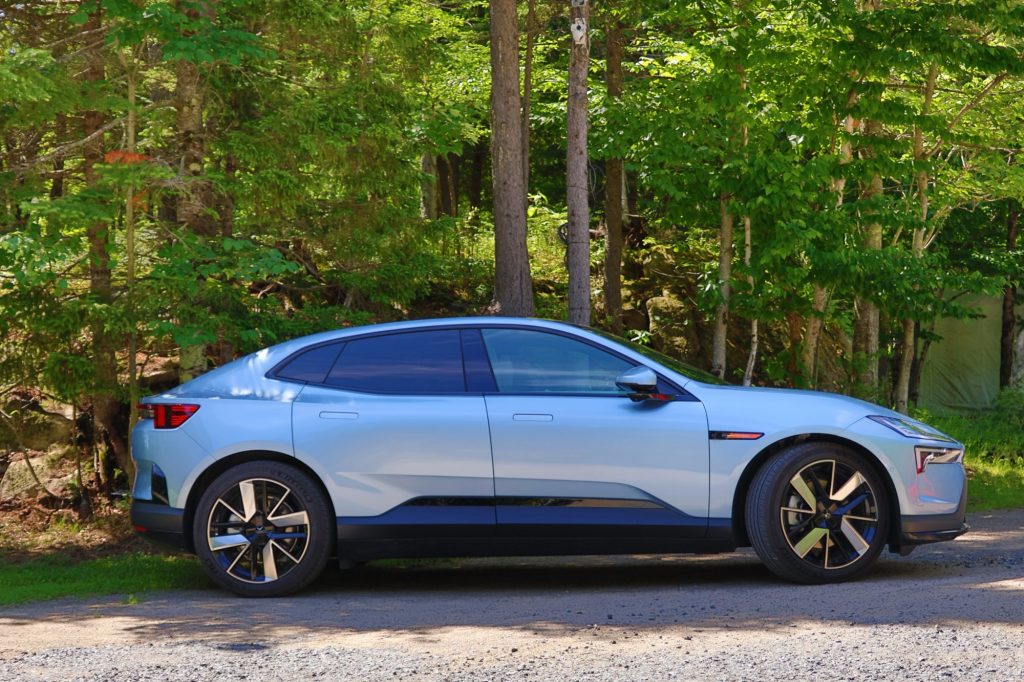
I’m going to be frank, a Mustang Mach-E Rally with 5.8-inches of ground clearance isn’t an SUV no matter how cool the 80s throw-back rally wheels look. The PS4 has barely more at just 6.5-inches of clearance and is just 60.4-inches tall.
This is a hatchback car; argue with me if you want but you’re wrong if you think otherwise. I am personally of the opinion that there is absolutely nothing wrong with being a car. I just bought a Kia EV6 with even less ground clearance than the PS4 and while my friend James Bell will take issue with my assessment, I’m glad it’s a car.
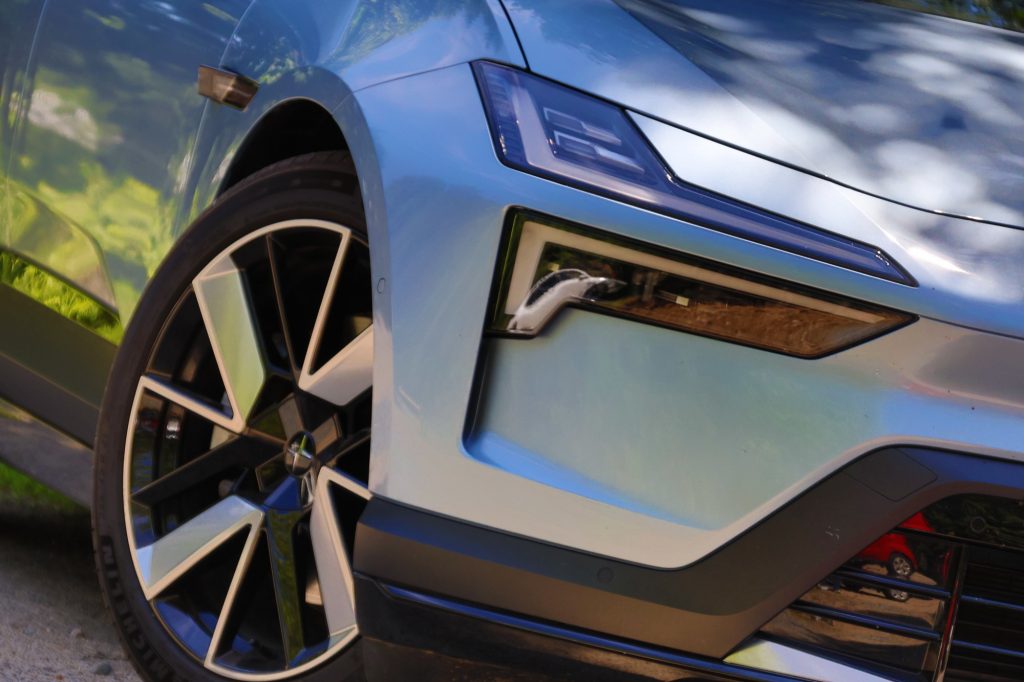
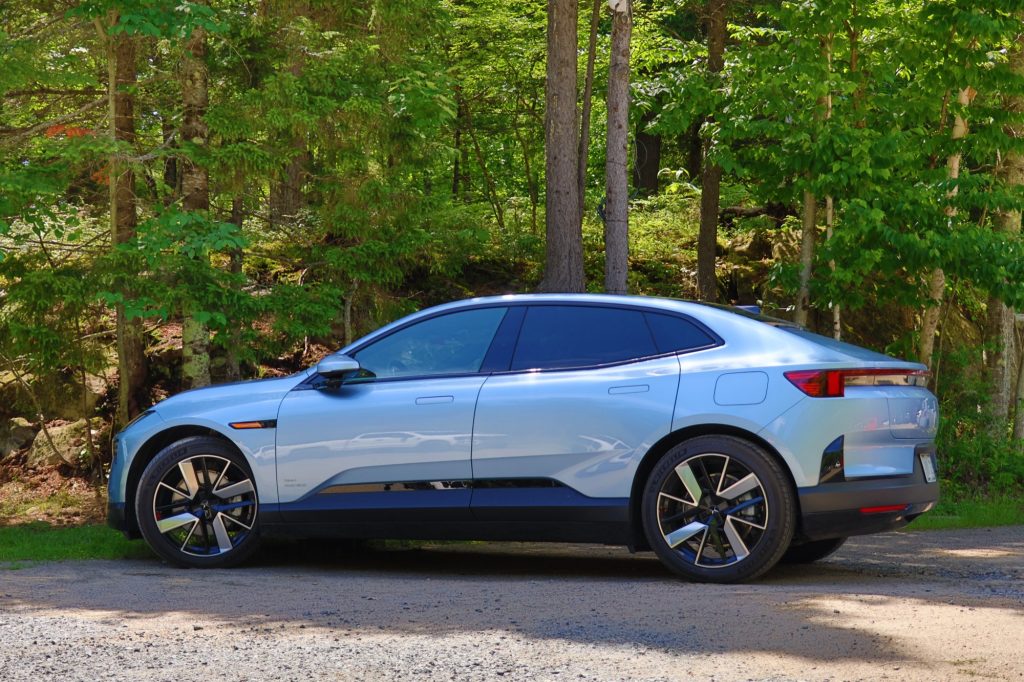
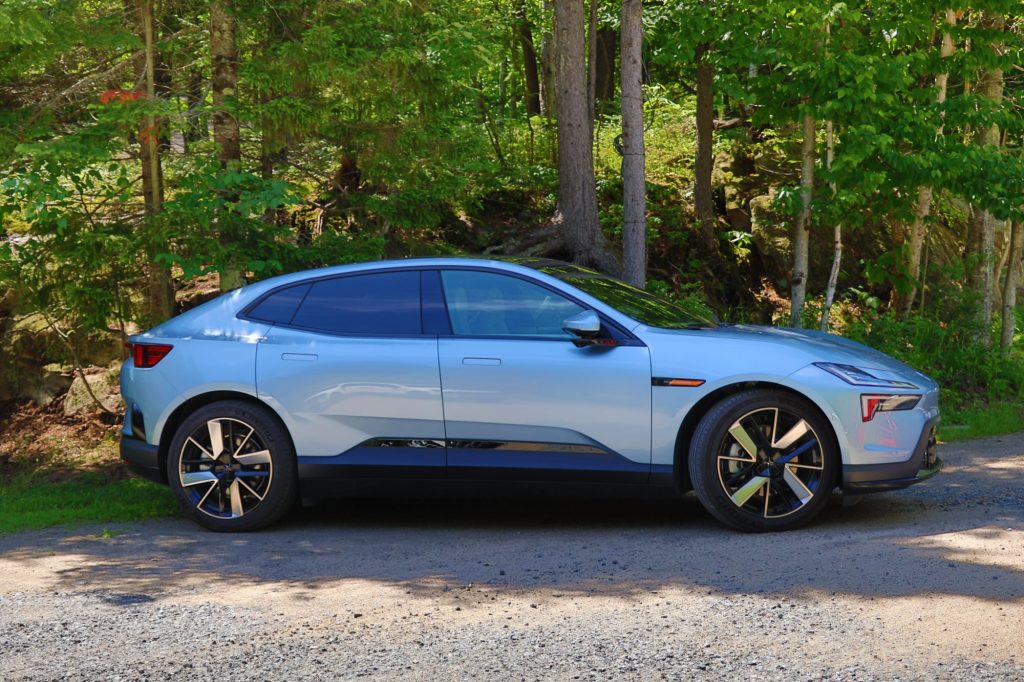
So how does this car look? I think it looks great. While the PS1 and PS2 were very clearly Volvos with new badges, the PS3 and now the PS4 have really started to step into a look of their own. There remains a tie in to Volvo in what Polestar refers to as the “dual blade” running lamps up front that are clearly an evolution of the “Thor’s Hammer” from Volvo.
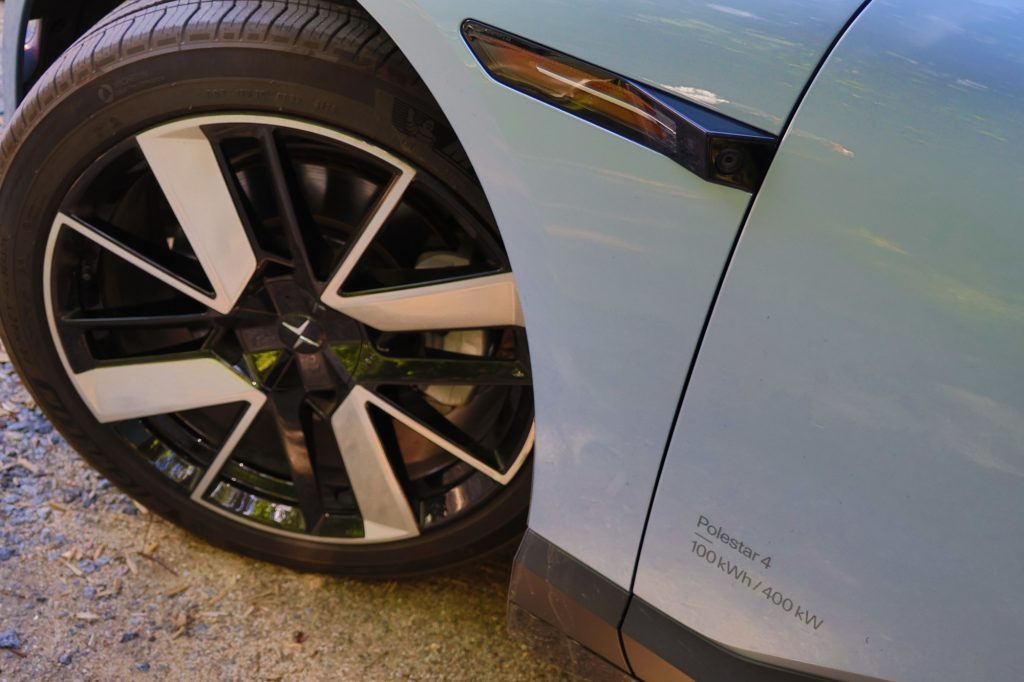
The overall shape is both sleek and sharply sculpted, showing the direction the brand is going with its upcoming models, the creatively named 5, 6 and 7. It’s a 5-door, fast-back hatchback. It’s about 2.4-inches shorter from front to back compared to the PS3 but has a 0.5-inch longer wheelbase. The roofline is also three-inches closer to the ground but it’s four-inches wider giving the PS4 a more athletic stance than its bigger sibling.

Adding to the sleek appearance are the retracting door handles that sit flush with the surrounding panel when the doors are locked. While these eliminate some aerodynamic drag which is good for EVs, they also tend to be finicky because they are software controlled.
There is also the challenge of ice storms that encase your car in frozen water. We couldn’t evaluate this on a hot summer day, but we’ll definitely have to try it out in winter time.

Take a close look around the PS4 and one thing you’ll notice is lots of cameras, 12 of them to be precise. There are three behind the windshield with heating elements to prevent ice buildup. There are two on each mirror, one facing forward at an angle as part of the advanced driver assistance package and one facing down for the surround view monitor. On the back edge of the turn signal repeaters on the front fenders are rear angled cameras and two at the back of the roof, one for ADAS and one for the digital mirror.

There are also 12 ultrasonic sensors and a forward facing long-range radar. The PS4 uses an ADAS system provided by Mobileye and powered by the EyeQ5 Hi system on a chip (SoC). This system is capable of providing Mobileye’s Supervision hands-free driving assist.
Supervision is a subset of Mobileye’s level 4 automated driving system being developed for robotaxis. It uses the camera subsystem of Mobileye Drive along with the radar and ultrasonic sensors for enhanced safety and collision avoidance.
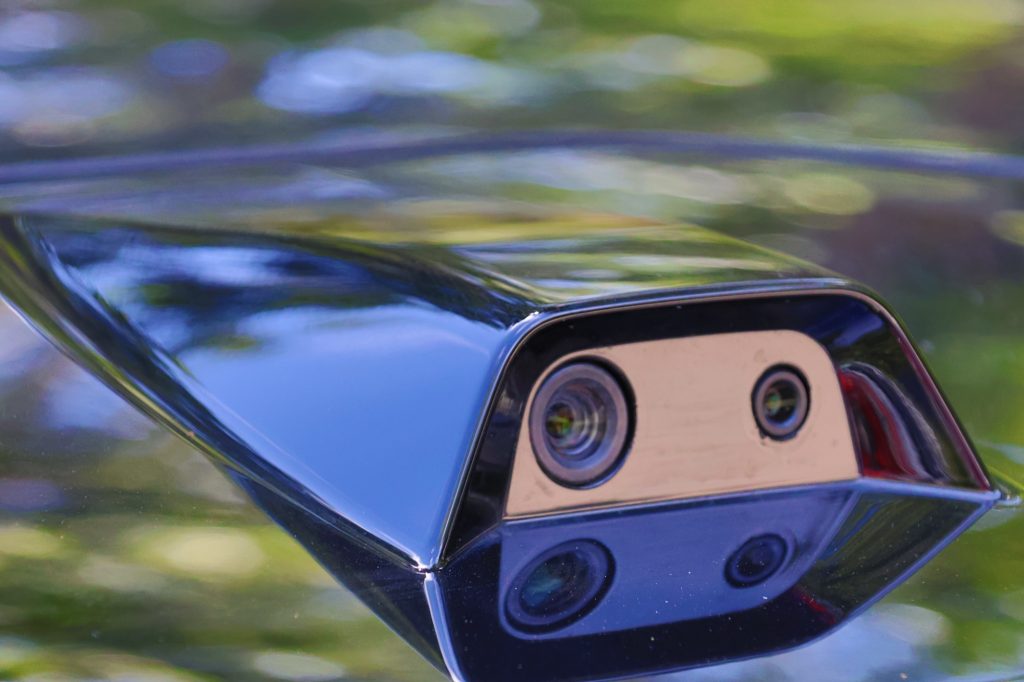
Unlike another brand that exclusively sells electric cars, Mobileye doesn’t believe that cameras alone are adequate to ensure the safety of higher level driver assist and automation. Mobileye also utilizes its Road Experience Management (REM) mapping system that collects data from millions of Mobileye-equipped vehicles around the world to build maps and gather data on where drivers actually position their vehicles on the road. This enables safer driving on roads even without road markings as well as knowing where to stop at intersections with limited visibility and what trajectory to take on complex turns.
PS4s sold in China already have this capability along with models from Zeekr and are able to drive hands-off but driver’s eyes-on the road on both highways and city streets. The PS4 also has cameras in the cabin to make sure the driver is watching the road, one is on the steering column while the other is on the driver’s side A-pillar. Polestar says that while Supervision won’t be enabled at launch in North America, once they complete local validation and testing it will get turned on.
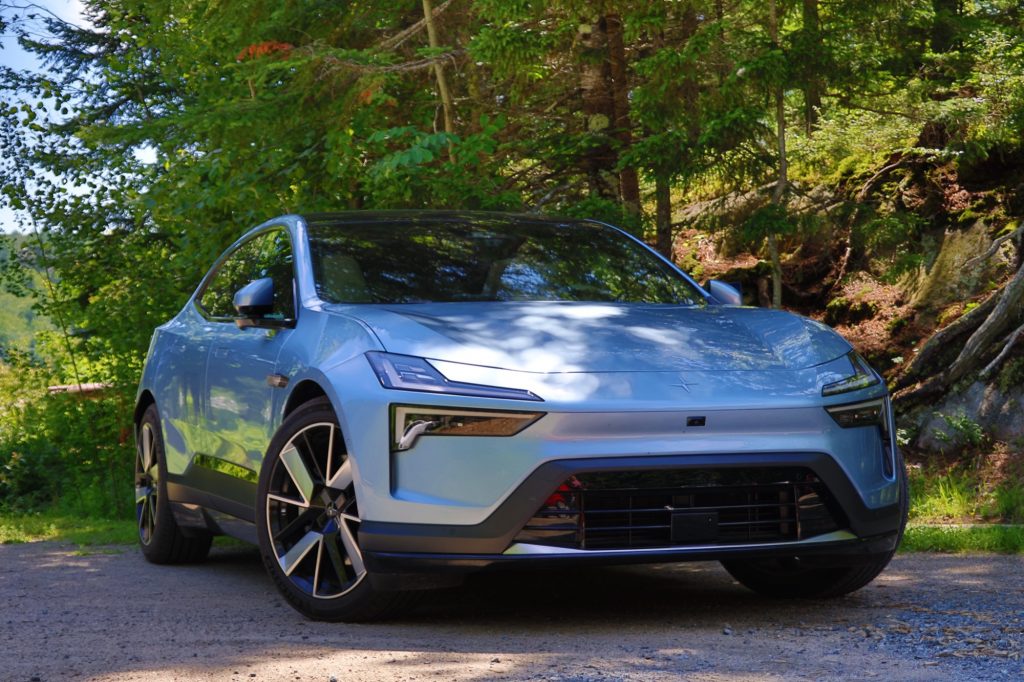
As a premium European designed car, it should come as no huge surprise to anyone that most of the PS4’s exterior color palette is the usual gradient of monochromatic shades – silver, white, black and dark grey in gloss or matte. But there are two interesting colors, the silvery-blue they call electron and a matte gold. We drove the electron which looks more blue in the sunlight than it does in the online configurator.

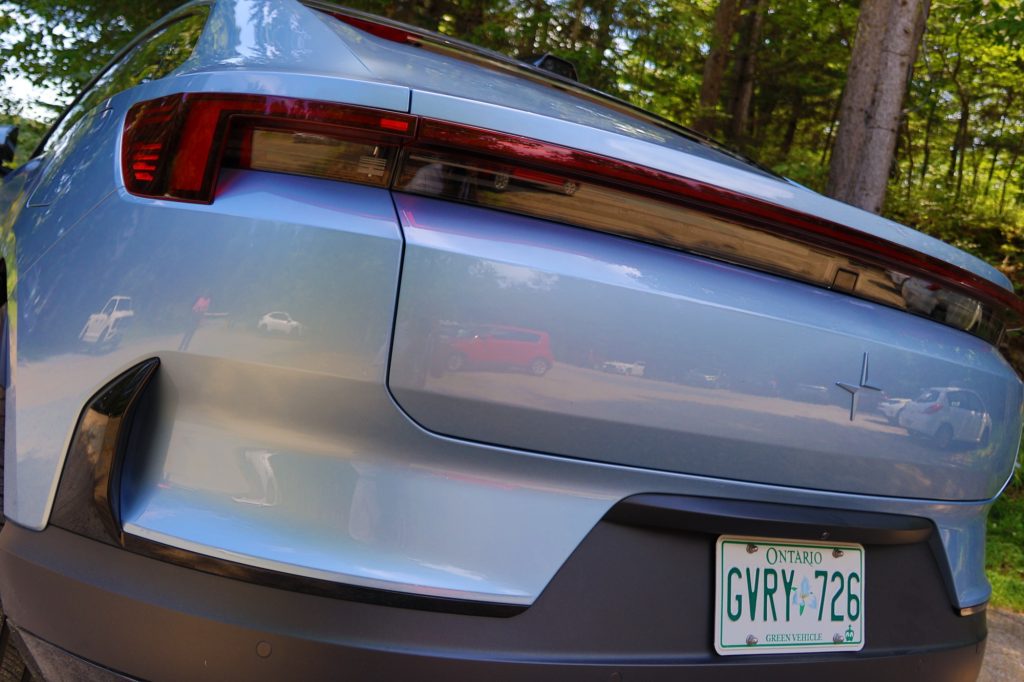
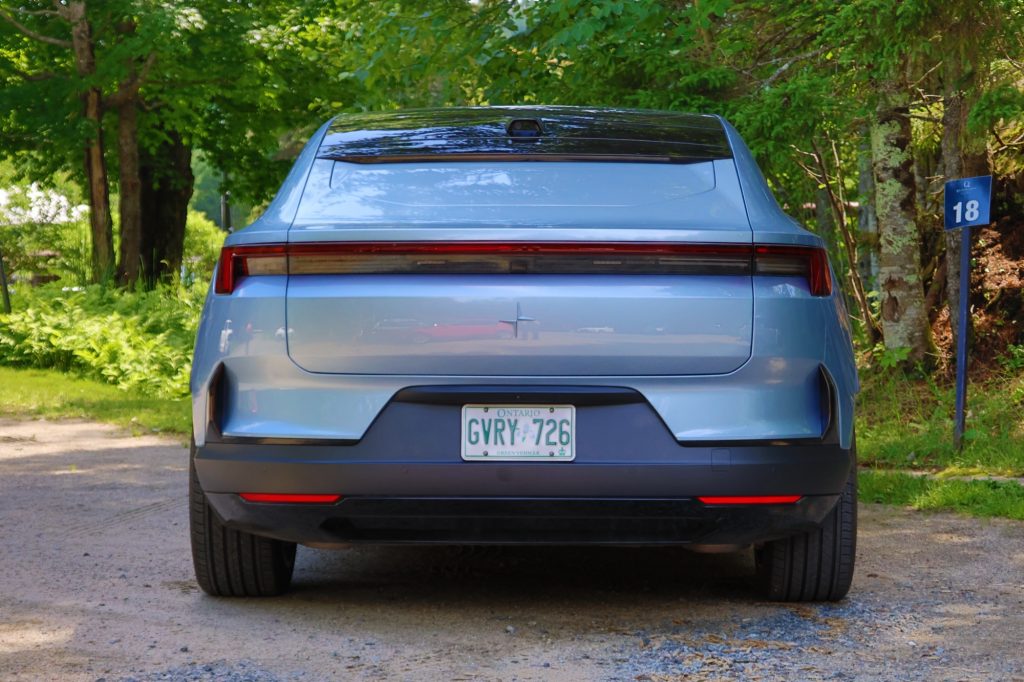
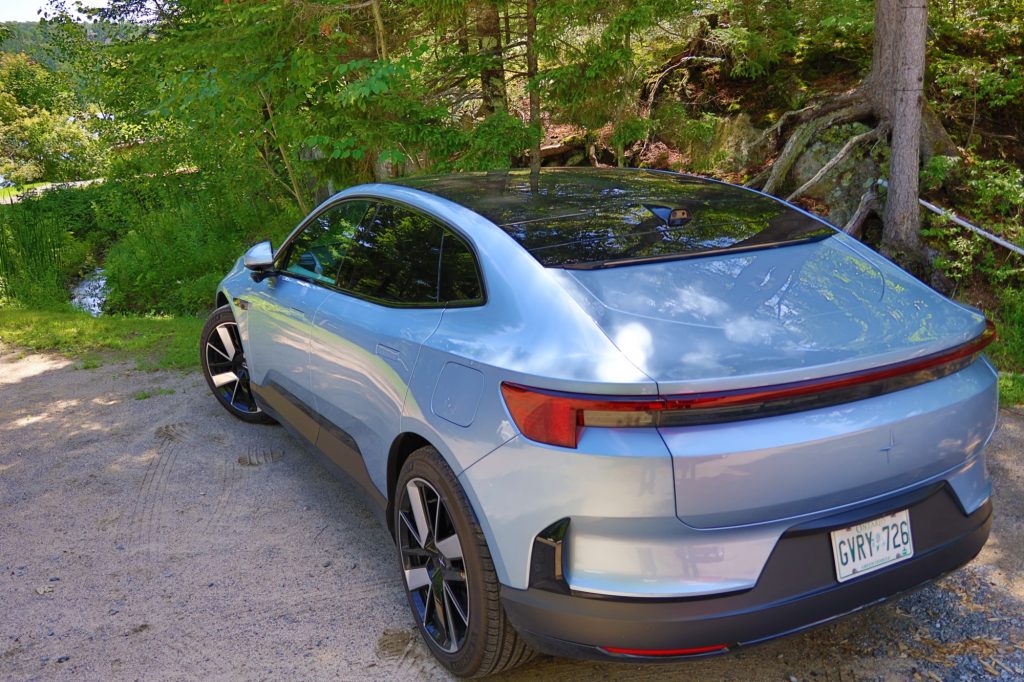
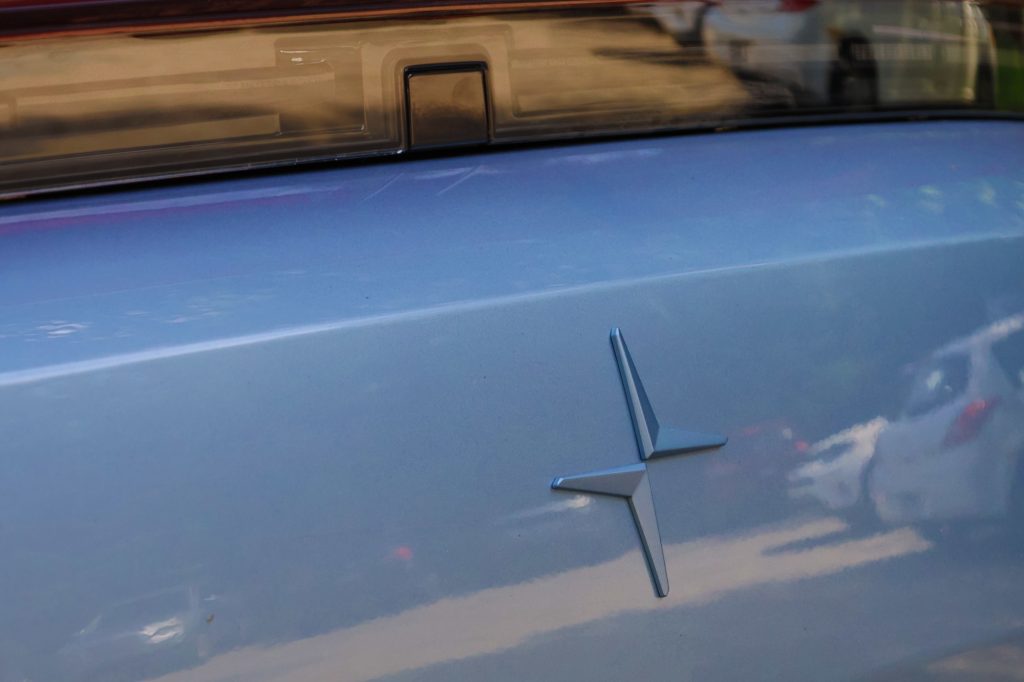
As part of the sleek look, the shoulder crease sweeps up toward the rear end. Standing behind the PS4, you’ll see the glass roof curving down over the top portion of the tailgate but then there is no glass in the tailgate itself. The angle of the top portion of the tailgate is extremely shallow and there is a body-colored insert where you might expect to find the glass but it is completely solid.
Mostly Loving the Living Space (But Not Entirely)

As good as a car might look on the outside, ultimately the cabin is where you are going to get the job done. At first glance, the PS4 is a winner from an aesthetic perspective.
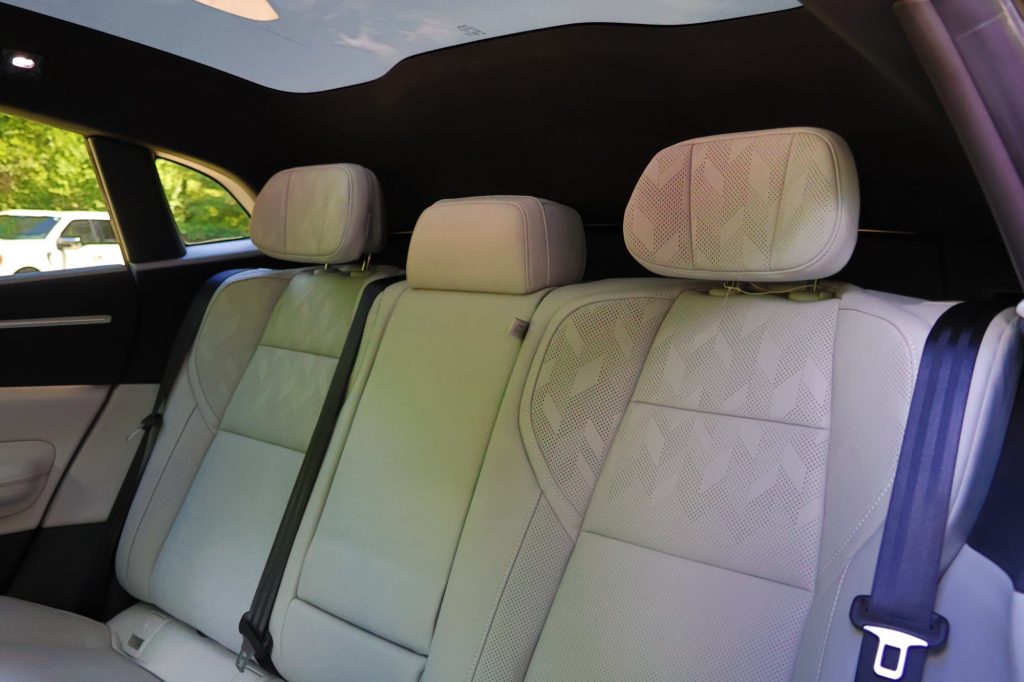
The interior color combinations are all monochrome ranging from an all black to four options with increasing areas of lighter grey. Our test car had the optional Bridge of Weir leather with light grey seats and trim around the doors, dashboard and sides of the center console.

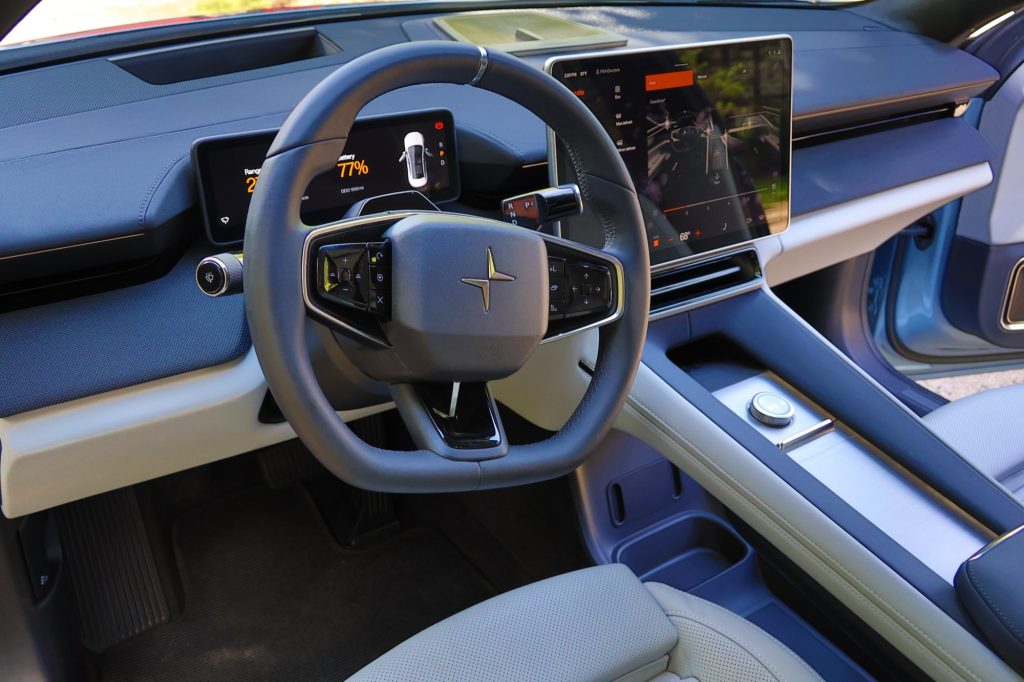
The shapes of the interior are pleasant and clean and emphasize the width. There are two displays, a 10.2-inch unit in front of the driver where it belongs for driving information and a 15.4-inch center touchscreen in a portrait orientation.
There’s also a 14.7-inch heads-up display with the sort of unique feature you would expect from a Swedish company. In the touchscreen controls there is a snow mode for the HUD which flips the main color from white to yellow, making it much easier to see in winter conditions.

One thing I was pleased to see when I climbed in was four window switches on the driver’s door armrest. None of the ridiculous two switches and a front/rear toggle that VW started and the PS3 has. But let me continue with the good stuff before I dive into the dumb.

The cabin materials and textures look great and feel very premium and there’s no piano black except for the touchscreen and the haptic buttons on the steering wheel. The fabric trim across the doors and dashboard is particularly interesting.
The Polestar design team worked with the Swedish School of Textiles to utilize a new 3D knitting technique for interior coverings. Rather than the usual method of creating textiles on a roll and then cutting and sewing, each piece is made to the finished dimensions and contours which requires less work and leaves no scrap.
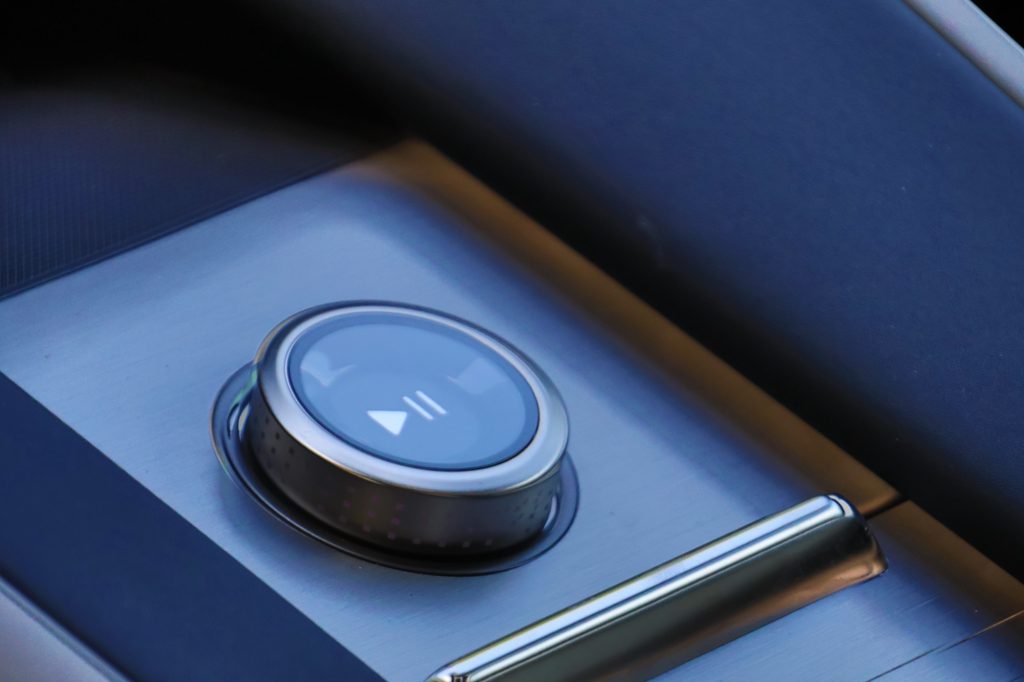
There’s also a material on the perimeter of the floating center console and a few other areas that feels a bit like a neoprene wetsuit but with less pronounced texture. It looks great and feels nice to the touch. At the forward end of the console is the usual large rotary volume knob and play/pause button with a metallic, knurled rim.
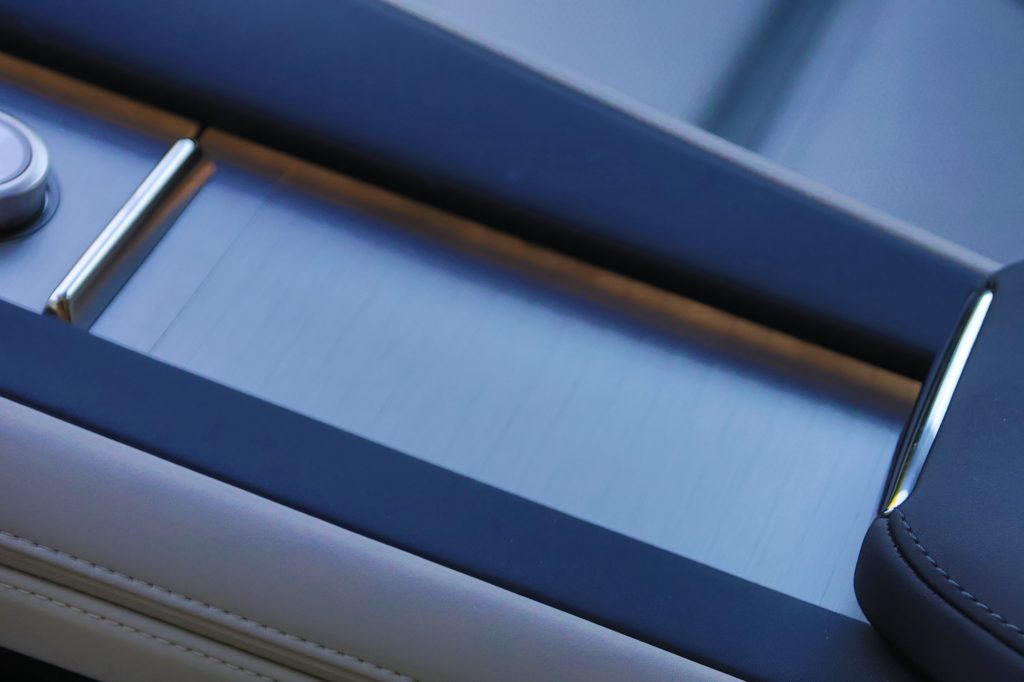
Behind this is roll-top surface covering the cupholders made up of metal slats. While this looks good, the sharp edges of the slats can be clearly felt when you run a finger along the closed surface.
The cars we drove were pre-production examples built in Korea and Polestar wasn’t able to provide an answer about whether this is the way it will feel on regular production models. It’s not a show stopper, but definitely seems a bit of a miss considering the thought that went into much of the rest of the interior.

All PS4s get a full glass roof panel and our test example had the optional $1,500 electrochromic roof. A touch of a button the screen switches the roof from providing a full view of the sky to a translucent-opaque that still lets in some light without showing the details.

Taking a look over your shoulder will reveal the back seat and nothing else. The Volvo C40/EC40 is a fastback “coupe” version of the EX40 crossover and has a similarly sloped roofline. Anyone who has driven that car knows that between the mailslot rear window and the rear headrests, there is effectively almost no rear visibility, so Polestar made the decision to just make the tailgate solid and just offer a digital rear view mirror.
The Tesla Cybertruck has the same issue when the tonneau cover is closed, but Tesla opted to put the camera output in the infotainment display amongst a lot of other information which can appear cluttered. Polestar retained the traditional mirror position which I think works better.
I personally don’t have an issue with relying on digital mirrors since I’ve actually come to prefer their added visibility on most modern vehicles. Some drivers don’t like these camera-based systems since it does require refocusing on the display rather on whatever you are seeing in a reflective mirror and if that is an issue you’ll probably want to take a pass on the PS4.

As with other current Polestar and Volvo products the infotainment system runs Android Automotive with Google Automotive Services built-in. That means Google Assistant is providing voice recognition which can be used for navigation, adjusting temperature and other functions without touching the screen.
Play services and the store allow downloading a range of apps for media streaming including Youtube (although you can only watch video when the car is parked. The Chrome browser is also present so you can check out websites while charging. Unlike GM, Polestar is also keeping support for phone projection so Apple users can use Carplay if they prefer.
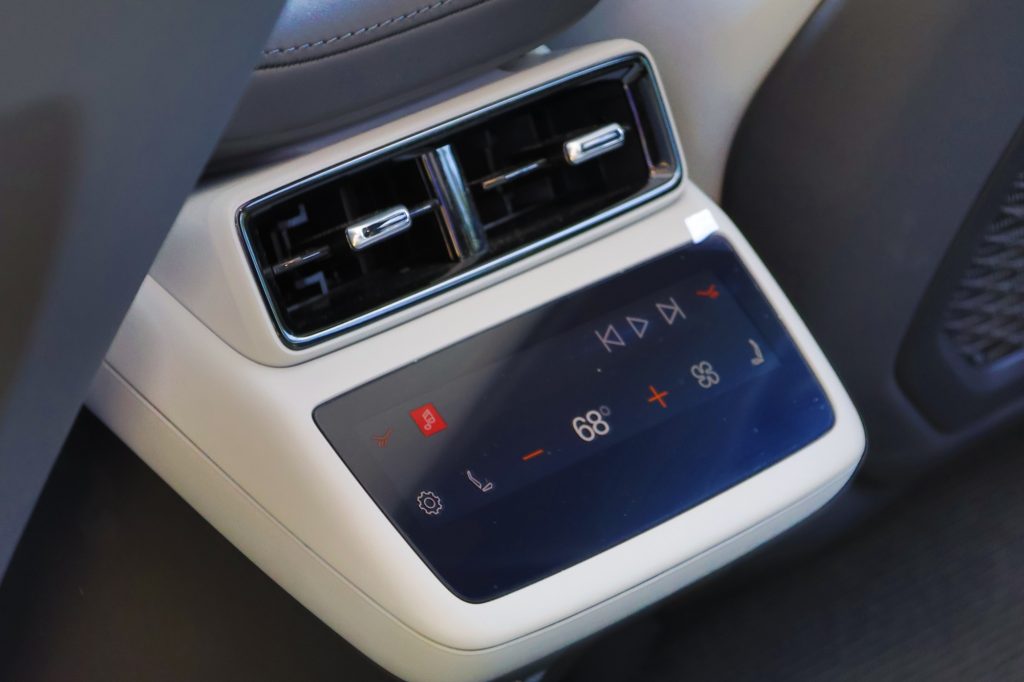
Unfortunately, as attractive as the cabin of the PS4 is, the designers at Polestar made at least one unforgivable choice. When you sit down, you will notice that unlike in a Tesla Model 3 or Y, the air vents are visible rather than hidden under the seams. Sadly, those vents have no tabs or handles that you grab to adjust the direction of air flow. You must instead go to the climate screen and then drag with your finger to adjust air flow.
This is a ridiculous decision, and while the majority of us reviewing these cars have made it clear to manufacturers that we hate this, it looks like the only way it will stop is if consumers refuse to buy. Fortunately, rear seat passengers get their own climate control with proper manual vents.
Let’s Head for the Mountains
Once we got all settled into our electron blue PS4 outside of our hotel near the old harbor in Montreal, it was time to hit the road. Our route took us northwest to Mont-Tremblant over a combination of city streets, highways and winding mountain roads.
The traffic in and around Montreal was just horrendous, but the size of the PS4 makes maneuvering far less stressful than it would be in an actual large SUV. This isn’t a mini car, but I personally think it hits a nice sweet spot that still provides ample room for people and stuff without getting ridiculous.

By the way, access to the car comes via a choice of the buttonless key fob, an NFC card or digital phone as a key. The fob seemed very finicky about when it would lock or unlock the doors and we ended up having to tap the card on the B-pillar almost every time to unlock the doors.
I frankly don’t find this to be particularly convenient when so many other cars just sense the key fob and unlock when you get close and lock when you walk away including the 2017 Honda Civic we just traded in. If I have to remove an NFC card, tap my phone or a fob, you’ve kind of missed the point.
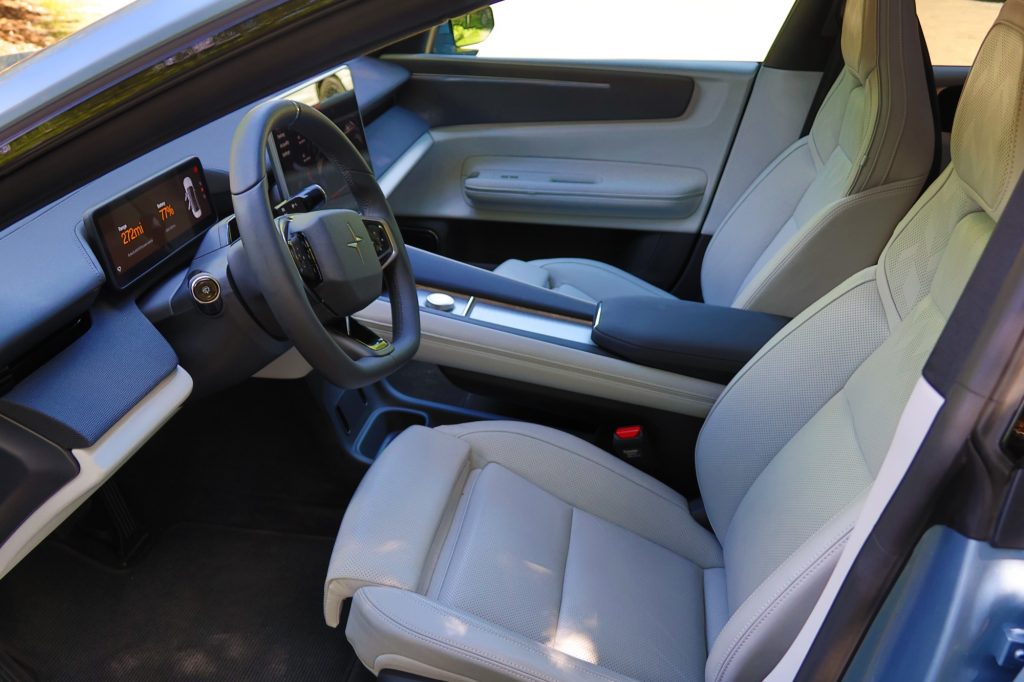
I was riding shotgun on the first leg which gave me time to explore the interior features and fiddle with the seat. Base models get 8-way adjustment for the driver and 6-way for the front passenger. Our car with the Plus pack raises that to 12-way for both seats and adds rear seat heating to the standard front heaters.
The seats in the Plus pack include ventilation although the controls are embedded in the touchscreen interface and not always easy to get to quickly while driving. The higher end front seats also offer a massage function, though, which always comes in handy after many hours on the road.
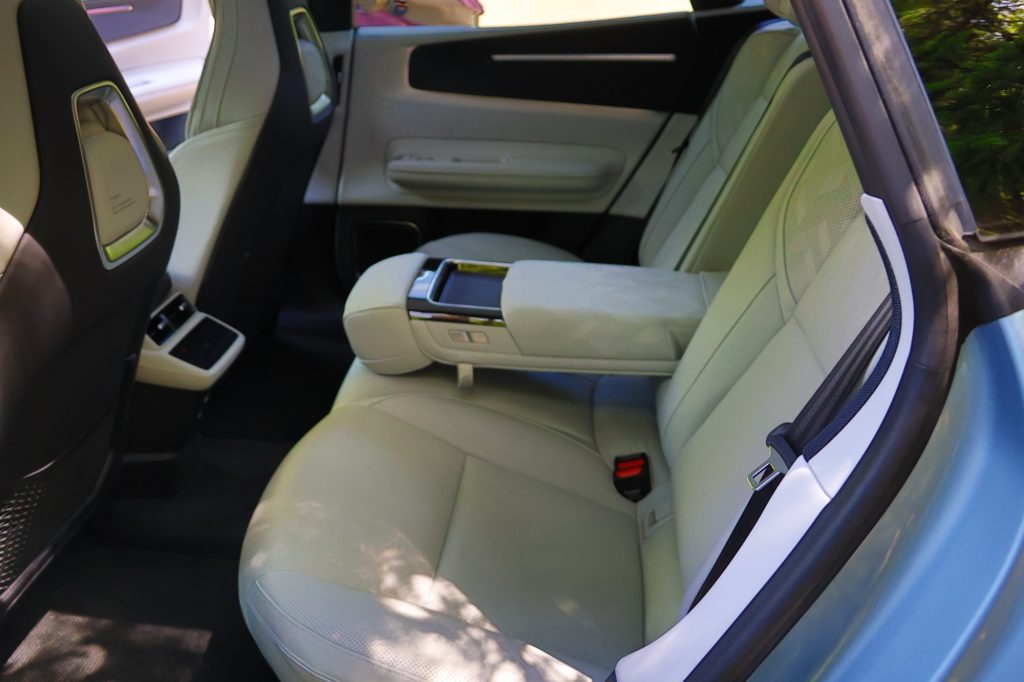
The seats carry on the comfort and support tradition of Volvo and hold you in all the right places. As someone with relatively long thigh proportions, I’m always glad to find adjustable thigh support which is also included in the plus pack seats. The rear seats also have a recline function with the switches built into the sides of the fold-down center seat/arm-rest.

Once I had a chance to move over to the left seat, I had to adjust the steering wheel and side mirrors which also replicates the pattern found on many modern EVs. You have to go into the touch screen to select what you want to adjust and then use the haptic buttons on the right steering wheel spoke to make that element move. There is a memory function if you have multiple drivers in the household, but that’s another of those things that I find adds more fiddliness in pursuit of minimalism. As is increasingly common, the transmission selector is a stalk on the steering column and this works really well, down for drive, up for reverse and press the end for park.
The PS4 is built on Geely’s Sustainable Experience Architecture (SEA) that is shared with the Zeekr 001 and other models across the broader group. There’s independent suspension with a 4-link layout on the front corners and an integral link setup at the rear with steel coil springs. Single motor versions get passive dampers while the dual motor variants get ZF adaptive damping.

There’s a 100-kWh lithium ion battery pack under the floor and a choice of either one or two 200-kW (272-hp) permanent magnet electric motors. All PS4s have a motor on the rear axle while the dual motors add one to the front axle. We didn’t get a chance to drive the single motor, just the dual motor with 544-hp and 506 lb-ft of torque. According to Polestar, the rear-drive model will get to 60 mph in 6.9 seconds while the all-wheel-drive cuts that almost in half at 3.7-seconds. We didn’t do any formal timing, but that number seems absolutely believable based on the way the car pushed us back into the seats when going foot to the floor.
As mentioned above, at some indeterminate future date, the PS4 will get Mobileye Supervision hands-free driving assist. But that date hasn’t arrived yet. For now, the car comes standard with the Pilot Pack which uses the radar and front camera to provide the same type of hands-on lane centering that Volvo and Polestar have had for years. When engaged, it will track the lane and keep the car centered and it has definitely gotten better over time since I first tried it on an XC90 about seven years ago.

In addition to lane centering, the PS4 also has automatic lane change assist. When you tap the turn signal stalk, the side cameras and blindspot radar check the adjacent lane and when there is an adequate gap you’ll feel the steering wheel turn and move the car over. As on other cars with the same feature, it’s not as useful as it would be with a hands-free system, but at least it will check and make sure the space where you want to move to is adequately clear.
One thing most drivers of cars with digital mirrors may not be aware of is that they typically offer several options for the field of view from a base level that is basically 1X magnification to a wide or ultra-wide angle. Polestar takes advantage of the extra optical view from the lens and the camera resolution to automatically adjust what is displayed when you activate the turn signal. Tap the left signal and the display automatically shifts left as if you had adjusted an optical mirror. As soon as the signal is cancelled, the view centers up again. It’s a thoughtful touch, but not enough to make up for digital vent controls.

Being as far north as we were, Quebec roads are subject to some pretty severe winter weather. Like Michigan, that means there’s frost heaves and assorted other unevenness. Despite that, the PS4 remained comfortable albeit not floaty smooth. This is a pleasant change from the Polestar engineered performance Volvo models I’ve driven in the past that could often be downright stiff.
Once we got off autoroute 15 and onto the more rural roads, things definitely got more interesting. Even with a curb weight of nearly 5,200-lbs, 544-hp and 506 lb-ft of torque will provide far more than adequate motivation whenever you need it. At one point I was stuck behind someone driving a BMW X3 well below the speed limit but as soon as I had a clear view of the road beyond a quick squeeze of the right pedal put me in the leading position almost instantly.
As is often the case on modern vehicles with electric power steering, there’s not a huge amount of steering feedback, but the weighting was good as was the precision for placing the car where I wanted it on the road. Despite the ample torque going through the front wheels, multi-link suspensions like this help to ensure that there was no unplanned directional change during acceleration.

I genuinely enjoyed the overall driving experience of the PS4 throughout the day. The performance was excellent and the overall footprint makes it much easier to maneuver than larger crossovers, SUVs and trucks. There was one other annoying anomaly I experienced in mid-afternoon. The sun was still up fairly high in the sky on a summer day and I got a very bright reflection off the metallic trim on the center console right into my eyes. This is one of those instances where the metallic finish looks really cool, but it has a notable functional downside.

The single motor Polestar 4 is rated at 300 miles of range per charge while the dual motor machine drops to 272 miles. Over the course of 225 miles, we averaged an impressive 31.4 kWh/100 miles (3.18 miles/kWh) which would in theory provide a range of nearly 320 miles. Considering we had the air conditioning on and drove a lot of the time at highway speeds, the official numbers are probably on the conservative side.
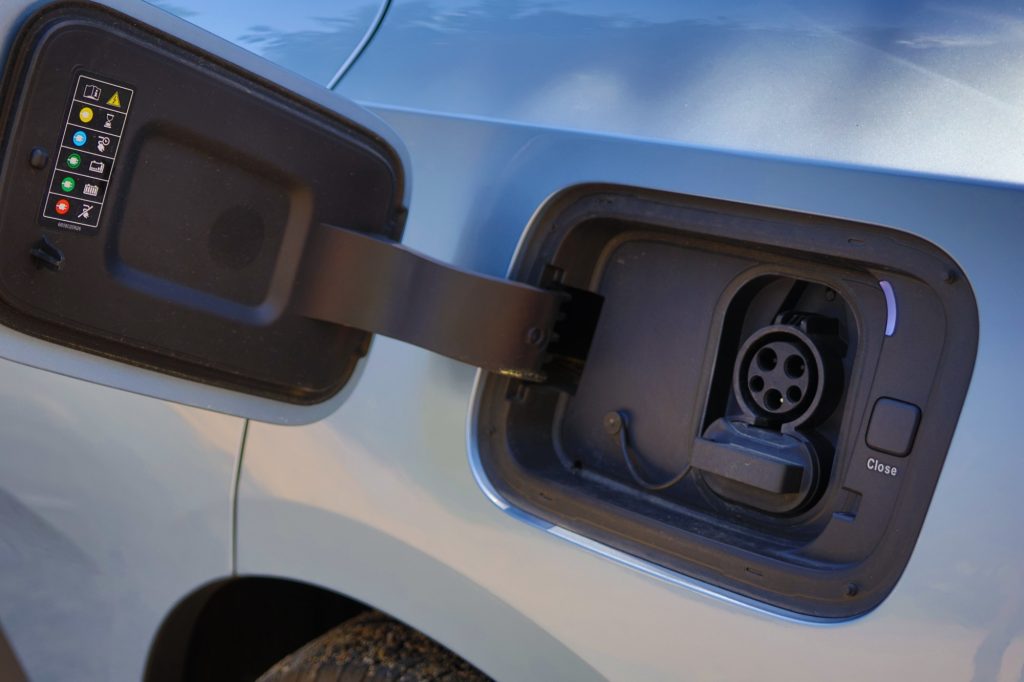
We didn’t have any opportunity to do any charging with the PS4, but we did note that it still has a CCS1 charging port. It is located on the left rear fender, much as Tesla does, which means that if you go to a Supercharger station with Magic Docks or an adapter, you won’t have to park in an adjacent slot to reach the super short cables. DC fast charging peaks at 200-kW and Polestar claims that it will charge from 10% to 80% in 30 minutes. Not as good Hyundai, Kia or Genesis EVs but still fairly respectable considering that real range will probably outlast your bladder. At home, the PS4 will consume electrons at up to 11-kW.
The $57,800 (For Now) Polestar 4 Is Good, But Probably Not Good Enough
The Polestar 4 is meant to slot in below the 3 and will be the entry model until the lower cost Polestar 7 arrives in 2028 and even that hasn’t been confirmed for North America. For now the PS4 single motor starts at $57,800 (including $1,400 destination charge). The dual motor starts at $64,300. Due to the uncertainty around the administration’s trade policies, it’s anyone’s guess what the tariff rates will be when the Polestar 4 starts deliveries this fall but Polestar has promised to honor current prices for any customers when they order.
The example that we drove in electron with the Plus pack, electrochromic roof and 21-inch sport wheels came to a grand total of $78,100. That’s quite a bit more than a Tesla Model Y Performance or a Lexus RZ but it’s in the range of a BMW i4. Overall I find the Polestar 4 more visually attractive although I love driving the i4. Still, the digital vents might just be a deal killer for me if I was looking to buy. I hate those things.
Top Image: Polestar
[Correction (11/4/2025 10:05 AM EST): The seats do offer ventilation. -DT]




I hope the PS4 doesn’t start a tread of no windows on the rear gate of SUVs for 2 reasons.
Cameras are great, in addition to mirrors but shouldn’t be the only way to see behind our cars.
So much tech. I’m not saying it’s necessarily got more than any other EV that starts around $60K, but any car with that many cameras, sensors, and so much software gives me pause. Were I to buy a new car of any kind, I’d like to do so with a decent chance that it’s still going to be drivable in 10 or 15 years… cars like this make me wonder if that’s even possible. Also, it reminds me a bit of a stretched Volvo EX30, which isn’t a surprise since both cars are based on (different) Zeeker vehicles.
TBH, I’d MUCH rather have the new Renault Twingo EV https://www.theautopian.com/this-is-the-new-renault-twingo-before-youre-supposed-to-see-it …probably for considerably less than half the price of this. Assuming that it comes with a LFP battery, it seems like the car might still be usable one or even two decades from now, albeit with a somewhat reduced range due to battery pack aging.
But I know that I’m not the kind of person who buys a new car every few years, so my opinion would be moot to Polestar (I still think the the Polestar 1 remains their most interesting and appealing car, though the revised/RWD Polestar 2 ain’t bad either).
I haven’t been keeping track, but is that actually impressive these days? Was this with a lot of heavy throttle or above-freeway speeds? 314wh/mi seems kinda high for anything modern with PM motors and (presumably) a heat pump.
And whoever is insisting on the bolted-on iPad look needs to be flogged. Is it really that hard to integrate it into the dash? Bad enough to move basic functions there but at least make it not look like an afterthought.
It’s not. I’m getting 3.2 miles/kWh on average in my 2023 EV6 Wind AWD.
That’s what I thought. My aging S is doing about the same in nice weather (AC but not heat) cruising a fair amount above interstate speeds. I would have expected more from something so much newer.
Yeah I was going to say on nice weather days my Polestar 2 gets 28-32 kwh/100mi right now since it is colder it is like 35-38. This is on my normal commute to and from work. When I was driving to my dad’s the other day I was averaging like 70mph I dropped all the way to like 40kwh/100mi
You cannot see into the trunk from the outside, ergo it is a sedan.
Actually, that one was a hattchback.
Had a Polestar 2 and now a 3, after a few updates Polestar got the software kinks worked out, both cars are great to drive.
Prior to buying them, I was confused as to how they were different from their Volvo EV cousins, but once you own one, it starts to be come clearer. Polestar seems to tune the suspension and driving dynamics to the sportier side.
I visit Montreal yearly and quite surprised to see that many Polestar 2 roaming the streets.
Is this driven by engineering or design dept? I want to know who to get mad at and send banana peels to in the mail.
If it’s stupid and annoying it’s not something engineers wanted.
It’ll be either Design or Marketing. Marketing love a surprise-and-delight feature that impresses in the showroom then infuriates the owner.
As a car marketing person myself, I must say I hate getting irate mail and having to read angry forum posts about how much a feature that I’m the product manager for sucks.
Engineering on the other hand just loves stuffing lots of tech in there because they can and it’s the newest, fancy thing.
I’m an engineer myself, but I work in govt contracting not automotive design. I try not to blame everyone else; I’m not blind to the fact that engineers can be ridiculous and difficult in their own ways.
That was kinda my point – there’s sooo many people, departments and stakeholders involved in making something as compley as a car, and each have their own interests, that is not super clever to put the blame squarely in one corner.
Sure, me and my marketing/PM colleagues have our own set of dumb ideas and fixations – but we’re far from alone in that! And that’s just working level. Talk about top management, and it’s all about whom they talked to last at times…
By the time I’m working on a project the spec is already fixed. That’s how it goes in powertrain anyway, or I’d have worked on a lot more 2.0 litre 9,000rpm straight sixes with metal-matrix monoblocks. Or any.
If engineers in software are going rogue then I can only suggest telling them it’s impossible to deliver precisely on spec, and no one has ever done it. Engineers are extremely susceptible to reverse psychology.
And yet there are companies like Mazda churning out insane ideas like compression-ignition ICE engines, or Wankel rotaries, and places like Mercedes making 400+ hp inline-4s, or Subaru turning everything into a boxer… Lots of places where engineering might rather be the driving force in product decisions.
The last engine I worked on was a variable compression ratio 2-stroke that burns petrol with no spark plug.
We get to do the crazy ideas for research. For production we just follow the product definition document, which is written at the start of a 4 year project, and we have to deliver exactly what it says.
I’ve tried jamming a new efficiency idea in to a production cylinder head half way through a project, and they didn’t want better efficiency, they wanted exactly what they asked for.
It did get approval for a research project though, then Honda put the same idea into production 4 years later.
All companies- please stop putting screens, cameras, and digital controls where the previous solution wasn’t broken. My MIL just bought a new fridge. It has SIX, count ’em, SIX cameras inside. For what purpose does a fridge need cameras?
Digital rearview mirror with no rear window? Not needed. People have driven box trucks for years without them.
HVAC on a touch screen? You’re killing me smalls.
ya I agree but people are stupid so they will run over their own dog if there was no rear view camera. Camera, not mirror, as the stupid people are like Tyrone from Snatch
As I was reading the review, my overall thoughts were “meh”. Then I saw the base price – that’s a bit high. The loaded test car’s price – yikes!
So Polestar is 100% Chinese owned at this point? Pass.
18 mentions of the touchscreen/ipad slapped on the dash so far when there’s a camera watching you drive inside of a heavily “connected” car owned and built by China. Priorities, people. A screen of some sort controlling most functions is standard on basically any car you can go buy today. Having to adjust an HVAC vent once a season through a touchscreen is the least of your worries and it’s time to let it go.
“As a premium European designed car”
that’s laughable.
Polestar is toast if this is what they’re selling. Yikes.
The lack of air vent control and overall lack of physical controls were enough to not even consider this car, never mind no keyless entry. This is so dumb it borders on insanity. These are features designed in Microsoft Excel and it shows.
When Polestar pulls out of the USA, will Volvo service then or will they be orphan cars?
I think most Polestars are sold and serviced via Volvo dealerships today. Last time I took my S60 to Volvo of Austin for service, there were PS2s and a PS1.
Yeah when I got my 2 as a CPO from Polestar Lisle outside Chicago they are affiliated with and right next to a Volvo dealer and the service center uses the same techs as Volvo.
$80,000 for this isn’t it.
Gross.
You could not pay me to drive one of these dystopian nightmares
I just bought a used Polestar2 last month and have been pretty happy with it so far. Unlike this car it has a rear window (though it’s pretty small and obstructed by the rear headrests). It has physical vents I can reach out and grab even if they’re small and poorly placed. But most importantly it’s 10″ shorter and 10″ thinner but since I’m coming from a BRZ it already feels like driving a Tahoe. Swapping into one of these would make me feel like Captain Stubing.
There are some things in this P4 that I like though. I wish mine had that electrochromatic roof and the ability to split the screen between the map and other apps. I also wish Polvostar would slap some more festive colors on their cars but every manufacturer outside of Dodge and Jeep are also guilty of that.
I use android auto in my 2 with that you at least can have maps up, a mini media player and the weather showing all at the same time on the screen.
I will probably switch to using auto, I wanted to atleast give the android automotive a chance first but I’m finding it lacking. It also doesn’t display notifications from half my apps when AA never had a problem with it.
Yeah the only thing I really miss from it is arrival state of charge but if you are just heading between home and work you can easily change over from Android auto to the built in Google maps to see what your estimate charge will be and android auto will stay working if you have a route plugged in on the android auto maps. Also voice commands still work the same with android auto going so you can still tell it to turn on heated seats or change the ac or whatever.
I’ll probably switch over on my drive in tmrw, thx!
Ok, AA was way better than using the built-in Android Automotive. Why did I wait this long before trying it?
Haha glad to be of help. When I first got the car I tried just using Bluetooth and the built in google stuff because the andriod auto I had in the 2023 Miata I had was awful so I thought it would be the same but nope the android auto night and day better then the built in google system. Which I am glad they implemented android auto (which I think came out either earlier this year or late last year)
The AA in my BRZ wasn’t bad, even on the 7″ screen, except for when it would lock up. But same as you I figured I could make the built in AAOS work for me but it’s just lacking. The biggest suck for me was that it wouldn’t give me Google Chat notifications like AA would.
I know somebody who returned her Polestar2 after three days because of poor visibility. Now here’s a model with no rear window at all, instead there is a big ceiling window for all the times you’re going straight up.
I have an FJ also so poor visibility is just my thing I guess haha. Oh and I have to drive semi trucks on a test track for work so yeah no rear visibility in the sleepers. But yeah the camera only rearview is dumb in this 4 I would prefer to have a mirror and window.
The rear window in the P2 is small but I don’t feel like it’s unusable but I just got out of a BRZ which didn’t have the biggest rear window either. Neither did the WRX I had before that. Honestly the last car I owned with decent visibility was my 2003 Tacoma.
I’m really not a fan of the digital rearview. You lose a lot of perspective & depth, and I feel heavily constrained by the limited FOV of the camera.
I don’t really like where this is going.
Having to focus on the mirror is also a huge issue for those of us that have to wear bifocals – the rearview camera image will always be a blur. Mirrors avoid this issue completely.
I feel called out.
Although I still turn and look for the majority of reverseing: I use the camera to validate that I’m equi-distant between both lines, and not over the rear line of a parking space.
The tacked on iPad is an instant and eternal “no”. I cannot wait for the pendulum to swing the other direction.
I hate the ipad-glued-to-the-dash look on any car.
I can’t tell if Sam’s use of “PS4, PS3, PS2” is because they’re not a gamer at all and thus unaware of the common meaning of those abbreviations, or if it’s intentional and meant to be slightly whimsical? Maybe I’m the only one who found it weird.
I normally see it abbreviated to P2, P3, and P4 which has its own “Intel Inside” connotations.
Sam is a nerd. I think it’s whimsical.
I use PS2 for my car (and my plates are my initials follower by PS2 haha) and I am a gamer though PC gamer nowadays haven’t had a PlayStation since ironically the PS2 which I still have.
This is the most I’ve heard people talk about PlanetSide 2 ever since they added fishing
I like the shape, but all else aside, making the vents remote-controlled is an automatic no. It’s a monumentally stupid, committee-driven design decision, on a par with Apple putting the charging port on the bottom of the mouse.
I don’t understand those at all; it’s needless complication for no reason. There needs to be a list of Non-Negotiables provided to designers/engineers:
No needless motor-driven items (vents, entry door handles, etc).Pillars should be as thin as possible, and windows as large as possible.No panoramic windows without physical shades.Steering wheels must be circular at least 80% along the rim, and tilt and telescope.The following items must remain on stalks and follow Japanese standards: Turn signals; Headlight controls; Windshield wipersGear shift levers must be either on the column or console and follow the PRNDL/M standard.HVAC controls must be manual.Manual volume knob must be present for infotainment.Standard wheel diameter must not exceed 17″ for a standard car-based passenger vehicle across all trim levels. All larger diameter wheels must be extra-cost options.Spare tire must be present; donuts are allowed.Cloth seat option must be provided.All seats must have adjustable lumbar support.BSD/RCTA mandatory across all trim levels.Sunroof/moonroof optional across all trim levels.
Feel free to add more.
Thankfully, my car ticks almost all those boxes, except that it came with summer tires on 20″ rims. The winter rims are 17″, thankfully.
I’d add spaces or paragraphs. Perhaps number them in case someone wants to comment on one of them.
Add:
“must have manual transmission as an option, even if it has to be special order.”
“First-minute-off-the-lot depreciation built in to sticker price.”
I tried; it had bullet points that disappeared. Can I still claim Kinja’d?
I would like to subscribe to your newsletter and/or vote for you in the next election.
No rear window? Ugh. Reliance on screens for mirrors is a solution in search of a problem. When’s the last time you had bad pixels or glitchy video on a mirror? And some of us get ill looking at those things for more than a moment, esp. during motion.
Also not a fan of the trend of EVs to slap an iPad-like screen in the dash and call it a day. That took, what, 0.5 seconds? How about integrating the screen into a pleasing interior? How about a cowl over the main instrument cluster so I can see it in all conditions?
The pop-out handles are another solution in search of a problem. God forbid you should be unconscious/trapped inside and someone tries to open the door from outside with no handles (esp. after an accident that cuts power).
Stop making EVs weird! Make them like a regular car. Innovation, sure – screens are ok (except for HVAC/radio controls) but don’t just glue one to the dash. Don’t make electric handles that are safety problems. Don’t make vents that you need to change on a screen. Don’t eliminate controls like stalks unless you really have a better solution. These are all just changes for the sake of change, often without any good reason behind them than “because we can.”
These are just a means to future service revenue. What percentage of traditional door handles drive revenue? Maybe 2% on the high end? Now that number spikes after a few nasty winters when the bits that make it go fail after trying to pop out when the mechanism is iced over.
I am not interested in being the source of some greedy executive’s bonus.
I wonder if stupid things like that increase your insurance rates?
I like to watch dashcam videos. I know what increases our insurance rates. Sheer rampant stupidity.
I would argue that it’s not a means for future service revenue. I doubt these items are serviceable at a reasonable price. It pushes people into new cars. “Well, it’s 5K to replace the headlights. Or, you can put 5K down and drive away with a new car today!”
Potato, potahto.
Preach.
Digital RVM’s force the eye to refocus, which may not be trivial for the driver if they require bifocal glasses to see up close. Even with good eyesight, you can’t glace at the mirror while maintaining peripheral view of what’s ahead. I can’t stand C8 Corvettes because of this, and it’s not like the side mirrors really make up for it due to the wide rear haunches.
Tactile controls, or the lack of them, are a huge safety problem. You should be able to do 95% of all normal vehicle functions, including changing the radio station, adjusting an hvac vent, or turning on heated seats, strictly by touch/feel. Anything that requires taking your eyes off the road (anything on a touch screen interface), is problematic.
Color choices range from “cigarette ash” to “carbon stain”. Now THAT is luxury.
Is it really so hard to make a color? I mean, they’re expecting people to pay almost $60,000 for a chubby hatchback, but making it a pleasant color is the dealbreaker?
I’m starting to feel old, I just don’t see the appeal in these sorts of things. Pointless dependency upon the central touchscreen for simple things like mirror and steering wheel controls seem like a frustration and not a benefit. I guess this is where I turn old because I don’t want to change what I’ve known for a long time. I know that in most any car I get into, the mirror adjustments are ahead of the window controls. The steering wheel controls are at the bottom or occasionally the left side of the column. I can get adjusted in about 15 seconds and on my way. I don’t see how that was such a huge problem.
At 52, I’ve been wondering if this is what it was like for my grandparents as cars changed over the years. I work in IT, so I’ve always been tech forward, but I could care less about the gee whiz electronic everything in modern cars. I don’t need an electric opening glove compartment from the touchscreen or sliding my finger across a touch screen to adjust an air vent (likely after digging through some menus). I don’t really think I would like automatic lane change assist. I do like blind spot monitoring and cross traffic alert when backing out from between two Suburbans are super duty trucks, though.
Now get off my lawn.
I will say that automated lane change assist is fine if it’s truly an ASSIST. In one of my cars, you hit the turn signal and the car will go IF it’s safe – but it doesn’t go until you tell it to. In others I see it will change lanes on its own volition to maintain speed set on the cruise – not a fan of that.
You’re not old. You’re just correct.
This is a case of neutral colors sell 1% better than all others, dealers want any given car to have the largest possible customer pool, so all cars are neutral colors.
If you want a not neutral color, tough luck. Next year the data will show neutral colors sell 11% better despite being the only option for many models.
“… isn’t an SUV no matter how cool the 80s throw-back rally wheels look. The PS4 has barely more at just 6.5-inches of clearance and is just 60.4-inches tall. This is a hatchback car; argue with me if you want but you’re wrong if you think otherwise”
I swear we had a name for something like this… Something that crossed over between an SUV and a car… I can’t think of it for the life of me though
Crossover or CUV has minivan/wagon vibes to customers. No one wants to buy a soccer mom car despite SUVs largely all being soccer mom cars today. Reality doesn’t matter, only marketing.
The wrong car at the wrong time.
test