

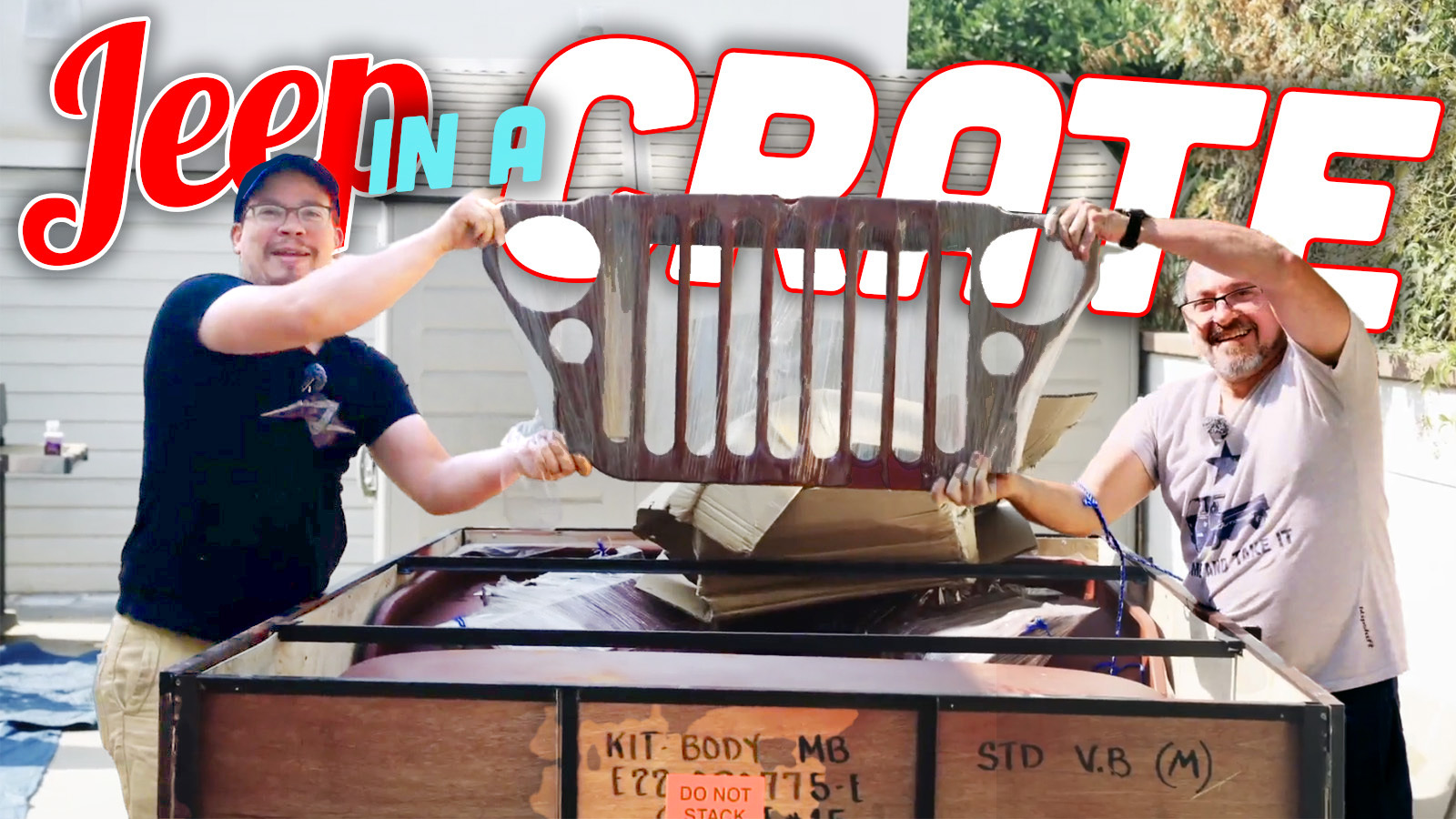
Did you know you can purchase an entire World War II Jeep body on eBay Motors for under $4000? As I found out recently, the iconic sheetmetal arrives in a humongous custom-built box that originated in the Philippines. Here’s a look at what it was like opening that box and unpacking a World War II Jeep.
You’re probably curious about how one can just buy a new body for an 80-year-old vehicle. It turns out that one company, MD Juan out of Manila, Philippines, started building World War II Jeeps in the late 1960s after running out of surplus Jeeps from Europe and Japan. The company discusses its history on its website:


MD Juan Enterprises, Inc. was founded in March 1967 by Dr. Maximino D. Juan, in response to the increasing demand for a sturdy, lightweight vehicle, particularly the multi-purpose jeep, in the Philippines. The company initially imported surplus World War II jeeps from Europe and Japan, but soon began producing their own bodies, which were popularly known as the Jeepstar.
In August 1969, MD Juan built its manufacturing plant in Novaliches, Caloocan City, and by 1970, the company had ventured into export markets in Japan, Australia/New Zealand, and the USA. MD Juan’s export concentration focused on jeep bodies and parts that were identified with World War II, such as the MB and Korean War M38. The company eventually expanded its production line to include civilian jeep models like the CJ series.
On MD Juan’s website, there’s an “Our Partners” page, which mentions the various companies that it supplies old Jeep bodies to; among those companies is C&C Equipment out of Nashville, Indiana (incidentally, you may know C&C from its rather popular YouTube channel). It’s C&C Equipment’s eBay listing that originally inspired this whole project idea:
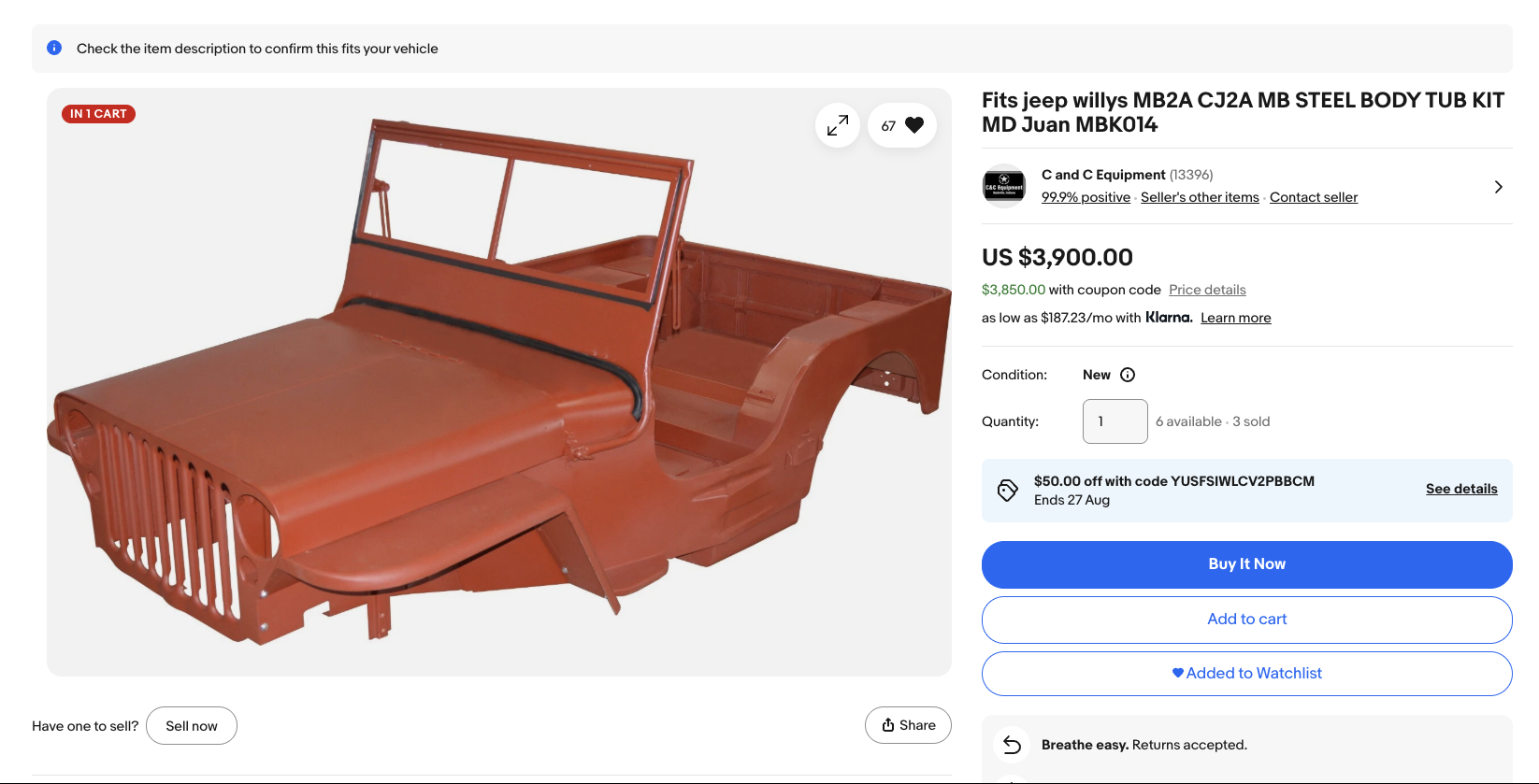
So naturally, I bought the above Willys MB body from C&C, and it came out to $4,441.88 after shipping. C&C communicated to me who would be shipping my huge box, when it would arrive at my local facility, and how I could schedule the ideal drop-off time at my house. One day, a humongous truck just showed up, and a gentleman expertly lowered the Willys down onto four dollies I had purchased.
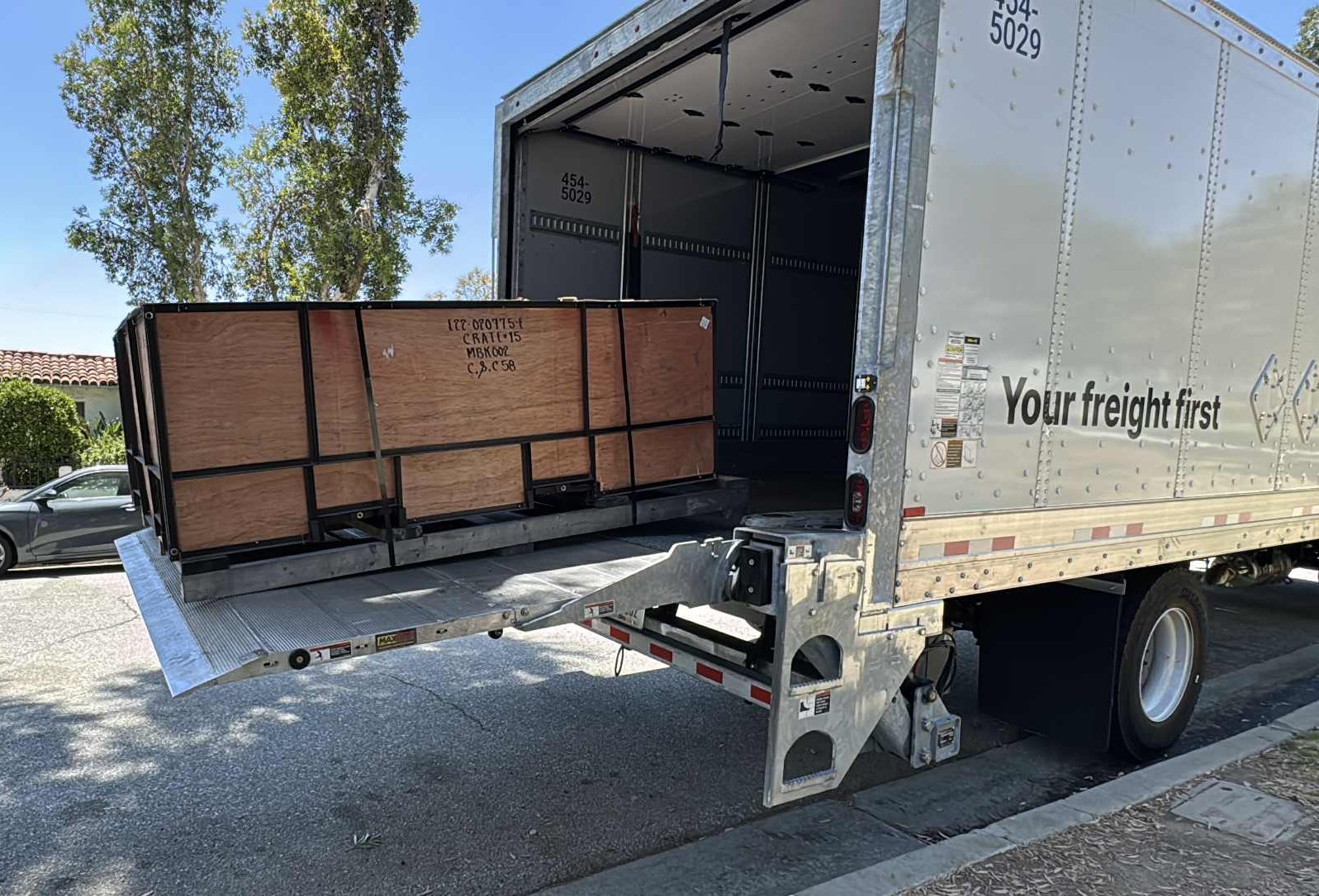
Once on the dollies, the 700-ish pound box could easily be rolled into my driveway, where Jason Torchinsky and I unboxed it.
The Unboxing
Though most WWII Jeeps were shipped overseas rolling on their own wheels, some made their trek in a wooden box, with their windshields folded and their wheels stored in their body tubs — all to maximize how many vehicles could fit in the hull of a cargo ship. Here you can see Ford’s official uncrating instructions for the WWII Jeep:
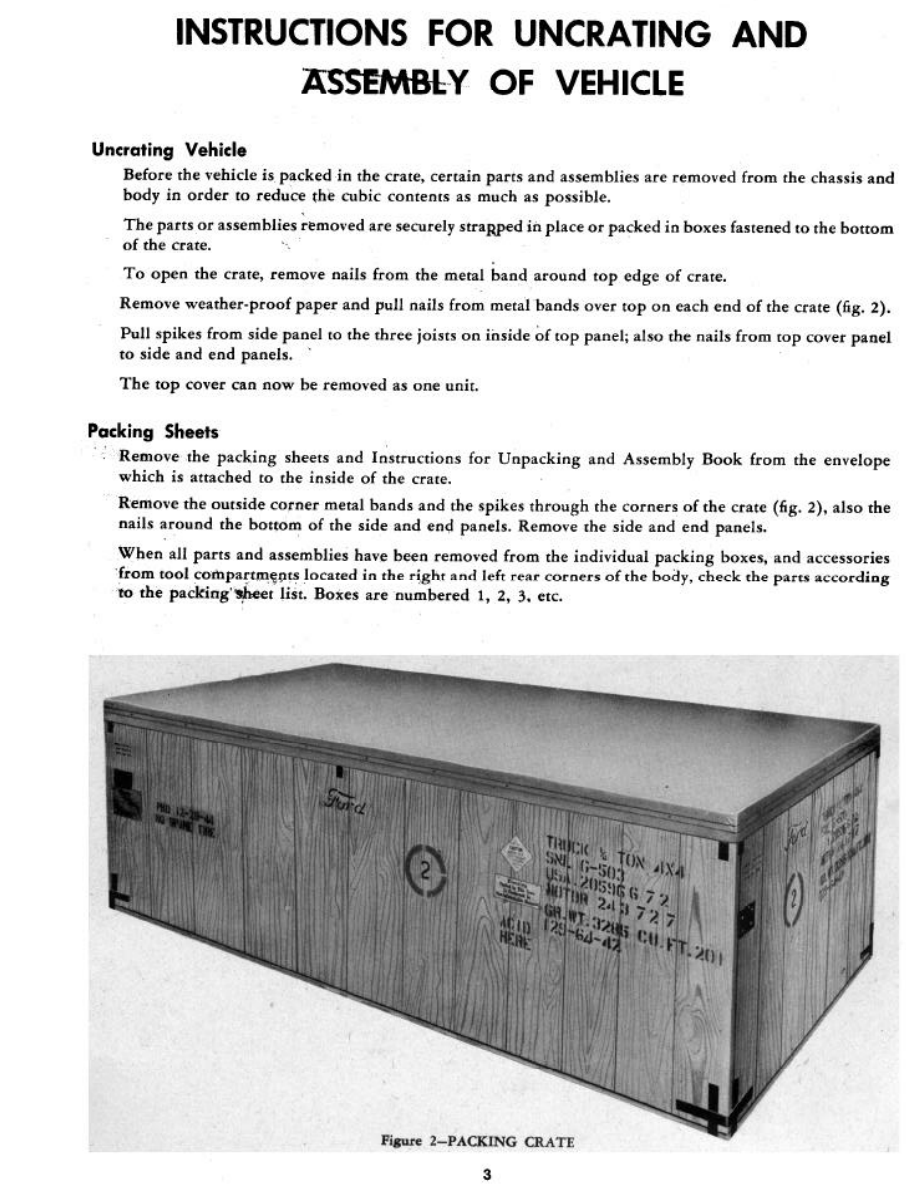
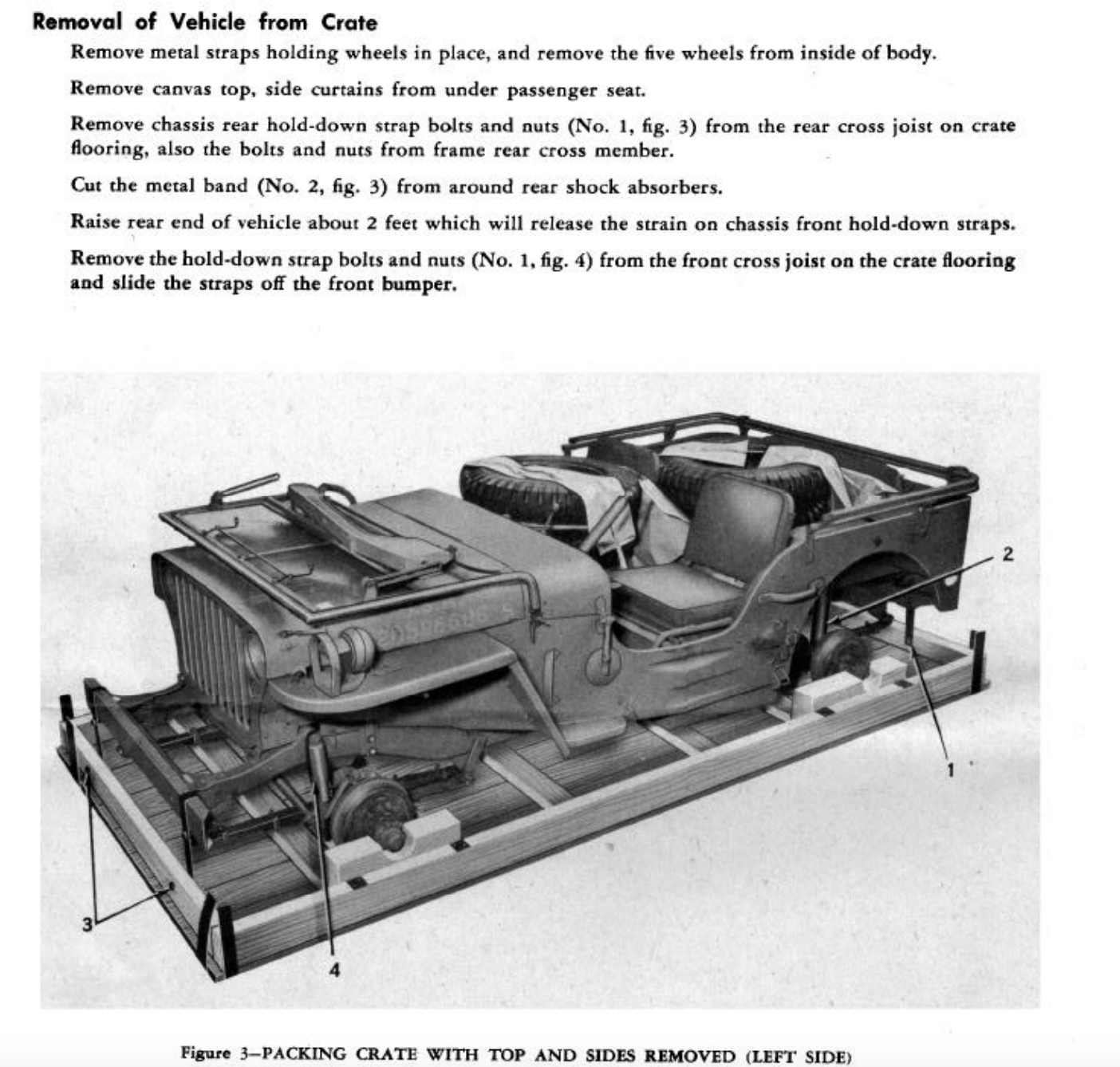
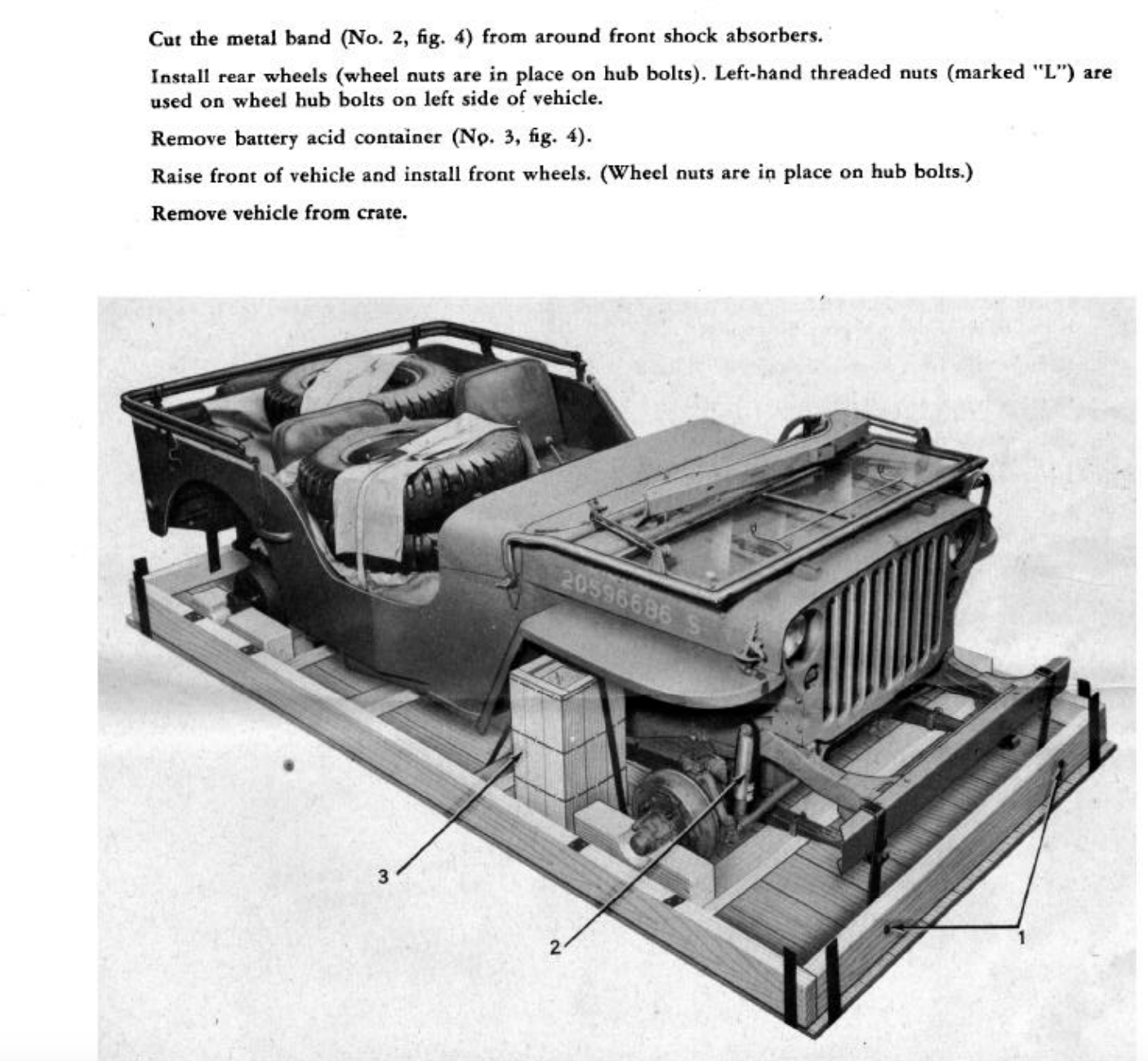
The Jeep-in-a-crate idea was romanticized after the war by a widespread myth that surplus Jeeps had been found still in their wood crates, and could be purchased for just $50. Most people consider this folklore, but this dream of a “holy grail” barn find in a box is something I couldn’t shake as I unboxed an actual Jeep-in-a-crate. It showed up in a giant box roughly 8 feet wide, 5 feet deep, and 3 feet tall.
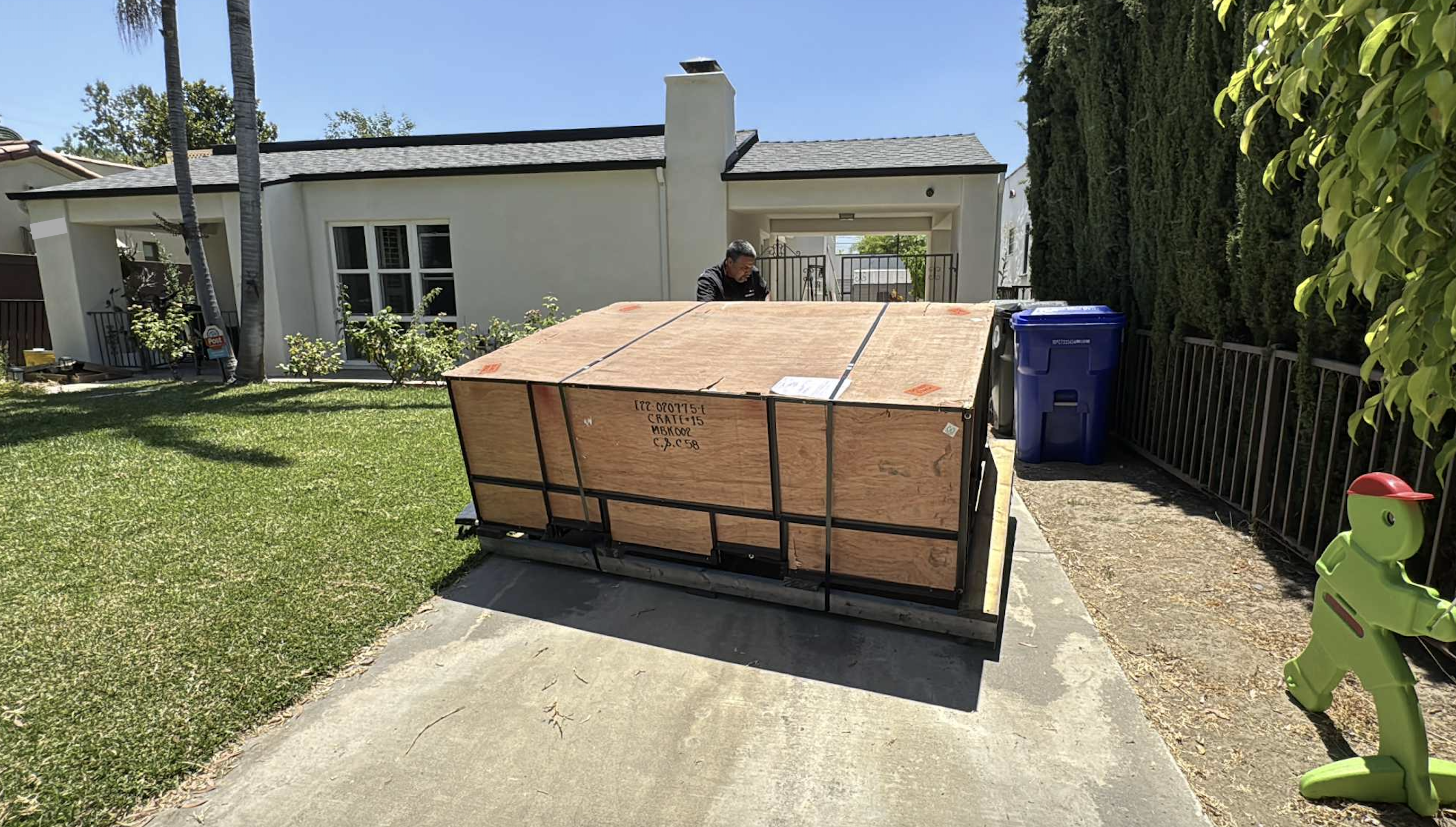
To help me with the unboxing, I enlisted my partner-in-crime, Jason Torchinsky, a man who has a history of unboxing entire automobiles from overseas.
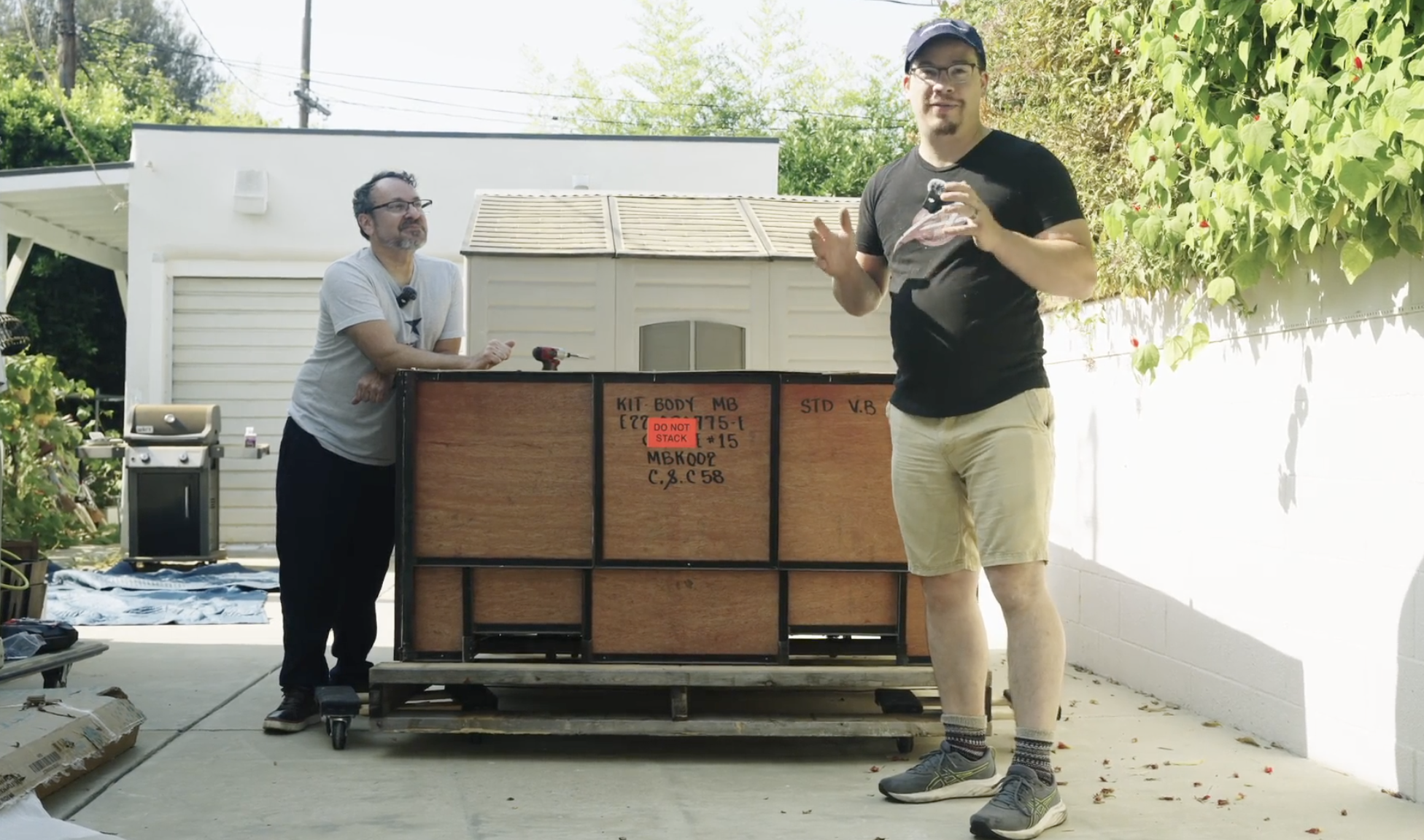
Step one involved me unscrewing the thin wood lid from the crate:
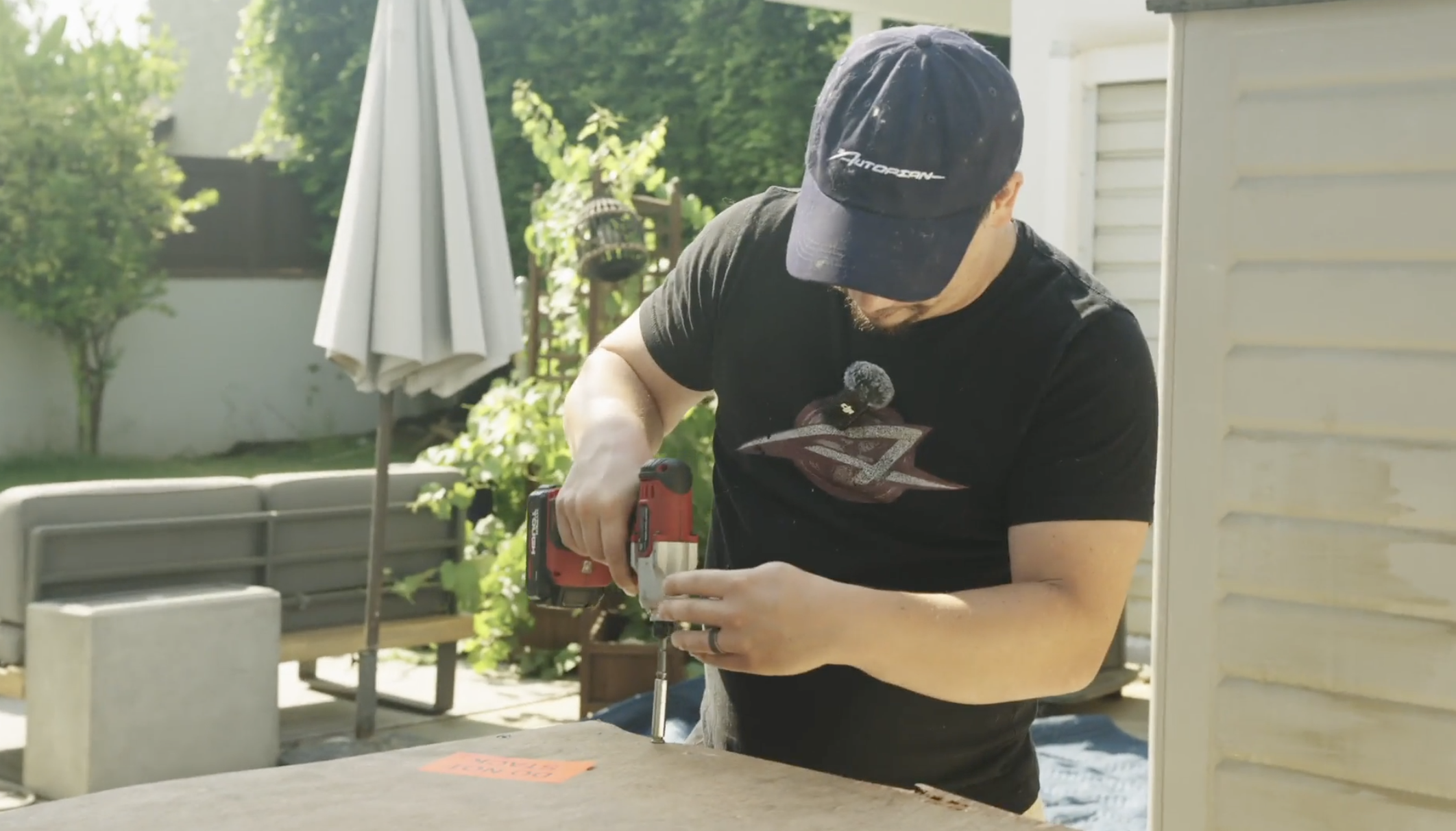
Then I cut the metal straps with a dull cut-off wheel: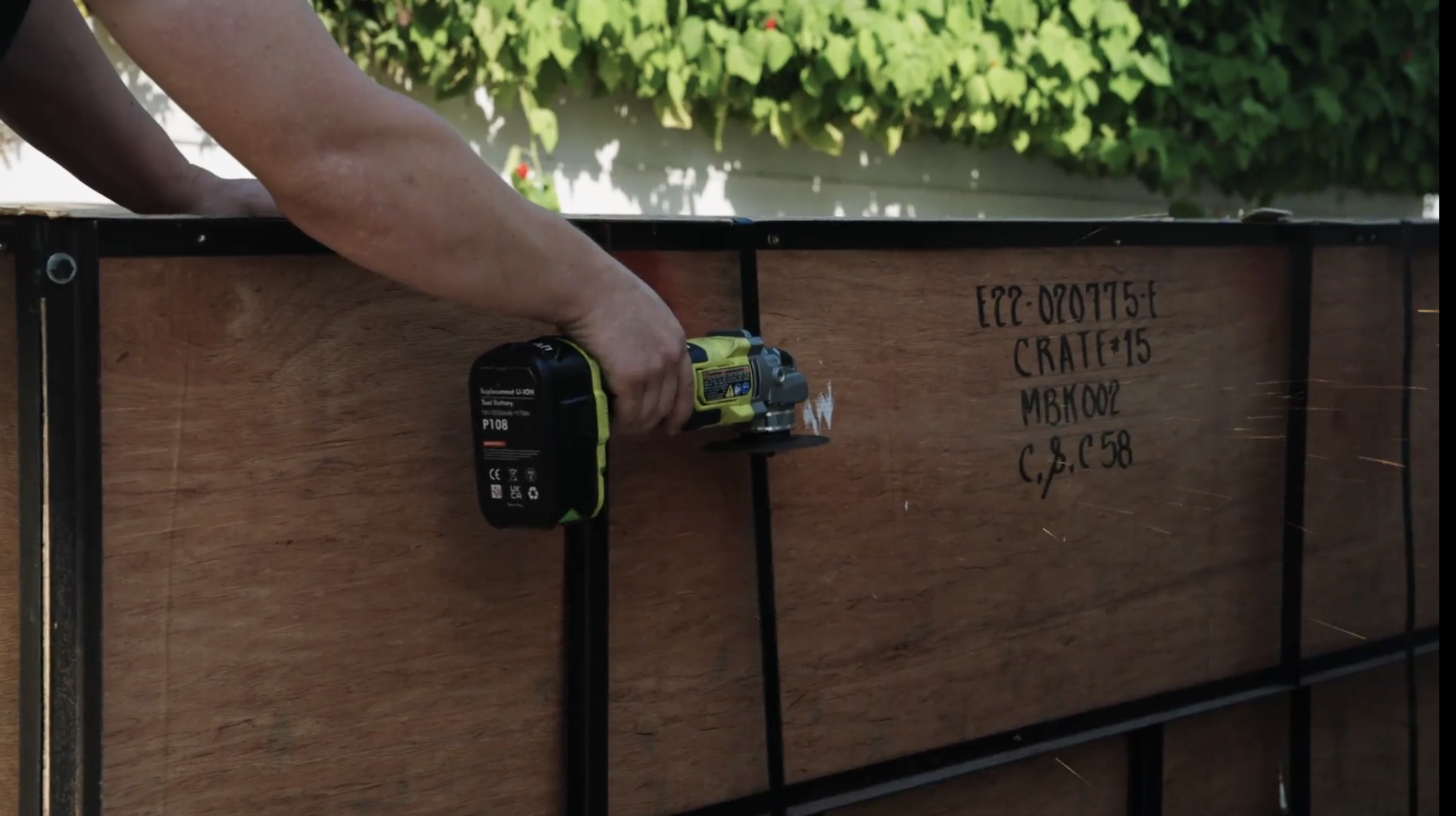
And with that done, the lid came off and we saw…
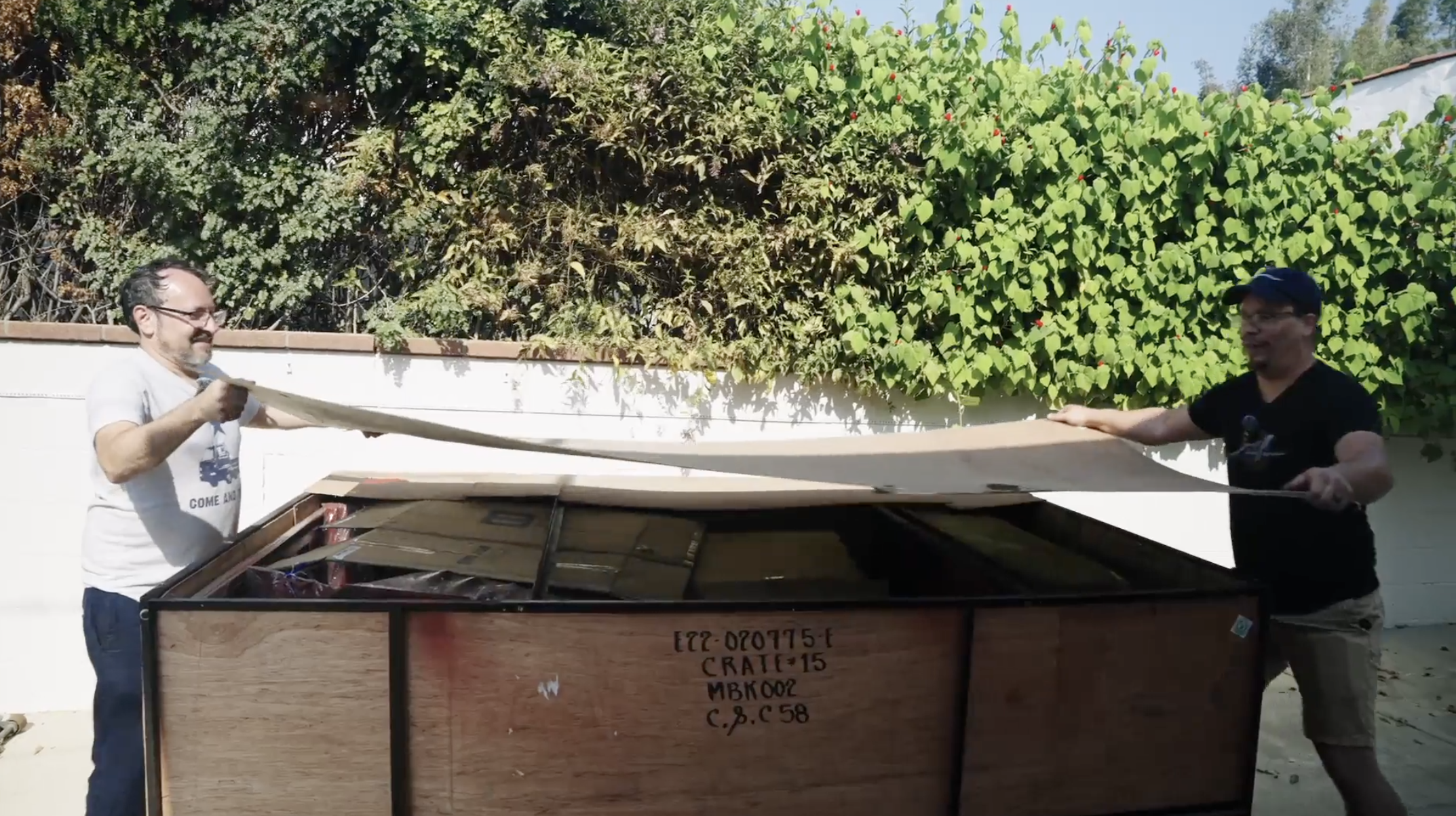
Mostly cardboard.
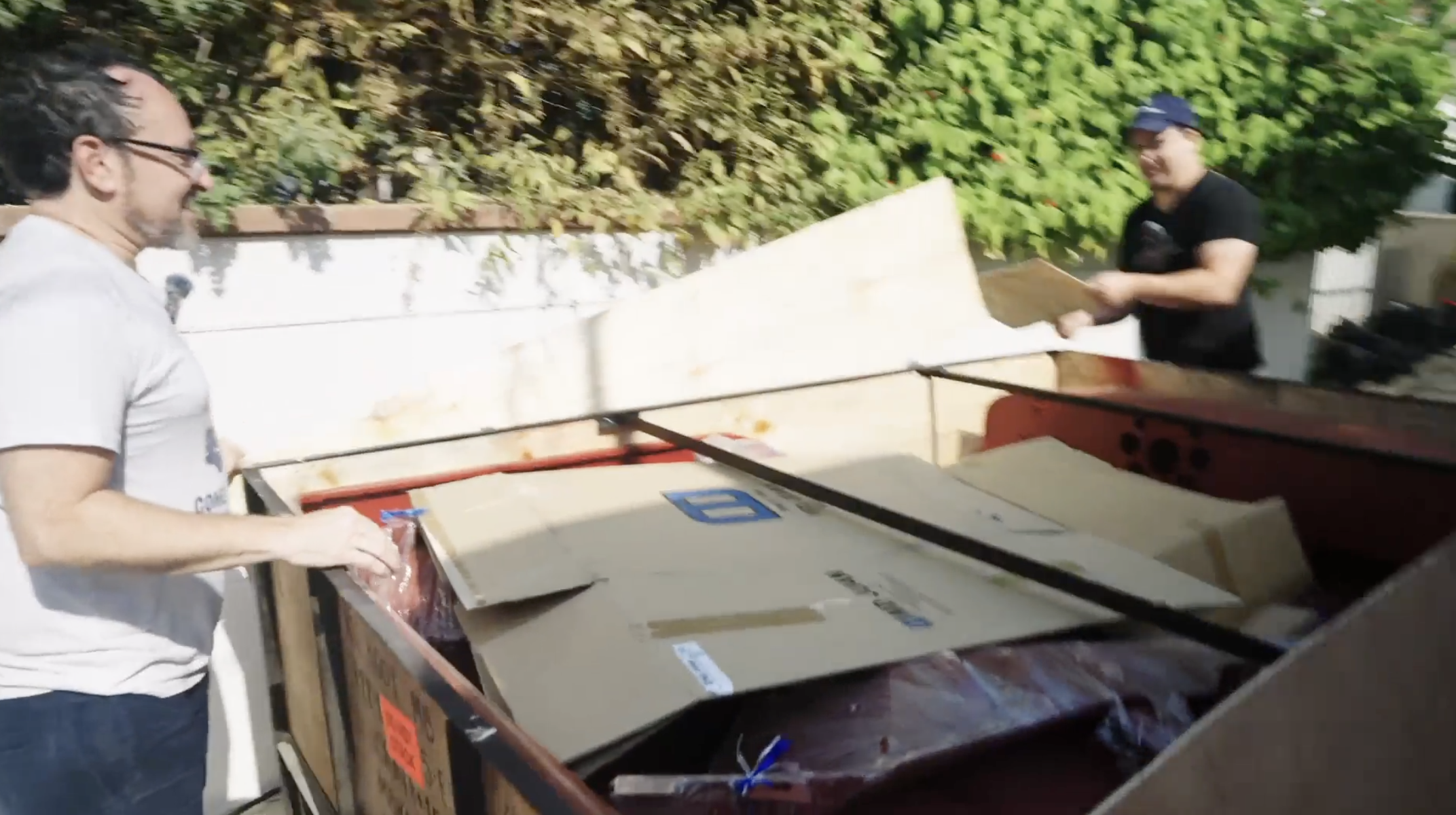
But removing that protective cardboard revealed true glory. There, on the toolboxes integrated into the rear wheel-wells, sat the front fenders that created the now-iconic “flat-fender” designation of Jeeps.
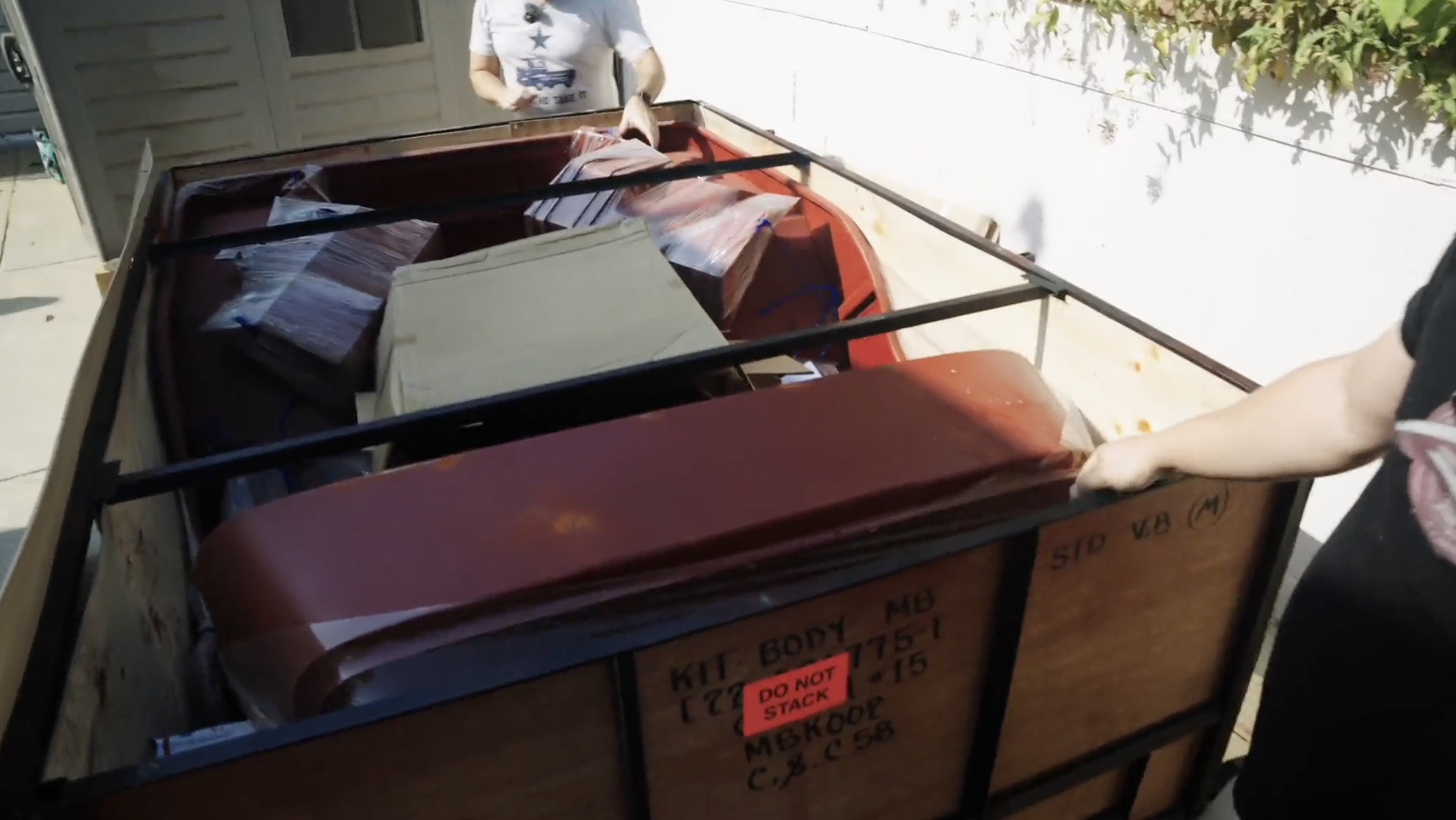
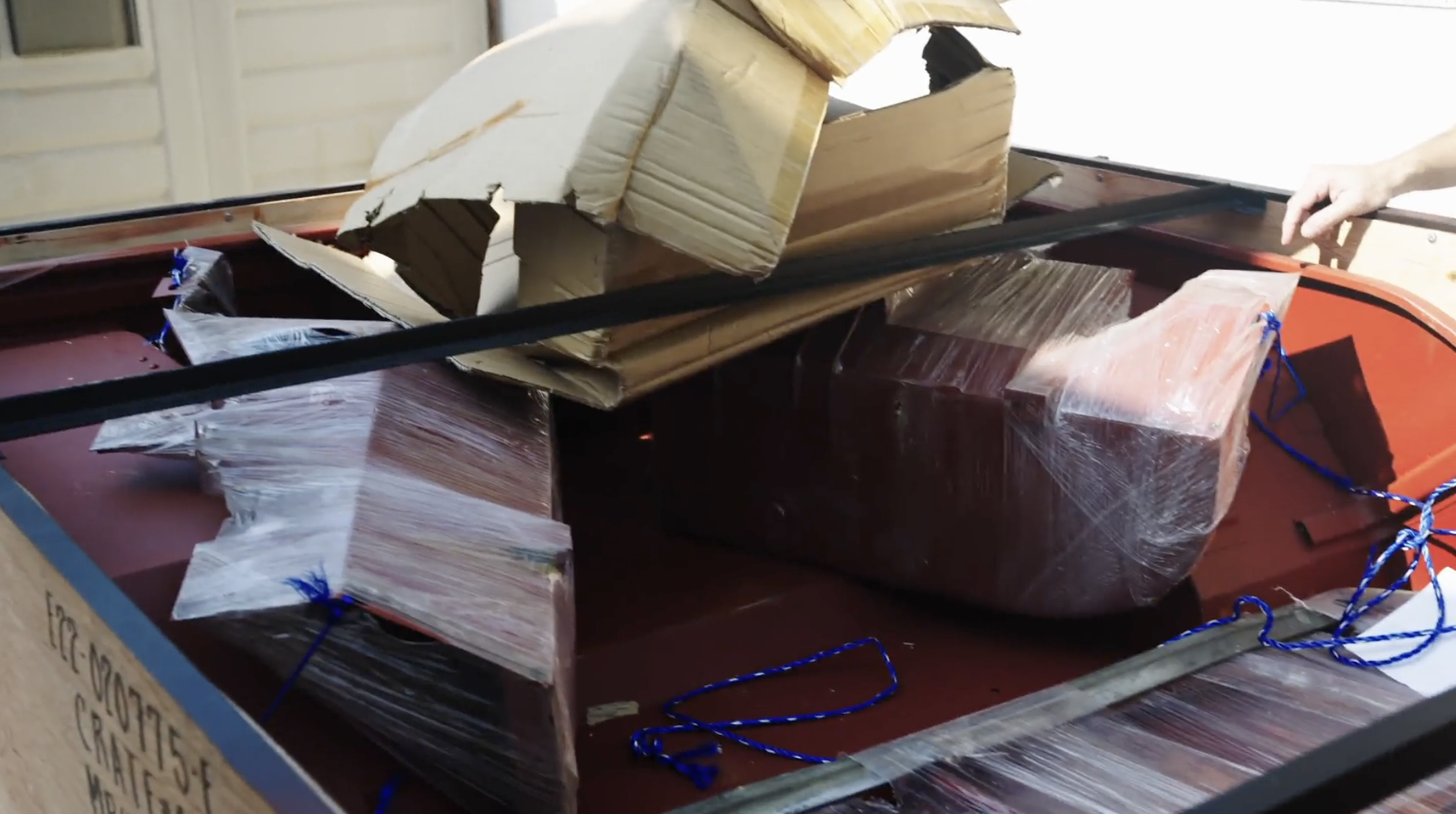
We removed the fuel tank that we had purchased in addition to the tub:
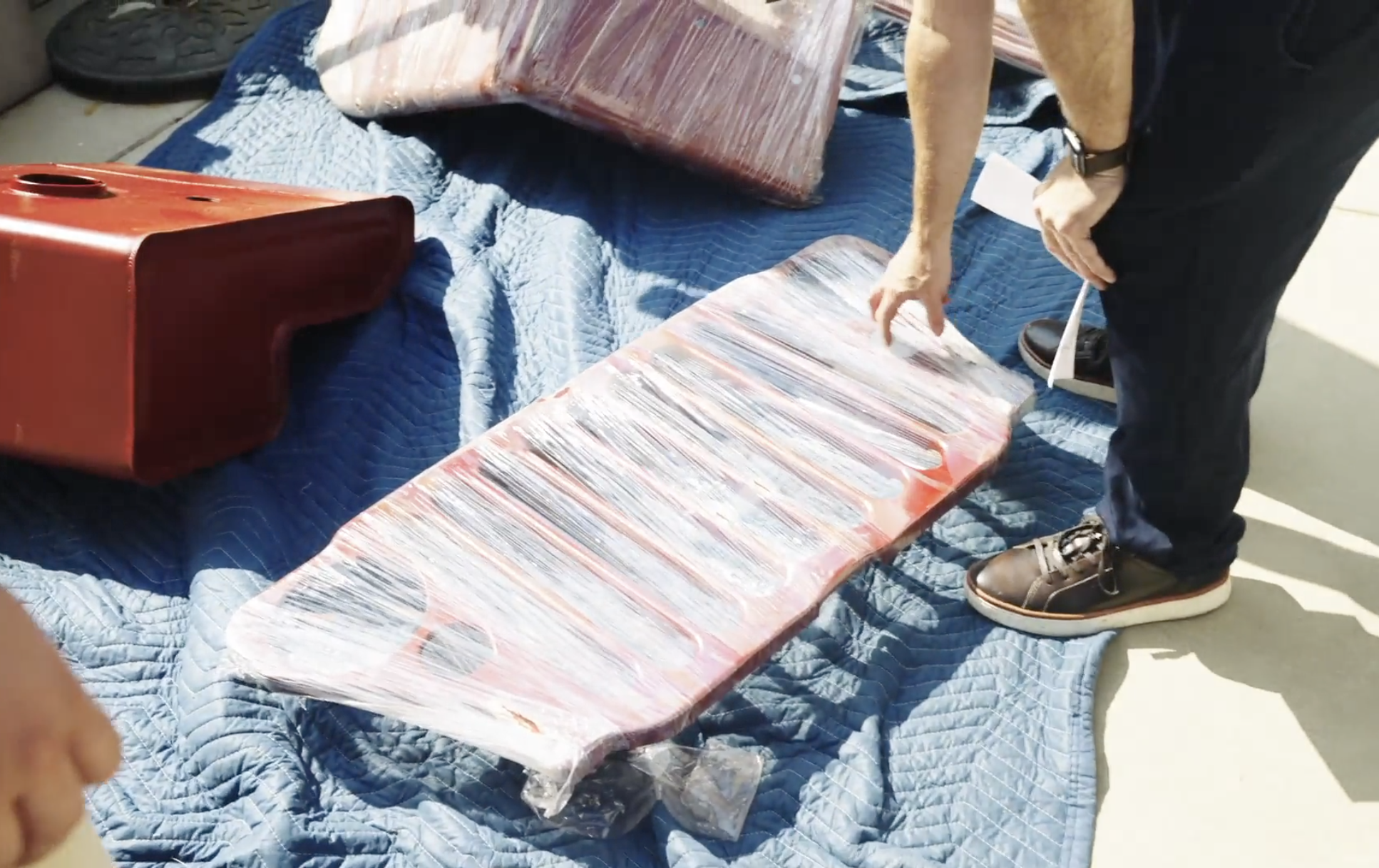
And below it was the rest of the body — the grille, the windshield and the hood — all tied down with twine and protected from damage via strategically-placed cardboard and lots of plastic wrap:
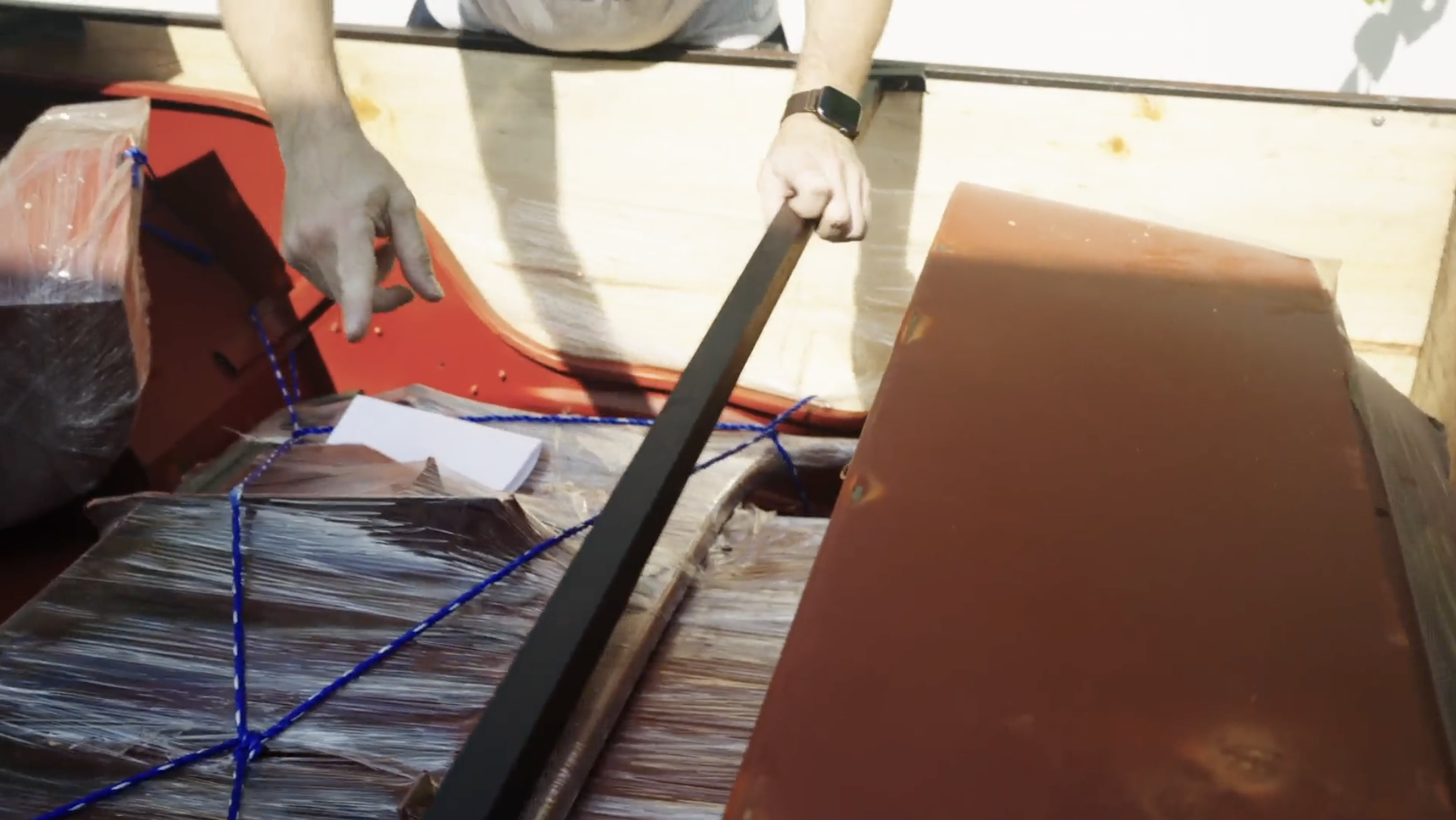
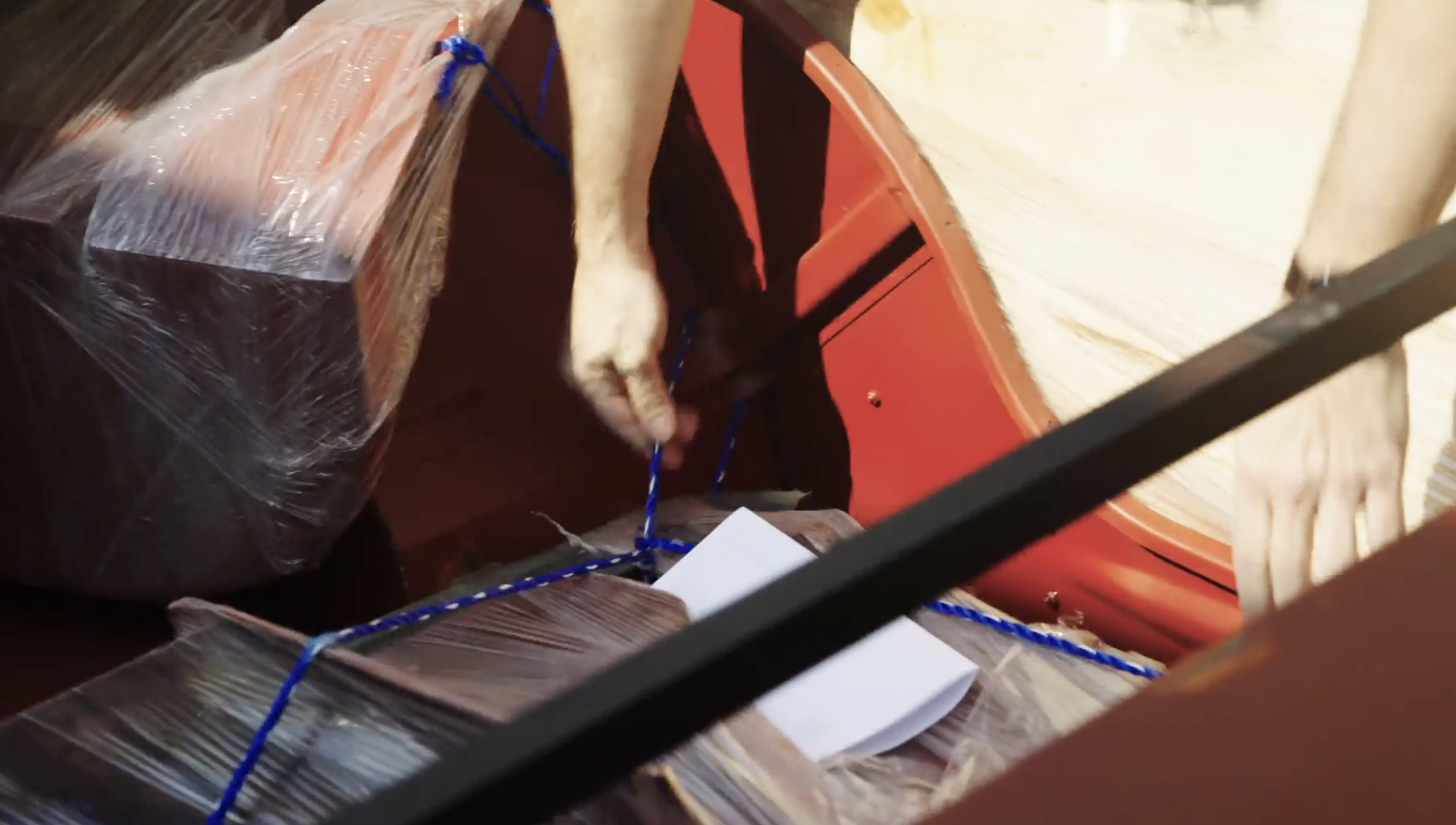
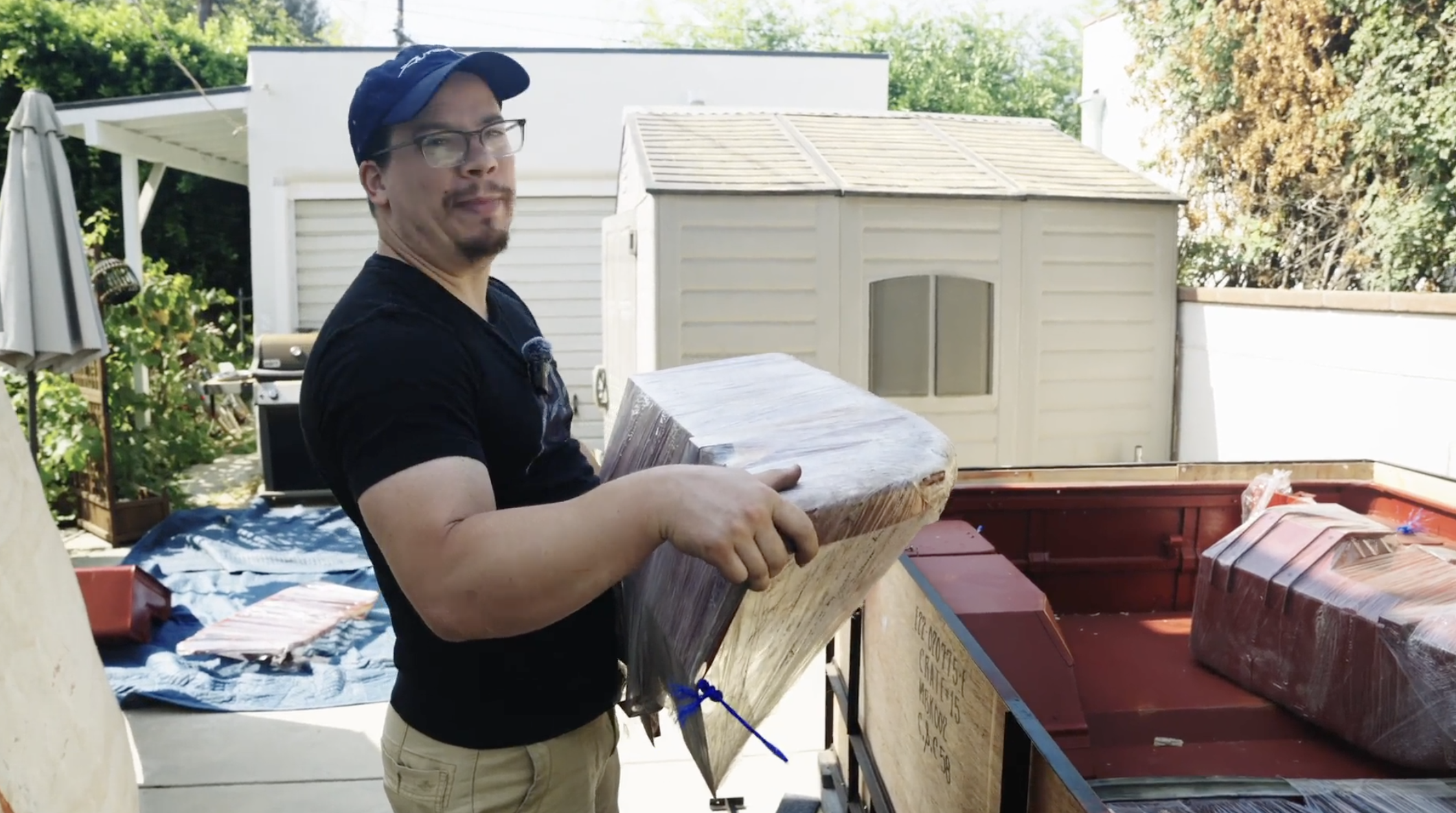
The first thing we did was remove the grille; wow what an iconic grille:
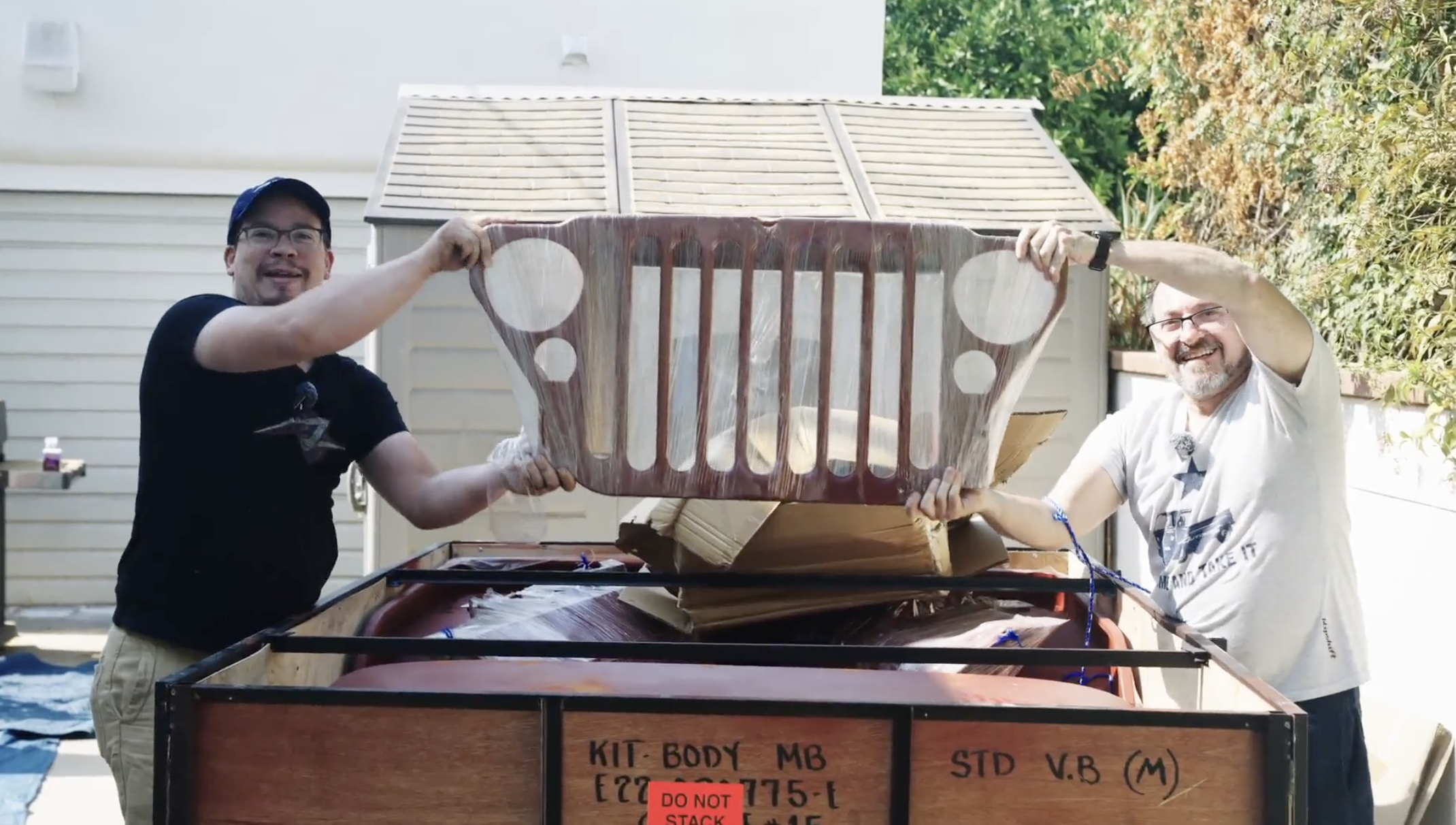
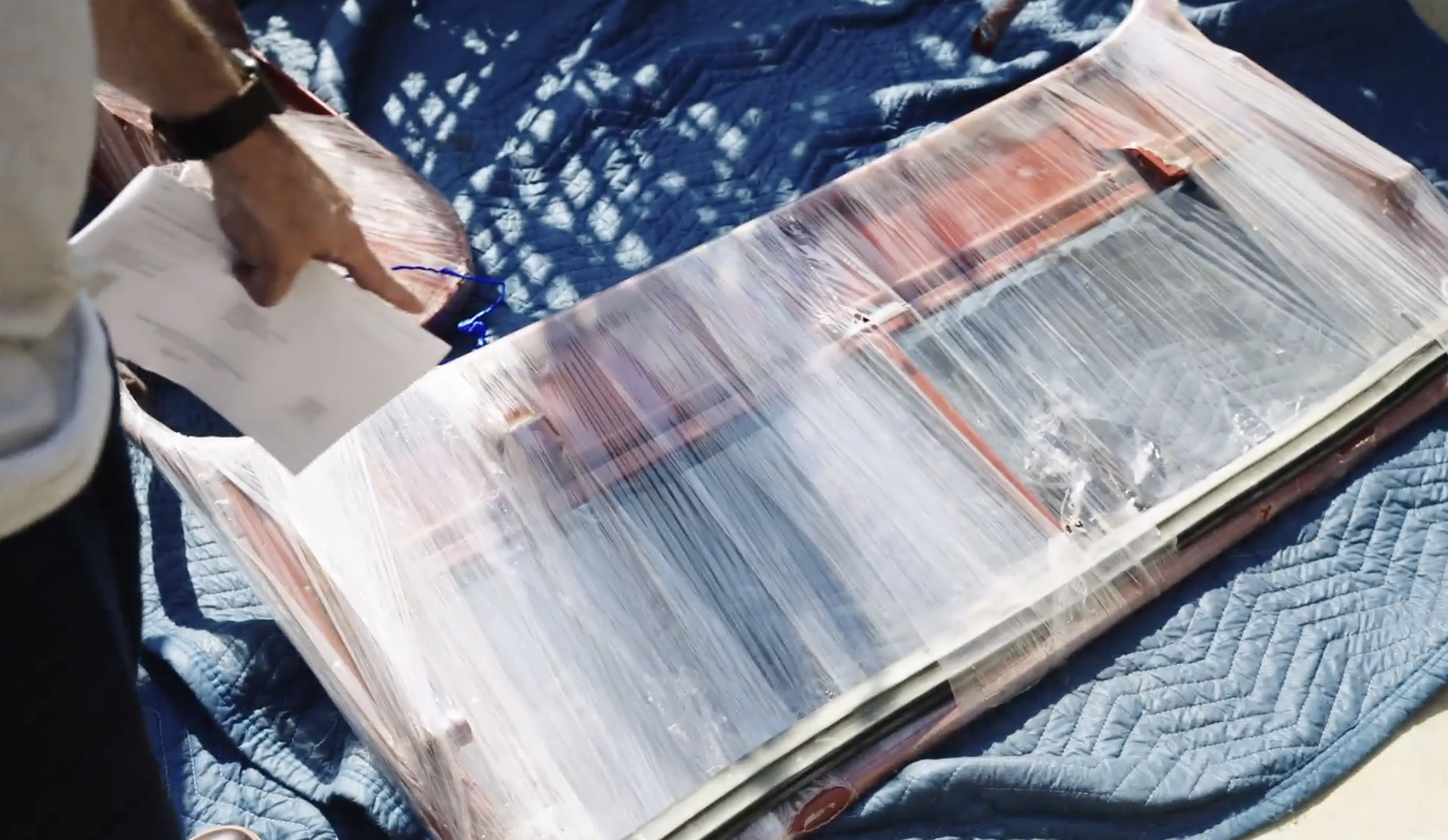
That revealed the hood and windshield below, all plastic wrapped. (Note that the windshield came with a rubber seal, but I’ll have to buy glass later):
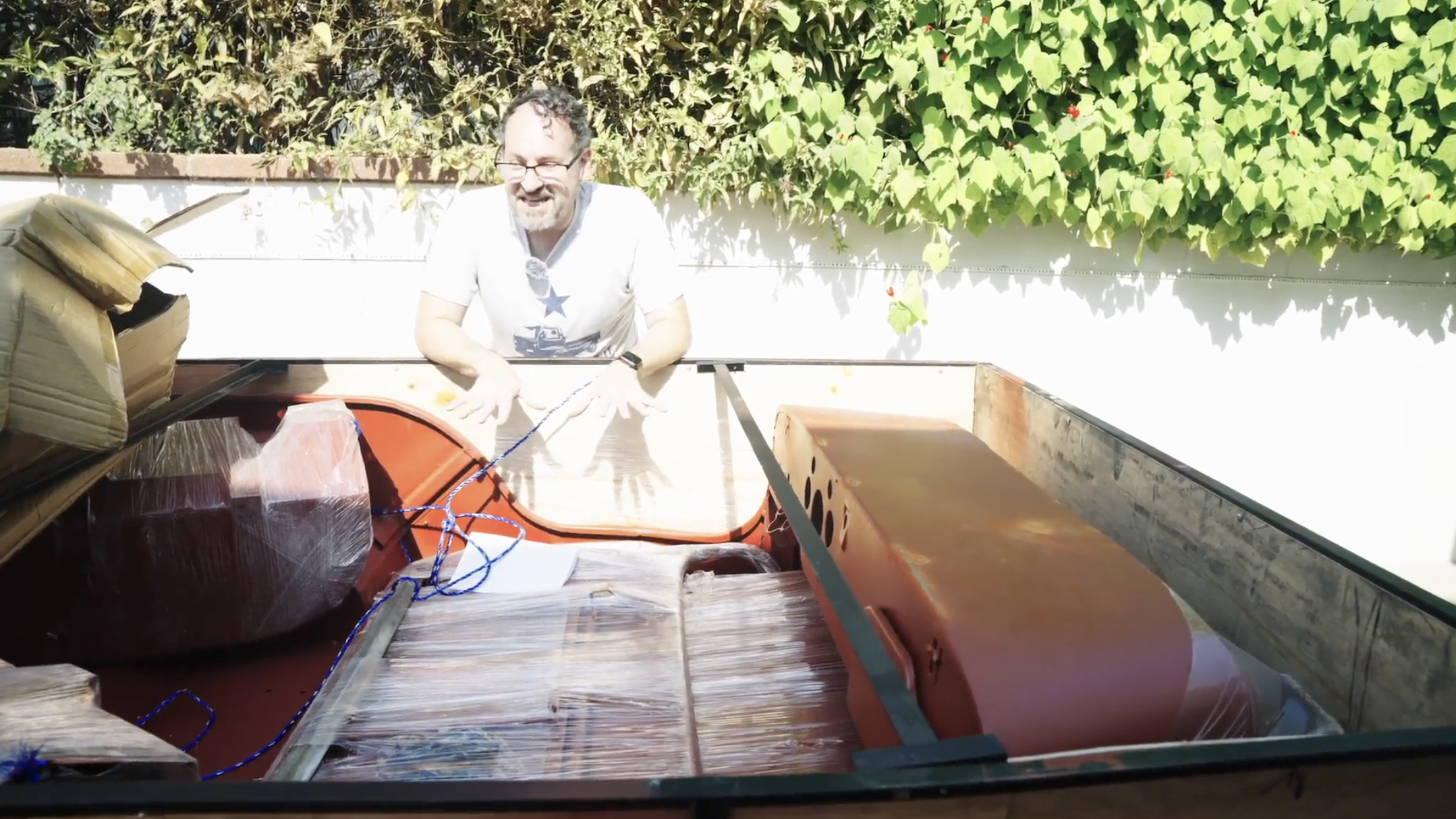
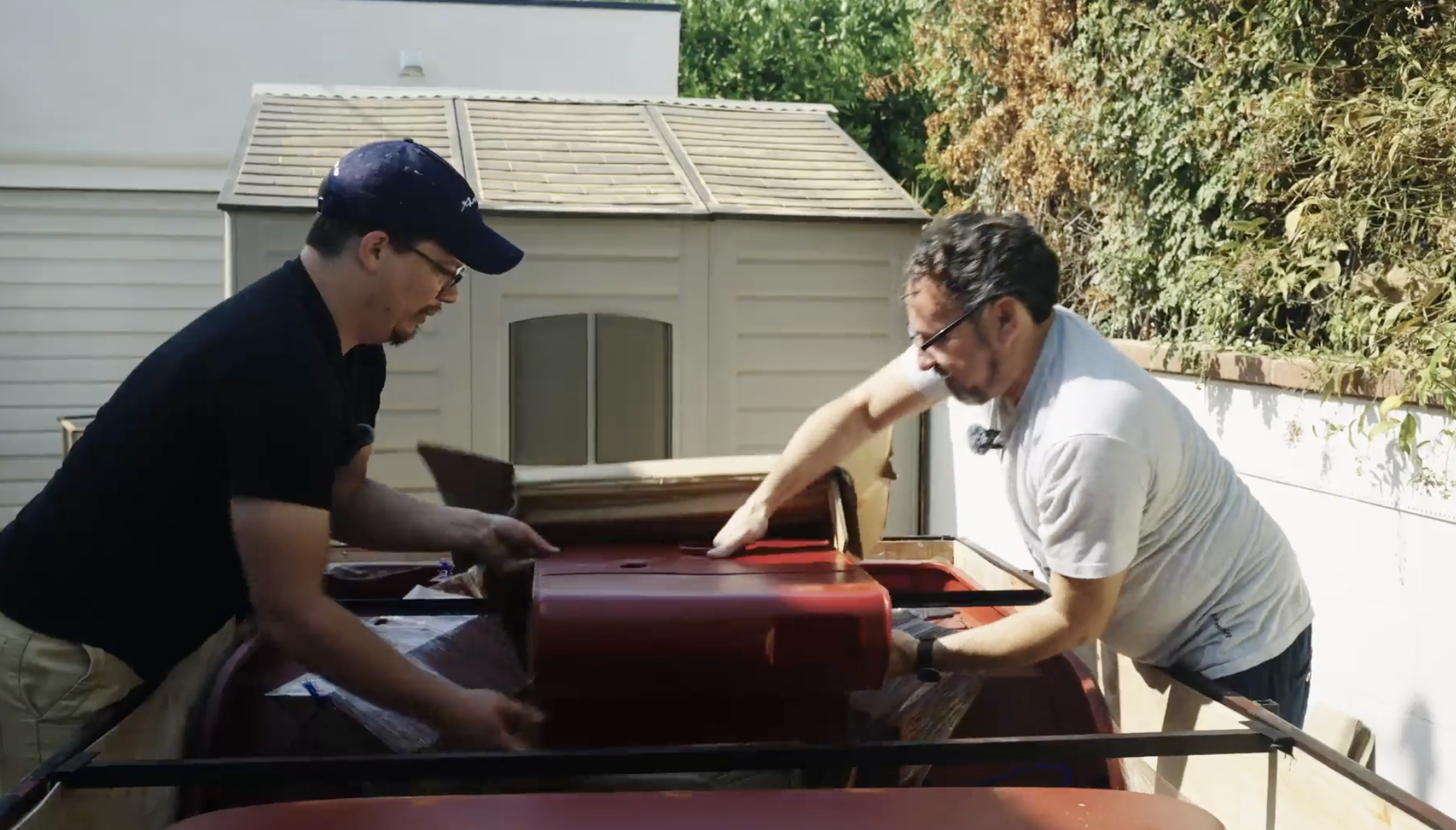
Before taking out the windshield, Jason and I cut the twine holding the two fenders to the back of the tub:
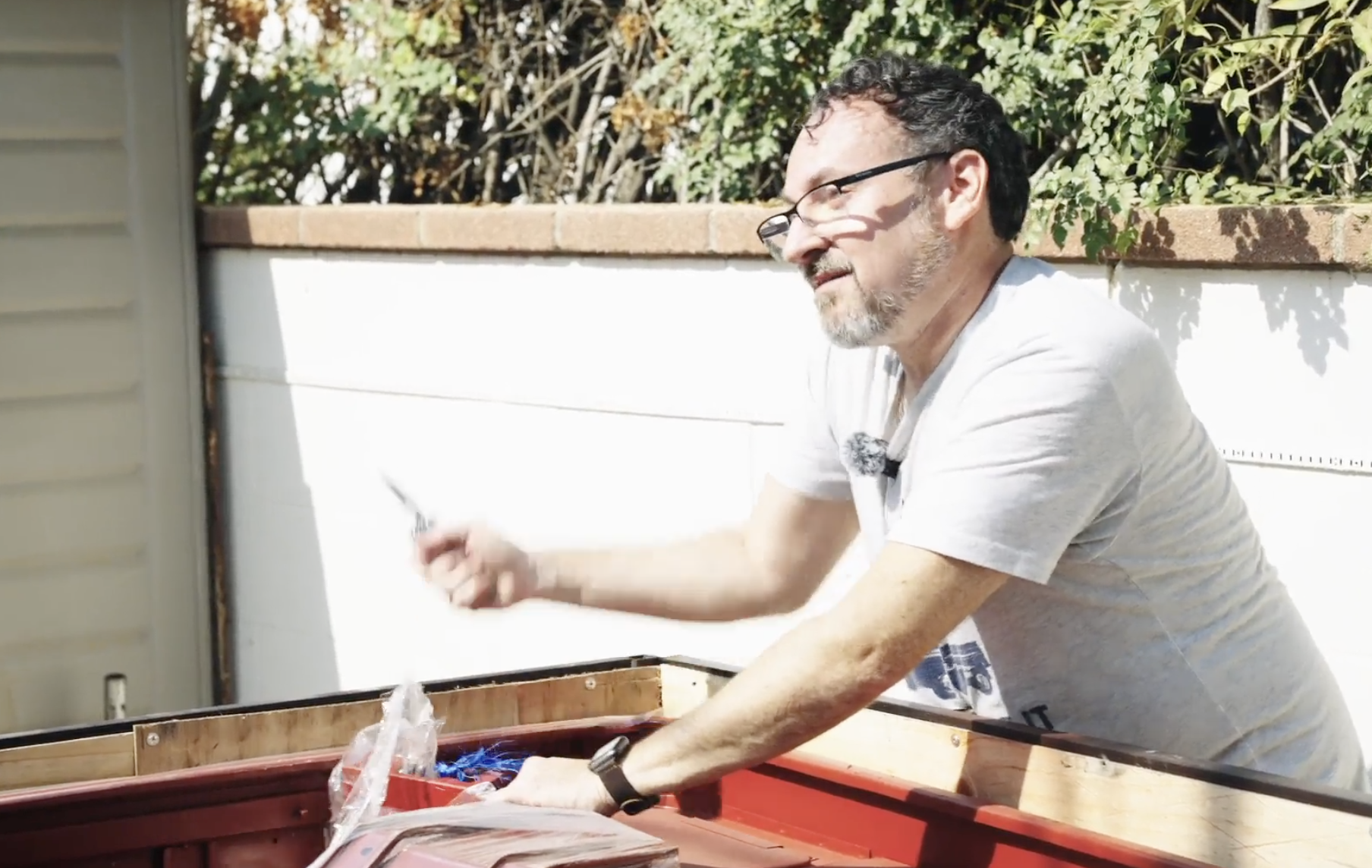
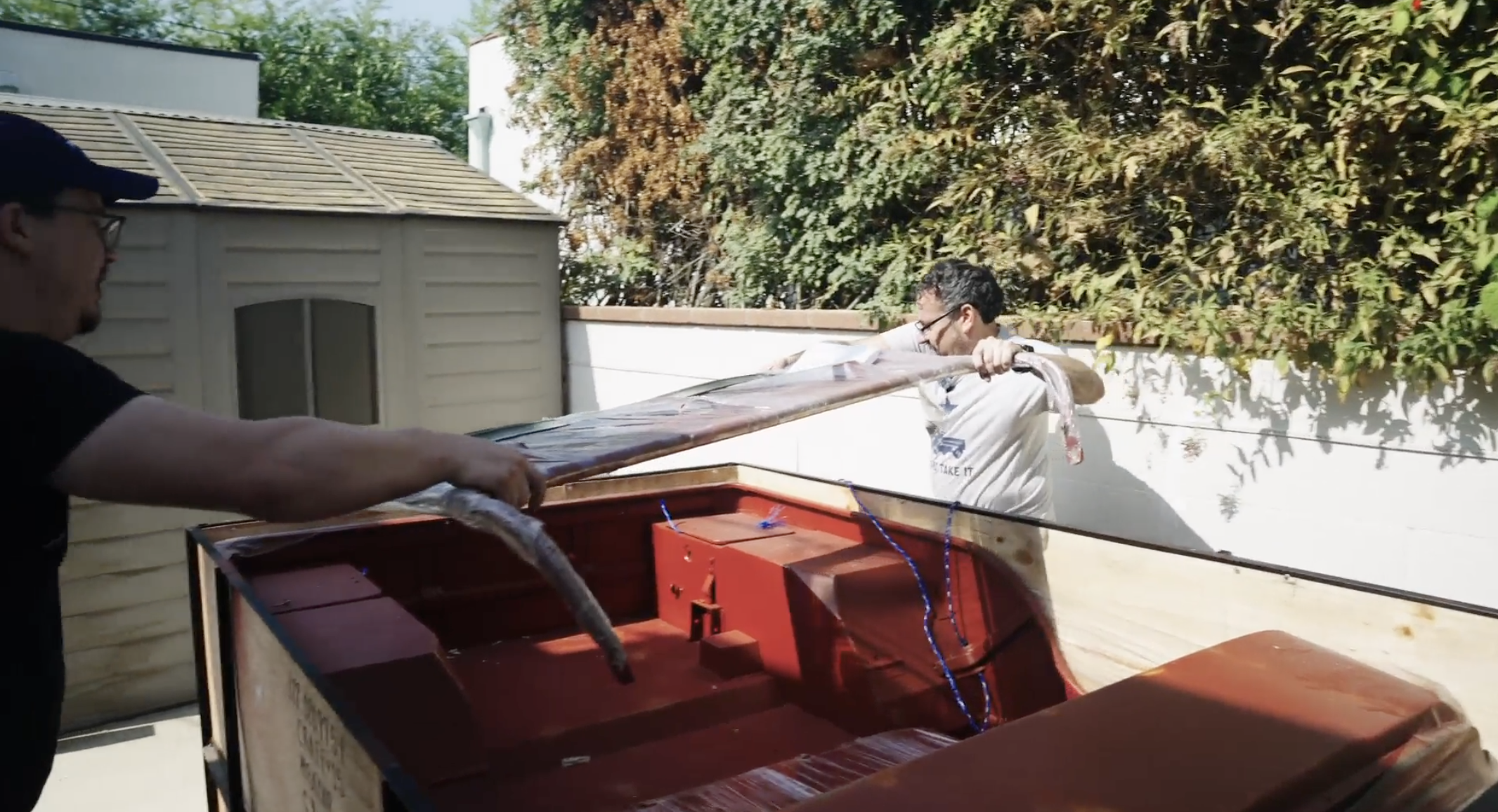
Notice in the photo below of Jason and me removing the windshield, with the front fenders no longer in the rear of the tub you can see the clever toolboxes integrated into the rear wheel-wells:
With the windshield out, we removed the hood:
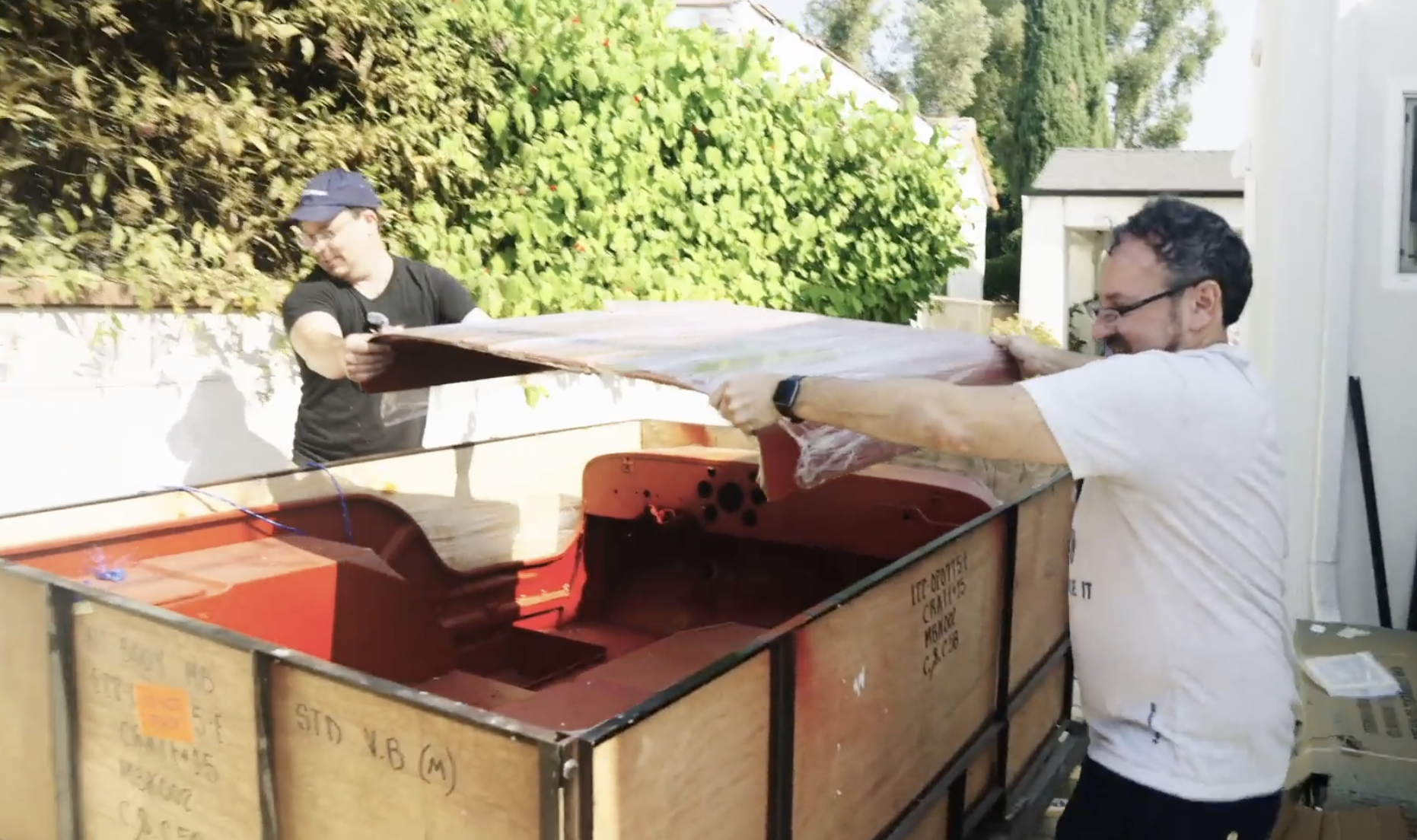
And that was everything! There aren’t many parts to a WWII Jeep body — just a grille, hood, two fenders, and a body tub.
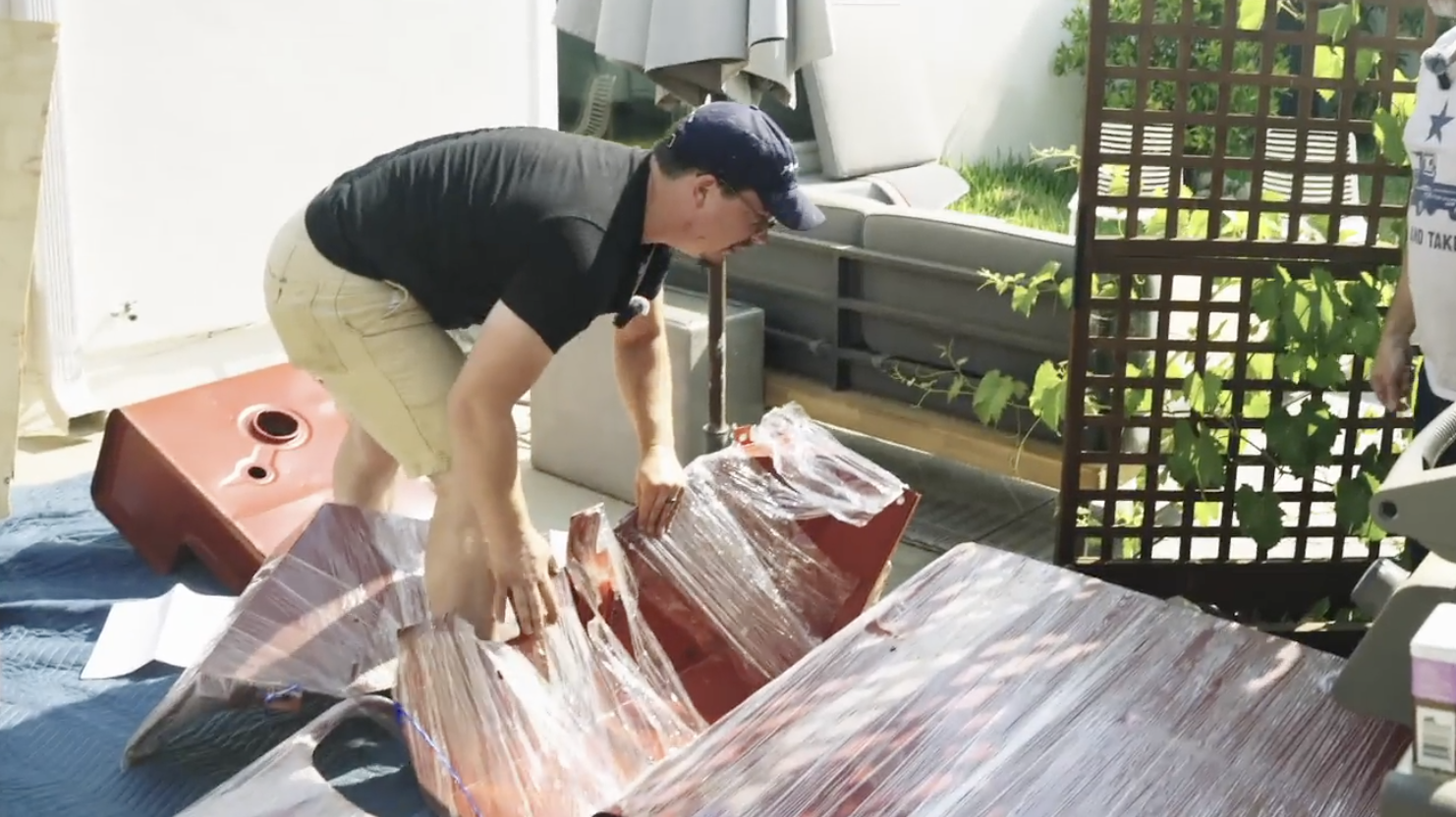
Here’s a closer look at that tub with the crate’s side removed:
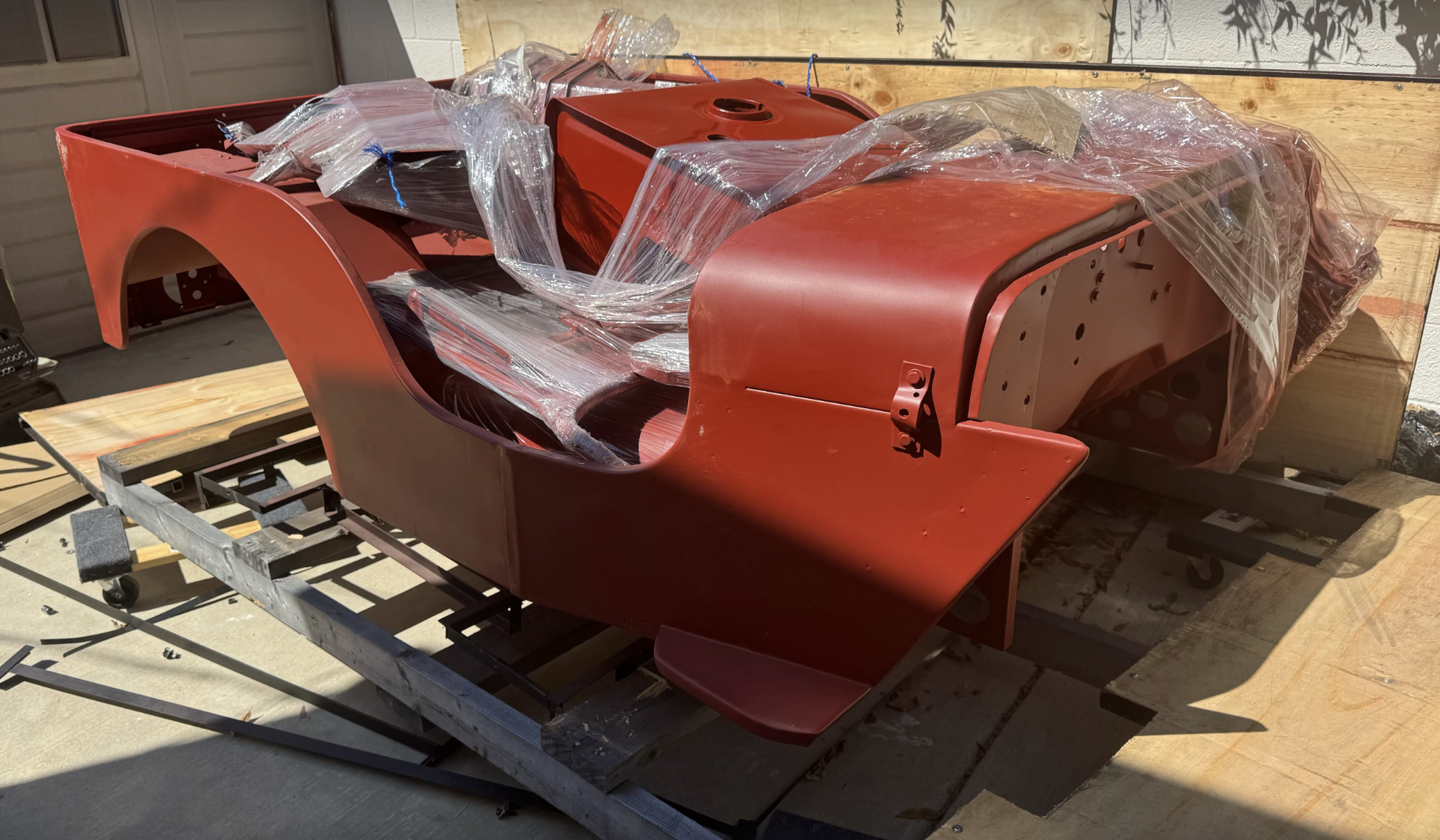
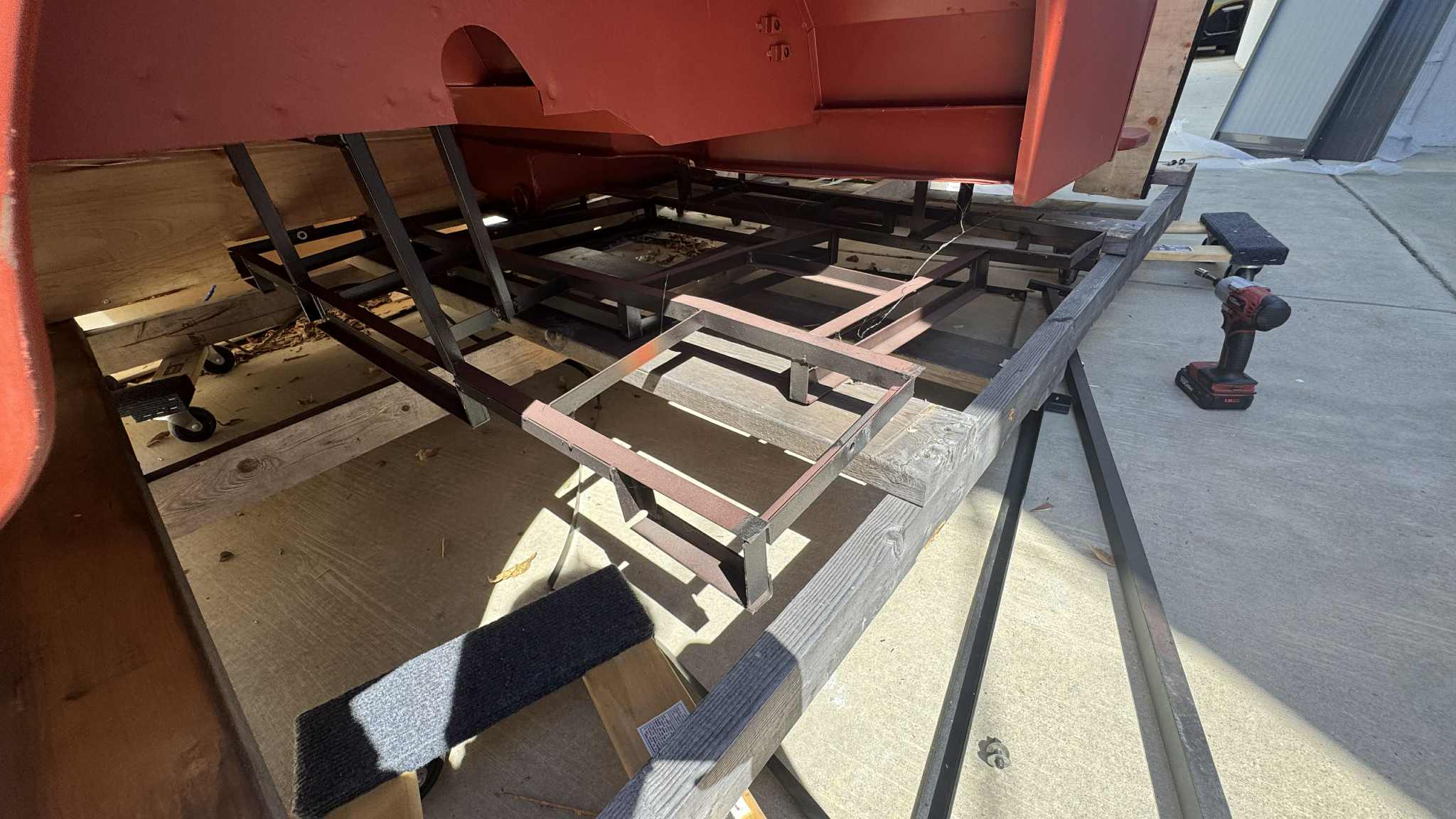
It appears to have made it to the states unscathed, free from major scratches or dings. The packaging included a custom steel box made of angle iron, with some thin wood screwed on and some straps holding it together. Here you can see some of the structure specially shaped to hold the World War II Jeep just so.
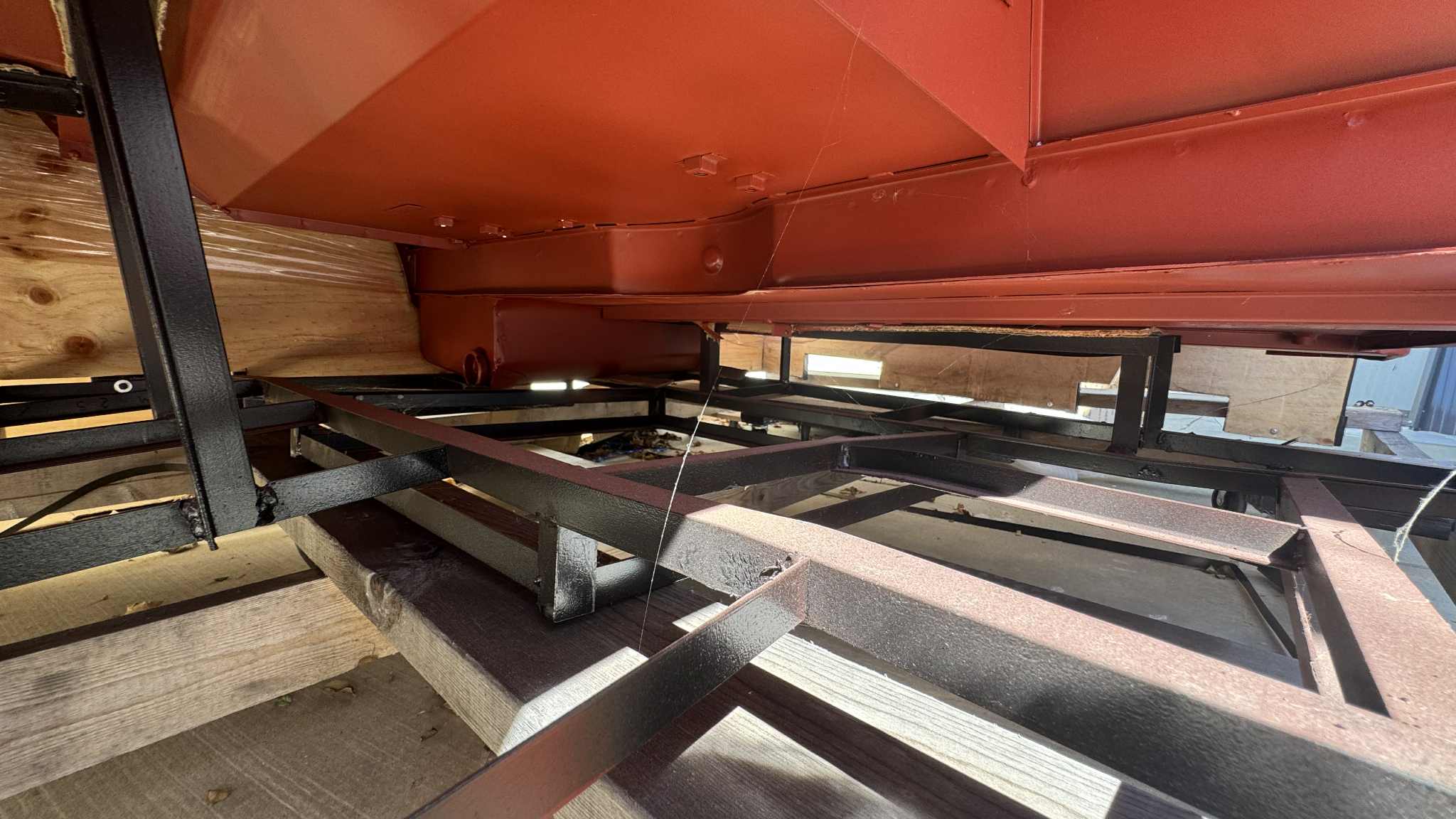
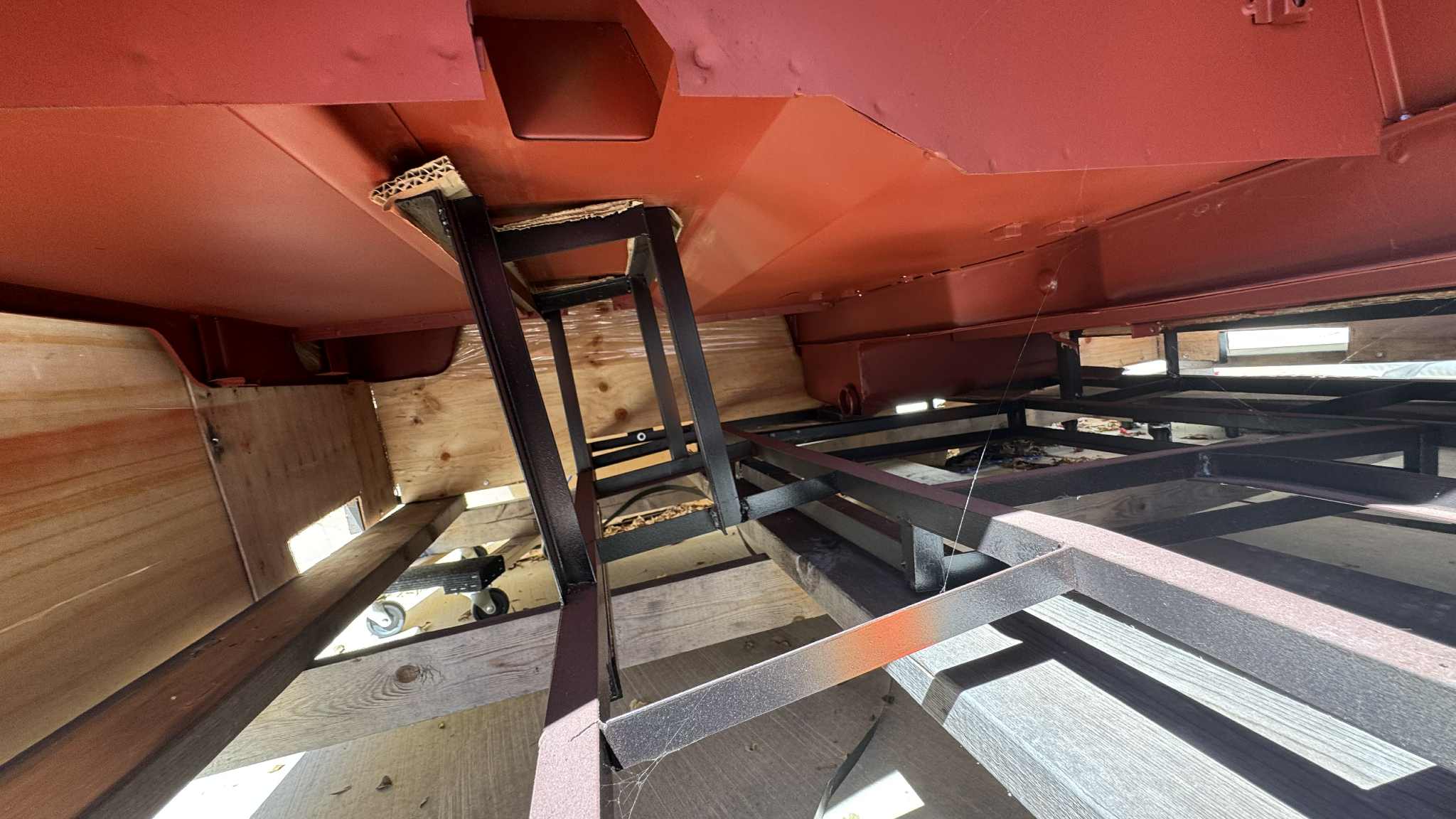
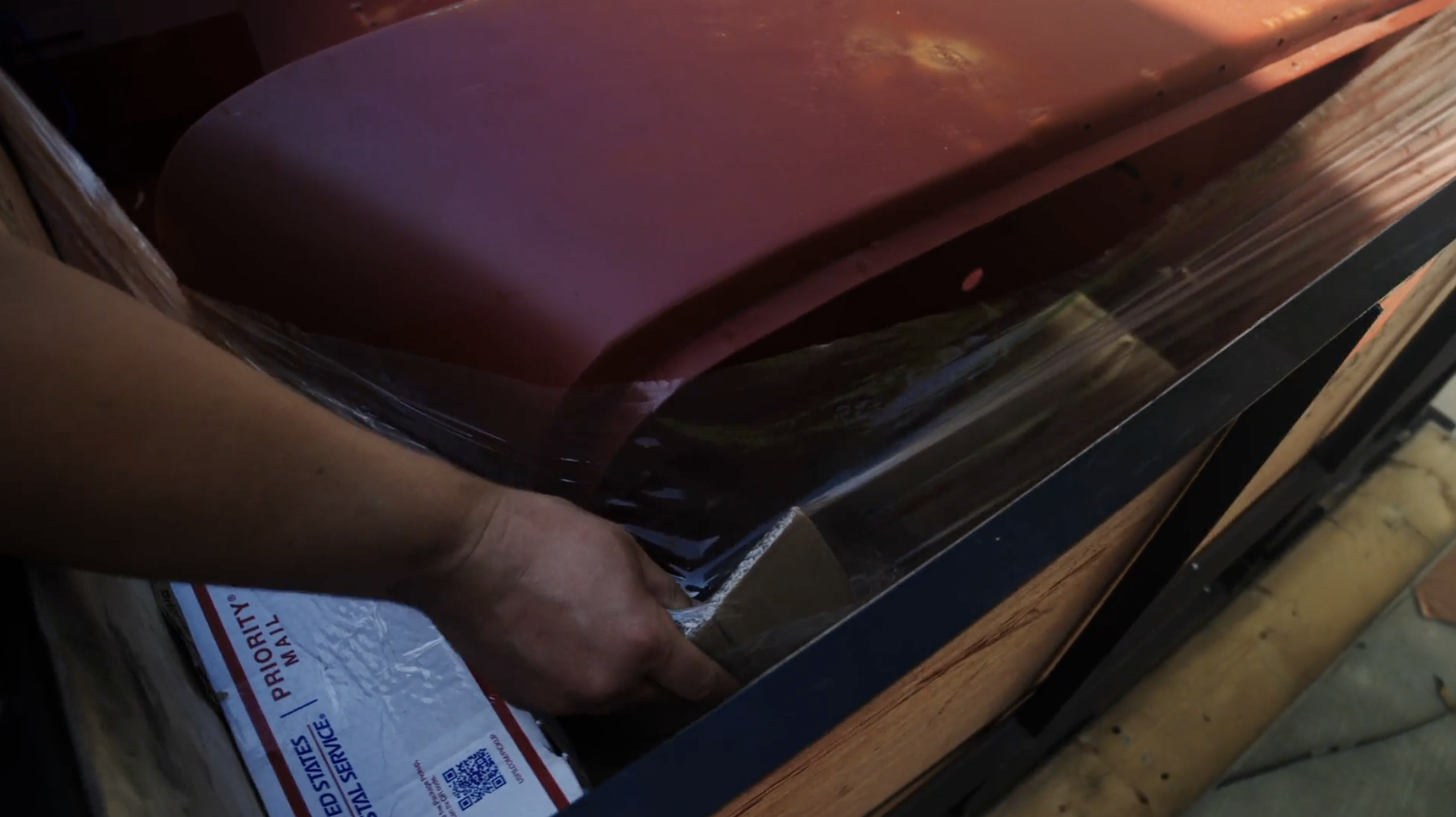
Otherwise there was a pallet from C&C, and just a bunch of plastic wrap and cardboard:
I never thought I’d unbox a brand new body of the greatest Jeep of all time, but here at The Autopian — and especially with the support of our friends at eBay — dreams come true. More on this wild project coming soon!
[Ed note: David mentioned the idea of building a brand new WWII Jeep to the team at eBay, and they loved the idea so much they said, “How can we help?” Their support and David’s Jeep-obsession are the fuel behind this crazy build. – MH]




This is the first unboxing article of any kind I’ve ever been interested in. Good job!
Can’t wait to see the progress on this build! Truly an inspiration for someone that has one too many project vehicles at home lol ????????
I am absolutely here for every update of this project. I want to know everything. I know I can’t reasonably do this, but I want to live vicariously through you.
You’ll need a low-profile engine to fit under that L-Head engine clearance hood, so I think that you’ll need to swap in an EJ25.
eBay is just enabling David’s addiction. But at least this Jeep doesn’t come with a tetanus risk.
Can this company in the Philippines also start building brand new air cooled Porsche 911 bodies? I think they would print money.
The rest of the internet take note: THIS is how you do a sponsored post! Great work David (and Torch). This is definitely going in my glovebox and I’ll be waiting for the sequel posts with baited breath (yes, I spelled that correctly – sorry about the smell of sardines).
I couldn’t be more enthused for this project!
Once again, I am asking for a Mercedes article on Filipino Jeepneys.
That requires a trip to the Philippines…
Let me rephrase that… that is an
Excellent excuse to take a trip to the Philippines!
Enough about the Jeep instructions, I want to know David Tracy’s forearm routine!
I was gonna say – careful with those fenders Popeye!
Years of hauling rusty parts out of junkyards 😀
I know how he’s going to pull this off folks. Judging by the beard and moustache (curiously absent in one photo) this is Evil David Tracy from an alternate universe.
In other words, there’s two of him.
Something like this? https://thelablib.org/wp-content/uploads/2012/10/evil-spock.jpg
Exactly. I mean he did put me in a Rodius.
I was thinking he was just starting to look more and more like Jason, sort of like how couples start to look alike as they grow old together… (or owners and their pets)
It is in California, the land where formerly normal things are now scary.
That red primer, is it red lead oxide primer?
Does it need covering with warning stickers.
Do you need a hazmat team if you scuff it?
Be safe don’t let Delmo lick it.
So, uh, do you often make up stories in your head? None of that happened.
I was just elaborating on fictitious programming from the internets.
I guess you didn’t see it.
It was quite humorous.
Hey I live near C&C (same county)! If I had paid attention and realized that’s where it was coming from I might have volunteered to haul this to you. Although that would be quite the trek from southern Indiana for someone without much spare time.
I’m a little further south, but trek up your way quite often to ride motorcycles. I have been past C&C many times,but didn’t realize that they had this hookup. I’ll need to keep this in mind for a future project…
A Jeep without rust? Inconcievable!
He’s got to drive the completed article through Detroit in winter in order to David-rust-ify it.
That Ryobi oscillating tool works well, especially with the LED, but it’s super unsafe. The “on” button latches, so you can turn it on and it won’t stop even if your thumb isn’t on the switch. You can put it down while it’s still running and it’ll happily keep running.
I like mine well enough, but it’s not as safe as it should be IMO.
I had a Bosch that had a switch that was like that. I now have a Milwaukee M18 and don;t have that problem.
Oscillating? That’s an angle grinder, isn’t it?
I recently bought a Milwaukee M18 one as well, and they offer both ones with a large paddle trigger, and a traditional sliding/latching switch. I went for the paddle one, which is probably safer, but I was probably more motivated by it looking more modern/cooler, in all honesty
That’s the angle grinder with the safety shield removed. Thank you for subscribing to Ryobi facts.
Huh, really! It looks a lot like the oscillating tool! I stand corrected. But be careful.
I love those old printed instructions, using the font what was the Arial of the time. No idea what was it called, but it is instantly recognisable and impossible to properly reproduce with word processors.
The kerning and overall alignment were done by hand, and so every piece is different, yet they all look the same with their imperfect, “good enough” look.
+10 internet points for allowing me to see the word “kerning” today!
BTW, what IS kerning? I could look it up, but I’ll wait for fellow Autopian to chime in, it is much more enjoyable to learn things from you all.
The horizontal space between letters, adjusted as needed for aesthetic and alignment purposes. Different letters will have different spacing depending on their shape.
To add on to Harvey’s Smokehouse Brisket’s excellent explanation, I will mention to you ‘kerning pairs’ to help understand.
Consider the word ‘ill’. Far more work than you would ever think went in to deciding how far apart the “l”s should be, especially next to an ‘i’.
Actually, that is not a great example. Ummm.. “AV”, “To”…. It is where a letter may look great with kerning ‘x’ against 24 other letters, but against the 25th, its kerning needs adjustment.
I think the “good enough” connects us with the human behind the work. Especially now that you can’t tell if the very words you are reading are machine generated.
“It not just about visuals — it is about feelings, connection and human interaction”, as any LLM would say without truly understanding it.
Exactly! I know a luthier whose instruments sound and play great but don’t have the same build perfection that top-tier luthiers achieve today, even with just hand tools (which is shockingly good). For example, he doesn’t use molds to keep his guitars’ and violins’ bent sides in their exact shape, so each instrument he makes won’t be exactly the same as another down to the 1/8 inch, etc. He calls this “evidence of the hand” and I kind of dig it.
The sans-serif font is Futura. The company I work for still uses it today, and partly for visual continuity in printed materials.
Typography fashions do change over time, so the letterspacing and kerning on digital versions of Futura and derivatives are different today, but the typeface is essentially the same. Part of the difference is that construction of offset masters and systems like Letraset and others did proportional spacing, but not quite to the exacting level you can get with digital typefaces. There will always be a distinctive “look” to hand-done and analog automated typesetting.
Thanks! Can you show any of the modern interpretations of this old style material, from your company or any other?
Just search “futura typeface” to get info on its history and samples. Variants are still widely used around the world and in different languages.
I should mention that it originated in Germany in 1927, so it has a great deal of Bauhaus influence in its original look. There are lots of samples online, from historical to modern re-interpretations.
As for my company, it appears mainly in internal materials and documentation, and in sales quote sheets. I’m not in sales, so I’ll stay out of trouble and not link to any of those without permission. 🙂
Edit: A version is included in Microsoft Office products. If you have Word or PowerPoint on your computer, it’s probably there and you can try out a modern version yourself.
Any ideas about the body text? It’s either a pretty heavy font, or a demi-bold of something maybe? By today’s naming anyway, I don’t know about back then.
The Microsoft version should have a simple body text-appropriate face.
But… By nature, Futura and variants tend to be “wider” per-letter (a letter nearly fills the diameter of a circle it’s inscribed within) and traditionally use wider lettterspacing for an “open” or “airy” visual impression. Modern digital versions sometimes condense letterspacing/kerning a bit for increased readability, at least around 12-point regular or so. Some condense the letterforms a bit as well, which really starts to drift from the original appearance.
A good on-screen compromise is Monotype/Microsoft’s “Segoe” typeface family. It has similarities to Futura, although it’s not really a derivative. (It’s closer to another called “Frutiger” which is a Swiss sans-serif typeface originally intended for signage.) Segoe variants adapt well for onscreen displays and digital publication and Segoe UI is part of the default typefaces/fonts installed on Windows, so it’s easy to play around with.
If you’re looking to do something with professional typesetting, remember that the division between display fonts and print typefaces still exists. You need an (expensive) extremely high-dpi monitor to accurately see what a print typeface really looks like on a screen. And even then, the screen appearance may be slightly “off” from a print sample for appearance and readability.
I haven’t dealt with print layout for any work in decades; I learned on paste-up and galley print approvals for hot-metal type from before desktop publishing took over. But DTP has certainly streamlined things… and created new conundrums and pushed the evolution of typography in interesting ways.
(Also, how few other places than the Autopian can a thread drift off into nerdy discussions of typefaces and obscure printing technology… 🙂 )
Thanks for the info! The tangent discussions here can be as enlightening and entertaining as the automotive chat.
Actually I wasn’t referring to a body version of Futura, but rather to the body paragraph text in the ad — serif type, fairly heavy but still easily legible. Crossed W’s, and the diagonal stroke on the R extends a bit farther than the loop. Looks like the lowercase ascenders might have triangular serifs.
Just wondering what this would look like with a set of tri-spoked Mustang wheels?
Will need to get my coworker on here and following this. If he had more time and money, this is his dream project. A little slice of home for him. He’d love to learn to drive a manual and just drive around downtown on the weekends in one.
Wow, the welds on the support frame sure are… welds. And all the overspray, guess they paint it on that structure and send it. Makes sense to me.
Growing up in the 70s, those $50 Jeep ads were everywhere an impressionable person would see them. At the time I figured the catch was that you’d get the title (do military vehicles have titles?) and picking it up from Guam was your problem.
I particularly remember the ads for the Austin champs with a “Rolls-Royce engine” available for $50.
Keep in mind that $50 was a lot more then. A Ferrari 250 SWB was worth about $3000 in 1970. Now, about $5 million for a nice one.
If you see any $80,000 WWII jeeps let me know.
The new in crate Allison V-1710 engines for $250 seem like a bargain in retrospect.
We had a bunch of deuce and a half CCKW 6×6 trucks and a military Caterpillar and roadgrader that were very cheap.
Now that I know the pedigree of this, I will be deeply disappointed if you don’t finish it in full Jeepney livery. Heck, I’ll even fly to LA to help with the graphics and painting.
Hint: I’m not that good, but this is outsider art after all.
Outsider art is the best art. Screw the establishment!
Is it me, or is DT getting kinda swol? (Don’t worry, Elise(NHRN). I am just admiring. I can respect he is a happily married man.)
I was thinking the same thing ????
Same, I was mirin’ DT’s guns.
“I thought YOU had the instructions!”
Score! We have an extra bolt left over!
I’ve been calling it Cacahuete Park (not a real location) since reading a post on another thread talking about making up your own LA neighborhood names just by adding “Beach” “Park” “Heights” or “Hills” to the Spanish name of any fruit, vegetable or flower.
Or “Canyon”
“Estates” works, too
Seeing David’s previous place something like “Willy’s Gulch” might be appropriate here. Though there is an alarming lack of junk vehicles in his new yard.
La Brea de Autopartes
Peyote Desert?
Just got married and singing this to the wife:
I got somethin’ real important to give you
So just sit down and listen
Girl you know we’ve been together such a long long time
(Such a long time)
And now I’m ready to lay it on the line
Wow, you know it’s Christmas and my heart is open wide
(Open wide)
Gonna give you something so you know what’s on my mind
(What’s on my mind)
A gift real special, so take off the top
Take a look inside it’s my Jeep in a box
It’s in a box.