

It feels a bit half-hearted to say that the EV market is about to get weird, mostly because it’s already become weird. Tax credits are gone, new choices are thinning a touch, nobody cares about the Cybertruck anymore, and used EVs are generally getting relatively cheap. Maybe too cheap for some owners’ liking, as several EVs failed to sell the other day on Cars & Bids.
See, Cars & Bids isn’t a normal used car classifieds site, it’s an auction site where bidders compete by throwing bands. When does it end? Sometimes it ends when one bidder runs out of Benjamins to swing around, but other times it ends when the last bid doesn’t hit reserve. Traditionally, cars at auction carry a reserve price, a secret floor price that the seller and auction company agree to. The amount’s not publicly disclosed, and if bidding crosses the mark, it’s game on. If bidding doesn’t reach the reserve price, the seller keeps the car. While a reserve prevents a seller from signing over a title while seeming unhappy about the sale price, multiple cars not reaching reserve is generally a sign of choppy waters ahead.


In this case, we have three late-model electric vehicles, all of which failed to meet reserve on Tuesday. While it seems the would-be buyers of these machines are out of luck, the fact that none of these things sold points toward a larger, emerging pattern in the marketplace.

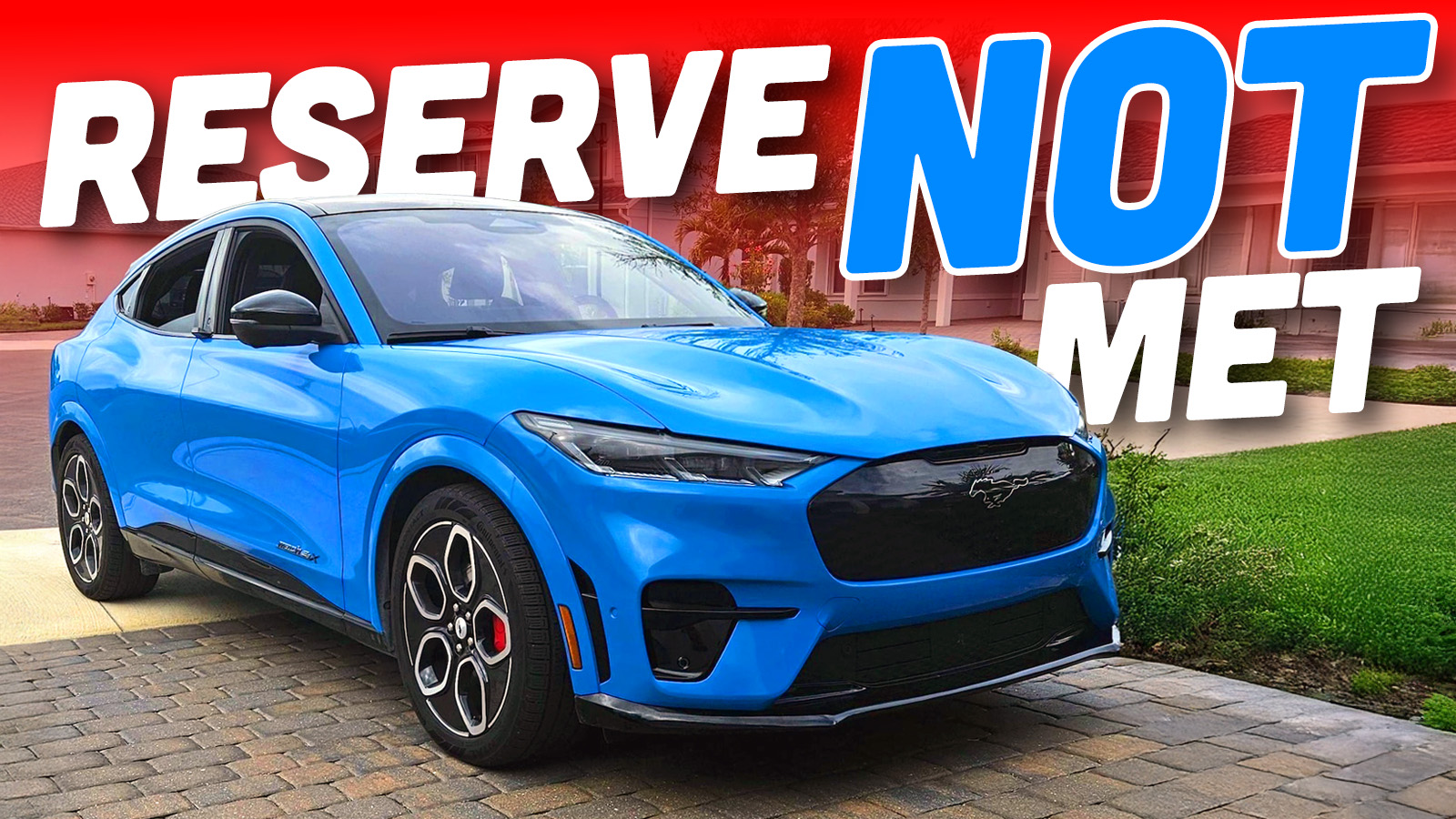
Let’s start with the most popular car that failed to sell, a 2023 Ford Mustang Mach-E GT. Sure, it’s in a great shade of Grabber Blue and only shows 5,051 miles on the clock, but it was a no-sale at a high bid of $31,500. The Carfax is clean, the car itself presents well, but even at 47.7 percent of sticker price, no dice. The market just didn’t bite the seller’s reserve.

Looking at comparable examples in the open marketplace, $31,500 seems about fair value. For instance, here’s a 2023 Mustang Mach-E GT with 6,822 miles on it listed for $31,416 in the same state as the Grabber Blue car. Sure, the lower mileage on the Cars & Bids example is worth something, but not enough to go above and beyond the five-percent buyer’s premium.

Next up, it’s a 2025 Lucid Air Touring, a posh dual-motor electric sedan rated for a bladder-busting 431 miles of range. It’s well-specced with $2,500 spent on upgraded advanced driver assistance, $3,000 spent on the Comfort and Convenience pack for niceties like window shades, soft-close doors, and a heated steering wheel, and $2,750 spent on massaging ventilated front seats. All-in, this electric luxury sedan cost its first owner $94,500 before tax, but one year and 8,400 miles later, it can’t bring in more than 56 percent of the original purchase price. The high bid came in at $53,500, and it simply didn’t meet reserve.

Admittedly, this one’s a bit hard to value considering it’s so recent and has such little mileage on it, but it’s historically not surprising that the market has spoken on previously listed examples. This highly-optioned 2023 Lucid Air Touring sold on Cars & Bids back in 2024 for $50,500 in a deal reached after the hammer dropped and the reserve wasn’t met. Sure, it had 17,500 miles on the clock, but supply was also tighter in 2024.

Finally, there’s this 2023 Rivian R1S Adventure Edition loaded up with the quad-motor setup and large battery pack. Even though Rivian’s R1 series of vehicles has received a significant tech update since 2023, these first-series quad-motor models are still unbelievably quick. Yet, with 19,800 miles on the clock, this one failed to hit its reserve with a high bid of $54,500. One commenter noted that this example was previously listed on the Rivian forums for $68,000, so is this just a case of a seller thinking their vehicle is worth more than it actually is?
Well, yeah, all of these are. While auctions—especially record-setting ones—aren’t always indicative of broader trends, they show what a set of buyers is willing to pay for a particular vehicle in a particular time period. You might see comparable examples listed for more on typical classified ad sites, but those are just asking prices. They aren’t necessarily indicative of final sale prices.

It’s no secret that we’ve moved into a relatively cool EV market. Models like the Ford F-150 Lightning, Volkswagen ID.Buzz, Kia EV4, and Chevrolet Brightdrop have either been put on hiatus, delayed, or cancelled altogether. Federal tax credits are gone, and at the same time, EV sentiment is weakening. According to AAA studies, in 2023, 25 percent of individuals surveyed said they were either likely or very likely to buy a battery electric vehicle. By 2025, that figure had dropped to 16 percent, while the number of undecided respondents fell from 24 percent to 21 percent. This last point is especially important for the second-hand market, because when it comes to selling quickly, desirability is pretty much everything.

At the same time, we’re about to see a flood of EVs in the secondhand marketplace. We’re now about three years removed from the December 2022 decision to apply a $7,500 federal tax credit to EV leases, and that had a profound effect on the EV market. While the proportion of new vehicles acquired on lease fell to near-record lows over the course of the chip shortage, this tax credit decision supercharged EV leases in 2023. According to JD Power, “Lease volumes for new EVs surged 355% throughout 2023.” With an average lease term historically hovering around 36 months, we’re very much in a buyer’s market for second-hand EVs. Expect pricing to respond accordingly.

Are these no-sales exclusively an EV phenomenon? No. Pretty much every day, a variety of cars fail to sell on digital auction platforms for a variety of reasons. Maybe the car itself is relatively unpopular, maybe the example itself isn’t that nice, maybe a particular seller’s expectations just aren’t realistic. However, with these recent EVs in particular, there appears to be a pattern and credible data to support falling prices. The next few years are going to be a great time to buy a second-hand EV, and if you already own a battery-powered vehicle, maybe just hold onto it. It’s perfectly good everyday transportation, and the longer you hold onto it and drive it, the less painful potential losses may be.
Top graphic image: Cars & Bids



There is a bell curve of people and what they are willing to pay for a specific car in an auction environment. When the top person wins a car they will likely no longer be in the market for one, thus pulling the person with the most cash to swing at an auction out of the pool. Sometimes some one new comes along and replaced them but this will drive prices down as it’s simply supply and demand for said model coming into play. There is almost always another car if one gets away.
I think part of the depreciation on EVs is timing – not only was the MSRP set with the assumption of tax credits, but also a lot of them came out in the 2021-2023 range when a lot of gas cars were selling for well over MSRP. They still probably depreciate a bit faster than gas cars for the most part, but I bet if you compare post-rebate/post-markup price paid new to current the gap shrinks a fair bit.
I can snag a good ionic 5 for 25k. I’m editing for under 20. F bAT
I can’t wait for DIRT CHEAP (used) EV SPRING!
I’m here for it, if we have a bunch of off-lease EVs being dumped onto the market, they’ll be competition for all cars and hopefully drag pricing down even more.
Overall, it appears that used prices are starting to drop a bit: https://www.cargurus.com/research/price-trends
Also, those “Mustangs” won’t sell because of those MFing ugly wheels! Why did Ford think that buyers would want a flower pattern wheel? They’re also the lower-rent GTs, the ones with the perf package have different (better looking) wheels.
There is an article on InsideEVs, I think, that indicates EVs have overtaken gas cars in Europe. This article came out 3 days ago and cites sales and market share. EVs continue to sell robustly in the European market despite the reduction or elimnation in subsidies.
The American market seems to be an outlier in world-wide EV sales where the Chinese seem to be dominating the global market. With the nascent trade deal between Canada and Chinal, cheap Chines EVs will be available for US consumers who can just drive across the border to procure a fairly decent, loaded Chinese EV and bring it home.
The Chinese have priced their brand new EVs in the mid-20K to 30k range. Unlike American manufacturers with prices in the 75K plus range. Except GM is killing it’s lowest priced and most affordable EV, because it is not profitalbe and is pivoting back to gas cars. Soon, the rest of the world will be EV-oriented except for the United States, which thanks to the current administration, will continue to burn fossil fuels.
Can you just bring a canadian car into the US and register it? I didn’t think that was possible.
If it’s a model that was sold in the US and that meets US emissions and safety regulations such that the US and Canadian versions are functionally identical, then yes. When I was shopping 2021 F-150s not all that long ago, I found a bunch of used ones that had begun life in Canada and somehow ended up across the border and all the way in my relatively-southern state. And even then, you run into cross-border issues regarding warranty and parts support, depending upon the brand. For instance, Ford seems to honor Canadian warranties in the US, and vice versa, while Volkswagen does not. Furthermore, when you take the car into service, the VIN may not even decode such that they can identify and get parts for the car.
If it’s a car that is sold in Canada and not sold here, you might be able to insure and register it, but probably not.
For a Chinese EV, it’d be a terrible idea. One of the problems with the Chinese EVs seems to be absolutely after-sales service and longevity support, and you’re going to exacerbate that problem if you take it to a country in which the brand has no presence.
No, you cannot import a vehicle that hasn’t been federalized. Chinese cars sold in Canada and Mexico cannot be imported into the US. Foreign citizens can bring their own personal car into the US on a temporary basis, but it would be illegal to sell that used car in the US if it wasn’t over 25 years old.
what the market is telling me as i drive down the highway is that there are plenty of these EVs in dealer lots…so why am i gonna pay an auction premium for something that’s freely available?
No one wants your shitty old used computer. This has been a fact, and will continue to be a fact.
Spot on!
I just bought a relatively recent computer that was unable to switch to the new windows version. Cost me about 70 euro. The thing is a spaceship on linux now.
Same for the two used EVs in our household. They were dead cheap and they are going strong with little depreciation.
I just don’t understand this trend of buying high, selling low.
I don’t think we can really learn much about the EV market from EVs not selling on Cars & Bids, a site that auctions mostly enthusiast vehicles to an enthusiast crowd.
The US is being left behind, EV sales in the EU keeps going up. Hybrids sold the most, then EVs, then just gas powered. US car makers will have nowhere but the US to sell their cars. Car markets are quickly separating again after a push for world cars despite agreements between the EU and US.
oh no! The EU is leaving me behind. LOL have you seen the EU’s economy? They can keep going where they are going, good fucking luck.
While I find your comment mildly offensive, you are probably correct.
And with the dollar basically collapsing in value, domestic production will grow even stronger.
I think once this AI bubble pops our economy isn’t going to be looking that great. The friends that I have looking for jobs have been looking for a while. This Amazon layoff event is going to compound their problems.
I hope to hell it pops soon. It needs a correction.
Wait EVs depreciate badly???!!!!! Who knew?
While the resale values are certainly not going to help sales of new ones, what I don’t get here is the extremely low mileages. These aren’t exotic, weekend toys. Why bother buying an expensive car that should cost less to run than an ICE and whose overall benefit to the environment only works out in comparison to ICE when driven a lot of miles? The depreciation is bigger in the short term, as well, so you’re making a huge financial hit all the worse and not utilizing the benefits. I suppose if they only do short occasional trips, a gas engine doesn’t like to sit as much and short trips aren’t good for the engine and an EV works better in that situation, but if you’re only keeping it for a few years, anyway, it’s not relevant. At the present time, the math really only makes any sense if you drive them into the ground. I can’t help but think these people are just stupid or, to be more diplomatic, financially irresponsible. Maybe they aren’t concerned with the loss of money (why a reserve, then?), but that still doesn’t make it a smart play.
I assume they are bought by guys like me. I have five cars, and not one of them is boring. I don’t put many miles on any of them – max about 7K in a year if I drive one to Maine and back from Florida, less than 4K if I don’t – three of them never see more than 2K in a year. Back when the automakers actually made cars I wanted, I bought a LOT of new cars just because I COULD, and I like cars. It’s not financially irresponsible when you have enough money it doesn’t matter – but I will also say I have never lost anything like as much money on a new car as these guys did – my tastes are more modest – and I will admit I am a cheap SOB – I don’t buy unless I can get a GOOD deal). I bought them right, and I sold them right, as a rule.
So I assume that a lot of these guys bought them because they thought they would be cool, but for one reason or another they decided they didn’t actually like the thing all that much and are getting rid of it. Nothing wrong with that. Basically the same situation as my BMW M235i. But I only lost about $6-7K on that car in 18mo, and I did have a heck of a good time driving it around Europe for a month with my mother.
It’s not responsible just because one can bear the cost. In this case, having a bunch of cars doesn’t make any more sense to me as these aren’t fun cars, they’re fancy commuters, and that’s where their strengths and value lies, but they obviously weren’t used as such. If they have a bunch of cars, why’d they buy something that’s best as a heavy commuter that they didn’t plan to drive and, if they needed a commuter, why didn’t they use it as such? I get buying some legendary car, icon, something you always wanted, or with a great reputation as a driver only to find out that you just can’t connect with it and moving it on in disappointment, but these? OK, maybe, though it seems odd that there are so many. Then, as a theoretical potential buyer, I also have to wonder if they hated them so much or had so many issues that they wanted them gone no matter the loss even with the warranty coverage. I made a similar determination a year after the “new” MINI came out. The number of year-old cars on the market with low miles on them had me wonder if they were either POS and/or highly disappointing. Turned out to be correct about the former as all the issues came to light and a test drive confirmed the latter.
I dunno – a friends of mine had two of these Fords, and while I am not a fan of EVs in general, they certainly ARE performance cars and not dull commuters like a Corolla, especially in GT form. Like I said with my M235i – sometimes you buy something and it just doesn’t click the way you think it will. And don’t forget – Mach-Es were recall queens – maybe they got tired of them sitting at the dealers and being buggy? That is why my friends no longer own two of them. Replaced with an Ioniq 6 and an Ioniq 9 (which isn’t long for their garage either – they hate it, but like the 6).
A Lucid is a legit full-on luxury car. Most luxobarge owners own LOTS of cars. It’s what I call a “going out to dinner car”, and would sit in the garage with their 911, Range Rover, some vintage something, etc. They probably drive their luxury SUV to work most days. Who knows?
The nice thing about having money is you can spend it as you damned well please. If you want to blow some of it on a new car you only keep a short while and don’t drive much, if it isn’t causing your kids to go to school with holes in their shoes or causing you to wonder if you can pay the mortgage, so what? Better than hookers and blow, playing the ponies, golf, boats or any number of other expensive adult endeavors that people blow money on. There are LOTS of people in America who have LOTS of money. I do just fine, but my multiple EV-owning friends make me look like a pauper (they own a tech company). And then I have Trustafarian friends who could buy and sell THEM all day with couch cushion money. One of whom has a collection of BMWs to make Jay Leno blush.
Every Ford is a recall queen right now, I say this as someone who would love to give Ford my money if they made the right car again (looking at you, Mustang Sedan)
Since 2017 I’ve had four fords. My last one was a maverick, ordered and delivered in Fall 2021 (one of the first off the line!) had probably 5 recalls in the 16 months I owned it, which I chalked up to the first model year.
Went back to look at another last spring and there was a stop sale for one recall and another recall came out while I was looking. Then, I was doing more research into Ranger Raptors as a possible replacement when my current lease is up. At the time they were on stop sale too. This keeps happening with Ford and I wouldn’t want to deal with any of that garbage especially as a secondhand owner.
It really is a sad situation. I really don’t understand how they can be screwing the pooch so badly, and across the board. Every new vehicle launch for a good while has been a disaster.
I don’t know why you seem to be getting defensive. I don’t care if you’re a billionaire throwing out a pizza because you decided you didn’t want it after it arrived, wasting money is still wasting money, it has nothing to do with scale or its percentage of total wealth. Spend it however you want, irresponsibly or otherwise. Hookers and blow are also financially irresponsible (as well as other, more negative things), though I would argue it’s less wasteful financially if one gets entertainment/pleasure out of an exchange rather than the disappointment of a poorly-considered purchase that is then dumped on the market at a loss.
I’m not being defensive at all, I am offering context. You obviously have zero insight into the sort of person who would buy a car like these and then sell them shortly after at a “loss”, so I am just trying to help since I have BTDT.
Wasting money is entirely an opinion. And a rather unfounded one at that. But that’s just my opinion – they are like assholes, everybody has one and the other guy’s always stinks.
FWIW the only people I’ve met with Lucids or Rivians are preschool moms who WFH and whose “commute” is to/from said preschool, maybe with a stop at the elementary school too.
I’m not saying they’re primarily mom-cars. But I don’t think some of your “why”s are as glaring as you make it sound. It’s really common for people who see a car, like it, can afford it, buy it.
I also suspect some of the one year sales are tech bros who got the fanciest EV they could and have since been among the many waves of tech layoffs, and what felt doable may no longer, especially if they think they can recoup (they’re wrong about the recoup part, but some people will be delusional).
That’s a REALLY good point about the tech bros. Bound to be a few sales of higher-end cars due to that. Have make that payment go away.
BTDT, though with nothing so extravagant as a Lucid. Lost my first new car due to being laid off and having to sell it, and learned a VERY valuable lesson about being underwater on a car. Thank Dog for the “First Bank of the Old Man”, who bailed my dumb ass out of that situation. At a very stiff interest rate. There is NOTHING that sucks as hard as making payments on a car you no longer have until the debt is cleared. I had to have a serious garage sale when that happened, and went from seven cars to two in about three weeks. But only the new one had a note on it. That was the end of my Peugeot collection.
Tech layoff people makes sense and that would explain an apparent wave of these types of cars. For the rest, my point is that these purchases are still irresponsible and shows that they likely don’t know their own preferences well or are sadly trying to impress other idiots they probably don’t even like. There seems to be some defensiveness about whether or not the people wasting money are able to afford it when that isn’t relevant. Whether you’re a billionaire tossing a pair of unworn shoes or a broke person buying an old Maserati from a BHPH lot, waste is waste, it’s just that one of those people is above any consequences and the other is not. I’ve wasted money, myself—so what? Anyone feeling guilty about it might be better served giving a shot at donations instead of chasing the brief highs of new purchases that quickly dissipate, which I suppose doesn’t sound too far removed from a drug high or the regretful morning after a one night stand (so I hear). That’s what I started to do and it works for me as well as the recipients. It wasn’t out of guilt in my case, but I don’t think that matters and the recipients don’t care, especially when they’re not humans.
I wasn’t disagreeing with your point about whether it’s wasteful/irresponsible. I was responding to this bit:
Low EV resale values do not surprise me. I’ve said for a while that EVs don’t have a full life cycle.
I see ICE cars in million dollar homes and outside of trailer parks and the projects. If you have a used car, there is always someone that will buy it if you price it cheap enough.
But I’ve only seen EVs in garages of nice homes. If you go to sell an EV, there are people that just cannot buy one because the charging situation is too suboptimal. Sure, they might have a public charger available, but the charging time is too long, it might be in a rough area, etc. etc. etc.
When someone goes to sell an EV, they have to find someone that has a situation that allows for home charging. While with an ICE car, they just need to find someone with a place to park it. This limits the market for used EVs. Which Econ 101 shows if the demand is low, the price will be too.
Curious what part of the country you live in. There are sub-$20K model 3’s EVERYWHERE in basically any decent sized city
Not Louisville.
Same here. But I think you missed the idea I am presenting.
Locally a 2023Telsa 3 LR is about $25k. So is a similar miles 2023 Civic Sport. The Civic Sport was around $30k new, while the Tesla was about $47k, which was $40k after tax rebate.
Or to go a different route, the Model 3 LR was about the same price as a C class M-B back 3 years ago. Now, the C class is is about $35k.
So why is the 3 LR not holding value like it should?
Supply and Demand. Telsa sold a LOT of 2023 Model 3 LRs. So they are pretty common on the used market as they come off lease. About as common as a Civic.
To get maximum value out of Model 3 LR, you need a house with enough electrical service to setup a level 2 charger (or a rare apartment with a charger). If you don’t have that, the charging situation is likely to be difficult and more of a pain in the rear than refueling the C class or Civic.
So thus, the number of people shopping for 3 year old Teslas is lower than for C classes or Civics.
Of course, there is also a political side here with Tesla, but I’ve seen similar value drops on Mach-Es, EV6s, etc.
I’m pretty sure none of the Uber/Lift drivers in their EV’s own any of those ‘nice homes’ you’re talking about; some I’ve talked to are actually renting apartments and have no garage to speak of.
Uber drivers are not typical car buyers. If you are driving around a city all day, then an EV is an excellent tool for the job (and I believe Tesla had a special deal with those companies to get the drivers in the cars). Lots of hours, not generally a ton of miles, and a fair bit of sitting around where you can sit at a charger just as easily as any other parking lot.
These are really following the typical depreciation of every luxury vehicle – aka massive. No different than a 7-series or an S-class. The big difference is that since these cars are being sold at auction, the original owner bought them rather than leased them. People who BUY high end luxury cars rarely privately sell them after only a year. They get traded in, and resold by dealers. So I have think these things are pretty much resale poison for dealers – cars this expensive usually get traded due to the net-of-trade sales tax regime in most states.
And the values are getting hammered relatively more because MSRP’s were inflated by the tax credits. Automakers priced them higher in the first place knowing that pretty much anyone in the market for a $70K+ car was going to take full advantage of those sweet, sweet tax credits. New ones are now cheaper and have BIG incentives on them in the case of the Fords (no idea what Lucid is up to), so you pretty much have to give away a used one to sell it, even only a year old with few miles on it.
Disagree. EVs are dropping values quicker than most luxury vehicles. A 2023 Model 3 LR is around $25k. A 2023 C-class Mercedes is around $35k. They were both around $47k new. Admittedly, the Telsa was $7500 less because of incentives back then, but there is still a $2500 gap in depreciation between a Model 3 and a Mercedes.
It all rounds to the same general area. And Tesla is getting hammered by the “Musk factor” too, so not a great comparison. MANY people simply will not touch them anymore, and that is hurting values considerably.
Agree that the Telsa is “Musky”. However, I see similar trends on Mach-Es and other EVs. Admittedly, these could be drug down by the crappy values of Telsas. There is a point where it is worth coating the back with bumper stickers to hide the shame.
I’d have to actually have any desire to own the car to bother. That said, if I LIKED Teslas, Musk being a facist asshole would probably not keep me from buying one (I’d get one of THOSE bumper stickers maybe). I stick my head in the sand over all the WWII atrocities that my favorite German car makers did after all, and they are a lot more concrete than anything Musk has done.
I think Mach-E values get hammered by the fact that it is pretty well known that they are buggy as hell. My friends loved theirs, but they were almost as bad as the Teslas. Actually better hardware reliability, but waaaay worse software. Their pair of Hyundai’s have had no real issues either way. They just don’t like the 9 because it’s actually bigger than they need.
That is slowly changing. I’m in southwest Ohio, so not far from Louisville. A lot more apartment complexes these days have charging stations.
A key difference is most apartment charging stations are not tied to your unit’s electrical system, they are a separate system with increased price per kWh because you are going through a middleman (sometimes 2 – the charging company and the landowner.) I just looked up a price at a local student apartment charging station. Only 4kWh rate, $41 bucks for 10 hours, and only a 11 mile per hour rate. That’s 41 bucks for 110 miles of range! I would get 800-1000 miles with my PHEV Escape for the same amount of money (depending on the season!)
“nobody cares about the Cybertruck anymore” We ever cared?
when it was supposed to be 40K, a lot more people cared
You can’t pretend it wasn’t huge news for months and you personally, did care about it. You probably were happy to see it do poorly because you hate Elon. But you did care enough to have feelings about it. Example and proof-making snarky comments pretending no one cared.
Cars & Bids is garbage. I recently sold a car there and they absolutely screwed me out of thousands of dollars. I’ll never use that POS site again and I can’t imagine why anyone else would either.
Care to share?
Personally, neither C&B nor BaT particularly impress me as to how they do business. It’s an expensive platform that can get a big audience of the “right” people, but ultimately it’s up to the buyer and seller to make a sale happen, with very little recourse if somebody does something stupid.
BaT ticked me off when they refused to accept my car that should have been a slam dunk for them – ’69 Saab Sonett with documented $30K+ spent on it’s unfinished restoration. That was before they were acquired and massively expanded though.
Sure. Half way thru my auction some idiot created a brand new account and posted a comment on my auction that he “knew my car and it had been in an accident.” That was a lie of course, obviously designed to keep the auction price down. C&B left the comment up for hours before taking it down and refused to restart the auction or even make my listing one of their highlighted auctions. Both of those things would have cost them NOTHING.
Instead, the auction went on and not a single bidder that bid before the offending comment made a higher bid AFTER the comment. The interest dried up almost totally.
THEN, when the highest bid came in under the reserve, C&B made up the difference so the car sold at the reserve. Of course, when you list it, they pressure you to keep the reserve low.
The customer service chuds were useless and just kept blathering on about how “we’re still super excited about your auction and think it will end really well!!!”. BS.
And this was on an expensive car, they cost me thousands. Screw them. No one should use that site. End of rant. Thank you
Wow – that is a seriously dick move, and you have every right to be pissed. And very much in line with other stories I have heard.
Unfortunately EV’s have a similar dilemma as townhomes. They are fundamentally fine but buyers always want the newest version.
Maybe if the sellers had found a set of cobblestone floor mats…
Why would anyone buy a used Mach E on Cars and Bids when you could go to any dealer in town and buy one? These aren’t rare hard to find collectables, these are simply mainstream vehicles in the wrong forum.
My understanding is that Ford is discounting the heck out of them too.
That was my thought too. These all look to me to almost new cars, and if you want to get a new car, why would you buy a second-hand one? Or even look for one on an auction site, which by definition only sells second-hand cars.
Well, I might, because I have no interest in new cars but I do like a bargain, but then most people don’t have my weird taste in cars.