


Whenever I’m out on the road, I see a lot of new cars. I often wonder to myself: How the hell does everyone afford these things? I think I make a decent living, but if I were to take out a $50,000 loan on an average new car, there’s no way I’d be able to make it work without going hungry or having to move to Madison, New Jersey.
As it turns out, most of those people I see out on the road are actually in the same boat as me. But instead of buying something cheap and stupid, like a $3,000 Range Rover from a guy off Facebook Marketplace, they do the only thing they believe they can: Take out an enormously stretched-out auto loan so they can afford to make monthly payments.


That’s the crux of The Morning Dump today. There’s a lot to look at here, from Edmunds’ new report on how down payments have dropped to worryingly low levels, to the fact that auto loan delinquencies are hitting record highs. It begs the question: Where’s the limit?
What else? Sales data for the third quarter is continuing to roll in. Kia and Hyundai released their stuff yesterday, but today we’ve got Stellantis, which posted its first quarter of year-over-year growth for 2025. The government is officially shut down, which, depending on how long it lasts, could affect stuff like new car certifications for the Clean Air Act.
Then there’s Elon Musk, who just became the first person to ever be worth $500 billion yesterday. It’s a good time to be a billionaire.
The Average Down Payment Is Down To Its Lowest Level In Years, And Rates Aren’t Helping

Edmunds released its quarterly analysis on the state of America’s auto loan industry yesterday, which gives a good sense of where things are when it comes to affordability and the general health of the average American’s finances. And the numbers aren’t exactly reassuring.
The biggest highlight is down payments. They’re the lowest they’ve been in four years, and the last time was during the worldwide COVID-19 pandemic. The average down payment has tumbled to $6,020, a near 10% drop from where it was this time last year. From Edmunds:
“In Q3, affordability in the new-car market remained stretched, with buyers putting less money down, financing more and relying on longer terms to keep monthly costs in check,” said Jessica Caldwell, Edmunds’ head of insights.
How much longer are we talking? Well, according to the data, the average car loan term grew to 70.1 months in the third quarter, up just under two months from the same period in 2024. The 84-month term is a huge factor here; it (and any longer loans) accounted for 22% of all-new vehicle financing in the third quarter.
With average transaction prices hovering in the high-$40,000 range, buyers are taking out bigger loans than ever. Edmunds says the average amount financed is now $42,647, the highest it’s recorded. So people are taking out longer loans to keep their payments down, despite the higher overall costs.
But it’s not just prices that have people taking out longer loans with lower down payments. Interest rates have been pretty awful this year, with the average hovering at 7% through Q3. There are also insurance costs, which are expected to rise due to tariffs upping the prices on replacement parts. It’s a double whammy of added costs at a time when people are also forced to spend more on stuff like food and housing. Not great!
It’s unclear how much longer Americans will be able to sustain this. Earlier this year, 6.6% of subprime auto loan borrowers were at least 60 days late on payments, according to Fitch Ratings data published by Axios. That’s the highest number ever recorded since the firm started tracking data in the mid-1990s. Defaulting on a car loan is one of the worst financial things that can happen to someone, as this report released by the Consumer Federation of America explains:
[D]elinquency and default on a car loan are especially dangerous as compared to other forms of consumer debt. Because of how central cars are to our survival, being late on a monthly payment can rapidly cascade into disaster. Losing a car to a repossession is catastrophic and sends borrowers down a spiral of even more (and often increasingly expensive) debt. It can mean losing a job, reducing or eliminating income, and making it almost impossible to reinstate the auto loan or purchase another car, all while still being obligated to repay the debt for a nonexistent car.
That same report claims Americans hold a total of $1.66 trillion in auto loan debt, which feels like an infathomably high number. Indeed, the report describes it as a “breaking point” for auto finance. How or when we’ll see the results of that breaking point remains to be seen.
Here’s How The Government Shutdown Will Affect The Automotive Sector

The government officially shut down as of yesterday, which means most federal agencies are going to cease non-essential functions until Congress figures out how to make nice and pass a funding bill. What does this mean for the car world? A couple of things.
When it comes to the Environmental Protection Agency (EPA), it means retaining only 1,734 of the agency’s 15,166 employees. It could also mean a delay in certifying new cars for compliance with the Clean Air Act. From Automotive News:
Among the activities that the EPA said would stop are “conducting research and publication of research results unless necessary for exempted or excepted activities,” “civil enforcement inspections, unless necessary for excepted or exempted activities” and “issuance of permits, guidance, regulations, and policies unless necessary for exempted or excepted activities.”
That has raised auto industry alarm about whether the EPA’s Office of Transportation and Air Quality’s Implementation, Analysis, and Compliance Division and its Testing and Advanced Technology Division can maintain normal operations. These entities certify vehicle compliance with the Clean Air Act.
“A delay in certification of [2026 and 2027 model year] vehicles beyond their anticipated start of production would necessarily either delay their manufacture or result in the need to store built vehicles while they wait for a certificate,” Dan Bowerson, the Alliance for Automotive Innovation’s vice president of energy and environment policy, said Sept. 29 in a letter to the EPA. “Either choice carries significant economic consequences for manufacturers and could interrupt the normal supply of vehicles to the market, creating scarcity of some models and potential price increases.”
What about tariffs? Sadly, it sounds like my plans of slyly importing a Skyline from Japan while the government isn’t looking to avoid the extra fee won’t pan out.
The Department of Homeland Security’s contingency plan specifies that it “will stop all financial operations and financial system operations” except for “U.S. Customs and Border Protection revenue collections” and other exempted activities.
U.S. Customs and Border Protection collects tariffs and passes them on to the Treasury, so border agents will continue that activity.
Damn.
Finally, the Federal Highway Administration and the National Highway Traffic Safety Administration (NHTSA) will seemingly be unaffected. Spokespeople for each respective agency told Automotive News no employees will be furloughed since “compensation is financed by a resource other than annual appropriations.”
Stellantis Finally Has a Positive Sales Quarter
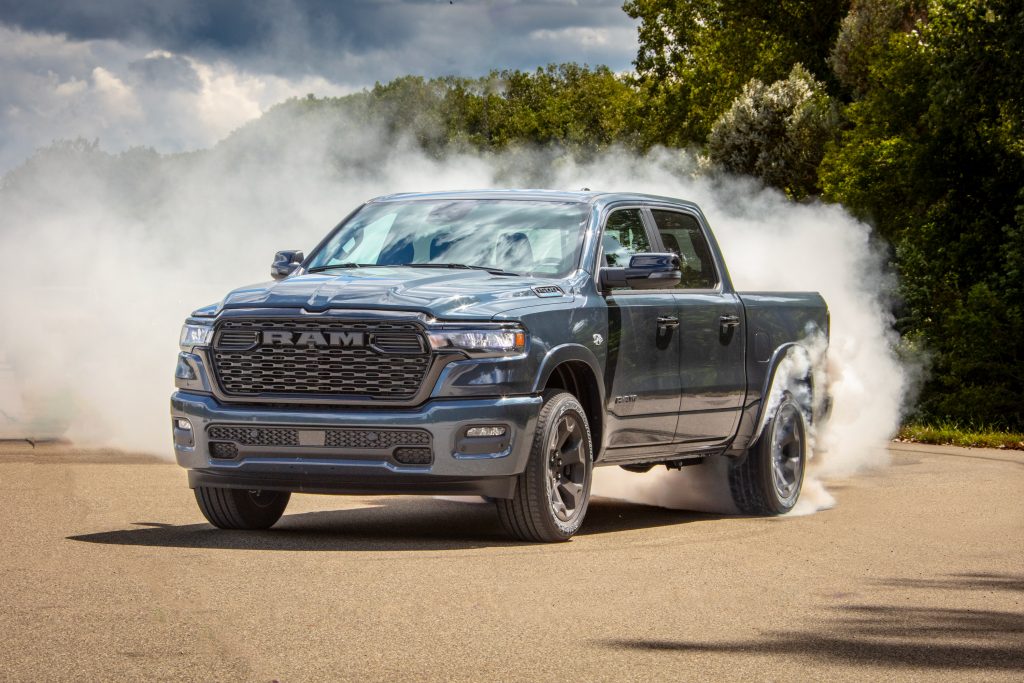
Is Stellantis’s turnaround finally upon us? CEO Anthony Filosa has only been in his position for a few months, but the company has, for the first time in 2025, seen year-over-year sales growth. Much of that growth might be people trying to get ahead of tariff-related price increases, but still, growth is growth.
Specifically, Stellantis—which still officially calls itself FCA US LLC in America—sold 324,825 vehicles in the past three months, an increase of 6% versus the same period last year. Ram saw the biggest year-over-year increase, with 26% more vehicles sold. While Stellantis doesn’t break down sales by trim, the new Hemi-powered 1500 likely had something to do with this, since, according to Stellantis, units took just five days to sell on average. If you know how dealer inventory works, you’ll know that’s incredibly quick. People really love their V8s.
Jeep was another winner, up 11% over last year’s third quarter. The Grand Cherokee remained the brand’s best seller, hovering at 54,553 units for the period (an increase of 1%). The Wagoneer and the Wrangler saw big increases (122% and 18%, respectively). Even Chrysler saw big increases, with sales of its minivans up 49 percent compared to the last quarter. The company expects the volume to continue as 2026 approaches:
“Fueled by sales growth across the Jeep®, Ram, Chrysler and FIAT brands, our U.S. sales saw strong results in the third quarter, including the month of September, which was our highest monthly market share in the U.S. in 15 months,” said Jeff Kommor, head of U.S. sales. “We are taking deliberate actions, including the highly anticipated return of HEMI® V-8 to Ram, the introduction of the all-new 2026 Dodge Charger Scat Pack and the return of the all-new 2026 Jeep Cherokee, a critical vehicle in the CUV segment, to keep that sales momentum moving forward, with all vehicles set to arrive in dealerships now through the end of this year.”
We’ll see how that shakes out, with tariff costs slowly creeping into every orifice of the car-owning process.
Elon Musk Just Keeps Getting Even More Insanely Wealthy

News of Tesla’s strong third quarter yesterday sent the company’s stock price climbing by 4%. Tesla CEO Elon Musk owns 12% of the company, which means the value of his shares grew by nearly $10 billion in the blink of an eye. According to Forbes, it was enough to push the 54-year-old South African’s net worth past the $500 billion mark.
Only $191 billion of that fortune is tied to Tesla, of course. Musk’s other ventures, like SpaceX and xAI Holdings (his AI company that merged with his X social media company back in March), make up the difference. As Forbes points out, Musk has been able to accumulate the vast majority of this fortune in just five years, having been worth “only” $24.6 billion in March 2020. Though according to him, the cash doesn’t matter:
If he keeps up that pace, Musk could become the world’s first trillionaire before March 2033, when the first of two vesting dates for his $1 trillion Tesla pay package hits. But according to Musk, that award isn’t about the money anyway.
“It’s not about ‘compensation’, but about me having enough influence over Tesla to ensure safety if we build millions of robots,” Musk wrote in a September X post. “If I can just get kicked out in the future by activist shareholder advisory firms who don’t even own Tesla shares themselves, I’m not comfortable with that future.”
Must be nice.
What I’m Listening To While Writing TMD
I’m not the biggest Scottish rock fan. In fact, I’m not really a rock fan at all. But Elon’s bag has me yelling DADA-DA repeatedly this morning as I sing along to The Proclaimers’ most famous tune, “I’m Gonna Be (500 Miles)” from the 1988 album Sunshine on Leith.
The Big Question
Would you take out an 84-month loan?
Support our mission of championing car culture by becoming an Official Autopian Member.


I just bought a new (used) car. The sales guy kind of did a double take when I explained my budget as a cash buyer. I was definitely shopping the low end of the lot, but any car sold in the US in the past ten years is going to be good enough as a daily commuter, A to B kind of car. Except FCA. But anyways, I already have a 3% car loan and a mortgage. Why on earth would I take on more debt just to keep up with Joneses when a less flashy car will still get me to work? I don’t even like the Joneses!
People should stop buying cars they don’t need and can’t afford. Simple as that.
Right? I MEAN RIGHT!?
Like… I know I make good money and I just couldn’t fathom spending $80k+ on… well basically anything on sale right now, yet there are so many new, exceedingly expensive cars on the road. Reminds me of that old Lending Tree commercial “How do I do it? I’m in debt up to my eyeballs. Won’t someone please help me?”
I don’t like paying interminably on something that depreciates, but I won’t do anything stupid.
No, I just plan on doing something silly like buying an $8,000-$10,000 Range Rover Classic from a guy off eBay Motors (or similar), that I know I can fix, daily-drive, and keep fixed. 🙂
Admittedly, being a car nut changes the calculus a bit. I’m “fiscally conservative” and while using the leverage of loans is fine, the math has to work out. Despite their longer lives, new cars still depreciate and the risk of going underwater on a car loan is unacceptable. Unfortunately, used cars are also over-priced versus any real value (defined as “can I get enough for it quickly in trade or on a private sale to pay off the loan” that late-model used is still a bad deal.
But as a car nut, I’ll make trade-offs to spend less money on an older vehicle that I’m well-acquainted with service and repairs for, and budget for the upkeep. It still leaves more left over in the budget for other things. It works for me, because I can wrench, and wrench on old/odd things.
My daughter drives a ten-year-old Forester that she’s paid off and intends to keep for as long as it’s cheaper to budget for service and repairs versus a car payment. The money saved she can bank for when she needs to put a decent amount down on a reliable used car such that the loan won’t be overly long and the payment in a range affordable to her. And routine service and repairs are cheap since she only has to buy parts and consumables and I do the work. The math would be different if she had to pay full shop prices for everything all the time.
Total cost of ownership is a huge variable for car owners. You’re at the mercy of dealer service and repair shops if you don’t do any of your own maintenance and that makes new-car warranties attractive. But probably more costly in the long run due to getting locked into long finance terms. The more wrenching you can do yourself, or get done by a family member/friend/contact, the more options you have for saving money if you’re OK with not driving the latest model.
For most of the non-Autopian types I meet out in the real world, they don’t have those options. Never even enters their minds. They just shake their heads over why I choose to drive old beater pickups and kind of stare back blankly when I explain that old trucks are cheap to buy, cheap to fix, and don’t lose ay value when I use and abuse them doing truck things like hauling building materials and rental equipment because I do most of my home repairs and improvements myself, too.
But I’m weird and from the oldest end of Gen-X, who leaned a bunch about doing and fixing things by oneself from grandparents and other relatives who lived through the Great Depression and WWII, who all passed on the value of leaning and knowing how to do a lot of things yourself. I fix older cars, repair older electronics, fix and improve my house, and also build cutting-edge (desktop) computers. It’s all alien to so many folks out there who rely on just buying stuff and paying for services. It’s (sadly) easy to see how we got here.
Human psychology and poor maths skills — tell them it is seven years and they will say no.
Tell them it is 84 months and it does not sound so bad.
Tell them it is 364 weeks, and they think, that is not too bad…
I know that my income is up 30% and if I were to replace my 12 year old jeep with an exact version today is also up 30% in cost. It just feels like I would not be able to buy a new car today. Things are just so uncertain and inflation is high.
An 84 month loan does not sound so bad if the car came with an included in the price
84 month bumper to bumper no deductible warranty.
We are exiting the golden age of used cars. Well actually that happened a while ago,
Government regulations required the mechanical bits to last a long time with shitty maintenance, and it was great. Then the manufacturers figured out how to add a bunch of stuff you don’t need that will actually render the car un-useable if it breaks, then they make those parts unobtainable, or at least unreachable.
So now, new car buyers don’t care about reliability and as a result used cars have all these new ways of breaking.
Maybe longer loan rates will result in cars with less cruft.
Probably not though, if buyers were thinking long term they wouldn’t get those loans in the first place.
A government shutdown? That explains a lot. I saw members of the National Guard holding cardboard signs saying, “Will deport you for food.” Mystery solved.
I recently bought a used car for under $30,000 with a large downpayment and excellent credit. To my surprise they offered me 84 month financing. I balked and took 48. When I asked them who would take 84 months they said almost everybody who qualifies. Woof!
My dad retired this year. He worked at a factory, on the floor. He’s been at that place a while. He drives a 2006 CR-V my folks bought used nearly 15 years ago.
A new hire? Maybe they make $40Kish. $44K tops Most will pass up overtime opportunities. They put in the minimum effort. This is in Eastern Massachusetts. Not Boston or anywhere near it, but still not a cheap part of the US by a long shot.
Yet the number who show up to work in a new, $65-70K pickup truck? Too many.
”Oh, but maybe their significant other works.”
Oh, they do. Doing the same exact job at the same exact place.
And in the same pick-up. Only in pink…
Stellantis was already doing 7 and 8 year loans for Dodge buyers, and they just announced that the entry price for the new 6-cylinder Charger will be 67% higher than the last one, so, I guess they weren’t at the limit already. 120 month loans have got to be coming soon.
Moving to Madison, New Jersey?
A fate worse than death. And a slightly better one than having to daily drive a Ssangyong Rodius.
I’ve been seeing this where I live. About every fifth truck now is a current generation RAM 1500. Now that they’ve got the first year teething issues out of the way, have brought back the V8, and have dropped below $60,000 people are grabbing at them. Especially when you compare the interiors, where the F-150 looks like a Recession era truck inside and the Chevrolets and GMCs look like a ten year old truck on it’s last refresh with all the fake chrome painted plastic and giant intrusive definitely-doesn’t-fit touchscreens.
It’s amazing that a single person can scam people that much. It’s less amazing that someone hasn’t done something about it. Then again, most people can’t even comprehend 500,000,000,000. The median net worth in the U.S. when tallying income and total assets is $275,000. That means to get to his net worth the median American would have to multiply their own by 1,818,181.81 times. Imagine having 275,000 little marbles, and then suddenly they grow by 1,800,000 times. That’d go from fitting in a bathtub to covering the entirety of Miami Florida and some of the surrounding areas.
I never take out any loans. I’m not stupid enough to give the equity funds free money.
Would you take out an 84-month loan?
On a car? Hell no.
I would argue there is a similar problem: getting stuck in a lease loop.
When the car you need is too much to take a loan on and nothing on the used market fits the bill (because the price is basically the same), you lease with the promise of buying out at the end.
You take the depreciation hit just to make the monthly with the option of walking away should the tides turn.
Then when it comes time to buy it out, rates are high, cash is tight and the same cycle starts all over again. Meanwhile you build no equity. But an 84 month loan at 7% would never build equity anyway, unless you put like half the value of the car down.
I respect those who want to buy a 20 year car in cash and ride it out until you have to move the wiper’s manually with a rope. But if you’re, let’s say, a real estate agent in a shakey market, you can’t afford to make that kind of impression.
I HAVE taken out an 84-month loan.
Stuff costs money, and reliable family transportation is important.
Used rates/prices aren’t good enough to make up the difference.
I average about 20k km/yr. For every 100k of mileage On a used unit, that’s 5 years of driving I won’t get.
Up here in the rust belt, that’s a bigger factor.