


Whenever I’m out on the road, I see a lot of new cars. I often wonder to myself: How the hell does everyone afford these things? I think I make a decent living, but if I were to take out a $50,000 loan on an average new car, there’s no way I’d be able to make it work without going hungry or having to move to Madison, New Jersey.
As it turns out, most of those people I see out on the road are actually in the same boat as me. But instead of buying something cheap and stupid, like a $3,000 Range Rover from a guy off Facebook Marketplace, they do the only thing they believe they can: Take out an enormously stretched-out auto loan so they can afford to make monthly payments.


That’s the crux of The Morning Dump today. There’s a lot to look at here, from Edmunds’ new report on how down payments have dropped to worryingly low levels, to the fact that auto loan delinquencies are hitting record highs. It begs the question: Where’s the limit?
What else? Sales data for the third quarter is continuing to roll in. Kia and Hyundai released their stuff yesterday, but today we’ve got Stellantis, which posted its first quarter of year-over-year growth for 2025. The government is officially shut down, which, depending on how long it lasts, could affect stuff like new car certifications for the Clean Air Act.
Then there’s Elon Musk, who just became the first person to ever be worth $500 billion yesterday. It’s a good time to be a billionaire.
The Average Down Payment Is Down To Its Lowest Level In Years, And Rates Aren’t Helping

Edmunds released its quarterly analysis on the state of America’s auto loan industry yesterday, which gives a good sense of where things are when it comes to affordability and the general health of the average American’s finances. And the numbers aren’t exactly reassuring.
The biggest highlight is down payments. They’re the lowest they’ve been in four years, and the last time was during the worldwide COVID-19 pandemic. The average down payment has tumbled to $6,020, a near 10% drop from where it was this time last year. From Edmunds:
“In Q3, affordability in the new-car market remained stretched, with buyers putting less money down, financing more and relying on longer terms to keep monthly costs in check,” said Jessica Caldwell, Edmunds’ head of insights.
How much longer are we talking? Well, according to the data, the average car loan term grew to 70.1 months in the third quarter, up just under two months from the same period in 2024. The 84-month term is a huge factor here; it (and any longer loans) accounted for 22% of all-new vehicle financing in the third quarter.
With average transaction prices hovering in the high-$40,000 range, buyers are taking out bigger loans than ever. Edmunds says the average amount financed is now $42,647, the highest it’s recorded. So people are taking out longer loans to keep their payments down, despite the higher overall costs.
But it’s not just prices that have people taking out longer loans with lower down payments. Interest rates have been pretty awful this year, with the average hovering at 7% through Q3. There are also insurance costs, which are expected to rise due to tariffs upping the prices on replacement parts. It’s a double whammy of added costs at a time when people are also forced to spend more on stuff like food and housing. Not great!
It’s unclear how much longer Americans will be able to sustain this. Earlier this year, 6.6% of subprime auto loan borrowers were at least 60 days late on payments, according to Fitch Ratings data published by Axios. That’s the highest number ever recorded since the firm started tracking data in the mid-1990s. Defaulting on a car loan is one of the worst financial things that can happen to someone, as this report released by the Consumer Federation of America explains:
[D]elinquency and default on a car loan are especially dangerous as compared to other forms of consumer debt. Because of how central cars are to our survival, being late on a monthly payment can rapidly cascade into disaster. Losing a car to a repossession is catastrophic and sends borrowers down a spiral of even more (and often increasingly expensive) debt. It can mean losing a job, reducing or eliminating income, and making it almost impossible to reinstate the auto loan or purchase another car, all while still being obligated to repay the debt for a nonexistent car.
That same report claims Americans hold a total of $1.66 trillion in auto loan debt, which feels like an infathomably high number. Indeed, the report describes it as a “breaking point” for auto finance. How or when we’ll see the results of that breaking point remains to be seen.
Here’s How The Government Shutdown Will Affect The Automotive Sector

The government officially shut down as of yesterday, which means most federal agencies are going to cease non-essential functions until Congress figures out how to make nice and pass a funding bill. What does this mean for the car world? A couple of things.
When it comes to the Environmental Protection Agency (EPA), it means retaining only 1,734 of the agency’s 15,166 employees. It could also mean a delay in certifying new cars for compliance with the Clean Air Act. From Automotive News:
Among the activities that the EPA said would stop are “conducting research and publication of research results unless necessary for exempted or excepted activities,” “civil enforcement inspections, unless necessary for excepted or exempted activities” and “issuance of permits, guidance, regulations, and policies unless necessary for exempted or excepted activities.”
That has raised auto industry alarm about whether the EPA’s Office of Transportation and Air Quality’s Implementation, Analysis, and Compliance Division and its Testing and Advanced Technology Division can maintain normal operations. These entities certify vehicle compliance with the Clean Air Act.
“A delay in certification of [2026 and 2027 model year] vehicles beyond their anticipated start of production would necessarily either delay their manufacture or result in the need to store built vehicles while they wait for a certificate,” Dan Bowerson, the Alliance for Automotive Innovation’s vice president of energy and environment policy, said Sept. 29 in a letter to the EPA. “Either choice carries significant economic consequences for manufacturers and could interrupt the normal supply of vehicles to the market, creating scarcity of some models and potential price increases.”
What about tariffs? Sadly, it sounds like my plans of slyly importing a Skyline from Japan while the government isn’t looking to avoid the extra fee won’t pan out.
The Department of Homeland Security’s contingency plan specifies that it “will stop all financial operations and financial system operations” except for “U.S. Customs and Border Protection revenue collections” and other exempted activities.
U.S. Customs and Border Protection collects tariffs and passes them on to the Treasury, so border agents will continue that activity.
Damn.
Finally, the Federal Highway Administration and the National Highway Traffic Safety Administration (NHTSA) will seemingly be unaffected. Spokespeople for each respective agency told Automotive News no employees will be furloughed since “compensation is financed by a resource other than annual appropriations.”
Stellantis Finally Has a Positive Sales Quarter
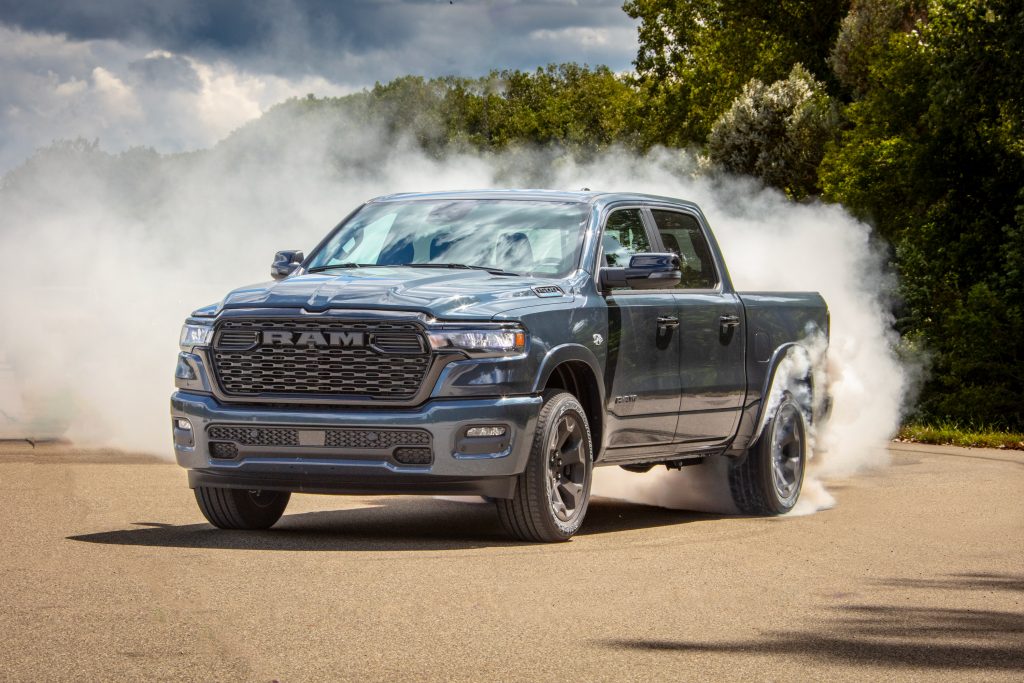
Is Stellantis’s turnaround finally upon us? CEO Anthony Filosa has only been in his position for a few months, but the company has, for the first time in 2025, seen year-over-year sales growth. Much of that growth might be people trying to get ahead of tariff-related price increases, but still, growth is growth.
Specifically, Stellantis—which still officially calls itself FCA US LLC in America—sold 324,825 vehicles in the past three months, an increase of 6% versus the same period last year. Ram saw the biggest year-over-year increase, with 26% more vehicles sold. While Stellantis doesn’t break down sales by trim, the new Hemi-powered 1500 likely had something to do with this, since, according to Stellantis, units took just five days to sell on average. If you know how dealer inventory works, you’ll know that’s incredibly quick. People really love their V8s.
Jeep was another winner, up 11% over last year’s third quarter. The Grand Cherokee remained the brand’s best seller, hovering at 54,553 units for the period (an increase of 1%). The Wagoneer and the Wrangler saw big increases (122% and 18%, respectively). Even Chrysler saw big increases, with sales of its minivans up 49 percent compared to the last quarter. The company expects the volume to continue as 2026 approaches:
“Fueled by sales growth across the Jeep®, Ram, Chrysler and FIAT brands, our U.S. sales saw strong results in the third quarter, including the month of September, which was our highest monthly market share in the U.S. in 15 months,” said Jeff Kommor, head of U.S. sales. “We are taking deliberate actions, including the highly anticipated return of HEMI® V-8 to Ram, the introduction of the all-new 2026 Dodge Charger Scat Pack and the return of the all-new 2026 Jeep Cherokee, a critical vehicle in the CUV segment, to keep that sales momentum moving forward, with all vehicles set to arrive in dealerships now through the end of this year.”
We’ll see how that shakes out, with tariff costs slowly creeping into every orifice of the car-owning process.
Elon Musk Just Keeps Getting Even More Insanely Wealthy

News of Tesla’s strong third quarter yesterday sent the company’s stock price climbing by 4%. Tesla CEO Elon Musk owns 12% of the company, which means the value of his shares grew by nearly $10 billion in the blink of an eye. According to Forbes, it was enough to push the 54-year-old South African’s net worth past the $500 billion mark.
Only $191 billion of that fortune is tied to Tesla, of course. Musk’s other ventures, like SpaceX and xAI Holdings (his AI company that merged with his X social media company back in March), make up the difference. As Forbes points out, Musk has been able to accumulate the vast majority of this fortune in just five years, having been worth “only” $24.6 billion in March 2020. Though according to him, the cash doesn’t matter:
If he keeps up that pace, Musk could become the world’s first trillionaire before March 2033, when the first of two vesting dates for his $1 trillion Tesla pay package hits. But according to Musk, that award isn’t about the money anyway.
“It’s not about ‘compensation’, but about me having enough influence over Tesla to ensure safety if we build millions of robots,” Musk wrote in a September X post. “If I can just get kicked out in the future by activist shareholder advisory firms who don’t even own Tesla shares themselves, I’m not comfortable with that future.”
Must be nice.
What I’m Listening To While Writing TMD
I’m not the biggest Scottish rock fan. In fact, I’m not really a rock fan at all. But Elon’s bag has me yelling DADA-DA repeatedly this morning as I sing along to The Proclaimers’ most famous tune, “I’m Gonna Be (500 Miles)” from the 1988 album Sunshine on Leith.
The Big Question
Would you take out an 84-month loan?
Support our mission of championing car culture by becoming an Official Autopian Member.


I refinanced my student loans for 80 months, and it is oppressive (especially when coupled with a 2023 mortgage…). No car loans and none of my cars cost anywhere near as much as the average down payment.
No.
on a house, perhaps
Not going anywhere near a 84 month loan unless it’s 0 interest. 4, maybe 5 years, is the max. Anything more than that and clearly, I can’t afford the car lol.
It certainly is reassuring to be told that the single force providing safety against millions of Tesla robots is Elon Musk, and that it will requires more than the annual budget of the U.S. Department of Defense to ensure that he does so.
TBQ: Depends on what the rate is. If it’s lower than the rate I can get from like a 5 or 7 year CD, then sure, that’s literally free money you’re leaving on the table, plus another opportunity to build up your credit rating.
I understand people’s visceral reaction to “being in debt”, but the honest truth is even if you can afford to but the vehicle outright, you need to think about what else you can do with that money in terms of investments. If a company is offering 0% APR, that becomes a ridiculously good deal spread over say, 5 years.
This. Always play the interest rate game. Your extra money goes towards the bigger number
Don’t forget that the CD return is taxed, though.
And money now is worth more than money later, and the marginal value of using the product, and…
Tbh it’s difficult to get an exact number, so most just give up and default to “never in debt” or “crazy go nuts time” and neither is correct.
Sure, and you’d have to account for that. But you can probably find a tax-advantaged investment instead if you were really concerned about it. Point is, being so focused on being “not in debt” can actually cost you quite a lot of money in the long run.
The sad truth of the world today is you have to know how to use credit and financing to your advantage, rather than just not use it.
Being in debt is very uncomfortable, too – unless you happen to have enough in the bank to cover said debt; then paying back a low-interest loan at a leisurely pace makes sense. I am not in a rush to pay back my student loans that sit at 3.22% when my high-yield savings gives me at least 4% – better to have an emergency fund since it costs me nothing to do so.
As with all things in life, you just have to beware of using logic to convince yourself that what you want to do is the best option.
Agreed. I had a cousin who asked me and his friend why we weren’t paying off our house. He places an emotional value on “owning your house outright”. The truth is, his friend and I both have pandemic era mortgages that are under 3 percent. We were both earning more money on our investments than the mortgage costs. Plus, we still get to take the mortgage interest write off (what little there is). If I dont have to, im NEVER paying my mortgage off early. That was a once in a lifetime rate. Every bank in the country is looking at those loans on their books salivating for the day theyre gone.
One more thing. I was shopping excavators. I shopped used and new. Kubota was offering 60 mo., 0% financing with nothing down. By the time I figured the cost of my own money, the larger write off of the new unit, the reduced cost of repairs on a new one, the lower rate on financing a new one, it was a no brainer to take the loan and buy new. The new one was going to cost roughly the same over 5 years, maybe a bit more, but it was 5 years newer at the end of the time. It was also going to be worth more.
Yes, I would take out an 84 month loan. I’d pay it off early, which looks nice on the credit report. Not that that matters much after the period between 2008 and 2012, for me.
I’m working to reduce debt. Daily driver is 12 years old. Paid cash. Parts are cheap and plentiful. It’s easy to work on. I hope to keep it going much, much longer. And when I can’t keep it alive any more, another cash replacement is what it will be. No more auto loans. Ever.
Yes. 0% interest 72 months on a 2019 Ionic in 2020. No down payment, they gave us a grand for that. 346/month, 40 to 50 mpg. And I’m paying them back now with 2025 dollars, soon to be 2026 and if the orange ahole keeps doing whatever the F he is doing that will be about 100 in real money per month
Runaway inflation does change the math.
I remember reading Alfred E. Neubauer’s book: he got a job selling cars in early 1920s Germany and managed to write a contract with a farmer, to be paid upon delivery – when the man picked up the car a few months later, the money he handed over as per the contract was worth less than one of the car’s headlamps.
The people taking out loans longer then the warranty is concerning to me. I wouldn’t go over whatever the warranty is. That being said with the financial literacy of alot of people I wouldn’t be surprised if the 20 year loans they use on motor homes , side by sides boats and other power sports happen. Negative equity on negative equity.
After many years and fortunate circumstances, I am 100% debt-free. There is exactly a 0% chance I will ever take out an auto loan again.
I recommend working to get a good down payment, buying a certified used model, and then trading it in for another every few years. If you can trade in a 6-year-old car for a 3-year-old car with a warranty and pay for the difference in cash, it is an inexpensive way to have worry-free transportation at a predictable cost without the expense of interest.
I see some other math in here:
I wonder what fascist tastes like?
Quite bad, I would guess. But I am willing to find out.
My guess is that particular fascist tastes like merde
Instant guttural reaction to the Big Q = Oh Hell No. That said, I did consider a 72 month loan way back before Covid when Chevy was dumping Sparks for $10K. We had already bought a used one for $3500 and the goofy thing kind of grew on me, so when I saw we could own a brand new one for 0% interest/$138/month which was pretty-much a negligible amount for us at that time, it was rather tempting.
Looking back, we instead ended up spending $15,500 on vehicles since then. However, they were all paid for in cash and instead of another Chevy Spark, we got a 2000 XK8, a 1994 Fleetwood, a 1971 Beetle, a 2007 Acura RDX, and a 2010 GTI.
> a 2000 XK8, a 1994 Fleetwood, a 1971 Beetle, a 2007 Acura RDX, and a 2010 GTI.
That’s a heck of a range.
I love when Elon and Tesla does well because you know it makes Matt seethe inside. It also makes all his political bullshit posts look even dumber since he’s been calling for the death of Tesla for a while now. Along with a good portion of the comment section. He couldn’t even work today it hurt him so much.
Love to see an American company succeed!
A cover of 500 miles was my first dance song at my wedding.
Huh are we reading the same website?
To be extremely clear, Matt is out because he is attending a wedding. David’s in Germany, and Pete had to visit a doctor.
I don’t think a temporary boost in sales equals Tesla doing well.
Secondly, Ted Bundy was an American, it doesn’t mean that we are supposed to like him. Same goes for Tesla.
I agree a bit with your first statement. I think numbers with all EV’s are spiked from last quarter with the end of the rebate. We will only get a real feel for things in the next 1-2 quarters. And it very well could be rough. But for now, no one is laid off and that’s a good thing.
Ted Bundy and Tesla being in the same group is a bridge too far for me!
You misunderstand; I am simply saying that we are allowed to dislike things even though they are American, be they companies or people or pineapple on pizza.
My highest/longest car payment ever was a new 2008 Mazdaspeed3, with trade-in I think it was ~$425 a month for 5 years/60 months. Next car loan after that was a used Focus ST for $14,000, much better payment on that and I’ve had it paid off for a few years now.
Might as well lease, assuming good terms.
I typically do a 60 month loan, but I also buy cars that are expected to be reliable and have lower operating costs. It would suck to have to take an auto loan out right now though given rising interest rates and general economic decline. If my car were totaled tomorrow and the insurance payout wasn’t enough for me to buy a reliable car outright I’d be looking to finance as little as possible.
Personally, I refuse to owe money on a car with no warranty, so that puts a loan length limit to whatever the factory warranty term is, and the payment is what it is. Not much of a limitation in my case admittedly. The highest payment I have had was for my ’16 M235i at about $1000/mo for a four year note. I put a decent downpayment down, and if I hadn’t traded the thing after 18mo I inevitably would have paid it off a year or two early. I paid off my previous new BMW in three years, and the new cars I bought past the M235i in about two years each, though they were much cheaper cars (GTI and Fiata). Only bought used since, and largely paid cash. I did take a note for half of my ’14 Mercedes wagon, but only because I was on the hook to replace a hurricane-damaged roof to the tune of $20K, and didn’t know how long it would take to get that back from insurance. When the check came, the Mercedes got paid off.
I think there is a real split in the marketplace. There are LOTS of people like me who make real money, are older SINKs, DINKs, or empty-nesters, have paid-off homes, and can afford new cars very easily. A LOT of people in the US have a LOT of money and disposable income, and at the end of the day only ~16M new cars are sold to a population of getting on to 350M. That is not a lot of new cars per capita really.
For the longest time I was a staunch believer in the “No more than 4 year payment terms on a new car” rule. I would say these days I’m softer on that front, perhaps accepting of 6-year terms, because of how long newer cars tend to last (at least from OEMs known for quality or still milking matured platforms). But to echo everyone else, yeah it’ll depend on the interest rate and other perks.
I wouldn’t take out a private conventional auto loan for that long, but if it’s OEM-backed with a matching length warranty, or a 0% financing situation, etc. it would make sense.
Loan duration is tired to the useful lifespan on the asset being financed. You don’t want to be paying off a loan after the car is worn out and gone. Cars today can be financed for longer periods because they last longer. Its completely reasonable to expect a brand new car to last longer than 84 months.
The longer the loan, the longer you’re underwater on the value. If the car gets written off in an accident, you could owe more than the payout.
There is no reason to ever be underwater on a car. If you can’t afford to put down enough money upfront to ensure that you are never underwater, IMHO you can’t afford that car in the first place. If you have no alternative, buy GAP insurance that makes the write-off issue go away at least. It’s offered quite cheaply by most insurance companies, or quite expensively by dealerships.
I got BURNED being underwater on my first new car due to a job loss. Never, ever again.
It’s a matter of maths: why would someone lock a bunch of money downpaying a very good factory-subsidized rate finance (3-6%) if they could retain liquidity and invest that for a larger return on virtually any available asset class nowadays?
It’s not like most of new cars will fall apart in less than, say, the 5/6 years you took to get out of the water on that 0% downpayment, anyways
It’s not falling apart that is the problem. It’s that a fender-bender can total a car older than 4 years these days. (I’m certainly speaking of extreme cases, but it is a trend.)
Also note that a fancy electronic module or DC transmission can cost a few grand. Computerized systems work great,- until they don’t.
I’m not taking ANY loans right now.84 monthly payments are just insane.I know costs are up but I’ll buy a 10 year old Avalon or Es350 and and be happy.Call me a Cheep O but at least I’m not looking over my shoulder for the repo-man.
Only at 0% interest.
Honestly, not even then at this point. The annoyance of having to make the payment, or worry about it being made automatically correctly, is enough for me to make the payment go away as quickly as is convenient if I don’t just pay cash in the first place. Though I certainly approve the theory of lost opportunity cost for the money, in my case it’s not enough money to care. Not to get too far into the weeds, but I practice “pay yourself first”. About 3/4 of my income goes directly into savings/investments. I live off the rest including messing around with cars. And I still don’t usually spend it all every month, so it’s been easy for me to pay off various car notes a few years early back when I was still buying a new car every other year (and having multiple cars at once has been the norm for me for 30+ years).
Of course, that isn’t an option for the average wage slave with a couple of kids struggling to get by. But when I was a wage slave struggling to get by, the very last thing I ever would have bought was a new car, or even a nearly new used cars. It was fully depreciated cars and I learned to fix them myself. A very valuable life skill. And that included when I lived in a downtown apartment.
And I did get burned by being underwater on a car when I lost my job 22 years ago with my first new car. Never, ever, ever again. No matter what, I want to be able to drive on over to CarMax and walk away with a check and no liability. Thank God for the First Bank of the Old Man, but his interest rates sucked, he’s dead a decade now, and there is NOTHING that sucks harder than making payments on a car you no longer have to enjoy once you do get a new job. Luckily, I had three cars at the time so it was not a disaster getting rid of the one I suddenly could not afford.
If you can’t rely on automatic payments, you need a new bank. I can’t remember the last time I manually made a payment on a recurring bill.
It’s not that I can’t rely on them, I have everything on autopay in my entire life. But I have had occasional issues over the years with them. Shit happens.
Ultimately, t’s that if I don’t HAVE to, I don’t WANT to, and I don’t HAVE to have a car payment at all. Unlike utility bills, credit card bills, etc. I can make a car payment go away and not have to think about it until I borrow money for a car again. Which could easily be never at this point.
Warranties should be for at least the length of your loan term. If they want to keep making longer and longer factory-backed loan terms, they need to also up the warranty to match.
This. Very much this.
I’ve known a few people with high-end vehicles and long loans that had to take a hard swim after the warranty expired and the vehicles needed major repairs. Those people all went severely under water on their loans, only to trade the vehicles in as inoperable to get something else.
All the more reason to skip the nonsense version of cars. There is a vast gulf in both the acquisition cost and running costs of for example a 328i and an M3. But they both drive like BMWs.
and at least the 75th percentile mileage* because a 10-yr 36,000 mile warranty means nothing to people.
No, I’m the kind of guy who pays off their credit card at the end of the month. I don’t want to owe any corporation anything.
I don’t even wait until the end of the month, I just pay them off every time I check my transactions, which is at least weekly. But I put $100K+ a year through my cards. I only use cards for the points and other benefits.
I only use Credit Cards due to fraud concerns, much easier to challenge false charges and get a new card when it’s a credit card than if it’s a debit card.
Comes under the heading of “other benefits”. 🙂 I’ve used the warranty benefits too. And on the rare occasion I rent cars personally, the rental ar insurance. But the points, and in the case of my AA card, Admiral’s Club membership are primary.
IMHO, you have to be a complete moron to use a debit card for anything other than to get cash out of an ATM, and then only under extreme duress. WAAAY too risky, skimmers are just everywhere today, the consumer protections for credit vs. debit are utterly night and day. And I have personal experience with this – my sainted Mother got in the habit of using her debit card everywhere, and got hacked. $5K gone in a flash, and it took MONTHS for the bank to give it back. Total nightmare, but thankfully not all the money she had in the world, just an annoyance. I’ve had multiple credit cards hacked, these days you don’t usually even have to call, you can dispute the transactions online and they just go away like magic.
I’ll second that, I fully understand the concept of getting a couple percent more investment return than loan interest, but I’d prefer to never have a loan again if possible. The extra little bit of potential income isn’t worth it.