

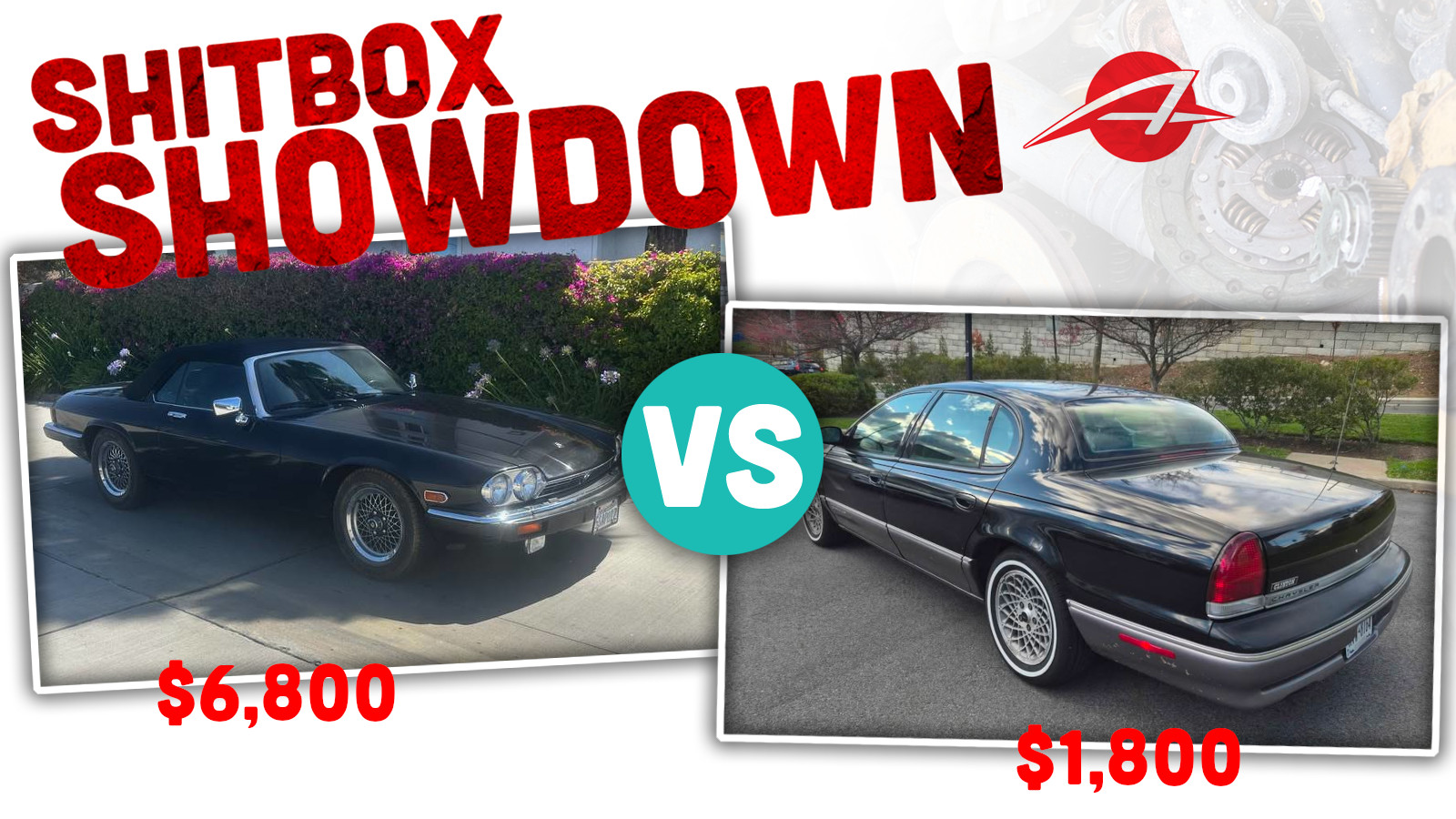
Welcome back! This week, I’m matching up cars that don’t go together by finding one metric they have in common, and today we’re looking at the number of valves in the engine. Both of these cars have 24 of them, despite one having twice as many cylinders as the other. I told you these were going to be arbitrary.
Yesterday we looked at two cars with the same rated horsepower, and I was pretty sure the sad old Pontiac wasn’t going to win. I sort of expected it to pull a few more votes than it did, though, based on the comments. Among those of you who did vote for it, a lot of you thought it would be more reliable long-term than the Fiat 500. But most of you preferred the Italian black beauty; it won by a factor of more than five-to-one.


I’d definitely choose the Fiat. I do like the old American cruisers, but I’d rather have something more special than a white Grand Prix if I’m going to put up with sluggish performance and a rattly interior. The Fiat may not be a Tercel when it comes to reliability, but it has to be better than a fifty-year-old British car. After dealing with that thing for nine years, my definition of “reliability” has shifted a bit. I’m sure this Fiat is just fine.

A sure-fire way to make an engine generate more power is to cram more air and fuel into the combustion chambers during each cycle. More air and fuel equals bigger boom, more force, more power and torque. Increase the size of the valves, and the manifolds leading to and from them, and you can move more air, but with round valves and round cylinders, there’s an upper limit to how big you can make each valve. You can have more than just one intake and one exhaust valve, however. Most engines these days have four (or more) valves per cylinder, but many older designs still use just two. Today, we’re looking at a car with an engine design from the 1970s, and one that was all-new for 1993. One has twelve cylinders and the other six, but they both have the same number of valves – and camshafts, come to think of it. Let’s take a look.
1989 Jaguar XJS Convertible – $6,800

Engine/drivetrain: 5.3-liter OHC V12, three-speed automatic, RWD
Location: Costa Mesa, CA
Odometer reading: Ad says 109,000, but photo of odometer shows only 9,000
Operational status: Runs and drives well
Inexpensive used Jaguars, even more so than other luxury models, always feel like a trap. You just know that they’re not as good as they seem. But that sultry purr has seduced more than one intrepid owner into the jaws of a money-eating machine. Not you, though. You’re too smart to fall for that. Every time you see one for sale, though, you think maybe this one will be different. After all, it’s not all that cheap, and the ad says it runs great. How bad of an idea could it really be?

This particular XJS convertible has a discrepancy in the ad that could make it better or worse than it seems. The seller has the mileage listed as 109,000, but that’s clearly a six-digit odometer, and the first digit is a 0. Is there a chance that this thing is still really under ten thousand miles? If so, that’s a criminal waste of a convertible in sunny southern California. Mileage that low can also lead to its own problems; cars don’t like to sit around. Things get sticky and brittle and corroded. Or has the odometer been replaced for some reason? The seller says it runs and drives great, but I think you would be wise to drive straight home and spend a weekend or two checking everything out. I mean, that’s good advice for any used car, but it goes double for an old Jag.

The photos of the interior support the low mileage theory; it looks really nice inside. Many XJSs, especially ones with over 100,000 miles, look like hell inside. This one not only looks like it wasn’t driven much, but it looks like it was kept in a garage, away from the harsh sun. Any bets on whether you could still get service for that giant ’80s car phone?

The photos in this ad are not great; it looks like they took pictures of it from across the street. If you look at the originals in the ad, you’ll see I cropped out an awful lot of Orange County scenery in the background. But from what I can see, it’s as clean outside as it is inside. The paint is shiny, and the convertible top is in excellent shape. It may still be a trap, but if so, it’s a very pretty trap.
1994 Chrysler New Yorker – $1,800

Engine/drivetrain: 3.5-liter OHC V6, four-speed automatic, FWD
Location: Yonkers, NY
Odometer reading: 110,000 miles
Operational status: Runs and drives well
When Chrysler introduced the LH-platform cars in 1993, the message was clear: Forget about the K-cars. This is what we’re doing now. But not all of Chrysler’s traditional customers were ready for the swoopy, cab-forward vision of the future; they still wanted a more traditional look. Chrysler had them covered with this car, the new-for-1994 New Yorker, which featured a more traditional roofline and a more pronounced trunk than the Dodge Intrepid, Chrysler Concorde, and Eagle Vision variants.

The New Yorker also featured a column-mounted shifter for its Ultradrive automatic transmission, but the engine in front of it was anything but traditional for Chrysler: a 24-valve overhead cam V6, displacing 3.5 liters and putting out a stout 214 horsepower. It’s mounted longitudinally, even though it drives the front wheels, so no worries about getting to the “back” bank of spark plugs on this one. It runs and drives “excellent,” according to the seller. But they don’t elaborate.

It has a split bench seat in place of the bucket seats and center console of the other LH cars, and that seat sure does look comfy. It’s in good condition, too. As you would expect, it has power everything, but the seller doesn’t tell us whether or not it all works. Try it all out to make sure it works, but it’s an $1,800 car, so if a couple things are broken, it’s not the end of the world.

It’s clean and shiny outside, but since it’s a New York car, there’s a good chance it has seen some road salt. Take a peek underneath to make sure that gray plastic lower cladding isn’t hiding any nasty surprises. I don’t think the LH cars were particularly rust-prone, though. The whitewall tires look silly on it, but if they’re in good shape, I guess you could live with them until they wear out.
The more I look at these two, the more similarities I see: they’re the same color, they both have lots of chrome trim, they even have similarly styled wheels. But that’s not why I chose them. We’re looking at the most tenuous and arbitrary of connections between cars this week, and the connection between these two is twenty-four valves. Tomorrow’s cars will have something equally weird tying them together. But until then, your job is to choose which one of these you’d rather have, by whatever criteria you see fit.




Can’t remember the agency, but rented this vintage New Yorker several times. Depending on the trim, surprisingly comfortable and a smooth ride. No idea what the handling was like, mostly freeways and slow surface streets.
A clean example at this price is going to be so much better, although they are appealing, than a Jag.
I had the same year and color but the coupe. Fun to drive and gets a lot of attention. Fascinating to work on, which you will be doing a lot. Finally sold mine to my mechanic which was the fiscally prudent thing to do at the time.
With the price difference, I’m definitely in the LH camp. I had a LH Intrepid and actually liked the car. The only thing that gives me pause is New York. I found out the hard way that the LH cars have a brake line that runs from the left side of the car to the right side over top the fuel tank. Now the fuel tank is plastic, so it won’t rust. The brake line on the other hand…. I had just bought mine 2 months before when trying to make an emergency stop in the rain, the brake line blew. I managed to come to a stop while just kissing the rear bumper cover on a new Hyundai (of some sort). Didn’t even scratch the paint on my hood, but it broke the plastic retainer pins on the bottom of the Hyundai’s bumper cover for a $1800 repair. Oh, and the passenger suffered a severe back injury and filed a claim with their insurance due to the pain.