

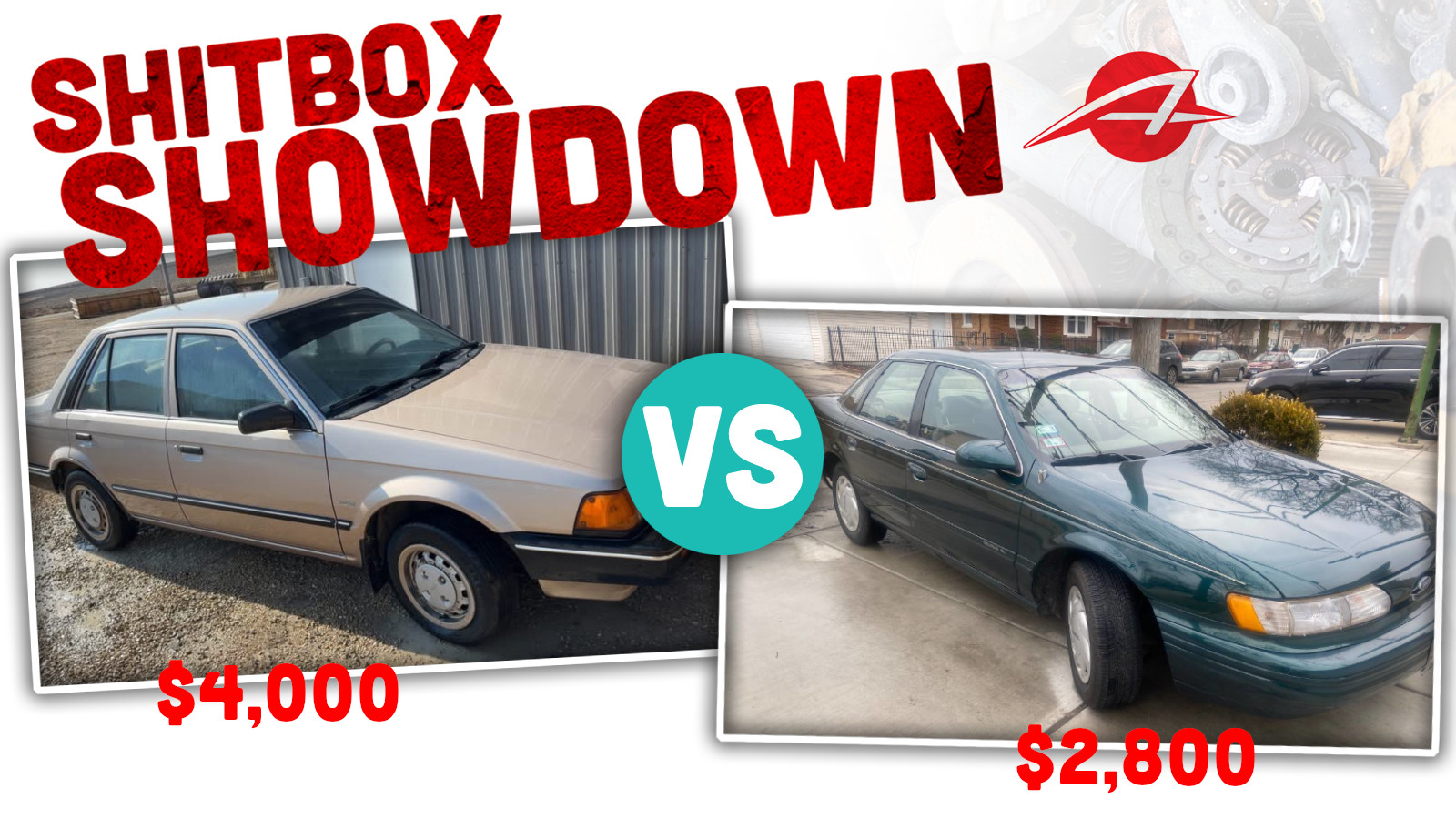
People buy cars to drive them, with very few exceptions, so it’s not surprising to see big numbers on the odometers of inexpensive used cars. But some folks just don’t drive that much, so some cars reach advanced ages without racking up many miles. And that’s the case with the cars I’m going to show you today.
You all surprised me yesterday; I thought there was no way a Dodge was going to beat a Honda. But that’s exactly how the vote turned out. Was it the relative rarity and novelty of the Rampage that did it, or was it the Honda’s high price? From the comments, it sounds like a little of both.


Lots of you had trouble deciding between them, and I’m right there with you. That’s my favorite generation of Honda Civic, particularly the hatchback, but then again I’ve wanted a Rampage since I was ten. Between these two particular examples, I think I’d take the Rampage – assuming I can find the parts to fix the brakes – but it’s a very close call.

The average number of miles driven per year is about 15,000, give or take. Some people drive way more than that, of course; when I was living in Los Angeles I put nearly 40,000 miles on a Ford Focus in a little over a year. But at the other end, I’ve seen cars that only accumulate a few hundred miles in a year. I guess some folks just don’t have that far to go. Today we’re going to look at a couple of sedans that haven’t gone far at all.
1989 Mazda 323 SE – $4,000

Engine/drivetrain: 1.6-liter OHC inline 4, four-speed automatic, FWD
Location: Plainfield, IA
Odometer reading: 100,000 miles
Operational status: Runs and drives well
Mazda’s compact car line is one of those cars that has had a ton of different names. It’s known as the Familia in Japan, and the 323 in most other markets, except for the ones that are called the Ford Laser. In the US, it started out as the GLC (short for “Great Little Car”) and later became known as the Protege. But in between, it was simply the 323 here, too – except for the version that was called the Mercury Tracer.

Power for the 323 comes from a 1.6-liter single overhead cam inline four, which makes a whopping 84 horsepower. This one drives the front wheels through a four-speed automatic, which makes it a less than exciting ride, but it is nice and reliable. This one has just over 100,000 miles on it, and the seller says it runs and drives well and gets great gas mileage.

For a car with so few miles on it, the interior isn’t in great shape. It’s not damaged, but it looks dirty and unkempt. I’ve seen it before: someone buys a car from an elderly owner who took immaculate care of it, and then lets things slide. You could certainly clean it back up; it’s just a shame that you have to.

It’s in nice shape outside, at least. It was clearly garage-kept in its previous life, and probably had regular washes. I bet there was a frequent-customer punch card involved. That’s the only way I can think of that a car this old has remained rust-free in Iowa.
1995 Ford Taurus GL – $2,800

Engine/drivetrain: 3.0-liter OHV V6, four-speed automatic, FWD
Location: Chicago, IL
Odometer reading: 79,000 miles
Operational status: Runs and drives “amazing”
This is one of nearly four hundred thousand Ford Tauruses produced in 1995. These things were everywhere in the 1990s; I probably changed the oil in half a dozen of them a day when I worked in the garage. And I bet half of them were dark green. But that was thirty years ago, and as common as they were then, a second-generation Taurus is a pretty rare sight these days, especially one this clean.

Originally, the base engine in the Taurus was a four-cylinder, but nobody bought them. By this second generation, the 3.0 liter “Vulcan” V6 was standard, as was a four-speed automatic. It’s a dull workhorse of a powertrain, but it seems to hold up well. This one doesn’t even have eighty thousand miles on its odometer yet, so it should have a lot of life left in it. It has a new battery, muffler, and tires, and the seller says it runs very smoothly.

For some reason, the ad only has this one photo of the interior, taken from the back seat. I don’t know if they’re hiding something in the front seats, but I doubt it. It looks really clean. And unlike most rental- or fleet-spec Tauruses, this one has bucket seats and a console-mounted shifter. Whether that’s a step up from the standard bench seat and column-mounted shifter depends on your taste, I suppose.

This one must have been garage-kept as well, because it’s cleaner than any ’95 Taurus has looked in Chicagoland in probably two decades. There’s no rust on it, and the paint is nice and shiny. This is probably the best-looking bodystyle of Taurus too, which makes the ovoid “catfish” model that came out a year after this one look even worse by comparison.
These are both old enough to be considered “classics,” but nobody is going to call them that. They’re just old cars, just like millions of others, that got lucky enough to lead easy lives. Yeah, the prices are a little higher than you might have paid a few years ago, but they’re nothing compared to a lot of ’80s and ’90s cars. And they’re both begging to have some more miles put on them. Which one do you prefer?


That Taurus is a time capsule.
I’d snag it, put some fresh Mercon in it, fresh oil and filters and drive it to the nearest radwood.
Why pay an extra $1200 to wallow in someone else’s filth?
That was the wrong 323. Now if it was a GTX then the votes would be different.
Heck, even if it were otherwise identical but manual.
Twin spoilers for the win!
The Mazdas of that era always brought a healthy dose of slow car fast joy of driving. I almost bought an 85. My well used 323 GTX is always satisfying to drive even if it cannot hang with most any modern car. All that said, $4,000 for an auto with a 70 hp engine is nuts. If I needed a car tomorrow, it would be the taurus.