

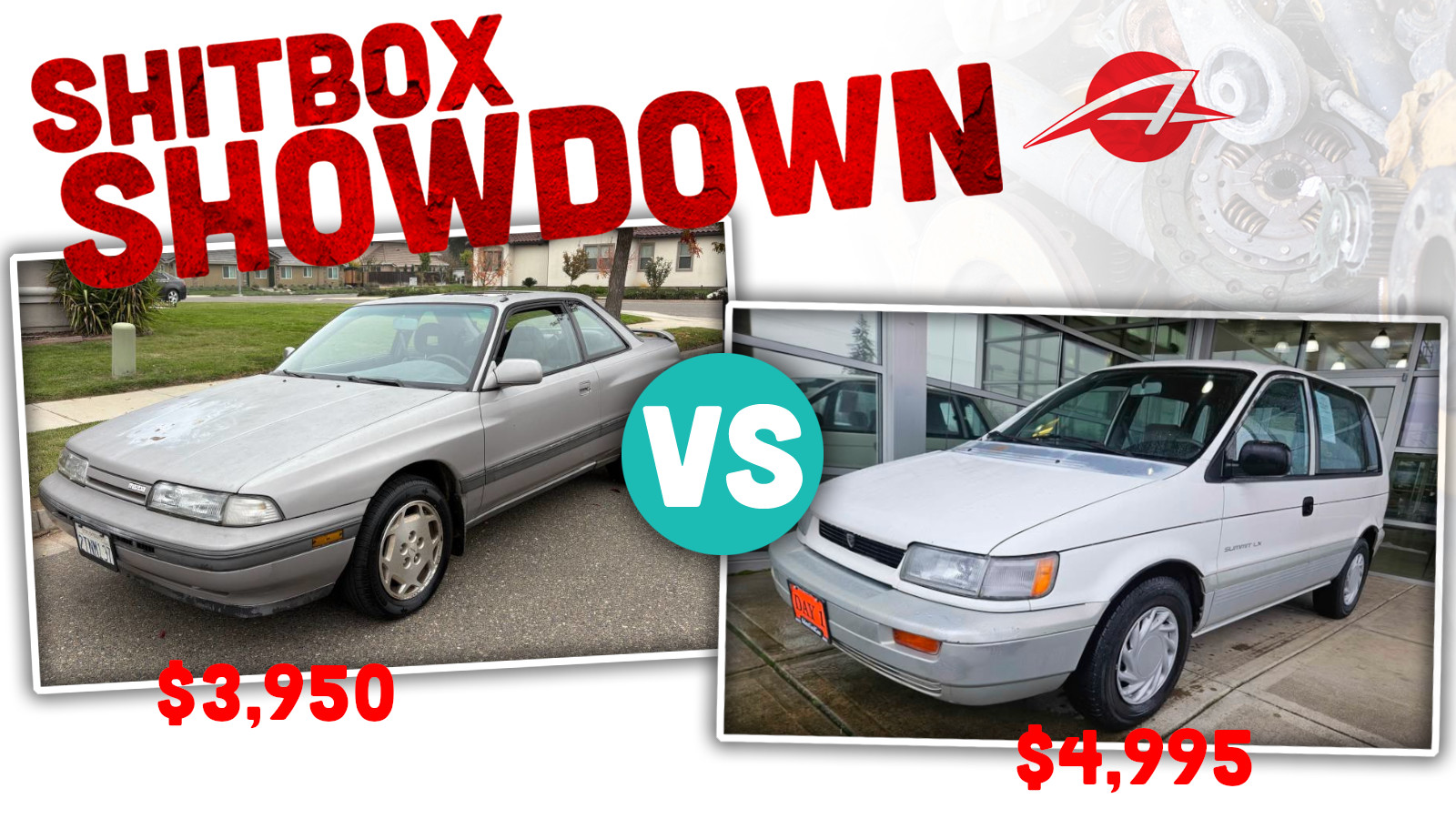
“Captive import” is the term for a car made in another country, but sold by a domestic brand. But what about cars that go the other way around, that are made in the US, but wear the badge of an import brand? Is there a term for them? I don’t think I’ve ever heard one. Regardless, I’ve got one of each for you to check out today: a captive import, and a whatever-you-want-to-call-it.
Yesterday, we looked at two Dodges that weren’t really Chrysler designs. One was a Renault by way of AMC, and the other was mostly Mitsubishi. It was a closer call than I thought it might be; the Dodge Monaco’s price put a lot of you off, but it still put up a good fight. But as of this writing, the Stratus coupe holds a small but decisive lead, so I’m declaring it the winner.


That would be my choice as well. The Monaco is interesting in theory, and it’s supposed to be a really nice car to drive, but it just doesn’t hold enough interest for me to choose it. The Stratus isn’t that interesting either, but it’s cheaper and it should be easier to keep on the road as time goes by, so it gets my vote.

In my past life working in a service station, I had a co-worker who was staunchly “buy American.” He actually got in trouble a few times for insulting imported cars, and sometimes their owners. At the time, I drove a beat-up old Nissan/Datsun pickup, which he, of course, scoffed at. But apparently he liked the idea of a small pickup, so much so that he showed up one day in a beat-up old Chevy LUV. My boss and I looked at each other, smirked, and said nothing. What made it even funnier was that my Nissan was built in Tennessee. That guy was fired not long after that, so I don’t know if he ever found out that his Chevy truck was built in Japan. I certainly wasn’t going to tell him.
Anyway, let’s look at a Japanese car built in America, and an American car built in Japan.
1990 Mazda MX-6 GT – $3,950

Engine/drivetrain: Turbocharged 2.2-liter OHC inline 4, five-speed manual, FWD
Location: Modesto, CA
Odometer reading: 131,000 miles
Operational status: Runs and drives well
By now we all know the story of the Ford Probe: how it was almost the 1989 Mustang, how Mustang fans cried foul and persuaded Ford to keep the Fox-body Mustang in production, and how the new car was released alongside it as the Probe. But the Probe’s sister model, the Mazda MX-6, doesn’t get nearly as much attention these days. Maybe it’s because its styling is much more subdued, or because Mazda didn’t sell as many MX-6s as Ford did Probes. Whatever the reason, seeing a first-generation MX-6 is a real rarity these days, especially a GT like this one.

Like the Probe, the GT version of the MX-6 received a turbocharged version of Mazda’s 2.2-liter four-cylinder engine, bumping the horsepower from 110 up to 145. It also got disc brakes in the rear and some suspension tuning. There was also, briefly, a four-wheel-steering option, but I don’t think this car has it. This one has only 131,000 miles on it, and the seller says it runs great. That’s all the info we get, though; this car is being sold by a wholesale dealer, and they’re not big on descriptions. I can tell you that it leaks oil from its valve cover, which is an easy fix, but a negotiating point.

Sadly, this being a 1990 model, it has passive restraints in the form of automatic shoulder belts. One year older, and it wouldn’t have been subjected to this foolishness. There are a few cars for which I might be willing to put up with motorized belts, however, and this is one of them. I used to have a 1989 Ford Probe, and it was a fantastic car to drive. This MX-6 should be the same, only quicker. The worn spot in the seat bolster is unfortunate, and the duct tape covering it even more so, but overall it’s not too bad inside.

It’s a sharp-looking car outside, with just a few blemishes. The paint on the hood is scorched, and it appears to be missing a badge on the trunk lid, but those are minor quibbles. It’s a Japanese sports coupe (built in Michigan) from an era that is rightly celebrated for its designs. This is one of those cars that I hope finds an owner who appreciates it.
1994 Eagle Summit LX wagon – $4,995

Engine/drivetrain: 2.4-liter OHC inline 4, four-speed automatic, FWD
Location: Salem, OR
Odometer reading: 152,000 miles
Operational status: Runs and drives well
When Chrysler bought AMC in 1987, it created the Eagle brand for AMC’s legacy models, hoping to ride the popularity of AMC’s most popular model, the Eagle wagon. To give Jeep/Eagle dealerships a full range of cars to sell, Chrysler stuck Eagle badges on some of its captive imports, like this Mitsubishi-built Eagle Summit wagon – also sold as the Dodge/Plymouth Colt Vista and Mitsubishi Expo LRV.

The Summit wagon was powered by either a 1.8 or a 2.4-liter four-cylinder engine. This being the fancy LX model, it has the larger engine. You could get either a manual or an automatic transmission; this one has the automatic. The seller actually doesn’t make any mention of how it runs, typical of a dealership, but I have to assume if they’re asking five grand for an economy car from the 1990s, it runs and drives flawlessly. It had better, anyway.

Eagle called this a wagon, but it’s really laid out more like a small van. It has two normal front doors, a sliding door on the passenger’s side only, and a rear hatch. It’s a pretty versatile and roomy little car. It’s in fine shape inside; it hardly looks used at all. This car has a weird arrangement to meet the passive restraint requirement: it has an airbag and a standard three-point seatbelt for the driver, but the passenger’s seat has an automatic shoulder belt and a manual lap belt.

It’s generally in good condition outside, but there’s some strange wear on the B-pillars that I don’t quite understand. Is it just sun-bleached paint? Nothing could have been rubbing against it there and wearing out the paint that I could imagine. But you could easily repaint the pillars black, if you so chose. At least there’s no rust.
Does it matter where a car is built? It shouldn’t, but I understand why it does to some people. If your livelihood is building cars, you want people to drive the cars you build, not the ones built somewhere else. But that ship sailed, metaphorically and literally, a long time ago, and cars come from everywhere now. And badges are no longer any help in telling you where a car actually came from. So I guess what really matters is, do you like the car? And more specifically, for our purposes here, which of these cars do you like?



I had an ’82 (I think) Datsun pickup and it put up with a lot of abuse as a new homeowner. It still said Datsun on the tailgate. I am pretty sure it was the next year it said Nissan. But again, I could be wrong. I don’t know why they gave up the brand name equity they had at the time with Datsun, but I guess that’s a topic for another story.
But that trucklet rode on its rear suspension bump stops with 1500 pounds of paving stones for at least 20 miles and recovered. It was squirrely as hell, but we made it home. And the next day, it was like it never happened. I never retried that event in my last FIL’s F-150. So, I really can’t make a comparison. His had a bigger bed, but unladen, the 720 was a lot more fun to drive. And his cabin stunk from chew tobacco.
I had a champagne MX-6 GT with the burgundy interior in college and still miss that car. If this had the right colored interior I’d be wondering how to hide a whole damn car from my wife…
Gotta go for the Mazda. I used to work at a quick oil change when these were new. The amount that came in with Ford badged engines in Mazda badged cars and vice-versa was amazing.
Wife and I had Summit wagon. Not a terrible car. Put a head gasket in at 175k. Then the sliding door fell off. And again. And again. The door opened with such a force that, once the stops were getting sketchy, it was a coin toss as to if it was going to stay on the car. Traded it for a Forester.
Both please!!!!
Anything from Modesto that qualifies for SS is literally CP. You hope thats only pee on the seats. Minivan unless Pete Davidson has been in it, then, reluctantly, still minivan.
Oh damn this was kind of a difficult choice.
Wow, yet another chance to pay homage to our old 2006 Mitsu Outlander’s wonderful 2.4l/4speed auto powertrain–I assume that’s what’s in this Summit?
It’s in fine shape, and might be kind of fun to drive. That Mazda’s tempting, but I think having to live with its rough interior would be depressing after a few days.
[Edited to note: Our Mitsu had the a similar powerplant but not quite: the SOHC 16V 4G69, similar hp/torque specs to the 4G64]
I was vote # 626, I’ve got a good feeling about that.
Eagle Summit all the way.
Is it unmemorable turds week on shitbox showdown? Yikes.
I’m sorry, but an MX-6 GT is an awesome car. One of the raddest.
This Summit might be the closest I can get to a Honda NBox.
MX-6 for me. And I recall back in the day, these were faster than the HP number would suggest.
I suppose the literal opposite of “captive import” would be “free export.”
I’d argue the 626 isn’t really an example of a “free export” as it, along with the Probe, was jointly developed with Ford and contained a number of Mazda parts. A more accurate example of “free export” would be the Mazda Navajo and B-Series, VW Routan, Isuzu Hombre, i-Series, and Ascender, Saab 9-7X, Honda Prologue, and Acura ZDX. What others am I missing?
1st and 2nd gen Nissan Quest.
Maybe you could say the Quest was joint-developed with Ford (like the Probe/626), but really since the vast majority of the vehicle was Nissan, I’d say the Villager was closer to being a badge-engineered Quest, even if it was assembled at a Ford plant.
The next gen MX6 fastback was one of the most beautiful cars
on the road in that era, but this isn’t that, so I’ll take the time capsule.
Have driven many examples of both offerings today.
And as much as I love MAZDAS there is no way today.
That Summit checking all the boxes for me. They were a pretty versatile car, even with the small size. If my memory is correct, the rear seat also had slides so there was a lot of leg room too. With a decent set of tires they can handle like holy crap.
Don’t let the van shape fool you, these are a hoot to hoon.
I wish it was closer to me, but the price is a bit more than I’d want to pay. YMMV
Though I’ve always wanted a Mazda 6, I chose the Summit because tiny van with a high roof.
But I’d like either one of these, which is a pleasant change from those days where I don’t want either one.
I’m sure the 6 will win this round.
Another day when I’d be tempted by both.
A Summit Wagon would be such a blast to through some purple-and-teal graphics on and take to RADwood. If this one was a manual, it would be the clear winner for me. It’s also yet another application of that good old 4G64 engine that we saw in yesterday’s Stratus.
I’d be willing to bet money the wear on the B-pillar is from a generation or three of kids putting their hands there as they get in and out.
Maybe I’m still jaded by the COVID years, but under $5k for anything running, driving and rust-free is reasonable to me, especially if it has both rarity and utility going for it as the Summit does.
The MX-6 is so rare to see and underappreciated. I’d happily rock it as well.
Since I already have a hatchback coupe of the period, I’ll take the Eagle to round out the fleet.
The Summit is cool, but it’s a crackhead price
Tough choice. The MX-6 would obviously be more fun to drive, but it’s rougher around the edges than the Summit and with that mileage, I’d worry about the turbo going unless it’s already been replaced. (Someone correct me if these things are known for going 200K on the original turbo, but my ’90 Eagle Talon went through its turbo well before 131K.) The Summit is in great shape and would be excellent for running people and stuff around. It’s clearly the smart choice out of the two. And in standard Autopian fashion, I’ll take the non-smart choice. MX-6 it is.
+1 for the Summit solely on looking like the ‘Gadgetmobile’
Go go gadget people-container!
I might actually like the MX-6 more than a Ford Probe. Though, at the time they were “futuristic”. The minivan is fine, but I don’t know if it’s worth that, even in comparison with other models of minivans.
Neither.
Why? Those fucking automatic shoulder belts…
I think it would be amazing to be able to subject your passenger to it, without having to deal with it myself. Too bad Oregon is so far away.
Even though the Mazda is a little rough around the edges I had to give it my vote for nostalgia. Dad had one he bought in 89 or 90 that he carted me and my brother around in. Mom had the standard of the time Chrysler minivan for big family trips.
Both mom and dad could row through the gears pretty hard, and while certainly not fast, for a young kid it was exciting. I remember goading my mom to give it hell from a stop light one day and she obliged. Front tires screaming away and a good power shift from 1-2 and then 2-3. We both still remember that story. That car and dad’s love for cars certainly helped turn me into a car enthusiast.
The not-a-probe wins for me on price and entertainment value. If the not-a-van was cheaper or a manual it would have been a tougher call. I am a proponent of vans, and they can actually be reasonably fun to drive, but I still don’t have kids and I don’t work a trade so I just can’t bring myself to own a van.
You could get those Mitsu-vans with a 2.4L 132 hp I4 and a stick, as I recall. I’d loved one of those in my teen/college years.
When I was in college I was shopping for anything cheap, wagonny, and manual there were a lot of weird little captive imports including the eagle summit, but ultimately I found a Honda Civic Wagovan that ended up being a disaster (my fault).
Here’s an uncommon circumstance: I have already owned one of these.
My grandmother, in one of the last times I saw her alive, gave me her 1992 Eagle Summit because she didn’t feel confident driving anymore. It was actually badged a Dodge Colt Vista, but of course we all know better. It was AWD with a 2.4 engine, and its body and interior were absolutely pristine. And in her 20 years of owning it, she had only put on about 50,000 miles.
Unfortunately, those miles were in Minnesota. When they salt the roads in MN, they mean it. While the top and inside of the car were absolutely gorgeous, the pinch welds were entirely gone. The only thing holding the top of the car to the bottom was friction. There were even corrosion cracks in the driveshaft.
While it worked, before it barfed a valve, I thoroughly enjoyed that car. It had Scion xB (first gen, of course) space, just gigantic inside. And it parked in tiny places…tiny places where you could see oh so clearly everything that was going on because it had big, tall windows everywhere. It was a wonderful car to own, except when it wasn’t.
So it’s gone. I liked it but it was in surprisingly poor condition once you got past the apparently unused interior. I wouldn’t say no to another example of space-efficient, go-anywhere practicality.
Yeah I think rust got most of these even outside of Minnesota. The fact that this one’s on the west coast is probably the only reason it survived.
I googled it a bit ago and the twin cities metro uses 1/4 million tons of salt in an average winter.