

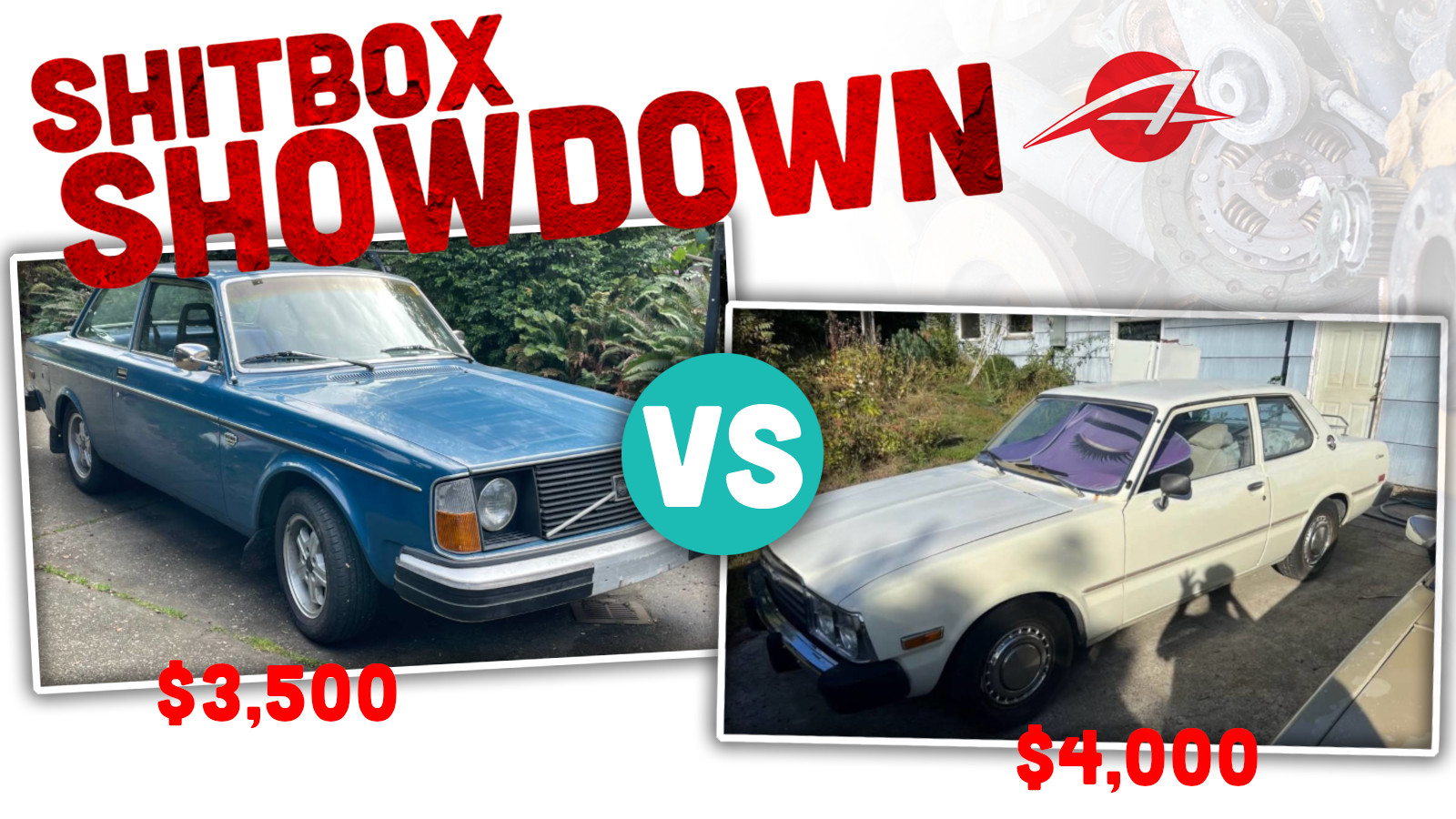
Many years ago, before the Great Crossoverification, you could get the same basic car from most manufacturers in a variety of body styles. Two or four doors, sedan or wagon, fastback or notchback – the world was your oyster. Some of those body styles are still with us, but one is as extinct as a woolly mammoth: the two-door sedan. But today, we’re traveling to a magical place where old cars still roam free to look at a couple of surviving examples.
On Friday, we threw the budget out the window to look at two ailing mid-engine sports cars. It sounded like a lot of you wanted to vote for the Acura NSX, but its hinted-at troubles were just too much. The disassembled but more honest Lotus Esprit took an easy win.


Between these two particular cars, I think that’s the right call. There’s nothing more frightening than a Lotus project car, but that one looks about as honest as you can get. The Acura feels about as sketchy as a “Reduced For Quick Sale” frozen burrito. Someone may take a chance on it, but it sure as hell wouldn’t be me.

One of the things I miss about living in the Pacific Northwest is the constant parade of rare old cars driving around. They’d be coddled classics elsewhere, but there, people street-park them in front of bars on Friday nights, or cram them into the notoriously tight parking garage at Powell’s Books. The two cars that we’re about to look at are rare versions of their breeds, but still not special enough to be anything other than daily drivers in that rainy corner of the country. Which one would you rather put some more miles on? Let’s check them out and you can decide.
1976 Volvo 242 DL – $3,500

Engine/drivetrain: 2.1-liter OHC inline 4, four-speed manual, RWD
Location: Seattle, WA
Odometer reading: 320,000 miles
Operational status: Runs and drives well
It’s astonishing how many Volvo 240s there are on the streets of Seattle and Portland. The newest of these cars is now thirty-three years old, and this early example turns fifty this year. And yet, stand long enough on any street corner, and I guarantee you one will go by. It may look like it has been through a war zone, but it’ll still be chugging along. But most of the 240s you see will be four-door sedans or wagons; an early flat-hood two-door like this is a rare beast.

This 242 is powered by a 2.1-liter version of Volvo’s “Red block” four-cylinder engine, driving the rear axle through a four-speed manual gearbox – without the electric overdrive. Like most 240s these days, it has an absolute buttload of miles on it – but hey, the odometer actually works. The seller is a little coy about its condition, saying only that it is “reliable” and has “no major issues.” That’s good enough to start; the knowledge base and community around these cars is extensive, so any minor issues that come up should be solvable.

The interior is typical of high-mileage Volvos: intact, functional, but not very nice. The driver’s seat has been replaced, and it doesn’t quite match. The condition of the door panels leaves a lot to be desired. And is it even possible to have a Volvo 240 without some wiring hanging out from under the dash? Did they come that way from the factory?

It’s a good twenty-footer outside, in a great color. When you start looking closely, you see a few rust spots, but that’s to be expected in a fifty-year-old car. The later 240 Turbo wheels are a nice touch. And of course, the Thule bike rack is included. They’re required on all Volvos and Subarus in that part of the country.
1977 Toyota Corona – $4,000

Engine/drivetrain: 2.2-liter OHC inline 4, four-speed manual, RWD
Location: Portland, OR
Odometer reading: 145,000 miles
Operational status: Runs and drives well
Toyota today is synonymous with quality and durability, and models like the Camry, Corolla, and RAV4 are legends. But Toyota’s first entry into the US market in 1958 was a failure. Its second attempt, in 1965, worked, thanks to this car: the Corona. By the time this generation of Corona came along, Toyota was on a roll – and Detroit was rightfully worried. 1970s Toyotas have all but disappeared from the roads in most parts of the world, though; reliable as they were, rust took out the majority of them years ago. This is the first two-door Corona I have seen in I don’t know how long.

Power comes from the legendary 20R four-cylinder that can be found under the hoods of so many Toyota pickups. The seller says this is the quietest-running 20R they’ve ever seen, and it has a ton of new parts to keep it humming along. It has a four-speed manual transmission that is starting to show its age; the seller says it’s a little sticky shifting into second gear. Just be a little sympathetic to it and it should be fine.

Inside, it’s really nice, but not perfect; there is some trim missing and a little wear and tear here and there. It’s completely original, though, right down to the radio. And Portland has a halfway decent classic rock radio station to complete the illusion if you want. I wonder how many times “Hotel California” has been played in this car over the past forty-nine years?

It’s very original on the outside as well, though I don’t think that luggage rack was original equipment. It looks like something from a J.C. Whitney catalog. Those wheel covers are the originals, though. It has a little rust at the base of the windshield, but if that’s all there is, that’s impressive for a ’77 Corona. I just wish it were some other color; too many of these old Coronas seem to be painted white.
You wouldn’t want to drive these year-round anywhere that uses road salt; they’d rust away to nothing in no time, like all the other examples have. But for fair-weather use, they’re perfect. If you want a fast car, or a corner-carver, look elsewhere, but if you’re looking for just want a nice old car that you don’t see everywhere, these both fit the bill. Honestly, I don’t think there’s a bad choice here, but it’s not up to me. It’s up to you. Which one gets your vote?



I voted for the Toyota 🙂
Both. But if I have to choose, I always loved the looks of the brick Volvos. And I have a use for that roof rack.