

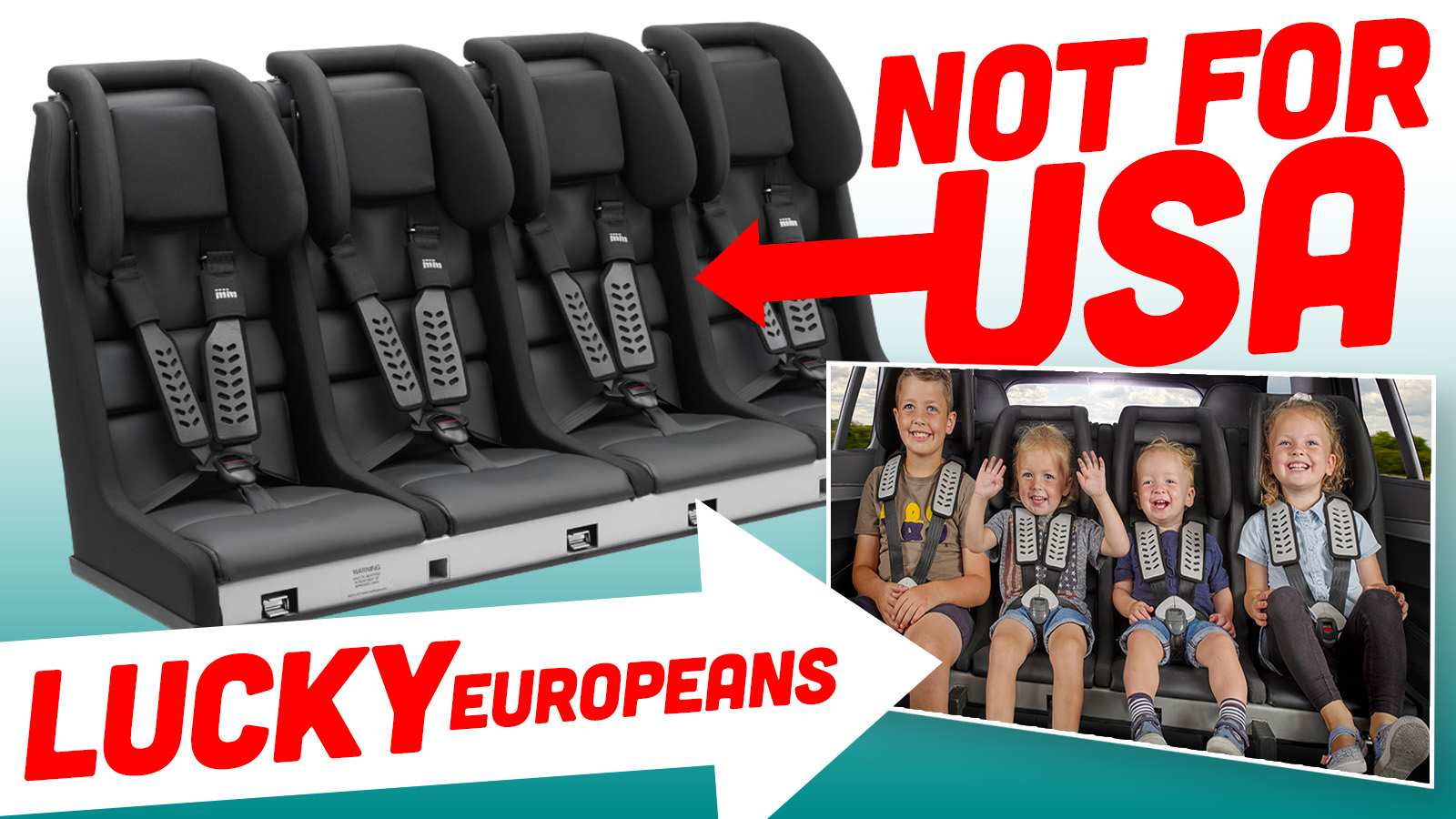
If you own a tiny car like I do, and your rear bench only seats two, you may someday find yourself forced to trade up for a larger vehicle. In Europe, though, there is an alternative option: Simply turn your four-seater car into a six-seater with the help of a fascinating (but illegal in the U.S.) contraption called the “Multimac.”
I’m writing this short blog because, while at a press drive talking with a longtime Car and Driver editor, I realized that most people have no idea what a Multimac is. I, as a new father and owner of a small BMW i3, have become well acquainted with the device thanks to my daily BMW i3 YouTube video search.


Specifically, I have found myself watching Ben Wallace’s YouTube channel “Dadcars,” which mentioned the Multimac in its BMW i3 review, before noting that Wallace had actually installed a Multimac into his own Maserati, turning it into a six-seater. Here’s an entire video on that conversion:
And if you’re not interested in watching a video, here’s a screengrab of the installation:

As big a failure as the BMW i3 was in the U.S., it was and remains a hit in Europe, especially in the U.K., where even the machoest of people don’t drive huge pickup trucks like they do here, but rather tiny hatchbacks. For them, having to buy a new, harder-to-maneuver-in-the-city car just because they had a child (for example) doesn’t make a ton of sense, so a popular solution is to — instead of buying a car equipped with more seats — simply shrink the existing seats from adult-size to kid-size. That’s essentially what a Multimac does.
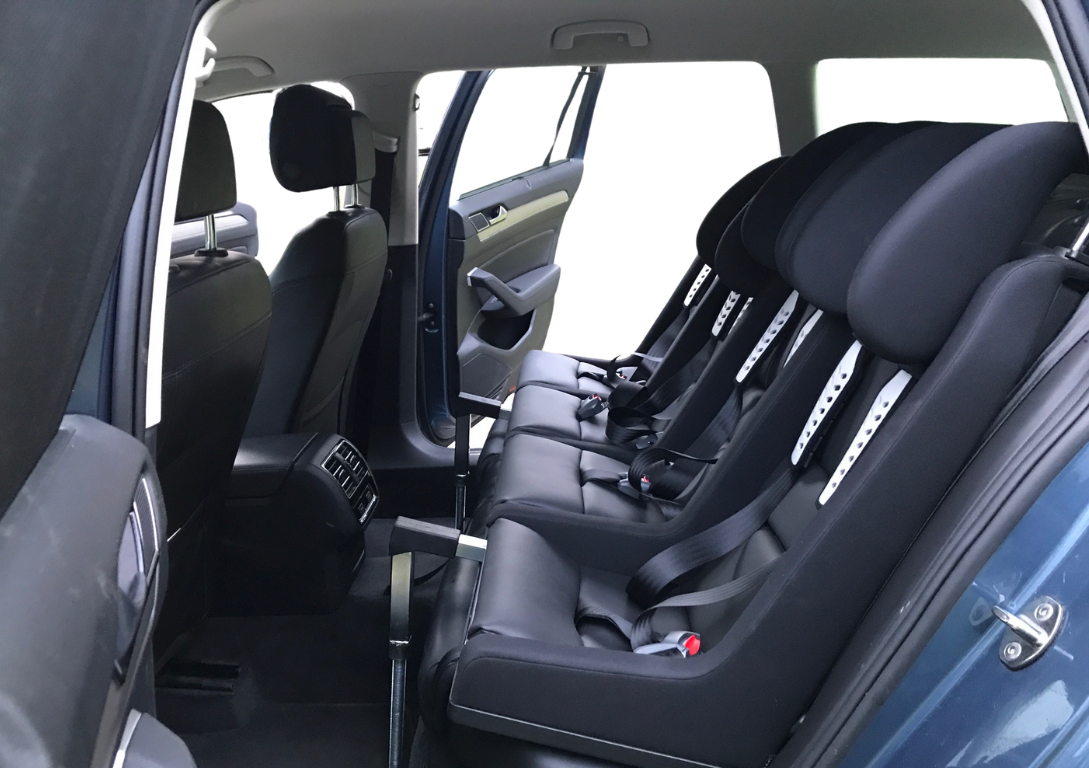
Multimacs are basically big aluminum frames covered in padding and fabric, with five-point belts offered for each seat. Here you can see the aluminum structure:


You can see the legs in that top photo; those, along with two straps that go from the existing seatbelt bolts into ratcheting mechanisms in the Multimac, are an important part of actually mounting this into a vehicle. The company recommends that one of its professionals install the device, going on to note on its website that ISOFIX points cannot be used and that installing the Multimac may require drilling through the car’s floors if the seatbelt mounts aren’t suitable:
The Multimac is held in place with two tether straps which are bolted to the floor of your car – usually using the existing seat belt buckle mounting points under the back seat.
(If those points do not exist or are not suitable, we have to drill the floor to create our own mounting points – we call this a Special Fitting)
ISOFIX points are not strong enough and must NOT be used.
You can also have tether straps fitted to multiple cars so you can move your Multimac between cars – you will require an additional fitting kit to do this as they are unique to each car.
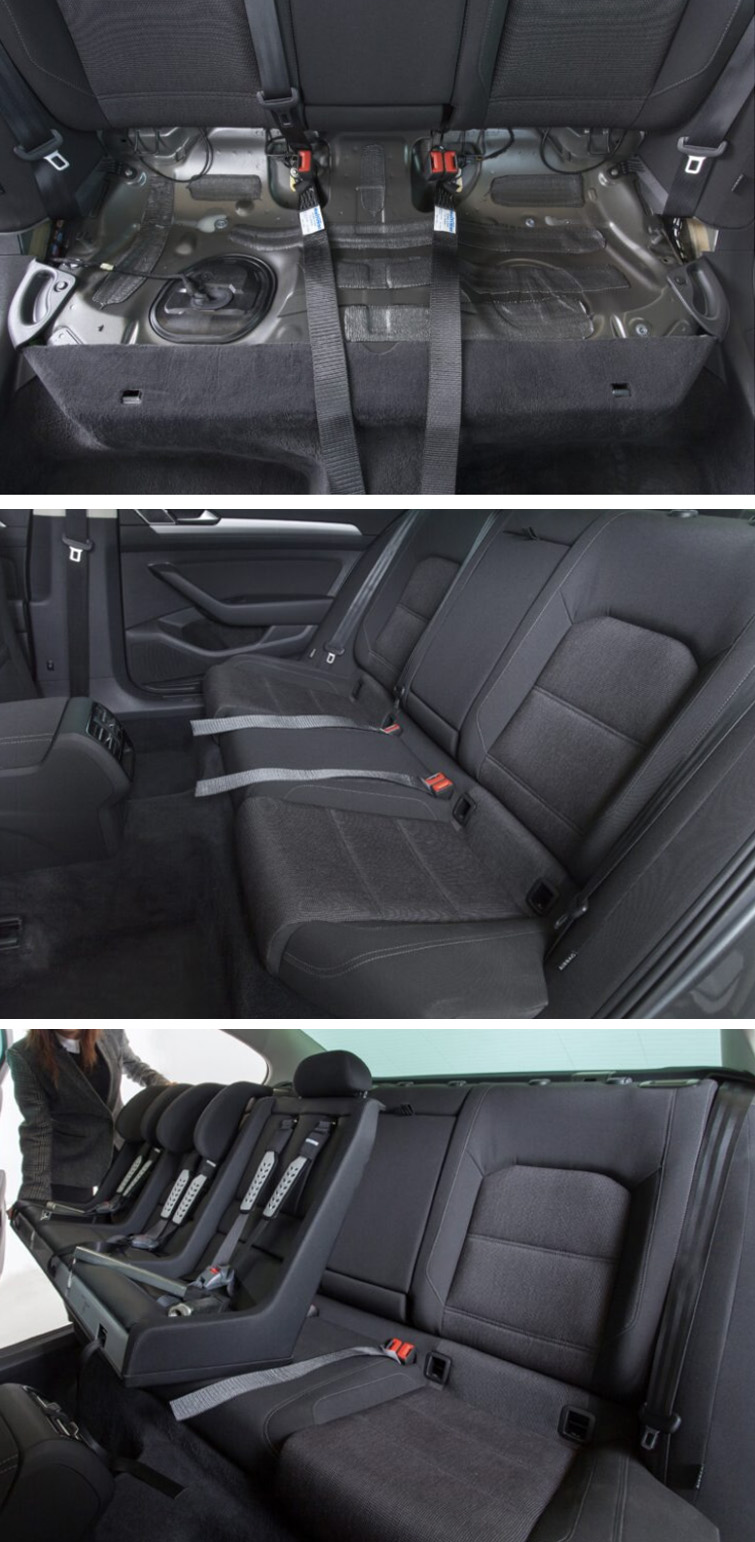
You can see the tether straps attached to existing seatbelt mounts in the top photo above. In the center, you can see the old cushion placed back into place. And in the lowermost photo, you can see the Multimac being slid over top of the existing bench; those two straps will be fed into ratcheting mechanisms in the Multimac, and the legs of the Multimac will be lowered so they brace against the floorboard.
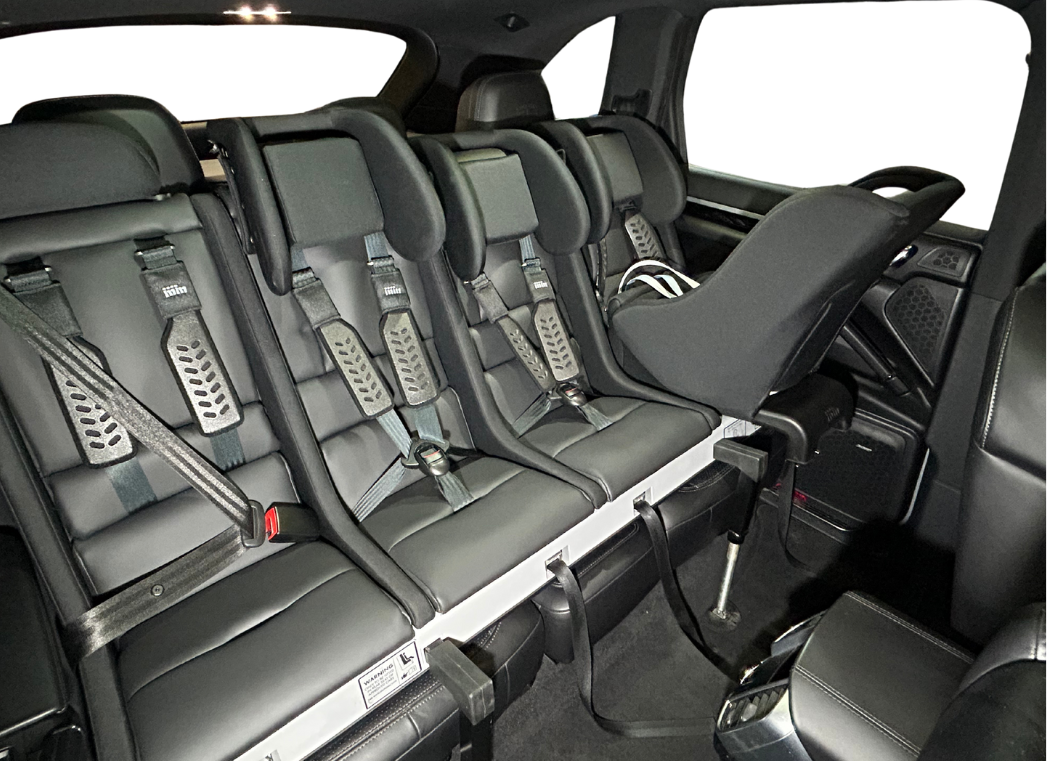
There are plenty of folks who have concerns about the safety of Multimacs, which come in 3-across and 4-across flavors. To that, Multimac replies on its website:
The Multimac undergoes rigorous crash testing at VTI in Sweden, a renowned institution recognised for pioneering child safety innovations such as the rear-facing seat, ISOFIX, and the Swedish Plus test. Since 2001, VTI has endorsed Multimac as an innovative and secure solution for accommodating 3 or 4 children in your car, affirming its safety and quality.
Additionally, the VCA (Vehicle Certification Agency), TRL (Transport Research Laboratory), the British Government, and the European Government have all played crucial roles in the development and global approval of Multimac for use in various countries, including the UK.
To ensure comprehensive safety, Multimac undergoes crash tests across 11 different child age and weight combinations, employing 28 dummies. This meticulous testing guarantees that Multimac provides maximum safety regardless of the specific age and weight configurations used.
View this post on Instagram
Here you can see some photos of Multimacs undergoing testing:

While searching for opinions on Multimacs, I found a comment from a Facebooker who is active in child seat groups and who claims that German’s equivalent to AAA, ADAC, had this to say about Multimac (Typically I don’t include comments from random sources, but this comment seemed fairly logical; also, I reached out to ADAC and will update this story when I hear back):
As a group we don’t really recommend the Multimac for a few reasons
1. It’s rear facing limit is 13kg, same as an infant carrier. After this children can only forward face2. There’s no side impact protection for children forward facing with the harness (and this could be a 13kg toddler!)3. The children on the outside have been placed closer to the door, which could be the point of impact in a collision.4. In some cases it might actually be cheaper to replace the car.

I had one of these, completely amazing bit of kit! It was expensive to buy but after we’d had it 7 years we sold it for pretty much what we paid for it. Given we didn’t have to buy a car with 2 rows of seat or a people carrier, it actually saved us loads verse la a bigger car AND a load of individual car seats that aren’t worth very much once you’ve finished with them.
I can see how these would be useful.
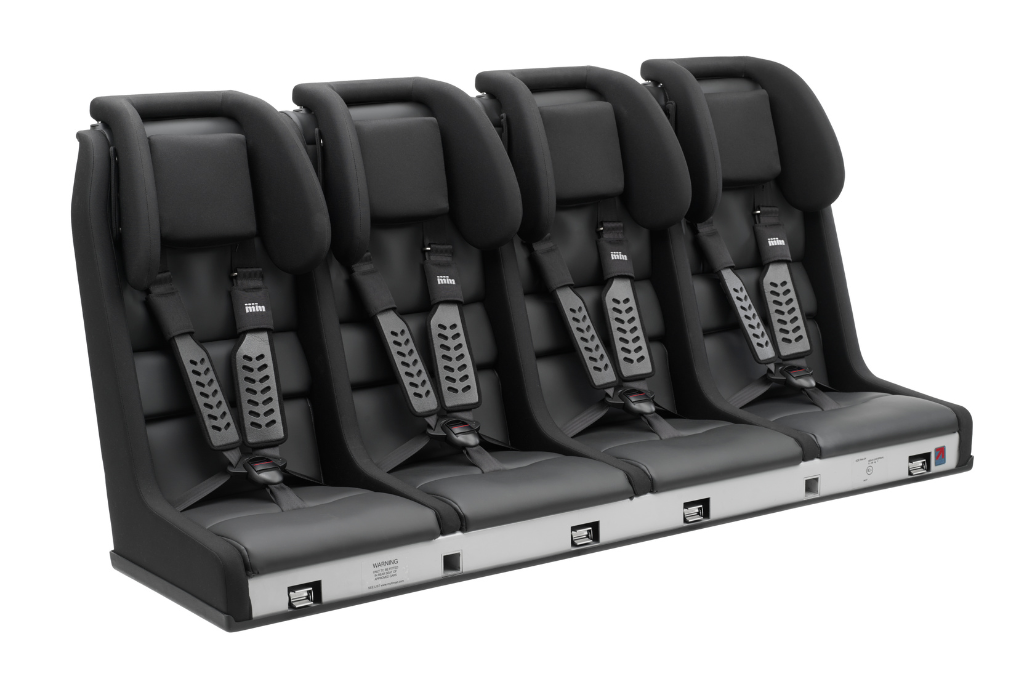
Even though there are clearly some compromises here, I would love one of these for my BMW i3 in case baby-Delmar has some friends come over. It won’t really solve the space problem when my in-laws come over, since they can’t fit into those tiny five-point harnesses, but none of that matters anyway because I can’t even buy a Multimac in North America. It’s not legal.
Multimac has a whole page titled “Why can’t I have a Multimac in Australia, USA or Canada?” It notes that, while the bench passes Europe’s ECE R129 “Uniform provisions concerning the approval of enhanced Child Restraint Systems used on board of motor vehicles (ECRS)” standard, it doesn’t pass U.S. standards:
So why isn’t this suitable for USA testing? One of the biggest issues with the American testing and test rigs is that they do not have a floor. This makes it impossible to test the Multimac, as the legs of the Multimac are a hugely important component of the design and the safety. All Multimacs have two legs at the front, which are height adjustable and sit tightly pressing to the floor of the car. They are crucial in the event of the crash. The support legs will deform and absorb energy; keeping the car seat fixed in place and preventing it from rotating, and are essential in ensuring the Multimac works whether there are 1,2,3 or 4 children sitting in it.
After reading the previous paragraph, you’re probably wondering how American child seats can be safe without the energy absorbing legs. As the American test rig doesn’t have a floor, their children’s car seats have to find their stability and security in different ways; favouring a top tether strap. The car seat laws in the USA require that the seats must pass the safety testing using only the lap belt, so the top tether strap is there to reduce the forward incursion, and hold the top part of the seat back. The top tether is a strap that attaches to a tether point in your car, which is usually located at the back of the back seats if you have a hatchback style car, or where the parcel shelf would be in saloon/sedan style cars. In Australia, they also favour a top tether anchorage system to hold the seat in place, however this specific version is unique to Australia, so will be slightly different to the laws, testing and tethering in the USA. Both solutions are safe and effective when used correctly.
So, will we be able to get the Multimac approved for use in America, Canada and Australia? How would we do that?
As a matter of fact, we faced a number of the same issues when we were initially gaining approval for use in the UK. The British test house is called BSI (British Standards Institution), AND their test rig also didn’t have a floor originally. When it became obvious that the energy absorbing legs were an essential part of the Multimac, we built a floor which was bolted onto the test rig before we did any of our tests. We finally passed our tests, with every combination of dummy loadings, but were then informed by BSI that we couldn’t be awarded approval, as the test rig had been modified. After asking why we had not been informed of this £50,000 and two years previously, our next steps were to work sequentially through their chain of authority, starting with the Vehicle Certification Agency, to the Department of Transport, then finally to the European Government who advised that we should instead work with VTI in Sweden. VTI, as stated earlier, is often known as the home of child safety, and their testing rig had a floor already built in, for testing the Extended Rear Facing Seats developed in Sweden, so was perfect for testing the Multimac.
When our testing at VTI proved that the Multimac was not only safe enough to be sold, but was in fact much safer than traditional child seats and enabled up to four children to be carried simultaneously in a normal car, VTI worked with us and helped us navigate the 190 page document that is ECE44-04, the current children’s car seat legislation, which is written for normal, single child seats, and gain full European approval.
Because Multimac is so unique, and the only one of its kind in the world, we needed someone like VTI, an advanced authority, who could see through the boundaries of the traditional legislation and help us gain authorisation for this revolutionary, ultra-safe child car seat. We now need someone within the legislators of America, Canada and Australia to help us gain approval. A way to get the ball rolling would be for the legislators in those countries to be made aware of the Multimac, the need for it and the existence of this ready-made solution.
The relevant U.S. child safety standard is Federal Motor Vehicle Safety Standard 213 (FMVSS 213), titled “Child Restraint Systems.” Here’s a one-pager on FMVSS 213, courtesy of carseat.org:

I don’t know the full extent of how the Multimac fails to meet FMVSS, but the bit above about having to pass a 30 mph crash test with “vehicle lap belt or lower LATCH attachments only” seems like an obvious fail, as Multimac requires tying into seatbelt anchor locations instead of using existing belts.
So Multimac — a popular European method of turning a two-adult-seater into a four-child-seater instead of having to buy a bigger car — just isn’t going to be an option for me and my beloved i3. As I understand, Multimacs cannot even be imported. Alas, it’s not really as useful in the U.S., anyway, since gas is cheap, space is plentiful, and huge cars abound. At least Europe, where people drive small cars for many practical reasons, has the option.
All Images: Multimac Unless Otherwise Stated
Top graphic images: Multimac


Not legal in the Netherlands and i think the rest of Europe.
On the registration of the car the maximum of seats is shown, you are never allowed to exceed this.
We sometimes got the question can you supply a Twingo with a extra seatbelt for the rear.
Answer:
A No there no points to mount them
B your registration says you have a 4 seater car
Can these be optioned with wheels and a tow hitch?
I used to think this was a great idea. But this is a very expensive solution to a relatively short term problem. You may end up with four kids, life happens, you aren’t prepared etc etc. There is only going to be a 2-5 year window where you will have all four of your kids in a car seat. At some point one kid is going to be too big and you are going to have to buy a larger car. Most people generally change cars every 5-10 years. You may have to bring this purchase slightly forward, if you are going to put $4k down on this seat I would say $4k plus whatever you own now even if its fully paid for would buy you an equivalent vehicle with 7 seats.
I had 2 sets of twins in the 80s and drove a VW Scirocco. I had one car seat in front and 3 car seats in the back, with a rope going through the backs of them and tied in a huge knot in the trunk. Did the trick until I could afford a bigger car. Today I would be in jail for child endangerment.
but I still remember standing over the hump between the seats talking to my parents. And laying on the rear shelf, resting my head on the speaker grill, watching the stars and street lights.
We’re old. I remember riding on the package shelf of my parents 49 Chevy fastback coupe. And once I was standing on the floor in the back seat and was sticking my head out the window while mom had it rolled down to talk to the gas station attendant. I was a bit slow pulling my head back when mom rolled the window up, catching me in the door frame.
Given my understanding of linear time and how it affects the growth of children, isn’t this just kicking the can down the road?
Or do you plan to cram four teenagers into that clown car setup eventually?
Kicking the can 5-7 years down the road is a perfectly valid objective, that’s longer than most people keep their cars for and even if that wasn’t the case it’s still 5-7 years of fuel, road tax and maintenance savings. Even if it only delayed the inevitable by 3-4 years, that’s a substantial amount of fuel, insurance and road tax, not including how much nicer it is to drive a smaller car for that duration.
It would have helped me out a lot back when this was an issue. With three kids to haul around, it meant that between my wife and I, we had to basically devote one car to kids only since my car (sedans then) could not effectively fit three car seats across the back. Technically it should work, but the reality of getting three car seats to fit safely was impossible. I tried it every which way, different orders, different seats, they were just too big.
Something like this would have permitted us to use any of the two cars if needed or not have to buy the CX9 we eventually had to purchase to fit all three and their gigantic car seats. Either that or we could have delayed that purchase for a few years and would have been able to afford something more reliable.
Those 5-7 years mean a lot for a growing family, especially when one parent may not be working and the other has to carry the financial load. In a similar time period, we went from a two income household with two people to a five person household with one income and back to a two income household. Getting a way to ease the financial load during that transitional period would have been very welcome.
If it costs $4k to make the retrofit, there’s gotta be a pretty specific use case where I couldn’t justify a Mazda 5.
Or a Ssanyong Rodius. Which Adrian told us is a perfectly cromulent car with zero downsides.
It’s definitely not cheap, and there are lots of comments here pointing out other flaws with the concept that are also totally valid, I can see the value of the 3-seat one, as Dingus pointed out it’d fit where 3 individual child seats wouldn’t and shouldn’t cost too much more, but I still would consider it an extremely niche solution. And of course it’s forward-facing so if you needed rear-having baby seats you’d have to shell out for those no matter what.
Some people replied below that it’s a valid solution. But what I realize is back when I would have NEEDED this thing, i could never have afforded it. Yeah we could buy a 10k car because I could finance it. But I coming up with $3k all at once was never a possibility.
If this device at $4k is an option, so is buying a used, 15 passenger church van. I say that would be way more useful. It then begs the question of why stop at four kids when you could fit 13 kids in this shit? Then, if you STILL need more space, you can buy a school bus and start a traveling family band.
Not here, where €4k would be reached very fast in taxes and insurances for a 15 passenger van.
We get cheap church vans and you guys get the fun, small cars.
Trade?
It is for sale in the Netherlands I just learned. But never seen one. Also tried to find testreport of this, but found none. I did found remarks from the ANWB, the company testing childseats. They had serious doubts over the fixing of the multimac to the car; because you don’t use existing equipment (seatbelts, ISO-fix) the fixing is as good as the execution of the installer. Secondly, cars have a number of seats for which they have certification. Two front seats and a rear bench with three seatposts mean you can seat five. So you can’t legally use the multimac to increase the number of available seats in the car.
In the past, in the Netherlands, it was legal to transport two children on one seat, but only if it was regulated schooltransport with taxi- minivans to- and from school. I was a stand-in taxidriver during my study, and I have driven a VW T3 packed with 12 (!) children. Would not recommend, to anyone, ever. Fortunately this exemption does not exist anymore today.
Those big yellow US school buses are still one of the safest modes of road transport in the world, despite a lack of seatbelts in almost every case. It still blows my mind that we do this, but it seems to work.
It probably helps to be a fearless child or a medicated adult, then you don’t think about it too much. Just like how I rode on high-speed trains in southern Spain last year…just sit back and relax, nothing can go wrong!
I can’t find it right now, but didn’t Torch (or another Autopian) pen an article on the old site outlining why the US not requiring seat belts n school buses isn’t actually as bad as it would initially appear?
I recall some of the justifications centering around: the relative mass of a school bus and that it typically isn’t accelerated in any direction by an impact with another vehicle; the relatively low speeds buses are typically driven (yes, some get driven on highways. These are edge cases and probably shouldn’t dictate all buses); the fact that they are built like brick sh!thouses with padded impact areas for the passengers.
That looks like a terrible solution, if you have 4 kids presumably you need more space than a bmw i3 just for their stuff.
I don’t think there is anything “lucky” about having four screaming children sitting behind you in the car.
I can just imagine the noise from the backseat mom he’s touching me.
Definitely will not pass in France.
And apart from legal concerns, how on earth will you persuade the little ones it is their turn in the middle ?
As soon as they can talk and express opinions, forget about it…
Also as others have said, can buy lots of old but good seven seaters for that sort of money.
A clever solution in search of a problem. We did sell our regular cab Ford Ranger when our second kid was on the way, and got a sedan. We made it until the youngest was in middle school with a Ford Escort and a Saturn SL2 before finally buying a Mazda5. If you have a big family it’s better to have something appropriate than cobbling your back seat. Over here, worst case you get an Econoline, over there you can get 3 child seats in a Fiat Multipla, or any number of 3 row vehicles
This is a solution to a non problem
I get the idea and it’s genius on the surface, but….
Yes, I have questions.
*Say you’re bringing your kids’ friends to a party or something…maybe ask another parent to bring their car on those rare occasions instead of permanently modifying your own car for such an esoteric use case?
Sorry for the cynicism, this is just something I would shoot down if an investor presented it.
For point 3, that is most likely true as I know that when living in the US, the car seat we had advised switch to the seatbelt and not use the LATCH points once your child hit a certain weight.
Here in Australia it is much the same, and booster seats (even harnessed boosters) only use the seatbelt and top tether, there aren’t any provisions to connect to the ISOFIX points.
However, I would never attempt to put one of these contraptions in my car or allow my kids to be transported in one.
Who tf feels it necessary to have four or more children? I cannot even imagine the decades of agita.
You get it! The cheapest solution isn’t to get the multimac. It’s just to not have kids.
Triplets? Quadruplets? You just going to send a few back?
Mostly men who don’t care for fathering their offspring.
Soundproof cage.
Dr. Faraday started out by trying to get away from screaming kids by getting himself struck by lightning, but it accidentally protected him.
One does not simply shuffle off this mortal (Tesla) coil that easily!
A used police K-9 unit with padded sides and a soundproof window.
Compared to what some families make do with, this thing is overkill. https://www.flickr.com/photos/dcmaster/5775493755