

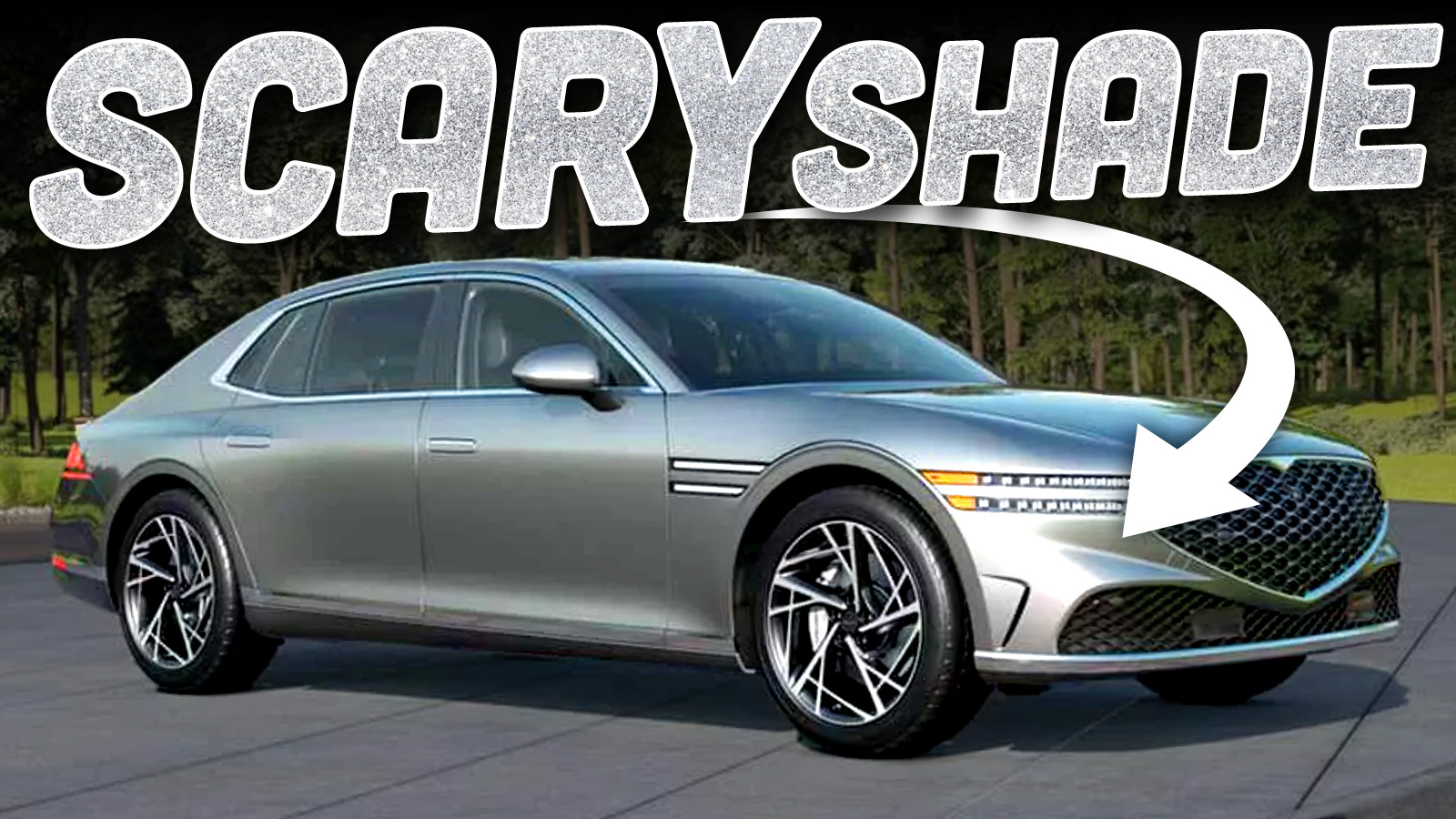
Most recalls are pretty boring. I sift through a large number of recall reports for my job here at The Autopian, and many of them—these days, at least—are software-related bugs that can be fixed with a simple update.
Sometimes, though, recalls can be a fascinating window into the world of car design. Faults or malfunctions that no one could have anticipated are uncovered due to a combination of parts that no one ever thought to test together.


That’s exactly what’s happened here, going by this recall from Genesis. The company’s big-boy G90 sedan has been recalled due to a phantom braking fault in its assisted driving software. But the problem only occurs in cars painted a specific shade of silver.
It’s All In the Reflections

Hyundai, Genesis’ parent company, began tracking this issue earlier this year when it started getting reports of phantom braking from owners. Specifically, the car was hitting the brakes on its own when the driver tried to get the car to change lanes at low speeds, even if there wasn’t a car in the adjacent lane. From the report:
The subject vehicles are equipped with Highway Drive Assist (“HDA”), an advanced driving assistance system that allows semi-autonomous driving on limited-access highways with continuous, direct supervision by the driver. The vehicles may falsely detect another vehicle entering its lane of travel and apply the brakes without warning when HDA is enabled at speeds below approximately 12mph or when HDA is enabled along with the Lane Change Assist (“LCA”) feature, activated by the driver moving the turn signal lever to the desired direction to change lanes.
Even at 12 mph, a sudden application of the brakes still creates a dangerous situation. Not only is it jarring for the driver, but the unexpected stoppage of movement in traffic could cause a rear-end collision from the car behind.
It wasn’t a faulty sensor or rogue software that was causing the issue, as is the case with a lot of these phantom braking incidents. Hyundai soon discovered that the aluminum used in its Savile Silver paint was screwing up the radars in its front bumper:
For vehicles in the Savile Silver exterior color, the front corner radar signals may reflect off the Aluminum content in the silver bumper cover paint and pass through the front bumper beam. These signals may be registered as an object in the opposing lane and can potentially affect Highway Driving Assist (HDA) operation.
In the grand scheme of recalls, this is pretty funny. This is basically the equivalent of an animal seeing itself in the mirror and scaring the bejeezus out of itself.
So What’s The Fix?

Replacing the paint with a version that’s not mixed with aluminum is the most obvious answer, but it’s definitely not cheap. You can’t just repaint the bumper cover, because it would look different than the rest of the car without that aluminum flake. So you’d have to repaint the entire car.
Instead, Hyundai is taking a more clever approach. Affected models will have their bumper beams—that is, the metal bars that hide beneath the painted bumper covers—replaced with a version that’s been “sealed to prevent radar transmission through the structure.”
Once Hyundai learned the Savile Silver paint was the issue, it stopped using it on production cars (the paint is available on much of its lineup). But once this new sealed bumper beam is incorporated into production, it’ll restart. So if your silver G90 on order is delayed, now you know why. Current owners should be getting notified about the fix at the end of next month.
Thankfully, there have been no reported crashes or injuries related to this issue. It would be pretty embarrassing to have to tell your body shop the car scared itself into getting rear-ended.
Top graphic image: Genesis



Author’s name almost checks out.
I think we have to give Genesis some credit here. If this is what one of their recalls look like, they must have nailed the rest of the car’s engineering and quality. This would be the automotive equivalent of a first world problem. If Doyle Dane Bernbach had their account, they’d be running ads in the Superbowl about this.
Solving puzzles like this almost make having the problem worth it in the first place. Fascinating.
Wild coincidence that this happened the week that famed architect Frank Gehry died. Whose building’s polished panels reflected intense blinding glare and concentrated heat.
Maybe I’m more impressed than I should be, but I’d like to have been there when the first guy or girl realized it was the color of the paint that mattered. Kudos to Hyundai/Kia/Genesis for figuring it out and dealing with it.
Effective problem solving usually poses some questions along the lines of
“what XXX (car, sofa, assembly machine etc.) did the deviation occur on”
“what other XXX could it have occurred on but didn’t”
Then you start focusing on the differences of the “was” and “was nots”.
I’m 100% sure Hyundai/Kia et al employ this type of structured problem solving.
So many untrained in it focus on the item having the issue and not the “negative space” the differences between the issue and the non-issue. Time and date is also important data, like “the toxic gas monitoring gets triggered every other day at 6:15 PM” and as it turns out that’s the date and time the crew washes the floor around the equipment. It’s an incredibly satisfying experience.
This is definitely true, but of all the variables on a car that could cause unintended braking, you would think that paint color would be a pretty long way down the list.
Part of me wants to do a deep dive into the data to find out whether they even have enough reports of this issue to be able to come to statistically significant conclusions based on any of these variables, but not enough of me to actually follow through.
This is definitely true, but of all the variables on a car that could cause unintended braking, you would think that paint color would be a pretty long way down the list.
But that’s exactly the point to being structured, nothing is disregarded. You do that and you lose the plot completely. Statistical significance is a different discipline (QC, SPC etc.), you cannot get tricked by statistics (real or off the cuff) in structured problem solving.
I mean if you ignore the paint color you ignore other factors too, like what happened the day you painted silver, or the team on shift when silver cars went through the line.
On data yes, they might have only had a few reports, all the more reason silver might stand out.
Big companies like this sweat the small stuff. Here’s a good example; My company makes wafer processing equipment, obviously made up of thousands of parts. some of these parts are directly related to the process on the wafer, some are not. However Intel sweats every single part. We heard from a vendor that a solenoid, that drives the valve turning on and off the cooling water, would have changes to the markings. The font and logo color would be changing. I had to test both versions, for electrical characteristics and heat creation etc., before Intel signed off on the part.
Now I’m not imparting any uncommon quality aspect onto Hyundai, just looking at it from my experience. We’re a mid tier company ($5B), but when it came to Intel (my account) every deviation was run down. Genesis is the premier brand so I suspect they take reports pretty seriously, otherwise the distinction doesn’t mean anything.
I absolutely appreciate your point – I just find myself wondering how many other deviations they had to run down before they came to the conclusion that the paint was the issue.
I’ve done a little work in quality control, and my current job involves a significant amount of root-cause analysis, so I fully acknowledge that this is a specialist area of work which, when done well, appears tantamount to magic to folks who don’t understand the process.
I’ve also (albeit briefly) worked at places where investigating and correcting systemic issues is frowned upon, including one ‘premier’ car brand. Kudos to Genesis for having a better culture than that.
I once worked on an issue with a new engineer, about an hour in he had to throw away his problem statement. As we worked though the exercise, it turned out he was looking at the wrong deviation.
I’ve also (albeit briefly) worked at places where investigating and correcting systemic issues is frowned upon
Oh my company is far from perfect, I’m out of that department now, so no clue how well or if the standards are being held. On the quality control side I got thrown into that as well, brutal walking into a meeting trying to defend a crappy vendor in front of Intel VPs. Those guys can spot a Western Electric violation from a 1000 yards.
Kudos to Genesis for having a better culture than that.
Absolutely, this is a great example of why these structured methods are so important.
In France there have been crashes and injuries, but so far no deaths due to phantom braking.
From memory one of the most famous cases — got on main TV news because an articulate lady with her daughter had a horrendous case on the motorway and were rear ended in the fast lane — involved a dark grey, metallic paint car…. Probably the metallic paint.
Before now the car makers were muttering about how it must have been a thrown tyre tread which confused the machine…
New and different electronics create new and different malfunctions.
Ha. This isn’t the first paint related recall for Hyundai. The yellow Kia Stinger had a recall as well.
I’ve never seen a yellow Stinger, but would like to.
I did see a super-clean second-gen Scion TC in chrome yellow the other day, with some black graphics on the side and though I’m not sure it’s factory original, it looked pretty great.
Definitely not enough yellow cars around.
They only made 400 of them.
Off topic, but those are some wild wheels in the top shot. And also in the last photo, I can’t say I like either of them, but I really don’t like the ones in the top shot.
I like those 7-spoke snowflakes in the bottom one, but my favorite wheels of recent years are the stock multispokes on the Fiat 500, so make of that what you will.
The bottom shot wheels are definitely better that the ones in the top shot.
Like the Sorento fire risk using fan speed 3, there’s always something with that duo…
Power to the person who discovered how that was happening (if they didn’t know about it earlier and finally got the executives to listen after getting a lot of customer complaints), that’s an impressive find!
But, also: what an issue to have!
See? We take the lead out of the paint and it leads to nothing but problems. No concerns of signals getting through with good ‘ol lead!
I even heard of a Zepplin made out of Lead once, it was massively popular from what I hear.
It went over like a Lead Zeppeli… oh wait.
Ah well, I guess I’ll just Ramble On.
Good times, bad times…
“Brother, I brought you some silver, yeah”
You haven’t heard? The EPA just announced lead is good again.
Aluminum in paint is now added to the DFMEA for radar braking, noted.
Mmm, FMEA, there’ve gotta be dozens of us that know that that is!
I like wrenching, but I’m broke and miss test engineering.
Failure modes baby. I go through life looking for them. It’s a painful existence.
And I spend a lot of time with Glossaries adding new company-specific made-up acronyms all the time. That and spent a couple decades as Mfg Engr.
I never expected to see DFMEA in here, thats part of my curriculum for the training classes I teach in my engineering job lol always the special characteristics missing in the file causing trouble lol
I think we now need a test to see if the Savile Silver cars are readable by police radar guns
There’s an obvious fix here: car bra! Cheap and classy solve.
I was going to say, I 75% expected the fix was “scuff paint” or “applied corrective decal.”
Anyone who says cars need more electronic crap can take a long walk off a short pier.
Aluminum is often used as Chaff to distract missiles. I guess this particular blend of paint, if sprayed, could help shake an S-300 off you…
Is Your Car Safe From Supermaneuverable Air-Defense Fighter Aircraft?
I would not like to be targeted by an A-10.
That was an amusing video. Kind of a non-sequitur.
Not on my list of top 100 things to look at to solve the mystery. I give a lot of credit to the investigative engineer who sat back, looked at the problem, and went ‘ah shit, it’s the paint’.
I guaranty there’s been at least 1 engineer screaming for months or years that that paint would break the radars but nobody would listen to them.
I thought only the US/Detroit treated engineers that way 😛
I’m pretty sure this is the universal treatment of engineers and technicians everywhere.
Silver cars should be recalled because it’s a stupid color LOL
Only good thing about it is that it sort of hides to-the-metal scratches, unless the metal starts rusting
Like how Premier Cruise Lines used to paint their hulls red to hide rust streaks
Owning a duct tape silver colored car is nice when you have a cracked bumper. The fix is almost invisible.
Hides dirt better than white or black, in my experience, and certainly more pleasant to look at than some greys.
Which isn’t to say we shouldn’t have more colorful cars out there.
I saw a G90 in an absolutely lovely dark green the other day. Why anyone would choose silver for this car escapes me.
Hear, hear!
I had to settle for silver to get a manual transmission.
So blinders, just like a horse. How ironic.
that’s an interesting fix, surprised they could not filter out false positives via a software update.
It reminds me of the early days of developing an industrial autonomous vehicle (yard hostler) and resolving false hits due to lighting. At work, the AV would not back to the trailer to connect to the kingpin and reported a stop for an obstacle. Ends up, it was a lighting issue – the sun was hitting the LIDAR from a low angle and all I had to do was stand in the sun to create a shadow on the LIDAR and the AV moved on its own again. LIDAR hit filtering via SW was the long term fix on that one.
Sometimes you can program it out, sometimes you can’t. Depends on whether or not you can reliably tell the difference between those false positives and a real positive. If that sweet spot is too small, you end up filtering out real positives, which in this case might be worse than the current problem. At least if you get rear-ended, you can blame the other guy.
yeah, if the material itself is inherently reflective, as in this case, it likely was cheaper to change material than to mitigate programmatically.
My suspicion is that the paint + bumper beam interaction created a long enough path length that the reflection appeared to be in a concerning location. For more filtering fun, I wonder if there’s enough flex in the panel to give the reflection just a bit of Doppler shift so that it appears to be moving at relative speed to the car.
Depending on the exact interaction, it’s possible that a filter that would eliminate this false positive would also filter true positives. Better to fix in hardware in that case.
Being a H/K product, I was honestly expecting the fix to be a can of black spray paint. But real name brand Rustoleum, not the generic stuff, because it’s a luxury car.
Somehow, I was expecting some sort of vinyl appliqué in a strategic spot that would end up looking like eye black
Or some bolt-on item from the pep boys accessory aisle.
It’s a G90, not a Lancer Evo.
That’s what I came to say. I’ll see myself out.
I was thinking they’d just give your car back with an unpainted black eBay bumper cover. Befitting of Hyundai-Kia indeed…
Either that or just disable lane assist and hand you an oil change voucher for the lost value.
Yet another reason to distrust tech that takes the wheel out of your hands.
Ever have a girlfriend on shrooms? Yeah, same effect.
Stopping silver? Oh no I hope they don’t have to paint cars actual colors now.
Where does this rank in the list of weirdest reasons for a recall?
…Somewhere behind the mazda spiders recall. The one where webs in the gas tank would cause spillage and fires.
In the vent line, and only in regions where that one breed of spider loves to block off holes of exactly that diameter. One of my favorite recalls too.
The Magliozzis talked about the Mazda spider recall at some length on their Car Talk radio program and on the Car Talk website which is how I first learned about it. Yeah, mighty memorable, lol.
Some 30 years ago I came across an old and rather odd book of anecdotes where much of it was about the U.S. military; the author talked about working on a military base where they were dealing with a rash of bombers inexplicably and spontaneously dropping bombs (without the warheads so no harm done, mostly) during training runs and they tracked the cause down to one specific species of wasp (a type of mud dauber, IIRC) liking to use the bombs’ sensor holes or tubes for their nests where the mud inside the holes/tubes would trigger some mechanism for dropping the bombs. Not sure but I think they fixed the issue by simply changing the diameter of those holes/tubes.
The same book also explained why so many storage sheds for explosives seem so flimsy; apparently they’re actually intentionally flimsy so that if somebody is inside such a shed when an accident happens and the shed blows up then that person has a slightly better (!!) chance of surviving (also !!) than if it were, say, a reinforced concrete building which would contain all the explosive forces and simply pulverize whoever was inside.
Alas, I do not recall the title of that book or the author’s name and sporadic online searches over the years have turned up nothing. Possible that a good reference librarian (or a Reddit forum) would be able to track it down…