


Becoming a parent can be as frightening as it is wonderful, partly because it doesn’t come with a Haynes manual and partly because it probably means your fun car can no longer be your only car. You can’t really fit a rear-facing child seat in a Scion FR-S, but you don’t want to roll the dice on a used Porsche Macan or BMW X3. What do you do? Well, the 2026 Toyota RAV4 PHEV GR Sport promises what you crave.
The recipe is simple: Take the high-output 324-horsepower RAV4 plug-in hybrid, send it over to people who really care about driving, and tell them to go nuts within reason. No powertrain tweaks, no crazy race suspension, but proper noticeable upgrades. The result is a serious option for the parents who roll up to daycare drop-off with a can of Monster Energy in the cup holder and Crankdat absolutely blasting on the stereo.


[Full disclosure: Toyota Canada brought this RAV4 PHEV GR Sport to AJAC TestFest, an annual event put on by the Automobile Journalists Association of Canada as part of the run-up to and evaluation for Canadian Car of the Year. Food and lodging were provided by the Association.]
The Basics
Engine: 2.5-liter naturally aspirated twin-cam Atkinson-cycle inline-four.
Battery Pack: 22.7 kWh 391-volt liquid-cooled lithium-ion.
Charging: 7 kW Level 2 AC charging, Level 1 AC charging.
Transmission: Two-motor/generator eCVT with planetary gearset.
Drive: Through-the-road all-wheel-drive with the rear axle driven by an electric motor.
Output: 324 horsepower.
Electric Range: 48 miles (77 km).
Fuel Economy: 41 MPG city, 34 MPG highway, 37 MPG combined (5.7 L/100km city, 6.9 L/100km highway, 6.4 L/100km combined).
Body Style: Five-door compact crossover.
Price: TBA
How Does It Look?

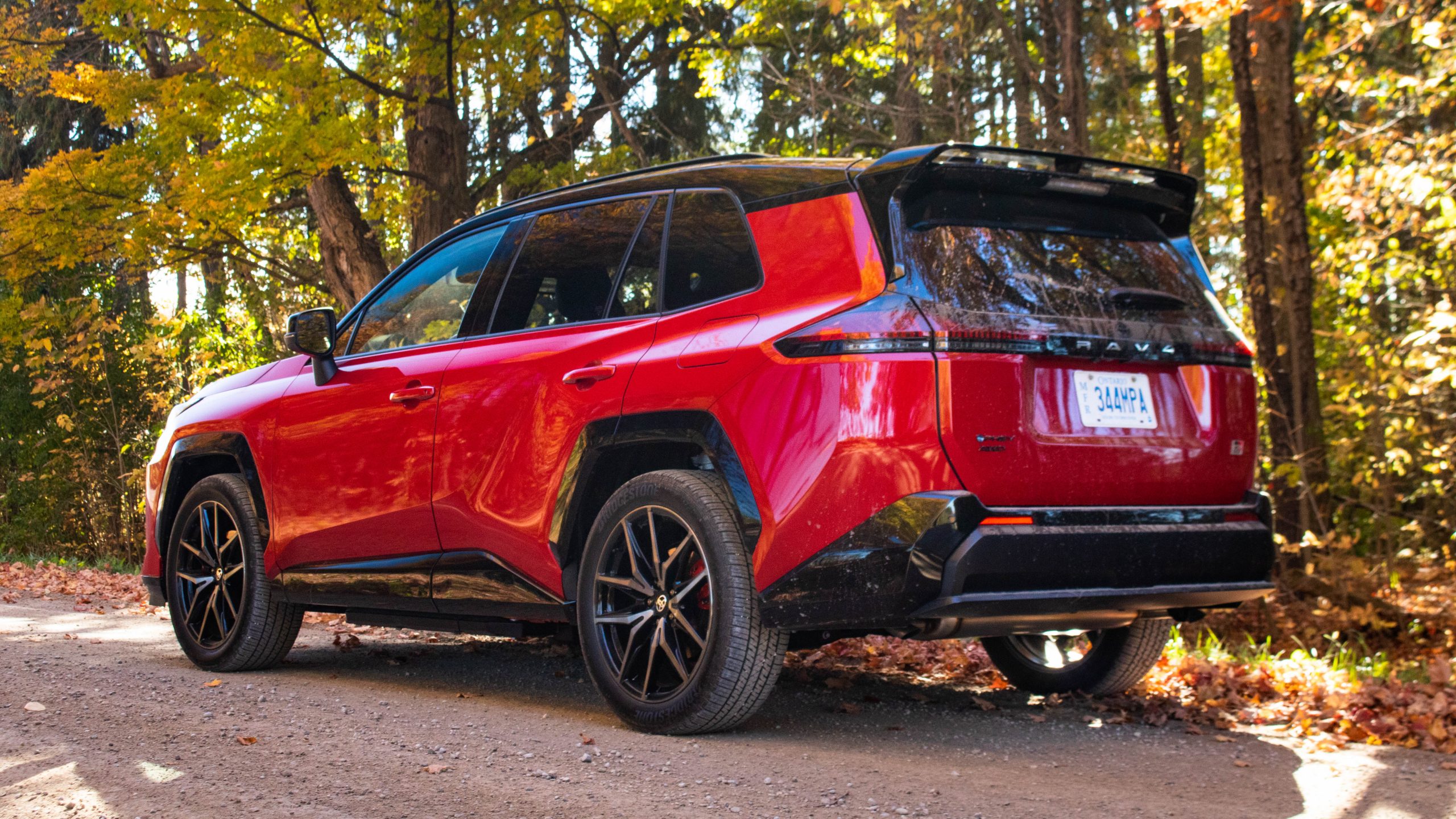
Right off the rip, the RAV4 PHEV GR Sport fixes the most contentious part of the new RAV4, the front end. Instead of a hole-punched bumper, it gets a tall grille reminiscent of the updated GR Corolla, along with a relatively deep front valence. Around the side, the 20-inch wheels not only great, they serve a purpose. The wheel and tire package on the GR Sport is 2.2 kilograms lighter than the 18-inch setup on the RAV4 SE, and frames a set of red brake calipers. Are they any different than the brakes on the regular RAV4 PHEV? Nope, but teenage pseudoscience says that red makes you faster.

A few pieces of black trim, like the mirror caps, add to the look, and things finish off around back with a hot hatch-grade spoiler and a pouty rear valence. Put it all together and you get the best-looking variant of the new RAV4, although it comes with a downside: That chunky rear valence means towing capacity is officially rated at ‘no’.
What About The Interior?

Of course, if you’re going to make a performance trim of a regular car, you’re gonna want to do something special with the interior. Unsurprisingly, the cabin of the Toyota RAV4 PHEV GR Sport shares a little DNA with the car you really want but can’t fit a rear-facing child seat into. The seats are clad in the same sort of Brin Naub suede you get in a well-specced GR Corolla, a solid percentage of the stitching is red, the pedals are aluminum, and you get GR badging on the headrests, door sills, and steering wheel. Tasteful. Unfortunately for tall people, the sides of the center console still aren’t padded, but knee clearance seems a bit better with the sport-look seats largely shared with the XSE and SE trims.
How Does It Drive?

The RAV4 PHEV GR Sport isn’t just an appearance package, and the first clue is a set of arch extensions that widen this crossover by 25 mm to make way for a 20 mm wider track and 10 mm-wider tires. From there, the GR team decided to drop it like it’s … warm. Alright, six-tenths of an inch or 15 mm isn’t a huge measurement, but it’s nice to know that new springs and retuned dampers actually bring the RAV4 PHEV GR Sport closer to the ground while firming up the ride. Speaking of stiffening, Toyota’s also beefed up the rear crossmember and added a structural damper for extra rigidity up front, then capped it all off by recalibrating the electric power steering in sport mode. Sounds lovely, but how does it feel on the road?
In a word: Better. Compared to a standard RAV4, the body control’s tighter, the steering in Sport mode is weightier, and the whole vehicle just feels more planted, should you want to take corners a little bit quickly. You even get a more composed ride quality because the dampers seem better-matched to the springs than on the regular model. Alright, so it’s not going to trouble an Alfa Romeo Stelvio or BMW X3, but the GR Sport is a significant improvement on a regular RAV4 for those who care about driving but want the promise of economy, reliability, and resale value of a Toyota plug-in hybrid.

Oh, and did I mention that this thing’s quick? Sure, it weighs 4,400 pounds, but a combined output of 324 horsepower should make for a zero-to-60 mph time on the sweet side of six seconds once rollout is deducted. Of course, there is one caveat here: While the front drive motor produces a lot more juice than in the regular non-plug-in hybrid model, the rear electric motor makes the same 53.64 horsepower and 89 lb.-ft. of torque as it does on the regular RAV4. The result is even more of a front-biased feel, and while that should be fine for those buying a less sporty PHEV, I suspect an infinitesimally small number of people will buy a GR Sport by accident.
Does It Have The Electronic Crap I Want?

If you’ve read our road test of the standard RAV4, you probably already know the drill when it comes to in-cabin tech. For 2026, the best-selling vehicle in the world gets a 12.9-inch digital instrument cluster, up to five USB-C charging ports, a slick new infotainment system with 16 GB of RAM, and an updated safety suite including a built-in dashcam. What makes the GR Sport different from a base model in this department? Well, it gets a larger 12.9-inch infotainment touchscreen and a 360-degree camera system. So far, so good, but there’s one thing you might want that isn’t just electronic but also functional.

While top-trim RAV4 PHEVs gets DC fast charging and an 11 kW onboard AC charger, the GR Sport makes do with no DC fast charging and a mere seven-kilowatt onboard AC charger. Sure, this means it should only take an extra hour or so to go from 10 percent to 80 percent on a Level 2 charger than it would with an 11 kW onboard charger, but the RAV4 GR Sport is sort-of an enthusiast car, and plug-in enthusiasts care about charging. Then again, the absence of the top-spec charging package seems to be a way of managing costs. Toyota’s hinted that, at least in Canada, the RAV4 GR Sport won’t be the top-trim plug-in RAV4, which means there’s a shred of hope when it comes to reasonable affordability.
Three Things To Know About The 2026 Toyota RAV4 PHEV GR Sport
- It gets some proper suspension tweaks over the standard model.
- No DC fast charging on this trim.
- It’s the best-driving new RAV4 of the bunch.
Does The 2026 Toyota RAV4 PHEV GR Sport Fulfil Its Purpose?
Absolutely. It’s a better-looking, better-handling Toyota RAV4 for people who care about that sort of stuff, it pays more than just lip service to the GR sub-brand, and it’s even based on the high-output plug-in hybrid model. Although we’re still waiting on pricing, if Toyota keeps it reasonable, this will be the best RAV4 yet. Sure, the old three-doors are cool, but they don’t handle or move out nearly this well. Twenty years ago, we were spoiled for choice when it came to performance trims of family sedans. Time to do the same to mainstream crossovers.
What’s The Punctum Of The 2026 Toyota RAV4 PHEV GR Sport?
It’s actually grounded to the ground, yo.
Top graphic image: Thomas Hundal


I am glad this exists but the front photo looks like a whale shark mouth on a Saturn vue.
I’d like it not to look like that.
I imagine it rides even worse for little meaningful handling benefit that the people who buy them won’t exploit and some dubious styling that precludes a hitch (though I’m sure there must be a way around that even if it might require a hole in the bumper cover). So, it’s a Sport-appearance small-u-utility Vehicle. I don’t get it and, sure, it’s not for me, but I’m wondering if their expectations on sales volumes are suitably modest.
You forgot to include the best feature mentioned in the press release: they’ve applied “Static Elimination Material on Front Driver’s Seat Aluminum Tape in Headliner”, which I’m guessing is to prevent static when the driver’s racing helmet rubs on the headliner during a track day.
I like GR better than TRD. for loads of reasons.
But let’s not dump on them.
Well to each their own, but no towing counts this one out for me!
Don’t buy it.
It is 0.59 inches lower
We’ll have to disagree about the grille. This looks like something was torn off in an accident. And I like the sci-fi perforations on the others.
Like this, except red:
https://cadivingnews.com/wp-content/uploads/2022/07/BaskingShark.jpg
Earlier this year I traded my GenII Prius for a ’21 RAV4 Prime, and I can tell you that it is far and away the most powerful vehicle I have ever owned. In fact, it’s more powerful than the weakest three combined…by a factor of two.
So as heavy as it is, as bulky as it is – it’s also pretty big compared to my usual choice of ride – this thing is pretty quick. I’m not a very aggressive driver – I’m in this thing for the EV miles more than anything else – but mat the go pedal and it leaps into action, no joke.
But I don’t really want all that. The ride is harsh enough already; this thing’s mission is to be a people mover, a family truckster. If you’re hellbent on going fast – and let me take this opportunity to remind everyone that the public streets are a service provided by the community and are not your personal playground – then choose something more appropriate.
To wit: the answer is always Miata.
Thomas shouting out Crankdat in a Rav4 review was not on my bingo card, but I’m here for it.
I think making performance versions of CUVs is smart, sense these are now the default “car” most people are buying.
Subaru levels of ugly
As much as I love how useful my RAV is, I’m glad that my experience of it is from the inside. I can’t see the outside from the inside. This pleases me.
I don’t really get the logic of a “family” car that has upgrades to go around corners faster. 20’s me would have thought it sounded good, but actually having a kid doesn’t make me want to push the limits of handling. My personal experience is an almost 30 year old jeep on mud tires has higher limits of cornering on a windy road than the limits of carsickness of a preschooler in the back seat.
I used to agree with you, then several years ago when we were shopping for a new minivan, I drove the Sienna LE and the SE back to back, and the SE just felt better, the road feel was better, the turning was more precise, all the things you would expect a sporty-ish edition to offer are there, and it just makes it more engaging to drive, and less tiresome. It’s no sports car, and I’m not trying to corner at high speeds with it or anything, but the better seats mean I have done 10 hour drive days without feeling sore afterwards, and the fact that it’s less boring to drive makes me more attentive and it’s easier to stay focused on the driving. I know it’s still a minivan, and it will never be cool or actually sporty, but I appreciate the subtle differences enough to know that this would be the version of the Rav4 I would want.
And, the fact that I could have a bit of fun when the road gets twisty and I’m on my own in it doesn’t hurt either.
Makes sense, I guess I assume that the minimum of handling/feel in a modern car is higher than it actually is, and can still be kind of bad
Feel has gone down so much in most modern cars! I despise electronic power steering systems, with very few exceptions.
I didn’t mind the electric power steering in my old A3, and thought it was more or less on par with hydraulic. The bolt certainly has lots of room for improvement though. I’d take either though over the hydraulic steering in my jeep, which can cut out if the engine quickly drops to idle, such as during clutch in to shift…
Can confirm old jeeps on windy days are a next level. The cool thing is that now she is grown my kid goes on jeep off road park days with me.
The handling fun is there for the likely much larger percentage of time you don’t have someone else in the car and need to worry about car sickness for a passenger.
I’m lucky and work from home, so only occasionally do significant drives by myself. I forget reality sometimes, and think family vehicle = family in the vehicle
At the price point this will likely be at, there are few reasons to not consider electric alternatives. Especially if L2 charging at home! It’s the more complex powertrain and it’s maintenance going goodbye, which is always a good thing.
I think there is a good reason why PHEV sales are quite behind both EV and HEV sales. They still effectively need at home charging capability like an EV to be more useful than a less expensive HEV, don’t have the maintenance benefits of an EV like you say, and are limited in the all EV operation/range. I think really they are mostly just a niche for people who want an EV but are too scared to commit, or those few who truly live somewhere that doesn’t have road-trip EV infrastructure.
“People who want an EV but are too scared to commit” is probably a very large niche, which will probably only diminish in a couple decades from now
I suppose, when viewed through the lens of the Lexus spindle grille, this could be considered an attractive crossover.
But that doesn’t mean it isn’t ugly as hell (and likely overpriced).
My mind immediately goes to the Jaws character from James Bond when gazing upon Toyota’s grille design.
Fuck me, that’s ugly…but I’m not sure which is uglier, the Black Gaping Maw or the weird Perforated Plastic for the other models. Toyota, you did so well with the Prius, then it’s all gone back down hill.
I think the biggest shame of the last decade has been the mandatory inclusion of go-fast appearance bits and sports packages on top-spec powertrains.
For me, I’d just want the PHEV powertrain without the GR nonsense. Do they plan to offer such a model?
Also, more importantly, will they produce enough of them to reasonably address demand this time? The outgoing RAV4 Prime has been so production constrained that people were waiting months or years and paying ridiculous markups (Toyota dealers have been particularly rapacious). It was to the point that you may as well have upgraded to the swankier (if less practical) NX 450h+…which they *also* weren’t making enough of.
They are – this is just a trim level of the PHEV.
Toyota and its grilles are… something else.
I remember not just the last Avalon (yikes), but also the most recent Corolla. The most recent Corolla had more grille “opening” (most was blocked out, but appearance) than sports cars making 3 to 4 times the amount of power.
I also bet those grilles aren’t cheaper to replace in a fender bender than alternatives. I wonder if that funky surface actually is a hit to fuel economy as well.
MY EYES!!
I’m going to come back and read this after the article on the base model. But I had to say it.
It’s really not bad at all. The wider arches and wing help to visually balance it surprisingly well. The base model isn’t great, though.
I like the back end and I think the spoiler on the GR is the proper amount of ridiculous. I agree that the width balances things out. I think the issue for me is the grill-to-headlight ratio. There is so. much. grill. The top image with the front 3/4 view looks like they took the front clip off of a bigger SUV and glued it on to a Rav.
I don’t like the rear fascia, mainly because it reminds me of the current Rogue.
Opposite opinion.
OK, circling back.
It seems to fulfill the brief, but I don’t think it’s going to be all that popular of a model.
And while the grill is a more “traditional” grill, it seems a bit over-the-top for the car.
*citation needed.
It looks just like all the other throw-a-bunch-of-random-shit-on-it style of the times.
How didn’t I know this was a thing? I guess my indifference to SUV’s is just that real.
This is cool though. I feel this is a rare case where a “performance” model receiving no additional power over a regular trim is A-OK, hah
Looks like the all blacked out front end was originally supposed to be a blank place holder and they just ran out of time to actually finish it
As a relatively new dad who’s eventually going to have to give up his rowdy hot hatch that’s already too small and inefficient, I do genuinely appreciate the fact that Toyota is thinking about us. VW also has the new Turbo trim for the Tiguan but the upgrades here seem more substantive. I’d rather have better chassis calibration than a slightly more aggressive tune and nothing else.
It’s also hard to argue with the utility of a PHEV if you’re an urbanite who also does long road trips like me. This will probably be on my shopping list in a few years. That being said, I do worry about the price and the competition. Seeing as a well equipped RAV4 Prime was already a nearly $50,000 proposition I assume this will be as well.
Also, if you’re EV curious enough to be looking at PHEVs you’re probably at least somewhat open to the idea of a full BEV…and once you’re in the 50s you’re talking iX3, the new Mercedes EV crossover, Ioniq 5 N, and eventually the Rivian R2 and R3 money…and outside of the Ioniq all of those cars have a combination of range and charging capabilities that make them stress free to road trip.
I’m personally running out of excuses to avoid an EV, and unless this seriously undercuts the ones I’ve listed price wise I’d have a hard time choosing it over them unless it’s truly transcendent…which it doesn’t sound like it is.
I just picked up an Escape PHEV, which ain’t sporty at all but makes a solid family car. And since it’s $10,000 less out the door, you can afford a little more fun on the other side of the driveway.
We’ll see how it shakes out on the new ones (both sticker price and actual at-the-dealer price) but in the past the plug-in didn’t make financial sense.
The performance increase the recent Toyota plug-ins have gotten certainly adds some interest, and if you look at it from that perspective and the electric range as a bonus it’s got some appeal.
Toyota’s PHEVs also work great as regular hybrids when operating as such. 41/34 is better than most of the traditional hybrid competitors, and if for some reason you’re violently averse to plugging your PHEV in this will still get great fuel economy.
I genuinely don’t understand how other companies can’t figure that out. As an example the 4Xe Jeeps offer virtually no improvement in fuel economy, they just offer the short electric range. It’s the same with most luxury PHEVs as well.
Agreed on all counts.
What gives me pause is the price delta between the regular Toyota hybrid models and the plug-ins. The math isn’t super easy because of incentives applied to plug-ins by different states, but in NY it didn’t make sense to me – it would never pay for itself.
To be fair, what I was personally looking for in a Rav hybrid was a bare bones model, which seemed like a worthwhile upgrade over a CorollaCross hybrid with similar options. Maybe if you’re starting with a mid-range model it’s an easier sell.
I think not burning gasoline is important to a lot of buyers of plugins here, not saving pennies on gas…
I do 1000 miles before I put gal. gas. One’s a while intentionally start the engine.
Great!
The Prime only made financial sense if you used the lease loophole to knock several thousand off the price (and also commute on electric power). Now that the credit is gone, I’m hoping they reduce the price premium a bit. But we’ll see how it shakes out. They’ve never really made enough of the PHEVs available, so we might just see fewer dealers marking them up instead of any MSRP reduction.
New dads like you are the reason Subaru should still be making wrx sti wagons.
that front bumper is supposed to look better? IMO, it looks worse, there’s something ED-209 about it though, so maybe I just need to get used to seeing it, but I generally do not like the big black gaping hole look on tall SUVs.
I have a 2024 RAV4 Prime currently. I have no need to get something new. I shouldn’t be spending money wastefully. But I really would like to drive one of these instead of my current one.
I’m definitely going to want to at least test drive one, even though I shouldn’t tempt myself.
Some my mixed feeling, my 2021 recent shows 55 miles onEV. Only one problem, peeling off leather steering wheel.
The 2021 had a lower advertised EV range, so you might see 60 with this one. But 55 is pretty good, that’s for sure. I think my guessometer tells me 51 whenever I’m mostly doing city driving for a few weeks.
I really love this thing so much, but I’m sure that it’s A: going to be far too close to $50k for comfort, and B: be effectively impossible to find at any dealer for the next 3 years until the off-lease trade-ins start showing up.