

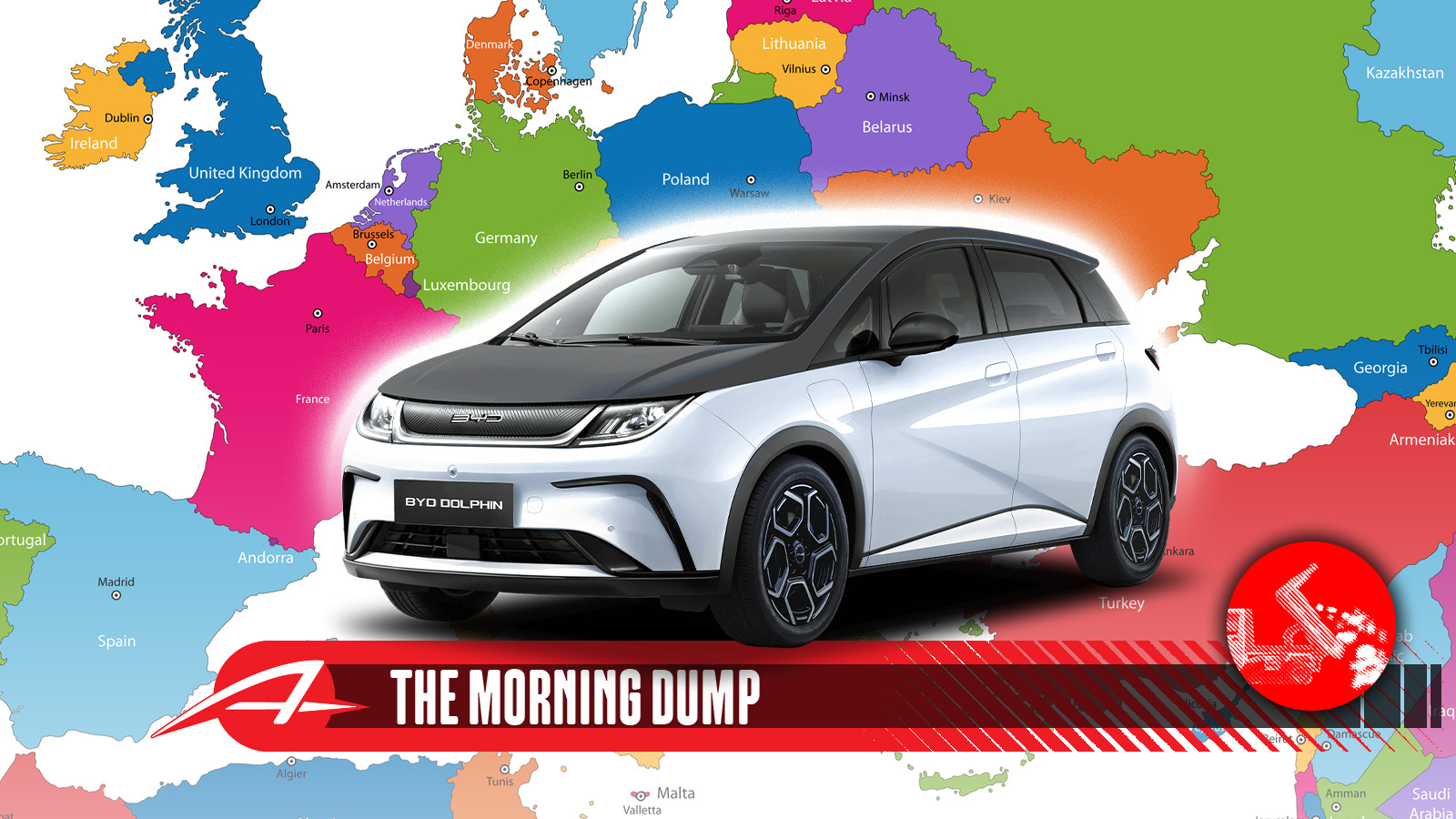
The average European car has always been a bit different than the average American car. Smaller, more fuel-efficient, cheaper—attributes deemed necessary for buyers who live in a place where space comes at a premium, and where gasoline is far more expensive.
If the sales of EVs in Europe and the US last month are anything to go by, the average European car will soon be even more different than the average American car. While EVs represent a smaller share of the market in the US, the market share for EVs across Europe is higher than ever. The landscapes are changing rapidly, folks.


Sticking with the topic of slowing EV sales in America, Dodge finally managed to legalize its Durango SRT Hellcat—a vehicle everyone expected to die three years ago—for all 50 States after it ran into some emissions issues back in September. On the opposite end of the spectrum, Renault just broke an efficiency record with its Filante open-wheeler EV.
In other news, Toyota is getting back into stage rally in America. The best part? It’s doing so with the GR Corolla. For the first time in what feels like forever, Subaru will finally have some competition. Let’s get into it.
Europe’s Car Market Is Starting To Diverge Even More
The disappearance of the federal tax credit and a shift away from nationwide emissions regulations mean the U.S. market is, in a way, turning its back on EV growth. In its place will likely be an onslaught of new plug-in hybrids and extended-range electric vehicles. Ford, knowing its buyer base for the all-electric F-150 Lightning was incredibly small and not likely to get any bigger, recently revealed an EREV version in its place.
The market is already seeing demand for EVs in America fall. While sales are about 2% higher than last year, the market share for electric cars is down to just 5.8% according to Cox, the lowest it’s been in over three years. Compare that to the European Union, which has EVs nearing a quarter of the market. From Reuters:
New car sales in Europe rose year-on-year in November for a fifth consecutive month, helped by an increase in EV registrations in markets including Germany, Italy and Spain, data from the European auto lobby ACEA showed on Tuesday.
Battery electric registrations, a proxy for sales, reached a market share of 21% in the European Union, 26% in the United Kingdom and 98% in Norway.
Unlike America, where the future of EV market share is a bit murky right now, analysts predict that electric cars will continue to take over more of the overall market in Europe, according to Reuters. This is despite the EU caving on its 2035 internal combustion ban last week. Even without that ban, the upcoming rules will be pretty strict.
As for which automakers won and lost in Europe last month, there weren’t many surprises. From Reuters:
Registrations at Volkswagen and Renault rose 4.1% and 3% year-on-year, respectively, while they fell 2.7% at Stellantis, a drop after three months of growth.
Tesla registrations fell by 11.8%, as record sales in Norway mitigated losses in other markets. They were up 221.8% at its Chinese competitor BYD. Tesla’s market share in the month was 2.1%, while BYD’s 2%.
Soon, the average European street will have mostly EVs. Compare that to America, which might have one in 10 cars be battery-electric in the next decade, if you’re lucky.
You Can Now Buy A Durango Hellcat No Matter Where You Live

Earlier this year, Dodge announced it would be bringing back the 710-horsepower Durango SRT Hellcat for the 2026 model year. The Durango Hellcat was supposed to be a one-model-year-only affair back in 2021, but it’s managed to stay in production this whole time, presumably because a supercharged V8-powered three-row SUV is about the coolest-sounding thing on the planet for a lot of Americans.
Dodge hit a snag back in September when it revealed the Durango Hellcat wouldn’t be available in all 50 States because it wasn’t certified with the latest regulations from the California Air Resources Board (CARB). As of last week, though, that’s no longer the case. The SRT Hellcat is now available to order in the United States, no matter where you live.
In addition to the new certification, Dodge has revived a color called Triple Nickel for the 2026 lineup, and added new stripe options, including carbon-fiber stripes. You know, in case the normal stripes weren’t ridiculous enough for your full-size SUVs.
Renault’s Cool Concept Sets An Efficiency Record

At the beginning of the year, Renault showed off a concept car called the Filante, with the goal of using it to break some sort of EV record in 2025. The company really waited until the last second, but it did, in fact, achieve an efficiency record. From the brand:
One challenge that Renault set itself at the beginning of 2025 was to drive an electric vehicle more than 1,000 km, with a battery the same size as Scenic’s, at realistic motorway speeds, without stopping to charge. The first attempt was scheduled in October but was called off at the last minute due to bad weather. The team finally pulled it off on 18 December at the UTAC test track in Morocco.
If their only goal had been to drive the longest possible distance between charges, the designers and experts could have fitted the car with a huge battery or driven it in eco mode at 30 km/h on average. But Renault was aiming much higher with its efficiency record: it powered Filante Record 2025 Record with a regular battery (87 kWh, like the one in Scenic E-Tech electric) and tasked the drivers with keeping its average speed of over 110 km/h. The objective: to cover more than 1,000 km in less than 10 hours, including technical stops and driver changes.
Going 626 miles in 10 hours is one thing, but to do it at highway speeds is another. It’s proof that with enough aero and drivetrain work, these huge distances are possible for an EV without having to creep along at 25 mph.
Toyota’s Going Rallying Stateside

Since 2017, Toyota’s been competing in the World Rally Championship with its Yaris hatchback. The WRC sadly doesn’t have any presence in America, but there is the American Rally Association (ARA), which puts on a national championship of its own.
Toyota, wanting to sell more sports cars here, has decided to enter a modified version of its U.S.-market-specific GR Corolla into the series, with an American driver at the helm. From Toyota:
-
TGR will newly enter the ARA National Championship from Round 2 in 2026, with the aim of developing cars on North American roads and making ever-better motorsports-bred cars.
-
The rally car based on GR Corolla will compete in the RC2 class (roughly equivalent to Rally2 level).
-
The driver will be young American Seth Quintero, who will compete in ARA in parallel with W2RC.
-
TGR’s employees will also participate as engineers and mechanics to conduct hands-on development of pit human resources.
Toyota’s entry into the sport marks the first real factory effort from a brand other than Subaru in many, many years.
What I’m Listening To While Writing TMD
The Big Question
What do you think the car landscape will look like in America compared to Europe in 10 years?
Top graphic image:


What the American auto market will look like in a decade (vs Europe…) depends on whether or not the next administration marks a return to normalcy or not. If so, and the worst transgressions of our current government are undone, then there’s hope for more parity between world auto markets. However, if some Orange Acolyte becomes our next president, and the current insanity becomes the new, permanent normal, all bets are off: continued expansion and support for the fossil fuel industry will happen, efficiency standards will erode more, and alternative energy products and industries will be robbed of the subsidies that the oil industry has enjoyed for decades.
In which case we can expect more Hellcat derivatives and three-row ICE SUVs, and no Renault 5ish EVs here ever. 🙁
It’s interesting that Europe had a lot more diesel-powered cars than the US and now they have a lot more EVs. So, are EVs the new diesels in the EU?
Please correct me and add to this if you’re in Europe, I’m no expert in this.
I think it has more to do with running costs, density, and size constraints. If you were to compare a 1.2L gas vs diesel, the diesel is going to feel much peppier at slow speeds, and cost about 1/3 to 1/2 the cost to fuel up. EV’s take the performance to another level, and for people that can charge at home also drastically lowers costs as both their electricity and fuel are unsubsidized so 20-40c / kwh and $8 / gal is roughly the true cost.
I don’t think people in Europe are dramatically more environmental than us, it’s simply more about dealing with real-life costs. If we as a country weren’t the world’s largest producer of oil and didn’t subsidize extraction and refinement, we’d probably be doing the same thing.
If the environment was an infinite dumping ground that never had consequences, what we’ve done in our worst times is the right thing to do. It gives us an advantage over other countries economically, and higher consumption in terms of fuel and vehicle complexity is another self-perpetuating growth cycle.
I’m from the US and not in Europe, so I will encourage Europeans to weigh in on this. I just know the last two times I rented cars in Europe, I rented diesel manuals (Peugeot 307 5M and Fiat Croma wagon 6M) and both were wonderful to drive. There was a Ford Focus in Ireland somewhere in the mix, but it was a gas automatic somewhere in that mix.
I would love a PHEV for my desired lifestyle. But I am having to make 700+ mile trips to visit my mom with rapidly declining Alzheimer’s. But a ’17 Accord that gets upper 30 sometimes 40s MPG down and up I-5 is pretty good.
> I don’t think people in Europe are dramatically more environmental than us, it’s simply more about dealing with real-life costs. If we as a country weren’t the world’s largest producer of oil and didn’t subsidize extraction and refinement, we’d probably be doing the same thing.
By and large I’d contend Europeans are markedly more environmentally conscious than Americans. The larger countries have actual Green parties that sometimes get parliamentary or cabinet posts. Europeans consume less in general. They’ve been working on hydro, wind, solar, and nuclear at scale for much longer than the US, and much more seriously. Germany, not renowned for its sunny weather, has a shocking amount of solar generation capacity.
And some countries do have significant interests in oil (e.g. France and Norway), but they also know that oil isn’t a viable long-term strategy.
I bought a TDI Jetta back in 2001, thinking I was helping. Now I have a V6 Accord (I was in TX and needed something to not get flattened by a F-150). But I get close to 40 mpg on the highway. And Dieselgate…, oy
The only problem is that I am having to make lots of 1500 mile roundtrips to visit with my Alzheimer’s plagued mom every other week. Probably less carbon footprint than flying from SEA to SMF and renting a car down there.
I watched a video from someone in Norway showing a Circle K where they removed petrol pumps and put chargers in. Norway is about 50% EV already. Sure, it’s a small part of the market but they charged forward pretty quickly. He mentioned that gasoline was about $8 a gallon. They also showed the chargers at McDonald’s; they have charging everywhere there.
I can tell you that I got out of a Scat Pack Charger that averaged 14 mpg into an EV that is faster and costs me less than 25% of the “fuel” cost running it in California. I take more road trips in it as well.
If gas stays under $3.50 it’s harder to make an EV or even a hybrid, make sense financially for the average person.
Maybe EVs are such a political issue there like they are here in the US?
Hybrid are the new diesels in the EU. They are the most common type of vehicle with 35% market share. Europeans used to drive diesels because diesel fuel was cheaper (taxed less) and diesel cars and weaker emission standards. EU regulators favored fuel economy over PM so they allowed diesels more PM than gas cars. That changed a bit make (can’t remember if it was Euro V or 6) but today gas and diesel cars have the same standards and they are stricter than the USA. Both DI turbo gasoline and diesel cars require a particulate filter there. Today hybrids are the most cost effective way to meet fuel economy and emission standards in the EU and customers like their hybrids.
(The USA will start requiring gasoline particulate filters for EPA 2027. Some US vehicles like the Ecoboost Maverick already have them so the manufacturer can accumulate emission credits)
EU new cars sales by power type are released every month:
New car registrations: +1.4% in October 2025 year-to-date; battery-electric 16.4% market share – ACEA – European Automobile Manufacturers’ Association
I think the answer to this is «yes». Diesels were also aggressively subsidised by governments for years only to be taxed even more aggressively when they found out that they weren’t actually so awesome for the environment as previously thought. I suspect the same thing is happening to EVs now.
If orange gibbon continues to fry the economy I expect our cars on the road will look like Havana with an aughts update.
Big miss that the lyric video’s background image isn’t Chicago’s iconic skyline set against Lake Michigan, but still a good song.
Brian,
What specifically did Dodge do to be able to sell it in all 50 states. Does this result in a more complicated car for the other 35 or 40 states that don’t follow CARB? Seems like something you would want to talk about since you decided it was big enough to include here.
Man I must be missing something but every other car sight I read says Europe is following Trump in the we aren’t going to force people to buy EVs and we are going to stop forcing poor people to subsidize EV prices for the rich.
In other news I read Russia is upset with the quality of EVs they are getting from China. They say the vehicles fall apart quite quickly.
More people have caught on to every forced market change being a manipulated scam based on surprize surprize, more lies!
History tells us how this ends.
I suggest you read the regulation not the headlines. The EU never had a ICE ban in 2035. They did and do have fines on automakers that fail to meet fleet fuel economy standards of 95 euro per g/km CO2. The EU basically has a “sin tax” on carbon emissions similar to cigarettes but they didn’t and aren’t banning gas cars.
The EU has proposed changing the 2035 fleet CO2 target to 11 g/km instead of 0 g/km. This would save the buyer of a gas car in 2035 1045 euro.
I don’t think many of the Europe predictions take in to account the political climate over there right now. As stated by a couple of our expat Europeans in these comments, if taxation and pricing structures change, if these countries swing back to being more open to businesses, everything can very easily shift. And there are strong indications that a shift is a reasonable possibility. But all the predictions are based on no changes in European politics.
“the Durango Hellcat wouldn’t be available in all 50 States because it wasn’t certified with the latest regulations from the California Air Resources Board (CARB). As of last week, though, that’s no longer the case.”
Is that because Dodge finally managed to pass or because they paid *someone* off?
Maybe the state has bankrupted itself defending lawsuits over bans on products that require non-existent vaporware be built in.
Why have voters tolerated this?
If California were a speed trap town, its govt would have been decertified generations ago, yet they continue to drag everyone down with them.
I am a nearly lifelong California resident who spent the 1970s in LA’s smog bowl and who has been subject to the rule of CARB on my own vehicles. I am glad CARB exists and has put the screws to all industries to clean up emissions. Cars run better, cleaner for longer and use much less fuel thanks to CARB. Did they go to far with the EV mandate? Probably. I was as shocked as anyone when it was announced and my initial skepticism has only grown.
I (like many, many others) figured there would be some stepping back from the goals. Even now I don’t see California’s electrical grid being ready to support the load, much less doing so affordably. That said we’re still a decade away. A lot can happen in a decade. White hydrogen remains a dark horse. Maybe even nuclear fusion.
“Why have voters tolerated this?”
Perhaps you are too young to know what life was like before CARB. California residents get reminded every few years when there’s a wildfire upwind. That’s what many days were like in LA during the summer; choking, stinging smog. The only thing missing is lead. I don’t miss that, at ALL. Nor do I miss the stench of pre OBD cars. Nobody needs a Hellcat, most don’t need an F-x50. Everyone needs clean air.
“If California were a speed trap town”
Sometimes I wish it were. Speeding is WAY too tolerated. I don’t know why anyone puts up with it.
Having visited a few developing world cities with lax/non-existent emissions standards, I’m damn glad for CARB and what they’ve done to clean up North American air.
People from outside of California sure love to bag on one of the most successful, prosperous, innovative, and educationally advanced state in the country.
100%. Like it’s cool that you love Nebraska so much! Places that have more than 10 people in them have different challenges to solve, haha
Within 10 years, someone (Foxconn/Walmart) will figure out how to build a cheap, Chinese based EV and sell it in the US at a price competitive with used cars…probably using an all inclusive (registration, insurance, data, trade-up) model that will feel like a lot like a mobile phone plan. The established car makers will likely continue business as usual selling increasingly expensive cars to a shrinking group that can afford them and certified used being the new “New” car for many people. The fleet age will creep up as a refurbishing industry crops up to keep the highest volume vehicles in used car market circulation for decades.
Someone tried this every few years throughout the 2010s, but it’s always too expensive and fails because the cars involved are in the steepest part of their depreciation curves.
If enough people insist on buying repairable cars, the market will correct itself.
The shortage of skilled repair techs now means they wield considerable power.