

If you’re Italian or of Italian descent, I bet you’ve heard a grandparent or uncle or some relative use the expression “condividi i tuoi segreti con una mortadella,” which translates to “share your secrets with a mortadella.” In Spanish-speaking cultures, perhaps you’ve heard someone say “memoria como un chorizo” (“memory like a chorizo”) when they forget their keys, or how a French speaker may smack their foreheads and say “merguez!” when they forget things. In American culture, there’s a similar expression you’ve probably heard: “tell it to a hot dog.” What all of these have in common is an idea that spans the globe: sausages have no memory.
That may have been true before, but I’m here to tell you, excitedly, that it is no longer true.


Yes, that’s right, I’m proud to announce that for the first time in recorded history, data has been stored to a common, everyday salami, proving once and for all that sausages can have memory. At least memory of a sort. Currently, that memory is pretty limited, just about 256 bytes per a 38mm diameter salami slice, but this is just a proof of concept. Currently, the data density we can store in cured meats is very low, but with future development the amount of data would currently take a salami six feet in diameter and 35 feet long could potentially be stored on a single Lunchable slice.
But that’s a long way off! Let me show you what Autopian Labs has accomplished so far!
View this post on Instagram
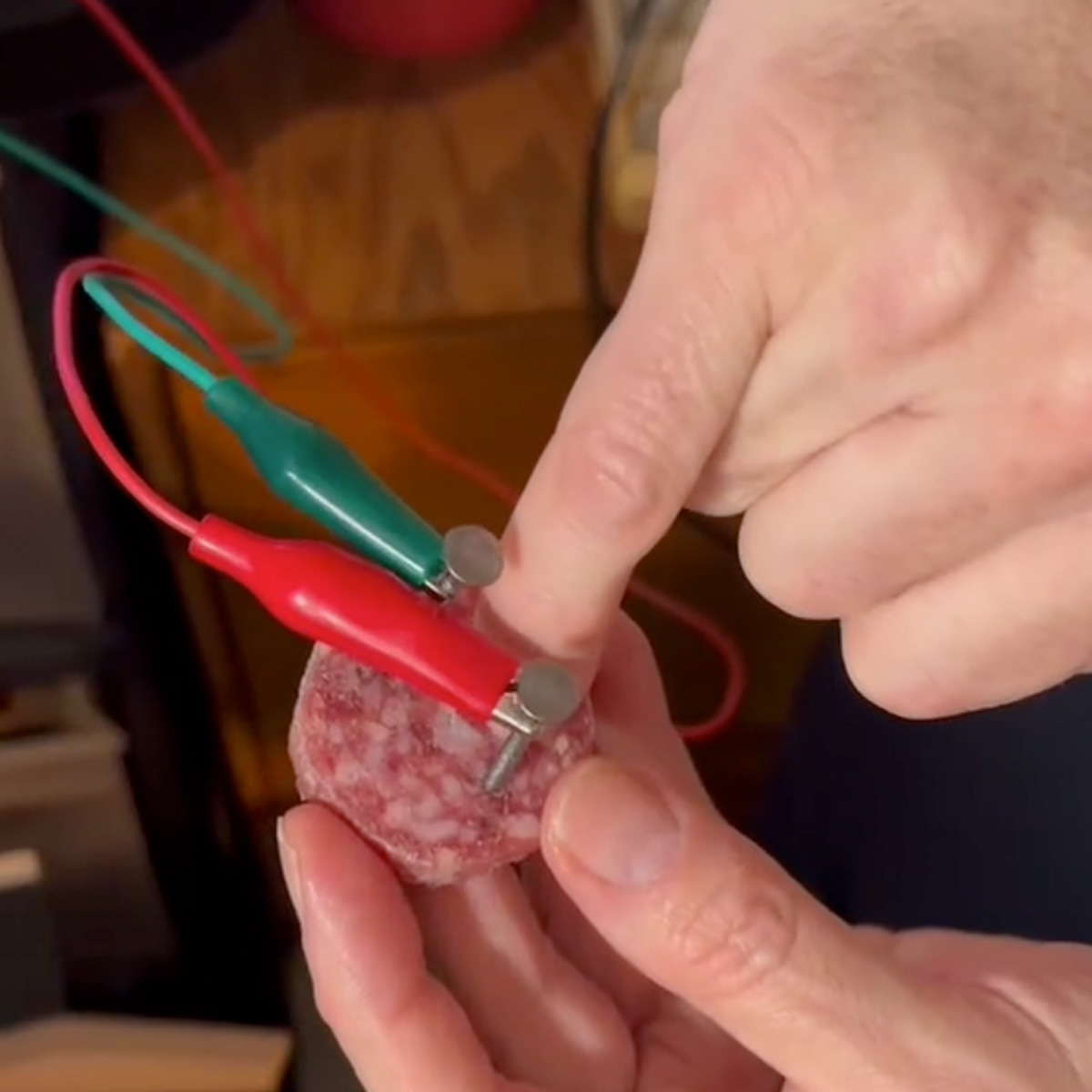
Did you see what happened there? I connected a slice of salami to my Macbook, where a special USB device allowed me to place a pair of probes into the salami matrix, where I encoded the phrase AUTOPIAN IS THE BEST! That’s 21 characters, so basically 21 bytes of storage, stored as ASCII data in the salami slice itself.
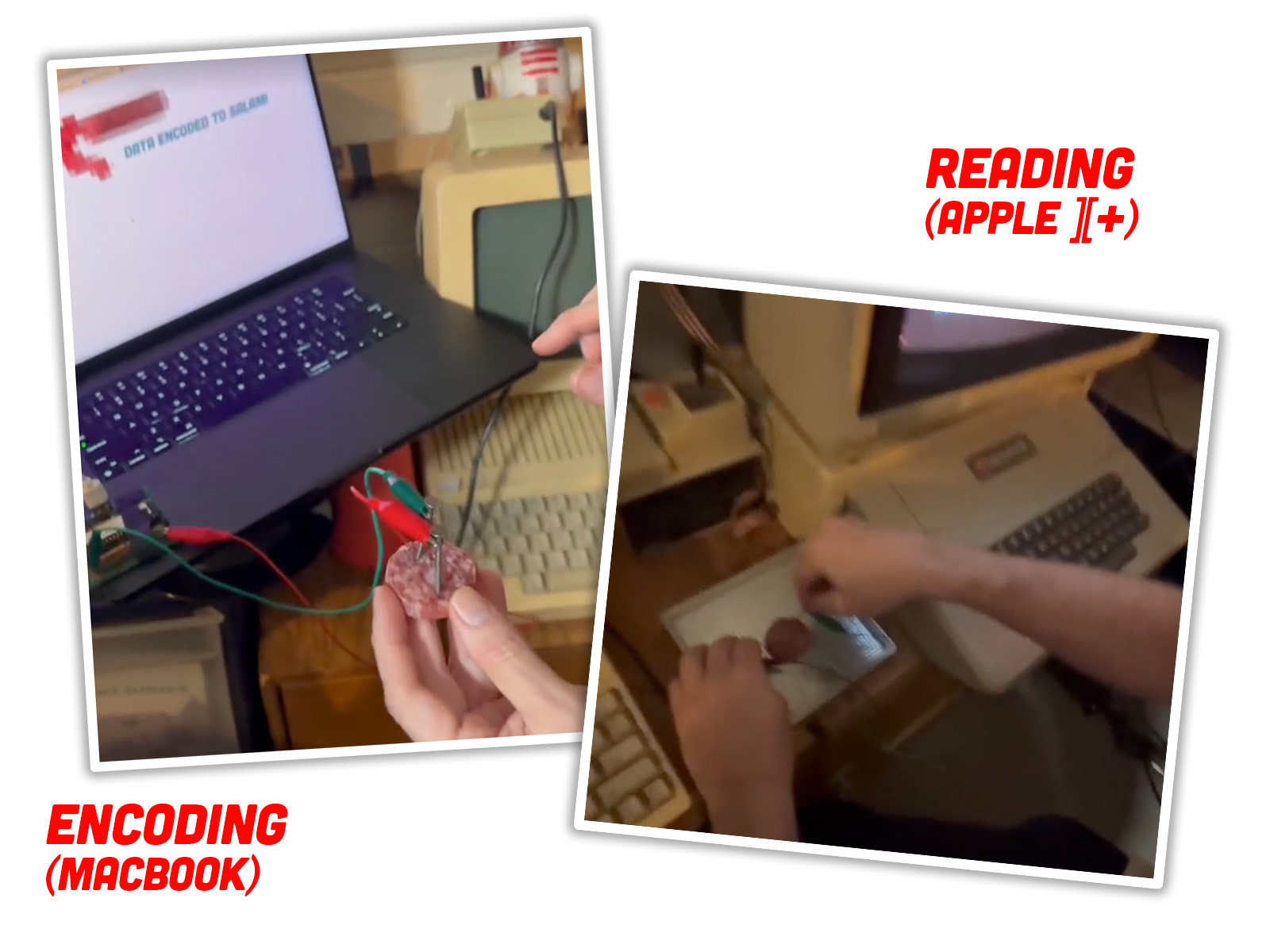
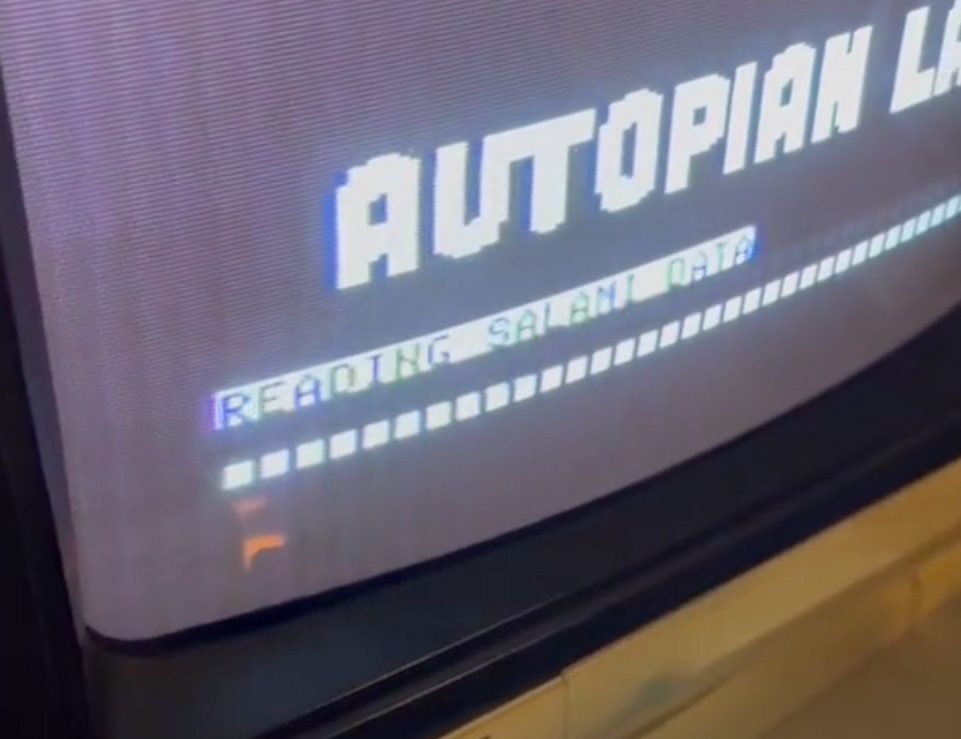
I then took that same slice of salami to another, very different machine – an old, 1982-vintage Apple II plus – and connected it to a similar (but much simpler) device, this one connected to the Apple II’s Game I/O port, specifically the four potentiometer inputs that can read values from 0-255, which is convenient when reading ASCII codes.
I used this same port to connect a DSLR camera for our member birthday drawings, if you recall:

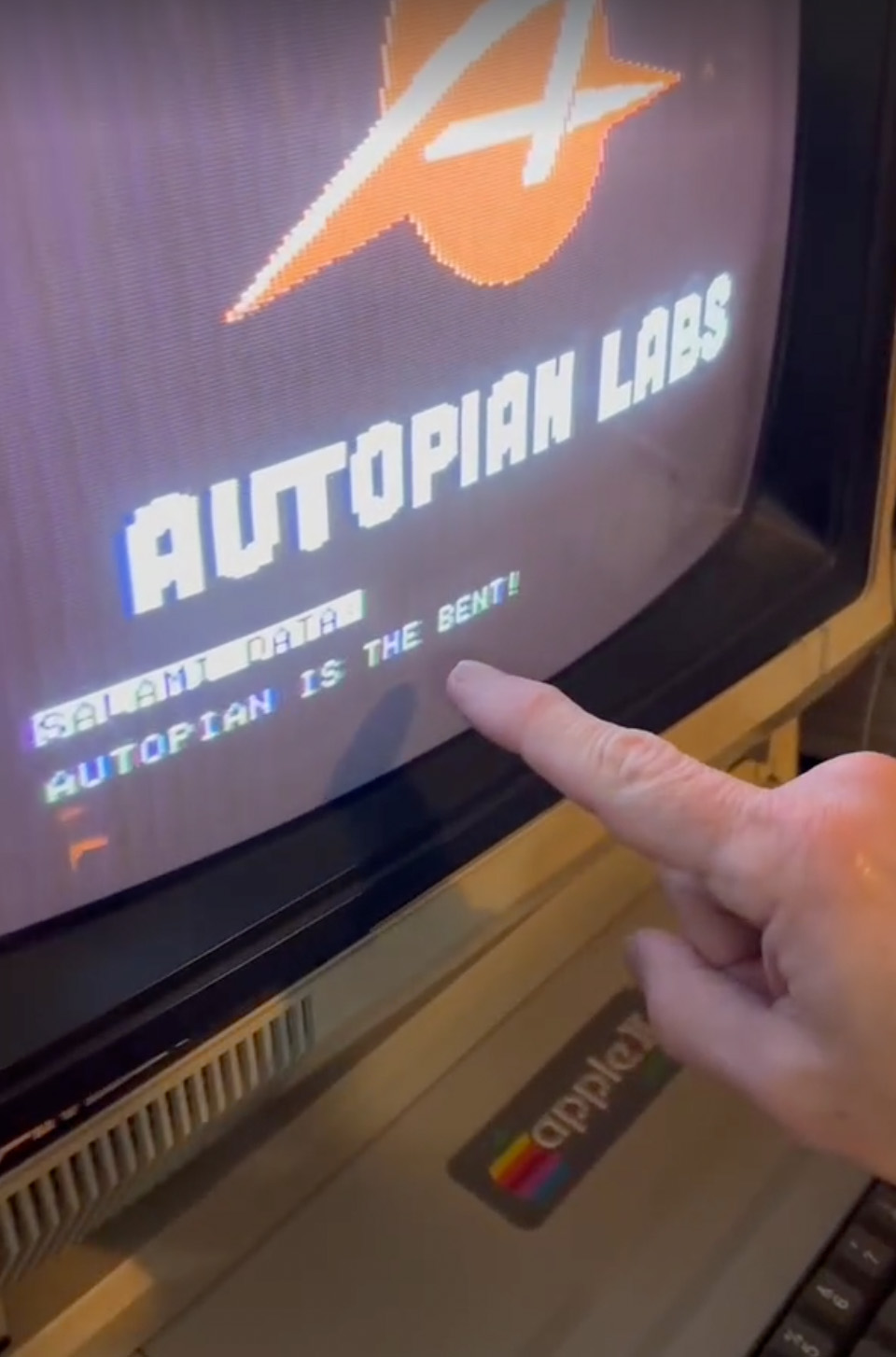
The Apple II salami data reader, despite being an incredibly simple device, was able to read the encoded ASCII data on the salami slice and replay it back to the computer! Well, with one error: the output was AUTOPIAN IS THE BENT! instead of “best,” but I still call that a victory. The character “S” is ASCII code 83, and “N” is 78, which probably hints at what went wrong, but I’m not really sure what that is right now.
The data is encoded onto the salami (or, really any sort of sausage with a pretty coarse granular consistency) in a radial pattern:
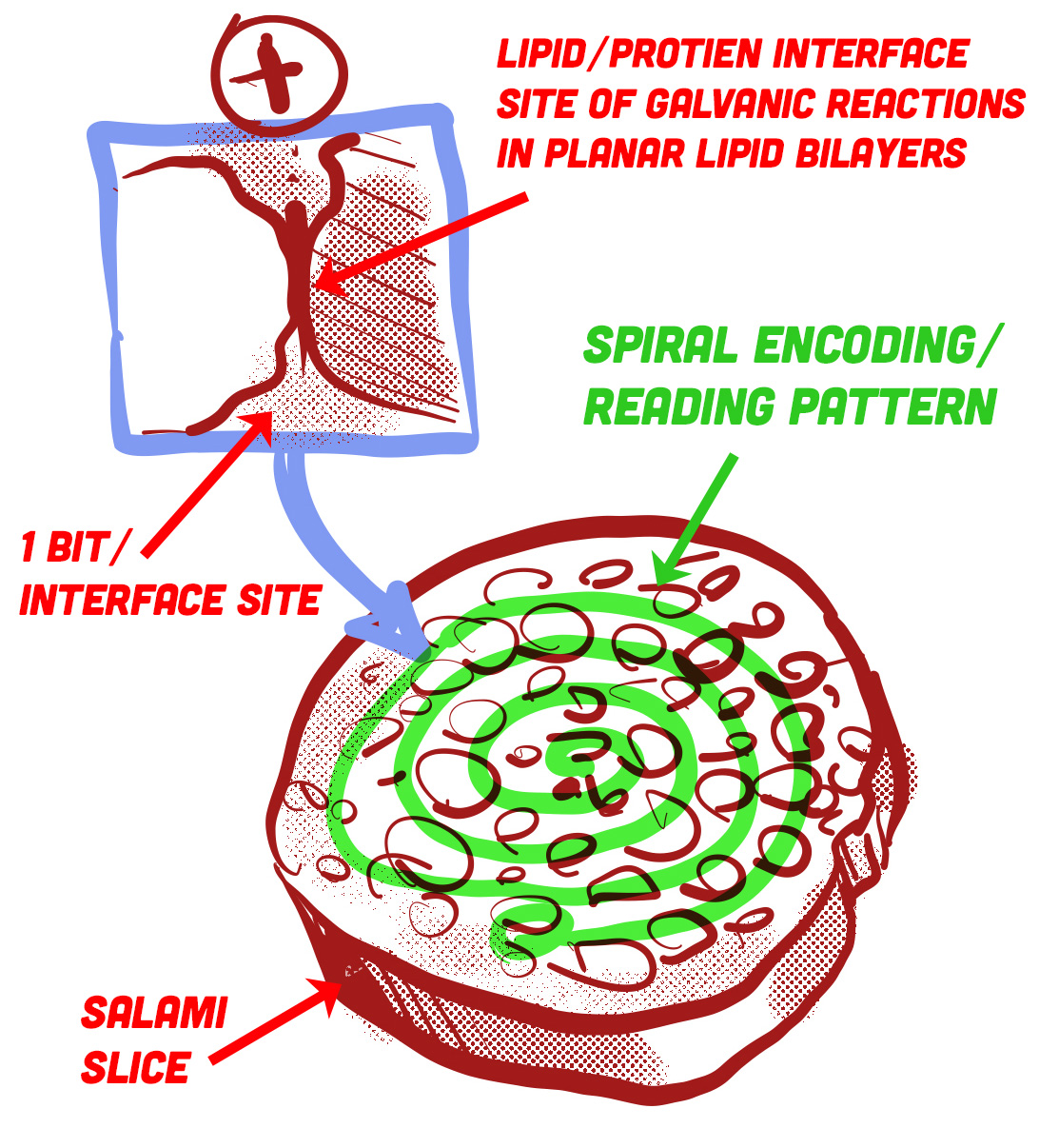
The way it actually works is a little much to get into here in detail, but fundamentally it has to do with the nature of sausage/cured meat construction and all of the points inside the sausage matrix where lipids (bilipids, technically, but whatever) are in contact with other protein compounds. That “interface,” the points where the lipid/protein molecules actually contact, is a point where data can be stored, thanks to galvanic currents and lipid-free radical oxidation.
Sausages with finer matrices of ingredients (bologna, hot dogs, many wursts) will be more difficult to encode data onto and read from, but offer the best possibilities for higher-density data storage than coarser sausages like pepperoni or soppressata, or mortadella. The crude nature of our current equipment means we are currently only able to encode and read from these coarser meats, but we’re hopeful to change that.
We here at Autopian Labs didn’t come up with all of this science, of course. We’re idiots, standing on the shoulders of giants. But if you look at papers like The reactions of lipid’s free radical oxidation, hemocoagulant properties of oral fluid in patients with galvanic currents in the mouth(translated from Ukrainian) and The role of lipid oxidation on electrical properties of planar lipid bilayers and its importance for understanding electroporation and, most relevant to our implementation, Electrode-supported and free-standing bilayer lipid membranes: Formation and uses in molecular electrochemistry I think you’ll get a sense of what we’re doing here. It’s pretty straightforward, really.
Now, we think this is a pretty revolutionary development, especially in an era when AI is forcing computer memory prices higher and higher – some sources suggest memory has increased in price by 500%! If we can adapt computer memory demands, both RAM and storage, to sausage-based media, then every deli in America has the opportunity to become a data center! Every sandwich becomes removable storage! Supermarkets full of cold cuts and sausages and charcuterie could be tasked to data storage on demand!
The meats retain full edibility even after having data encoded, so there’s no waste of food here; once a slice of, say, soppressata is no longer needed for data storage, it can be happily eaten, perhaps with a slice of brie.
Now, while I get that this is not our core mission – we’re still a site about cars, after all – this does have a lot of potential for car ECUs and other automotive computing applications: fragile circuit boards could be replaced with rugged, hard-wearing pepperonis and other durable sausages, for example.
I’m very excited. Autopian Labs is the research arm of Autopian, and we don’t have the resources to commercialize this development, but we are happy to take meetings and discuss development agreements. We anticipate some issues stemming from the fact that I may have made all of this up for reasons I myself can’t even comprehend, but if we can get past that, I’m very excited about what the future of sausage-based data storage may hold!
This is a brave and delicious new world, people!


I smell the Nobel Prize coming!
I think that’s just the bologna you’re smelling
Is this real life…
Is this just fantasy…
Caught in a landslide
No escape from salamity…
Is the positive relationship between time of David not actively editing the site and the bonkersness of Torch’s articles correlation or causation?
Either way, I’m happy my membership money is going to cutting edge research!
Aww man you almost tricked the AI but it picked up on your “made up” claim.
I never sausage a case for the Ig Noble Prize as this one!
The best/bent error wouldn’t happen if you’d sprung for server-grade, ECC (error correcting code) salami. You see, cheaper consumer-grade hardware (meatware?) is more susceptible to bit errors, but it’s fine for non-critical uses…
I think Salami is firmware, not hardware, unless you leave it out to dry for a very long time.
Technically it’s a kind of Field-Programmable Grease Array (FPGA).
So, plain old commercial off the shelf salami won’t ensure data integrity.
I couldn’t help but read this in Chef Elzar’s voice, like when he’s comparing slugs for his down home neptunian style gumbo.
I prefer error correcting cappacuolo*, but your point remains valid
(*Actually I hate that stuff)
We take what we can get out here in meatspace.
This is the type of content I’m paying for! Perfect excuse to store my CAD files on prosciutto for “work”
The dog ate my homework.
David is so going to regret his road trip and I will want him to take so many more. This is how I like my Autopian.
Do you want Johnny Mnemonics? Because this is how you get Johnny Mnemonics.
Easy there J-Bone
Meat your future overlord: salami.
When can we order “Autopian is the bent” t shirts?
Yeah I came here to demand an AUTOPIAN IS THE BENT! tshirt
Ugh, how did this get through my spam filter?
Now I want to see Torch hook up a lump of SPAM to his setup and see if it comes up as a Stellantis in-car ad.
This seems like a bunch of baloney.
Yeah, duh, it’s an SSD. Salami State Drive.
I really thought that statement was a euphemism for…or never mind.
Isn’t that why VHS won out over Betamax?
As opposed to Italian indecent, which is a whole other type of salami
Are submarines involved?
Extremely interesting. A few points that slice of salami is one bite maybe two if you are in your Sunday go to meeting clothes. Secondly, forget about people stealing your data or the computer eating it because just about anyone will grab the salami and eat it, and then there is no getting that back it is a true unformating of the data. Finally until you find a better pizza topping than sausage I am pulling for using it on pizza.
Can’t we just hook up old computers to new computers for the extra data storage?
On the upside, deletion is delicious…and permanent!
This is the rare case where people will happily back up their data.
Torch, did you sleep in the RV?
And does it leak exhaust into the cabin?
I am happy to donate my storage media disposal services, in this case with a slice of sourdough with some brie.
You know, for science.
Great. Now the price of cured meat tubes is gonna skyrocket.
Only a matter of time before Sparky ingests last year’s family photos.
I eagerly await the breakthrough design that will allow you to store a salamegabyte
Does that say on the second computer, “Autopian is the bent!”? Are you already experiencing data degradation? whats the data degradation rate as compared to the meat rotting/degradation rate?
Depends but with salami storage temperature is more important than ever.
AWS
Amazon Web Sausage
GCP
Greasy Cured Pork
Congrats! You’ve invented the world’s first flesh drive.