

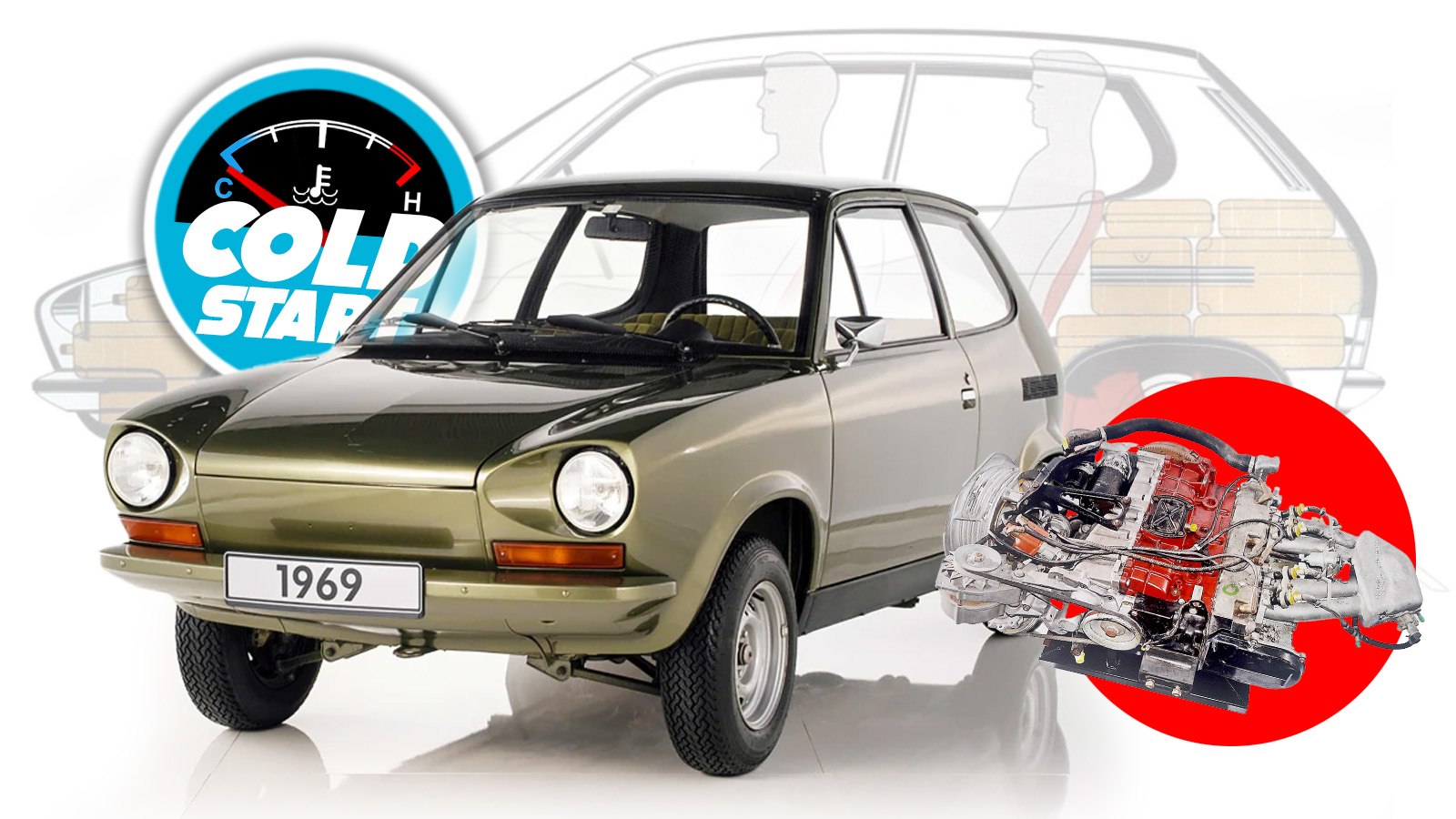
I feel like if there’s been a theme for this year so far, it’s that I’m learning new and fascinating things about inline-four engines that are laid flat on their sides. Engines which I’ve known about for years, but never really scrutinized before. For example, I found out all sorts of interesting things about the Wright Flyer engine, and now I find myself amazed by details about another inline-four engine laid on its side: the engine proposed for use in the Volkswagen prototype known as EA266, my favorite of the many never-realized VW prototype cars.
For those of you not familiar with the EA266, I have written about it a couple of times before, mostly over at The Old Site. But if you want a quick summary, EA266 was a Beetle-replacement project developed with assistance from a Porsche team led by Ferdinand Piëch, and was really quite a revolutionary design, or would have been, had it made production.


The core of what made this car so fascinating I think has to do with its incredible packaging design, one that got the absolute maximum amount of usable interior volume possible via some really bold approaches to packaging design. The engine, a liquid-cooled 1588cc inline-four design, was transverse and laid flat under the rear seat, driving the rear wheels via a transaxle; the fuel tank was in front of the dashboard, the spare wheel under the driver’s seat, and there were two good-sized cargo areas, front and rear. It’s an absolute packaging masterpiece:

It’s incredible, isn’t it? I think so. Of course, part of why I think so is that I’ve never had to try and access that engine to do any sort of repair or maintenance, but conceptually, I really admire this design.
I think they were pretty cool looking on the outside, too; the top image here is an early body design, the middle picture and the bottom one (it’s next to the Beetle, second from left) shows its sleeker final look.

These were essentially pre-production cars by the point the lower pictures were taken, but things changed dramatically for VW when Rudolph Leiding, formerly head of VW Brazil, took over the company in 1972. Oneof Leiding’s first actions was to cancel the EA266 project, and moved the future technical direction of VW to abandon their old rear-engined, air-cooled ways and adopt the liquid-cooled, front engine/FWD tech from recently VW-acquired companies NSU and Auto Union, which gave birth to the Passat, Golf, and the whole path of modern VW.
It was kind of a shocking move, as the EA266 project was expensive and very close to production, and VW had a whole plan for an EA266-based lineup of cars, including sports cars and microbuses:

It’s all a fascinating sort of what-if to think about. And I was thinking about it recently because I happened upon a site that showed some interesting styling proposals for the EA266 that I’d never seen before, including this one from Pininfarina:
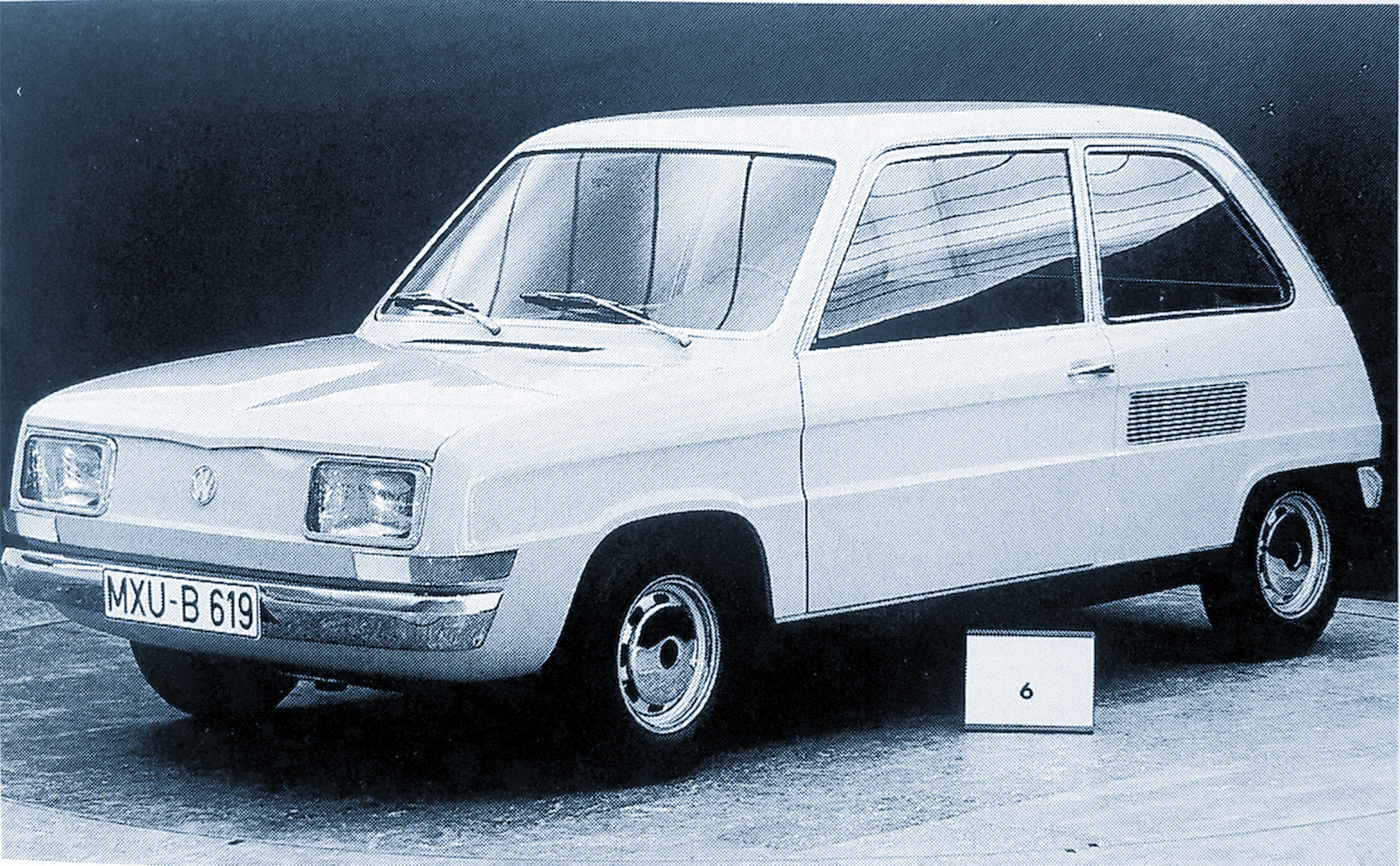
I don’t think it looks as good as the one that was eventually settled upon, but it is interesting, especially with those huge rectangular headlamps. But what I found even more fascinating was this picture of the EA266’s engine that I’d never seen before:
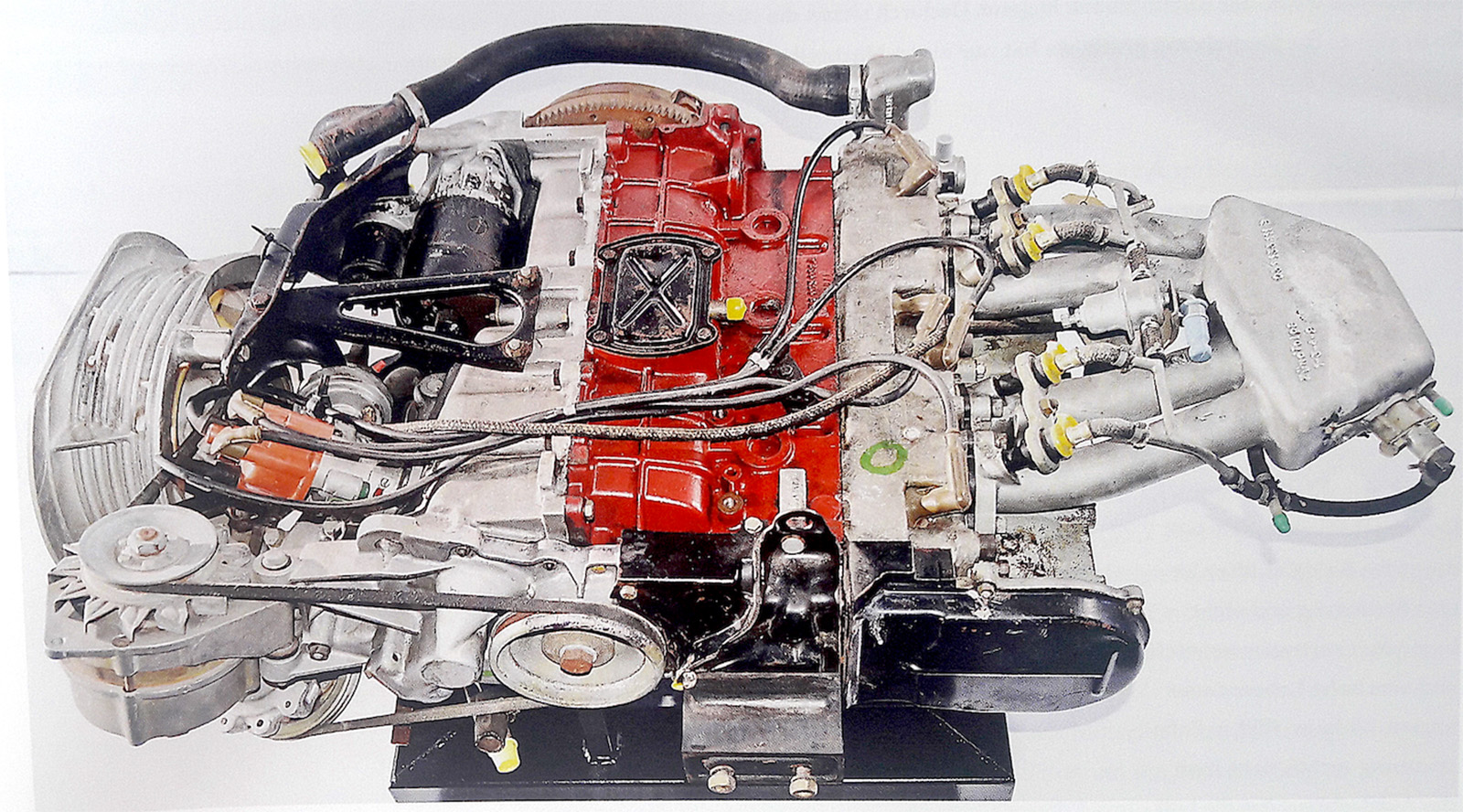
Previously, I’ve only seen this engine in schematic drawings or already installed in the car, where it was very hard to see. It’s quite wide, perhaps the result of making it so flat, and I think that ribbed unit at the far left was the fan/air duct assembly for what would have been a side-mounted radiator. The fuel injection and intake manifold I think is off to the far right, like some kind of quadrapus grappling at the engine, which is also interesting to see.
But what really caught my attention is the belt and pulley setup used to drive the accessories like the alternator and water pump, etc. It’s interesting because it looks like they contracted the design out to MC Escher. Look at this thing:
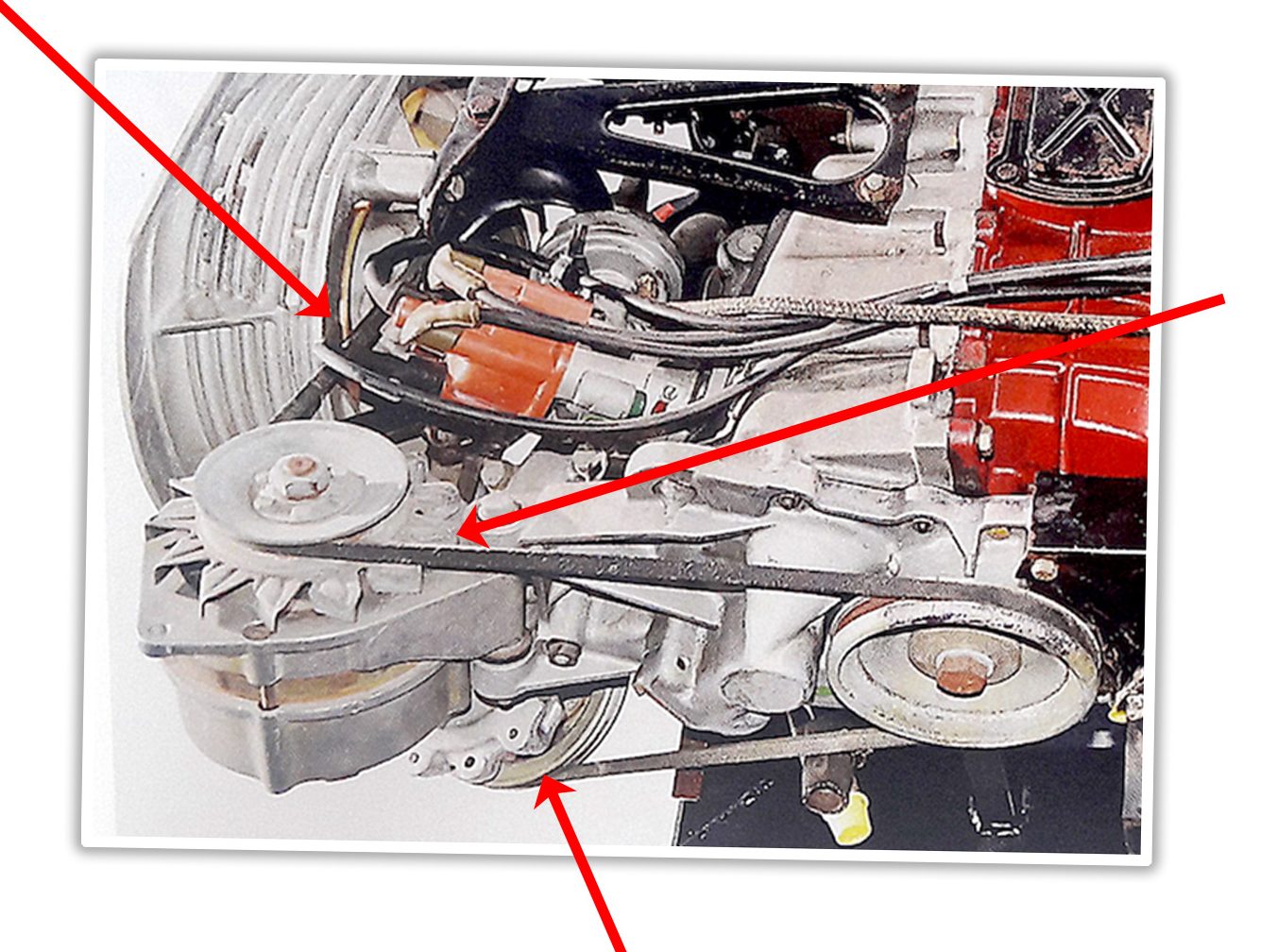
Look at these bends and twists in that belt! This is beyond a serpentine belt, which usually just serpents on a single plane; this is making all kinds of three-dimensional (possibly more, haven’t checked) twists and turns. And we’re just seeing one bit of it! Where does the other end of that loop go? Each of the three pulleys I can see here are on a completely different plane, and that belt is going to have to make some more crazy bends to form a workable loop. It’s astounding!
The closest I analogue I can think of on a production car is the Chevy Corvair’s right-angle-ish bend that its belt makes coming from the vertical crank pulley, then up and over the generator, turning to then drive the horizontal fan atop the engine:
Still, that looks downright tame compared to whatever is going on with the EA266’s multi-dimensional-serpentine belt!
There’s only one or two EA266s left in the world; if I ever get back to Wolfsburg, I’d love to roll under that EA266 and try to see just what the hell is going on there. I bet it’s sort of a mind-bending experience.


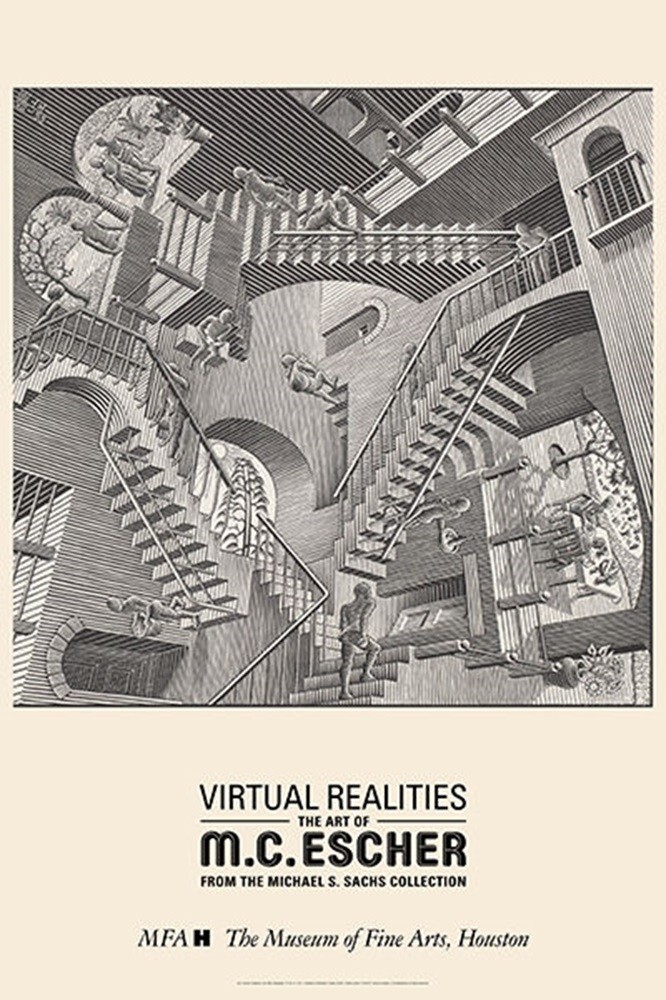
I do love me some MC Escher, just not under a hood.
As one who grew up with and learned to drive on a ‘74 412 I can confirm that picture with the outrageous body roll. I can hear the skinny Pirelli front tires squealing to this day! If you could find a gear with that shifter linkage you could drive anything. I loved that thing and would brag to other kids who didn’t know what it was that “it’s got a Porsche engine!” lol
There’s no way the spare wheel fit under the drivers seat. Look at it! Rear seat passenger would have no room for his feet.
Peugeot 204 and 304 had similar belt on their engine for fan
I hadn’t even got to the point in your article where you started talking about the accessory belt, and the pictures were already making my mind hurt. And feel sorry for the belt.
One thing I have wondered over the years, do horizontal engines end up with more wear on the underside cylinder walls and rings from the weight of the pistons vs a more vertical arrangement?
An interesting bit of trivia is that when they cancelled this project, they ordered all the prototypes destroyed, which was done by driving a Leopard tank over them.
Well, the Leopard 1 was a Porsche product (sort of).
I wish this sort of packaging had become mainstream. VW did it better than at least most. It was just never a priority after this program was shuttered. EVs give me hope…
I don’t see how that tiny radiator tucked well away from any air stream, would be sufficient to cool a 4cyl engine. I think this layout would make much more sense using the Type3 aircooled pancake engine. With the aircooled engine, even if you had to drop the engine for whatever reason, it’s still manageable for a home mechanic with a floorjack.
Note the Coupe and the Roadster II were styled by Wolfgang Möbius – maybe he had a hand in designing the belt layout too!
Wow. Mobius and Escher mentioned in the same article and comments. Two guys I haven’t thought of in quite a while. It has put quite a smile on my face this morning. Thank you!!
That belt routing looks just like those 14 foot long belts that run the blades of mower decks.
Looks like they took the pancake engine out of the Type 34, and pounded it out even flatter.
Maybe it was going to be Kevlar reinforced, too!
I’m more fascinated by the distributer being driven out of what looks like the oil pan?
“Get your self a brand new VW EA266! Only $1995. Oil changes are $475. Need new spark plugs? We’ll write you an estimate.”
Engine placement came back in the Boxster…
I guess many repairs/maintenance jobs would involve dropping the entire rear subframe, which might not have been too difficult if they designed it well.
I remember my dad saying that to work on the engine in his Hillman Imp*, he’d just unbolt the whole rear subframe, and disconnect the engine, gearbox, and rear wheels as one unit, roll it away from the rest of the car, do whatever work it needed, then just roll it back into the car again.
*(I think. He definitely had an Imp, but I’m not 100% sure it was the car he was talking about)
I’ve been fascinated by this thing for a long, long time, but it was definitely the smarter move to swap to FWD, liquid cooled, slightly less ambitiously engineered vehicles.
That was the true break between ur-VW and its maturation into a serious global automaker. There’s too much Beetle here. Yes, very clever, but still a remix of the Model A, right down to the fuel tank in the dashboard.
The Golf was twice the car this was – and this would have turned out to be a flop, I can confidently say since there are no consequences for making affirmative statements about things that never happened in a time that has passed.
This engine was water cooled though. It’s an inline 4 cyl engine lying on the right side, and as Jason said, the round finned looking thing is actually the radiator.
Yeah, they were going waterpumper one way or another
I had a housemate in college who had a ’75 Golf and it was such a cool car compared to my ’68 Datsun 510 wagon. I think it was a much better path to go down than the EA266 described above. If I had a two-car garage, I’d probably be on the lookout for a time capsule ’75 Golf. Fortunately, I don’t.
There’s people that would sell their children for a 510, even a wagon.
The 510 certainly had some character to it, and a few stories. I wouldn’t sell my child, but he could easily outbid me if it came to that.