

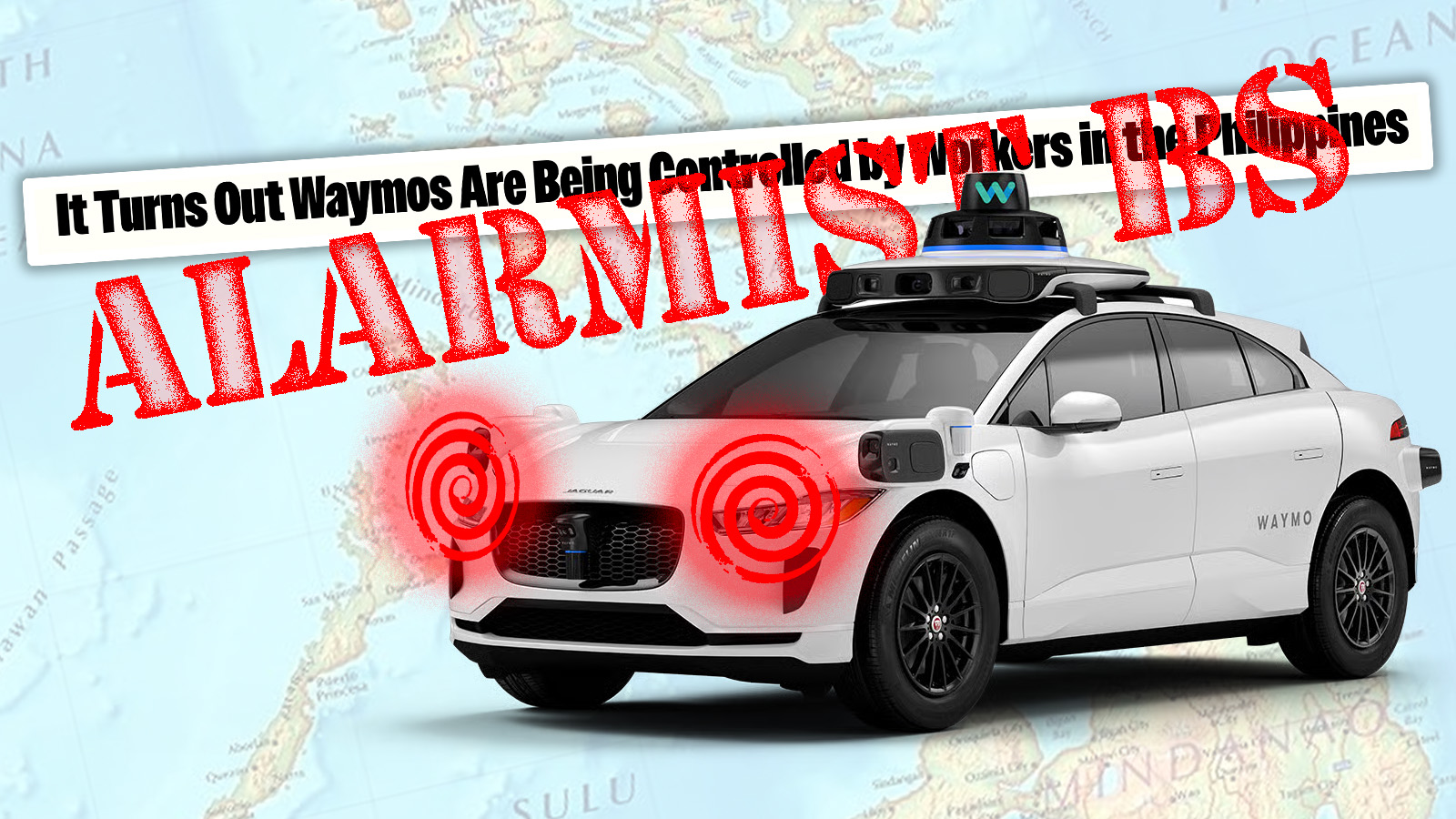
Automated Vehicles (AV) are getting a lot of attention at the moment, specifically Waymo’s robotaxis. This stems primarily from a congressional hearing that took place on Wednesday about the future of self-driving cars in America, as well as scrutiny of robotaxi safety after a Waymo robotaxi hit a child in Santa Monica, California. Luckily, the kid was okay, and there’s an NHTSA investigation looking into the incident, which is good. We should be scrutinizing all incidents with AVs, we should be studying how they work in our greater, largely human-driven environment, and we should give real thought not just to how these companies are operating and managing these cars, but how we want them to be operated and managed. What certainly doesn’t help any of this, though, is alarmism, both relating to the role of the human operators and where they’re located.
It was during these hearings that the fact that Waymo robotaxis will sometimes reach out to human “fleet response” operators was first revealed, dramatically, by Waymo’s chief safety officer, Mauricio Peña, probably sweating lavishly as he was grilled by senators like Ed Markey (D-MA). Well, I mean, “revealed” and “dramatically” are only true if you, say, ignore the fact that Waymo has never kept the fact that they use remote human input to assist their robotaxis when needed, as they describe in some detail in this post from May 2024.


Media outlets have been treating this operational fact as some kind of wild gotcha, as you can see in headlines from a Google search:
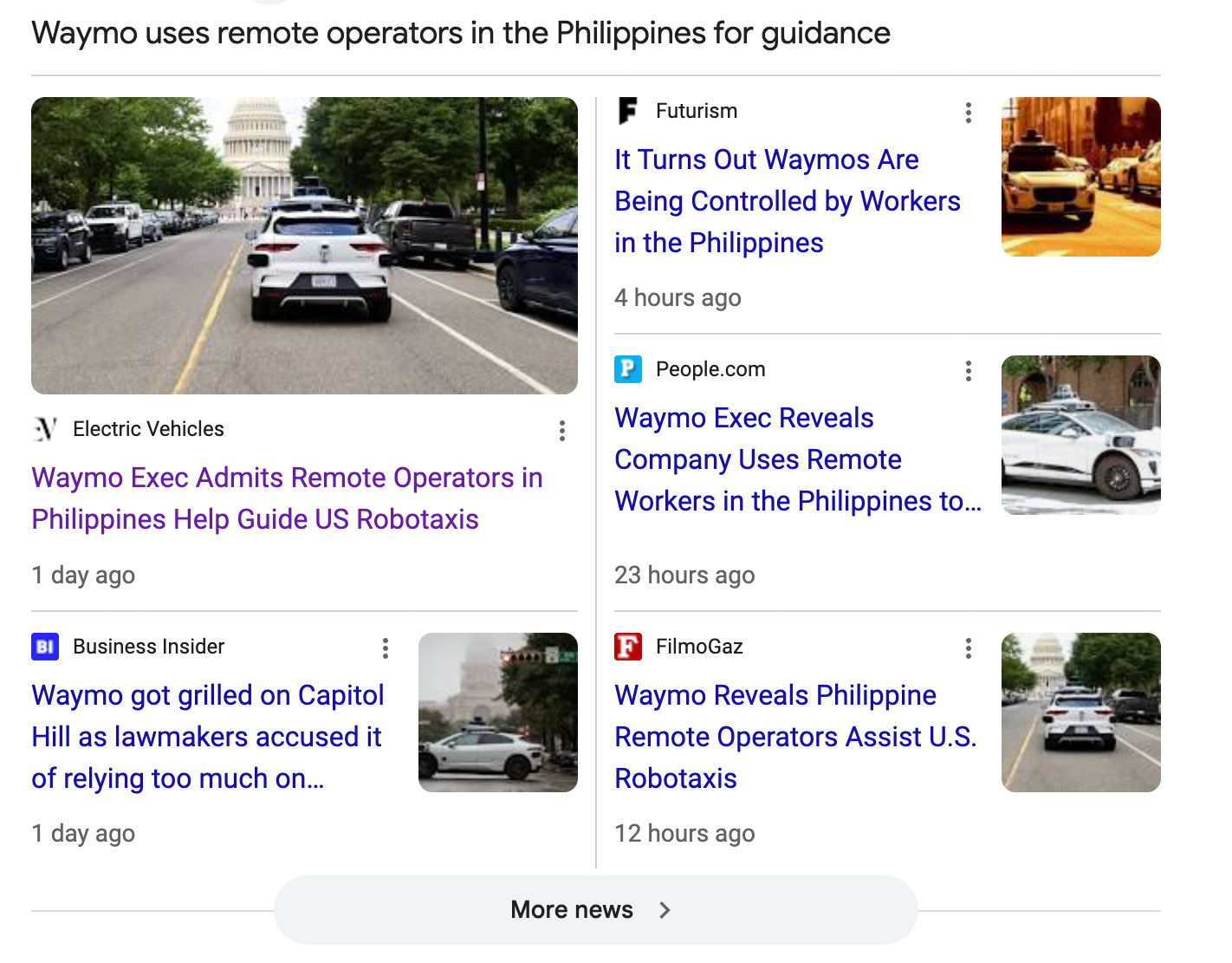
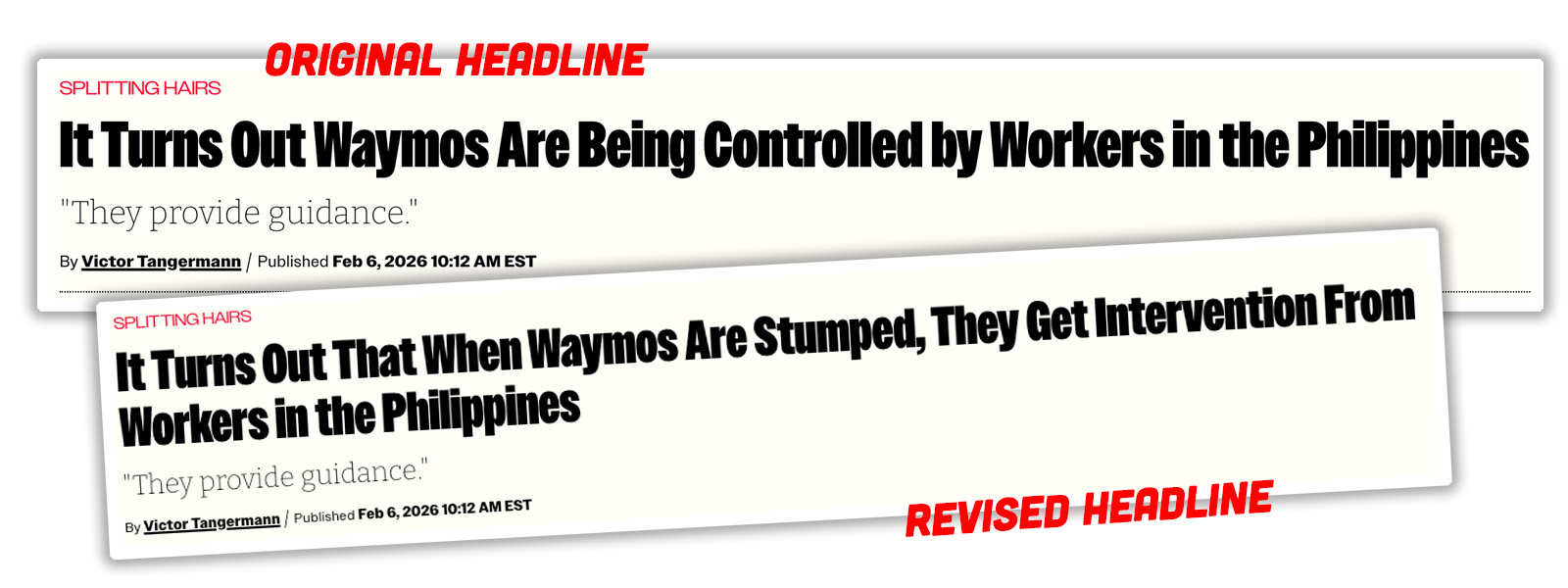
While some of these headlines describe what the remote operators do as “assist,” which is really a more accurate way to describe what’s happening, some really went for it and cast the situations as people from an island nation outside of America’s direct influence are “controlling” 4,000-pound driving robots in our cities. The website Futurism had what may be the most alarming headline, which they changed about three or four hours after the story went up:
Let’s just be clear about what’s going on here: humans, no matter where they are, are not driving Waymo robotaxis. I spoke with Ethan Teicher at Waymo to confirm all this, and from what I was told – and what is described in Waymo’s 2024 post on the subject – the Waymo Driver (that’s what they call the combination of hardware and software that actually drives the car) – is always in charge of the actual driving of the vehicle, for better or for worse.
From that post:
“In the most ambiguous situations, the Waymo Driver takes the lead, initiating requests through fleet response to optimize the driving path. Fleet response can influence the Waymo Driver’s path, whether indirectly through indicating lane closures, explicitly requesting the AV use a particular lane, or, in the most complex scenarios, explicitly proposing a path for the vehicle to consider. The Waymo Driver evaluates the input from fleet response and independently remains in control of driving.”
No one is driving these cars remotely; in situations where the Waymo is confused, it may call for assistance and get guidance from fleet response. This seems pretty clear when you think about some of the dumb and obvious mistakes Waymo robotaxis have made over the years, like when, this past October, a Waymo robotaxi seemed to be absolutely baffled by one of the most obvious vehicles on the road, a schoolbus. If a human were driving, no matter where they were, they would not have made as many misguided driving decisions as the Waymo Driver did.
And yet, despite the fact that Waymo using remote people to assist the cars was no secret, we still get videos with titles that start with “SHOCKING REVELATION“:
Here’s the thing, though – why is any of this “shocking?” It’s a good thing that these cars reach out to humans to get input about complex or confusing driving situations. Why wouldn’t you want a robotaxi to be able to escalate a situation to get input from someone who understands how the world works? This should be – and probably is – a default expectation for any organization looking to field automated vehicles into public areas.
Now, the part about these remote operators being staged in places like the Philippines may be a bit more complex, but I also feel like there’s a lot of alarmism going on there, too. Let’s be honest: we know fundamentally why Waymo has these centers in the Philippines. It’s cheaper! I mean, come on, that’s not really hard to figure out. It’s not like Waymo was looking for the country with the world’s finest drivers; if that were the case, all these centers would be based in Finland.
And, yes, sure, Waymo is expanding globally and will be launching robotaxi service in Tokyo and London soon, so having multiple locations for their fleet operators makes sense from that perspective, too.
But if you watch that video clip, the Senator is suggesting that these remote operators being outside of America is a security risk, and I think that’s a bit misguided. They’re remote; even if they were located in Kansas, if a malicious entity wanted to hack that line of communication between a fleet operator and the robotaxi, they could do that regardless of where they are. Cybersecurity issues aren’t constrained by geography.
Now, the point about jobs being shipped overseas, I think, is more valid; it used to be that local taxi service jobs simply couldn’t be outsourced to another country, and now they sort of can be. That’s not great! AI takes away enough jobs as it is, so perhaps some restrictions on robotaxi companies moving all the jobs to countries where they can pay people less should be imposed. But that’s not the same thing as the implication that non-US-based fleet operators are a huge security risk.
If you’re worried about humans influencing Waymos to do bad things, it should be reassuring that the Waymo Driver system is always in full control. As Waymo’s statement notes:
It is very important to note, however, their role is never to drive the vehicle remotely. Our technology, the Waymo Driver, is in control of the dynamic driving task, even when it is receiving guidance from remote assistance. Fleet response agents can provide additional context requested by the Waymo Driver (often in the form of multiple choice questions). The Waymo Driver can then appropriately accept or reject Fleet Response agents’ suggestions.
Now, if your concerns are with the decisions that Waymo Driver makes, maybe this is bad news. But if you’re worried about someone getting a job at a Philippine-based Waymo fleet operations center to try and guide a Waymo to, say, drive into the big creepy clown on the Circus Liquor sign in North Hollywood, I don’t really think that’s a valid concern.
There are still plenty of big, important issues yet to be solved with AVs, whether they’re robotaxis or automated delivery vehicles or whatever. We’re only at the very beginning of this journey, and it’ll go a lot easier if we can keep focus on the real problems and not get sucked into distracting alarmism.
Top graphic images: Waymo; Amazon; Futurism





I think that you are missing some points, Jason. One important this is the level of influence and responsibility that the remote operator actually has. Because even if the vehicle is in charge of the dynamic driving task, certain input from the remote operator can be considered as part of that DDT.
And, depending on that human influence, what education levels do the remote operators have? Are they required to have a US driving licence to understand the context and regulations they are taking decisions within?
The one question no-one seems to ask is whether Waymo will ever be profitable?
Been going a few years now and still seems like throwing dollars into the furnace.
They’ll need to add kill switches before I’d ride in a Waymo.
I know someone who drove wayward Waymo cars out of trouble and he was often busy.
This contradicts the October 2025 Passenger Safety Plan Waymo filed with CPUC:
Event Response agents are able to remotely move the Waymo AV under strict parameters, including at a very low speed over a very short distance.
It was weird for me to read Jason’s writing today that says, “It’s not like Waymo was looking for the country with the world’s finest drivers; if that were the case, all these centers would be based in Finland.” because just yesterday, I was scrolling through rally clips on my Instagram feed and thinking to myself, “Damn. Finns really are the best forkin’ drivers, aren’t they?”
I got a taxi in Finland once. He turned left across a four lane junction with a turn of right hand steering because he was that sideways on the snow.
He did this while he was entering our hotel into his satnav with his spare hand. The entire journey was the most nonchalant drifting I’ve ever seen. Smooth, fast and confident.
Is it a good thing?
All of Comcast’s call centers are in the Philippines. Even if you have a ‘bulk’ account spending thousands per month.
‘Help’ doesn’t seem to be their specialty.
That’s a Comcast problem, not a located in the Philippines problem. Their support was no better when it was in Atlanta.
I have great difficulty understanding the reps in the Philippines. It’s a combination of old ears and their cadence which throws me off (I think).
I’ve dealt with a lot of foreign-based phone support through the years, Comcast is the only time I have ever had to ask to speak to another rep because I couldn’t understand. I feel like a jerk doing it, but there’s no point in having a conversation that way.
That is a fair point, I work in global tech and have to deal with every imaginable accent every day. I used to regularly work with a team in Manilla, and they can speak very quickly. On more than one occasion I’ve had to translate accents between people from other sides of the world, the most entertaining example of this was between an Irishman and a Brazilian.
In a past Job I had a guy from Northern Ireland working with me. We had a customer from China and our Irish coworker simply could not understand. He would get frustrated. His face would get bright red and he’s stomp around the office after the call.
We forwarded every call from that customer to him for our own amusement.
OOO I also used to work in a local computer store staffed almost entirely by recent immigrants from various regions of China. For whatever reason their versions of Chinese didn’t make sense to each other, so they often spoke in English, and would occasionally drag me into their arguments because they couldn’t understand either their dialects of Chinese, or their English accents.
Language is fascinating, and weird.
That is genuinely funny (I am imagining this happening at escalating volume levels).
At one point I worked with global folks. Irish, French, Japanese, Indian, and others on the same call. On one phone call, I could tell that the person from France could not understand what the speaker from India was saying. So, I was very diplomatic in finding ways to repeat the Indian speakers content for the French speaker without insulting the Indian. It was a challenging task.
Robot driver trying to contact customer support. When is the last time you called customer support and got someone helpful in under a calendar month?
“It’s not like Waymo was looking for the country with the world’s finest drivers; if that were the case, all these centers would be based in Finland.”
I’m not sure about that, it’s easier to drive in a country where everyone respect the rules than it is in a place where there’s chaos on the roads.
One of the safest driver I know is from Madagascar, and his experience made him really aware of his surroundings when driving…
That initial collision in Santa Monica never would have made the local 5 o’clock news if it were a meatbag in the driver’s seat.
True, 500,000 homeless, drug used in the streets people just dropping dueces in public billions of dollars disappeared certainly a kid gets hit by a car is not news. File this under REALLY?
You can prove they aren’t actually driving the cars just by the fact that latency to the philippines has to be way too long to drive even if they wanted to.
Also I wanted to mention that location certainly does matter to security, it would be a lot easier for bad people to get physical access to the computers in some places. That being said, it really isn’t relevant for this since all their doing is sending the AI driver suggestions that it can choose to ignore.
The way this thing works is that the car sends a picture of the situation to the remote operator and a few possible interpretations of the problem/solution. (For example: “lane blocked by a double-parked car, drive around into opposing traffic” which is a thing a human would do in that situation)
The worker picks the one that fits best (or sends it back if none apply) and then the car carries on.
That works so well when the taxi decides to lap its parking garage w/ a revenue fare in the back, or pass a stopped schoolbus discharging or collecting passengers.
To be fair, those are both proof that someone isn’t driving them from the Philippines…
Tesla, in the same hearing, also confirmed that their driverless taxis call for remote help.
I would love to see how many times Waymo and Tesla AVs use the “phone a human” option per 100 miles. That would help us determine who is leading the software development race. Maybe if we had a functioning government, they could require driverless taxi manufacturers to disclose that along with other safety data.
A lie will travel all the way around the track before the truth lets off the clutch.
Okay, what about that, presumably, the Phillipines has different traffic laws and driving habits than the US?
One would expect the remote operators to be trained for the job at hand. They get training for all sorts of jobs and perform them reasonably well, and this wouldn’t be an exception. Otherwise an operator in India or Australia would make the Waymo drive on the wrong side of the road.
Remote employees are still subject to state licensure—your radiologist still needs to be licensed in your state even if they’re reading the x-rays elsewhere.
“Because internet” is a not a justification for avoiding regulation of safety-critical industries, despite the Obama admin’s corrupt precedent-setting for Uber (Tony West and David Plouffe, specifically).
What does have to do with anything?
You need a license to operate a car.
A remote car operator is a new type of remote employee but being a remote employee isn’t new. It’s a settled legal question. You need state licensure.
The immense majority of remote workers don’t need any kind of local, state, or national licensing of any kind. Tech support, call centres, writing software, design, etc ad infinitum.
Now I do agree that interfacing with a Waymo remotely and giving it hints should require some kind of objective measure of competence, including knowing traffic rules where the car is traveling. But as the article states, the operators aren’t driving. And even if they were, I’m not convinced a driver’s license is the right mechanism.
Obviously unlicensed professions don’t need a license. What does that have to do with licensed professions?
As this article clearly states, no human is operating the car. Therefore no license required per your statement.
They are making decisions about how the car drives. The same sorts of decisions that appear on a driving test.
We’ve added automation to cars before and the person making decisions has always been considered the driver.
You’re carrying water for the company’s regulation-skirting argument.
I am doing no such thing. I am not operating an autonomous vehicle, nor an I occupying one. You’re splitting hairs, and I’m pointing out how that is flawed. Ironic give your username 🙂
I’m from the UK, I read the DMV regulations for every US state I’ve driven in, and every country I’ve driven in.
The one that would have caught me out is stopping for school busses. Also jaywalking isn’t a thing here, pedestrians can cross most roads wherever they like. And four way stops, which have an unwritten additional control logic of “that guy in the truck is just going to go anyway”.
In some of my downtime avoiding the real world I’ve been watching very old Top Gear. One of the episodes focused on child traffic safety, and specifically cited the US as “having figured this out” which was a strange thing to hear. But apparently in 1981, school speed zones were largely ignored by drives in the UK, as there was minimal enforcement.
In 1981 I was walking a couple of miles to school every day. My knowledge of road safety from back then is patchy, but we didn’t have school busses or special speed limits.
But speed enforcement was pretty much non-existent in the 90’s, unless you passed a police car.
What alarms me (well, surprise tinged with wariness is more like it) is that the remote operators can’t actually take over and instead have to rely on suggestions to modify the car’s behavior. Seems like a recipe for too little, too late.
Am I afraid Waymos might re-enact Maximum Overdrive if scary, scary foreigners can prompt them to change lanes? Of course not. I’d be more worried if there weren’t a human in the loop.
If Congress is going to look into threats from the Philippines, they should focus on matters that are more on their level, something far scarier than the NoHo clown: the Jollibee mascot. That thing can take its ketchup-slathered hot dog spaghetti right back across the Pacific. I’d miss the Chickenjoy, though, so scratch that.
When the vehicle needs input from a human, it stops until it has that input. That’s what caused the chaos in SF a few weeks ago — every single Waymo was waiting for human input at the same time. But, of course, there’s not a 1:1 relationship between AVs and supervisory workers — so the cars were stuck in place waiting for input.
2 delicacy’s I was totally unaware of until our Filipino daughter-in-law took our son & grandson to the islands.
Peach Mango Pie!
“Autonomous” Vehicles (but not really):
The Original AI Slop.
First, I’m going to repeat my strong objection to calling anything but a living, breathing human a driver, unless they add sufficient adjectives to their “Waymo Driver” phrase to disqualify what it sounds like without them. “Waymo Robotic Driver” or “Waymo RoboDriver” for example, would be fine.
Second, in the same general area of thought, Waymo have to some extent brought this upon themselves with their misleading naming. “Waymo Driver” sounds like a a person from Waymo, somewhere, driving the car.
I felt compelled to carefully reread those sections, too. “So there is a driver, but it’s still just the robot, although a human who is not allowed to drive can remotely affect the driving via prompts?” It wasn’t the clearest path to clarity, but legislative grilling tends to go that way.
Does it? A cab driver isn’t a person from Cab. Neither is a truck driver an employee of Truck.
I’m not trying to be difficult, I just don’t see that naming as problematic.
In your two examples, the first word serves to state what is being driven, and yes, the same applies to the Waymo. But the point remains, a “driver” is undertood to be a person, not a robot.
Again I’m not trying to be difficult, I swear.
But in software, a driver is a piece of software that lets one system use and control another (e g a printer driver lets your computer tell a printed what to do). A screwdriver is also not a person. Neither is a pile driver. So I honestly don’t see an issue with calling the robot in the vehicle its driver. It steers it, applies power and brakes, makes decisions based on its environment, etc. It’s a driver.
Likewise not trying to be difficult—
Yes, I considered software drivers, pile drivers, screw drivers, etc., all of which share the concept of making something go or advance or be pushed. But.
To expand and expound a bit, what I’m trying to say is: despite the many meanings of “driver,” many of which can be considered metaphorical to an original meaning regarding directing the motion of animals and later directing the motion of automobiles, when I hear “driver” in reference to operating a car I fully expect a human, not a robot (and not some element of Canbus).
Fair enough!
Now what about this driver?
https://youtu.be/itGhunw16FU
Not a fan of the intervention required in the event of inflation issues.
Also fair enough.
A sovereign citizen would say they’re not Driving, the Waymo software is ‘ traveling’. No license necessary!
<snerk>
Yea I’d rather they have back up real humans to take over if things go wrong, that’s actually better, ugh society sucks.
Over promising and under delivering hasn’t helped.
How they got permission to beta test on public roads without taking progressively more difficult DARPA courses makes me question every decision made.
To be fair, the original ancestor of the ‘Waymo Driver’ is Stanley — the car that won the original DARPA course. There’s a reason that the car had giant ‘android’ stickers on it…
After the 2005 Grand Challenge, Sebastian Thrun and the rest of his team left Stanford and joined Google.
The counterpoint to this is that this doesn’t address his point that the road from 2005 Grand Challenge winner to beta testing on public roads should have included a few more steps named “20xx Grand Challenge winner” to ensure that we really had some significant progress before reaching this stage.
They did do that though… just under CA DMV supervision rather than DARPA. After the 2007 “Urban Challenge” Waymo did hundreds of thousands of miles with safety drivers around California.
They built their own course at Castle Air Force Base to simulate a huge number of potential scenarios, and they’ve virtually simulated millions of more miles on top of that.
The cars have been hands-off but supervised since 2014, and unsupervised since 2018.
The question really is “what amount of testing would be enough to satisfy” — if someone doesn’t have an answer, their objection isn’t really well thought out.
I’m a states’ rights guy, so in my opinion CA DMV deciding Waymo could test in their state is California doing California (by way of Florida). But it sounds like what you’re trying to say is that Waymo alpha-testing in California was a good thing because they did a couple more years of autonomous driving challenges and they had safety drivers until 2018 and, hey, look at what they’ve accomplished in that amount of time.
I’m not sure what Hoonicus’s exact take on this is, but I personally would have preferred to see quite a few MORE years of autonomous challenges undertaken and successfully completed, along with demonstrations of graceful ways of handling various autonomous driving failure modes. This crap framework we have now with the various levels of autonomous driving (Level 1? 1+?)? I feel it is a result of focusing too much on just the autonomous driving aspect and not enough on the automation-human interface aspect of it.
I mean, I do have to acknowledge that had things moved more slowly, it’s possible we wouldn’t have had the successes of Waymo to compare/contrast with the dumpster fire that is FSD, but I also feel that it might have also led to stronger standards that FSD would have had to fall in-line with.
But in the end this is all moot because it’s all wishful thinking, and this is the timeline that we are stuck with. I do believe Waymo is far ahead of Tesla in this space, but I also believe that we have seen that even Waymo’s superior system has serious flaws that I think should have been taken care of in alpha-testing stage rather than beta-testing. (Ah, and that’s another argument just waiting to be broached, isn’t it?)
My point is that they *did* design and pass several more challenges — specific sets of tests likely to match the kinds of conditions they’d see in the real world. They’ve also done a lot of simulation where they did human-driven data collection runs and then simulated all the drives with the computer “behind the wheel.”
The problem is that driving is an unbounded domain — you simply can’t simulate or test every possible scenario in the real world, and at some point you have to interact with the real world.
There is no number of years you can alpha test that will get you to 100% of all scenarios the robot will eventually encounter. The question only is the point on the asymptotic curve beyond which you’re not going to improve the robot brain any further.
Oh, I would 100% pay an upcharge fee if to have Kimi Räikkönen dial in and make sure that WAYMO gets to the airport YESTERDAY.
Mmuahmmm…
Calling the autonomous suite “The Waymo Driver” isn’t helping with the confusion, but obviously the sensationalist headlines aren’t concerned with that aspect.
If you give the waymo driver a tip, who gets to keep it?
That’s one of my favorite things about Waymos. Just a few years ago I was very opposed to the deployment of self-driving cars, but the handful of Waymo rides I’ve taken completely sold me on them for ride hailing. The way they drove approached my Platonic ideal for a cab: safe but very efficient. I got to sit up front. I could have picked the music if I wanted. I did not face the lose/lose conundrum of either trying to converse with the driver or ignoring them like a rude aristocrat. I could honestly rate my ride without the social gymnastics that have made anything less than five stars an act of war.
But the cherry on top was that tipping wasn’t even an option.
You make a lot of good points. I haven’t had the opportunity to use a Waymo and I often find myself irrationally angry at technology, but perhaps I should just accept that it’s not inherently good or bad; it depends on the implementation.
And the inside of the car doesn’t smell of cigarettes and cologne.
There is no way to tip a Waymo – which is yet another reason to prefer them to Uber, Lyft or a Taxi.
It seems like every level of human interaction in the US economy is being degraded by crass expectations that a tip is required.
On one hand reporting the story with the truth would and capturing the nuances would be morally right, on the other hand if we misrepresent the situation and create a frenzy we might get more clicks. Both really good points
Lee Iacocca famously said our costs walk in on two feet every day but I wonder how much cost saving all this taxi automation will really realize?