

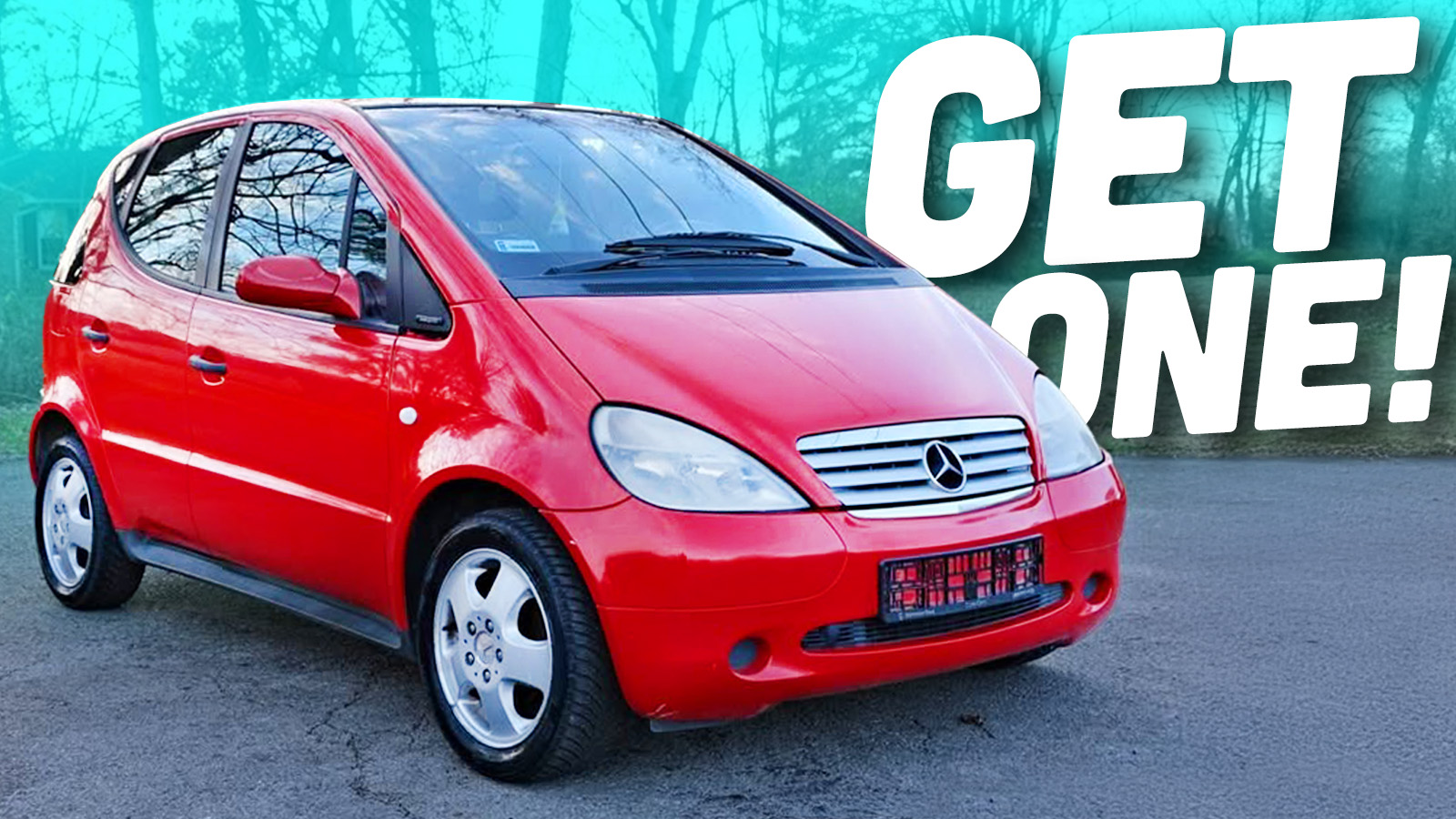
The world is full of fun cars that Americans never officially got access to. Japanese Domestic Market cars tend to get all of the attention, but Europe had great cars, too. One of them is the original Mercedes-Benz A-Class, which is easily the cutest car to wear the three-pointed star. America wasn’t cool enough to these adorable city cars, but enough time has passed, and that’s not a problem anymore. A beautiful A-Class has shown up for sale right here in America, and it appears to be in solid shape.
There is a lot of uncertainty in the car import world right now. The federal government has placed reciprocal tariffs on goods coming from anywhere in the world, with some countries getting higher tariff percentages than others. Then there are the tariffs on specific goods and materials. It’s easy to develop a headache trying to figure out how much Uncle Sam wants you to cough up. If you asked five different Customs brokers about what tariffs you’d have to pay on your import, you’d probably get five different answers. I only know because I have asked different brokers the same questions and got different answers. You may even get a bill if the government decides that you didn’t pay enough.


It’s for this reason that I stopped importing cars. I would love to add an Audi A2, a Smart City Coupe, or a Mercedes-Benz A-Class to my fleet, but it’s hard to figure out what my final cost will be. If you find yourself in the same situation, maybe the solution would be to buy a car that’s already here and titled. That way, the headache of tariffs is someone else’s problem.

That’s the opportunity being offered by the 1998 Mercedes-Benz A160 Avantgarde that’s up for grabs in Tennessee right now. It’s a car that’s here, titled, and ready to go. Even better, this bright red city car is left-hand drive and comes with an automated manual transmission.
A Real Car, Only Tiny
As Automotive World reports, the creation of the A-Class was a part of a wider initiative within Mercedes-Benz. The company was interested in expanding into markets it hadn’t previously explored. Mercedes entered the highly lucrative SUV market with the ML, and began catering to “lifestyle” buyers with the SLK Roadster.

The A-Class served a couple of roles. It would add an entry-level vehicle to the Mercedes portfolio while also adding a Mercedes product to the market of trendy city cars. Mercedes had long been interested in city cars and had even created prior concepts like the gloriously blocky NAFA. Of course, Mercedes would also join in on the Swatch car project, which would later become the Smart.
Mercedes-Benz says the A-Class made its first appearance at the motor show in Frankfurt as the Vision A 93. This car was more than just a design study, but represented an upcoming production model. The automaker says the Vision A 93 gained instant worldwide curiosity.

One of the design themes behind the A-Class was to do what hadn’t been done before. In Mercedes’s eyes, existing city cars made poor use of their available space or weren’t particularly safe. The A-Class was designed to show that tiny cars can have large interiors and that they could be just as safe as larger vehicles.
This goal meant that Mercedes-Benz wasn’t able to use an existing platform. Mercedes-Benz created a platform that utilized two horizontal planes. The passenger cell was placed on the upper plane while the mechanical parts up lived front and on the lower plane. In a frontal crash, this “sandwich” design allowed for the powertrain to slide down and out of the way of the passenger cell.

Mercedes-Benz continues:
In the new model series over 20 technical innovations were implemented which had not hitherto existed in this product category. Thanks to the unique sandwich principle, the A‑Class delivered the spatial comfort and safety standards of a mid-range saloon. The innovative rear seats and the option of a removable front passenger seat offered the adaptability of a mini MPV and allowed the five-seater vehicle to be transformed into a four, three, two or one-seater. In total, there were 72 potential seat variations. The A‑Class could also rival large estates in terms of load capacity, offering 390 to 1340 litres, depending on the position of the rear seats, or, with the front passenger seat removed, an impressive 1740 litres. The flat floor, large tailgate and low load compartment sill made loading easy.
The robust floor assembly with its combination of straight longitudinal members and cross members was an integral part of the innovative safety concept. At the front end of the longitudinal members was a novel front module made of aluminium, with two lateral crash boxes. These were bolted to the longitudinal members and could be replaced quickly and relatively cheaply in the event of an accident. For the first time in large-scale production at Mercedes‑Benz, a plastic was used for the front wings which quickly resumed its original form following a minor collision, without the need for repairs or paintwork. To save weight, the tailgate was also made from plastic. The easy-to-repair design of the A‑Class not only reduced repair costs following an accident, but also resulted in low comprehensive insurance costs.
In terms of passive safety, the new model series achieved practically the same level as the exemplary model series 210 E‑Class. Besides the unique sandwich principle, the restraint systems installed as standard and specially adapted to the A‑Class concept with its short crumple zones contributed to this result. They included full-size airbags for the driver and front passenger, automatic seat belts, with belt tensioners on the front and outer rear seats, and belt force limiters on the front seats.

Mercedes-Benz would apply similar safety logic to the Smart City Coupe, which was also under development in the 1990s.
The automaker says it also had to engineer a new series of engines and transmissions to fit into the A-Class since the area taken up by the drivetrain was so small. The new engines had alloy blocks and were reportedly 25 percent lighter than other four-cylinder engines in their class. Mercedes-Benz would mount what it called the “drive unit” at an angle below the pedal box so that the interior could be as large as possible without the drivetrain getting in the way. Apparently, Mercedes even had to give the A-Class specific transmissions that formed around the bodywork of the vehicle.
The suspension was also chosen for its compactness. Mercedes says it went with MacPherson strut assemblies and a torsion-bar stabilizer up front, plus a trailing-arm suspension and coil springs in the rear. The A-Class even got crafty with emergencies, as the standard model eschewed a spare tire for sealant and an air pump. However, a real spare tire was available upon request.
A Rocky Start
The A-Class was introduced in 1997, and Mercedes produced barely more than 2,500 copies when a total public relations disaster occurred.
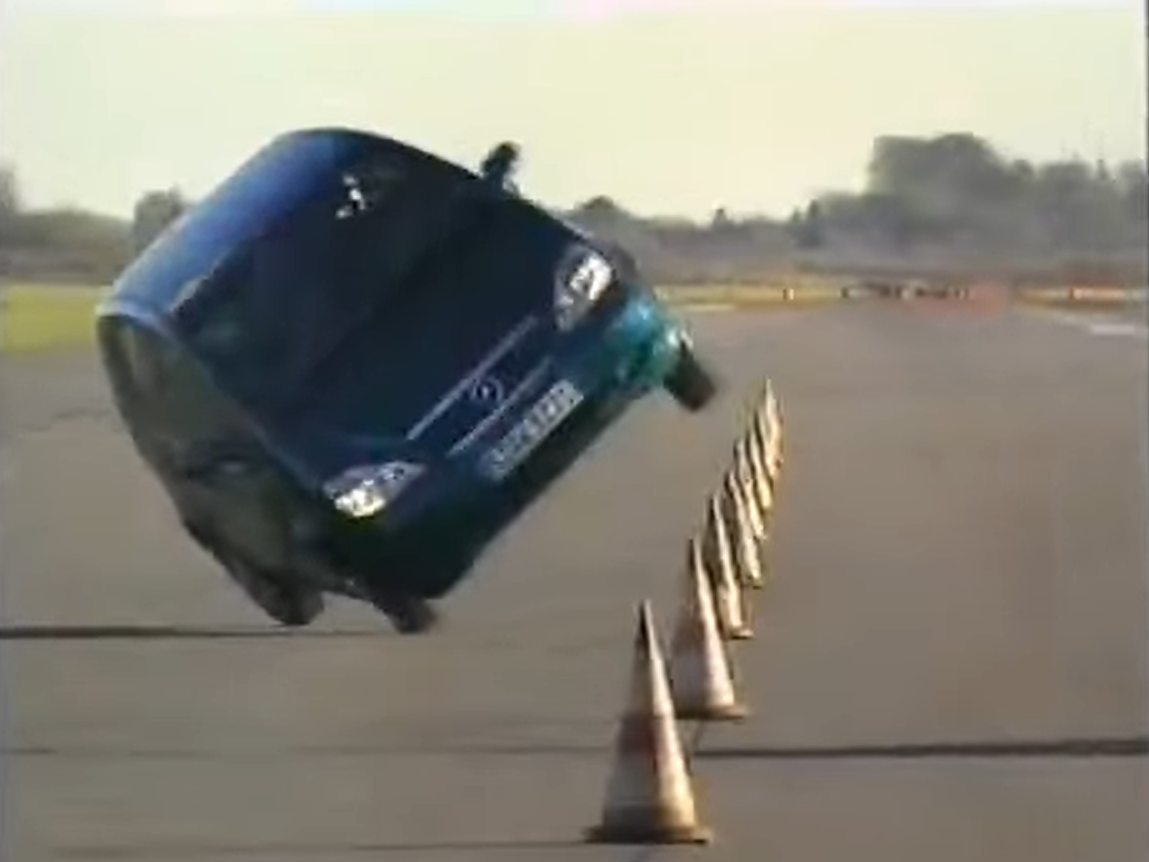
Unfortunately, as Hagerty UK writes, while Mercedes made some engineering triumphs with the A-Class, it was also half-baked in areas. The most infamous example of Mercedes’ folly was when Swedish journalist Robert Collin performed his ‘elk test’ with an A-Class. All the vehicle had to do was swerve around an obstacle, as one might do if an animal appeared in the road ahead of your vehicle. The A-Class tried and failed, rolling rather than completing the test.

The failure was an embarrassment for Mercedes-Benz, which initially denied the existence of an issue before stopping sales for three months. When the A-Class came back onto the scene, it had a modified suspension and stability control. The car sacrificed handling to keep all of its wheels firmly planted. That was enough to get it to pass the elk test (above). The A-Class also managed to impress car journalists and attracted plenty of customers.
Unfortunately, the woes did not end, from Hagerty UK:
The iceberg of woes was tipped with keyfobs and alarm systems that didn’t work. Moving down to terrible wipers (and no repositioning for right-hand drive) that required a total recall in 2005, and electronic malfunctions including sunroofs. Suspension, anti-roll bars, steering and fuel pipes all have reported issues. And right down at the frozen fundamentals level are infamous problems with diesel ignition and faulty transmissions that frequently resulted in a rebuild/replacement bill larger than the value of the rest of the car.
Poor A-Class. It didn’t turn out at all well, really. It certainly transformed Mercedes’ fortunes. But not in a good way, because the company is said to have lost 2.5bn Euros on the project despite selling 1.1m of them, making it probably the best-selling bad car of all time. And yet with a delicious irony, its litany of misbehaviours did not include safety. Assuming it could be worked over enough in the service bay so the engine could actually maintain acceleration, the brakes work properly, and the car’s vim not be extinguished by driving through a deep puddle (thereby waterboarding the low-hanging power steering pump), the original A-Class would look after you.

The A-Class and the first-generation Smart Fortwo were similar in a low of ways. They both were both tiny, surprisingly safe cars that were temperamental. Both of these cars also sold in healthy numbers, yet still cost their manufacturers piles of money, anyway. It didn’t help that the cheapest A-Class, the A160, had an expensive starting price of £15,490 in 1998, and the price climbed quickly from there.
But all of these events transpired more than two decades ago. The world has moved on from cars like the original A-Class. As it stands right now, it’s not very hard to find an old, imperfect A-Class with some miles on its odometer and a price under $2,000. Some of these cars are finding new life by coming to America. A handful of model years of the A-Class are legal to import, and some people are going through the work to bring them here.
This Mercedes-Benz A-Class

One of those cars is this 1998 Mercedes-Benz A160 Avantgarde. It’s currently for sale in Tennessee, and it appears to be in pretty good shape. Mercedes says that the original A-Class was sold in three trim levels:
Three variants – CLASSIC, ELEGANCE and AVANTGARDE – were available, all of which came with a comprehensive assortment of standard equipment. Compared with the basic CLASSIC version, the ELEGANCE variant offered a range of additional interior and exterior features. These included light-alloy wheels, a radiator grille and exterior mirrors painted in vehicle colour, chrome inlays in the door handles and two-tone tail light lenses. The AVANTGARDE was the advanced-technology model variant, featuring light-alloy wheels with wide-base tyres, a silver-painted radiator grille, exterior mirrors in vehicle colour and single-tone tail light lenses.

This one is the Avantgarde, and it features the bits noted above, plus air-conditioning, hybrid cloth and leather seats, power steering, front power windows, and power mirrors. Power reaches the front wheels from a 1.6-liter M166 four-cylinder with 101 HP and 111 lb-ft of torque on tap. The transmission is a curious oddity, as the original owner didn’t opt for a regular automatic or manual, and instead got a manual transmission with an automatic clutch. The driver still moves the gear shifter through the five gears with an H-pattern shifter, but an electric motor handles clutch duties.
The A-Class is also properly quirky. The rear windows have cranks, the dashboard is wavy, and the seats aren’t much thicker than what you’d find in a city bus. But the car also shows some wear, especially on the steering wheel, but otherwise looks pretty clean for a vehicle with 110,282 miles.

The car even comes with a short story about how it got here. The seller says he often travels to Europe and has a knack for buying cars from private owners and then bringing them to America. Sure enough, his Facebook Marketplace page is full of totally normal European cars that he brought to America.

Before you pull the trigger on a car like this, you should be aware of what you’re getting into. Yes, this is a Mercedes-Benz, but it’s also still a city car at heart. This won’t be super quiet, super comfortable, or that great of an American road-trip car. Think of this as something like a four-door Smart Fortwo and then adjust your expectations accordingly. Even Doug DeMuro learned the hard way that an early Mercedes A-Class might not be what you’d expect.
Really, this A-Class might be great for the kind of person who might be interested in a Japanese Kei class car, but might want a little more space, a little more speed, left-hand drive, and a little more power. This can also be a decent pick for someone who lives in a state that doesn’t like Keis. This car is bigger than a Kei and has a 17-digit VIN, so you’ll probably slide right under the radar. Of course, be sure to check local rules on emissions testing and such.

The price also seems reasonable. The seller wants $9,500 for this car. Yes, that price is more than you’d pay if you imported one of these yourself. However, you’ll likely have to pay a vehicle sourcing agent, two shippers, a broker, and then tariffs. Or you can fly to Europe and do the transaction yourself for less money. Based on quotes I’ve gotten to have someone find me a cheap European car and then have it imported, going your own way might save a couple of grand or so. Paying extra might be worth bypassing the hassle.
Honestly, I’m just stoked to see another Mercedes-Benz A160 in America. I get that importing cars from Japan is crazy easy, it’s why I do it. But I’d love to see more cars from other parts of the world coming to America. Sure, the Mercedes A160 is small, weird, and will probably test your patience. But look at the thing! How can you say no to cuteness like that?




If you’re going to go through the hassle of importing an A-class, at least get one with a diesel engine and a proper manual; that combination would get you city mpgs in the 40’s, compared to the middling fuel economy of the gassers.
I am looking to buy a car for my wife right now, but I already have two imports and $9,500 is about twice my budget right now. Also, neither of us like red on cars and I can imagine the transmission sending my mechanic into a tailspin.
“Get One!”
No!
I used to own one A140 about 20 years ago. It is really a stretch to call it a Mercedes due to its really bad quality. I mean everything rusted in that MB era but this model was flawed with a bunch of electrical issues and irritating quality issues with buttons falling. One thing to keep in mind is that the AC is driven by the universal belt, meaning that it costs pretty much the value of the car to change that one.
I don’t think I’ve ever seen an A-Class but saw quite a few B-Class vehicles in Canada and thought it would be cool to own one. But I think a 1st or 2nd gen Fit with a stick would probably make more sense.
Mercedes-Benz briefly offered the B-Class in America as an electric vehicle. Other than the middling range it’s not a bad car. They came in a lovely blue color that I was tempted by, but I wasn’t at a point in my life where I could have justified that niche of a vehicle even as a spare vehicle.
Early Fits are neat but they seem to develop rust and water penetration issues. Putting the fuel tank under the front passenger seat to allow for the “Magic Seats” is clever packaging, though, I’ll grant.
If I were getting something that small I’d probably get a Mazda2, Toyota Yaris, or a Fiesta ST. Or maybe a Mazda CX-3, which is essentially a taller 2 and a way to get a third-gen Mazda2 without importing one from Puerto Rico or refacing a Yaris iA.
I’ve driven a Yaris. No thanks. I don’t know about the other two. I kind of liked stick-shift Focus and Escapes back in the day. Hated their DCT. I haven’t even been inside a Fiesta (since 1978). I rented a CX-3 and liked it.
I want to like it for many reasons, most of all the packaging innovation while adhering to a high level of safety. But with all the potential mechanical headaches, I would prefer to just buy a manual transmission Honda Fit. First or second generation only. There was an HDPE instructor who drove from NYC to NH’s Club Motorsports in his Fit, swapped the wheels to track wheels in the parking lot, changed the alignment specs and then proceeded to track the car with great success. Then he simply readjusted everything back and drove home.
Some feedback from a W168 owner. I live in Sydney, Australia, and from 1999 to 2010 I owned three W168’s and drove over 300,000km or almost 190,000 miles in them. They all had the auto-clutch manual gearbox, 1.6 litre petrol engines but the second and third one were long wheel base.
These were exceptional cars for my family of five, my daughters loved the spacious rear seats and the versatility of removing all the seats (except the drivers seat) meant it doubled as a cargo van when needed.
It could be parked anywhere and the modest 75kW engine had enough torque to be zippy in traffic. We also found it comfortable on long highway drives over many hours.
Yes, the sandwich floor design was visionary to enable hydrogen fuel cell versions (some were made) and potential electric versions without interior space being violated. The W168 has the most interior space ratio to length of any car.
Many advanced features in the car, a lot of fun to drive, but Mercedes-Benz service costs sting. But I loved the auto-clutch manual.
Great real-world input — thanks.
I seem to recall reading at the time the first A-Class was launched, that the double door was also designed like this so that it could hold the batteries for an electric version (which was never put into production.
I think based on all of the failure points featured in the article, I can indeed say no to cuteness like that.
It’s a shame though, I love a good hatchback!
You have to be very careful with cheap cars exported from Europe. Almost all of them are rusty. Some are exported because they can’t pass inspection over there.
As a European, this is scare tactics. Especially as some US states don’t even HAVE an inspection.
https://legalclarity.org/what-states-dont-require-car-inspections/
Yes it’s a scare tactic. I searched for over 6 months for a Honda Logo from Europe because I wanted a LHD car not a RHD one from Japan. Every single one had rusty quarter panels. I gave up and got Civic EG here in the US, rust free. Be careful. Buyers in the US seem to think cars from Europe are going to be nice and clean and the cheap ones generally are not.
That really-really depends on where exactly you’re buying a car in Europe, just as it does in the US. EU has their own “rust belt” areas, sometimes, even within a single country.
Americans don’t understand how popular the extended A-class market is on its own in the EU. Somewhere around 15 percent. Expensive gas and tight roads, remember? Small doesn’t mean decontented either. They can be equipped with all manner of useless features and accessories larger cars come with.
I understand the appeal in Europe. However we don’t have any of the things that make tiny cars popular in USA. We have wide open roads, giant parking lots, and cheap fuel. Which explains why small cars fail every time they are tried in the USA.
I have a Chevy Bolt which is considered tiny in the USA. The A-Class is basically the same height and width but almost 2 feet shorter.
Laughs in a Boston accent at the idea that ALL of the USA has wide open spaces.
In all fairness, he didn’t use the word “all”. You do make a good point mentioning Boston – a useful, compact-sized car such as this or a Honda Fit work well in cities with narrow roads and limited parking. A Texas-sized pickup would be as easy to maneuver as a box truck. (How do people move when Uhauls are too large to fit in some streets?)
By avoiding Storrow Drive.
Only the smart ones.
My wife and I agreed that our fleet must contain at least 1 compact just in case city maneuvering is needed. I know its big compared to the old ones, but her Mini is great for weaving in a cramped car park or squeezing into a small parallel parking spot. We’ve saved so much time not having to circle the block for a spot
Worn out steering wheel rim below 200000km is not very Mercedes-Benz. I mean look at it. Maybe previos owner used some acidic hand lotion? Makes the whole thing look sub-2000$ to me.
Other than the novelty of having the only one in your entire State, this just seems like a slightly more robust penalty box with an odd MB grill. For $9500, if you want a small car, buying this over a: (All 2015+)
Chevy Spark
Fiat 500
Kia Soul
Ford Focus
Ford Fiesta
Nissan Leaf
Nissan Versa
(or even a) Mercedes Benz B-class…
(and many more)
…you can just about get a 10 year old Honda Fit for $9500.
I like odd cars like this Benz but $9500 is kind of steep for a 28 year old tech, bare bones, economy car with wear.
The same logic applies to almost every question of “should I import this weird car”.
People import cars to have a unique car.
I seem to recall Sheryl needs a car with a luxury badge to replace the Toyota….
Is it too avantgarde to have rear brakes? I can’t see them at all in the pictures.
Normal small car sized drum brakes. But looks silly with the massive rims.
Oh, makes sense.
We had an A-Class as a rental in Portugal in 2011. It was a really good little car. Stick made it a little fun. Very solid, sure footed and would cruise at 80 MPH no problem. I was impressed.
I noticed the absence of the clutch pedal despite the stick shift; I was wondering precisely what the deal was there. I have NO experience with automatic clutches and I’m pretty sure I don’t want to.
And yet this thing is just three hours west of me…
Probably has the same issues Saab had with the Sensonic
Coincidentally, I learned to drive in a SAAB – the 96. The four-sttroke V4 engine model, with the freewheeling clutch held over from the two-stroke days. From a Saab with “no” clutch to one that had two.
Man, I miss SAAB. Or Saab.
If the nerfed suspension and tiny motor aren’t enough to scare you away… WE INSTALLED A GUESS O MATIC CLUTCH! You’re welcome!
when you roll to a stop do you put it in neutral or does it keep the clutch depressed for you and then when you go to hit the gas it does the needful?
I’m with you on not wanting to. go with 3 pedals or 2 and an auto, not sure who said “let me shift but clutches are too complicated so maybe some german electronics can take care of that part of it for me on my city car?”
The SAAB’s freewheeling clutch allowed the engine to drop to idle and the car to continue coasting. It prevented oil starvation in the two-stroke models, the car driving the engine but the engine’s oil supply cut off by the closed throttle.
So you could have the engine go slower than the car, but not the other way ’round. At rest, the clutch needed to go in or shift the transmission to neutral. But going up and down through the gears, you could just let off the gas and shift. Coming down was especially easy but it took me a while to learn that other cars had such an effect as “engine braking.” To use clutchless shifting while climbing up the gears, just rev her up to about 4500, let off, shift. It’d pick up somewhere around 3000.
I had one of these as a hire car when they were new!
It certainly handled like a car built on top of another car.
Too bad that example doesn’t have the big sunroof 🙁
Also, the A-Class is the reason VW made the Phaeton. VW saw the A-Class as an intrusion into VW’s cheap car territory, so VW wanted revenge by intruding into MB’s expensive car territory.
And look at the smashing success each of them was for their respective companies!
It’s usually better to stay in your own lane.
The Phaeton met sales expectations globally and worked just fine as a way to amortize the all-new Bentley platform. Which was it’s real goal.
It was never going to be a car that idiot Americans would appreciate – didn’t show off the size of your wallet in the right way. But it’s the only uber-luxobarge of that era I would have any interest in owning. Because it’s so discrete.
It was a car that smart Americans avoided, because the Toyota Avalon and any number of domestic cars did the same thing cheaper, minus the Autobahn-bred ultra high speed capability we can’t legally access anyway.
If you think an Avalon is in any possible way comparable to a Phaeton, I have a bridge you should invest in. A Phaeton is literally a Bentley in a non-shouty suit. They are not even on the same plane of existence. Not that an Avalon isn’t a perfectly nice Buick substitute, but it is in no way shape or form a luxury car.
Not really. The Pheaton was mostly a way to amortize the expense of the all-new Bentley platform.
Is this the same tiny MB that Canada got? I used to visit Vancouver regularly ~15 years ago, and tiny MB like these were all over the place.
Canada is an easier import than Europe.
No. They got the B-Class, which was based on the second gen A-Class.
Had one as a rental in Germany 20 years ago. Small and cramped yet still got crappy fuel economy and required premium fuel as a bonus. No thanks.
EDIT: The worst rental “upgrade” I’ve ever received.
I thought premium was all they had in Germany. Do any German gas stations even have 91 RON?
Yes, I believe it just took normal RON 95 in Germany. However, 20 years ago RON 95 was significantly more expensive than diesel – which is what powered most of my rentals in Europe.
Import one to the USA and you will be filling the tank with premium to enjoy those 80 hp.
Not so much today: the diesel and E10 (95 RON) petrol are usually 1-10 cents per litre…
Not today but in the early 00’s diesel was quite a bit cheaper than 95 RON. The switch to 10 ppm sulfur diesel and changes in taxes have raised the price of diesel.
Here in the US our national average fuel prices are:
$2.87 – 87 gasoline
$3.45 – 89 Gasoline
$3.81 – 91 Gasoline
$3.68 – Diesel
Premium is 33% more expensive than regular – something I feel every trip to the pump as I was foolish enough to buy my first vehicle that uses Premium. Diesel is 28% more expensive – which wipes out any saves in fuel economy from choosing a diesel over gas. (Which I feel when I fill the tank on my diesel)
At least most of my miles are done in my EV – which is super cheap to fuel charging at home. at $0.09 per kWh.
The overwhelming majority of cars that spec premium will run just fine on regular. Assuming you aren’t driving the thing on a track or like a cast member of The Fast and the Furious.
Though where I am, assuming there is a BJ’s handy the price difference is more like $.30 most of the time, so my cars get premium. Which is 93 here, not 91.
I very much agree that diesels are largely pointless today, and while I loved my old ones, I would never buy a modern one for personal transportation.
True, especially the new generation of turbos. Which is great for rental car fleets as I’m sure nobody puts premium in a rental
My wife’s Acura will knock on 87 octane so I mix my own 89 at Costco. My wife doesn’t have time for that nonsense and just tells the nice attendant to fill it with premium.
At the moment 87 octane is $3.29 and 91 octane is $3.79. 40 cents isn’t a lot for a 15 gallon fill ($6) but that is a still a pint at the local taproom. Premium just seems wasted on the Acura with its 200 hp 4 cylinder when the Accord makes 190 hp on regular with basically the same engine.
The ARAL filling station near me (all in litre and dollar amount in gallon):
Super E5 (95 RON) – €1.86 ($8.50 US)Super E10 (95 RON) – €1.80 ($8.23 US)Ultimate (102 RON) – €2.17 ($9.92 US)Diesel – €1.75 ($8.00 US)Diesel Ultimate (60 cetane) – €2.02 ($9.24 US)
I haven’t seen the Super Plus (98 RON) at many petrol stations in Germany.
Diesel has been historically cheaper than petrol in Germany and most European countries for decades. To this day, I never understood why diesel is more expensive than petrol in the United States for at least thirty years.
The diesel with higher cetane is optimised for the older diesel engines but doesn’t do much improvement for the newer diesel engines.
The Federal tax on diesel is less than ten cents a gallon more than on gasoline, so that does not justify the huge price difference. The oil companies make many billions in profits every quarter, and that money has to come from somewhere…
Diesel was cheaper than 98 octane gasoline until 2008 when the USA switched to USLD. Since thing diesel has only been cheaper than gas for a handful of weeks.
We have also export 4x more diesel today than we did in 2008 – which lowers the surplus and increases the price.
The 91 RON is no longer offered in Germany since 2007 when its price began to match 95 RON closely. Its demise also made room for the E5 to be used in the older vehicles that cannot tolerate too much ethanol while the E10 became common.
Today, two common ratings are 95 and 98 RON while some stations offer 100-102 RON (usually more expensive at over €2 per litre or $9.15 per gallon US).
To get idea of German and American ratings:
95 RON (Super) = 91 AKI (Regular)
98 RON (Super Plus) = 93 AKI (Mid-Grade)
We even have Premium Diesel with higher cetane rating (55-60).
It sounds like a Mercedes-Benz in name only. Kind of like a base model Metris or Sprinter.
From a US centric point of view maybe. In Europe Mercedes is taxis and garbage trucks along with luxury cars.
I disagree. There’s a lot of thoughtful, interesting and (probably) overengineered ideas in this that feels very much like the kind of things Mercedes were doing up through the R129.
The problem is probably that it actually came out in the Daimler-Chrysler era.
Neighbors overseas had MB A-Class cars. About the same as the Honda Fit in the USA, and the Honda is reliable.
Honda Fit is superior in virtually every way.
But doesn’t have a Mercedes badge.
I love mine. It’s anti-snob snobbery.
No idea what those guys in Germany were thinking.
This was the answer to nobody’s question.
Now that we know how much this endeavour cost the company – it’s no wonder the Germans went after the Billions stashed away in the Chrysler accounts.
Compared to a Mk3 Golf it was a much better car. Unfortunately, at the same time, VW introduced the Mk.4. 🙂
Was it?
Because I never heard of a Golf flopping onto it’s side while avoiding a Moose/Squirrel/Russian Agent.
I’m very dubious about tests that rely on someone’s driving skill and are not repeatable.
Different suspensions require different approaches, obviously.
The so-called Elk/Moose test is easily repeatable, it’s a simple obstacle avoidance maneuver that is repeated at increasing speeds until the car becomes uncontrollable. This test has been performed with countless cars by the mentioned Scandinavian magazine, and the A class was the first passenger car that rolled on its side. Once this was discovered, many other magazines performed the test with the same result, and it was even worse if the car was loaded with 3 passengers, if i remember correctly. After denying it at first (naturally…), MB stopped production and reworked the suspension until the car managed to pass this test.
According to Top Gear’s Jeremy Clarkson, they had to stiffen up the suspension to a point that its ride was very harsh, making the car quite uncomfortable. Obviously that’s just an opinion, but I wouldn’t be surprised if that’s true, after having seen the before/after test video.
The re-worked production cars were unproblematic – I still regularly see first-generation A-Classes on the road; right now they are the German automotive equivalent of a Buick Century or Toyota Avalon.
Mk3-Golfs however are all but extinct on German roads by now. Haven‘t seen one in years.
Mk3s had serious rust issues.
Given the era, I am shocked that A-classes don’t seem to have the rampant rot issues of that time. The rest of the late ’90s early ’00s Mercedes were terrible for rust. Took them a while to figure out “green” seam sealers and paints and whatnot. The w210 E-class in particular was an absolute rotbox, MUCH worse than the w124 it replaced. Which got much better with the w211 and solved with the w212s like mine.
I mean the fancy-suited Mk 4 Golf Audi put on the market at the same time as the A-Class required a very similar emergency recall and rework for its notorious handling issues.