

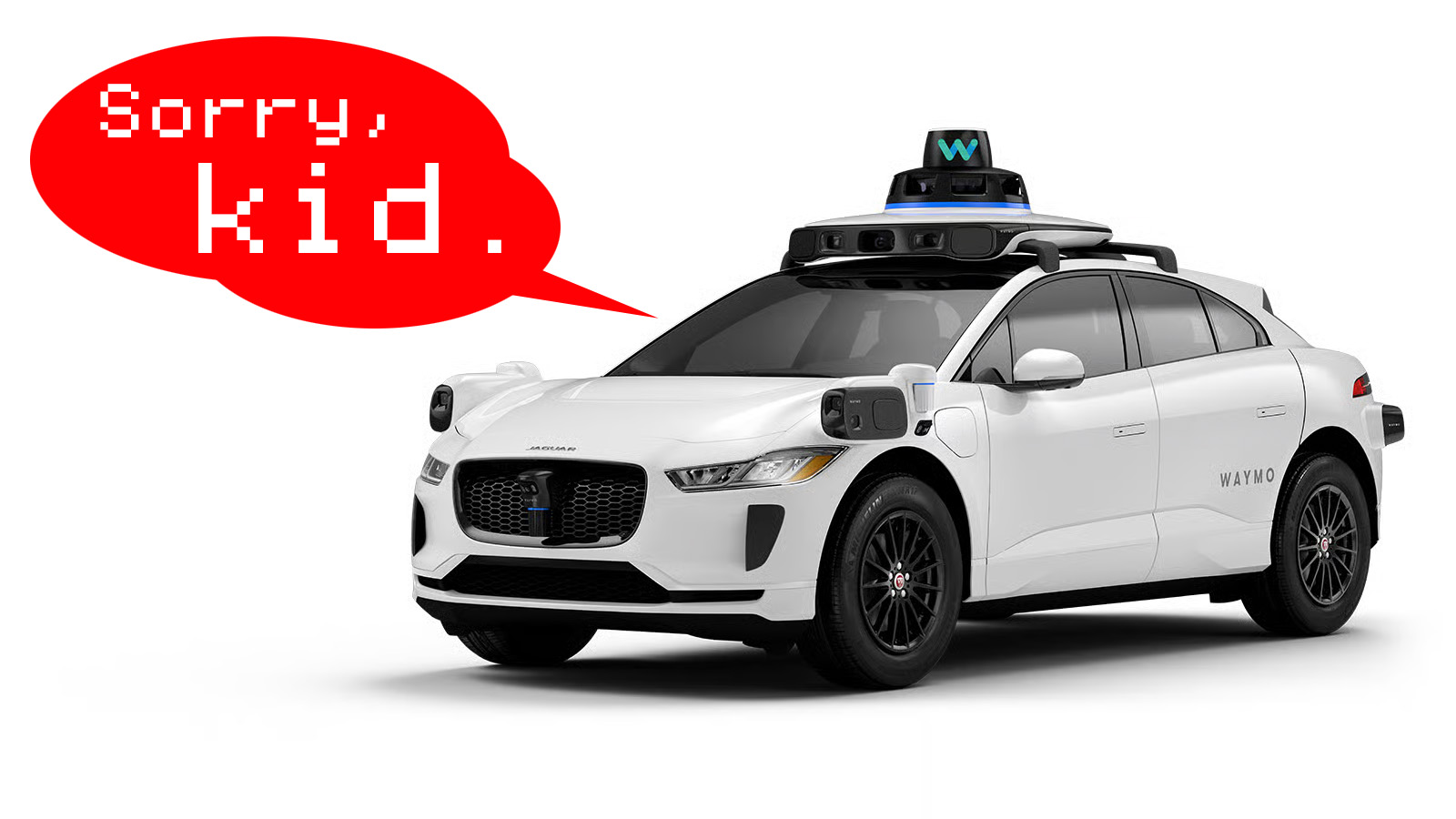
This past Friday, January 23, a Waymo robotaxi, driving near an elementary school in Santa Monica, California, struck a child who was attempting to cross the street during normal school pickup hours. There’s an NHTSA investigation currently pending, and happily the child’s injuries were only minor. Because this was an automated vehicle, this story is news, and it should be. It also brings up an interesting question: is it reasonable to expect an automated vehicle to avoid accidents that a human would likely have had? Is our standard that they should never get into any accidents? Is that reasonable?
I don’t have the answers to these questions exactly, but they’re questions worth asking. Based on the description of what happened, I think a human would likely have hit the child as well. Here’s how NHTSA describes what happened:


NHTSA is aware that the incident occurred within two blocks of a Santa Monica, CA elementary school during normal school drop off hours; that there were other children, a crossing guard, and several double-parked vehicles in the vicinity; and that the child ran across the street from behind a double parked SUV towards the school and was struck by the Waymo AV. Waymo reported that the child sustained minor injuries. Investigation: PE26001 Open Resume Page 1 of 2 At the time of the incident, the Waymo AV was operated by Waymo’s 5th Generation Automated Driving System (ADS). No safety operator was present in the vehicle.
… and here’s how Waymo describes it, from their blog post about the incident:
The event occurred when the pedestrian suddenly entered the roadway from behind a tall SUV, moving directly into our vehicle’s path. Our technology immediately detected the individual as soon as they began to emerge from behind the stopped vehicle. The Waymo Driver braked hard, reducing speed from approximately 17 mph to under 6 mph before contact was made.
So, it looks like a kid walked into the street, and was obscured by a big SUV. If the Waymo was actually going 17 mph, that’s well below the California school-area speed limit of 25 mph. This feels like the sort of situation that would end up badly for any driver, human or machine: a kid walked in front of a car. The Waymo did what it was supposed to do, stop as quickly as possible once the kid was spotted, just like a human would.
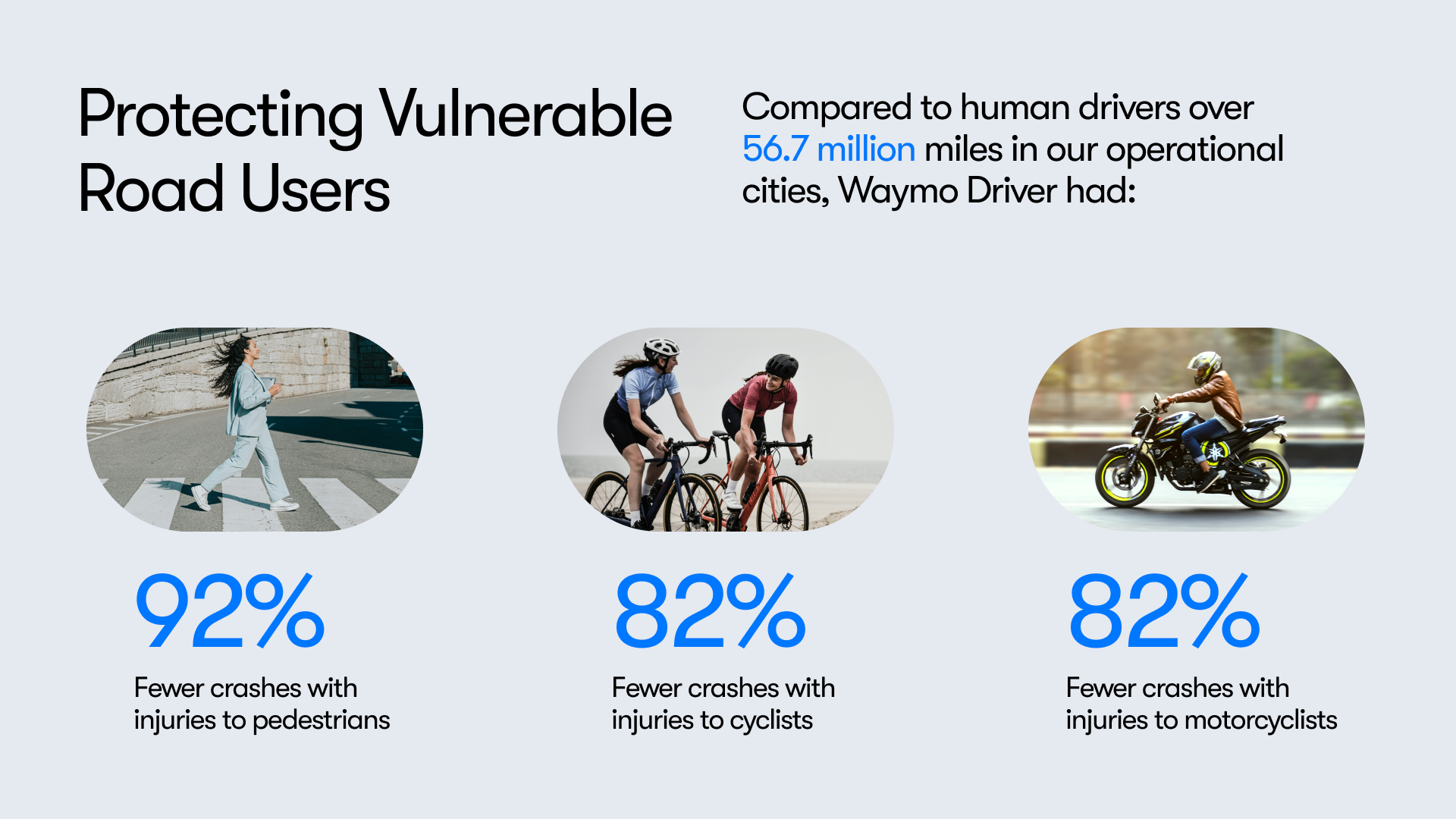
Did the Waymo do any better or worse than a human? I don’t have enough information to go on. But what I think I do know is that not every crash that happens is avoidable. The NHTSA is right to investigate this, but for all of our criticisms of automated driving and robotaxi issues, I don’t think this particular event is necessarily an indicator of some bigger systemic problem as much as it is a reminder of a bigger systemic question: what do we expect from AVs?
If we are to believe that they will make driving safer for everyone, we still don’t really have enough data to show that’s the case. There’s some evidence they’re safer in some situations, but worse in others, but overall, I think the jury is out. And in this particular case under investigation now, I think the Waymo handled itself as well as it could have, given the situation.
What could have made this better? Could there be even more awareness when the car is known to be in a School Zone at a time when kids will likely be on the street? If so, how could the car’s behavior adapt? Go even slower? Honk every 20 feet? What’s the balance between safety and acceptable behavior?
Assuming we don’t have tech to see through cars, perhaps a robust car-to-car network could help here. If there were a standardized, widespread communications system for cars to inform one another about their surroundings, a car that had passed by the child before they attempted to cross the street could have made the Waymo aware of the child’s presence even if the Waymo’s view of that kid was obscured. Such a network does not currently exist, but could with enough effort and resources, and will, but is that the level we should be aspiring to?
I mean, ideally it is, right? If we’re going through all of this effort to make self-driving cars, shouldn’t we be doing all we can to make sure they’re actually safer? Or is this all just about people who want to look at their phones and sleep while being driven places? The tricky part is that a lot of what it would take to really, genuinely make AVs safer than humans will require large-scale cooperation between companies and governments and everyone, because it’s an overall system that will bring real safety benefits more than technological tricks in individual cars.
I’m curious to see what the findings of this investigation are, and people’s reaction to it. If the child had been more injured, I suspect the narrative around all of this would be very different, and understandably so. There will always be wrecks that can’t be avoided; that’s just the nature of physics when you’re moving around thousands of pounds at pretty much any speed. It’s how we choose to accept this notion, and what we do with that acceptance that matters, and I think we’re just at the beginning of that process.
Top graphic image: Waymo


Maybe instead of automated cars, we can just have public light rail, effective mass transit, walkable cities, and bicycle thoroughfares?
Wait no, then our capitalist overlords would make less profits. What am I thinking?
If a few children have to die every year so Elon Musk and other ghouls can be richer, than I guess that it’s the price that society has to pay.
But if it was a commissar in a Lada the kid would have been okay because the car would have disintegrated on impact?
*The replier to this comment has been sent to gulag*
Do you remember, comrade, that the first people your friend Mr. Dzhugashvili killed were the engineers?
So wouldn’t the world be a wonderful place if we could kill all the engineers?
If Elon Musk can make himself a gazillion dollars by making the Internet universal and cheap, who gives a shit.
I think you are missing the point. Making walkable cities with plenty of public transit is better for most people, even drivers. If everyone isn’t practically forced to drive, it will not only reduce accidents, but it will make driving more enjoyable for those of us who actually want to do it.
If you are rooting for Musk to make the internet cheap and universal, you clearly believe in societal improvements. Good public transit is an improvement.
I commute by bicycle year round in Fargo ND. Public transit always requires either high density population or it requires long waits.
And it almost always requires massive subsidies, even compared to roads and cars which are heavily subsided. It is not practical in much of the USA.
We’re a rich country. We can at least make it work in a lot more places than we do now, even if that means investment. The thing about subsidizing things that benefit society is that society benefits from them.
My guess is that the most cost effective transportation system is small cars on roads. Actually it is bicycles on those roads, but I am prejudiced.
We in the US have ignored cost effective delivery of services, and as a result the service on the public debt is becoming a significant constraint.
The “free shit for everyone” attitude is running into a wall. D and R don’t seem to recognize it anymore.
Not talking about deficit spending. Talking about spending as a percentage of GDP. Too high and it does impact available investment capital.
It’s not a “free shit for everyone attitude” it’s a “stop bankrolling billionaires, massive evil corporations, unlimited forever wars, aircraft carriers that can’t launch aircraft, next-gen aircraft that can’t fly, and stupid pork barrel projects and redistributing those resources to benefit the public” attitude, but clearly your brain has been poisoned with austerity BS, so I might as well talk to my shoe.
As a car driver in a city that once again has decent public transit (MBTA) I want more $ to go to public transit so there are less cars on the road. I don’t get why so few people get this – investing in public transit is good for you even if you never use it.
I’m less of a Stalin guy and more of a Abdullah Ocalan guy, FYI.
Apropos of nothing, this reminds me f my Georgian friend who once told me that all the ‘Vilis were horse thieves back in the day.
I’m all for all the public transit options, but the stopping distance for light rail is pretty miserable
But light rail tends to have better controls in place to prevent folks from accidentally running out in front of the train, especially in places where the risk of such is high.
I know of one instance of a pedestrian being struck by the Max light rail system in Portland Oregon. Yes, they went past the safety barrier.
The problem is, if you make something idiot proof the world will make a better idiot.
I don’t think there’s much that will completely prevent people from making poor choices or getting hurt in freak accidents, but reducing the frequency of such occurrences is a win.
In my time as a firefighter/ medic the majority of what people called “accidents” were the result of alcohol intoxication. Just saying…
Tourists in Amsterdam almost get hit by the light rail trams in the city daily. But then tourists also get hit by bicycles in Amsterdam daily walking across the bikepaths. It always comes down to looking at your phone rather than your environment.
I cycle through a city which has banned cars from large chunks of its centre, I cycle next to a train line and along bus routes.
I cycled because it’s much quicker than catching the train or the bus, although much slower than just driving.
Kids still walk out in front of cars, busses and me on my bike, because kids just do that. Full grown adults walk down dedicated cycle lanes and shout at cyclists who avoid them.
Joggers are the worst, they’ve run into my stationary bicycle (six lights and wearing full orange hi-viz) on multiple occasions because people are morons.
We need autonomous walking.
You absolutely can lobby your local/state government for more tax resources to go to transit. But that has nothing to do with automated vehicles.
Musk and his acolytes are very cavalier about kids losing life and limb in the name of capitalism disguised as freedom (to do R&D on public roads for profit, or to own firearms, etc).
My single greatest fear whenever my children are in my car is that we’ll get pulverized by some gross techbro in a Cyberdumpster who’s watching VR porn on his Apple Vision Pro while his 9,000 deathtrap is on Autopilot. The fact that Muskrat is basically alpha-testing his BS tech on live streets with no serious regulation or pushback is genuinely terrifying.
This is a fraught proposition. I see at least two scenarios.
1) Kid was behind a single double parked car, then blindly walked out.
1a) If a previous car in motion had come from the same direction as the Waymo, it would have no more information than the Waymo did.
1b) if a previous car came from the opposite direction, might have been able to discriminate the kid behind the car from the back of the car — maybe. That’s a bit of discrimination to be doing.
2) If the kid was between two double-parked cars, either
2a) no chance here to be spotted by a moving vehicle in roadway.
2b) If all cars theoretically monitor at all times even if not being operated, and constantly communicate their info, then the kid could have been detected. This would also be the biggest privacy and surveillance state problem imaginable.
The person at fault here is the overprivileged idiot who double parked their luxury Canyonero to drop their useless mediocre offspring off at Silver Buttspoon Academy because “I am too important to find proper parking”
or the kid that ran into the street in front of a car. if the SUV was a miata, the kid would have still ran in front of a car. That’s the issue
Miata owners know how to drive, and how to park. Try again.
And how to capitalize the first letter in a sentence and proper names, and how to end a sentence with a punctuation mark.
I’m not saying the car was the problem. It was parked fine. The kid is the problem
Kids are *gonna be dumb* they are KIDS. Much like protesters have a right to say mean things about the government without being shot at, kids deserve the ability to make mistakes. A lot of traffic engineering is about designing failure into the system! We don’t do double parking even if you’d “technically fit” *for pretty much this reason*.
Yeah, Jimantha learned a (thankfully) non fatal lesson and will probably think a lot harder about how they move into the street now, but kids are gonna kid.
Our house backs up to a high school and we have a middle school a block away. I can attest to the fact that parents picking up their kids will operate their automobiles in just about the most annoying and irresponsible manners possible. If you live on our block, you can pretty much forget about either leaving the house or going home in your car for about a half hour each morning and a half hour each afternoon.
I grew up in Europe, so no school busses and no mom drop-off. You walk about 10-30mins to school, or on the off-chance you live further that that, you hop on a bus. Oh, and about half the kids start 1st grade at 6 years old, not 7.
But I guess letting even a teenager walk to school is ‘child abuse’ here, no wonder kids have no clue how to cross the street without getting run over.
Well, a large no parking zone — passenger loading zone would be one answer, close the street to non school traffic a couple hours a day would be another. Better public transportation would be the best.
But yes, get rid the parking near schools.
In general, I feel the tech companies have been mistaken in focusing on simply replacing human drivers with technology that merely mimics human drivers; they see in practically the same way, drive in practically the same way, think and react in practically the same way. Yes, of course, they’re operating in an environment which was designed specifially for human drivers so that was likely the logical starting place from a capital standpoint. But, imagine if they had looked at this from a completely different starting point. As pointed out in the article, why don’t autonomous vehicles work “in mesh”, either adding direct communication in a radius or via location-based network?
Real-time multi-vehicle communication over ad-hoc networks that change every few seconds or more is hard and slow.
The Waymo Driver braked hard, reducing speed from approximately 17 mph to…
I object to their using the word “driver” for their automated system. Capitalizing it to give just a slight whiff of possible nonstandard meaning is not enough. Any quote taken without full context could be misconstrued as representing a human driver present. It is 97% misleading/
That Waymo Driver phrase really caught me by surprise.
To me it smells of “let’s call it that until we’re legally forced not to.”
I’d agree this is primarily more a kid/parent/supervision problem, not a Waymo problem. But just out of curiosity I looked on Google street view at the elementary school I went to years ago in Santa Monica (I don’t know if it’s the same school as this incident since the article doesn’t specify the school). The speed limit is clearly signed (recent Google image) as 15mph “when children are present”. So it’s possible the Waymo was slightly exceeding the posted speed. Only a couple of mph, but given the shit show that is going on in front of any elementary school when people are dropping off their spawn to run in random directions, I think most human drivers would be watching carefully and driving substantially slower than that.
I cannot fathom that the CA limit is 25, which is simply a normal speed limit in any area with a lot of peds. Like, I’d be lying down in the streets if the limit around my kid’s school were 25. Maybe it’s 25 at all times, and 15 during drop-off/pickup times; that would make sense.
Anyway, I agree that that situation, with double-parked cars and such, is one where careful drivers would be going slow as hell, but also plenty of drivers would be going speed limit + 5, bc society is breaking down.
A new law has taken effect making it easier for local municipalities to lower the school zone speed limit to 20 or 15 MPH. In a few years, a lower speed limit will be universal statewide.
Have you met humans?
I probably should have said I’d like to think but I’m a bit of an optimist despite all the evidence to the contrary. It’s a little bit conditional. In the smaller city where I live now, some school zones seem to work just fine (mostly in quiet residential areas), others are insane even with flashing lights, orange cones and everything else.
And you’d be wrong. I see soccer moms texting going 30+ mph to drop their kids off at elementary school my kids go to. They’re constantly blowing through stop signs, cutting in line, not paying attention, and not moving forward with the line, then racing to catch up. On the flipside, I see kids riding electric scooters straight across roads (not at crosswalks) without looking. It’s truly astonishing to me that nobody has been hit.
School zones are 20 mph around here, and I’m extremely careful to watch out for other people around there, so I’m usually going slightly slower than that, but I’m definitely in the minority. It’s part of the reason my kids will never walk to school.
The middle school down the street from us puts cones out on the street in front to keep drivers in their lanes and has a teacher or administrator at each of the two crosswalks in front plus another one directing traffic from the side street that dead ends in front of the school. As far as speed goes, there’s no way anyone’s going faster than 10 mph during pickup/dropoff as it’s way too congested and slow to do otherwise. I have no idea what went on in Santa Monica, but having plenty of school authorities out to keep people from double parking and such can sure help. If they weren’t doing that down there, then I sure as hell hope they start now.
When I was an eight grader at K-8 school I was a crossing guard, wearing a reflective Sam Browne belt, and controlling a gate that swung all the way across the road. No children were harmed with this arrangement. Is it still used anywhere today? Did anyone else in this crowd share similar experience?
When I was in first grade, my mom would drop us off at (what was then called) a nursery school across a busy street from out elementary school. When it was time for school to start, we’d get led to the intersection where an eighth grader with a reflective sash and a stop sign would help ensure that no one ran the red while we were in the crosswalk.
is it reasonable to expect an automated vehicle to avoid accidents that a human would likely have had? Is our standard that they should never get into any accidents? Is that reasonable?
Ask yourself how it would have worked out for the kid had the vehicle been a massive truck or SUV driven by someone in the middle of sending a text.
If so, how could the car’s behavior adapt? Go even slower? Honk every 20 feet?
Take a page from 19th century locomotives and install kid (cow) catchers.
Another option: Unless the school is the destination simply avoid school zones during school time.
Very hard to do in California. A lot of schools are placed on busy thoroughfares because it’s one of the legitimate ways to lower speed limits on streets. An interesting side effect of the state’s law that prevents city’s from becoming “speed traps” to generate revenue.
I doubt it’s THAT hard. Looking at my local distribution (I’m in the SFBA) A quick perusal of my area shows the schools on busy thoroughfares tend to be high schools. Elementary schools are squarely in suburbia or at least have a few quiet streets facing the school where pick up and drop offs can be required. And I think elementarily school kids are the most at risk.
Unless the Waymo is picking up or dropping off close to the school during school hours they should be able to route themselves a block or two away.
In terms of Santa Monica/Hollywood/that whole chunk of LA, weren’t most of the schools sited in the 1920s and ’30s?
Probably, but there are elementary schools on some major thoroughfares in Los Angeles. Rerouting around them at school hours (And how do you keep that updated in the system? Even Google Maps can’t tell you for sure when school hours are) means having to bypass major streets like Olympic and Santa Monica in places, sending you into neighborhoods and adding to traffic on other streets.
Historically, they build a school on a quiet road, then it becomes a busy thoroughfare.
I read another article about this incident and it mentioned that Waymo told the investigators that modeling showed a human would have only slowed down to 12mph (if I’m remembering it correctly). Considering the source you have to take it with a grain of salt, but I wouldn’t be surprised if the machine braked quicker than a meatbag.
Yup. They could, and should, tell us the elapsed time between when the child became visible and the brakes were applied. I’m going to guess it was far faster than any of us would have reacted.
Perhaps a human would have chosen to go slower but just as likely they’d have been going faster.
Humans are not particularly good at emergency braking – applying exactly the right amount of pressure needed for maximum deceleration is hard, and so there is a tendency to brake too hard (causing the wheels to lose traction and skid, which extends stopping distance) or not brake hard enough (which also extends the stopping distance).
I also subscribe to the opinion that self driving cars should be more safe than humans. Not just as safe as humans.
In the case of the kid leaping out on the street- although the self driving car couldn’t avoid hitting the kid, in an ideal world it would swerve to one side to avoid a head-on hit and instead hit the kid on the side of the front fender.
I don’t think there’s enough information on what happened to make that determination if such a swerve was feasible. As a human driver, I also don’t want autonomous vehicles around me making instantaneous sudden maneuvers into oncoming traffic that might cause an even worse accident.
The better question to ask might be, “if it could swerve to possibly avoid the child, but would 100% hit the parked vehicle, should it?”
On the surface, it sounds like it there was going to be an impact no matter what. I’m glad Waymo was able to lessen that, and I’m sure they’ll learn more from this and continue to improve.
The better question to ask might be, “if it could swerve to possibly avoid the child, but would 100% hit the parked vehicle, should it?
Is that “parked” car illegally double parked?
If so yes.
Meanwhile in the real world, that would require engineers to decide on the kinds of injuries to favor/avoid (is a run over foot better than potential TBI? Doesn’t matter— parents gonna sue either way!).
Also — does the car “decide” to hit the kid at 6mph or brake fully at the expense of causing the following car to rear end it? At the very least you’d want an independent Ethics Committee at each OEM to be making these calls.
I do agree with you, I just don’t know how we could actually get to that point.
The car behind you’s problems are not your problems. You should always drive assuming that anything can happen and the car behind you should do the same.
As someone who drives a motorcycle, that is terrible advice. Even in a car, the force of the person smashing you can make you smash whatever is in front
To answer one of your questions, there are definitely some people who just want to sleep while the car drives. I’ve witnessed two “drivers” asleep at the wheel on two separate occasions in Teslas on I5 heading south toward Sacramento. Both solo in the car, both at night, both at around 75-80mph. The first time I just couldn’t believe it. The second time I also just couldn’t believe it. But I would happily ride in a Waymo around town and I’ve told my daughter if she’s out late in the big city, think about getting a Waymo.
I’ve witnessed two “drivers” asleep at the wheel on two separate occasions in Teslas on I5 heading south toward Sacramento.
Tesla *supervisors* at their finest.
Your post brings up an interesting question: who was in the Waymo that was driving in the school zone? Did Mom send Junior to school in a Waymo so she could spend more time at Starbucks or the nail salon?
This is a win, and doesn’t even come close to the dystopian fears I have for FSD vehicles. Well done!
(the rear fear is when a utilitarian decision has to be made between harming a passenger vs harming another vehicle or pedestrian…that’s where the gray area will be. I’d love to learn more about the decision engines for some of these. I know the car isn’t making them up, they’re buried in the code somewhere)
My work takes me to lots of different Southern California schools as a district contractor for school district Facilities and M&O departments. The most dangerous thing I see on any given day is the way parents drive when dropping off and picking up their kids. I’ve almost been hit on foot more than once. In addition to breaking whatever rules the schools have about pick-up and drop-off, parents are breaking all kinds of traffic laws constantly.
Cities enforcing traffic laws around schools instead of treating being in front of a school as an excuse to drive recklessly and park illegally. Parents will complain, but who gives a shit? It’s okay to do nothing in response to the complaints of people who are wrong. Hell, it’s necessary for things to function.
The only thing I’d add that isn’t on the books is a no idling law in school zones to discourage parents from camping out at a school long before the bell rings and turning the place into traffic and exhaust hell for much longer than it needs to be.
“I’m not parking, I’ll just be stopped here less than a minute.” – mom/dad dropping off their kid blocking the neighbourhood residents from being able to exit their own driveway
This is 100% a reaction to the needlessly draconian rule where a kid who is late gets locked out of the classroom.
Every action has a reaction. That is something a school needs to understand.
OR I dunno, that “reaction” could be to drop the kid off a bit early or a block away.
If the kid is late because the kid was dragging their feet then the kid needs to suffer the consequences of spending an hour wearing an imagined dunce cap in the principles office.
I don’t know all the considerations behind that rule, but I’ll tell you as someone who has taught: without it the first 10 min are wasted bc you can’t do anything when half the class is still wandering in. Which teaches everyone it’s ok to miss the first 10 min. Which makes the problem worse…
I’ve worked at about two dozen local school districts over the last decade and a half and none have had this policy.
I’ve heard of the policy you’re talking about. I’m sure it can contribute to these problems at drop-off where it is in place, but it’s not a factor here and doesn’t excuse the exact same behavior at pick-up time.
Or you could, you know, teach your kids to stop and look both ways before advancing out into a street.
Had a woman busy on her phone fast walk out in front of me against the light as I was turning the corner. She wasn’t there when I began the turn. Managed to stop before hitting her.
My point is the world is a random place. Adults, kids, animals do the unexpected.
If you don’t do it Waymo will!
and several double-parked vehicles in the vicinity
It can teach those people a lesson too. Maybe with a key on a stick.
I am reasonably confident the hit child had been taught this many times. Kids gonna be kids. It’s not their fault we dropped them into a world where walking to school is a life or death situation.
Who/what is the “Waymo driver?” An interestingly phrased description.
I noticed that they capitalized Driver. I am assuming that is their name for the either the software or the vehicle itself.
I guess there are unanswered questions as dragged out in the story…
Having a hard time here seeing this as anything other than a huge success.
Situation where if replicated with human driver I bet you the kid gets hit at full speed most times.
Robot sees kid with is omni-vision and instantly brakes avoiding serious injury?
Win
I would not be surprised if this isn’t already in the works if not already implemented at least for Waymo vehicles. Waymo could probably also access all the geo-location data that phones and watches are collecting. If the kid was wearing a smart watch, would Waymo have been aware of it’s location and velocity, and responded even more appropriately?
Breaker breaker, we got a herd of kiddos up ahead, let up the hammer and mind your mirrors.
The car-to-car comms would change the game. For all the talk about increased safety and less traffic, I don’t think it will be materially better until we have the Car Hive Mind.
Sure, predictable flowing traffic patterns would be nice, but these worker bee cars could go so much further: when some filthy human is driving recklessly, the AVs can surround it and vibrate the offending car until it explodes!
Yes. Although in this case the kid is on foot, so that would not have helped.
All Waymo vehicles should be pulled from American streets until the not quite fully baked tech is “baked…” A few multi-million dollar lawsuits will result in their demise.
.
I’m not in favour of this outcome.
What’ll remain is Tesla claiming they’re the only ones who can do it with a handfull of cameras that can’t see near as well as Waymo.
By that “reasoning” all cars driven by humans should be pulled from American streets as well.
What is fully baked? 1 in a million error rate? One in a trillion? It’ll never be 0 so I think you are going to be baking forever…
If it was your kid who may have been killed you’d think differently.
I mean, there’s a non zero chance my kid will be killed by a human driver every time we are on the road. Fully baked/fully safe does not exist.
I think that a human in that situation may well be more alert to the possibility of a child hopping out from behind an obstruction. If it was going 17, that is a good start, but there are a lot of relevant details that could affect things.
Was it going 17 because it was quickly accelerating after a previous stop? If so, perhaps the context of having just stopped in a school zone is important.
Was it going 17 because it was slowing for an upcoming stop? This might suggest the vehicle is not actually more cautious in school zones and perhaps means school zone behavior should be tweaked, depending on other factors.
Was it going 17 because the vehicle in front of it had braked? A human might have been extra alert and slowing down more before the child appeared, because the vehicle ahead braking probably means they’ve seen something.
I also note that there are multiple mentions of vehicles being double-parked. I believe a human would take that circumstance to indicate there may be unexpected children and unexpected driving behaviors, given the school zone and people wanting to quickly pick up their children and rectify the parking situation. Did the Waymo do anything to account for that?
All this is to say there is a lot to investigate. There is every possibility a human would have reacted differently in any number of ways, better and worse. People understand context better than a computer, but they also get hurried, frustrated, and distracted.
This November, a child was run over crossing a street in my neighborhood. The pickup involved had stopped at the stop sign, but did not see the child as she passed in front of the pickup and he started his right turn. I fully believe a Waymo would have avoided that accident, as its sensors would have “seen” the child even if a human driver missed her.
“I think that a human in that situation may well be more alert to the possibility of a child hopping out from behind an obstruction.”
Unless the human is texting.
Or plugging in nav location data.
Or changing in-car settings.
Or talking to their kid in the back seat.
Or simply looking the wrong direction.
Or even just because the kid is too short to be seen from behind the wheel of a super-sized truck/SUV – similar to the scenario you outlined.
Because kids have generally been taught not to dart out into the road from behind parked cars.
But apparently not this one.
Yeah.
Or driving a modern truck/SUV with hood visibility issues.
Etc.
I’m going to go ahead and say that the kid surviving with minor injuries in what would have likely been a death/severe injuries situation with a human driver is a huge win.
Let’s not immediately jump to blaming the kid, either. Kids are known to be erratic. Adults know this. Are adults always as careful as they should be? No. But I do think an adult seeing double parked vehicles in an active school pickup zone knows that a kid might be in that mix and do something unpredictable. Does the human do anything differently than the Waymo? Maybe, maybe not. I just think there are a lot of factors that the investigation will be considering.
I was thinking similarly: this is a context issue. To the Waymo robot, this happened at random out of the blue sky, and it reacted far quicker than a human would have. If it were me, I’d clock the situation and drive very slowly while watching around and under the massive SUVs for running kids. The robot is good in a generic context, but can’t recognize that context, or watch reflections and shadows to infer pedestrians, or predict the movements of excited children.
All in all well done, and I hope Waymo figures out how to mitigate weird situations like this.
All I know is KITT never hit any damn kids.
I don’t think the main issue is *ability* – it’s *liability*. Obviously, in this case, it’s a robotaxi, so Wamo owns it and is 110% liable for anything it does. But that is not at all clear-cut if YOU own a self-driving car and it damages somebody or something at this point while doing it’s own thing. Where does YOUR liability end and the manufacturer’s begin? Joint and several liability is a bitch sometimes too. YOU and the manufactuer get sued to oblivion, even though you were just sitting there – or not even in the car if Musk’s theory of them paying for themselves as robotaxi’s works out.
I think there will be cases where self-driving cars avoid crashes, and probably cases where they get into an accident a human driver would not have.
If they can’t rein in the accidents, I see WAYMO lawsuits in their future.
Do they get in accidents more often than a similarly-sized meatbag-driven taxi fleet in the same city? That’s the question.
I kind of doubt it given they really only run under pretty damned ideal conditions. I had an Uber driver hit somebody as they were turning into the driveway of the building where I was being picked up. <facepalm>
IME: Uber drivers range from excellent to “why have the police not impounded your car and taken your license away?”
On the other hand: Dad dropping off his kids in his Ram1500 when he’s rushed and trying to get to work, is likely at the low-end of the safety scale and outcomes of hitting a child at ‘claimed’ 17mph are probably much worse than the Waymo.
In my experience drivers and their vehicles fit a standard bell curve. The better drivers and cars cluster around the middle, BAE, dropped Hondas and jacked rusted out pickups with drivers in bell curve shaped levels of experience and inebriation.
Autonomous vehicles are going to have problems in the wild until all such vehicles are autonomous and are plugged into a mesh net that includes humans.
Agreed on both counts, LOL.
…that was a pun, wasn’t it?
100%
We are in need of waymo puns
I believe they are already a dead walking, er… rolling. Another injury or God-forbid a death and they will be done.
Dat kid was in MUHWAY.
Uber good punnage there. Really lyfted my spirits. Kind of feeling like going to the zoo(x) now.
It’s entirely possible that the accident was unavoidable. That’s what investigations are for.
However, should the Waymo be found at fault, who gets held accountable?
That’s the FAR more important part. Capitalism is gonna capitalize, and if there’s no or not enough accountability, they’ll let accident rates be acceptable at any number that governing agencies give them.
IMO, this is all part of a problem that gets solved by better public transit. Even buses could be automated with less risk as they run set continuous routes and have less decisions to make.
The accident was completely avoidable.
Kids should know to look both ways before crossing the road.
It’s clearly the parents fault for not teaching their kid basic survival skills.
Yeah back in the day we would have been yelling at the kid for not looking both ways. Now we’re yelling at the robot.
Similar to how when I was failing in school, my parents had a stern talk with me.
Now it’s parents telling teachers it’s their fault their little AI-addicted snowflake is failing school.
I suspect the kid also got yelled at. I also think if the exact same circumstances occurred with a human driver and this kid, both would be getting yelled at, and I think that is happening here.
I double-doubt the kid was yelled at.
A panicked parent that thinks their kid might have died? There very well could be some yelling, both to ensure the kid retains the lesson and because stress manifests in many ways.
There’s a good chance the kid was coming out of one of the double parked cars and told “Hurry! Mommy/daddy is double parked.”
Parents can get really irresponsible in front of schools, and no one expects the world to look after their child like a bad parent.
I’m not saying it’s what happened here. We don’t know, but it’s definitely within the realm of reasonable possibility.
Most people don’t have that survival skill.
In training for transit bus operators, we teach them to “platoon” at bus stops. Pull up and basically touch the bus in front of you.
If you don’t, passengers will use the shortest route and go between the buses.
It actually happened to me back when I started there (all techs are required to have their CZ license where I work), while the driving instructor was explaining it.
That was 10 years ago, people have only gotten dumber.
I’m always learning. This explains a behavior I’ve seen but never thought about. Thanks and another reason I’m an Autopian.
We aim to (dis)please!
That’s unfair. I tell my 4 yr old to look both ways and to never cross a street or parking lot without holding my hand. She listens 95% of the time. But she still has some kid in her and when we park by the ice cream store she’s gonna make a run for it. I know this so I can stop her. My point is, even when she’s a bit older, I don’t think there’s anything I can do that will get her to do the right thing 100% of the time. Kids are kids.
I don’t know a lot about these vehicles, but I’m guessing they mostly follow posted speed limits?
Around me, getting people to slow down through school zones is an ongoing fight. I drive through one in a residential neighborhood every day on my commute and usually have someone on my bumper because I slowed down to 20MPH. Occasionally, I’ve been passed illegally.
I think they usually go pretty much exactly the speed limit. The fact this one was supposedly going 17 has me wondering why. If it is because they are more cautious in school zones, that is good. If it is because something else was happening that might have given a human a contextual reason to expect a kid to step into the roadway, I do wonder if a human would have been watching for this kid. A lot of questions for the investigators to consider. Glad the kid is okay and I’m glad they are investigating. Lessons learned are useful in preventing worse incidents.
From what I’ve noticed, crawling traffic tends to be when the phones come out…