

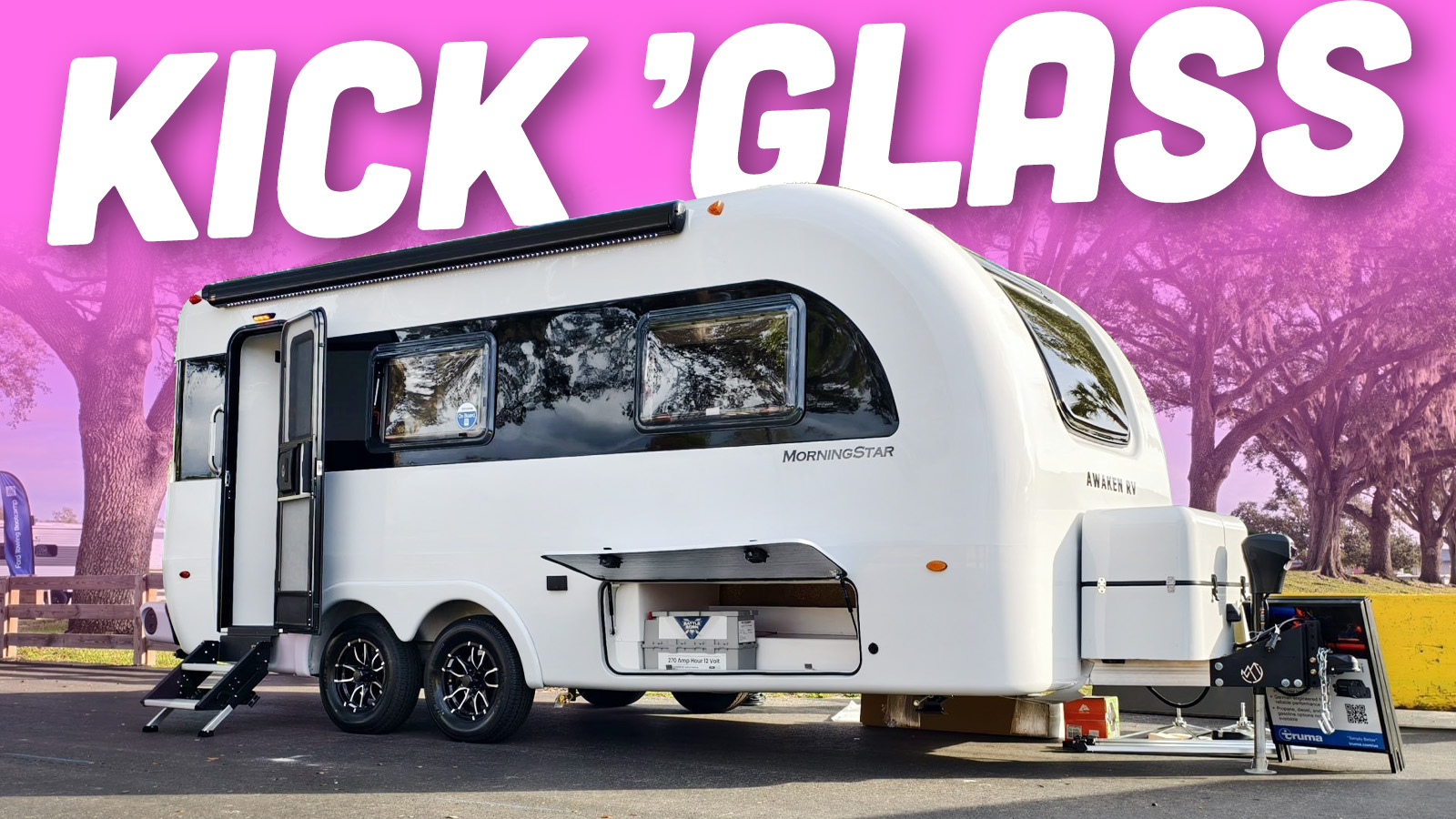
The RV industry is an impressive machine. While auto manufacturers pump out something new every few years or so, some major players in the RV industry still crank out campers that aren’t much different at their core than they were decades ago. One new company wants to change that. This is the all-new Awaken MorningStar, and it’s a fiberglass RV by an executive who wants to do something different. I toured this trailer, and it might live up to the promise.
I’ve noticed many great, positive trends during this year’s Florida RV SuperShow in Tampa. Many major RV manufacturers are putting a focus on affordability. That’s awesome in itself, as you shouldn’t have to be rich to enjoy RV-based camping. However, I have also noticed that many of the new affordable units on the market are built better than the RVs of the past. One of my favorite trends is that several manufacturers are slowly moving away from wood framing and rubberized roofs for more durable materials. Water leaks and catastrophic damage have been some of the greatest enemies of the RV for most of RV history, and the changes happening now are great.


Then there are the startup companies. Many of these companies, including Lightship, Pebble, Evotrex, and AC Future, want to do more than just build a camper that’s not made out of sticks and tropical plywood. These firms want to lace RVs with technology borrowed from EVs and computing, including huge batteries, traction motors, and AI.

However, to Awaken RV founder Scott Hubble, most of the RV industry is still trapped doing things the old way, building boring boxes out of inadequate materials, and it’s time for something different. Awaken wants to sell Americans a camper that’s designed to last, is roomy, and has that European flair many buyers are begging for right now. Specifically, Awaken wants to build an evolution of the classic fiberglass camper.
Awaken’s Origins
Scott Hubble has long taken command of a weirder side of the RV industry. He was a co-founder and then CEO of nuCamp, the American brand with a knack for repurposing European RV designs for the American market. Under Scott’s control, nuCamp grew to become what the company claims is the world’s largest teardrop camper manufacturer. After about 15 years with the company, Scott left nuCamp in 2024 and founded Awaken RV in September of that year.

According to Awaken RV, the impetus for its creation was Scott’s realization that much of the RV industry was spinning its wheels, building the same trailers it had made for decades. Indeed, if you go to an RV show, it’s still not hard to find a rubberized roof or wood framing. The downsides of these construction methods have been known for decades. Nobody likes water leaks, and repairing damage can cost more than you paid for your RV.
Awaken admits that yes, there has been a lot of innovation in RVs lately, but too many units are still just the same thing as they’ve always been, only with new decals and interior decor.
Scott believes the future of RVs is in its past – specifically, fiberglass. There have been viable fiberglass campers since at least the early 1950s, and fiberglass really came into its own by the 1970s. The fiberglass campers of the 1970s and the 1980s were lightweight, durable, affordable, and cheerful. Many of these campers were built so well that it’s not even hard to find one still being used today, decades after they were built. The most famous fiberglass brand in America is Scamp, and its trailers don’t look a whole lot different today than they looked back in the 1980s.

Scott has taken note of all of this. Molded fiberglass has proven itself to be one of the best materials to make an RV out of if longevity is a primary concern. Sure, you have to forget about slides and fiberglass campers tend to be smaller units, but those are worthy trade-offs for many buyers.
The folks of Awaken took a peek at the fiberglass market and found a bit of an oddity. The vast majority of the market is either on the affordable end, like Scamp and Casita, or on the high end, like Oliver and Bigfoot. Awaken thinks there’s a spot right in between these ends for a mid-priced trailer. The company has also taken note that most fiberglass RV producers do direct sales, and wants to make something for whatever buyers out there might still prefer a dealership model. Oh, but there’s a catch to this.
Then there’s the trailer itself. Most fiberglass campers on the market are of the famous classic “egg” design, featuring two very round molded halves joined at the center. Awaken loves molded fiberglass, but wants to do something different than another egg. The result is the MorningStar, and I got to tour the prototype at the RV show.
The MorningStar

The existence of Awaken RV has been known for a while. I did not write about it because Awaken RV had nothing but unconvincing renders of what its trailer would look like and no concrete details. Awaken RV then wanted to debut the MorningStar at the big show in Indiana back in September, but the prototype wasn’t quite ready yet. So, that morning when I saw the MorningStar in Florida, it was the first time it was being shown to the public.
The MorningStar starts off with an aluminum chassis. Aluminum frames are known for their light weight, strength, and longevity. They also don’t start rusting only a month outside of the factory like some trailers with steel frames do. Oliver, inTech, and ATC are among the other brands known for aluminum frames. That said, aluminum frames can also be tricky. Some inTech owners have complained about frame cracks that were repaired with welding and then reinforced to prevent future issues.

Continuing with the underbody, the frame features a pair of Dexter torsion axles, sealed bearings, and a GenY coupler. The underbody also has fiberglass panels for aero and protection. I’m told that the panels of the prototype, shown here, are rough, and the production version will be smooth underneath.
Sitting atop this chassis is a molded fiberglass body. Awaken makes the MorningStar like other modern fiberglass campers, and the build consists of double-hulled fiberglass that is joined at a central point. The difference here is that there isn’t a visible beltline (where the multiple layers of fiberglass are met and bonded together) as you’d find on most other fiberglass designs. Awaken says its double-hull design and insulation allow the MorningStar to be used comfortably in every season.

The fiberglass of the MorningStar is substantial. It feels rock-solid, and the exterior gel coat finish is smooth and shiny. I couldn’t even cause the fiberglass to flex more than maybe a few millimeters by leaning on it. If you squint, you can see a faint line where the upper and lower halves of the fiberglass were joined together.
The MorningStar’s look comes from the fact that Scott loves what people can buy in Europe, from RVBusiness:
“I’m a big fan of having a lot of windows to let in natural light, so you’ll see that with these units. And I’m a big fan of the European caravan market, so I think you’ll see some of those styling trends, because I wanted something that’s visually pleasing,” he said. “It’s also important that this unit be functional, so it was important that it was a four-season camper and that it had those creature comforts, like a good-sized dry bath.”

The MorningStar has sizable acrylic windows that let in tons of natural light. I hate how many trailers feel like dungeons inside. This? It feels light and airy. So that’s a big win in my book.
The exterior does appear to be pretty well thought-out, with one large storage compartment up front, one more hatch in the rear, and a bumper with storage for your sewage hose. It’s a pretty minimalist design, with the fiberglass broken only by the addition of the awning and a few exterior ports to hook up to shore connections or to provide outside power.

The only part I’m not a fan of on the outside is the 15-inch wheels. Those wheels look like they belong on a trailer carrying a gaudy boat, not a fancy and restrained camper. But I suppose those shouldn’t be too hard to replace yourself.
It’s So Nice Inside

The interior is where the MorningStar shines. These trailers will be built in Ohio Amish country and feature real handcrafted wood. The cabinetry, doors, and counters are all made out of real hardwood. You’ll find no particleboard or plywood here. The floor covering is woven vinyl, while the countertops and tabletops are Sorrento parchment.
All of the interior materials have a good feel and quality to them. I love the feeling, quality, and weight of real hardwood. The floor plan is pretty simple with the bedroom up front, a U-shaped dinette, the kitchen in the middle, and the bathroom taking up the rear. The list of features is pretty good, too. You get a three-burner stove, a convection microwave, ducted Truma heat and air-conditioning, a Truma water heater, a 12-volt refrigerator, and a dry bath with a porcelain toilet and a relatively roomy 24-cubic-foot shower.

All of this, Awaken says, is supposed to make for a nice little home away from home for a couple. The bedroom up front features a convertible bed that switches between 33″ by 79″ twins or an 80″ by 60″ queen. Technically, the camper sleeps up to four people. I think there should be some sort of privacy divider between the bedroom and the rest of the trailer, even a removable one would work.
Stores seem pretty reasonable for two people. The trailer has 270Ah of Battle Born lithium batteries and more than 500 watts of solar, plus a 39-gallon fresh tank, 32-gallon gray tank, and 18-gallon black tank.

The MorningStar measures 24 feet in length (of which 19 feet is the living space), weighs 5,320 pounds empty (7,000 pounds loaded), and has a decent 6’6″ interior height. Awaken says that the MorningStar will be assembled in Apple Creek, Ohio, using fiberglass parts sourced from AC&T and Goldshield, both located in Decatur, Indiana. Awaken expects its 17,000-square-foot facility to produce around 200 units a year at first, before later ramping up to 1,200 units per year.
You Keep Using That Word…
I walked out of the MorningStar pretty pleased. It’s not perfect, but it does so much right, from the build quality to the interior. So then, what’s the catch? It’s the price.

The MorningStar starts at $88,900. Now, you might be scratching your head a little bit because Awaken talked some big game about making a trailer for the middle of the market. A mid-priced fiberglass trailer should cost around $55,000 or so. Awaken is solidly in the high-end fiberglass luxury field, which it said its trailer will not be a part of. Mind you, $88,900 is only the starting price, so it gets even more expensive from there.
There’s also a MorningStar-i on the way, which is the same length but weighs 5,690 pounds, has an independent suspension, and has off-road tires for the starting price of $93,500. Awaken also wants to make bigger models somewhere down the line.

Awaken says the MorningStar is mid-priced, but its starting price is about $9,000 more than an Oliver Legacy Elite II, which starts at $79,995, is about the same length, and is basically a yacht inside. Incredibly, Awaken also lists out competition that has luxury trailers like the $103,900 Airstream Flying Cloud 23FB. So, Awaken and some of the RV industry press keep saying “mid-priced” or “middle of the market,” but the pricing shows a different reality.
At any rate, Awaken says that the ideal buyer for the MorningStar is a Gen-X couple who have retired or are near retirement and have an empty nest. Presumably, that couple also has Airstream Flying Cloud money, but will want to spend it on fiberglass, instead.
There’s so much to love about the MorningStar, from its fresh design, high-quality interior, and just doing something new with fiberglass. I thought the MorningStar was one of the biggest debuts of this year’s Florida show. But it’s very disappointing that the price is nowhere near where the marketing says it should be. Regardless, if you do have the kind of cash this commands and you don’t want to spend it on an Airstream, I can see picking one of these up. If Awaken is right, maybe we’ll still see these rolling around decades from now.
Top graphic image: Mercedes Streeter





The people that make box truck bodies seem to have figured out how to take some fiberglass or aluminum panels, some cast aluminum corner pieces and extrusions, and make strong, durable, leak free boxes that move for a reasonable price. Why aren’t there RV’s built like delivery trucks?
“countertops and tabletops are Sorrento parchment”
Someone in Sorrento is scraping down animal hides to make countertops and tabletops? That seems both unsanitary and expensive.
I love to RV… really!… but the math for me and Ms. Six (we’re an empty nest couple who are closing in on retirement age) is really bad on a lot of rigs – especially this one.
Avg. Hampton Inn night: $175
Cost of RV above: $90,000
90,000/175 = 514 nights at a Hampton Inn
514 nights = 1.4 years!
I also don’t have to drain my own sewage at *most* Hampton Inns. Plus, there’s storage and containment of the RV beast. And insurance. Etc. Oy. We’ll just keep renting from a nearby dealer when we want to RV.
I might actually buy something like this at $40,000. At $90,000? No way. I wonder how many more they’d move if they priced it more accessibly. Price is certainly the hardest of the 4Ps.
Looks like a very nice trailer and it’s always good to see more build quality and molded fiberglass, but a price point higher than Lance, Escape, Bigfoot, and even Oliver makes it pretty hard to swallow even if it does have a few more bells and whistles than Bigfoot.
I’d be curious about the “4-season” part. In the travel trailer world, that means anything from “anything above 30F” to “maybe a bit below -20F”, and that last one’s basically just Bigfoot.
Want a 4 season rv trailer at more affordable price? Check out fish houses. They have to be well insulated bc of their winter use. Weight also reasonable for same reason bc made to be on the ice. Full bath, kitchen usually sleep 4-6 people too.
https://outdoorica.com/blog/a-deep-dive-into-the-best-ice-fish-house-outdoorica/
Interior/exterior fiberglass w expanding foam in between is a very strong method often used in the marine industry. They did a good job blending the upper and lower halves together, you can see the faint line only due to the change in the draft angles required between the two parts. I think the issue w this construction is it is labor intensive and hard to scale, and also requires a lot of hand work to blend the seam.
I find no negative catch taking a construction and manufacturing route that dispenses with a material that can rot and get mold, by the inevitable leaks. Seriously, what took them so long to correct this? In a related situation, I very much wonder why the American home construction industry is still set on stick construction (obviously the reason is the lumber lobby and $$$). Homes made of, for example, concrete, would offer a few centuries of longevity with no almost no maintenance, termite issues, mold, wood rot, and greatly reduced fire risk, not to mention better energy efficiency.
It’s mostly the money issue. I’m certain people would happily pay a bit more for the durability of concrete block construction, but you add 100k and they are out. That said, part of that is a gap in available labor to do the block construction, and that could close. Coastal construction in Florida has moved to block construction because of hurricanes, and if that creeps up the east coast it could drive prices down.
Lumber construction can be very robust, but but when it’s a race to the bottom on cost and speed….not so much.
I was always enamored of tilt-up concrete construction. It seems like that could be used for residential construction. You can do really interesting things with the forms you pour the walls on. Unfortunately, the building codes make it difficult.
i live in a 70 year old concrete house designed by an architect. There is still a fair amount of wood holding the roof up. It is a beautiful house, but the land it is built on is in California’s central valley is shifting, and concrete really doesn’t like that. Big cracks.
Of course, a balloon construction stick house that was 70 years old would have undergone its second renovation or would have been torn down by now.
I am moving into a pre-war (civil war I think) house in NY that has had plumbing and electricity added sometime, probably twice, in the last hundred years, but the original post and beam structure is fine.
Our ~126 year old home in NY is a fun time capsule (well fun until something breaks). Coal furnace was replaced by oil fed boilers at some point, then natural gas – since the boilers were added later the plumbing to the second floor is visible on the first floor.
Originally gas lighting (some of the piping still hidden in the ceilings) replaced by knob and tube. Knob and tube is mostly (I hope) dead, but much of it replaced by cloth-wrapped wire in conduit – some of that is still active.
Full of surprises.
There’s a bit of abandoned knob and tube, i have not seen any gaspipes I think there was one renovation when knob and tube was put in, and then Romex and modern plumbing in the 70s
In park slope they still have gaslighting in the front yards because the gas company was giving perpetual free gas. Every so often some workman saws into an active gas pipe unexpectedly with great excitement Still some live knob and tube too.
If I am spending Airstream money (I am not) I want to know that it will last and depreciate like one.
I like the idea of fiberglass and no seams. One minor quibble though- “You’ll find no particleboard or plywood here”. High end cabinets are made of plywood with veneer. You actually do not want solid wood cabinet carcass as it is more unstable and likely to warp. It is also very uncommon these days as the old stuff was from old grwoth wood which is mostly gone. Maybe the doors are solid? But plywood does not = cheap. Quite the opposite really.
Proper furniture grade plywood is $$$. Not the junk you can get in a big box store.
Good plastic is also humidity stable.
As a person not in the camper world, can someone explain why fiberglass has a bad reputation? Is it just bc it’s become shorthand for “cheap?” From all I’ve read, seems like a darn good material for RVs.
Madison Avenue tactics would be my guess.
The issue is usually not the fiberglass itself but the method of construction. Most campers and RVs are not a continuous fiberglass shell like a boat hull. Instead they’re individual flat foam-core fiberglass panels which are connected at the wall/floor/roof junctions with aluminum channel. This provides a lot of opportunity for water to find it’s way in, especially after this big flexy box has been down the road a few times.
This camper appears to be made more like a boat hull with two halves fiber-glassed together and then gel-coated.
That makes sense. Thank you. And I’m guessing it’s not possible to manufacture a “unibody”?
Anything is possible with enough money! Technically, carbon fiber bicycle frames are “unibody”, laid up in a two-part mold with an inflatable bladder inside to apply outward pressure against the mold during the curing process. Once it’s cured, the mold is split, the frame is removed, and the bladder is carefully extricated. To do a similar process for something travel trailer-sized would require absolutely enormous and ruinously expensive tooling, not to mention the equipment and skilled labor required to manage and handle a mold that big. As if RV’s weren’t expensive enough already…
A bike frame is about as complicated topologically as anything and even worse, it’s relatively small, and engineering exactly the right amount of stiffness is important. A similarly sized object of camp trailer complexity would be a chair or wastebasket.
For the exterior, a roving gun inside a big mould would be my first idea. Spray a little more roving over some foam strips to stiffen it up.
Tooling wouldn’t be that expensive, especially after the first one is made. A robot arm hanging in the center of an upside-down form would knock one out pretty quickly. Interior walls of whatever, inject foam to fill the space,
It would be easy to manufacture at scale, but the problem is selling them at scale. How many thousand a year could you hope to sell?
You definitely can! Check out boat manufacturing and then look at the price of boats. Campers tend to approach $100k in price while boats tend to start well into the six figures!
Most of the “stick-built” trailers with fiberglass panels aren’t even foam-core fiberglass. They’re lauan plywood laminated to a thin fiberglass sheet. So any water ingress at all means delamination and rot.
This is also true! No matter how you cut it, traditional camper construction is subpar but at least it’s cheap! Most consumers will appreciate this because they purchased an $80k truck to pull their hot mess.
Guaranteed it’s tied to labor costs. Every company will always take the cheapest route to do or achieve anything. Fiberglass is more labor intensive.
I don’t think it does have a bad reputation. Generally the molded-fiberglass trailers are considered to be on the higher end for quality.
Molded fiberglass actually has a very good reputation.
One, I spent a couple of years building travel trailers in the 1970s. You are correct, the industry has not changed much over the last 50 years, with the two biggest being slide-outs and increasingly bigger units, especially fifth wheels and Class A motorhomes. Quality-wise, most were pretty crappy back then, and most remain pretty crappy today.
Two, over the past fifty years, the country’s population has doubled while the number of campgrounds has not (far from it). The ones that we do have are being “loved to death”. Finding “good places” to park is becoming increasingly difficult while highways continue to get more congested in and around resort areas.
Three, most RVs spend most of their lives parked, not lived in. The ones that do see serious/full-time use tend to need constant maintenance. And, during that time, they depreciate rapidly (worse than most EVs), whether they’re being lived in or not.
Four, while this one does “move the needle” in a positive direction, it’s doing so at a pretty high cost/price. It seems more like another “toy” that will be used to impress a buyer’s friends than something full-timers would covet or frugal campers can afford. If $100K is “throwaway money”, by all means, add it to your collection. And if you do something like travel nursing and can park it at each new assignment (and don’t mind its limitations), it could make sense.
For everyone else, I’m just not seeing much of a use case once you factor in a $50K-$75K tow vehicle, insurance, and maintenance costs (and dealer hassles). For that very real $20K-$40K annual cost, you can take several nice cruises and/or splurge on a lot of nice resorts without any of the responsibilities ownership brings.
I think the problem you speak of, a large population of RVers and a stable campground population, is only temporary. That very large population segment, that makes up that RV-loving generation, is already leaving this earth. I expect a glut of used RVs on the market in a few short years, and a huge hit to the industry.
COVID was terrible for overcrowding campgrounds too, and unfortunately it hasn’t returned to “normal” like I expected it to either. At a popular, but remote, campground my family has gone to for 50 years, it’s getting hard to find any site, much less one of the good ones on the water. You have to be ready at 9 AM the day reservations open and hope you win the lottery. The majority of the time you don’t get the site you were trying for. It takes 4 or 5 days of playing the game to get a site now.
Ah yes, at a time where affordability is declining and vehicle payments are at an all time high.
Time to buy a 100k trailer!
I will be astonished if they survive at this price point.
No, no, you’re wrong. It’s not fibreglass, it’s Cosmo-Lite *jazz hands*
There’s always a catch!
The catch on every single camper I see is either the price or that it’s built like crap.
Or both.
I’m not in the market for an RV, but this one struck me as being something I might buy one day. Probably not at that price, but it seems like a well-done trailer that would work for the way I would probably use something like this.
Nice trailer. $80-90 grand is a lot. I’m having a hard time wrapping my head around spending that much so I can park it in a crowded campground with a bunch of everyone’s noise and visual clutter around me, though.
I could avoid this by yanking it down some dirt roads to more remote locations, but again…$80-90 grand.
Anyone here own an expensive RV? Where and how do you use it?
I don’t but a buddy of mine does. He lives in his and bobs around from place to place.
Some of Thor’s non-Airstream models made out of cardboard and spit can get to that price, if you’re someone who’s going to spend that much on a camper anyway, might as well spend it on one that isn’t going to rot and fall apart after a couple of years
The RV industry is following in the footsteps of the automobile industry and the average car price now nearing $50K. This is how your industry commits suicide.
Awwww. My brain flipped the price at first and I was super excited. Thought it was $39k….
But this is nice and I would love to own a used version down the road.
I had to do a double-take – as I initially thought I was looking at a rerun of the NuCamp Haven article.
But this one doesn’t stink.
Its certainly a handsome and interesting alternative if you have an extra $80K+ burning a hole in your pocket.
BTW – Ever notice it seems every other RV maker and yacht builder, is using the same laser-cut self-adhesive chrome sans-serif letters for their name boards ?
Amazing how fonts become trendy for a while. I wonder when comic sans will get its turn?
I appreciate anyone who uses comic sans professionally. It means they’re likely not a lawyer or MBA, and they still have a soul.