

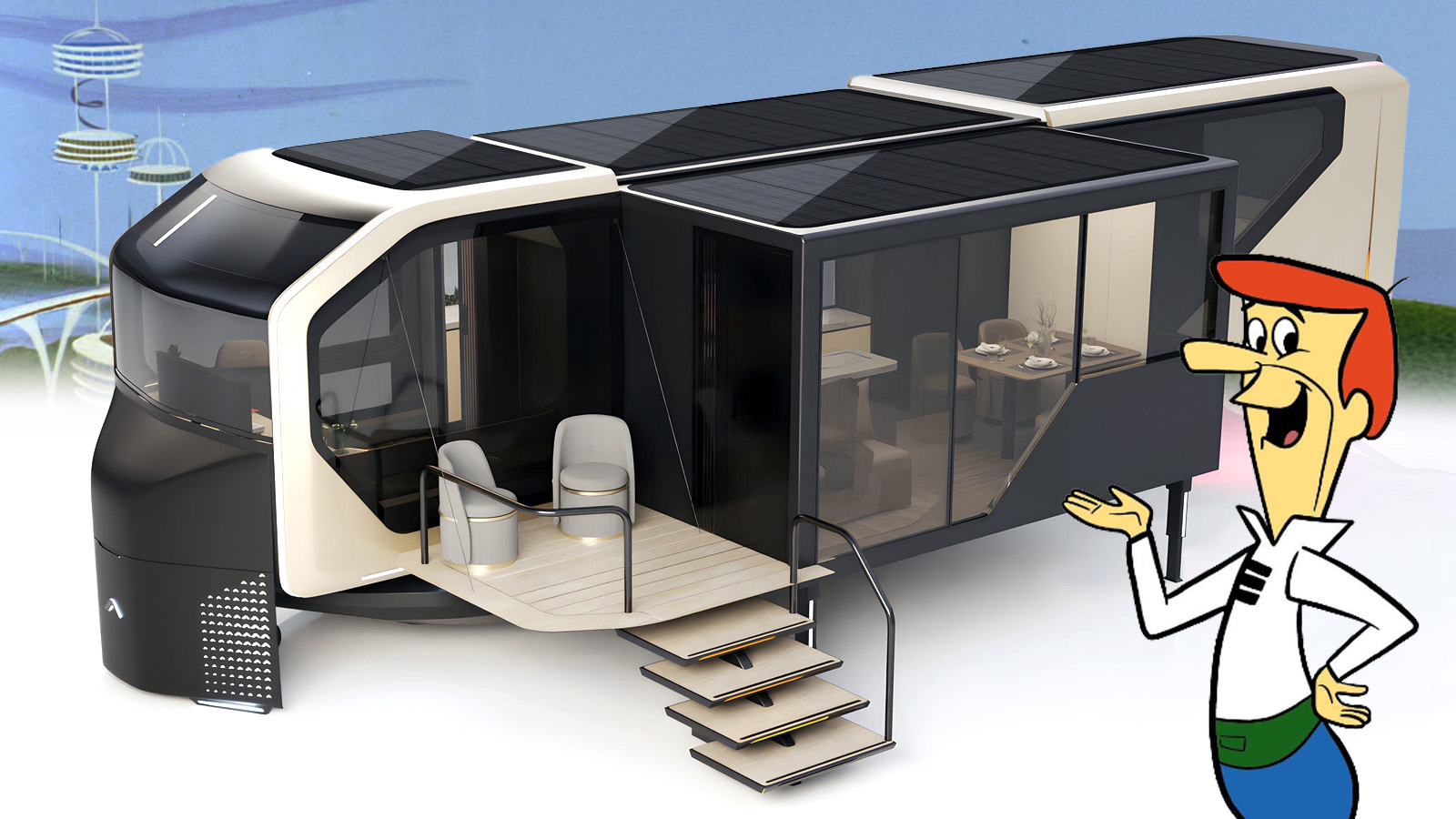
The tech world has finally discovered the recreational vehicle, and as a result, we’re now seeing a flurry of designs loaded down with buzzwords and huge promises. The wildest might be the AC Future AI-THt. This travel trailer promises to not only nearly double in size when it’s parked, but also to help its tow vehicle along and to make camping better through the use of AI. But look beyond the buzzwords, and I see one heck of a headache.
Two startup companies have achieved something that’s genuinely impressive. Lightship and Pebble gathered teams of engineers from all kinds of disciplines, from electric cars to RVs, and managed to assemble two functional, competing campers that none of the RV companies from Indiana have been able to match. The Lightship AE.1 and the Pebble Flow are both all-electric aerodynamic campers that are built out of durable materials, feature huge batteries, and can be optioned with electric drive systems that help reduce the load on tow vehicles. The closest thing the big guys had to this was the Airstream eStream, but that didn’t go into production while the Lightship and Pebble are being made right now. So many startup companies fold without ever producing anything, so kudos to Lightship and Pebble.


Now, there’s a new challenger in the ring, and this company is trying to go even more ambitious than Pebble or Lightship. For years now, AC Future has been pitching itself as the future of not just recreational vehicles, but also the solution to California’s housing crisis. The company likes rolling into every CES with a flashy concept, and this year is no different. But this time, we have some more information rather than just renders. AC Future is calling its AI-enabled travel trailer “America’s First AI-Transformer Home, Trailer.” Let’s take a look at what the heck that even means, and, apparently, what AC Future wants to charge you for it.
A Grand Mission
If the name AC Future sounds familiar to you, it’s because I’ve been writing about this company exactly once a year for the past two years, at about exactly the same time. Here’s a very quick rundown about what AC Future is:
AC Future Inc., which also goes by A&C Future Inc. depending on where you’re viewing the company’s information, was founded in 2021. It’s a subsidiary company to A&C Kings LLC, which also runs A&C Technology Inc. Arthur Qin founded AC Future in Silicon Valley with the ambitious goal of creating a lavish and futuristic home on wheels.
AC Future says its designs are penned in part by the iconic Italian design house of Pininfarina. The house doesn’t just design beautiful cars, but has also designed more functional objects like soda fountains and some industrial designs. So, the addition of Pininfarina to this project is pretty cool, but not really Earth-shattering.

The company’s original idea was to make a $200,000 motorhome that nearly doubles in size. This motorhome, AC Future pitched, would cost only a third of the average house in California, and thus help solve California’s housing issues. Admittedly, that marketing pitch never worked with me because there are lots of people in California who live in RVs right now, many of them much cheaper than $200,000, and the housing crisis remains.
AC Future didn’t put all of its eggs into the motorhome basket. In addition to the motorhome, AC Future wants to make an expandable accessory dwelling unit for existing houses, in addition to a travel trailer. All three of these designs are largely similar at their core. They are compact units that expand to nearly twice their size at the push of a button. RVs have had slides for several decades. AC Future just wants to go absolutely nuts with them.
These units are known as the AI-Transformer Home, Trailer (AI-THt), AI-Transformer Home (AI-THu), and AI-Transformer Home, Drivable (AI-THd), respectively. The motorhome used to be called the Electric Transformer House (eTH) before AC Future decided to get all weird with the AI stuff. Of these three, AC Future says that the travel trailer is coming first, and the company has finally released more details about it.
The AI-Transformer Home, Trailer
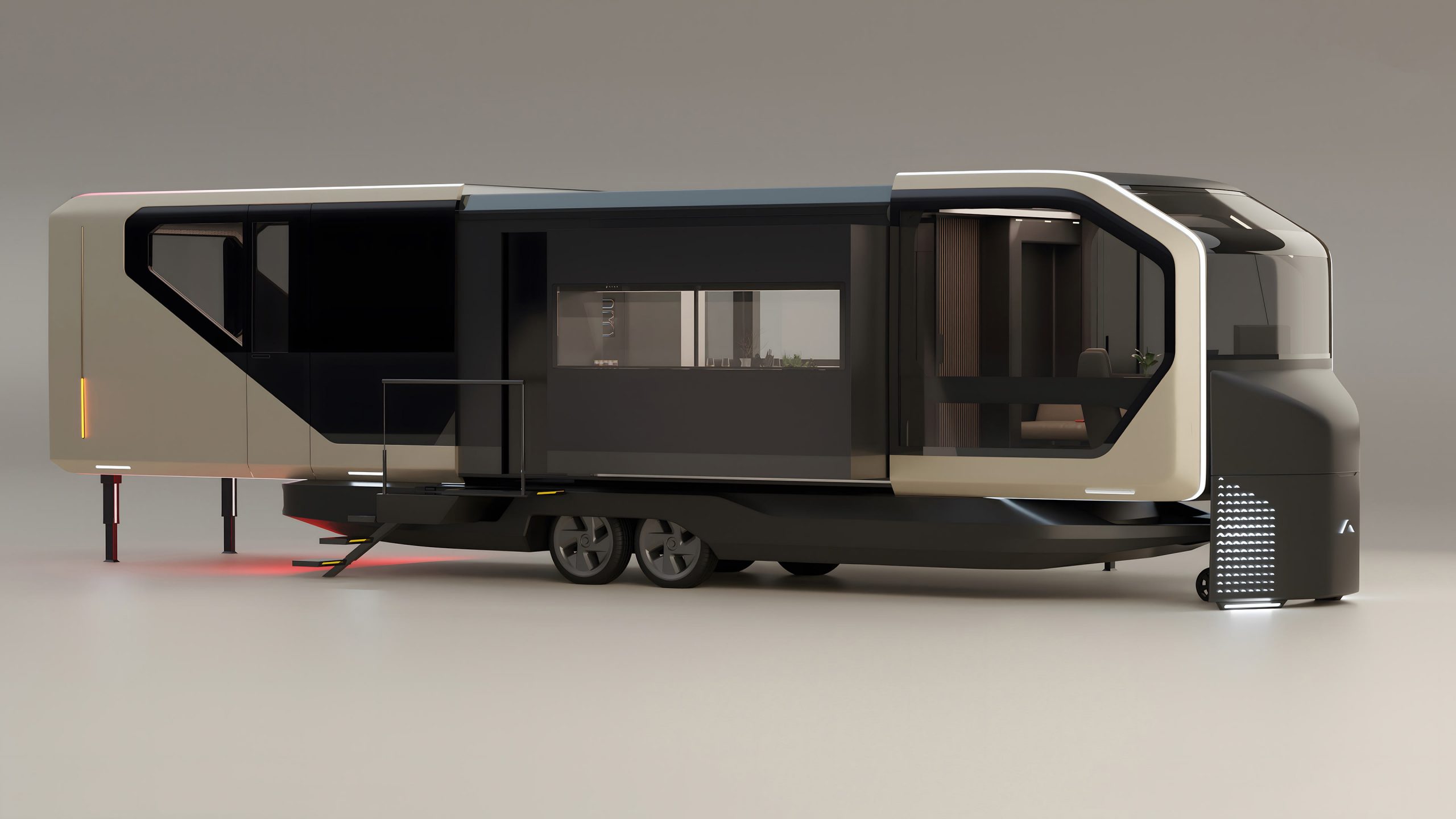
The AI-THt, which I hope gets a far better name before it reaches production, starts off as a 24-foot-long box. AC Future doesn’t say what this box is made out of, but if it looks anything like the renders, I would expect a mix of metal and composites rather than plywood.
AC Future says that the camper will be able to expand from 150 square feet to over 350 square feet in the touch of a button. That’s the whole “Transformer” part. Despite the buzzword, slides have existed in campers for a very long time. What AC Future is doing differently is how the slides deploy. The company says that the interiors of these trailers will be collapsible, modular, and folding, so that the camper can somehow open and close on itself. AC Future has yet to actually demonstrate this in real life with the trailer, so it’s anyone’s guess as to how it actually works.
But if the company can pull it off, it says that the AI-THt will expand from 24 feet in length to 38 feet in length.
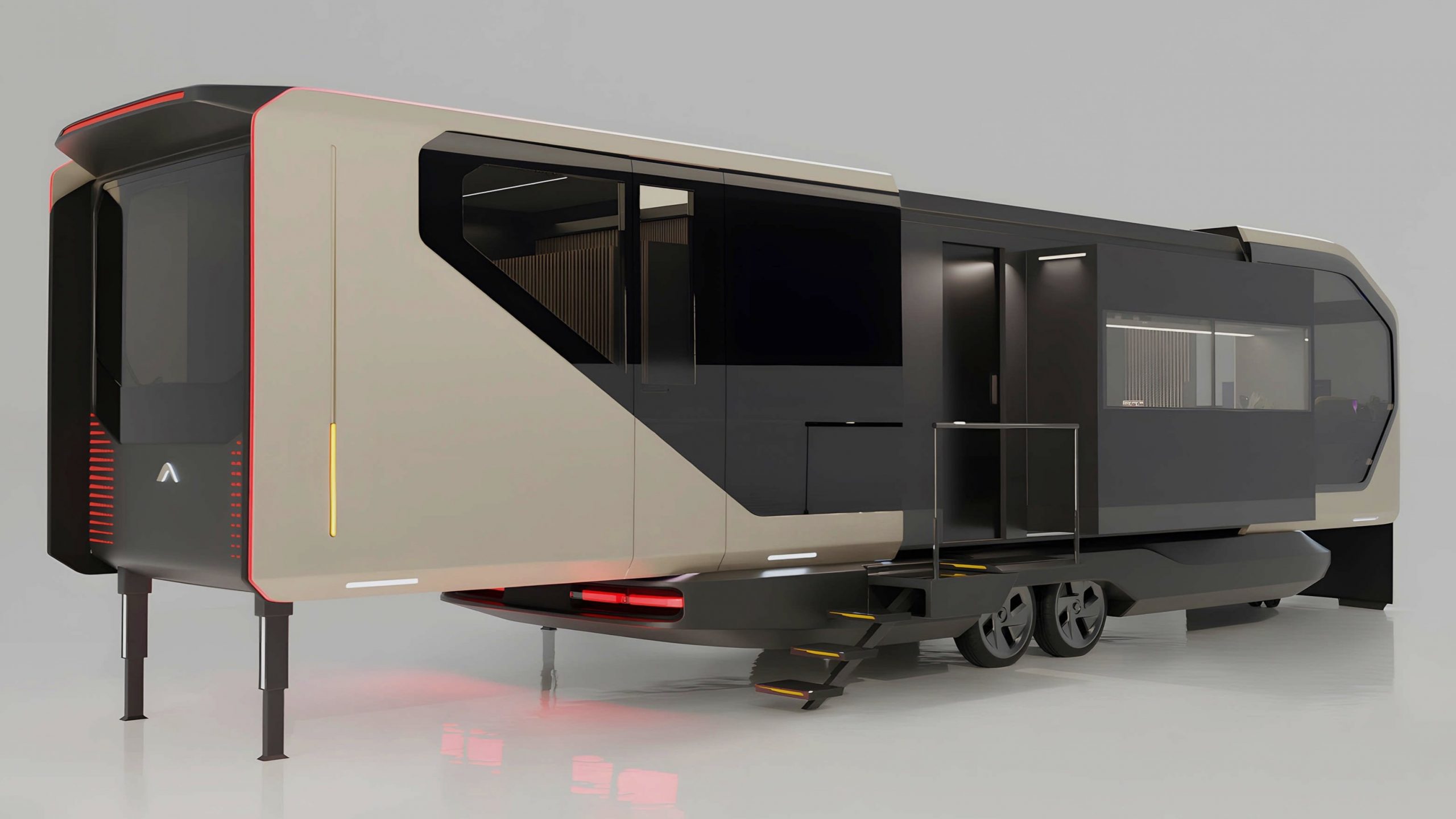
The exterior of the trailer hasn’t changed from what I showed you last year. The camper expands from three zones, the front, the left side, and the rear. The front portion is interesting as it’s supposed to expand out, over, and past the trailer tongue.
Last year, I criticized AC Future for this bizarre paragraph, emphasis mine:
Unlike traditional trailer homes, the AI-THt does not require a front driving cabin, resulting in a more spacious and premium interior environment that doubles in size when fully expanded. The exterior design of the AI-THt interprets architectural design elements, blending aesthetic sophistication with aerodynamic efficiency to improve towing performance and range. The result is a sleek, moving habitat that harmoniously merges with its environment.
It’s a weird statement because traditional trailer homes have never had a driving cabin. I thought that what AC Future meant to say was “unlike motorhomes,” but since the company has staff from other countries, maybe there was a translation error. Today, that paragraph now reads:
The AI-THt does not require a front driving cabin, resulting in a more spacious and premium interior environment that doubles in size when fully expanded. The exterior design of the AI-THt interprets architectural design elements, blending aesthetic sophistication with aerodynamic efficiency to improve towing performance and range. The result is a sleek, dynamic habitat that harmoniously blends with its surroundings.
AC Future says that the AI-THt will be optimized for aerodynamics, will be able to hitch itself to your tow vehicle, and will have a self-towing assist system. Exact details about this towing system or the self-hitching system are not described. What we are told is that the trailer will have a battery that’s up to 100 kWh, a roof full of solar panels for up to 25 kW of capture, EV charging, and the ability for the trailer to function as a battery for your house.
The battery doesn’t sound that crazy. The Lightship AE.1 has a 77 kWh battery, for example, so I don’t think it’s impossible for a bigger trailer to have a bigger battery. The solar seems wild for the scale of this trailer. Remember Living Vehicle? That RV company will sell you a 39-foot fifth wheel trailer that has a roof and two awnings that are totally covered in solar panels, and the company advertises up to 6 kW of generation. I’m not sure where AC Future is getting its 25 kW claim from.
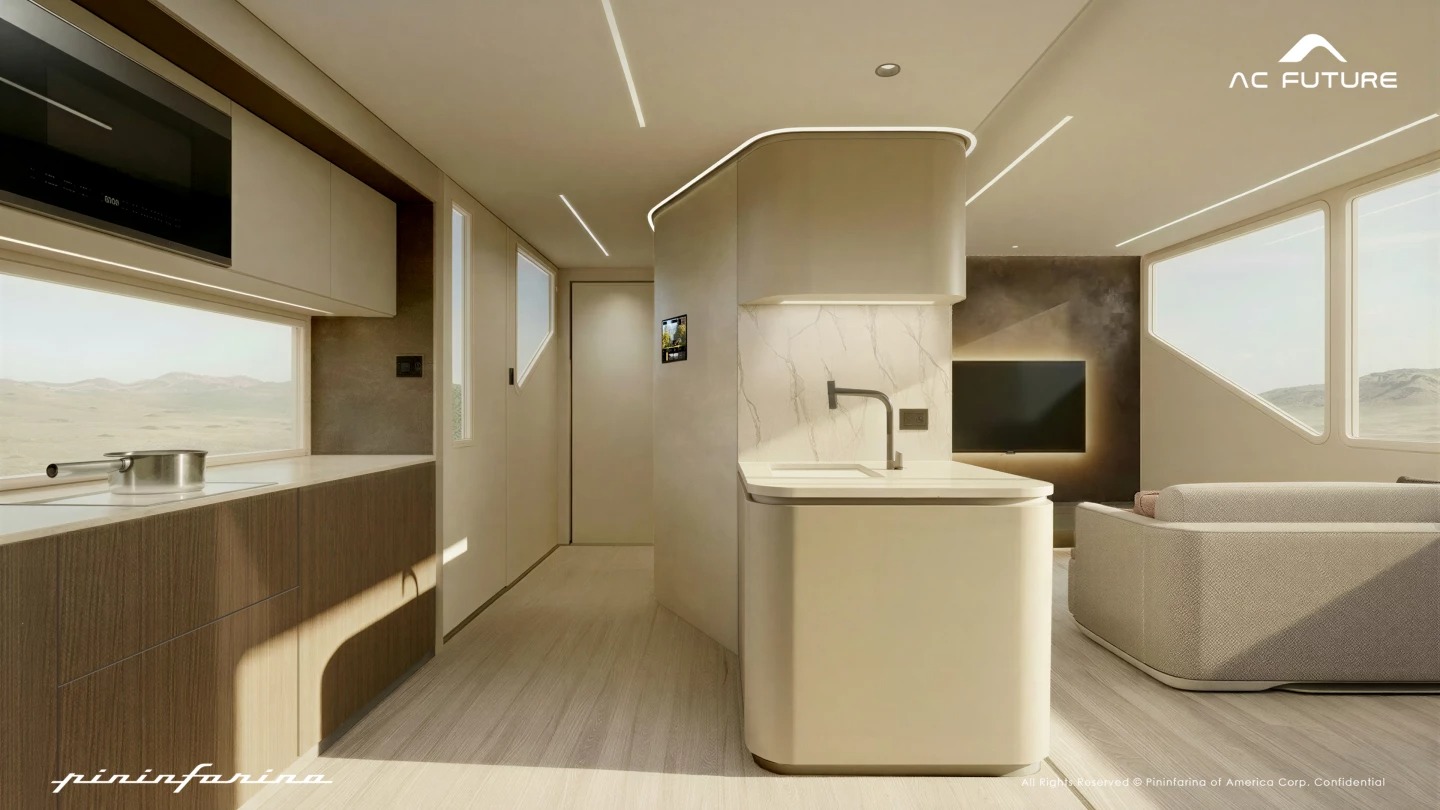
The interior is new this year, or at least the renders of the interior are new. It’s hard to get a sense of scale or realism from renders, but if the trailer looks anything like the renders inside, it’ll be a pretty cool space.
What Does The AI Do?
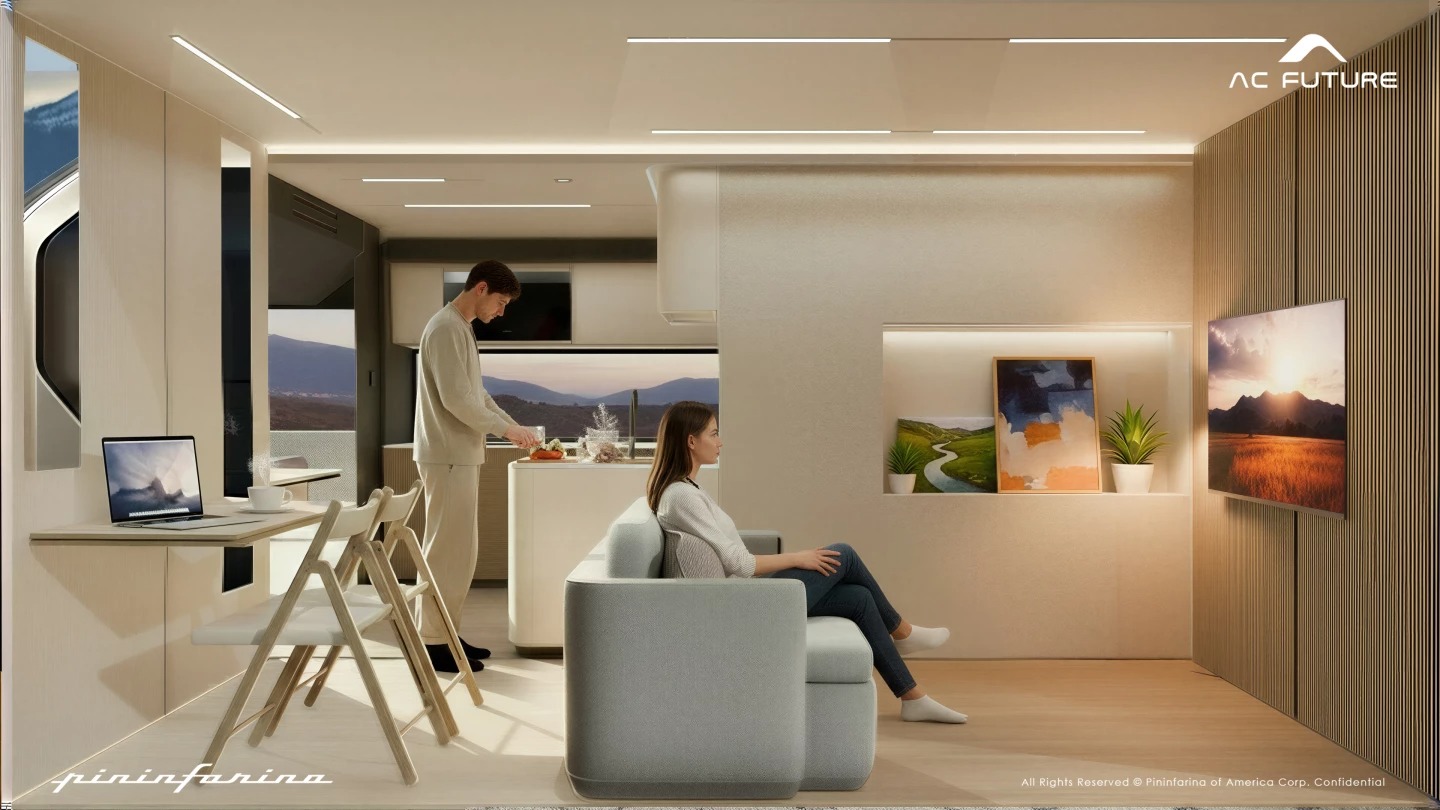
AC Future says that the trailer will have a mini-split, residential appliances, high-efficiency climate control, and water recovery technology. Finally, AC Future touts “AI-powered smart features.” What are these features? Great question! In the past, AC Future couldn’t explain what the AI would be doing. Now, AC Future offers this:
– Intelligent Water and Power Management System.
– Security System.
– Satellite Internet Connectivity (Starlink).
– Active Monitoring.
– Remote Login Serviceability.
That still doesn’t really tell us much of anything, and none of that even needs AI. It’s a bit weird that a company so obsessed with AI cannot even describe what its AI will do. Also, you honestly don’t need AI to go camping. ChatGPT won’t be sad if you disconnect for a while.
Anyway, AC Future wraps it up by saying that the AI-THt will start at $158,000 and deliveries begin this year. The company is now taking orders for the AI-THt.
Pumping The Brakes
I have some concerns with this camper. We’ve now been seeing AC Future’s lackluster renders since 2024, and enough time has passed that I have had plenty of time to think about whether this camper would even work in real life. I don’t think it will.
Let’s start with the whole transformer gimmick. In theory, an expandable camper is genius. It’ll be easier to tow, and should take up less space in storage. But nearly doubling in size sounds like a nightmare. Consider that, when you park at a campground, you usually get a pretty confined space to park your camper. With an AI-THt, you’re adding extra steps to parking. Instead of just fitting your camper into a spot, now you have to make sure that it can nearly double its size without hitting anything.
Then there’s the fact that this thing balloons up to 38 feet long when it’s expanded. You’re just not going to fit at all in smaller campgrounds unless you don’t expand the AI-THt, and the company doesn’t say if the trailer will be usable in a closed state.

My final concern is with the progress this company has made against its projected launch date. Last year, AC Future made a prototype of its motorhome. But aside from that prototype, we’ve seen nothing but renders, and they aren’t particularly high-quality renders. Allegedly, the AI-THt is supposed to be launching within the next 12 months, so I would think we should be past renders by now. Certainly, I would not be giving a company my hard-earned money for a camper based on nothing but renders.
As always, my advice is that you should never throw money at something like this until the company can show you that it actually exists.
But if AC Future can pull this off, it will have some of the most distinctive campers on the market. The AI-THt looks like it came from the future, and I’m sure the trick slides will make people say “wow.” But I’m not sure I’m convinced about the practicality of it all just yet. I hope AC Future proves me wrong, because I always dig when new RV designs hit the market.
(top image source: Hanna-Barbera)


I rented one of these. When I asked the AI “what is best sleeping arrangement”?, it drove me to the La Quinta and issued me a refund. Then it took itself home.
COTD? High value response to this “RV”
An expanding camper that costs $200k and advertises AI as a selling point, that’s a big bunch of nope. Nothing is appealing and fools will throw money at it because of pretty renders and AI
Cut to Xzibit – Yo dawg, we gave your AI more AI so your old AI has its own AI. It’s like Clippy but on steroids (West Coast Customs dudes nod approvingly in the background).
So the new tag on an rv is like the 80’s “Turbo” badge but will be “AI”. When do we see the new Cali AI-THc model?
On April 20th I reckon…
I hope Pininfarina got paid.
You’re supposed to use your camper to escape the AI robot army that is chasing you, and not bring it with you.
Maybe it drives itself to the campground so you don’t have to get stuck towing it. That would be an acceptable use of AI, I guess.
So do you pronounce it “Aiight?” Because that sounds like a pretty terrible name for something they want you to spend $200k on. “The future of recreational vehicles is here and it is…aiight.”
Bill the Galactic Hero would be a fan. “Engage Bloater Drive!”
Maybe it’ll come with Long Blockchain-brand iced tea on tap?
https://en.wikipedia.org/wiki/Long_Blockchain_Corp.
“Self-Towing AI RV”
So it’s a motorcoach with level 5 drive assistance?
“…make a $200,000 motorhome that nearly doubles in size. This motorhome, AC Future pitched, would cost only a third of the average house in California, and thus help solve California’s housing issues.”
The average SF house price in CA is in the $800-900K range.
But most people aren’t going to give up living in a house, condo or apartment to live in a self-folding trailer.
You’re saying a $200k luxury toy isn’t the solution to the housing crisis?
You may as well claim that wake-surf boats are the solution to the housing crisis. They’re cheaper than a house, right?
Ah, acronyms.
Just what every camping site needed.
I guess Elio is making RVs now
Hey now, I don’t think Elio got into the whole AI thing…but I guess Elio’s obsession with crypto wasn’t far off.
“It’s a bit weird that a company so obsessed with AI cannot even describe what its AI will do.”
Every AI BS ever. not saying it doesn’t have uses but can we figure out what they actually are before inserting buzzwords into everything?
While I definitely agree that the RV industry could stand some disruption, this ain’t it. I’ve rarely seen a series of statements that is so completely out of touch with reality. Camping is about experiencing the Great Outdoors, not being in some AI cocoon. Solving the housing crisis in no way involves a $200K box with no place to put it.
And where, pray tell, do they think you’re going to park it? Because this thing isn’t stealth camping in random neighborhoods.
I’m ordinarily one who thinks the extra complexity of a slide is worth the additional space, but this seems insanely prone to failure. If for no other reason than someone will leave a beach toy on one of the collapsible pieces of furniture and jam the whole system. I predict this will be much like the CrossCab’s roof – each opening or closing will likely be its last.
So, a true AI company then. I expect a market cap of at least 1 trillion dollars in the next 18 months.
This is so idiotic and out of touch.
“You know what poor people need? An enormous travel trailer! It’s a bargain because it’s only 1/3 the cost of a house!!”
That $158K price tag is coming from a company that is way too excited to use the term “AI” in any application on its product brochure. Especially when what, for example, the water “management system” needs is usually a simple On/Off switch. I don’t need AI for that, I can use Actual Intelligence and flip the switch myself for thousands of dollars less.
Oh look, an RV in my area, four sliders, bigass Cummins engine, a front driving cabin (woohoo!) and just $30,000. Looks pretty good even.
Hard pass.
These idiots don’t understand camping.
– A quote by no one ever who went camping.
I wish I could give you more than one smiley. Here, take these smileys as a bonus:
:^) :^) :^) :^) :^) :^)
In addition to camping, I think these idiots don’t understand AI beyond adding it to a product pitch gets attention from investors.
Thanks but I already have several vehicles that quickly occupy double their original space or more as soon as I park them and start working on them.
So as always, if this thing ever does achieve desublimation, who’s buying it?
I welcome a change from the standard RV construction, and am aware that will come with a price point, but these seem to go past solutions for existing problems. The Venn diagram for people who can afford this and want to also go “camping” seems uneconomically small.
“Desublimation,” dammit that was beautiful.
Seconded
I think that if you can afford one of those, you don’t care how many camping spots you take up, whether it actually fits, or even what people who make less money than you think of how much room your monster expando-camper takes up, you only want the biggest, most techy, “green”-est, and…um…biggest when you go camping.
For the rest of us, it’s the winter of our discount tent.
Just last week I went on a winter campout with the family in our discount tent and it was lovely. We hiked 7 miles with 2700 feet of climbing on New Year’s Day and I didn’t run into a single AI.
It’s avoided the horrendous ugliness of the giant swooshy supergraphics, but a giant shiny box is never going to be unobtrusive
I was thinking, the marketing people wrote that without actually seeing the thing, or it’s another translation error.
It’s a nice looking trailer and I like it. But park that in any campground and it’s certainly not boing to blend in.
Or it was written by AI
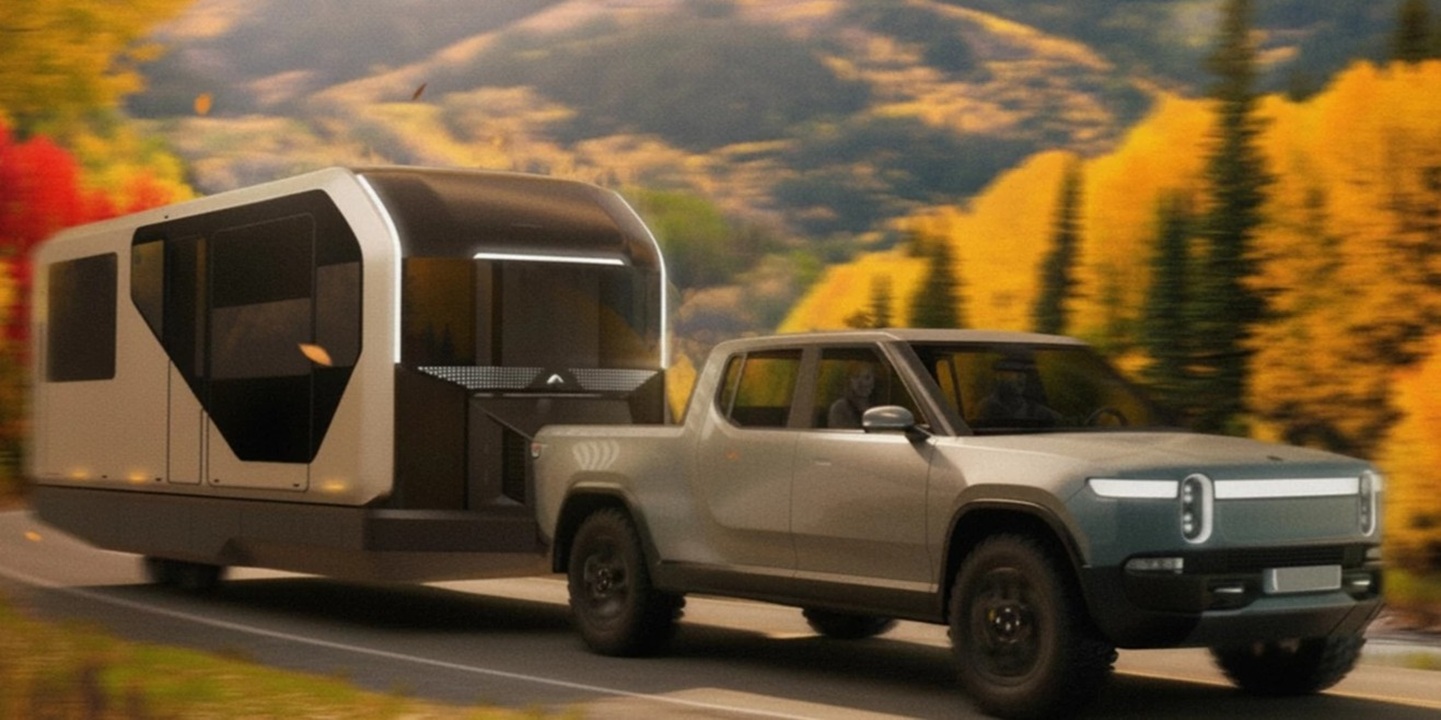
I don’t know what you mean, when I look at these images I just see a small grove of trees being towed by a Rivian! Where’s the RV???