


Cargo aircraft come in all shapes and sizes. Conventional jets like the Boeing 747-8F, the Antonov An-124, and the Airbus A350F are basically giant flying holes to shove loads into. Then you have bulging weirdos like the Aero Spacelines Super Guppy, the Airbus A300-600ST Beluga, and the 747-400 LCF Dreamlifter. But all of these planes share a common trait in that the cargo goes inside the plane. In 1980, Lockheed explored a bizarre idea: What if you took a flatbed truck and strapped it to the back of a plane? Meet the Lockheed “Flatbed,” a real idea that engineers thought would work.
As wild as the Flatbed looks, the concept of using an aircraft to carry external cargo isn’t the craziest idea. The most iconic heavy cargo lifter in history, the late Antonov An-225 Mriya, was built to carry the Buran, the Soviet Union’s equivalent of a Space Shuttle. In the An-225’s early days, the Buran rode on the back of the beautiful, sextuple-engine aircraft.


Over in America, we had two Boeing 747 Shuttle Carrier Aircraft, which performed the same role of hauling space planes on their own back. The Sikorsky S-64 Skycrane also carries cargo externally. Sometimes, you’ll also spot a backcountry pilot with something strapped to their airplane.

But if you need to ship something like a truck, tank, or other piece of military equipment, it’s rolled into the hold of a cargo aircraft. That jet might be an outsize cargo aircraft like the aforementioned Dreamlifter, Super Guppy, and Beluga, but even they haul cargo inside of their weirdly huge holds. The U.S. military carries its vehicles in the holds of transports like the Boeing C-17 Globemaster III and the Lockheed C-5 Galaxy.
Can you imagine seeing a plane landing at an airport with a few dump trucks strapped to its back? Such a crazy idea was explored by Lockheed engineers and NASA researchers, and there was some logic to it.
The Brain Behind The Machine
The Flatbed was the work of aircraft engineer Rollo G. Smethers of the Lockheed-Georgia Company, who specialized in truly unhinged ideas. In 1966, for example, Smethers filed for a patent for a flying boat that had hydrofoils.
In 1985, Smethers filed for a patent on the design of a plane that had a huge antenna ring surrounding its fuselage. It was his belief that existing early warning aircraft, which house their radars in rotating domes above the aircraft’s fuselage, have blind spots above and below the aircraft. In his idea, moving antenna equipment to a ring around the fuselage would eliminate these blind spots. It also produced some wacky patent images.

In 1968, Smethers also concocted an idea for a massive jumbo transport aircraft that worked as a flying aircraft carrier. While the idea of deploying smaller “parasite fighters” out of a large mothership dates back as far as the airship era, the idea Smethers had was similar in concept to the later flying aircraft carrier idea that the U.S. Air Force and Boeing had in the 1970s.

Smethers’s ideas got crazier as time went on. In 1974, he designed a short take-off and landing flying boat that had a catamaran hull, a V-tail, and three high-mounted turbofan engines. This one actually got a lot of attention and was built into a scale model. That year, the New York Times reported that the U.S. Department of Transportation expressed interest in a full-size version, which might have measured around 140 feet long with room for 100 passengers. Piedmont Airlines also said it wanted to see more of the flying boat.
Smethers passed away in 1986 at the age of 61. He left behind a legacy of being able to dream up some seemingly magical flying machines. The wildest of all of them was what he called the Flatbed, and it was supposed to solve a really specific gripe he had about existing aircraft.
If A Flatbed Truck Had Wings
In 1980, Smethers published Flatbed – A Unique and Versatile Transport Airplane, in the SAE Transactions journal. In his paper, Smethers lays the groundwork for what he thought was the problem with existing cargo planes:
Historically, transport aircraft have been designed to carry either passengers or cargo, and previous attempts to design dual-purpose transports have not been successful. Although passenger airliners can haul some cargo in belly holds, passenger airliners are relatively inefficient when modified to permit operation as cargo aircraft. This inefficiency results from such aspects as the relatively higher cargo floor, more difficult loading through side doors, structural penalties for doors wider than originally designed, and inability to haul vehicles.
Similarly, aircraft designed at the outset as cargo transports make relatively poor conversions to passenger carriers because of general fuselage configurations and lack of windows. The “QC” (quick change) approach has also achieved only limited success. Military requirements, particularly the carriage of large items such as tanks and bridge launchers, have produced transports of very large size and weight which would require much revision if economic operation as a civil cargo carrier were to be realized.
Traditionally then, three separate and distinct airframes have been developed and operated: passenger airliners optimized for carriage of passengers, designed-for-the-purpose cargo aircraft (such as the L100) used by several civil cargo airlines, and outsize cargo aircraft (militarily the C-5A or the Guppy/Super Guppy series for civil use). Each of these had its own development costs spread over a given production run. However, the question arose as to whether one aircraft design might be able to perform all three operations efficiently, with obvious savings in acquisition costs. The challenge was thus to derive a viable configurational concept.

Smethers described the problem even further in his patent. In it, he said that cargo aircraft are inefficient. They require fuselages large enough to fit the desired cargo; however, the cargo doesn’t actually take up all of the space. So these planes spend a lot of their time hauling air. Then, when they aren’t carrying any cargo, they’re lugging around a heavy, empty fuselage. Smethers also thought that cargo doors were a bottleneck, as they determined the ultimate size of what you could put into the plane.
Then, Smethers took aim at passenger aircraft, noting that part of the reason behind long turnaround times at airport gates is due to tasks that don’t directly relate to flying. The cabin needs to be cleaned, the water tanks refilled, the waste tank dumped, and stocks refilled. Yet, it’s likely that the aircraft itself is ready to go out again before all of the cabin work is finished.

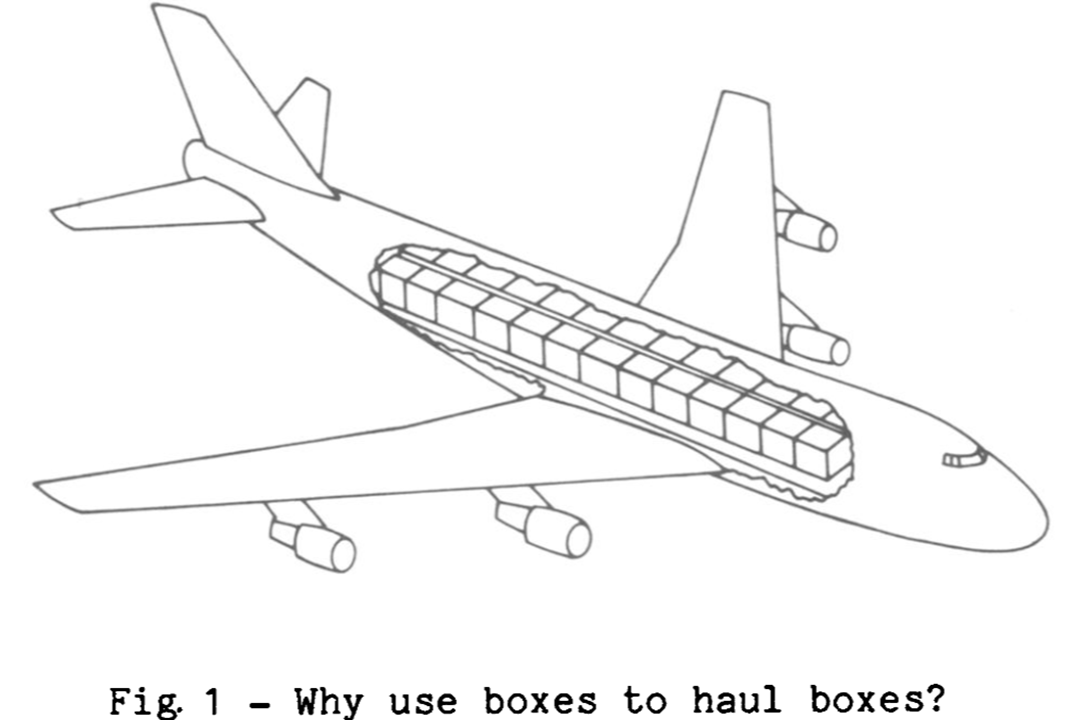
Smethers said he got the idea for the flatbed after wondering why humans use boxes (airplane fuselages) to haul boxes. To him, the solution already existed. Flatbed trucks can carry all sorts of cargo right out in the open. That cargo isn’t restricted to the dimensions of the trailer that hauls it. A flatbed truck can haul a dump truck on one load and a tractor on another. But how do you get a plane to do this? Smethers had an “aha” moment when he realized that the cargo itself could just be the plane’s fuselage.
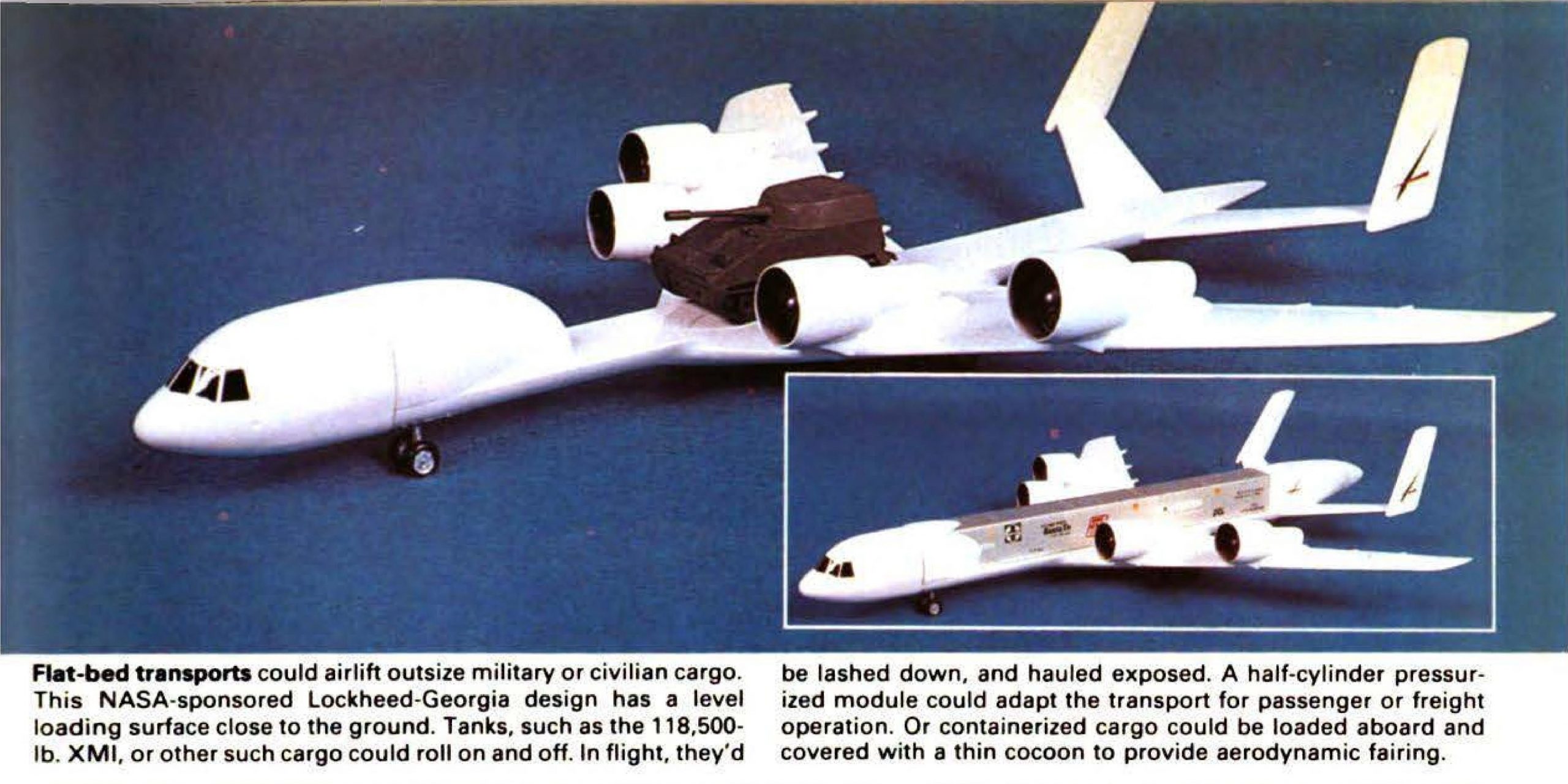
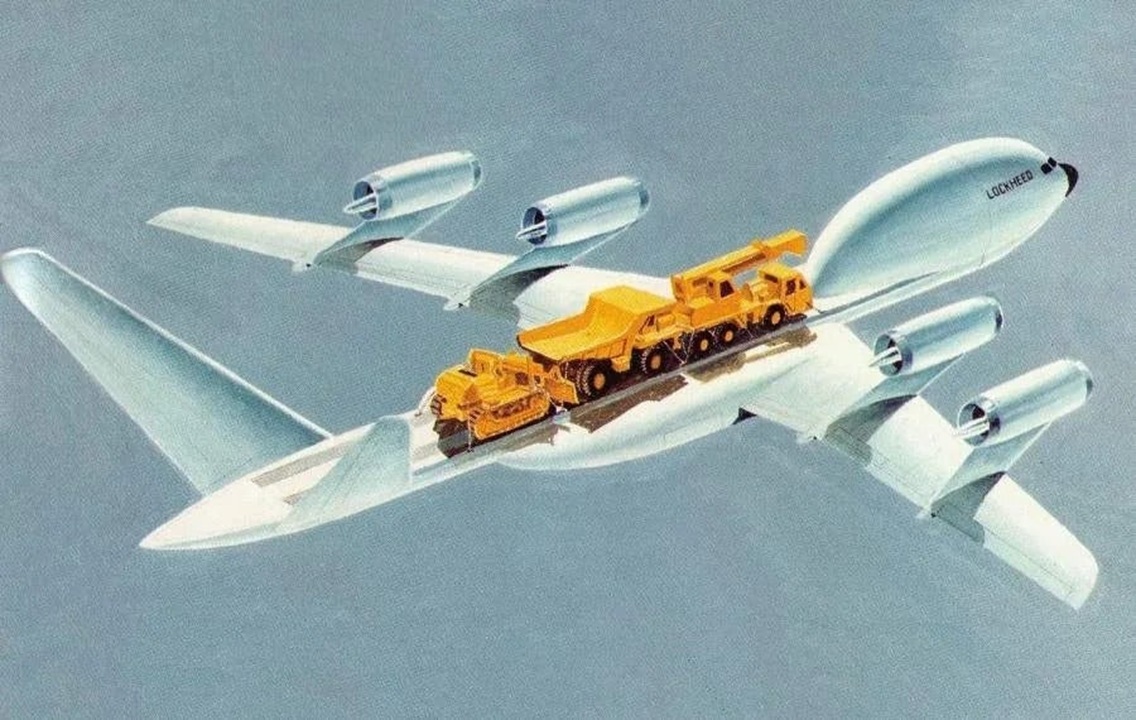
Smethers and a team at Lockheed would cook up the Flatbed. According to his paper, the aircraft starts with a nose, which features a pressurized flight deck. The flight deck would be attached to a hinge, allowing the nose to pivot out of the way for loading. Behind the fuselage would be a deck that stretched the entire remaining length of the aircraft. Smethers imagined that the Flatbed would measure 158.5 feet long, stand 35.8 feet tall at the tips of its vertical stabilizers, and have a wingspan of 148.4 feet. These dimensions, Smethers said, would have made his Flatbed similar in size to a Boeing 707 and much smaller than the heavy transports in use in 1980.

The aircraft’s extremely goofy look had a purpose. The low wings are sort of obvious, as there would be nowhere to mount high wings. The cargo bed was designed to sit only 83 inches (just under seven feet) off the ground when the aircraft’s landing gear was in a kneeling position. This meant that the engines would sit extremely close to the runway, subjecting them to potential foreign object damage. Smethers concluded that the engines would have to sit on pylons on top of the wings, like the VFW-Fokker 614 of the era or the Honda HA-420 HondaJet of today. The proposal called for the use of four CFM-56 engines, which are known for their use in the Airbus A320 and the Boeing 737.
Even the V-tail had a practical purpose. Smethers claimed the V-tail would weigh less and have less drag than a conventional tail. The unique tail also meant that the entire fuselage could be used for cargo. Smethers envisioned cargo handlers seamlessly driving vehicles onto one end of the plane and off the other.

Smethers pitched the Flatbed as having practically endless possibilities. It would have been able to carry standardized intermodal containers, construction equipment, military gear, dump trucks, cranes, or anything else that you might want to fly somewhere.
The flatbed concept was also big on accessorizing. If, for example, the cargo the plane would carry was no larger than the diameter of the flight deck area, Smethers said that the Flatbed could use a 4,800-pound fiberglass or Kevlar cocoon. This would aid in aerodynamics while also weighing less than a full aluminum fuselage. Engineers also devised a passenger cabin attachment that could slide right onto the deck. This attachment would allow for at least 180 passengers.

The Lockheed engineers even had an idea for how to combat snow and ice buildup on the deck. A team of workers could deploy a special 120-pound nylon tarp that rolls over the entire deck, which would electrically detach when the aircraft was ready to take off. Pressurization was weird, too. If you needed to carry cargo that needed pressurization, the container had to be located between the engines in order to feed from the bleed air. Same with the passenger module.
Smethers also said that the aircraft would have been able to use existing airport systems, like jet bridges, as well as roller and rail loading systems. This was promising as, unlike some of the ideas I’ve written about in the past such as the Ikarus PALT, it didn’t require the entire airport to change to make it work.
But having a flying flatbed truck was only the start of the elevator pitch. To Smethers, this was an everything plane.
The Plane To Reinvent Airports

Remember how I said he didn’t like the turnaround times for commercial aircraft? Smethers believed the solution was simple. A Lockheed Flatbed with a passenger module would park at a standard airport parking space. Then, an airport tug pulling a trailer would retrieve the passenger module and then pull it to the gate. Then, Smethers says, while that module is being deboarded, cleaned, and prepped for its next flight, the waiting Flatbed could be fitted with a passenger module that’s ready for departure.
This system was also intended for cargo. In theory, a Flatbed could fly passengers on one flight and then fly cargo on the next flight. Smethers says that a module swap could happen so fast that the average aircraft could operate for two more hours per day compared to the typical commercial jet. The cargo deck also had built-in, deployable ramps, so that cargo, like tanks or other military gear, could drive directly onto the Flatbed from any location.

The team even took a shot at the famous mobile lounges of the Washington Dulles International Airport. To them, instead of carting passengers to the plane, the plane could be carted to the passengers. Since the passenger module wouldn’t have had any wingspan to work with, future airports could have been built with smaller terminals with shorter distances between gates. Of course, this proposal would seem to suggest that regular planes would not be able to access the gates.
Even wilder was the was the idea that the Flatbed passenger module could slide onto a railcar that would roll into the terminal before it continues to the city, functioning as a subway. Lockheed even saw the Flatbed supporting the construction and agricultural vehicle manufacturing industries of the Midwest by flying equipment to buyers.

Smethers and his team got the attention of NASA. In theory, a Flatbed could be used to fly rocket parts across America. Normally, these parts would have to roll on trains or sail on ships. But flying those parts on a Flatbed could save several days of travel time. NASA funded a 12-month study to identify the feasibility of the Flatbed.
Researchers didn’t just crunch numbers, but also built roughly HO scale models of the Flatbed, loaded them with scale cargo, and put them into a smoke tunnel.
The Flatbed Could Have Flown

In theory, a production Flatbed would weigh 123,429 pounds empty, or 154,288 pounds when configured for outsize cargo, or 127,674 pounds in passenger configuration. Maximum gross weight would have been 303,011 pounds, and fuel range 2,600 nautical miles. The engines of the cargo version would have put out 24,574 pounds of thrust each. It’s also notable that the Flatbed was developed as a scalable platform, and Smethers expected that a series of large and small planes could have been made on it. In this case, the estimated spec sheet was for the standard model. These numbers also assumed that the aircraft would be built with the materials of the 1990s, which were at least a decade away when the study was published
NASA’s findings were rather surprising. When carrying either the passenger module or a standard cargo module, the aircraft could cruise at 0.82 Mach while burning 11 percent more fuel than a typical aircraft. The team saw this as potentially justifiable, as it was believed that the Flatbed would be cheaper to build, cheaper to repair, cheaper to insure, and depreciate less than a typical plane. The estimated running costs of the Flatbed with the cargo cocoon installed were 15.6 cents per ton per mile, compared to 16.1 cents for a reference aircraft. The passenger version had an estimated cost of 2.49 cents per seat mile versus 2.53 cents per seat mile for the reference aircraft.

Besides, the Flatbed was pitched as a way to make carrying cargo and passengers easier, not as a way to save fuel. Still, the math changed dramatically when the Flatbed model was loaded with military equipment. The study selected a 115,000-pound XM-1 tank and a 120,000-pound M60 bridge launcher for evaluation.
Surprisingly, the researchers found out that it was possible for the plane to fly while carrying exposed equipment on its back. However, the drag penalty was immense. Carrying external cargo would theoretically slow the aircraft’s cruising speed down to 0.5 Mach or 0.6 Mach. At cruising altitude, the team found, the Flatbed would have likely burned 20 percent more fuel than a conventional jet transport. At a lower 18,000 feet, the Flatbed would have likely burned 55 percent more fuel than a typical transport.

Fuel figures this bad would be hard to justify. The researchers tried to get around the fuel burn issue by suggesting the use of more efficient unducted “propfan” engines, which were in development at General Electric at the time. The engineers also considered deploying a vortex control system to create suction over the bed, reducing drag.
General Electric ended its UDF development program in 1989, so Lockheed’s engineers would have had to find a different way to decrease fuel burn.
A Dead End
Ultimately, Lockheed and NASA concluded that the Flatbed was technically and economically feasible. NASA said that the Flatbed was worthy of more research, wind tunnel testing, and development. However, development never surpassed the creation of static and wind tunnel models. It’s unclear why the project didn’t progress further.

Yet, it’s also not entirely surprising that the Flatbed nor any aircraft like it exists today. It was great that the Lockheed engineers designed the Flatbed to be handled using existing jet bridges and aircraft handling equipment. But, having Lockheed Flatbed aircraft park at ramps to have trucks swap out modules might have been rather convoluted. The Lockheed team’s grander suggestion to have future airports built around the Flatbed might also be a bit of a large ask.
Still, it’s wild that not only was the Flatbed proposed, but two whole teams of engineers and researchers looked into the chance that it could be made real. The Flatbed looks like something AI would create, but somehow, it was a real idea. I wonder how a plane with dump trucks on its back would handle?
If you were involved in this project and know why it did not progress, I’d love to know why. Email me at mercedes@theautopian.com.
Hat tip to Thunder Pumper on Discord!
Top graphic image: Lockheed


WAY back when i was co-oping in aerodynamics, my supervisor told me about this airplane. The transition to flatbed occurs far enough aft that the boundary layer is already turbulent, so there isn’t as big a penalty as you would expect with having what is essentially a really rough surface aft of there. My concern would be fuselage rigidity.
Do you really want a static boundary layer there, creating surface friction and thus drag? We want that air to be moving. Even a little turbulence off the surface would be welcome. Think rough surfaces or divots on a golf ball.
I explain the situation to students using an unfortunate historical occurrence. Remember the Indonesian Tsunami? There’s video of a group of townspeople curiously staring at the ground, as a little bit of water trickles in. The water is moving slowly, as it’s dealing with a static boundary layer; the pavement. As the next ‘layer’ of water comes in, it’s moving on top of an already moving layer. It has less resistance, and thus builds up more speed. Repeat. Suddenly there’s a lot of water moving quite rapidly. It’s an unfortunate example, but it gets the concept across.
That sounds about as big a penalty as I’d expect lol
A detachable passenger module… It’s like the 787 Max Doors that blow off except we all die! I’m happy this did not move forward for passengers.
It seems like you’d also diminish your fuel carrying capacity with something like this.
Another part of the problem here (at least to me) is that when you’re transporting large equipment and cargo like this, you usually have a lot of ancillary cargo going with it for support. Tools and repair parts and equipment for the military vehicles certainly. Having an enclosed cargo area provides more flexibility for that.
I guess there could be some smaller cargo area under the flatbed but I assume that’s mostly for fuel tank, landing gear and other essential parts for the operation of the plane itself?
I guess file this one under, “cool stuff that is sort of obvious to anyone doing this for a living as to why we don’t do it this way.”
Who among us hasn’t experienced a large hunk of gravel falling off the track of an excavator and hitting our windshield at 500mph?
It’ll blend in with the hail of blue ice.
So Rollo invented the Rollon Rolloff aircraft
I prefer his chocolate-covered caramel candies. You can roll a Rolo to your pal.
Mount a couple of Cessnas for even more lift.
Aerospace engineers are an interesting bunch. When I was in college my department shared a building with Aerospace Engineering; I went into the computer lab one day to find that someone had used most of the chalkboards on one side of the room to show how a barn door is actually a really good airfoil.
Rollo: “Boss! I have another idea!”
Supervisor: “You know, Rollo, this company has spent hundreds of thousands of dollars patenting your ideas and studying them in the windtunnel, and not one of them has become a commercially viable product.”
Rollo: “Hear me out: we make a plane that has a farm on it, and fly the food to the end customer!”
“Sir, the trucks you ordered via Express Air have arrived!”
“Why do they lack windshields, side mirrors, and generally look like they were beaten by an angry giant?”
“Aerodynamics, sir!”
Jesus christ, just hit it with us in the first two lines, eh?
What is this, OnlyTurbofans?!
Glad I’m reading this on my personal phone, not my work computer.
carrying uncovered cargo would be insane, but swappable modules does make sense.
Kudos for another interesting story. Where do you find this stuff? Wherever and however, keep it up! Can’t wait for your next expose’.
This one was a reader suggestion! 🙂
The drag would be acting so strongly on the cargo itself, I can’t not imagine a bulldozer breaking free from its straps and plummeting to the ground.
It’s raining CATs
I can only imagine what the headlines would have looked like the first time this was flown and some massive piece of equipment broke free of its tethers at 25,000 feet.
Can only imagine the sheer amount of tiktoks all with the caption “Bro, this is why you ALWAYS secure your load”.
Pfft, nuth’n ain’t flew out of ma truck before.
As long as they tug on the strap and say “that’s not going anywhere” they’ll totally be fine.
Came here to say exactly this!
who tf starts drawing this up and says, “yea, drag won’t be a problem”???
The passenger module swapping might be something, but the open cargo? Let’s just stick a bulldozer in 600mph wind, what could go wrong? How did anyone give this concept a first thought? Did Smethers share some of the coke he was obviously doing with the nasa engineers?
Yes Mriya and the 747 carry external cargo: but notably the space shuttle and the buryan are also planes (sorta); designed to be in a very high-speed airflow
The 747 shuttle carrier was actually a test vehicle before being repurposed into a transporter: they did a whole series of ground, captive flight, and unpowered glide tests with the Enterprise before any of the orbiters were allowed into space.
Hear me out…
This makes no sense…
But, in theory, this thing could have been a giant flying ferry boat.
How unhinged/awesome would it be to be able to drive your car onto the back of a plane and hang out in your own car while it flies you, y’know, anywhere?!
Would it be safe or practical? Absolutely not. But count me in.
Like this?
https://hagerty.co.uk/wp-content/uploads/2020/10/1-8_bristol_170_mk21_lympne.jpg
I went on one of these!!!
I had looked into the old Amtrak AutoTrain from DC to Florida, but the expense and time didn’t make sense…but AutoPlane, now … hrmmm. I’m sure aerodynamically my Pacifica would be fine at 500mph. Or not. Either way it would be a helluva ride.
I love all things aviation, and I did not know about this madness. Thank you, Mercedes.
1980 you say?
“OK, OK, hear me out. We build a plane that we can do rails off the back of *snooort*”
“I’m goin off the rails on a crazy plane!”
It’s very clear, the wind tunnel images in the article show it- with that stupid design and exposed cargo you are shedding vortices and turbulence off of the cockpit straight into a bunch of flat sided wonky cargo, which in turn generates more vortices and turbulence in such a sloppy way that even an An-2 would be embarrassed.
At 100 knots this would be an unstable, unmangeable nightmare. Taking off in any sort of crosswind would be playing Russian roulette with a semiauto.
At 400 knots any gust would produce instabilities resulting in a very interesting race between what fails first: the structural integrity of the control surfaces, or the tie-down points for that very heavy cargo (which once liberated would probably smash into said control surfaces).
Throw a fairing on it, and these problems go away. But then you will discover that unless you make said fairing unreasonably stiff and heavy, it’s still too flexy to be safe. So you decide to do the smart thing an pressurize it, which adds stiffness without the weight penalty. And finally you realize you have reinvented the cargo plane, all of which happen to be designed that way for very good reasons of physics and math.
That NASA actually entertained this lunacy instead of laughing it out of the room I can only presume is due to healthy consumption of hallucinogenics.
even an An-2 would be embarrassed
You keep my beloved An-2 out yo filthy mouth! 😉
NASA didn’t just entertain it, but said the plane could work and just needed more research to work out the kinks! I wonder if some brass at Lockheed saw what its engineers were doing and told them to quit it.
Presumably at some point they would have gently explained the need for a fairing. Which is when someone would notice their design was actually just a C-5 Galaxy rolled over on it’s back asking for tummy rubs.
…I have major aerodynamic concerns – controllability, especially – about carrying heavy equipment not designed to go 500mph on a massive aircraft. Even if uncontrolled outwashing turbulence doesn’t stall the tailplane, parts flying off the haul truck might just break it off. Oversized loads would require custom, rocket-style fairings to not cause the plane to lose control. The model tests wouldn’t scale up that well, even with the already dismal results.
Then there’s another misconception; Intermodal containers’ real advantage is that they can be shipped in bulk long distances and then distributed near the destination. Shipping just a few when you still have to truck them to the warehouse or factory or whatnot is way more expensive per container even if an international flight measured in hours is multiple times faster than a train trip measuring days or a voyage measuring weeks.
I get why this thought occurred: containerized freight was the new hotness and everyone wanted to get in on it, and I think the open deck freight transport was viewed as a bonus. Reality, however, would have, and probably did, ensue.
Man, I wonder if these aeronautical engineers thought about the affects of aerodynamics when they dreamed this whole thing up.
The guy in question apparently had a reputation for off the wall ideas that never went anywhere. And if there’s anything I’ve learned in following F1 and aircraft stuff? It’s that air is weird and will do things you don’t expect, that no simulation will catch.
The article even shows like two or three ideas of his regarding improving aerodynamics of exposed (or covering them) cargo. It wasn’t forgotten.
I mean, sure, we can doubt if that was enough, but the whole idea never got off the ground, so it’s not like we expect it to be thoroughly calculated.
I think the intermodal container idea was due to military equipment and supplies. Heck, I highly doubt construction equipment was much more than an afterthought. Lockheed is well known to be a major player in th3 military congressional industrial complex
If that’s the case, Lockheed themselves made something that the USAF already used for transport of large containers and containerized items: The C-5 Galaxy. Lockheed would have been competing against themselves with a platform that worked – and still works – perfectly well for the Air Force. And usually the Military will tell the companies exactly what they want. NASA looking into this concept doesn’t surprise me as they always look for new ways to ship rocket bits, and exploring new concepts, but considering it never got built, it probably didn’t offer any real advantage for transport over what they already had.
I think this engineer read something about intermodal shipping, and wanted to get in on that action in any way possible.
Fair assessment.
I don’t understand adding the complexity of a hinged flight deck when the cargo could have been rolled on/off the back of the plane.
This just proves that everyone loves pickup trucks. Even airplane designers. 😀
Throw a RAM logo on the front of the plane with tons of chrome, and you now have a flying DUI-mobile.
Gotta add four badges of defiance as well.
The badges show an angry low-bypass turbofan. lol
Love it!
Are you sure these guys were engineers who designed this? They missed the flow dynamics class. They get an F for horrible aerodynamics, poor stability and poor fuel efficiency.
A plane pickup truck!? This is BS, it’s just going to lead to a bunch of overcompensating suburbanites flying their Skyoneros running over pedestrians while cosplaying cargo pilots.
It’s just another lifted pickup truck…….VERY lifted.
I’m sorry but I’m far too immature and undercaffeinated to not giggle at this.
Anything you can get a visual of in 0.3 seconds that makes you giggle this early in the morning is acceptable.
yup, that was a lot to read at the start of an article so early in the morning lol
After that, it came as no surprise to read sextuple-engine instead of six-engine at the end of the next paragraph.