

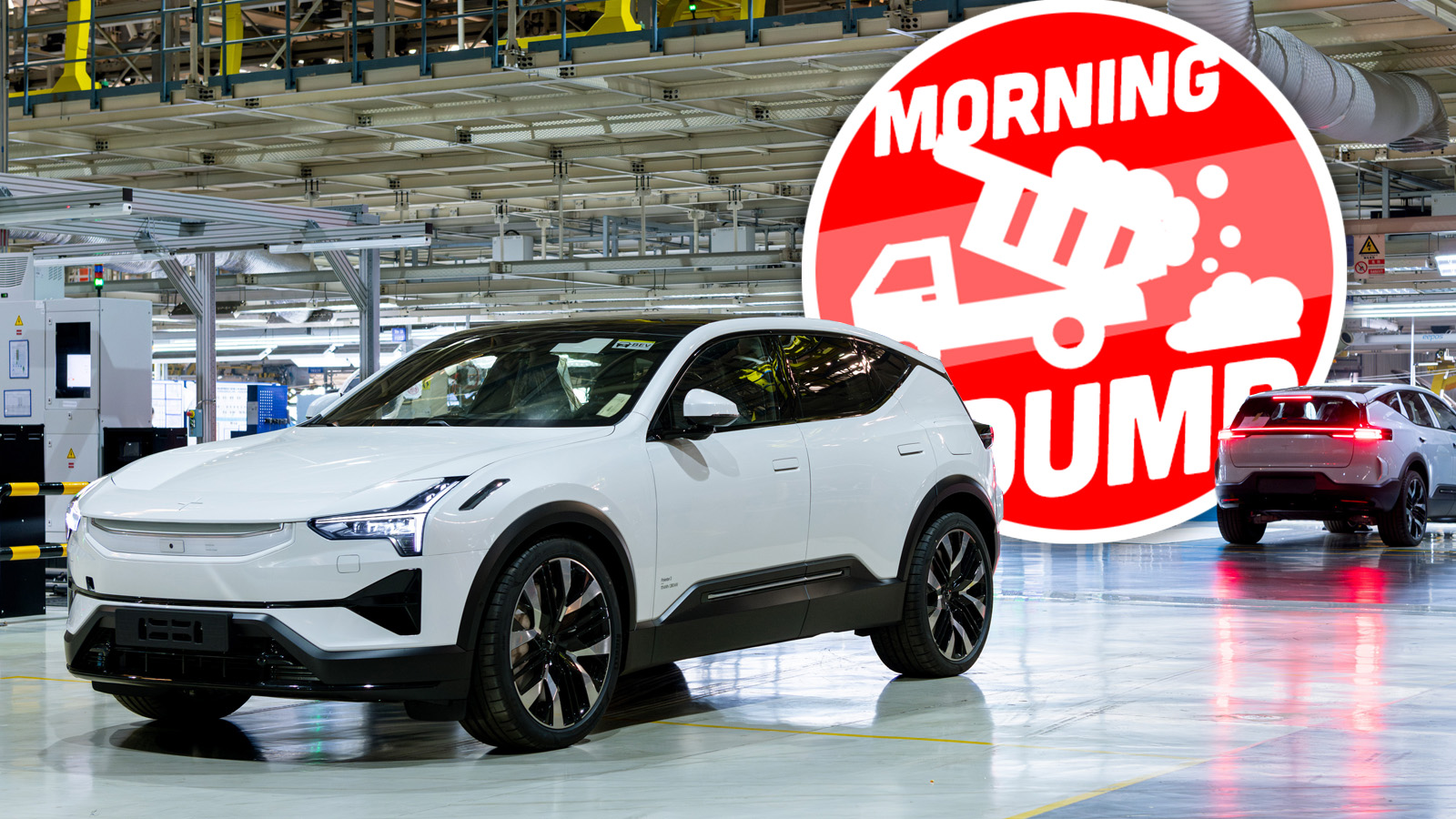
Nearly two months ago, Polestar announced that it’s been banned from selling new cars in America from the 2027 model year onwards. This news came shortly after Volvo was granted an exemption under the ICTS Connected Vehicles Rule, and it came as a bit of a shock. Polestar makes cars in America; why pull the rug out from under the brand? Understandably, this has left some dealers unhappy. The first reported lawsuit has officially rolled in, and it’s looking like it’s going to be a messy one.
Meanwhile, Lincoln has an end date for the American-spec made-in-China Nautilus, we might now know when Porsche Taycan production wraps up, and the Rivian R1S gets a welcome addition. All this in The Morning Dump.


More Problems For Polestar

If anything was certain following Polestar being banned in America, it’s that dealers were going to be furious. As Automotive News reports, one New Jersey Polestar franchise holder, Prestige Imports, has filed suit against the brand, claiming the lack of new 2027 model-year cars to sell is a violation of New Jersey’s Franchise Practices Act.
The suit follows Polestar’s June 25 announcement that the Commerce Department had denied its request for authorization to sell 2027 models and beyond.
Two weeks later, according to the complaint, Polestar sent Prestige a formal “force majeure” letter declaring the restriction outside its control.
Prestige argued the letter constitutes a constructive termination of its franchise. It says the move is unlawful because Polestar failed to provide the required 60-day notice and offered no “good cause.”
Is being banned by the United States government not a valid reason for not sending dealerships 2027 models? As things stand, even if 2027 model-year Polestar vehicles made it to America, they couldn’t legally be sold by dealers anyway. You can blame the U.S. Department of Commerce’s Bureau of Industry and Security (BIS) for that roadblock. It’s worth noting that a significant part of this lawsuit hinges on statements made by former car dealer, current U.S. Senator, and person who “shredded documents as he faced a lawsuit accusing him of wage theft“, Bernie Moreno.
“Polestar was screwed by Polestar. It wasn’t screwed by the U.S. government,” Moreno, an Ohio Republican, told CBT News in July.
“Volvo was given a list of items that they needed to follow in order to comply,” he said. “It was a very exhaustive and tough list that Volvo had to follow. Volvo chose to follow it.”
Polestar, on the other hand, used the restrictions as “a convenient excuse” after losing $30,000 to $35,000 on each vehicle sold in the U.S., the senator said.
“By blaming the Department of Commerce, they think they can bypass lawsuits from dealers and call it a force majeure clause,” Moreno said. “That’s obviously just a scam on dealers.”
There are a couple of things to note here. Firstly, that “list” is completely opaque. There’s no public transparency of the federal government’s demands on Polestar in order to keep vehicles flowing, so at this point, it’s one party’s word against another’s. Generally, that doesn’t hold up to scrutiny without supporting evidence, so something substantial will likely need to come to light during discovery in order to support Moreno’s claims.

Secondly, the allegation of the BIS ban being a convenient exit ramp doesn’t make an enormous deal of sense given how Polestar’s carrying on in Canada, and Canadian-spec cars are far closer to U.S.-spec cars than European-spec cars. Canadian cars require U.S.-style side markers, standard backup cameras, and DOT lighting just like American cars, and even efficiency testing’s equivalent across the two markets. Many Canadian-spec cars are so similar to American-spec cars that they even come stamped saying they meet FMVSS and EPA requirements and can be imported well before they turn 25 years of age. Canada is a tiny market compared to the United States, so it only makes sense for a manufacturer to spread out some of the costs of homologation across both markets if feasible.
While much of this case is yet to unfold, it reads as a huge deterrent to car brands looking to enter America. Depending on corporate ownership, marques could themselves be locked into a franchising model, banned seemingly arbitrarily from the market, and then subject to civil suits from angry franchise-holders. Now that it’s already happened once, why would anyone sane voluntarily sign up for that?
Lincoln Up

Speaking of Chinese-built cars, Lincoln has a sunset date for the current Chinese-built U.S.-market Nautilus midsize crossover. You know, the two-row one that’s bigger than an Escape and comes with a pillar-to-pillar screen setup. As Bloomberg reports:
Ford Motor Co. will stop importing the one model it ships into the US from China, with the automaker shifting production of Lincoln sport utility vehicles to its home market.
The Dearborn, Michigan-based automaker said Wednesday it will expand Lincoln output in the US beginning in 2030. It has imported the Lincoln Nautilus SUV from China since 2024.
Talk about a 180-degree turn. The previous-generation Nautilus was built in Oakville, Ontario, Canada, alongside the Ford Edge. However, Oakville Assembly’s gone through some twists and turns in recent history. Initially, it was set to be retooled for a forthcoming large electric SUV that never really materialized. Since then, it’s actually been reworked for truck production, with Super Duty trucks set to roll off the line later this year. This all meant that the comparatively lower-volume Nautilus needed to be sourced from somewhere, and that somewhere is Hangzhou for now.
Granted, this reported end-of-decade shift back to American production likely lines up with the end of the current Nautilus’ model cycle, which kicked off for the 2024 model year. Will it be replaced by something of roughly similar size? Almost certainly, but all signs point to the next U.S.-built midsize Lincoln SUV looking markedly different from the current Nautilus.
Taycan Away

The quickest Porsche you can buy right now runs on batteries, and it’s amazing. The Taycan Turbo GT is absolutely mind-bending, and more affordable Taycan variants maintain a great deal of its cornering composure. However, with the model having received a major update in 2024, its days are allegedly numbered. Germany’s Wirtschaftswoche newspaper reports that Porsche is ending Taycan production by 2030. As translated by Google:
Because electric cars are selling even worse at Porsche than combustion engine vehicles, Leiters is putting an end to the “Swabian Tesla” project. He is selling the business of Croatian electric car pioneer Mate Rimac and trying to divest Porsche’s stake in the Californian AI company Applied Intuition. According to insiders, the flagship electric vehicle, the Taycan, is to be discontinued in 2030. A corresponding agreement with the works council simply needs to be put in writing. Porsche declined to comment, but confirmed that Taycan variants are to be dropped.
While no successor’s announced at this time, it wouldn’t be entirely surprising if Porsche just chooses to focus on other electric models. Last year, only 16,339 Taycans were delivered globally. That didn’t even beat the 718 sports car, which was partially discontinued in Europe in 2024 due to GSR2 regulations and then completely phased out of production in October. Still, if you want to buy a mind-bogglingly quick electric German sedan, you have a bit of time.
Crunch, Picard, Morgan

It’s common for automakers to make minor changes to a car when a new model year rolls around, and now that the Rivian R2 is out, that’s exactly what’s happening to the R1S and R1T for 2027. Kicking things off, you can finally get a Rivian R1S with one of the most desired features in the three-row SUV world: second-row captain’s chairs. That ought to stop the kids from fighting. These new thrones come with individual armrests, heating, and deployable cup holders, although pricing varies based on trim and upholstery. You could be looking at as little as $1,500 or as much as $4,500.
Otherwise, the R1T gets a new 20-inch wheel-and-tire package, and trim levels have been simplified to “Premium” for dual-motor models, “Performance” for tri-motor models, and “Quad” for quad-motor models. That’s about it as far as rolling changes go, expect the R1T to start at $81,885 for the R1T and the R1S at $85,885.
What I’m Listening To While Writing TMD
The beauty of digital crate-digging is that sometimes you find something that’s slid completely under the radar, yet scratches an itch perfectly. This is “Council Estates” by kaiork3y, and it probably ought to have more than 94 views on YouTube. Airy soundscapes meet a smooth flow, creating something sonically compelling.
The Big Question:
With Polestar set to exit America’s new car market, have you ever bought a car from a brand that doesn’t exist in America anymore? How was it?
Top graphic image: Polestar


TBQ: Yes I have purchased from a brand that no longer exists in the US. Parts are a bit difficult to find but otherwise there’s no big issues.
Wait, I’m being informed that Mitsubishi does in fact still sell new cars in the US. Nevermind.
I’m a Suzuki man, purchased my SX4 after the company left the US. Great car, but someone bought up all of the spares and is hoarding them to raise prices. Then I got a Fiat 500, which has so far proved much less reliable than my two 30-year old JDM vehicles.
Song choice is aces today, Thomas. This is a great thursday morning vibe to start working to.
Thomas’ music tastes are my favourite part of when he takes over TMD.
I’ve owned 4 Pontiac F-Bodies, they were all awesome in their own way, although the 81 was a POS when I bought it in 1995 as a teenager.
I still have my last, an ’00 Formula, A4 with T-Tops.
I also had a 94 Mercury Cougar XR7 circa 1999-2003. I loved driving that car, it had the 4.6 and it was not at all quick, but it was sooooo smooth.
TBQ: Not yet, but it’s a debate.
My C63 despite the 6.2L lacks “lookback factor”, and I’d prefer the looks, sound, and packaging of a… late 2019 pre-facelift Jaguar F-Type SVR coupe in Ultra Blue, any non-glass top (at least painted), with forged wheels.
So I’m looking hard at long-term support, which is different here in the states than the UK. It’s reasonable, but there’s much less expertise than you’d like. Honestly, I found getting great independents to work on the Mercedes to be somewhat challenging compared to Porsche — the Porsche guys know they’re getting paid, whereas with Merc they do a lot of more expensive work a Toyota mechanic would do instead of being more resto-focused like the Porsche mechanics are.
I’m giving it a few years. See where Jag goes. Meet the up and coming mechanical stewards (there are some!) , get their take. Research more how long it takes to get parts when annoying things dry out and need replacing. The Jag crowd is also very polarized in being either very value focused, with only a few wanting concours level work done.
At least based on my friends’ anecdotal experience with F Type Rs is that things can break, but as of now parts are not hard to come by, but good indy shops can be.
Yep, shops are the hard part. As mentioned, it was far harder to find a GREAT shop to do resto-class work on a modern-ish Merc than it would be for an RS Porsche.
I know all the F-Type bugbears so what I’d hate is for it to be 1.5 – 2 years for all of them to be proactively addressed (I address before it’s a problem, not when it breaks), as that’s what it took to find people who met my bar for working on the C63.
As I tell people, “shop mechanics before you buy the car.” If I did decide to move to Jag after the C63 resto is done to my standards, I’m very much understanding that I need to make the rounds and meet the Jag indies.
I had recently seen another article (which, darn it, I can’t find the link to) suggesting that Polestar could have fought this but chose not to. Given the Polestar-Volvo connection, it doesn’t seem to make sense that Polestar hardware and software is so different that one company could meet US regs but the other one couldn’t.
As far as Canada, the US began tariffs on Chinese cars (like the Polestar 2) in 2018, but Canada didn’t start doing anything until 2024, so I think Polestar was able to maintain some momentum in Canada.
The hardware and software is the same. Every piece I’ve removed on my Polestar says Volvo on the back of it. And while riding in Volvo loaner cars at the Volvo dealership that works on my Polestar I’ve noticed that the infotainment, seats, keys, mirrors, air vents, etc are all the same.
It’s not out of left field to suggest that the tech layoffs across the country are simply using AI as an excuse to appease shareholders. Maybe not fighting the ban is similar. Polestar is using it to cut their losses and exit a failing market.
This is likely the case, but it doesn’t move the needle politically in either direction, which seems to be the spin needed for media coverage of the subject. I would wager they are still selling them in Canada as any last ditch effort to run out the parts inventory ordered for the NA market spec cars. no reason to eat all of the waste if you can avoid it. Polestar only sold 60,119 cars globally in 2025, of that 5384 were sold here.
I also read elsewhere that the lawsuit ‘alleges that Polestar spent two years planning its U.S. departure and “maneuvered the [government] into a ban”’.
That, frankly, is absurd. A tiny little automaker coerced the US government into a technology ban? Sorry, no.
Well, Mexico had some tariff pressure eased because the President’s voice “sounded nice” so it seems you can make things happen if you don’t mind getting your nose a little dirty.
Well, Mexico had some tariff pressure eased because the President’s voice “sounded nice” so it seems you can make things happen if you don’t mind getting your nose a little
dirtybrown.FTFY
The dealer owner must be a Republican voter. Only someone from the Maga crowd could make a fucked up line of reasoning like that.
Both my MGB and my TR6 were from brands that were out of business everywhere when I bought them. And both have excellent parts availability.
It can not be overstated that a healthy enthusiast community with at least a little bit of cash to spend will keep cars alive in the aftermarket for decades after official support ends.
And the cars and the parts are affordable. Plus, the cars can be driven hard at reasonable speeds, as opposed to something exotic, that pretty much needs a track to appreciate.
This is a crap paragraph. The law is quite clear- if the ownership is sufficiently Mainland China and in any meaningful way influences the connected technology stack, it’s banned. It’s not arbitrary, it’s straightforward. And it’s long overdue, both from a security perspective, and the fact that it’s somewhat reciprocal to CCP prohibitions on foreign ownership stakes in mainland firms.
Is it?
Seeing that Teslas are rolling around China, I can’t see your argument holding water.
Tesla is an American company selling it’s products in China, and one who’s products are very strictly banned from government property.
Polestar was a Swedish company approved to sell in the US that is now under Chinese ownership and who’s products are allowed anywhere.
You are complaining my apples do not make good orange juice.
“You are complaining my apples do not make good orange juice.”
Well clearly you need to fix your apples so they make better orange juice mister!!!
LOL
Moreover, operating a cloud service in Mainland comes with the requirement that the data must be hosted on local servers while the US doesn’t have the same requirement
Had a 2001 Pontiac Firebird Formula and despite its electrical problems it’s still one of my all time favorite cars I’ve owned, RIP Pontiac.
I still have an ’00 Formula. No electrical issues other than the garbage window motors. Although it’s been in storage a few years, so that may have changed.
Those window motors really were the worst lol
Porsche went all-in with regards to government EV mandates, more than any other brand, but didn’t foresee a few things.
The didn’t anticipate the obvious race to the bottom (in terms of value-for-money) in China, where everyone in the BEV space is getting eaten alive. They didn’t expect governments to start backing away from their original intentions. They also didn’t expect the beginning of a functional level of austerity (not formally, but at some level in practice) starting to permeate their core markets.
718 replacement is a giant question mark. High-end versions with ICE or not? No meaningful number of existing Porsche enthusiasts wants them to be BEVs (they want a flat six).
Macan EV sales already tapering after the initial people who want them bought them.
They got properly bamboozled by their hard change in direction. Which is the problem. If you have a very successful business and you make that hard a pivot, if you’re wrong you’re going to be VERY wrong.
It’s a fantastic example of executives screwing up in almost every way possible.
A- thinking their regulators somehow had the power to maintain hard EV mandates in the face of some very basic math saying it won’t work. I get it, Important Government People loudly proclaimed a new future, but when reality quietly begs to differ, you go with reality not the Suits.
B- Seeing China as a partner and a market rather than a ruthless competitor. China unapologetically does things that are in China’s interest (and I frankly cannot blame them for this). Any business relations with them are temporary at best, and are guaranteed to benefit the non-China partner less than they think it will. At this point, there’s like 30 years of history proving this, and if Porsche was unable to realize and plan for an eventual exit, that’s a miserable failure of executive judgement.
C- Not knowing what their own customers will buy. People will buy Porsche EVs, but those exist as a subsidiary to the actual brand halo which is made of ICE models, with the 911 king among them. Brand cachet is a thing, and voluntarily trashing the key element of your own is once again a dumbass self-inflicted wound.
There is another nuance that both the governments and the automakers struggled with in this scenario. I’m not sure it has happened before in quite so dramatic and successful fashion.
That is, the governments gave the deadlines on compliance and though the products were available, the consumers basically said no, we will not accept this reality. It wasn’t necessary and the evidence was there if you looked hard enough but I think everyone looked at how these things typically unfolded in the past and went with it (more so in Europe it seems).
I guess we won’t know if people would have eventually complied with the mandates (policy changes if you prefer) and bought up whatever was available once ICE vehicles could not abide by the various laws but one thing is certain: The cars being offered did not really provide an optimistic view of what that future looked like and consumers responded.
In Porsches case, I think they tried to stay focused on what they always do but make it EV. I’m not sure that was the way to go with EVs as there is just not enough emotional appeal in them. At least not in their offerings, maybe they just hadn’t cracked the formula yet. I’ve driven a Taycan on a track and it is am amazing machine that I didn’t enjoy and do not want to own.
That’s a good point- we’re only just now getting enough BEVs on the market that seem fun and friendly for consumers to have a proper choice. Even three years ago it was pretty friggin dismal, and if that’s all you’re allowed to take from, then yeah, people are gonna be pissed.
The limited number of electric vehicles in the first half of the decade was by design. Looking at the US market the EPA had no EV mandate and the CAFE regulations could be met with hybrids. CARB did have mandated percentages of ZEV vehicle but ZEV includes hybrids.
For CARB a large percentage of ZEV sales were not required until the end of the decade and in the middle of the decades most manufacturers were simply burning the massive piles of credits they had collected by doing things like selling gas cars with sealed gas tanks. (Remember the Subarus with PZEV on the hatch?)
2027, 2028, 2029 where the key years when a whole bunch of new electric vehicles were scheduled to roll out for the US market – just in time for regulations to completely change.
Sure, the interesting BEVs would have came (and fortunately some still are coming), but you can’t blame buyers for looking at what they could get at the time, and their options were terrible.
Both EPA’s CAFE and CARB’s ZEV percentages were on track for the regulations. Enough buyers found the current offerings attractive enough to buy them in the intended percentages.
BEVs were never expected to work for everyone all at once. The transition is a process in which both the vehicles and charging infrastructure get better over time and work for more and more people. CARB’s transition was a 35 year plan. (Personally not a big fan of CARB’s approach but I do know what the regulation actually said)
For example, my first EV was a 2016 Spark EV. EPA range = 82 miles. It still worked for 1/2 our driving because my wife and I have multiple cars so it was an excellent commuter for my 45 to 50 mile commute and worked to run errands around town or grab dinner.
That was replaced with a Bolt which has a 250 mile range and allows a much larger radius of operation on a single charge and some “fast” charging which is slow by today’s standard. Yesterday we did a 200 mile loop to the coast and spent $4.50 instead of the $30 it would have cost in my wife’s TSX.
Our next EV will have fast charging and will be car that can truely go just about anywhere. At least here on the west coast with CARB states that have some of the highest EV percentages and the highest number of EV chargers that go hand in hand with more EVs.
What really got me with the mid engine cars is they got to the point with the 981 where they weren’t looked at as an also-ran anymore. They were genuinely great cars.
Then we got the 4-poppers. Hey, they handle and the power band is both usable and VERY reliable, but they lack the experience factor. At least we got the 9000rpm runout, albeit without manuals (the prototype had it!) because of federalization costs.
… and then they threw what was becoming a VERY strong, new, “best in class” brand damn near in the trash with it being the risk-bearer for BEVs. Then they kind of back out. Then they might’ve reversed back to “BEV only” since.
25+ years of building the Boxster and Cayman up into other cars people genuinely wanted and were willing to lay down REAL cash for (RS ASP was over $200K), to insta-trash it.
TBQ: I’ve ONLY bought cars from brands that don’t exist in America anymore!
-1996 Suzuki Sidekick
-1996 Pontiac Sunrunner
-1995 Geo Tracker
The first two were rusted out doomed projects, but the third has been great!
You should get badges from ALL the brands the Tracker was sold under and stick them on the back of your Geo Tracker.
I would kind of love to! I’ve already got Suzuki and Geo, and Chevrolet, GMC, and Pontiac wouldn’t be hard to find in a junkyard. Finding an Asüna badge, though, might be more of a “I have a 3D printer” kind of situation. I’d also ideally have Tracker, Sidekick, and Sunrunner badges. I have the first two, but I don’t know if Sunrunner badges actually exist, or if they just had stickers. I’ve also got a Vitara badge, for good measure
Judging by the pictures in an auction for this Asuna Sunrunner:
https://www.yacauctions.com/auctions/6505/lot/38180-1992-asuna-sunrunner-4wd-2ckbj18uxn6943278
It looks like they’re just stick-on labels/decals.
Of course you should come to Canada to buy that Sunrunner… just to be sure.
True, though it’s unclear what’s going on with the front badge. It looks like a uniquely shaped piece of plastic, but I can’t make out any text on it. That being said, I find it a lot easier to 3D print stuff than to 2D print stuff! My 2D printer is always broken, and generally takes hours of work to convince it to print my anything. My 3D printer, however, despite being built by me out of spare parts, is quite reliable and easy to fix!
I’m actually already in Canada, though not exactly close to Saskatchewan
I ran into a very minty 1986 Suzuki Samurai locally four months ago.
Had to just walk on over and find out the whole story and check it out from the owner. AMAZING condition, full decals, amazing paint, etc. Really glad that he let me pore over it, as I hadn’t see one anywhere near that condition in 30 years.
Yeah, SRT – a two year run that was shorter than even Edsel got.
It’s pretty awesome, thanks for asking.
Edit, duh I owned several Pontiacs too….those hold such a spot in my heart I barely acknowledge the brand is dead.
TBQ – Does my JDM Suzuki Alto Works count? Not that it was ever sold here, but Suzuki used to sell cars here until they didn’t any more. My Alto actually delightful, as long as you don’t mind that any vehicle-specific parts take a few weeks to get here from Japan.
Does Jaguar count? AFAIK, they don’t really exist here anymore, at least until they start slinging that Type01 around, which I’m sure they’ll sell tens of. I’m actually looking forward to their return, and I’ve greatly enjoyed both my XJ6 with it’s retro-fitted Chevy TPI 350 as well as my bargain-basement 2000 XK8 convertible.
“JLR” = The “Jaguar” is silent….
TBQ – I had a 2004 Chevy Astro, and technically that version of GM does not exist anymore. This would apply to anyone who owned/owns a pre-2009 GM product.
Every time I see Astro mentioned, I like to point out, that they were manufactured in Baltimore. GM made cars here in 1930s up until the early 2000. I think we land where the factory was is an Amazon warehouse now.
TBQ: My Triumph, a brand as dead as any.
Since I DIY repairs and aftermarkst/used parts were plentiful the ownership experience was no different from owning any other out of warranty car.
RE Polestar
Are we at a point where we consider any claim made by certain politicians is immediately considered ragebait and likely completely false?
Gotta own the libs! At ANY cost
Some of us reached that point a century *checks math* decade-that-feels-like-a-century ago.
I miss an era where a tan suit, or the word “misunderestimate” was newsworthy.
TBQ:
*looks out at the Scion FR-S in the parking lot.*
…I think pretty well.
My best friend has a Scion iA. It’s a Mazda2 with an ugly grille, but it’s surprisingly luxurious and capable. Of course it was renamed as a Toyota twice before it was axed.
My daily currently is a Saturn Sky. Love my little orphaned roadster
Polestar should just go ahead and send them some cars they can’t sell and give them the full 60-day notice after collecting payment on those cars.
As sleazebaggy as the guy sounds, he has a point. Polestar was losing money and selling close to nothing. They needed an excuse to exit.
I am interested to see what comes out in discovery. Were they given 6 months to make 5 years of changes or were the requirements actually reasonable? We know automakers love to play chicken with government regulations, but we also know that the government can ignore reality when making decisions.
If this were Reddit’s “Am I the Asshole,” this probably ranks ESH–“Everyone Sucks Here.”
The bill was first proposed during Trump 1, then solidified during Biden’s term, finalized January of 2025. IMO ESH applies since they gave a loophole to Volvo. Either make a rule and stick to it or don’t. When the government picks the winners and loser of capitalism, the consumer loses.
Yeah, I get really frustrated by the crony capitalism that always ends up with some companies subject to different rules than others.
I’d love to see the exceptions, rules, and expectations for any and all companies granted any level of exemption from the rule. If they are all the same, regardless of company size or market presence, it’s no wonder the smaller Polestar didn’t get there. If they are tailored to each company, then I’d love to see if some companies received more favorable terms. It’s entirely possible Polestar took the chance for an exit, but I think they would have provided additional warning to dealers to avoid this sort of lawsuit.
I suspect they either thought the govt would back off or that they could get a more favorable exemption plan.
I see a few Polestars daily. I also work in an area where Rivians and Ineos are plentiful. I even see an occasional Fisker
My office’s parkinglot has many more Polestars than Volvos.
Anecdotal evidence does not equate to real evidence. They only sold 5376 cars in the US from Jan 1-Nov 30 2025. Not quite the volume mover people think they were. Volvo itself moved double the number of cars in that same period.
You can see dozens and dozens of Fiskers in NYC daily. I see Ineos-a-plenty daily too – I live close to the main US distributor. I consider my observations irrelevant however 🙂
Polestar sold 13k cars in 2024 and less than half that in 2025. Those were both EV credit years.
1500 cars sold in the first 6 months of 2026, prior to their announcement.
That writing on that wall is quite fushia on green in my book.
We’ve got Fiskers and Vinfasts here near Clearwater, FL. I’ve even seen two Vectors!
Ummm Saab, Renault via AM, Opel Mantra, VW GTI (that one is satire folks, but in many minds VW no longer exists)
TBQ: I’m driving a Polestar 2 today… I’m not too worried about maintenance, repairs, warranty, etc because this thing is still a Volvo and I assume my local Volvo dealership will continue to service it as they have been.
My biggest concern is with the connectivity, the car comes with an LTE cellular connection that I don’t pay for, wouldn’t know how to pay for, and I assume talks to some Volvo/Polestar servers on the backend for things like scheduling charges and climate controls and such. It’s not necessary to drive the car but makes the experience nice. It would suck if that gets cut off because of all of this.
TBQ: Car, no. Motorcycle, yes. I have a Brammo Empulse R, and it went unsupported pretty soon after I bought it. Getting parts has been a bit problematic. It kinda sucks, TBH.
Don’t they also sell the wildly-popular toy: Log? All kids love Log!
It’s better than good, it’s wood
Seems to me that the NJ Polestar dealer is suing the wrong people…
…but considering most dealership owners from NJ are not exactly liberal or all that intelligent – they couldn’t possibly go after their golden calf.
Ah yes, the famous “liberal intelligence” that consists of being very sure about who exactly penned the ICTS Connected Vehicles Final Rule on January 16, 2025.
Which is being selectively enforced by whom, exactly?
I wouldn’t say it’s selective- Volvo needed a waiver which included a number of stipulations regarding the tech stack, a waiver Polestar couldn’t obtain. Mercedes Benz is currently going through the same issue, and will either need the same waiver or to discharge it’s Chinese ownership.
Well, considering it was written by the US Commerce Department – I’m sure it was a group effort.
And it was written based on regulatory framework stemming from Executive Order 13873, originally issued by President Donald Trump in May 2019 – so there’s that.
Meanwhile, Volvo got its waiver from – you guessed it – the US Department of Commerce in May 2026.
Mercedes-Benz will also need either a waiver or a transfer of @20% of it’s ownership (BAIC Group, and Geely founder Li Shifu – Geely being the company which owns Volvo and Polestar) by 2030 in order to not fall afoul of this same rule.
Yes, but curious that this was one Trump 1 exec order that was not only not rolled back but formally adopted into regulation by Biden. So I agree, it was a group effort. And a well-done one IMO, the issues addressed are significant and represent an active threat that has not been properly mitigated. So not a liberal vs conservative thing, it was good policy that happens to screw Polestar and it’s dealers, something something omelettes and eggs.