

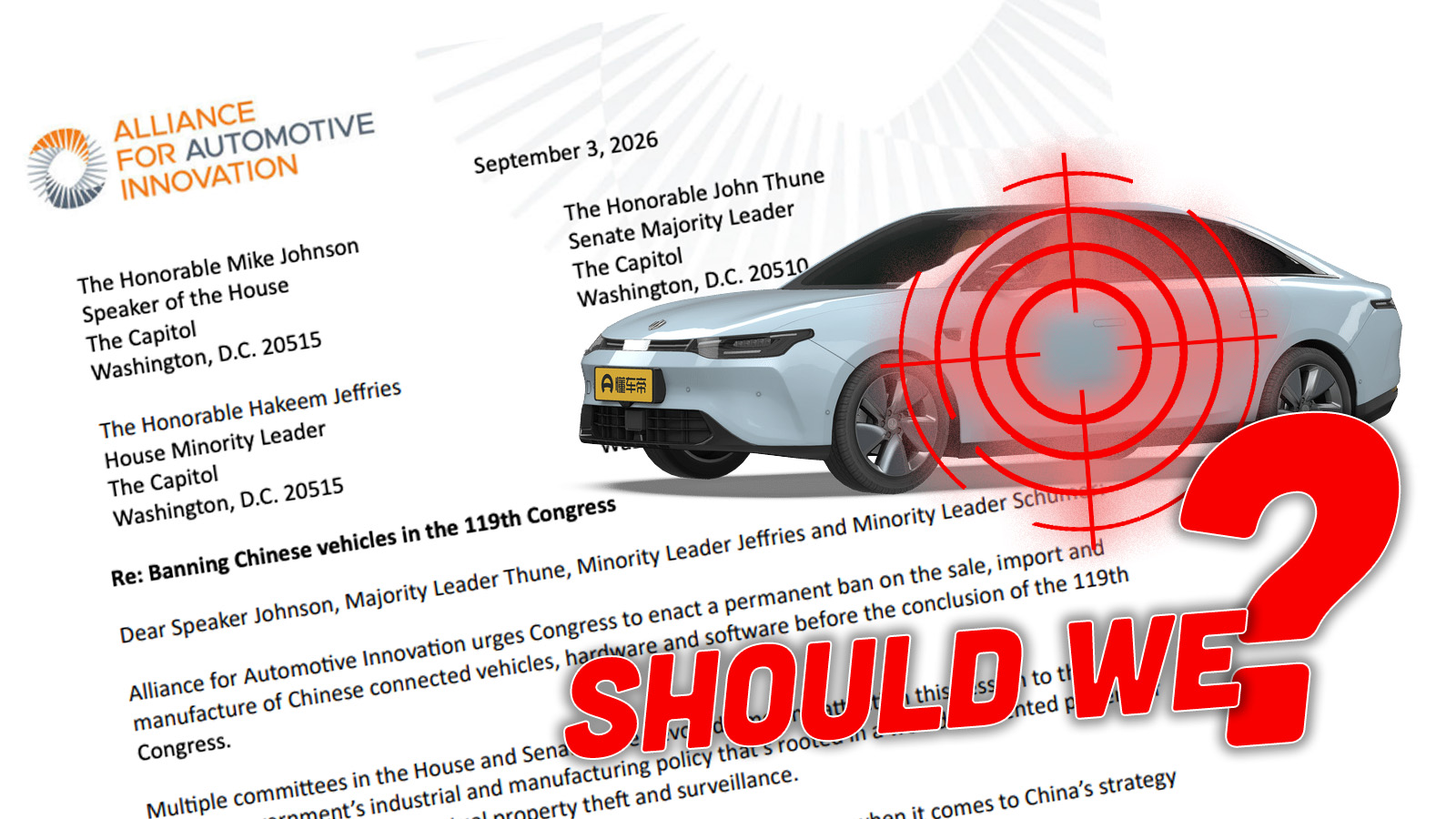
I know people lament that letter writing is dead, but I’m happy to say I don’t think that’s true. I say this because just yesterday the Alliance for Automotive Innovation – a trade group made up of a large number of automakers, including GM, Ford, Ferrari, BMW, Honda, Mercedes-Benz, Nissan, Mazda, McLaren, Toyota, Subaru, hell, even VinFast, among many others – sent a heartfelt, personal letter to congressional leaders asking about enacting a “permanent ban” on Chinese-made “connected” cars in America.
Their argument in the letter is essentially that they believe Chinese carmakers don’t play fair, and are determined to surveil Americans and, when able, steal intellectual property. Here’s what they say in the letter:


“Alliance for Automotive Innovation urges Congress to enact a permanent ban on the sale, import and manufacture of Chinese connected vehicles, hardware and software before the conclusion of the 119th Congress.
Multiple committees in the House and Senate have devoted time and attention this session to the Chinese government’s industrial and manufacturing policy that’s rooted in a well-documented pattern of unfair trade, subsidies, intellectual property theft and surveillance.
This behavior is a feature of the Chinese approach and especially acute when it comes to China’s strategy to dominate global automotive manufacturing and critical supply chains.
Right now, Chinese automakers are dumping subsidized vehicles with connected software and hardware around the world. China is capturing market share in Europe, Australia, Southeast Asia, Mexico and South America with vehicles capable of collecting, processing and transmitting sensitive vehicle and consumer data to the Chinese Communist Party.
This hasn’t happened inside the U.S. yet, but given the scale and urgency of this threat, we urge you to enact a Chinese vehicle, software and hardware ban before adjourning this year and make this policy the law of the land.”
Now, I’m not exactly sure how I feel about all of this; are these genuine concerns, or is this an industry just trying to protect themselves from a lot of significant competition? We’ve seen some impressive new cars coming out of China lately, in pretty much the full spectrum of the market, from the extreme low end to ultra-premium luxury barges, laden with technology. It makes sense that they’d be a bit scared. They should be a bit scared.

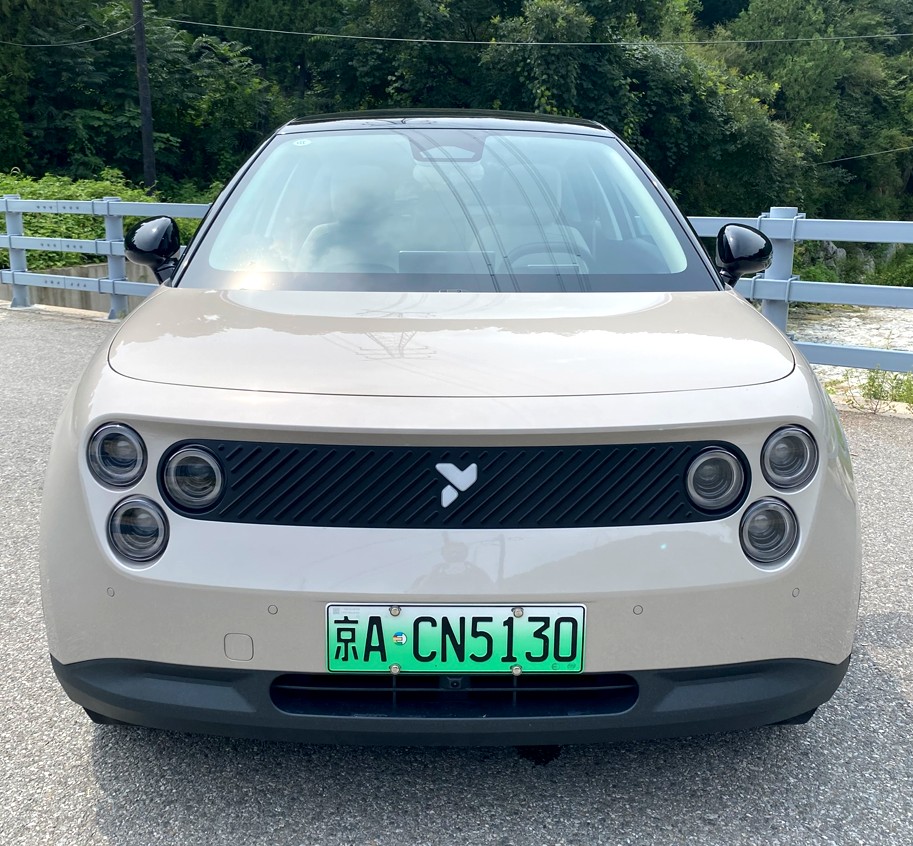
Then again, it’s not like the claims made by the Alliance for Automotive Innovation are all made up; China absolutely has a history of being pretty, let’s say “relaxed” when it comes to intellectual property. That car above there sure looks like another extremely famous car, but did that stop China’s Ora from pretty shamelessly cribbing the design? Not a bit.
And, yes, there is rampant data-gathering and privacy violations with many Chinese cars and how they gather data. Then again, it’s not like other global companies aren’t guilty of this as well, because they absolutely are. I wish this was a China-specific problem. But are Chinese companies sending all that data right to the Communist Party? Maybe? I have no idea. Is it any worse than companies taking data for their own use and using it to track us and sell us even more things and find new ways to monetize our every action? Again, maybe? Maybe no one is an innocent here.
The letter urges that bills like the Connected Vehicle Security Act of 2026 (S. 4429) in the Senate and similar bills in the house be passed before the end of the year. These bills would ban automakers from selling in America if they have over a 15% Chinese ownership stake. This limit would effectively ban the sale of Mercedes-Benz cars in America, for example, as they have a 20% ownership stake from Chinese investors.
So, what do we, as painfully obsessive car geeks, make of all of this? Should the US ban Chinese cars to protect an industry that’s important to America economically and psychologically, or is this just protectionism for American and other global brands that will only end up harming consumers? Are there genuine security concerns? Concerns that are qualitatively different from what other, non-Chinese companies are doing? Is protecting domestic automakers a good idea? Is that protectionism? If so, will we get exciting things, like how Brazil’s protection of their local industry gave us so many weird Volkswagens? Or will we just end up with uncompetitive, boring cars?
I’m not ready to absolutely give an opinion on all this just yet, which is why I’m curious about what all of you – the brightest, best-informed, wittiest, and best-smelling automotive community on the inter-net – has to say about it all.
Let’s figure this out.



I find the whole thing utterly absurd. This is classic hypocritical protectionism at its finest. But this time, the American manufacturers don’t build anything that’s affordable and competes anymore; and that is what they are PETRIFIED of.
High dollar buyers for their *ultra profitable* luxury models are getting quite scarce, as even the wealthy are starting to hold their cards closer to their chest as the economy severely contracts…and there’s TENS OF MILLIONS of Americans that NEED basic, affordable transportation that isn’t a computer on wheels.
First manufacturer to get that right and price it in the $15-20k range and offer attractive interest rates is going to go full send to record profits. And China could do that, easily.
So I think the only ‘fair’ way to allow Chinese manufacturers into the market is to demand the same conditions they gave American manufacturers: Joint manufacturers with local companies. Pair up BYD with Ford, Chery with GM, Geely with Stellantis. Open new factories that are UAW, with large capacity, in union friendly states (sorry, red state chuds, you don’t get to claim the jobs y’all exported 20-40 years ago back, it needs to be in places that treat people like humans, thanks!) and do a split profit agreement.
That worked for decades the other way around, there’s not a reason it couldn’t work here.
FAW and Dongfeng already have agreements with Honda and Nissan, respectively, in other markets, so let them build those under license in US plants and sell them badged under their names or as rebadged Honda’s or Nissan’s.
But on the chance that the lobbyists win this battle… aight, if we can’t have new Chinese cars because of ‘IP concerns’.. then kill the fuggin’ idiotic 25 year Import Ban once and for all and let American citizens buy anything at least 5 model years old (to *ostensibly* not compete with new car sales.
No manufacturer in North America has made ANYTHING I would want since roughly 2018 (last year of the manual, AWD VW Golf Alltrack Wagon) and we’ve never, EVER gotten a six speed manual, diesel dual cab ute in the US market.
If we’re a ‘free market’ then we should be able to vote with our damn dollars and drive what the fuck we want, not what the namby pamby nerds at NHTSA and IIHS say is ‘safe’.
I don’t want your shitty connected crossover with a CVT or $50-70k gussied up excuse for a ‘truck’.
Let me import my Rallye Green 2015-2018 Skoda Octavia RS wagon with a manual from Germany, and import a Yamabuki Orange 2019-2021 Triton L200 with a six speed manual, turbodiesel and a 6′ bed from Mexico, and leave me the hell out of this whole connected car computer on wheels nonsense.
But then how is the industry going to “voluntarily” get you to accept a 96-month payment plan at 11% APR on a $90k truck in order to maximize shareholder value? Your politicians would tell you your proposal is “unrealistic” because they themselves won’t be willing to pass it, while simultaneously telling you they will fight for your interests as they cash checks written by lobbyists.
So while we’re at it, let me add, if I were president, I’d issue an executive order called the Federal Motor Vehicle Anti-Enshittification Order: elimination of the footprint rule in CAFE standards with an immediate next model cycle 70 mpg CAFE for cars, 45 mpg CAFE for light trucks, 140 mpge CAFE for EVs, CAFE is now averaged over the number of cars a company produces and not the average of the model lineup(eg. to make CAFE go up, produce more of the efficient vehicles, less of the inefficient vehicles in the lineup), an end to all subsidies, cap auto executive pay at 5x that of the lowest paid worker, cap dividend payments to shareholders to never exceed total employee wages, a ban on stock buy-backs, mandatory right to repair, all software open-source, all data-gathering and connectivity by explicit customer opt-in consent only(with the vehicle still functional if the customer declines), mandatory minimum 15 year 250,000 mile full vehicle bumper to bumper warrantee for all non-consumable parts(consumable parts being wiper blades, tires, ect), standardization of electronics and parts so that even if the car is 40 years old in the future it will be able to use parts from newer vehicles such that repairs can easily/economically be made, the original “Leno law” proposal becomes standard in all 50 states, an elimination of mandatory vehicle insurance in all 50 states(or alternatively, allow the insurance buyer to opt-out of paying for profit margin), AND a ban on usury for car loans by capping interest rates at the official inflation rate. Single-seat microcars getting 3 and 4-digit mpg or mpge could be calculated into the CAFE compliance and will be exempt from many NHTSA rules if they are available at a cost of 1/2 the annual full-time income at Federal minimum wage or less and provided they can reach a minimum top speed of 85 mph on flat ground. Exemptions for NHTSA safety standards and these rules will simultaneously be made for small startups, kit car manufacturers, one-off vehicle builders, hot rod builders, tuner shops, ect., but as soon as a company gets big enough, they have to abide by the rules set out for the big companies.
The goal? Minimize customer expense by preventing corporations from maximizing extraction of customer money, minimize environmental degredation from car use, keep a proliferation of reliable used cars everywhere to keep vehicle costs low, keep from filling the landfills up with more crap, keep the government/corporate spying out of people’s personal lives and personal vehicles, end planned obsolescence, and foster a highly competitive and creative auto industry paradigm that drives innovation and experimentation by allowing the non-wealthy to get into the game and design and sell their own cars as local auto manufacturers and cottage car industries spring up all over the USA thanks to modern 3D printer, CNC mill, and material science technologies.
Lots of people commenting here have probably never even stepped foot in China.
Their factories don’t really use ‘labour’ in the traditional sense any more. It’s all automated robots.
So their issue is one of privacy? Okay fine then. They should also insist on a ban of Chinese-made televisions, cell phones, and computing devices. I’m pretty sure that consists of 98% of those devices sold in the US.
Automakers: No, no, no, it’s the cars that are dangerous. Trust us. We would never lie to you.
We just bought a refrigerator and stove from a Chinese company with factories all over the world.
That’s a good start, after that they should target telecommunications network devices, wifi and modem routers. Gaming devices and robot vacuums.
Wait, the American automakers that currently import Chinese cars don’t want Chinese cars to be imported? I mean, Ford and GM could put an immediate halt to Nautilus and Envision sales if it bothers them that much.
But, yeah, I get that this is specifically about Chinese connected cars, not Chinese cars in general, so, what if we just all agree not to do connected cars at all, regardless of where they come from? I honestly don’t know what that’s even needed at all, to be honest.
I say we let all cars come in that meet regulations. BUT that means having, actual, good, enforceable regulations on things like data sharing/collecting, IP litigation, connections to subhuman working conditions etc.
Now that would impact Chinese cars for sure, but it would also definitely hit all the other OEMS as well as none of them are entirely clean there either. It comes down to the extent of dirtiness and how quickly they could clean up.
We will never see anything close to this though, so I do generally agree on at least pumping the brakes on Chinese cars. Its kinda like not buying the first model year of any car, you want to let others be the test dummies for a bit, then you can be okay with it. That should also give enough time for the western OEMs to try and compete with their products.
The scary part to me is going full isolationist in the USA, I am calling it the “Pickup truck Island”, where Chinese EVs will be allowed into all other regions except the USA so the USA will have 0 exports and just be making/selling pickup trucks for its own people until the US industry just collapses since it cannot compete on materials costs from other countries at that point.
But global Warming will destroy our planet before that even gets to play out, hooray!
Basically, you’re talking about the US retreating into what the Brazilian auto industry was in the 1970s and ’80s
If you can’t make cars you can’t make heavy weapons… so you tell me.
I’d like to see a ban on connected cars in general, and for Chinese cars I’d create a new tariff-free category for vehicles that are;
All other Chinese vehicles keeping the current 100% tariff.
In other words he wants a Temu Autozam for $10,000, and I fully stand behind this idea.
At this point, I trust China to be a far more reliable government.
But companies? It’s been a long time since Google claimed to not be evil – and here we are, with evil Google.
I want this ban to happen but to all cars regardless of where they’re designed, built, programmed, or painted.
I think what bothers me most in all this is how the companies will argue for banning Chinese cars out one side of their mouth while arguing that regulations on them should be reduced or eliminated out the other. Let’s at least be consistent here – if car companies want a walled garden, they should be held to much stricter standards of efficiency, affordability, etc. Or if they want deregulation, then open up the marketplace to all comers and let them show that they’re the ones making what the market wants.
“Permanent”? Are you kidding me?
These guys belong in straitjackets because that’s nucking futz.
I’d be fine with something like an inexpensive Chinese mini-truck, something like the Slate. Rip out all the telematics and sell it as a basic ICE or electric truck. Then let the owners decide what and how much “infotainment” and data tracking they are comfortable with and they can have aftermarket equipment installed.
I’ll bet China could sell a basic no-frills regular-cab ICE or electric pickup in the U.S. for under $15K. Like others have mentioned, have their labor practices scrutinized and if human rights violations were occurring, have the companies punished according to major international watchdogs like Human Rights Watch and Amnesty International, as well as intergovernmental bodies like the UN Human Rights Council.
This is, of course, once we get to the next election cycle and the U.S. re-joins said international human rights groups.
How do you verify every car coming in has no telematics? That hardware is small, and it’s difficult to tell if a car is sending data out, especially for the driver, who likely doesn’t have the skills necessary to figure it out. It’s easy to hide telemetry hardware and e.g. activate it a month after the car has been sold, so it can checks at the port of entry, dieselgate style.
Conspiracy-wise, it’s entirely possible, today, for a car manufacturer to sell connected cars using satellite internet and activate a botnet of self-driving cars to wreak havoc in american cities.
This, but I don’t think they will swarm, we aren’t there yet, IMHO.
Your first paragraph is spot on though, even though I may have suggested otherwise above.
Swarming may not quite be here yet, but it will be within a year, if recent openai events are to be believed. That said, they don’t need to swarm to cause a lot of mayhem. Self-driving cab companies are already doing it today! 😀
It would be a basic truck. I wouldn’t ever connect a phone to it. There would be no antenna on it, unless an aftermarket one was installed.
I saw the law bans all connected vehicles. I’m tired of being a marketing data point.
What law? These numbnutz letter-writers only want to keep the diabolical JIE-NEE from connected cars.
The rest of these theiving bastards get to mine our data and own us.
Lobbing groups always name them selfs things they aren’t. Should be anti innovation, anything family should be anti most people
It’s simple open source software checked by cisa, mitre,fcc,nsa, etf, whoever wants to. No binary blobs allowed. If they want in the market show the source code. If they don’t want to do that build them with western systems who should should undergo the same code review and be pressured to open source their work so others can review.
Data harvesting is a is a hot button issue this election cycle. This seems like opportunistic finger pointing that will include donations to campaigns. They all have gotten caught data harvesting. Vinfast appears to be clean in the US but certainly not in other markets.
American automakers are undoubtedly protectionist.
But… I’m also fine banning Chinese vehicles. For a few historical and novel reasons, namely:
So, yeah. I’m not going to go buy a Ford on account of this, but I’m happy to keep Chinese cars off US roads when the Chinese state-sponsored entities who produce them have absolutely no moral qualms about human life. For all the frustration people have, American and European car manufacturers can and are held accountable for their failures in expensive and painful ways; we have not demonstrated anywhere near the same testicular fortitude when it comes to the Chinese.
I suppose you can also add the shit they’re doing with Taiwan and the Philippines. I mean, yes, we’ve made some threats toward Greenland and Canada and appear to be about to do something stupid RE the Falklands, but we’re not outright rehearsing plans for a full-scale invasion (at the moment) or actively assaulting Canadian and Danish naval and coast guard vessels
I interviewed with a company’s photovoltaics manufacturing group in early-to-mid-2000s. When I followed up a few weeks later (this was back when even if you didn’t get the job you normally got a rejection letter) they said that they had shut down the photovoltaics, because they couldn’t compete.
“And while people like to make big hay about how rough things are in the American economy, it’s not, ya know, slavery.”
Except for the explicit carve out in the 13th amendment for the prison population. And all of the automotives use prison labor at dirt cheap prices to facilitate the assembly of their vehicles.
Seems to me that none of the claims made against Chinese automakers can definitely be said to not be happening at the American OEMs, except we pay a significantly high price. Same as healthcare.
Do you have any sources to back up “all automakers use prison labor” claim? Granted I have only worked in 4 automotive assembly plants, 3 different OEMs, but that isn’t a case I have seen in my albeit anecdotal experience. I’m not new to the manufacturing industry either.
Open it up. And if we get a government that actually does its job then that government can look at what comes in and determine accurately if it is in fact “dumping” or using forced labor and then apply the appropriate measures, you know, like we used to do. Note that is NOT the same as some guy with a Sharpie just making up random numbers to levy on everyone else while everyone standing around just nods.
Once open, let everyone compete on their own merits. Sink or swim. Just like Yugo tried and sank, nobody complained about their $3995 sticker price did they? And Hyundai almost sank at the same time and now is thriving if you’re old enough to remember the ’80s.
And I am under no illusions that my data is being kept securely in the vaults of american companies, no, it’s being profited off of with or without my knowledge. And if caught, the fine is ALWAYS far less than whatever profits were generated, i.e. zero repercussion or future deterrent. Just like when someone hires an illegal immigrant, when caught, who goes to jail or the camps? Not the employer although that would serve to stop that supposed “problem” right quick.
Since when have American automakers wanted anything other than minimal regulations, lax oversight, and protection from
JapanKoreaChina?They were fine with partnering with Chinese firms to build cars for the Chinese market to reap the profits.
Now that the student is teaching the master…”Whoah, we can’t have that!”
Even Farley likes Chinese cars better than the junk his company produces!
Compete or die: That’s Capitalism, my friends.
You forgot the part where they were also just fine with partnering with Chinese firms to build cars FOR THE US MARKET WITH THE BUICK AND LINCOLN LOGOS on them. Both of which I believe are still for sale today (Envision and Nautilus).
COTD nomination
If the real harm is the collection of personal data without the user’s permission Congress should pass laws banning all companies from doing that.
Allowing US car and technology companies to collect and sell our data but banning Chinese cars for doing the same thing makes no sense.
Looking at you BMW and Spiderman
I feel like a Chinese connected car sending your information back to the Chinese government is better than an American connected car sending it overseas to an entirely different country. Obviously we’d prefer if this wasn’t the case at all, but in a world where we’re always being watched, you might as well go the route where you’re being watched by as few parties as possible.
“uncompetitive, boring, expensive cars” – fixed that for you.
I’m not sure Japan or South Korea would have gotten their footholds in the U.S. without some government backed shenanigans either, but neither was a strategic competitor or an authoritarian state anymore when it happened – they were friends and important Cold War allies and we had a strategic stake in seeing them succeed overall. China doesn’t get the benefit of the doubt.
I’m less concerned about data harvesting than I am in an unfair practices and the threat of losing any more manufacturing capability than we already have.
Are the automakers really any more concerned about “fairness” than proponents of voter ID’s? On the one hand I wouldn’t argue (the nice little old lady at the polls has tried to hand me my brother’s ballot more than once), but GOP leaders in our state are also on record saying that the real point is to disenfranchise voters on the other side. If all those car companies commit to building cars people can afford without a 96 month loan, I might take them a more seriously, but I get the feeling that’s not going to be the case.
Hyundai entered the US market in 1986 during the 5th Republic. The leadership of that government came to power in a military coup in 1979. In 1980 after killing hundreds of protesters they disbanded the general assembly and appointed replacements. They held power until 1988 when more protests toppled them and real elections were held.
I didn’t realize Hyundai showed up that early – corrections are about to be made!
You’re not wrong – but one thing folks also may not know is that when Hyundai began importing cars to the US – guess who built the ships they came over on?
Hyundai!
(Japan did similar in the 70’s when the “K Line” (K is for Kawasaki) started building RoRos to export their cars to the US)
Jason please explain the difference between support for US Union Workers to get paid 6 figures, but have no problem with Chinese workers being forced at gun point and being starved to the point of death while celebrating their cheaper vehicle? You don’t strike me as a non caring person, you don’t strike me as an idiot that doesn’t realize all the dead people who are forced to make the cheapest cars. Make me understand why cheap cars made by slaves is something to support
Slave labor? Hyperbole much?
By any accounts I can find, yes, they’re worked harder than our people and are paid worse. But they’re not enslaved.
And you might want to check what percentage of manufacturing costs involve labor. Believe it’s about 5%. What the Chinese manage to underpay their workers doesn’t account for the price advantage.
Their leverage is problematic, but stop with the ridiculous stereotypes about the majority of their labor force.
We have Chinese factories. There are no slaves being forced to work at gunpoint. In fact those Chinese auto workers make more than Mexican auto workers. (That could change the changes to the Mexican standard work week phase in)
We have similar slave labor in US prisons for many “Made in America” products. These prisoners even get to process personal information like names, addresses, and social security numbers. Sometimes, they make car parts for GM or Ford via 3rd party suppliers. GM and Ford also use the same slave labor from China as well.
All because corporations don’t want to pay a living wage here, and neither the Chinese or US government calls it slavery, but pretends it’s “voluntary” instead.
How is the CCP harvesting data for nebulous, if potentially nefarious, reasons any worse than the connected infotainment system in many modern cars selling that information to the owners’ insurance companies to potentially raise their rates? I have no particular interest in Chinese cars and almost definitely wouldn’t buy one but automakers pretending that consumer data is sacrosanct is ludicrous in 2026.
I have a problem with them using slave labor and comiting genocide, not like the fake genocide the terrorist from Palestine claimed but actually killing millions. Maybe you are okay with that to save a few thousand bucks for a car built with stolen data. And I have yet to see an actual crash test, battery test. China put nuclear waste in baby food, cancer causing chemicals in toothpaste and drywall. I fail to see how people here can’t differentiate between making a design close to one that the compensation isn’t using any more vs forcing a population to work as slaves right up until they kill them. Might as well ask for human skin leather like the Nazis used for books and lamp shades but since China is actually killing more people we can get human skin interiors. And China doesn’t deny it.
LOL. Now you’re really losing it.
Thanks, I needed a good laugh.
I certainly do. I see no reason to open our market to them. We already exported enough jobs and money to our biggest economic rival.
By “we”, you mean all the capitalist American companies that decided to use outsourcing to drive value for the shareholders, right?
In that briefest of moments, the shareholders gains made wealthy people even more wealthy.
Yes. That is in fact why we exported entire industries to the third world. In theory “we” as in everyone, benefit from lower prices, but does that really help us when it made literally 10s of millions of good-paying jobs go away so that we can buy t-shirts for $.50ea cheaper? And of course NAFTA was a middle-class killer. We should absolutely have free-trade agreements with economies that are on par with our own in wages, aka Canada and Europe, but not Mexico and China and other extremely low-cost countries. Though China is not nearly so low-cost TODAY, they mostly just have a huge supply chain advantage while being enough cheaper to offset the cost of shipping.
Also, if you have a 401K or other investments you are very much part of the shareholder class that this was done for.
So why not do what we did with the Japanese 40 years ago and require them to build their cars here? Our go the old Chinese way and require them to form joint ventures?
They get access to our market, consumers get a choice, US companies get to learn new technologies, and US workers get the jobs.
We never “required” the Japanese to build cars here. They built cars here because it insulated them from currency exchange issues back when the Yen was flying high, and got them out of the “voluntary import quotas” of the 70s and 80s – which were, again, voluntary (maybe they might have become not-so-voluntary, but I doubt it, and ultimately the Japanese loved it because it let them charge much higher prices). The Chinese, however, DID require joint ventures to even be able to sell cars there.
I’d be perfectly fine with that sort of requirement to sell cars here, but not holding my breath.
In May 1981 the USA and Japan agreed to a trade deal that put a limit on the number of cars that could be imported into the USA from Japan. That lasted until 1994. The limits were only “voluntary” in the sense that they were agreed to by Japan instead of being imposed by the USA unilaterally. Sales of Japanese cars dropped 20% the year after the cap went in place and it took awhile for Japanese automakers to set up factories and continue their rapid increase in US market share.
Exactly, they were voluntary. And as I said, no *requirement* to build cars here. And the bigger motivation was the currency situation, not the import limits – those limits made the Japanese a fortune on the cars they did sell here. And lower labor costs. Same reasons Ze Germans went all-in on building cars here.
Idc if they ban em. I will look at them here and decide if they’re worth it. As far as ip theft hah that’s rich. Tracking, as Jason points out, the complainants are already deeply into this are are all of the mobile operators and smartphone manufacturers. Can’t compete then either learn or die.